Disclosure: airfryerkitchensupply.com is reader-supported. When you buy through links on our site, we may earn an affiliate commission at no extra cost to you.
Where to buy
The fastest way to check current configurations, sizes and availability for the best pillows for sore shoulders shortlist is Amazon, where each verified pick below carries its own product link. Use the links in Quick Picks, in each review and in the comparison table to land on the exact listing we verified, then check price on Amazon on the day you buy — we do not print static prices, because listings change too often for a printed number to stay honest. If a pick is marked as unlinked, it has no link yet by design: its specification is the shopping target, not a specific listing.
Key Takeaways
- Comfort framing only: a pillow can change the height and shape your head and shoulder rest in, which many side sleepers find more comfortable — it is not a medical treatment, and persistent or worsening shoulder pain is a reason to see a clinician.
- Shape is the story here: crescent and shoulder-cutout designs exist specifically to give the shoulder somewhere to go instead of being folded under the pillow’s edge.
- Adjustable shredded fill is the safest bet when you do not know your ideal height, because you can remove fill over several nights instead of guessing once.
People searching for the best pillows for sore shoulders are usually side sleepers who wake with an aching top shoulder, or back sleepers whose pillow pushes the head forward and leaves the shoulders hunched. This article takes a deliberately narrow, honest line: pillows are comfort products. The right height and shape can let your head, neck and shoulder rest in a position many people simply find more comfortable, and the designs below — crescents, shoulder cutouts, dual-height contours and adjustable fills — are the shapes built for exactly that resting geometry. What a pillow cannot do is diagnose or treat a shoulder problem. If shoulder pain is persistent, worsening, follows an injury, or comes with weakness or numbness, stop shopping and see a clinician; the disclaimer matters more than any pick.
With that boundary set, the shopping itself is genuinely interesting, because ‘shoulder-friendly’ is one of the few pillow briefs where shape beats fill. A standard rectangular pillow forces a side sleeper’s shoulder to either fold forward under the pillow edge or lift the whole pillow stack; a crescent or cutout design removes material exactly where the shoulder sits, so the head can rest lower without the shoulder being crushed upward. Adjustable shredded foam solves the same problem differently, by letting you tune height night by night. The six picks below cover both strategies, in queen sizes and standard sizes, with certifications stated only where the verified title states them.
One more framing note before the picks: some of these products carry enthusiastic wording in their listing titles. What we describe is construction — shape, fill, size, stated certifications — and the comfort logic that follows from construction. Judge the picks on those facts, and give any new pillow a fair trial of several nights, changing one variable at a time, before you conclude anything about your own shoulders.
In this guide
Quick Picks
Best Overall — Coop Home Goods Original Crescent Adjustable Pillow, Queen: A queen crescent-shaped adjustable pillow aimed at back and side sleepers, with the shoulder curve built into the silhouette and fill you can tune. Check on Amazon
Best Shoulder Cutout — Naturepedic Organic Latex Side Sleeper Pillow: A latex side-sleeper pillow with a dedicated shoulder cutout, in the premium tier — the most specialised silhouette in this roundup. Check on Amazon
Best Curved Design — Sidney Sleep Adjustable Curved Pillow, Queen: A curved queen pillow with shredded fill, extra fill in the box and a CertiPUR-US statement — adjustability plus a shoulder-friendly curve. Check on Amazon
Best Cooling Crescent — btasleeep Side Sleeper Pillow, Queen: A queen crescent in shredded memory foam with extra fill included and a cooling, soft cover — the warm sleeper’s version of the shoulder curve. Check on Amazon
Best Dual-Height Contour — DONAMA Cervical Pillow, Contour Memory Foam: A dual-height contour in memory foam: two usable heights in one pillow, so side and back sleepers can each find their edge. Check on Amazon
Best Simple Contour — EPABO Contour Memory Foam Pillow: The straightforward contour option: an ergonomic memory foam shape titled for side, back and stomach sleepers, with no adjustment system to manage. Check on Amazon
How These Picks Were Chosen
Only listing-confirmed pillows carry a dp link; all six picks here are linked. Within the verified shortlist we selected for shoulder-relevant construction: a crescent or cutout shape, a contour with more than one height, or an adjustable fill that lets a side sleeper set the height precisely — plus a spread of fills (shredded memory foam, contour memory foam, natural latex) so readers with a fill preference still have a shaped option.
We excluded travel pillows, knee pillows and body pillows even when their titles mentioned shoulders, because the keyword is about the pillow your head sleeps on. We also deduplicated size variants of the same model — the Coop Crescent appears once, in queen — and we were careful with certifications: CertiPUR-US and GREENGUARD Gold are mentioned only for the pick whose verified title states them, and described for what they are, which is foam and emissions standards, not comfort guarantees.
The 6 Best Pillows for Sore Shoulders (Comfort-Focused Picks)

Coop Home Goods Original Crescent Adjustable Pillow, Queen — Best Overall
The crescent is the most literal answer to the shoulder problem in this roundup: the curved cutaway gives a side sleeper’s shoulder a place to rest instead of being folded under a straight pillow edge, while the adjustable fill lets you set the height of the head section independently of that curve. It suits side and combination sleepers who have already discovered that ordinary pillows feel fine for the head and wrong for the shoulder.
Strengths
- Crescent silhouette directly addresses shoulder placement for side sleepers
- Adjustable fill — add or remove to tune height over several nights
- CertiPUR-US and GREENGUARD Gold stated in the title for the foam and emissions-conscious buyer
Trade-offs
- Crescent shape feels unusual the first nights if you are used to a rectangle
- Medium firm positioning may be firmer than down lovers expect
- Queen size only in this listing; check your pillowcase stock
Key specs
- Size: Queen
- Shape: Crescent, for shoulder, neck and head support (as titled)
- Fill: Adjustable foam, medium firm positioning
- Certifications stated: CertiPUR-US / GREENGUARD Gold
Adjustment is this pillow’s real feature, so use it properly: change the fill in small handfuls, sleep at least two nights between changes, and judge by how your shoulder and neck feel at waking, not by how the pillow feels in the first five minutes. Side sleepers generally need more height than back sleepers to keep the head level with the spine, and the crescent lets you run that height without the shoulder paying for it. Keep the removed fill in its bag — combination sleepers often end up between two settings and will want it back.
Best for: Side and combination sleepers who want a shoulder-shaped, tunable pillow / Not suited for: Anyone who wants a traditional plump rectangle or a very soft down feel
Check on Amazon — check price on Amazon before you decide, since listings and configurations change.

Naturepedic Organic Latex Side Sleeper Pillow — Best Shoulder Cutout
Where the crescent curves, this design cuts out: a defined notch removes material where the shoulder sits, so a committed side sleeper’s head can rest at a natural height while the shoulder occupies its own space. Latex gives a buoyant, resilient feel that pushes back rather than letting you sink, which some side sleepers strongly prefer over memory foam’s slow hug. It is a premium, single-purpose purchase for people who sleep on one side most of the night.
Strengths
- Dedicated shoulder cutout — the most targeted geometry here
- Latex fill: resilient, springy support that does not pack down like fibre
- Standard/Queen sizing fits common cases
Trade-offs
- Premium tier positioning — the most expensive logic in this list
- Latex feel is distinctive; committed memory-foam fans may not convert
- Single-purpose side-sleeper shape is wasted on stomach sleepers
Key specs
- Size: Standard/Queen
- Shape: Side sleeper design with shoulder cutout (as titled)
- Fill: Latex (as titled)
- Positioning: Luxury tier
A cutout design lives or dies on fit: your shoulder should land in the notch without you consciously arranging yourself. Give it a week, and pay attention to whether you stop doing the classic side-sleeper manoeuvre — shoving a hand under the pillow to lift it — because that habit is usually a height complaint in disguise. Latex also sleeps temperature-neutral compared with dense foam and keeps its shape for years, which is the honest justification for the tier: you are paying for a specialised shape in a durable fill, not for a promise about your shoulder.
Best for: Dedicated side sleepers who prefer latex and want a true cutout / Not suited for: Stomach sleepers, or anyone unsure they like latex’s buoyant feel
Check on Amazon — check price on Amazon before you decide, since listings and configurations change.

Sidney Sleep Adjustable Curved Pillow, Queen — Best Curved Design
Sidney Sleep’s design combines the two strategies this article keeps returning to: a curved profile shaped for the neck-and-shoulder line, and shredded fill you can add to or remove, with extra fill included so the tuning range runs upward as well as down. It suits side and back sleepers who want to experiment — the people who have bought two pillows in two years and suspect the answer is a height they have not tried yet.
Strengths
- Curved profile aimed at the neck and shoulder line
- Extra shredded fill included — raise or lower the loft at home
- CertiPUR-US stated in the title
Trade-offs
- Shredded fill can feel less uniform than a solid contour until it settles
- Curved shape needs a case that accommodates it
- Tuning takes patience: several nights per setting
Key specs
- Size: Queen, 19 x 29 inches as titled
- Shape: Curved, for neck and shoulder support (as titled)
- Fill: Shredded fill with extra fill included, adjustable
- Certification stated: CertiPUR-US
The included extra fill is a bigger deal than it looks, because most adjustable pillows only let you subtract. Side sleepers who stack a hand under the pillow, or who sleep on a soft mattress that lets the shoulder sink, often need more height than a pillow ships with. Work methodically: add or remove a small amount, note the change, and sleep on it twice. And remember the comfort-only boundary — if a setting leaves you waking with worsening pain rather than ordinary stiffness, that is information for a clinician, not a cue to keep tuning forever.
Best for: Side and back sleepers who want to experiment with height in a curved shape / Not suited for: Anyone who wants a pillow that is perfect out of the bag with zero adjustment
Check on Amazon — check price on Amazon before you decide, since listings and configurations change.

btasleeep Side Sleeper Pillow, Queen — Best Cooling Crescent
This pick mirrors the crescent logic of our top choice and adds the two things warm sleepers ask for: a cooling-feel cover and shredded fill, which sleeps less hot than a solid foam block because air moves between the pieces. It fits side sleepers who like the shoulder curve idea but have abandoned memory foam before because solid foam felt warm and unyielding.
Strengths
- Crescent design for side-sleeper shoulder placement
- Shredded fill plus extra fill included for height tuning
- Cooling and soft dual character cover stated in the title
Trade-offs
- Shredded fill needs a morning fluff to stay even
- Cooling covers feel cool to first touch, not all night — set expectations accordingly
- Queen only in this listing
Key specs
- Size: Queen
- Shape: Ergonomic curved crescent design (as titled)
- Fill: Adjustable shredded memory foam, extra fill included
- Cover: Cooling and soft cover stated
Treat the cooling cover honestly: fabrics that feel cool at first contact genuinely help you fall asleep, which is when most people overheat, but no passive cover refrigerates a pillow until morning. The durable wins here are the crescent shape and the adjustability. Shredded foam also conforms around the shoulder itself, so side sleepers who alternate sides get a forgiving surface on both. If you run hot and sleep on your side, this is the most coherent package in the roundup aimed at you.
Best for: Warm side sleepers who want a crescent shape without solid-foam heat / Not suited for: Cold sleepers, or anyone who dislikes fluffing a pillow daily
Check on Amazon — check price on Amazon before you decide, since listings and configurations change.

DONAMA Cervical Pillow, Contour Memory Foam — Best Dual-Height Contour
A dual-height contour is the pragmatic classic: the taller edge supports a side sleeper’s longer head-to-shoulder distance, the lower edge suits back sleeping, and rotating the pillow swaps between them. This DONAMA design adds cooling positioning to the familiar shape. It suits households where one pillow may serve two sleep positions across a night, and buyers who prefer a solid, predictable surface over shredded fill’s adjustability.
Strengths
- Two heights in one pillow — side and back positions both covered
- Solid memory foam contour holds its shape through the night
- Simple, proven geometry with no setup beyond choosing an edge
Trade-offs
- Fixed heights: if neither edge matches you, there is no adjustment to make
- Solid foam sleeps warmer than shredded fills
- Size is not stated in the verified title — confirm dimensions on the listing
Key specs
- Size: Not stated
- Shape: Dual-height ergonomic contour (as titled)
- Fill: Memory foam
- Cover feature: Cooling positioning stated
The right way to trial a dual-height pillow is one edge per week, not per night, and to keep everything else — mattress, sleep position habit, room temperature — constant while you test. Note that contour pillows position the head in a cradle, which some back sleepers love and others find confining; that is a preference, not a defect. Because the size is not stated in the title we verified, measure your current pillow and compare against the listing’s dimensions before ordering, especially if your cases are a snug standard size.
Best for: Position-switchers who want two fixed heights in a solid contour / Not suited for: Anyone who needs fine height adjustment or dislikes a head cradle
Check on Amazon — check price on Amazon before you decide, since listings and configurations change.
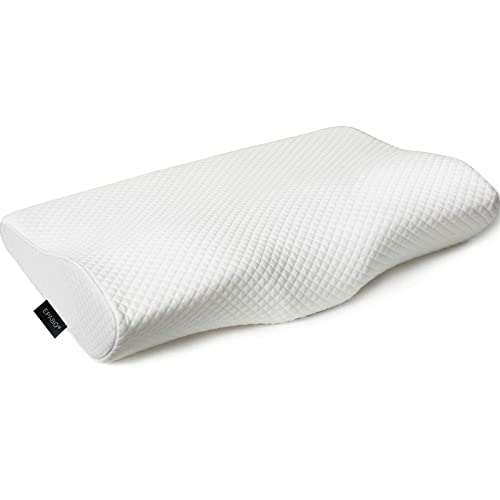
EPABO Contour Memory Foam Pillow — Best Simple Contour
EPABO’s contour is the no-fuss entry in this roundup — a single ergonomic memory foam shape, positioned for all three sleep positions, at the accessible end of the contour market. It suits buyers who want to try the contour idea itself before spending on cutouts and crescents, and guest rooms or second beds where a generally supportive shape matters more than a personalised fit.
Strengths
- Classic contour geometry at an accessible tier
- One-piece memory foam — nothing to adjust, fluff or refill
- Titled for side, back and stomach sleepers, so it flexes across positions
Trade-offs
- No adjustability if the single shape does not suit your build
- Solid foam feel will not please down or shredded-fill loyalists
- Size not stated in the verified title — check the listing
Key specs
- Size: Not stated
- Shape: Ergonomic cervical contour (as titled)
- Fill: Memory foam
- Positions: Titled for side, back and stomach sleepers
Think of this as the control experiment of the group: if a basic contour already leaves you more comfortable than your old rectangle, you have learned that shape is your answer, and a specialised crescent or cutout becomes a rational upgrade later. If it changes nothing, you have learned the opposite for the price of the cheapest ticket. Either way the information is worth having, and the pillow remains useful in a guest room. As ever in this article, that is a comfort experiment — ongoing shoulder pain belongs in a clinician’s office, not in a pillow rotation.
Best for: First-time contour buyers and guest rooms / Not suited for: Anyone who already knows they need a specific cutout or adjustable height
Check on Amazon — check price on Amazon before you decide, since listings and configurations change.
Comparison Table
The table compresses each pick down to the one verified specification that matters most for this category, plus the job it does best. Read it as a shortlist filter, then go back to the full review of the two or three rows that survive — the detail paragraphs are where the honest limitations live.
| Pick | Badge | Key spec | Best for |
|---|---|---|---|
| Coop Home Goods Original Crescent Adjustable Pillow, Queen | Best Overall | Queen | Side and combination sleepers who want a shoulder-shaped, tunable pillow |
| Naturepedic Organic Latex Side Sleeper Pillow | Best Shoulder Cutout | Standard/Queen | Dedicated side sleepers who prefer latex and want a true cutout |
| Sidney Sleep Adjustable Curved Pillow, Queen | Best Curved Design | Queen, 19 x 29 inches as titled | Side and back sleepers who want to experiment with height in a curved shape |
| btasleeep Side Sleeper Pillow, Queen | Best Cooling Crescent | Queen | Warm side sleepers who want a crescent shape without solid-foam heat |
| DONAMA Cervical Pillow, Contour Memory Foam | Best Dual-Height Contour | Not stated | Position-switchers who want two fixed heights in a solid contour |
| EPABO Contour Memory Foam Pillow | Best Simple Contour | Not stated | First-time contour buyers and guest rooms |
How to Choose a Pillow When Your Shoulders Ache at Night
Begin with your dominant sleep position, honestly assessed — not the position you fall asleep in, but the one you wake in. Side sleepers need the most height, because the pillow must fill the distance from mattress to ear that the shoulder creates; that is also why shoulder-shaped designs exist, since the shoulder itself occupies part of that space. Back sleepers need less height and benefit from a gentle contour that supports the neck’s curve without pushing the chin down. Combination sleepers should prioritise adjustability, because their ideal height literally changes during the night.
Then choose your strategy: shape or tuning. Crescent and cutout shapes solve the shoulder-placement problem geometrically, and suit committed side sleepers. Adjustable shredded fill solves the height problem experimentally, and suits anyone unsure of their number. Solid contours sit between the two — shaped, but fixed. There is no strategy that is best in the abstract; there is only the match between a strategy and a sleeper. Finally, consider fill feel: latex is buoyant, solid memory foam is slow and cradling, shredded foam is mouldable and cooler. You will spend a third of your life on this decision, so weight feel as heavily as geometry.
A Comfort-Only Framework: What a Pillow Can and Cannot Do
This article — and this section in particular — is not medical advice. A pillow can change the angles your head, neck and shoulder rest at, and many people find some angles more comfortable than others. That is the entire claim. A pillow cannot repair a rotator cuff, reverse arthritis, or substitute for assessment of pain that persists, worsens, wakes you repeatedly, follows trauma, or arrives with numbness, tingling or weakness. Those are clinician symptoms, full stop, and no purchase in this roundup should delay that appointment.
Within the comfort frame, be a good scientist about your own sleep. Change one thing at a time, give each change several nights, and write down a simple morning score for a week before and after. Pillow marketing thrives on first-night impressions and on the natural week-to-week variation of aches; your own notes cut through both. If a new pillow coincides with clearly worse mornings, stop using it — a shape that fights your body is the wrong shape for you, whatever it does for other sleepers. Comfort is personal data, and you are the only instrument that can collect it.
Getting Height Right: The Side Sleeper’s Geometry
For side sleepers, the test is visual: lying on your side, your head should sit level, with your nose roughly in line with the centre of your chest, neither tipped down toward the mattress nor propped up toward the ceiling. A partner, a mirror, or a phone photo from the foot of the bed settles it in seconds. Too low and the shoulder below takes the load and the neck bends down; too high and the neck bends up all night. Shoulder cutouts and crescents cheat this geometry helpfully by letting the shoulder sit inside the pillow’s footprint, effectively lowering the head without lowering support.
Mattress firmness changes the answer, which is why copying a friend’s pillow so often fails. On a soft mattress your shoulder sinks in, shortening the distance the pillow must fill; on a firm mattress the shoulder stays up and the pillow must be taller. This is the strongest practical argument for adjustable fill in this whole category: the correct height is a property of you plus your bed, and only tuning at home can find it. Start from the manufacturer’s suggested setup, then adjust in small steps, two nights apart, until the photo test looks level and your mornings feel ordinary — ordinary being the realistic goal.
How to Set Up and Trial a New Pillow Properly
Most pillows are judged in one night and returned or kept for the wrong reasons. This trial routine spreads the judgement across two weeks and gives the adjustable picks in this roundup a fair chance to be tuned to you.
- Let the pillow expand and air out: Foam pillows ship compressed. Give a new pillow several hours — ideally a day — to reach full shape before judging its height, and let any new-foam smell dissipate.
- Set the starting configuration: For adjustable pillows, begin with the fill as shipped. For dual-height contours, start on the edge that matches your main sleep position. Change nothing else in the bed this week.
- Run the level test: Lie in your usual position and check head alignment with a mirror or photo: nose in line with chest centre for side sleeping, chin neither tucked nor tilted back for back sleeping.
- Adjust in small steps, two nights apart: Add or remove a small handful of fill, or swap contour edges, then sleep two nights before judging. One-night verdicts measure novelty, not fit.
- Keep a one-line morning note: Score shoulder and neck comfort out of ten each morning for the trial. Two weeks of notes beat any single impression, yours or a reviewer’s.
- Stop rules: If pain clearly worsens, or you notice numbness, tingling or weakness, stop the trial and seek clinical advice. A pillow trial should never push through warning signs.
At the end of two weeks you will know three things: your best height, your preferred shape family, and whether pillow changes move your comfort at all. All three are valuable — including the third, because it tells you the pillow was never the lever, and your time and money belong elsewhere, starting with a clinician if symptoms persist.
Beyond the Pillow: The Rest of the Side Sleeper’s Setup
A pillow is one component in a system, and shoulder comfort at night often improves most when the system is adjusted together. Start with the mattress: a mattress that is too firm holds the shoulder up and forces the pillow to do all the accommodating, while one that is too soft lets the shoulder sink and effectively raises the pillow’s relative height. Neither extreme is a pillow problem, and no pillow in this roundup can fully compensate for a mattress working against you. If you are changing both, change the pillow second — its correct height is partly a function of the surface beneath it — and re-run the level test from the how-to section on the new combination before judging either purchase.
The shoulder that is not underneath you matters too. Side sleepers commonly let the top arm fall forward, rotating the whole shoulder girdle and dragging the neck with it; a small cushion or the end of a body pillow to rest that forearm on keeps the chest open and the neck quieter. Several readers will recognise the classic alternative — hugging a spare pillow — which works on the same principle. This is comfort ergonomics, not therapy: you are arranging resting positions so that nothing is folded, hanging or twisted for eight hours. If a position requires effort to hold, it is the wrong position, because sleep is precisely when effort stops and the body slumps into whatever the furniture dictates.
Sleep position transitions deserve a word as well. Many people who identify as side sleepers actually spend a third of the night on their backs, and a pillow chosen purely for the side — tall, shaped, committed — can be wrong for the back hours. That is the practical case for the adjustable and dual-height picks in this roundup: they degrade gracefully across positions instead of being perfect in one and poor in another. Judge any pillow here across your whole night, not your first position, and use the two-week trial structure honestly. And keep the article’s boundary in view throughout: these are arrangements for comfort. Pain that persists, worsens, or arrives with neurological symptoms belongs to a clinician, and no arrangement of foam changes that.
Finally, a note on pillow lifespan in this specific category. Shaped pillows — crescents, cutouts, contours — depend on their geometry in a way rectangular pillows do not: when the foam softens, the shape’s whole argument softens with it. Expect a contour or crescent to give its best service for a few years rather than indefinitely, and judge replacement by the morning test, not the calendar: when the pillow that used to leave you comfortable stops doing so despite correct height and a sound mattress, the foam has retired before the cover shows it. Replacing like with like, same shape and height, is then the lowest-risk purchase in this entire category — you are re-buying a proven geometry, not gambling on a new one.
When the Pillow Is Not the Problem: A Sober Checklist
Because this article is determined to stay honest, it should give you the means to discover that a pillow is not your answer — cheaply and quickly. Work through the alternatives in order of cost. First, position: many self-described side sleepers actually fall asleep on their back with a shoulder twisted under them, or on their stomach with one shoulder hiked — positions no pillow can redeem. A week of asking a partner, or a phone recording a night’s sleep, tells you more than a month of shopping. Second, the arm: a shoulder that aches in the morning is often the top shoulder, pulled forward all night by a dangling arm, and the forearm-support trick described earlier fixes it for the price of a spare cushion. Third, daytime load: shoulders that carry laptops, children and steering wheels for sixteen hours complain at night regardless of foam, and the pillow gets blamed for the day’s arithmetic.
Fourth, the mattress and the base beneath it: a dipping mattress or a slatted base with a broken slat tilts the whole body, and the shoulder at the bottom of the tilt does the suffering. Put a straight edge or a level app across the bed’s sleeping zone; a visible sag is a finding no pillow purchase should paper over. Fifth, temperature and bedding weight: a heavy duvet dragged over the top shoulder all night is a load, and some sleepers find a lighter covering changes their mornings more than any pillow in this roundup. None of these checks costs anything, all of them take under a week, and together they form the control group your pillow trial deserves.
If you work through that checklist and the pillow still looks guilty — mornings track with pillow changes, the level test shows a clear tilt, a shaped design demonstrably helps — then buy with confidence from the six above, because you will be buying on evidence. If the checklist clears the pillow, you have saved the money and learned where the problem actually lives, which is the more valuable outcome. Either way, the discipline is the same one this article has applied to itself: comfort claims should be testable, tests should be fair, and anything beyond comfort’s reach should be handed, promptly and without embarrassment, to a clinician.
A Note on Pillow Protectors and Cases for Shaped Pillows
One practical detail decides whether a shaped pillow keeps its shape in service: what you put over it. Crescent, cutout and contour pillows depend on their geometry, and a thick, tight or quilted case can fill in a cutout, round off a crescent’s curve and quietly convert a specialised pillow back into a rectangle. Choose smooth, thin, stretch-tolerant cases that follow the pillow’s silhouette rather than fighting it, and be suspicious of any protector padded enough to change the profile you paid for. Wash that case more often than you wash a standard pillow’s — a side sleeper’s face and hair rest in the same curve for eight hours a night, and the curve collects what a flat pillow sheds. If your chosen pick ships with its own fitted cover, treat that cover as part of the product: it was cut for the shape, and replacing it with a generic case is a downgrade disguised as housekeeping. Keep the spare fill, the instructions and the cover’s care label together in one drawer; shaped pillows reward owners who treat them as equipment rather than bedding, and the small discipline of the right case is the cheapest performance this category offers.
Common Buying Mistakes
Expecting a pillow to treat a shoulder condition. Pillows adjust resting geometry and comfort. Persistent, worsening or injury-related shoulder pain needs a clinician, not a shopping cart.
Judging a pillow in one night. Foam needs time to expand, bodies need time to adapt, and aches vary night to night. Two weeks, one change at a time, or you have learned nothing.
Copying someone else’s perfect pillow. Ideal height depends on your shoulder width and your mattress. The same pillow can be right for your partner and wrong for you.
Ignoring the shoulder itself. Side sleepers often shop only for head support. Crescent and cutout designs exist because the shoulder needs somewhere to go — include it in the brief.
Stacking two pillows to fix height. Two pillows create a hinge at the neck and slide apart at night. One pillow at the correct, tuned height beats a stack every time.
Final Recommendation
For most readers the Coop Crescent is the starting point: a shoulder-shaped silhouette with adjustable fill and stated foam certifications, tunable enough to forgive an uncertain brief. Committed side sleepers who know they want latex should go straight to the Naturepedic cutout, while experimenters on a tuning budget will get more from the Sidney Sleep’s included extra fill. Warm sleepers get the btasleeep crescent, position-switchers get the DONAMA’s two heights, and the EPABO remains the sensible first contour to try before spending more.
Hold the boundary one last time: everything above is about comfort. Choose the shape that lets you rest most comfortably, trial it honestly, and if your shoulders are telling you something persistent, let a clinician — not a pillow — answer it.
Shortlist links, for convenience: Check on Amazon Check on Amazon Check on Amazon Check on Amazon Check on Amazon Check on Amazon — check price on Amazon for each before you decide.
Best Contour Side Sleeping Pillows
Best Contour Neck Pillows For Sleeping
Best Affordable Pillows For Stomach Sleepers
Best Cool Pillows For Sleeping
Going Deeper on Best Pillows For Sore Shoulders
It is worth pausing on how a shortlist like this should be used, because the difference between a good purchase and a regretted one in this category is rarely the product — it is the match. Every pick in this article was verified the same way, against the same listing record, under the same rules about what may and may not be claimed. That uniformity is deliberate: it means the differences that remain between the picks are real differences of construction, size, format and fit, rather than differences in how generously each listing was read. When you compare two picks above and find their spec boxes nearly identical, that is information, not a failure of the research — it tells you the category has settled on a standard answer to the brief, and that your decision should be made on the secondary factors: the finish you prefer, the size run that includes you, the care routine you will actually keep, and the terms on the day you buy.
The second habit worth adopting is to treat the first week with any pick as a trial with a structure, not a first impression. The how-to section of this article gives that structure for this category specifically, but the principle is general: use the product in the real conditions it was bought for, change nothing else at the same time, and judge on the pattern of days rather than the novelty of the first one. Products bought this way tend to stay bought — the return rate of a well-trialled purchase is a fraction of an impulse one — and the products that do go back teach you something precise about your own requirements, which makes the next choice better. Keep the notes you make, even if they are two lines in a phone: your future self, shopping this category again in three years, will be glad of them.
Finally, hold on to the spec discipline this article models. A stated figure — a height, a capacity, a size, a material — is a commitment a maker can be held to; an adjective is not. Wherever this guide could quote a number from a verified title, it did, and wherever it could not, it wrote Not stated and told you to check the listing. Shop that way everywhere and the whole category becomes easier: you will find yourself comparing commitments instead of comparing adjectives, and commitments can actually be compared. That, more than any single pick above, is the skill this roundup hopes to leave with you.
Frequently Asked Questions
Can a pillow fix shoulder pain?
No. A pillow can change the position your head, neck and shoulder rest in, which many people find more comfortable, but it does not treat any condition. Persistent, worsening or injury-related shoulder pain, or pain with numbness or weakness, should be assessed by a clinician.
Why do crescent and cutout pillows exist?
For side sleepers, a straight pillow edge forces the shoulder to fold or lift. A crescent curve or a cutout removes material where the shoulder rests, so the head can sit at a comfortable height without the shoulder being compressed upward.
How high should a side sleeper’s pillow be?
High enough that, lying on your side, your head sits level with your spine — nose roughly in line with the centre of your chest. The exact height depends on your shoulder width and mattress firmness, which is why adjustable fill is so useful.
Latex, memory foam or shredded fill — which is best for shoulders?
None is best in general. Latex is buoyant and durable, solid memory foam cradles in a fixed contour, and shredded foam can be tuned and sleeps cooler. The shoulder benefit comes mainly from shape and height; choose the fill feel you will actually enjoy.
How long should I trial a new pillow?
About two weeks, changing one variable at a time and keeping a simple morning comfort note. Judge on the pattern of mornings, not on the first night.
What if a new pillow makes mornings worse?
Stop using it. A shape that fights your body is the wrong shape for you, and worsening pain is a reason to seek clinical advice rather than to keep experimenting.

