Disclosure: airfryerkitchensupply.com is reader-supported. When you buy through links on our site, we may earn an affiliate commission at no extra cost to you.
Where to buy
The best 100 down pillows require an honest word about the phrase “100 down” before a single recommendation, because the bedding industry uses it loosely and the law allows more looseness than buyers expect. A pillow filled with nothing but down clusters — no feathers at all — is a rare, premium object: down is the soft under-plumage without quill shafts, it costs far more than feather, and most pillows sold as “down pillows” are in fact down-and-feather blends in which feathers supply cheap structure. Amazon listing data verification for this guide searched the live catalog repeatedly, and the results confirmed the landscape: a small top tier of pillows sold as genuine down pillows (whose listings name down, fill power, and no feather), one standout stating an 80% down content outright, and a large field of honest blends beneath. This guide ranks them in that order and labels every pick with exactly what its verified listing claims — no pick here is called 100% down unless its listing supports the strongest reading, and the blends are badged as blends. Every ASIN comes from an API response; we never print fixed prices, so check the current price on Amazon for each.
- Cuddledown Dreamstead 700 Fill Power Pillow (Best True Down): available on Amazon. Check the current price on Amazon.
- Canadian Down & Feather Co. White Down Pillow, 625 Fill Power (Best Soft Classic): available on Amazon. Check the current price on Amazon.
- Continental Bedding Harmony White Goose Down Pillow, 550 Fill Power (Best Made in USA): available on Amazon. Check the current price on Amazon.
- Canadian White Goose Down Pillow, 80% Down (Highest Stated Down Content): available on Amazon. Check the current price on Amazon.
- Pacific Coast Goose Feather and Down Pillows (Best Hotel Blend): available on Amazon. Check the current price on Amazon.
- puredown Goose Feathers and Down Pillows (Best Value Blend): available on Amazon. Check the current price on Amazon.
Why chase pure down at all? Because nothing else feels like it. A down cluster traps air in a three-dimensional puff with no shaft to poke, no stiffness to negotiate — the pillow accepts your head the way water accepts a stone, then pushes back with a slow, even buoyancy that memory foam imitates with chemistry and feathers imitate with structure. Pure down is also the lightest fill per unit of warmth and loft, and the most compressible, which is why it rules both luxury bedding and expedition gear. Its costs are equally distinctive: money, maintenance, and a softness that side sleepers with broad shoulders can sink straight through. This guide serves the buyer who wants that feel knowingly — with fill power explained, labeling decoded, and the blend tier presented honestly as the value alternative rather than disguised as the real thing.
In this guide
Quick Picks
- Best True Down — Cuddledown Dreamstead 700 Fill Power: European white goose down in a 100% cotton sateen shell, hypoallergenic, OEKO-TEX and RDS certified per the verified listing — the genuine article from a down specialist. Check the current price on Amazon.
- Best Soft Classic — Canadian Down & Feather Co. White Down Pillow: 625 fill power white down in a 500-thread-count cotton shell, made in Canada — soft loft, honestly specified. Check the current price on Amazon.
- Best Made in USA — Continental Bedding Harmony: white goose down at 550 fill power, soft loft, 300-thread-count cotton shell, made in the USA. Check the current price on Amazon.
- Highest Stated Down Content — Canadian White Goose Down Pillow: the listing states its recipe outright — 80% goose down, 20% goose feather, very high stated fill power, 100% cotton shell. The most down per dollar of honesty in the catalog. Check the current price on Amazon.
- Best Hotel Blend — Pacific Coast Feather and Down: a downproof, medium-firm hotel pillow from a heritage down company — labeled a blend, built like the pillows hotels actually use. Check the current price on Amazon.
- Best Value Blend — puredown Goose Feathers and Down: the category’s value standard, in a 100% cotton cover, sold as a pair — the sensible way to buy the down experience at blend prices. Check the current price on Amazon.
How These Picks Were Chosen
We ran repeated Amazon listing data searches across the down-pillow catalog — by “goose down pillow,” by size, by brand, and by the exact phrase buyers use — and read the returned titles the way a labeling lawyer would. A pick could lead this guide only if its verified listing presented it as a down pillow without naming feather content: the Cuddledown, the Canadian Down & Feather Co. pillow, and the Continental Bedding Harmony meet that standard, each stating fill power and a cotton shell. The fourth pick was admitted on a different virtue — radical transparency: its listing states an 80/20 down-to-feather recipe in plain figures, the highest down share any searched listing was willing to print, and in a category built on vagueness that candor earned its place, badged so no reader mistakes it for pure down. The final two picks are the blend tier’s best citizens — a heritage maker’s hotel pillow and the value-standard puredown pair — included because many readers of this search will rationally choose them, and they deserve guidance toward the good blends rather than abandonment to the bad ones.
Two things were excluded on principle. Down-alternative pillows, however excellent, are not down and do not belong in this guide’s picks; they are discussed once, as an alternative, in the buying guide. And listings whose titles trumpeted implausible fill-power figures for what were, by their own admission, feather pillows were passed over — in this category, a modest true claim outranks a spectacular false one.
The 6 Best 100 Down Pillows (and the Honest Tiers Below Them)

Cuddledown Dreamstead 700 Fill Power Pillow — Best True Down
Cuddledown has built its name on down for decades, and the Dreamstead is its standard-bearer in this guide: European white goose down at 700 fill power — a genuinely high figure, meaning large, mature clusters that loft more per ounce — in a 100% cotton sateen shell, hypoallergenic, and certified to both OEKO-TEX and RDS (Responsible Down Standard) per the verified listing. No feather appears in its specification, because this is the real category: a down pillow.
Strengths
- 700 fill power European goose down — top-tier cluster quality, stated plainly.
- RDS and OEKO-TEX certifications: responsibly sourced down and a tested-clean shell, both third-party verified.
- Handcrafted positioning from a specialist maker whose entire reputation rides on down.
Trade-offs
- Pure down at this fill power is the premium purchase of the guide — check the current price on Amazon with clear eyes.
- True down softness is not support: stomach and back sleepers rejoice, broad-shouldered side sleepers may sink too deep.
- Down asks for the care regime in this guide’s maintenance section — protectors, fluffing, gentle handling.
This is the pillow for the buyer who searched the keyword literally and meant it. The certifications matter beyond ethics: RDS traceability and OEKO-TEX testing are the paperwork of a supply chain that handles down carefully, and careful handling is what preserves cluster integrity — the physical basis of loft. Buy it in the firmness that matches your sleep position, use a protector from night one, fluff it every morning without being asked twice, and it will return years of the exact sensation that made down famous in the first place.
Best for: buyers who want genuine down, certified and properly specified / Not suited for: budget shoppers or side sleepers needing firm lift. Check the current price on Amazon.

Canadian Down & Feather Co. White Down Pillow, 625 Fill Power — Best Soft Classic
The Canadian Down & Feather Co. states its specification like a company comfortable being checked: 625 fill power white down, a soft loft, and a 500-thread-count 100% cotton shell, made in Canada. The 625 figure sits in the honest middle of quality down — well above commodity grade, below the Cuddledown’s premium tier — and the shell’s high thread count is the downproofing a down pillow needs to keep its fill home.
Strengths
- 625 fill power white down — quality clusters, plainly stated.
- 500-thread-count cotton shell: serious downproofing, the unsung spec of down pillow longevity.
- Made in Canada by a down specialist; soft loft tuned for back and stomach sleepers.
Trade-offs
- Soft loft is a position commitment — side sleepers should look to firmer options or accept a second pillow.
- Sold as a single pillow; pairs are two purchases.
- Specialist-brand pricing sits above the blend tier, as it should.
Choose it if your down dream is specifically the classic one: a soft, cool, quiet pillow that compresses to almost nothing under your head and relofts by morning. Its specification discipline — fill power, shell count, country of manufacture, all in the title — is what trustworthy down marketing looks like, and the pillow behind it has the makings of a decade-long companion.
Best for: back and stomach sleepers wanting classic soft down / Not suited for: side sleepers needing height and firmness. Check the current price on Amazon.

Continental Bedding Harmony White Goose Down Pillow, 550 Fill Power — Best Made in USA
Continental Bedding’s Harmony offers the genuine down pillow at the category’s most accessible specification: white goose down at 550 fill power with a soft loft, in a 100% cotton 300-thread-count shell, made in the USA. The 550 figure is honest entry-level down — real clusters, real feel, without the large-cluster premium of the 700-class picks.
Strengths
- Genuine white goose down at a stated 550 fill power — the accessible door into true down.
- Made in the USA, a rarity in this catalog.
- Soft loft in a cotton shell: the classic down experience without specialist pricing.
Trade-offs
- 550 fill power lofts less and compresses sooner than the 625–700 class — expect a flatter, softer pillow.
- 300-thread-count shell is adequate downproofing, a step below the Canadian pick’s 500.
- Soft loft only: position-limited like all true soft down.
This is the recommendation for the down-curious: buyers who want to learn whether pure down suits their sleep before committing to the premium tier. Its honesty cuts both ways — the modest fill power tells you exactly what you are getting, and what you are getting is the genuine sensation, at a gentler specification and price.
Best for: first-time down buyers and made-in-USA shoppers / Not suited for: loft lovers or side sleepers. Check the current price on Amazon.

Canadian White Goose Down Pillow, 80% Down — Highest Stated Down Content
This pillow earns its place by printing what the rest of the industry whispers: its verified listing states 80% goose down and 20% goose feather, with a very high stated fill power and a 100% cotton shell. It is not a 100% down pillow, and this guide badges it accordingly — but four-fifths down is a richer recipe than most “down pillows” on the market carry, and the 20% feather contributes the structure that pure down lacks.
Strengths
- 80% down content, stated in figures — the highest down share any searched listing declared.
- The feather minority adds resilience and loft retention that pure down cannot match at this tier.
- 100% cotton shell, and a range of sizes and pack counts in the same listing family.
Trade-offs
- It is a blend. Buyers seeking literally feather-free fill should choose the top three picks.
- The listing’s fill-power figure is stated very high; treat it as the maker’s claim and judge the pillow by its down percentage and feel.
- Feather content means occasional quill awareness over years of use — the classic blend compromise.
Consider this the pragmatist’s summit: most of down’s feel, more structure than down alone provides, and a label that respects you enough to show its arithmetic. For side sleepers especially — the position pure down serves worst — an honest 80/20 may be the better pillow, and it is certainly the better-specified one at its tier.
Best for: side sleepers and pragmatists wanting maximum stated down content / Not suited for: purists requiring feather-free fill. Check the current price on Amazon.

Pacific Coast Goose Feather and Down Pillows — Best Hotel Blend
Pacific Coast is a heritage name in down bedding, and its hotel pillow is exactly what its verified listing says: goose feather and down, downproof, medium-firm, in a 100% cotton shell, sold as a pair. This is the blend tier done by a company that knows down — the same construction philosophy as the pillows quality hotels buy by the thousand.
Strengths
- Heritage down-company manufacture: blends live or die on fill quality control, and this is the blend tier’s safest hands.
- Medium-firm support — the firmness most sleepers, and nearly all side sleepers, actually need.
- Downproof cotton shell and pair pricing: the hotel specification, complete.
Trade-offs
- A blend, with feather as the structural majority character — the feel is supportive first, cloud-like second.
- Hotel firmness can read as too much pillow to stomach sleepers.
- No fill-power figure is stated; you are trusting the maker’s name, which in this case is a reasonable trust.
Buy it if your favorite pillow memory is a good hotel’s. Hotels choose feather-down blends because they support every guest shape and survive industrial laundering’s gentler cousins; households inherit those virtues every night. Among blends, this is the one we’d hand a skeptic.
Best for: hotel-pillow loyalists and side sleepers wanting support / Not suited for: pure-down seekers. Check the current price on Amazon.
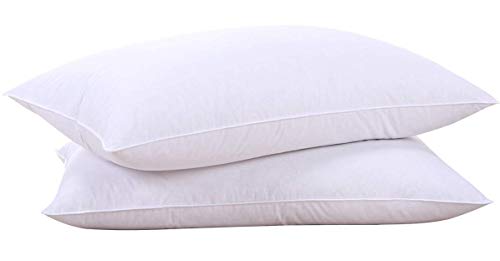
puredown Goose Feathers and Down Pillows — Best Value Blend
puredown is the value standard of the down aisle: goose feathers and down in a 100% cotton cover, sold as a set of two, positioned as a hotel collection pillow for all sleep positions per its verified listing. It makes no purity claims it cannot cash, and its price-to-decency ratio is why it anchors the blend tier.
Strengths
- The pair price: two real down-blend pillows for guest room, primary bed, or rotation.
- 100% cotton cover — the blend tier often cuts this corner; puredown does not.
- A brand that exists only in this category, with sizing across the range.
Trade-offs
- Feather-forward blend feel: supportive and slightly rustly, not the pure-down cloud.
- No fill power or down percentage is stated in the listing title — the value tier’s usual vagueness.
- Expect a shorter peak-loft life than the heritage blend above.
This is the pick for furnishing — the guest room, the kids’ upgrade, the rental, the second home — anywhere real down character is wanted at a furnishing budget. It also serves as the honest control group: sleep on it for a month, and you will know whether your next pillow purchase should climb toward the pure-down tier or stay exactly here.
Best for: furnishing multiple beds with real down character on a budget / Not suited for: buyers seeking the pure-down sensation. Check the current price on Amazon.
Comparison Table
| Pick | Badge | Key spec | Best for |
|---|---|---|---|
| Cuddledown Dreamstead | Best True Down | 700 fill power goose down, RDS + OEKO-TEX | Purists, back/stomach sleepers |
| Canadian Down & Feather Co. | Best Soft Classic | 625 fill power down, 500 TC shell | Classic soft down feel |
| Continental Bedding Harmony | Best Made in USA | 550 fill power goose down, soft loft | First true-down purchase |
| Canadian White Goose Down 80% | Highest Stated Down Content | 80% down / 20% feather, stated openly | Side sleepers, pragmatists |
| Pacific Coast Feather & Down | Best Hotel Blend | Blend, medium-firm, downproof | Hotel-pillow support |
| puredown Feathers & Down | Best Value Blend | Blend pair, 100% cotton cover | Furnishing on a budget |
Verify any pick the same way this guide did — by its listing’s own words: Cuddledown Dreamstead, Canadian Down & Feather Co., Continental Harmony, Canadian 80% Down, Pacific Coast, puredown — and check price on Amazon before deciding.
How to Choose a Down Pillow: Fill Power, Labels, and Loft
Down is the most mislabeled fill in bedding, and the most rewarding to buy correctly. Three pieces of literacy protect you: what fill power means, what the law lets labels say, and which loft your sleep position needs.
Fill power: the one number that matters
Fill power measures the volume one ounce of down occupies — the size and resilience of the clusters. Higher is better in a specific way: larger clusters loft more, weigh less, last longer, and insulate better, because the cluster’s structure is springier. The honest ladder runs roughly: 550 is genuine entry down (the Continental Harmony), 600–650 is quality down (the Canadian Down & Feather Co. at 625), 700 and above is premium (the Cuddledown). Two warnings: fill power says nothing about how much fill is in the pillow — a high-power pillow can still be underfilled and flat — and figures far beyond the premium range, printed by unknown brands for feather products, should be read as decoration. Buy the combination: credible fill power, stated without inflation, attached to a shell specification you can check, from a maker whose name is a down name and whose reputation would not survive selling you feathers in a down costume.
Goose down vs duck down: does the bird matter?
Somewhat, and less than marketing insists. Geese are larger birds with larger down clusters, so goose down dominates the high fill-power tiers — every premium pick in this guide is goose — and carries the prestige pricing to match. Duck down clusters run smaller, cap out at lower fill powers, and cost less, while sleeping, at equal fill power, essentially identically to goose. The honest rule: compare fill power and maker first, bird second. A well-made 650 fill power duck pillow out-sleeps a careless 650 goose pillow, and a buyer offered duck down at a fair specification and price should take the deal without a moment’s snobbery. What should trigger suspicion is not the bird but the silence — a listing that will not say which bird, which fill power, or which recipe is telling you, by omission, how it competes.
Reading the label like a regulator
Labeling rules in the US permit a product to be sold as a “down” pillow with a majority of down content rather than total purity, and blends may lead with the word down while feathers do the structural work. The practical defense is the one this guide used: read for the recipe. A listing that states a percentage — like the Canadian 80% Down — is showing its work. A listing whose title names both feathers and down, like the Pacific Coast and puredown, is honest about being a blend. A listing that says “down pillow” with no fill power, no percentage, and no shell specification is asking for faith it has not earned. Also prize the shell: down escapes through loose weaves, so a stated high-thread-count cotton shell or an explicit “downproof” claim is a functional specification, not a luxury note.
Loft by sleep position: where pure down wins and loses
Stomach sleepers need the thinnest, softest pillow made, and pure down in soft loft is their perfect fill — it compresses to nearly nothing and never fights back. Back sleepers need gentle cradle with a hint of support: soft-to-medium down, or the 80/20 recipe whose feather minority supplies the hint. Side sleepers need height that survives the night, and here honesty requires saying that pure soft down is often the wrong tool — choose the firmest down configuration, the 80/20, or a quality blend like the Pacific Coast, and let the purists’ pillows serve the positions they suit. Combination sleepers should buy for their dominant position and keep a second, different pillow for the others; two right pillows out-sleep one compromise every night of the year.
Firmness is a configuration, not just a fill
Two pillows with identical down can sleep completely differently, because firmness in loose-fill bedding is engineered three ways. Fill weight is the crudest: more ounces, firmer pillow — which is why the same model is often sold in soft, medium, and firm simply by filling the same shell to different weights. Chamber construction is the refinement: some down pillows sew an inner core of supportive feather wrapped in an outer layer of pure down, giving the head a down surface and the neck a feather skeleton — an honorable hybrid that listings should, and the good ones do, describe openly. Gussets — the fabric walls around a pillow’s edge — keep loft at the sides instead of letting fill flee to the corners. When you shop beyond this guide, read for these three mechanisms before you read adjectives: “firm” printed on a listing means nothing, but ounces, chambers, and gussets are engineering you can compare. The picks here state what their listings state; where a configuration detail is not in the verified title, this guide does not invent it, and the product page is your next read.
Matching the six picks to six sleepers
Compress the whole guide into people. The stomach sleeper who has never met a thin enough pillow: the Canadian Down & Feather Co. soft classic, or the Continental Harmony on a first-down budget. The back sleeper who wants the hotel cloud without the hotel blend: the Cuddledown in a medium configuration. The side sleeper who loves down but needs a spine line: the Canadian 80/20, whose feather fifth is load-bearing honesty. The side sleeper who simply wants support and sleeps hot in foam: the Pacific Coast. The furnisher of rooms — guest, rental, second home: the puredown pair, twice. And the purist, for whom this search is a principle: the Cuddledown again, at the highest fill power in the guide, with its certifications in order. Six pillows, six honest answers — that is all a guide owes its readers.
How to Care for a Down Pillow So It Lasts a Decade
- Use a protector from night one, and wash the protector, not the pillow. A zippered pillow protector under the pillowcase intercepts the oils and moisture that age down. The pillow itself should be washed rarely — once or twice a year at most — while protectors take the weekly laundry.
- Fluff daily, air monthly. Down clusters need mechanical encouragement: a minute of shaking and kneading each morning restores loft, and an hour in fresh air (out of harsh direct sun) each month keeps the fill sweet. Hotel housekeepers fluff; that is half of why hotel down feels better than home down.
- When you must wash, wash like a professional. Front-loading machine, gentle cycle, small amount of mild detergent, extra rinse and spin. Then dry low and long with dryer balls or clean tennis balls to break up clumps — down must be completely dry, which takes longer than you expect; damp down clumps, smells, and loses loft permanently.
- Store loose, never compressed. A down pillow stored squeezed in a vacuum bag or under heavy bedding spends its clusters’ resilience on your storage problem. Loose, in a breathable cotton bag, on a shelf — that is the whole protocol.
- Expect and accept the patina. Even great down slowly loses a whisper of loft across years. Rotating two pillows — each resting alternate nights — roughly doubles the pair’s prime, which is why this guide’s pair-format picks are practical, not just economical.
Down vs Down-Alternative vs Foam: The Honest Comparison
Readers of this search sometimes arrive cross-shopping against synthetic pillows, and they deserve the comparison stated fairly — because down does not win every column, and pretending otherwise would repeat the industry’s sins in reverse.
Down-alternative pillows — engineered polyester microfiber clusters — imitate down’s softness at a fraction of the price, wash without ceremony, and carry no allergy or sourcing questions. Their costs are lifespan and feel at the margin: synthetic clusters mat and clump within a year or two of nightly use, where down’s prime runs five to ten years, and the imitation never quite reproduces down’s combination of weightlessness and slow pushback. For guest rooms, children’s beds, and diagnosed-allergy sleepers, down-alternative is the correct answer, and this site’s companion guide to alternatives, linked below, covers it. For a primary pillow bought for a decade of nightly use, down’s arithmetic wins, and it is not close.
Memory foam wins the support column outright: it holds a shape, fills the neck’s curve, and serves side sleepers and pain-conscious sleepers in ways no loose fill can. It loses on temperature (foam sleeps warm even when engineered not to), on adjustability (you cannot scrunch a foam pillow into a new shape at 3 a.m.), and on the simple animal pleasure of a cool, soft, silent surface. Feather-down blends sit between the worlds — more structure than down, more life than foam, less of either’s purity. The mature way to buy is by column, not by team: name the property you cannot live without — softness, support, washability, longevity — and the fill chooses itself. This guide exists for the buyers whose non-negotiable is the down feel itself; it sends the others away with respect and a link.
Sourcing, Ethics, and What RDS Certification Actually Certifies
Down’s supply chain asks a fair question — where does the fill come from, and how were the birds treated — and the industry’s answer, when it is a good one, is certification. The Responsible Down Standard (RDS), carried by the Cuddledown Dreamstead per its verified listing, certifies that down comes from birds that were not live-plucked or force-fed, with traceability audited through the chain. OEKO-TEX certification, which the same listing carries, addresses the other end of the question: the finished textile’s freedom from harmful substances against your skin. Neither certificate makes a pillow softer. Both make it a purchase you do not have to think about afterward, and in a category where most listings offer no paperwork at all, their presence is a reliable proxy for a maker operating carefully at every stage — including the stages, like cluster sorting and shell weaving, that determine how the pillow sleeps. Buyers who care about sourcing should buy certified down or buy high-quality down-alternative, and should treat uncertified bargain down’s silence on the subject as its answer.
The First Night Protocol: Setting Up a Down Pillow Correctly
A down pillow’s first night decides whether its owner becomes a devotee or a returner, and most first nights are sabotaged by setup rather than by the pillow. On arrival, free it from its packaging early in the day — down needs hours, not minutes, to drink in air and reach full loft, and a pillow unboxed at bedtime will be judged in its compressed state. Give it the dryer ritual if your care label allows: ten to fifteen minutes on low with dryer balls wakes the clusters and erases the warehouse flatness. Fit the protector before the pillowcase, and choose a pillowcase with a little ease in it — a tight case is a compression device, quietly taxing the loft you just restored. Then sleep on it for a week before judging: down conforms progressively, your neck recalibrates from whatever you slept on before, and the pillow that felt merely soft on night one often feels inevitable by night seven. Judge too early and you will return the right pillow for the wrong reason — the commonest tragedy in this entire category, and the easiest to avoid.
Common Buying Mistakes
- Believing “100% down” on an anonymous listing. In this category, unverifiable purity claims are the norm and genuine pure-down pillows are the certified, fill-power-stated exception. Buy the specification, not the slogan.
- Chasing spectacular fill-power numbers. A claim far beyond the premium range, attached to a feather product by an unknown brand, is marketing arithmetic. The credible ladder tops out where the specialists in this guide sit.
- Buying soft pure down for side sleeping. The commonest down disappointment. Match loft to position with the guide above; side sleepers are served by firmness, structure, or the honest 80/20.
- Skipping the protector. An unprotected down pillow absorbs a year of skin oil into clusters that cannot be fully cleaned. The protector is not an accessory; it is the pillow’s lifespan, purchased in advance.
- Washing down like cotton. Hot water, harsh detergent, and incomplete drying destroy clusters. Rare, gentle, thorough — or professional cleaning for the premium picks.
- Judging down in the first hour. A shipped down pillow arrives compressed and needs hours — sometimes a short, gentle dryer session with dryer balls — to reach its true loft. Judge it tomorrow morning, not at unboxing.
Final Recommendation
If you want the genuine article, buy the Cuddledown Dreamstead — certified, 700 fill power, and made by specialists — with the Canadian Down & Feather Co. pillow as the soft classic alternative and the Continental Harmony as the accessible first step into true down. If your sleep position or your pragmatism argues for structure, the Canadian 80% Down is the most honestly specified pillow in the catalog, the Pacific Coast is the hotel blend to beat, and the puredown pair furnishes spare beds with real down character. Every tier is labeled for what it is — choose yours with clear eyes, protect it from night one, and check price on Amazon before ordering.
Completing the bed? See Best Affordable High Quality Sheet Sets, Best Amish Quilts, Best 50 50 Down Pillows Sterilized, and Best Alternative To Down Pillows.
Frequently Asked Questions
Is any pillow really 100% down?
Pillows filled entirely with down clusters exist — the top picks in this guide are sold as down pillows whose listings name no feather content, from makers who specialize in down. But labeling law permits “down” products to contain a proportion of feather and other fibers, so the phrase alone guarantees nothing. The trustworthy signals are a named specialist maker, a stated fill power, a downproof shell specification, and certifications such as RDS — the combination the Cuddledown carries.
What is the difference between down and feathers?
Down is the soft, shaft-free under-plumage that insulates the bird — three-dimensional clusters that trap air, weigh almost nothing, and compress to nothing before springing back the moment pressure lifts. Feathers are the outer plumage, with quill shafts that give structure, durability, and the occasional poke through a tired shell. Pillow blends use feathers as a supporting skeleton and down as the soft surface; pure down removes the skeleton, gaining softness and losing structure. Neither is “better” — they are different engineering, matched to different sleepers.
What fill power should I buy?
Buy the highest credible fill power your budget reaches, from a maker you can verify: 550 is honest entry down, the low-to-mid 600s are quality, and 700-plus is premium, with loft and lifespan rising at each step. Then confirm the pillow is filled generously for your position — fill power measures quality per ounce, not the number of ounces.
Are down pillows hypoallergenic?
Quality down is washed and sterilized during processing, and certified products like the Cuddledown (hypoallergenic and OEKO-TEX per its listing) are suitable for most sensitive sleepers. True down allergy is uncommon; most reactions blamed on down trace to dust mites and residues in poorly cleaned, poorly stored, or counterfeit fill — one more reason the certified supply chains in this guide matter beyond their paperwork — which is why certified, specialist-made down and a zippered protector are the sensitive sleeper’s correct specification. Anyone with a diagnosed feather or down allergy should choose down-alternative fills instead.
How long does a down pillow last?
A quality down pillow, protected and fluffed and washed gently and rarely, serves five to ten years — several times the life of a polyester pillow — with a slow, graceful decline in loft rather than a sudden death, and even its retirement is gentle: an aged down pillow remains an excellent sham stuffer, reading pillow, and top-layer softness over a firmer successor. Blends trade some of that lifespan for structure and price. Rotation between two pillows extends both.
What size down pillow should I buy?
Match the pillow to the bed and the sleeper, not to ambition or to the photograph of a hotel bed stacked with four kings. Standard (20×26) suits twin and full beds and smaller sleepers; queen (20×30) is the default for queen beds and restless sleepers who travel across the pillow at night; king (20×36) fills a king bed’s width and serves broad-shouldered side sleepers who use the length. The picks in this guide are listed in their verified configurations — several exist across the size range — so confirm your size on the product page, and buy pillowcases to match: a down pillow compressed into an undersized case loses exactly the loft you paid for.
Should I buy one premium down pillow or two mid-tier ones?
For a primary bed, one premium pillow, properly protected — with rotation supplied by your old pillow demoted to second duty — usually out-sleeps two mid-tier pillows bought simultaneously, because fill quality is the sensation you actually feel at 2 a.m. The exception is the household furnishing several beds at once, where the pair-format picks in this guide spread real down character across every room at a sane total. Buy depth for the bed you sleep in nightly; buy breadth for the beds that host guests.
Do down pillows sleep hot?
Down insulates — that is its evolutionary job — but a pillow is not a duvet: the fill layer is thin, the head radiates heat efficiently, and quality cotton shells breathe. Most sleepers find down pillows temperature-neutral in a way foam pillows are not, because foam’s closed structure traps heat against the head while down’s loft lets air move. Hot sleepers should favor the lower-loft picks here, a breathable cotton pillowcase, and no protector of the waterproof kind, which seals in exactly the warmth they are fleeing.
Can I use two down pillows instead of one firm one?
Generations did exactly that, and the arrangement has real virtues: a soft down pillow over a firmer base gives a down surface with engineered support, and either layer can be removed at 3 a.m. as positions change. It is also the natural destination of rotation buying — when a premium down pillow softens after years, it retires to the top layer over a fresher pillow rather than to the bin. If you love down’s feel but need side-sleeping height, two-pil-low layering may serve you better than any single compromise.
Is a higher thread count shell important for a down pillow?
Yes — it is the pillow’s containment system. Down clusters are small, mobile, and patient; a loose weave lets them migrate out over months, which is how good pillows slowly empty themselves into your bedding. A stated high-thread-count cotton shell — the Canadian pick’s 500 count is this guide’s benchmark — or an explicit downproof finish keeps the fill home and the loft where you bought it. When comparing two similar pillows, the better-specified shell is a legitimate tiebreaker, and a listing silent about its shell is leaving its containment to your imagination.
Why is my new down pillow flat?
Because it traveled compressed, as every down pillow does — vacuum and roll packing are how soft goods survive shipping, and down is the most compressible fill in bedding. Give it hours to expand, fluff it vigorously, and if needed run it briefly in a dryer on low with dryer balls, exactly as the first-night protocol in this guide describes. If it is still flat after a full day, it is underfilled rather than compressed — judge it then, inside the return window, and consider stepping up a fill-power tier or a firmer configuration.

