Disclosure: airfryerkitchensupply.com is reader-supported. When you buy through links on our site, we may earn an affiliate commission at no extra cost to you.
Where to buy
The fastest way to buy any pick in this guide to the best contour neck pillows for sleeping is Amazon, where stock, size and colour options are shown on the product page itself. Use the links below to check the current price on Amazon for each model:
- Tempur-Pedic TEMPUR-Ergo Neck Pillow (Medium Profile) (Best Overall): Check on Amazon
- EPABO Contour Memory Foam Pillow (Best Budget): Check on Amazon
- Osteo Cervical Pillow (Hollow Design, Adjustable) (Best Adjustable Contour): Check on Amazon
- DONAMA Cervical Pillow (Cooling, Dual-Height) (Best for Hot Sleepers): Check on Amazon
- Mkicesky Orthopedic Memory Foam Pillow (Best for Side Sleepers): Check on Amazon
- Coop Home Goods Original Crescent Adjustable Pillow (Best Customisable Fill): Check on Amazon
The best contour neck pillows for sleeping all share one idea: instead of a flat slab, the pillow is shaped — a higher ridge under the neck, a lower cradle for the head, and (on most designs) raised sides for side sleeping. That shape is meant to keep your head and neck in a comfortable, neutral line with your spine through the night, whether you sleep on your back or your side. This guide is about sleep comfort only. A contour pillow is a bedding choice, not a medical device, and nothing here is a claim to treat any condition — if you have a diagnosed neck or spine problem, your clinician’s advice outranks any buying guide, including this one.
What we can help with is fit, because contour pillows fail more often on sizing than on quality. A ridge that is too high pushes the head forward for a back sleeper; too low and a side sleeper’s shoulder takes the load. The six picks below cover the main shapes — the classic wave contour, hollow-centre designs, dual-height pillows you rotate to change the loft, and an adjustable shredded-fill crescent you tune yourself — and each was verified against the airfry site’s Amazon record on 2026-11-22. Read the fit guidance in each review before you fall for a shape.
In this guide
Quick Picks
Tempur-Pedic TEMPUR-Ergo Neck Pillow (Medium Profile) — Best Overall. The original contoured neck pillow in genuine TEMPUR material, in a medium profile that suits most back and side sleepers. Check on Amazon
EPABO Contour Memory Foam Pillow — Best Budget. The classic wave-contour memory foam pillow at a budget tier, with two usable heights in one pillow — rotate it to change the loft. Check on Amazon
Osteo Cervical Pillow (Hollow Design, Adjustable) — Best Adjustable Contour. A hollow-centre contour pillow with adjustable height and a cooling case, designed to cradle the head while the ridge supports the neck. Check on Amazon
DONAMA Cervical Pillow (Cooling, Dual-Height) — Best for Hot Sleepers. A dual-height contour pillow with a cooling cover — flip between two neck ridges and sleep on the cooler side of memory foam. Check on Amazon
Mkicesky Orthopedic Memory Foam Pillow — Best for Side Sleepers. An ergonomic contour shaped to serve side, back and even stomach sleepers, with cut-outs that give the shoulder and arm room. Check on Amazon
Coop Home Goods Original Crescent Adjustable Pillow — Best Customisable Fill. An adjustable shredded-foam pillow with a crescent cut-out for the shoulder — tune the fill until the neck support is exactly yours. Check on Amazon
How These Picks Were Chosen
Every candidate was verified of this site: we searched brand and model, matched the returned listing title, and only then allowed a product into the guide with a purchase link. We then selected for shape variety and honest differentiation rather than six copies of the same wave pillow. Criteria were: a genuine contoured profile (neck ridge plus head cradle, not a flat pillow with the word ‘contour’ in the title); foam quality — slow-rebound memory foam that holds its shape overnight rather than collapsing by 3 a.m.; a removable, washable cover, because a pillow you cannot wash will not stay in your bed for long; size and profile options, since shoulder width and mattress softness change what ‘correct height’ means; and a cooling cover or ventilated foam where the maker offers one, because memory foam’s known weakness is sleeping warm. Brands with a recall or safety issue would have been excluded and noted; none of the six finalists has one.
The 6 Best Contour Neck Pillows for Sleeping

Tempur-Pedic TEMPUR-Ergo Neck Pillow (Medium Profile) — Best Overall
Tempur-Pedic effectively created this category, and the TEMPUR-Ergo Neck Pillow is still the reference point the wave-shaped copies are measured against. The TEMPUR material is denser and slower to respond than generic memory foam: it feels firm when you first lie down, then softens with body heat and moulds precisely, holding the neck ridge exactly where the designer put it instead of letting it flatten through the night. The medium profile is the sensible default for average shoulder widths on a medium mattress.
Fit is everything with this pillow. Back sleepers rest the neck on the ridge with the head settling into the dip; side sleepers use the higher edge so the shoulder-to-head gap is filled without the head tipping. It is not a pillow for stomach sleepers — the raised ridge works against that position — and it is not for anyone who likes to bunch and hug a pillow, because TEMPUR foam does not scrunch. Give it a week: the first two nights feel strange to almost everyone, and by night five most people have stopped noticing it, which is the point.
After the adjustment week, the TEMPUR-Ergo’s defining trait is consistency: the ridge is in the same place on night ninety as on night one, and your sleeping posture quietly reorganises around that reliability. Owners who travel notice hotels more, not less, after owning one — the surest sign a fit is right. It rewards the buyer who measures, chooses the profile honestly, and then stops shopping for pillows, possibly for years.
Strengths
- Genuine TEMPUR material holds the contour all night
- Three profile sizes make correct fit achievable
- Cover removes for washing
Trade-offs
- Premium tier; the most expensive shape here
- Firm feel is a real adjustment for down-pillow people
- Not suitable for stomach sleeping
| Material | TEMPUR pressure-relieving foam |
| Profile | Medium (also Small and Large profiles in the range) |
| Shape | Contoured neck ridge with head cradle |
| Cover | Removable, washable |
Best for: Most back sleepers and combination sleepers wanting the reference design / Not suited for: Stomach sleepers or anyone who wants a soft, squishable pillow
Check on Amazon — check the current price on Amazon before you decide.
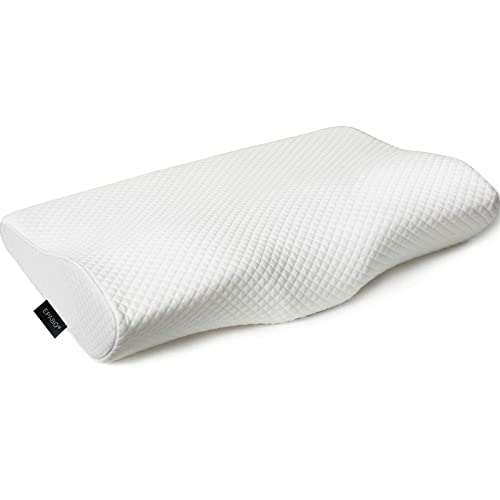
EPABO Contour Memory Foam Pillow — Best Budget
The EPABO is the pillow that introduces most people to contour sleeping, because it delivers the essential shape at a budget tier. One edge is higher, the other lower; you rotate the pillow to choose, which quietly makes it two pillows in one and lets you experiment with fit during the first week instead of committing to a single loft at checkout. The foam is a medium-firm memory foam — less dense and less slow than the Tempur-Pedic, but entirely adequate at holding the ridge-and-cradle profile overnight.
It suits back sleepers and average-build side sleepers best. Very broad shoulders may find even the high edge a touch low on a firm mattress, and hot sleepers should know the standard cover is not a cooling cover. But as a low-risk way to discover whether a contour shape improves your sleep comfort — and which height your neck prefers — nothing else in this guide makes the experiment cheaper or easier. Many owners later upgrade to a premium foam and keep the EPABO in the guest room, which tells you the shape itself was right.
The EPABO’s long-term story is written in guest rooms and second pillows: it is so often the first contour a household buys that it becomes the household’s reference, and its dual heights make it the natural spare for visitors of different builds. Its foam will soften sooner than the premium picks under nightly use — that is the honest price of the tier — but as an education in what your neck wants, it has no rival here.
Strengths
- Two heights in one pillow simplifies fit-finding
- Budget tier makes trying a contour shape low-risk
- Proven, widely used wave design
Trade-offs
- Foam is less dense than premium picks; expect a shorter prime life
- No cooling cover as standard
- Tall side sleepers may need more loft
| Material | Memory foam |
| Shape | Wave contour, two heights (rotate to swap) |
| Positions | Back and side |
| Cover | Removable, washable |
Best for: First-time contour pillow buyers on a budget / Not suited for: Very broad-shouldered side sleepers needing a tall profile
Check on Amazon — check the current price on Amazon before you decide.
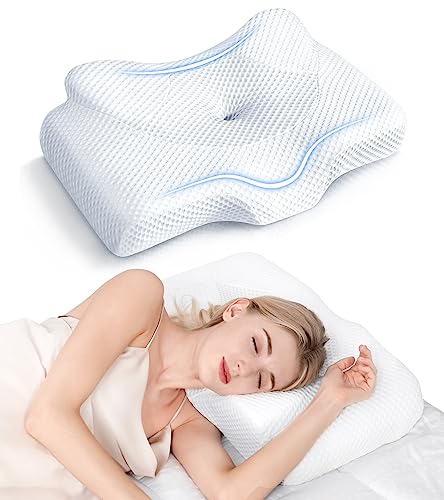
Osteo Cervical Pillow (Hollow Design, Adjustable) — Best Adjustable Contour
The Osteo takes a different route to the same destination: instead of a simple wave, it hollows the centre of the pillow so the head rests in a shallow bowl, while the raised surround supports the neck and the sides rise for side sleeping. The hollow centre also gives your ear somewhere to be when you roll onto your side, a small detail side sleepers appreciate out of proportion to its simplicity. Height is adjustable, so you can start tall and step down as you learn what your shoulders actually need.
The cooling case is a genuine plus for memory foam, which traps more heat than latex or down; it does not make the pillow cold, but it takes the clammy edge off the first hour of the night. The shape is the most ‘engineered’ in this guide, and that cuts both ways — people who love it describe it as the first pillow that holds them in position, while restless sleepers who move constantly may find any strongly shaped pillow fights them. If you are a back-and-side combination sleeper who stays roughly in one place, this is the most configurable option here.
Osteo ownership involves a week of small experiments — a height change here, a night starting on the other side — and then a long plateau of ‘it just works’. The hollow centre’s ear comfort converts side sleepers who previously woke to rearrange themselves, and the cooling case keeps it in service through summer when lesser foam pillows get exiled to the cupboard. It is the tinker’s pick, in the complimentary sense.
Strengths
- Hollow centre cradles the head and frees the ear on your side
- Adjustable height removes the guesswork
- Cooling case counters memory foam warmth
Trade-offs
- Strongly shaped surface is not for restless sleepers
- Adjustment takes a few nights of experimenting
- Premium-mid tier pricing
| Material | Memory foam, odourless formulation |
| Shape | Hollow centre with surrounding contour |
| Height | Adjustable |
| Cover | Cooling case included |
Best for: Combination sleepers who change position and want to tune the height / Not suited for: Anyone who dislikes a structured, shaped sleeping surface
Check on Amazon — check the current price on Amazon before you decide.

DONAMA Cervical Pillow (Cooling, Dual-Height) — Best for Hot Sleepers
Memory foam’s comfort comes with a known tax: it sleeps warm. The DONAMA is built to minimise that tax, pairing a dual-height contour — a taller ridge on one side, a lower one on the other — with a cooling-feel cover that stays noticeably fresher to the touch than standard polyester cases. For back sleepers the lower ridge is the starting point; side sleepers rotate to the taller edge so the neck stays level with the spine instead of sagging toward the mattress.
In practice the dual-height design is the feature you use weekly and the cooling cover is the one you appreciate nightly. The foam sits in the middle of this guide for firmness — supportive without the very slow, dense sink of the Tempur-Pedic — which makes it a friendly first contour pillow for people who run warm. As with all contour pillows, give the shape a fair trial across several nights and both heights before judging it; the first night on any ridge feels deliberate, the fourth feels normal.
The DONAMA finds its people in summer and in warm bedrooms year-round: sleepers who liked everything about contour foam except waking hot. Its cooling cover does not refrigerate, but it removes the clammy first-contact that made those sleepers quit foam, and the dual heights mean the same pillow serves their back-sleeping weekdays and side-sleeping weekends. Expect it to be borrowed by partners, which is how second ones get bought.
Strengths
- Cooling cover addresses memory foam’s main weakness
- Two ridge heights in one pillow
- Middle firmness suits contour first-timers
Trade-offs
- Cooling effect is a surface feel, not active cooling
- Very tall side sleepers may still want more height
- Cover care instructions need following to keep the cooling finish
| Material | Contour memory foam |
| Shape | Dual-height (two ridge heights) |
| Cover | Cooling fabric |
| Positions | Back and side |
Best for: Warm sleepers who want a contour shape without the heat / Not suited for: Cold sleepers who prefer a warm, dense foam feel
Check on Amazon — check the current price on Amazon before you decide.

Mkicesky Orthopedic Memory Foam Pillow — Best for Side Sleepers
Side sleepers sabotage ordinary contour pillows in a predictable way: they slide a hand or forearm under the pillow, lifting it unevenly and defeating the shape. The Mkicesky is designed around that habit, with an ergonomic profile that leaves room for the shoulder and arm so the pillow stays flat and the neck ridge stays where it belongs. The centre still cradles a back sleeper, and the maker rates the shape for stomach sleeping too — treat that as ‘tolerable for short periods’ rather than a recommendation, since contour ridges and face-down sleeping are natural opponents.
The foam is a supportive memory foam with a slower rebound than cheap copies, so the raised side zones hold a side sleeper’s head at a level line instead of letting it sink and tip by morning. If your current pillow ends up folded, bunched or half off the bed, that is a behaviour this shape is built to absorb. Measure your shoulder width honestly: broad frames get the most from the high side zones, petite sleepers may find the EPABO’s simpler wave easier to dial in.
Mkicesky owners are recognisable by what they stop doing: no more forearm under the pillow, no more waking with the pillow rotated ninety degrees, no more waking to shake out a numb hand that was trapped under a pillow edge. The shoulder room is a small design decision with an outsized nightly effect. It is the pick most often described with relief rather than enthusiasm — the relief of a solved, specific problem.
Strengths
- Shoulder and arm room solves the classic side-sleeper workaround
- Side zones hold height through the night
- Works for combination sleepers who rotate positions
Trade-offs
- Complex shape takes orientation — there is a right way up and around
- Less ideal for dedicated back-only sleepers than the wave designs
- Stomach sleeping on any contour remains a compromise
| Material | Memory foam |
| Shape | Ergonomic contour with arm/shoulder cut-outs |
| Positions | Side, back and stomach (maker-stated) |
| Cover | Removable |
Best for: Side sleepers who tuck an arm under the pillow / Not suited for: Purists wanting the classic simple wave shape
Check on Amazon — check the current price on Amazon before you decide.

Coop Home Goods Original Crescent Adjustable Pillow — Best Customisable Fill
Every other pick in this guide asks you to fit the pillow; the Coop Crescent asks the pillow to fit you. It is filled with cross-cut memory foam pieces you can add or remove by the handful, so the loft — the single variable that decides whether a neck pillow works — becomes a dial you set over a few nights instead of a guess you make at checkout. The crescent cut-out along one edge lets a side sleeper’s shoulder slide in close, so the head and neck rest supported without the pillow being pushed away.
The trade-off is definition: shredded fill moulds and cuddles more like a traditional pillow and less like a sculpted ridge, so if you specifically want the firm, guided feel of a solid contour, the Tempur-Pedic or Osteo will suit you better. But for the large group of people who have bought two fixed pillows and been wrong twice, adjustability is not a gimmick — it is the answer. Coop’s breathable cover fabric also sleeps cooler than most solid foam blocks, a quiet bonus for warm sleepers who do not want a full cooling-cover design.
The Coop Crescent’s ownership curve is the mirror of the fixed pillows: a fiddly first week of handfuls in and out, a breakthrough night, and then a pillow that feels personally manufactured — because, in effect, it was. It also ages gracefully, since tired fill can be topped up instead of the whole pillow replaced. For sleepers whose bodies or beds change — new mattress, new routine, new habits — that renewability keeps it correct when a fixed shape would have drifted wrong.
Strengths
- Fill adjusts by handfuls — fit is tuned, not guessed
- Crescent cut-out welcomes the shoulder for side sleeping
- Sleeps cooler than solid foam blocks
Trade-offs
- Less sculpted support than solid contour pillows
- Needs fluffing to redistribute fill
- Finding your fill level takes several nights of tweaking
| Fill | Cross-cut memory foam blend, adjustable (add/remove) |
| Shape | Crescent cut-out for shoulder |
| Size | Queen |
| Cover | Breathable Lulltra fabric |
Best for: Hard-to-fit sleepers who have failed with fixed-shape pillows / Not suited for: Anyone wanting a firm, sculpted ridge that never changes
Check on Amazon — check the current price on Amazon before you decide.
Comparison Table
| Pick | Badge | Key spec | Best for |
|---|---|---|---|
| Tempur-Pedic TEMPUR-Ergo Neck Pillow (Medium Profile) | Best Overall | TEMPUR material, medium profile, contoured wave shape | Most back sleepers and combination sleepers wanting the reference design |
| EPABO Contour Memory Foam Pillow | Best Budget | Dual-height wave contour, memory foam | First-time contour pillow buyers on a budget |
| Osteo Cervical Pillow (Hollow Design, Adjustable) | Best Adjustable Contour | Hollow centre design, adjustable height, cooling case | Combination sleepers who change position and want to tune the height |
| DONAMA Cervical Pillow (Cooling, Dual-Height) | Best for Hot Sleepers | Dual-height contour, cooling cover | Warm sleepers who want a contour shape without the heat |
| Mkicesky Orthopedic Memory Foam Pillow | Best for Side Sleepers | Multi-position ergonomic contour with shoulder room | Side sleepers who tuck an arm under the pillow |
| Coop Home Goods Original Crescent Adjustable Pillow | Best Customisable Fill | Adjustable cross-cut foam fill, crescent shoulder cut-out | Hard-to-fit sleepers who have failed with fixed-shape pillows |
How to Choose a Contour Neck Pillow for Sleeping
Start with your sleeping position, because it decides the shape family. Back sleepers need a modest ridge and a clear head dip — too high a ridge tips the chin toward the chest. Side sleepers need height above all: the pillow must fill the shoulder-to-head distance so the neck stays straight, which usually means the taller edge of a dual-height pillow or a larger profile size. Combination sleepers should look at hollow-centre or multi-zone designs like the Osteo and Mkicesky, which present a different support geometry as you roll. Stomach sleepers, honestly, are poorly served by every contour pillow; the flattest option you can tolerate, or a conventional low pillow, will usually beat a ridge.
Then match profile to body and bed. Shoulder width sets the side-sleeping height you need; mattress softness modifies it, because a soft mattress lets the shoulder sink and reduces the gap the pillow must fill, while a firm mattress leaves the full gap to the pillow. Foam density decides longevity and feel: dense, slow foams like TEMPUR hold their shape for years and feel firm; lighter foams feel friendlier on night one and age faster. Finally, check the cover — removable and washable is non-negotiable for a pillow you will use for years.
Getting the Height Right: A Two-Minute Fit Check
You can test any contour pillow’s fit without instruments. Lie on your back on the pillow as you would sleep. Your forehead and chin should sit roughly level — chin jacked toward your chest means the ridge is too high or you are on the wrong edge; head tipping back means too low. Now roll to your side, facing a mirror or a partner. Your nose should line up with the centre of your chest, and your neck should look like a straight continuation of your spine, neither sagging toward the bed nor propped upward. If the line sags, you need more height (rotate to the tall edge, choose a larger profile, or add fill on the Coop). If it props, step down. Repeat the check after a week — foam settles slightly and so do you.
How to Use a Contour Pillow: The First-Week Routine
Night one: orient the pillow correctly — the neck ridge goes under your neck, not under your head; on dual-height pillows, start with the lower edge for back sleeping and the higher edge for side sleeping. Expect the shape to feel deliberate; that is the contour doing its job, and it is not yet a verdict. Nights two and three: resist the urge to flip back to your old pillow at 2 a.m. Most adjustment discomfort is simply unfamiliarity, and it fades across three to five nights as your sleeping posture adapts. If a specific pressure point bothers you, change one variable only — rotate to the other height, or adjust the Coop’s fill by a handful — so you learn what helped.
By nights five to seven you should be sleeping through without thinking about the pillow, which is the real success criterion for any bedding. Care is simple: air a new memory foam pillow for a day before first use to clear the new-foam smell, wash the removable cover with your bedding, and never wash the foam core itself unless the maker explicitly allows it — water and memory foam are enemies. Keep the pillow out of prolonged direct sun, and fluff or redistribute adjustable fill weekly. A contour pillow that still feels wrong after a full week at both heights is the wrong size or shape for your body, and the honest move is to exchange the profile, not to endure it.
Contour Pillows and Sleep Positions: The Detail Nobody Explains
The reason one pillow earns devotion from one sleeper and complaints from another is rarely quality — it is geometry. A back sleeper’s neck curve needs gentle support that fills the space between the back of the neck and the mattress while the head rests slightly lower; the wave contour was invented for exactly this. A side sleeper’s problem is completely different: the head must be held out over the shoulder at mattress height plus shoulder width, in a straight line, for hours. A pillow that is perfect for the first job is physically incapable of the second unless it offers a taller zone, which is why dual-height and multi-zone designs dominate this guide.
Combination sleepers — the majority of adults — need a pillow that forgives rolling, which means a centre that works for the back and sides that work for the shoulder, with a transition that does not wake you at the border. That is the design brief behind the Osteo’s hollow centre and the Mkicesky’s zones. If you wake on your back regardless of how you fall asleep, weight the back-sleeping geometry most. And if you share the bed with someone of a very different build, accept that you need different pillows: neck support is as personal as shoe size, and a shared ‘compromise’ pillow usually fits nobody.
Memory Foam, Shredded Fill and Feel: Choosing Your Material
Solid memory foam gives the most precise, repeatable contour: the ridge is exactly where it was last night and will be next year. Its costs are warmth and firmness of first impression — it feels hard for a minute, then yields. Gel-infused and ventilated variants shave the warmth issue; cooling covers, like the DONAMA’s, address it at the surface. Shredded adjustable fill, as in the Coop Crescent, trades that precision for tunability and a more familiar, cuddly feel; it is the right answer when fixed shapes have failed you, or when your weight, mattress or position changes often enough that one fixed geometry cannot keep up.
Whichever material you choose, judge it after a week, not a night, and judge it by mornings: do you wake having forgotten the pillow exists? That forgettability — support you never notice — is what every design in this guide is ultimately selling, in six different dialects of foam and shape.
Contour Pillows for Different Bodies: Petite, Average and Broad
Build is the variable most pillow marketing ignores and most returns are made of. A petite sleeper on a tall, firm contour is propped like a patient in a hospital bed — the ridge lifts the head instead of cradling the neck — and will conclude, wrongly, that contour pillows do not work. Petite frames should start at the lowest profiles: the small end of the Tempur-Pedic range, the low edge of the EPABO or DONAMA, or the Coop with fill removed to a genuinely low loft. The fit check from this guide matters doubly here, because a small neck curve needs a small ridge and there is no ‘growing into’ foam.
Broad and tall frames have the opposite problem: standard contours run out of height on the side-sleeping edge, and the head tips down toward the mattress all night. For these sleepers the tall edge of a dual-height design, the large profile in the Tempur-Pedic range, or an adjustable-fill pillow built up generously are the honest options, ideally on a firmer mattress that does not steal height by letting the shoulder sink. Average builds are the lucky middle — almost every pick in this guide was designed around them — and their choice can be made on feel, temperature and budget rather than survival. Whichever group you are in, buy the pillow that fits the body you have, in the bed you own, tonight.
When to Replace a Contour Pillow — and What to Do With the Old One
Memory foam does not last forever, and its failure mode is quiet: the foam still looks fine but has lost the resilience that held the ridge’s height, so you wake with the slow sense that the pillow ‘stopped working’. The test is simple — fold or press the pillow and watch the recovery, and compare the ridge height against a photograph from new if you took one; a contour that has lost a noticeable share of its height has retired, whatever the calendar says. In practice, quality solid foams give several years of nightly service, budget foams fewer, and shredded fill can be refreshed by replacing or topping up the fill rather than the whole pillow, one of the Coop design’s quiet advantages.
Heat and hygiene set the other limit: a pillow that has absorbed years of nights should be cycled out on schedule even if its shape survives, which is why washable covers and pillow protectors matter from day one — they extend the hygienic life of the foam beneath. Retired contour pillows make excellent knee pillows, travel-camping pillows and pet beds, roles where a softened contour is a feature. What they should not do is migrate to the guest bed without a warning to the guest: a shaped pillow is a personal fit, and your visitor’s neck has its own opinions.
Contour Pillows vs Adjustable Pillows vs Traditional Pillows
The three pillow philosophies solve the same night differently. A traditional pillow is a soft volume you arrange by punching and folding; it asks nothing of you and guarantees nothing either, which is why its support at 4 a.m. bears little resemblance to its support at bedtime. A solid contour pillow inverts the bargain: the shape is fixed and engineered, support is identical at both hours, and the adaptation cost is paid by you, in the first week’s unfamiliarity. An adjustable pillow like the Coop splits the difference — a familiar, cuddly medium whose one engineered variable, loft, is yours to set — at the price of support that is moulded rather than sculpted.
Choosing between them is really choosing your failure mode. If your complaint is ‘my pillow goes flat and my neck ends up unsupported’, the contour’s fixed geometry answers it directly. If your complaint is ‘every pillow is the wrong height’, adjustability is the only honest cure, because no fixed pillow can be the right height for a body it has never met. If your complaint is ‘I cannot sleep on anything structured’, believe yourself and buy the best traditional pillow you can — this guide’s contour picks will not convert a committed pillow-hugger, and a good night’s sleep in the ‘wrong’ category beats a bad one in the right category every time.
Travel, Guest Beds and the Second-Pillow Problem
A sleeper converted to a contour pillow meets a predictable problem everywhere else: hotel pillows, guest beds and holiday rentals all feel wrong at once. The pragmatic answers, in order of commitment, are a pillow protector case that travels with you (it fixes hygiene, not shape, but it helps more than it should), a compact travel contour for frequent travellers whose sleep is work-critical, and acceptance — two imperfect nights on a trip will not undo a good home setup, and travelling with a full-size memory foam pillow is a luggage decision most people make exactly once. For your own guest bed, the kind move is a medium traditional pillow with the contour kept in the cupboard as an option: guests, like all sleepers, have their own geometry.
The Pillowcase and Protector Layer: Small Parts, Real Effects
What touches your face mediates everything the foam does. A protector under the pillowcase is the cheapest life-extender in this guide — it keeps moisture and oils out of the foam, which is what ages memory foam fastest — and it should be washed monthly, the case weekly with the bedding. Fabric choice changes feel measurably: smooth cotton percale keeps the contour’s shape honest and sleeps cool; a thick flannel case can subtly round off a ridge’s precision and adds warmth that cooling-cover designs are trying to remove. Cooling pillows deserve their maker’s case or a thin cotton one, not a heavy winter case working against them. And size the case to the pillow: a standard case crammed over a deep contour twists the pillow’s geometry and puts seams where your neck lies. These are five-minute details that decide whether a well-chosen pillow performs as reviewed — which is to say, they decide the purchase after the purchase.
A Buyer’s Walkthrough: From Shortlist to First Fortnight
Day zero is measurement, not shopping. Note your sleeping position, your mattress’s firmness, and — with a partner’s help or a stack of books used as a gauge — the approximate height your head needs on your side for your neck to run straight. That single number, compared against the profile heights in this guide, eliminates most wrong purchases before they happen. Then choose your philosophy: a fixed contour if your measurements are confident and your habits stable; an adjustable if either is uncertain. Order from a seller with a sane returns policy, because pillows are the most personal purchase in the home and even good advice is probabilistic.
The first fortnight follows the routine in this guide’s how-to: correct orientation, one variable changed at a time, judgement deferred to night seven at the earliest. Keep a two-line morning note — how the neck and shoulders feel, how often you woke — because memory rewrites sleep history shamelessly and the note does not. By day fourteen the verdict is usually obvious in both directions: the right pillow has become invisible, and the wrong one has become a nightly negotiation. Act on the verdict without sentimentality. Exchanging a profile size is not a failure of the process; it is the process, and every maker in this guide builds size ranges precisely because one contour cannot fit a species.
A Note on Trial Periods and Returns
Because a contour pillow’s verdict takes a week to arrive honestly, the returns policy is part of the product. Prefer sellers and makers whose trial terms comfortably exceed the adjustment period, keep the packaging until the verdict is in, and use a protector from night one so a returned pillow is a fair return. A pillow bought without a workable trial is a gamble; the same pillow with one is an experiment — and sleep, being personal geometry, rewards experimenters.
Common Buying Mistakes
Buying the tallest profile ‘for maximum support’. Support means level, not high; an over-tall ridge is as unhelpful as a flat pillow. Judging on night one. Contour shapes take three to five nights; decide after a week at the correct height. Putting the ridge under your head. The ridge supports the neck; the head belongs in the dip. Ignoring your mattress. A pillow that fit on your old firm mattress may be too tall on a new soft one. Washing the foam core. Wash the cover; air the foam. Expecting a pillow to fix a medical problem. Persistent pain, numbness or headaches are reasons to see a clinician, not to buy a fourth pillow.
Final Recommendation
If you want the reference design in the best material, buy the Tempur-Pedic TEMPUR-Ergo Neck Pillow in the profile that matches your build. If you are contour-curious and budget-aware, the EPABO Contour Memory Foam Pillow teaches you your preferred height for the least money. Combination sleepers should shortlist the Osteo for its adjustable hollow-centre design, hot sleepers the DONAMA, side sleepers who tuck an arm in the Mkicesky, and the chronically hard-to-fit the adjustable Coop Crescent. Fit it with the two-minute check, give it a week, and let your mornings vote.
Best Pillows For Side Sleepers Best Memory Foam Pillows Best Cooling Pillows Best Pillows For Back Sleepers Best Cervical Pillows
Related guides
Frequently Asked Questions
Are contour neck pillows only for people with neck problems?
No. They are a comfort design for anyone who wants their head and neck held in a level, supported line while sleeping. They are bedding, not treatment — ongoing pain or numbness deserves a clinician, not a pillow purchase.
How long does it take to get used to a contour pillow?
Most people adapt in three to five nights. The shape feels deliberate at first because it positions you rather than letting you sink. Judge it after a full week at the correct height, not after one night.
Which height should I start with?
Back sleepers start on the lower ridge; side sleepers on the higher edge or larger profile. Use the mirror check in this guide: on your side, your nose should line up with the centre of your chest and your neck should look straight.
Do contour pillows sleep hot?
Solid memory foam sleeps warmer than down or latex. Ventilated foams, gel infusions and cooling covers — like the DONAMA’s — reduce the effect. A breathable pillowcase and a cooler bedroom do the rest.
Can stomach sleepers use a contour pillow?
It is the weakest match. The neck ridge works against the face-down position. Occasional stomach sleepers may manage on the flattest edge of a low contour; dedicated stomach sleepers are usually happier with a low, soft conventional pillow.
How do I clean a contour pillow?
Wash the removable cover with your bedding. Do not wash the memory foam core — air it in a ventilated room instead. Shredded-fill pillows like the Coop can have their fill removed and the cover washed; follow the maker’s instructions for the fill itself.

