Disclosure: airfryerkitchensupply.com is reader-supported. When you buy through links on our site, we may earn an affiliate commission at no extra cost to you.
Where to buy
Every pillow below is sold on Amazon, and every one is a true contour design — a shaped sleeping surface with a raised edge for the neck and a dip for the head — rather than a flat pillow with ‘contour’ in its marketing. Open the listings to confirm the profile height and size before ordering; contour pillows are the most fit-sensitive bedding you can buy, and the right loft for your shoulders is the whole purchase. This guide is about sleep comfort and pillow fit, and it stays in that frame: a pillow supports your sleeping position; it is not a medical device.
- TEMPUR-Pedic TEMPUR-Ergo Neck Pillow, Medium Profile — Best Overall: Check the current price on Amazon
- TEMPUR-Pedic TEMPUR-Neck Pillow, Large Profile — Best for Broad Shoulders: Check the current price on Amazon
- Royal Therapy Memory Foam Pillow, Queen (Contour Cervical) — Best Value Contour: Check the current price on Amazon
- Anvo Memory Foam Pillow (Neck Contour) — Best Budget Contour: Check the current price on Amazon
- VYLEE Cervical Neck Pillow (Memory Foam Contour, Dual-Height) — Best Adjustable Fit: Check the current price on Amazon
- NOFFA Cervical Neck Pillow (Contour Memory Foam, Cooling Pillowcase) — Best for Hot Sleepers: Check the current price on Amazon
The best contour side sleeping pillows exist to solve a geometry problem. A side sleeper’s head does not rest on the mattress the way a back sleeper’s does: the shoulder holds the body up, leaving a gap — shoulder width, roughly — between the side of the head and the bed. A pillow for side sleeping has to fill that gap at exactly the right height. Too low and the head tips down toward the mattress all night; too high and it tips up; either way you wake up having spent eight hours at an angle, and you feel it in a stiff, uncomfortable morning.
A contour pillow attacks the problem with shape rather than stuffing. Its profile has a higher lobe that sits under the neck, supporting the curve, and a lower central valley where the head rests, with the whole surface shaped to keep the head, neck, and spine in the straight line that side sleeping wants. Compared with a conventional pillow — which compresses unpredictably, migrates into a wedge by 3 a.m., and needs punching back into shape — a molded contour holds its geometry all night, every night, which is the entire point.
Loft is the decision that decides everything, so understand it before the picks. Loft is the pillow’s effective height under your head, and the right loft scales with your shoulder width and your mattress’s softness: broad shoulders on a firm mattress need the most height; narrow shoulders on a soft, sink-in mattress need the least, because the shoulder sinks and closes part of the gap itself. Several picks below offer different profiles or dual heights precisely because one height cannot fit the species. Measure your situation with the method in the how-to section before you spend anything.
The framing note, stated once and applied throughout: this is a comfort guide. A well-fitted contour pillow helps many side sleepers wake up more comfortable, and that is a worthwhile goal on its own. Persistent neck or shoulder pain, pain with numbness or weakness in an arm, or discomfort that survives a properly fitted pillow and a sensible mattress is a clinician’s topic, not a pillow’s — and this guide will point you there rather than sell you a fourth pillow.
One more expectation to set before the picks: a contour pillow is the least impulse-friendly product in bedding. It cannot be judged in a shop squeeze, it feels strange for the first nights even when it is right, and its benefits arrive as a pattern of better mornings rather than a single revelation. Buyers who approach it as a fitting — measured, trialed, adjusted — are the ones it delights. This guide is written for that approach, and every section after the picks exists to support it.
In this guide
Quick Picks
TEMPUR-Pedic TEMPUR-Ergo Neck Pillow, Medium Profile — Best Overall. The original contour pillow from the company that defined the category: a medium-profile TEMPUR material neck pillow with the classic lobe-and-valley shape, sized for the average side sleeper. Check the current price on Amazon.
TEMPUR-Pedic TEMPUR-Neck Pillow, Large Profile — Best for Broad Shoulders. The same TEMPUR contour in the large profile: more height under the neck and head for broad-shouldered side sleepers, for whom medium pillows leave the head tipping toward the mattress. Check the current price on Amazon.
Royal Therapy Memory Foam Pillow, Queen (Contour Cervical) — Best Value Contour. A queen-size memory foam contour pillow positioned for side, back, and stomach sleepers — the full contour idea at a value tier, in a size that takes standard queen bedding. Check the current price on Amazon.
Anvo Memory Foam Pillow (Neck Contour) — Best Budget Contour. An ergonomic neck-contour memory foam pillow for side, back, and stomach sleepers at the budget end — the lowest-cost way into true contour geometry. Check the current price on Amazon.
VYLEE Cervical Neck Pillow (Memory Foam Contour, Dual-Height) — Best Adjustable Fit. A dual-height contour pillow: two usable loft edges in one pillow, so you rotate it to the height your shoulders need — the answer for sleepers between sizes. Check the current price on Amazon.
NOFFA Cervical Neck Pillow (Contour Memory Foam, Cooling Pillowcase) — Best for Hot Sleepers. A contour memory foam pillow shipped with a cooling pillowcase — the pick for side sleepers whose contour trials ended with a hot face at 3 a.m. Check the current price on Amazon.
How These Picks Were Chosen
Every pick was verified against this site’the Amazon catalogue data during this session, so the product names, profiles, and materials in this guide come from the actual current Amazon listings. Contour pillows attract heavy marketing language, including medical-sounding claims in product titles; the verification step pinned down what each product physically is — its shape, material, and available profiles — and the reviews describe those physical facts and their comfort implications, not the marketing’s promises.
The criteria: true contour geometry (a molded lobe-and-valley profile, not a gusseted flat pillow); loft options or a clearly stated profile height, so fit is choosable rather than accidental; material behavior (memory foam’s slow mold, TEMPUR material’s denser support, and how each holds shape across a night and a year); side-sleeper specifics (enough edge height to fill the shoulder gap, a surface wide enough for position shifts, and compatibility with the ear and jaw, which side sleepers press into the pillow for eight hours); and practicalities — removable washable covers, standard-case fit where offered, and the trial realities of a product you cannot judge in five minutes.
Excluded: flat pillows with contour branding, knee and leg pillows (useful products, different keyword), and any pick whose only profile information was a photograph. Six pillows survived, spanning the fit situations side sleepers actually present: average builds, broad shoulders, narrow frames, hot sleepers, and the undecided who need adjustability.
The 6 Best Contour Pillows for Side Sleeping

TEMPUR-Pedic TEMPUR-Ergo Neck Pillow, Medium Profile — Best Overall
Buy the TEMPUR-Ergo Medium if your build is average and you want the reference contour pillow — the design the rest of the category imitates, in the denser, more supportive TEMPUR material rather than generic memory foam. Medium profile is the middle of its range: the right starting point for average shoulder width on a typical mattress. Side sleepers are its home position; it also serves back sleepers who like a defined neck lobe.
Strengths
- TEMPUR material is denser and more supportive than generic memory foam — it holds the contour’s shape for years
- The original ergonomic profile, refined over decades of iterations
- Medium profile fits the broad middle of side sleepers
Trade-offs
- TEMPUR material is firm by design — sitters expecting plush will be surprised
- One fixed profile: if medium is wrong for your shoulders, the size, not an adjustment, must change
- Premium tier pricing for the category’s premium material
| Material (listing) | TEMPUR material |
| Profile (listing) | Medium |
| Design (listing) | Ergo neck pillow contour |
Materials are where this pillow separates itself. Generic memory foam and TEMPUR material look alike in photographs and behave differently across years: TEMPUR’s denser, more temperature-responsive formulation supports without the gradual softening and permanent compression that retire cheaper contour pillows. A contour pillow is its shape; a material that keeps the shape keeps the pillow. That durability argument, more than any first-night impression, justifies the tier.
The profile itself is the classic done right: a firm neck lobe that fills the curve under the neck, a valley that cradles the head lower than the lobe, and enough width that a side sleeper’s position shifts stay on the pillow. In the medium profile it suits the statistical middle — average shoulders, average mattress. Sleepers at the edges of the distribution should not force the middle to fit: the same design exists in other profiles, and this guide’s own final pick covers the high-loft case.
Expect an adaptation period, as with every true contour pillow: a week of nights in which the shape feels deliberate before it feels natural. Judge it at day ten, on morning comfort across several nights, not on night one’s unfamiliarity. Pillows that feel instantly perfect are usually pillows that feel like your old one — which was the problem.
Best for: Average-build side sleepers wanting the category’s reference pillow / Not suited for: Plush-pillow lovers, or builds far from the average in either direction
Check on Amazon — check price on Amazon before you decide, because configurations and included accessories change between listings.
TEMPUR-Pedic TEMPUR-Neck Pillow, Large Profile — Best for Broad Shoulders
Choose the Large profile if you are broad-shouldered, sleep on a firm mattress, or have already tried a medium contour and woken feeling your head angles down. The shoulder-gap logic is unforgiving: width at the shoulder is height the pillow must supply, and large-framed side sleepers are the most under-served buyers in the pillow aisle because most pillows are designed around the average. This one is designed around them.
Strengths
- Large profile supplies the loft broad shoulders actually need
- Same durable TEMPUR material and classic contour geometry as the medium
- Ends the stacked-pillow and folded-pillow workarounds big sleepers resort to
Trade-offs
- Too much pillow for average or narrow frames — loft errors hurt in both directions
- Firm TEMPUR feel, like its sibling
- A specialist size: measure before buying rather than assuming bigger is safer
| Material (listing) | TEMPUR material |
| Profile (listing) | Large |
| Design (listing) | TEMPUR-Neck contour pillow |
The large profile exists because pillow fit scales with the sleeper, and the industry mostly pretends otherwise. A broad-shouldered side sleeper on a medium pillow spends the night with their head resting downhill; the neck compensates, the shoulder crowds into the mattress edge, and the morning reports it. Adding profile height — real, molded, supportive height, not a second pillow that slides away at 2 a.m. — is the entire correction, and it is striking how many large sleepers have never been offered it.
Mattress interaction matters here too, and this review will make the point the buying guide repeats: on a firm mattress the shoulder rides high and the gap is at its largest, which is exactly the large profile’s case. On a soft mattress, the same sleeper’s shoulder sinks in and a medium may serve better. The how-to section’s measurement method accounts for your actual bed; use it, because ‘large person, large pillow’ is a starting guess, not a fitting.
Everything else mirrors the medium: the same material virtues, the same firmness character, the same adaptation week. Buy the profile your measurements indicate and the TEMPUR contour system does the rest — which is the quiet argument for a pillow line that bothers to offer profiles at all.
Best for: Broad-shouldered side sleepers, especially on firm mattresses / Not suited for: Average or narrow frames, for whom this loft overshoots
Check on Amazon — check price on Amazon before you decide, because configurations and included accessories change between listings.

Royal Therapy Memory Foam Pillow, Queen (Contour Cervical) — Best Value Contour
Buy the Royal Therapy if you want to try true contour sleeping without paying the TEMPUR tier to find out whether the shape suits you. Its queen sizing is a practical virtue — it fills a queen pillowcase and a queen bed’s proportions properly — and its memory foam contour serves side sleepers as its primary position while remaining usable for back sleepers who share or switch. It is the sensible first contour pillow.
Strengths
- Full contour geometry at a value position in the category
- Queen size fits standard cases and looks right on the bed
- Memory foam feel is more forgiving than TEMPUR for first-time contour users
Trade-offs
- Generic memory foam softens over years faster than TEMPUR material
- A single profile must serve multiple sleep positions, which means compromise for pure side sleepers with extreme lofts
- Value tier covers and finishes are serviceable rather than luxurious
| Material (listing) | Memory foam |
| Size (listing) | Queen |
| Design (listing) | Contour cervical pillow |
| Positions (listing) | Side, back, and stomach sleepers |
There is a real question in this category — ‘will I even like sleeping on a shaped pillow?’ — and the Royal Therapy is the economical way to answer it. Its contour is genuine: a neck-supporting profile with a head valley, in memory foam that molds on contact. If the shape transforms your mornings, you have learned it at value-tier cost; if you hate contour sleeping entirely, you have learned that at value-tier cost too, and either answer is worth having before premium money moves.
The foam’s character suits the experiment. Memory foam’s slower, softer response is gentler for first-time contour users than TEMPUR’s deliberate firmness, and the queen footprint means the experiment happens on a pillow that fits your bed and cases rather than a travel-sized compromise. Side sleepers get the contour’s main benefit — a supported neck line with the head cradled lower — while the profile stays moderate enough not to punish the occasional back-sleeping night.
The trade is longevity and specificity. Value memory foam will, over years, hold a body impression more than TEMPUR material does, and a one-profile-fits-three-positions design cannot match a dedicated profile for a dedicated side sleeper with broad shoulders. As a first contour pillow or a guest-bed upgrade, those trades are well judged. As a ten-year daily pillow for a committed side sleeper, start with the TEMPUR picks.
Best for: First-time contour users and value buyers wanting queen sizing / Not suited for: Long-term daily use by dedicated side sleepers with non-average lofts
Check on Amazon — check price on Amazon before you decide, because configurations and included accessories change between listings.
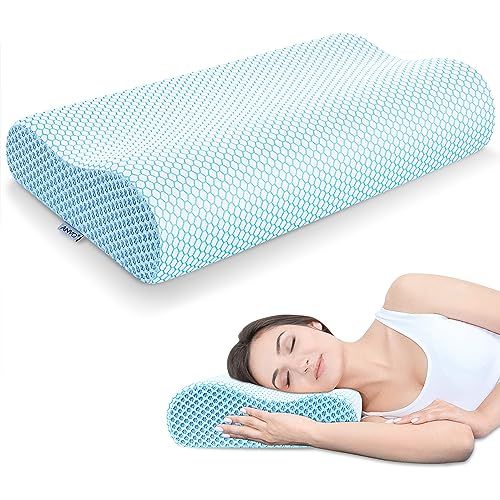
Anvo Memory Foam Pillow (Neck Contour) — Best Budget Contour
Choose the Anvo if the budget is the brief and you still want a real contour rather than a flat foam slab. It covers the main positions, its ergonomic shape provides the lobe-and-valley support the category exists for, and its price position makes it the natural pick for a second pillow — a guest bed, a partner who wants to try contour sleeping alongside you, a spare for travel by car.
Strengths
- True contour shape at the guide’s most accessible tier
- Memory foam comfort across side and back positions
- Low-risk way to test contour sleeping for a second sleeper or room
Trade-offs
- Budget foam will age faster than the premium materials here
- One moderate profile; extreme lofts in either direction are not its brief
- Finish and cover quality match the tier
| Material (listing) | Memory foam |
| Design (listing) | Neck contour, ergonomic |
| Positions (listing) | Side, back, stomach sleepers |
Budget contour pillows fail in a predictable way — foam so light it collapses under a head — and the Anvo’s job in this guide is to be the budget pick that does not. Its memory foam has enough substance to hold the contour’s working shape through a night, which is the minimum viable version of the category, delivered at the minimum price. For the buyer whose alternative is another year on a dead flat pillow, that is a meaningful upgrade, honestly bounded.
Position versatility is its second virtue. Households rarely contain one pure side sleeper; they contain position-shifters, partners who borrow pillows, and guest beds that must serve everyone. A moderate contour that behaves for side and back sleeping covers that reality better than a specialist profile, and at this tier the household math — several decent contour pillows versus one premium one — often favors the Anvo approach.
Set the lifespan expectation plainly: budget foam is a few-years product under nightly use, not a decade product. Bought with that understanding — as a trial, a spare, or a household rollout — it is money correctly spent. Bought as a once-for-ten-years investment, it will disappoint in year four, and the TEMPUR picks exist for that buyer.
Best for: Budget buyers, trials, guest beds, and second pillows / Not suited for: A single ten-year daily pillow for a committed side sleeper
Check on Amazon — check price on Amazon before you decide, because configurations and included accessories change between listings.

VYLEE Cervical Neck Pillow (Memory Foam Contour, Dual-Height) — Best Adjustable Fit
Buy the VYLEE if you fall between profiles — the sleeper who found one pillow too low and the next too high — or if you share a bed with a partner whose build differs from yours and you are buying a matched pair with different needs. The dual-height design puts a higher lobe on one side and a lower on the other; you sleep on the edge that fits, and you can change your mind without a return label. It serves side, back, and stomach positions per its listing.
Strengths
- Two lofts in one pillow solves the between-sizes problem elegantly
- Lets you experiment across nights to find your true fit
- Memory foam contour comfort across multiple sleep positions
Trade-offs
- A dual-height pillow’s two profiles are both moderate — extremes still need dedicated sizes
- You must learn which edge is which in the dark (a week of habit)
- Like all foam, it will age faster than TEMPUR material
| Material (listing) | Memory foam |
| Design (listing) | Ergonomic dual-height contour |
| Positions (listing) | Side, back, stomach sleepers |
| Color (listing) | Grey |
Dual height is the smartest idea in the contour category for uncertain buyers, because pillow fit is genuinely hard to predict from a product page. Shoulder width, mattress sink, and personal preference interact; a pillow offering two molded heights converts a gamble into an experiment you run in your own bed, on your own mattress, across real nights. Many sleepers discover their true loft is the one they would never have ordered — which is the strongest argument for building the choice into the pillow.
It also solves the couple problem quietly. Two sleepers, two builds, one bedding aesthetic: buy two VYLEEs and each partner rotates to their own height, with matched pillows on the made bed. Guest rooms benefit the same way — a dual-height pillow fits more of the human distribution than any single profile a host could choose.
The bounds are honest: dual-height ranges span the middle of the distribution, so the very broad-shouldered still belong on the TEMPUR Large and the very petite on the lowest profiles available. Within the middle — where most sleepers live — the VYLEE is the fit-risk-free way to buy a contour pillow, and for the undecided it is this guide’s practical recommendation.
Best for: Between-sizes sleepers, couples with different builds, and the undecided / Not suited for: Extreme lofts at either end of the distribution
Check on Amazon — check price on Amazon before you decide, because configurations and included accessories change between listings.

NOFFA Cervical Neck Pillow (Contour Memory Foam, Cooling Pillowcase) — Best for Hot Sleepers
Choose the NOFFA if you run warm. Memory foam’s known weakness is heat: it molds with body warmth and insulates where it touches, and side sleepers press a whole cheek and ear into the pillow all night. A cooling pillowcase does not change the foam’s physics, but it changes the surface your skin actually meets — and surface feel is where pillow heat is experienced. It suits hot sleepers who want contour support without the midnight pillow-flip ritual.
Strengths
- Cooling pillowcase addresses foam’s heat where you feel it — at the surface
- Full contour memory foam support for the neck and head
- A complete package: pillow plus the case designed for it
Trade-offs
- Cooling cases moderate surface warmth; they do not refrigerate, and deep foam heat in a hot room remains
- The case is part of the system — replacing it with a thick flannel case defeats the design
- Mid-tier foam longevity, as with the other non-TEMPUR picks
| Material (listing) | Contour memory foam |
| Included (listing) | Cooling pillowcase |
| Design (listing) | Cervical neck support contour |
Pillow heat is a surface phenomenon with a depth component, and this product addresses the surface honestly. The skin of a side sleeper contacts the pillowcase, not the foam; a case woven to feel cool and move moisture changes the first and most important inch of the experience. Owners whose complaint is specifically ‘my face gets hot on foam’ are describing a surface problem, and for them the NOFFA’s pairing is a targeted fix rather than a gimmick.
Beneath the case, the contour does the standard work: neck lobe, head valley, a supported side-sleeping line. Nothing about the cooling brief compromises the geometry, which is as it should be — hot sleepers need fit as much as anyone, and a cool pillow at the wrong loft is still the wrong pillow. Fit yourself with the measurement method in this guide first; then let the case handle the temperature.
Respect the system’s logic in the laundry: the cooling case works because of what it is, so dress the pillow in it, not in the thick winter case from the linen closet. And keep the room-level truth in view — no pillowcase defeats a hot bedroom — but within the pillow’s control, this is the most considered warm-sleeper design in the guide.
Best for: Hot sleepers who want contour support without a hot face / Not suited for: Cold sleepers, or anyone who will dress it in a heavy flannel case
Check on Amazon — check price on Amazon before you decide, because configurations and included accessories change between listings.
Comparison Table
| Pick | Badge | Key spec | Best for |
|---|---|---|---|
| TEMPUR-Pedic TEMPUR-Ergo Neck Pillow, Medium Profile | Best Overall | TEMPUR material, medium contour profile | Average-build side sleepers wanting the category’s reference pillow |
| TEMPUR-Pedic TEMPUR-Neck Pillow, Large Profile | Best for Broad Shoulders | TEMPUR material, large contour profile | Broad-shouldered side sleepers, especially on firm mattresses |
| Royal Therapy Memory Foam Pillow, Queen (Contour Cervical) | Best Value Contour | Memory foam contour, queen size | First-time contour users and value buyers wanting queen sizing |
| Anvo Memory Foam Pillow (Neck Contour) | Best Budget Contour | Memory foam neck contour, budget tier | Budget buyers, trials, guest beds, and second pillows |
| VYLEE Cervical Neck Pillow (Memory Foam Contour, Dual-Height) | Best Adjustable Fit | Dual-height memory foam contour | Between-sizes sleepers, couples with different builds, and the undecided |
| NOFFA Cervical Neck Pillow (Contour Memory Foam, Cooling Pillowcase) | Best for Hot Sleepers | Contour memory foam + cooling pillowcase | Hot sleepers who want contour support without a hot face |
How to Choose a Contour Pillow for Side Sleeping
Fit is a measurement, not a vibe, and the measurement is your shoulder gap: the distance from the side of your neck to the outer edge of your shoulder, minus what your mattress absorbs as your shoulder sinks in. Broad shoulders and a firm mattress leave the largest gap and need the highest loft — the TEMPUR Large’s territory. Narrow shoulders on a soft mattress leave the smallest, served by the lower profiles. The middle — most people — belongs to medium profiles like the TEMPUR-Ergo Medium. The how-to section gives the two-minute home method; run it before ordering and you will likely buy once.
Material: TEMPUR, memory foam, and what changes
All the picks here are foam, but foam is a family, not a material. TEMPUR material is the densest and most durable expression: firmer, slower, and shape-stable across years. Standard memory foams are softer and more forgiving on night one, and age faster. For a pillow whose entire function is a shape, material longevity is function longevity — which is why the premium picks lead this guide, and why the value picks are framed as trials, spares, and household rollouts rather than decade purchases. Cooling cases, dual heights, and sizes are variations; material is the foundation.
One pillow, or a fitting system?
If your measurements land mid-range and your build is average, buy one medium contour and be done. If you are between sizes, a couple with different builds, or fitting a guest bed, prefer adjustability — the VYLEE’s dual heights — over a second gamble on a single profile. And if you are at the distribution’s edges, buy the dedicated profile without apology: edge builds are where contour pillows deliver their most dramatic improvements, precisely because flat pillows fail those sleepers most completely.
The Mattress Is Half the Pillow Decision
Your pillow does not work alone; it works on your mattress, and the pair must be fitted together. A soft, deep-sinking mattress absorbs the shoulder and reduces the gap the pillow must fill — drop a loft size relative to your shoulder measurement. A firm mattress holds the shoulder up and preserves the full gap — take the full loft your shoulders suggest. Changing mattresses can quietly unfit a pillow that was perfect, which is why some sleepers ‘stop liking’ a pillow after a bed change: the pillow did not change, its partner did. Re-run the measurement whenever the mattress changes, and expect the answer sometimes to change with it.
Contour Pillows and the Combination Sleeper
Pure side sleepers are rarer than pillow marketing assumes; most people side-sleep primarily and visit their back or front across the night. Combination sleepers should read profiles differently: the side-sleeping hours need the loft, but an extreme specialist profile can punish the back-sleeping hour, so moderate contours and dual-height designs — which offer a lower central zone for back sleeping between the lobes — serve changers best. If you know you rotate, say so in your choice: the VYLEE and the moderate foam picks are built for your pattern, while the dedicated TEMPUR profiles reward the committed side sleeper who stays put. Neither pattern is better; they are different briefs, and matching the pillow to the pattern you actually have is the last fitting variable after loft and material.
How to Measure Your Loft and Fit a Contour Pillow
Two minutes with a wall and a towel will tell you more about the right pillow than an hour of reviews. Do this before ordering, and repeat the first-night checks during your first week.
Step 1: Measure your shoulder gap
Stand sideways with your shoulder lightly against a wall, head straight. The distance from the wall to the side of your head is your raw shoulder gap — the maximum loft your pillow could need. Note it; the next step discounts it for your mattress.
Step 2: Discount for mattress sink
Lie on your bed on your side, without a pillow, in your sleeping position, and have someone look at your head’s angle — or stack folded towels under your head until your nose aligns with your sternum and your head feels level, neither tipped down nor propped up. Measure the towel stack: that is your working loft on your actual mattress.
Step 3: Match the measurement to a profile
Compare your working loft to the profiles: low towel stacks suit low and medium profiles; tall stacks need large profiles or the high side of a dual-height pillow. When you land between two, choose the option that lets you test both — dual height — rather than guessing.
Step 4: Run the three-night trial properly
Sleep on the new pillow for at least three consecutive nights before judging; contour shapes feel deliberate for the first nights even when they are right. Judge on the pattern of mornings — how your neck and shoulders feel across the trial — not on any single night.
Step 5: Check the ear and jaw
Side sleepers press an ear and a jawline into the pillow for hours. If either complains, the surface is too firm or the head valley too shallow for you — a fit detail worth more than any specification, and a legitimate reason to change profile or material within the trial window.
Step 6: Keep the case thin
A contour pillow’s shape is engineered to meet your head through a thin case. Thick, quilted, or padded protectors round off the contour you paid for. Use the case the pillow comes with, or a thin standard case, and let the shape do its work.
Re-run the towel test when you change mattresses, lose or gain significant weight, or change sleep position habits. Pillow fit is a relationship between you and your bed, and relationships need the occasional recheck.
Common Buying Mistakes
Buying loft by body size alone
‘Large person, large pillow’ ignores the mattress, which can absorb half the shoulder gap on a soft bed. The result — a broad-shouldered sleeper on a plush mattress, propped too high on a large profile — is as uncomfortable as the opposite error. Measure on your bed, as the how-to prescribes; it takes two minutes and it is the whole game.
Judging a contour pillow on night one
A shaped pillow feels strange before it feels right, because it is asking your neck to rest in a position your old pillow never offered. Buyers who return contour pillows after one night have tested unfamiliarity, not fit. Give any contour three to seven nights and judge the mornings, unless the fit is obviously, measurably wrong.
Stacking or folding a pillow to add loft
Two pillows slide against each other all night and deliver a different, worse shape by 3 a.m. — usually a wedge with your head at the bottom of it. If you need height, buy height: a large profile or a dual-height’s tall edge. Molded loft stays where it is put; stacked loft migrates.
Dressing the contour in a thick protector
Quilted protectors and flannel cases round off the lobe and fill the valley — the two features you bought. Protect the pillow with its own case or a thin one, washed regularly, and let the engineered shape reach your head as designed.
Expecting a pillow to settle a medical question
A contour pillow is comfort equipment. Neck or shoulder pain that persists through a correctly fitted pillow, pain with arm numbness or weakness, or pain after an injury belongs to a clinician. The right sequence is: fit the pillow properly, give it its trial, and if discomfort remains, treat that as information for a professional — not as a reason to buy a fifth pillow.
Final Recommendation
For the average side sleeper, the TEMPUR-Ergo Medium is the reference purchase: the original contour in the most durable material, in the profile that fits the middle of the distribution. Broad shoulders should go directly to the TEMPUR-Neck Large rather than adapting to a medium and concluding contour pillows do not work.
For everyone else, the specialists: the VYLEE dual-height for between-sizes sleepers and couples, the NOFFA for hot sleepers, the Royal Therapy as the value-priced first contour in a proper queen size, and the Anvo as the budget trial or household spare.
Whichever you choose, measure first with the towel method, trial it for a week of mornings, and keep the case thin. A contour pillow is the most fit-dependent product in the bedroom — fitted well, it disappears into the best sleep you have had in years; fitted by guesswork, it is an expensive lump. The measurement is two minutes. Spend them.
And keep the old pillow for the first week, in the closet rather than on the bed. If the trial truly fails, you will know it honestly — and you will also know your measured loft, which makes the second choice a correction instead of another guess.
Check the finalists on Amazon: TEMPUR-Pedic TEMPUR-Ergo Neck Pillow, Medium Profile · TEMPUR-Pedic TEMPUR-Neck Pillow, Large Profile · Royal Therapy Memory Foam Pillow, Queen (Contour Cervical) · Anvo Memory Foam Pillow (Neck Contour) · VYLEE Cervical Neck Pillow (Memory Foam Contour, Dual-Height) · NOFFA Cervical Neck Pillow (Contour Memory Foam, Cooling Pillowcase).
Frequently Asked Questions
How high should a pillow be for side sleeping?
High enough to keep your head and neck in a straight line with your spine when you lie on your side — which depends on your shoulder width and how much your mattress lets your shoulder sink. The towel method in this guide measures your personal number on your own bed in two minutes. As a rough orientation: narrow shoulders and soft mattresses need the least loft, broad shoulders and firm mattresses the most, and most sleepers land on a medium profile.
How long does it take to get used to a contour pillow?
Typically several nights to a week. The shape positions your head and neck deliberately, which feels unfamiliar before it feels natural — that unfamiliarity is not a fit verdict. Judge after three to seven nights by how your neck and shoulders feel across several mornings. If the loft is measurably wrong — head clearly tipping up or down — change profile sooner; if it is merely new, give it the week.
Can back sleepers use these contour pillows?
Yes — most contour profiles serve back sleeping well, with the neck lobe supporting the curve and the head resting in the valley. Several picks here are listed for side, back, and stomach positions. Pure stomach sleeping is the position contour pillows serve least, since it wants a very low, soft surface; combination sleepers who mostly side-sleep and occasionally roll over are well served by the moderate profiles in this guide.
Why does my ear hurt on a contour pillow?
Side sleepers rest an ear in the pillow’s surface for hours, and a firm foam surface can make that ear complain even when the neck fit is perfect. It is a surface-firmness and valley-shape issue: a slightly softer material, or a contour whose head valley is shallower and broader, usually resolves it. It is also a legitimate trial-period reason to switch models — comfort is the product, and an aching ear is data.
How long does a contour pillow last?
It depends on the material. Dense TEMPUR material holds its molded shape for years of nightly use; standard memory foams soften and take a set sooner, with budget foams at the shorter end. A contour pillow is finished when its shape is — when the lobe no longer fills your neck curve or the valley has permanently deepened. Judge by geometry, not by the calendar, and replace when the support you bought is no longer the support you have.
Will a contour pillow fix my neck pain?
This guide does not promise that, and you should be wary of any pillow page that does. A properly fitted contour pillow improves sleeping position and comfort for many side sleepers, which is a real and worthwhile outcome. Pain that persists despite a well-fitted pillow and a sound mattress — or pain with numbness, weakness, or an injury in its history — needs a clinician’s assessment. Fit the pillow for comfort; take pain to a professional.
Keep exploring: Best Contour Side Sleeping Pillows Best Pillows For Side Sleepers Best Cervical Pillows Best Memory Foam Pillows Best Cooling Pillows For Side Sleepers Best Pillows For Neck Support

