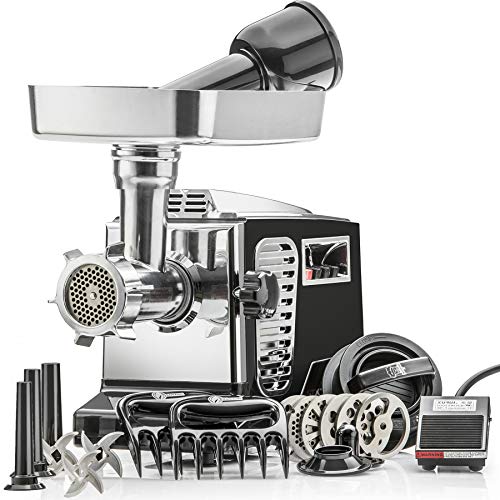
Disclosure: airfryerkitchensupply.com is reader-supported. When you buy through links on our site, we may earn an affiliate commission at no extra cost to you.
Where to buy
Every grinder in this guide to the best hunting meat grinders is sold through Amazon, where listings confirm the current configuration — plates and stuffing gear included vary, so verify the box before comparing. Start with the LEM BigBite Dual Grind #22 for the benchmark, the MEAT! 1 HP #22 for full harvests at a challenger price, or the Weston #12 for the mid-size middle path. Modest harvests point to the LEM BigBite #8; tight budgets to the Valley Sportsman #22 or the VEVOR #12.
The best hunting meat grinders are judged differently from kitchen appliances, because their working year is compressed into a few high-stakes weeks: an animal on the table is perishable, the weather is a deadline, and a grinder that falters mid-processing is not an inconvenience but a crisis. This guide compares the best hunting meat grinders across the classes hunters actually run — the #22 full-harvest machines, the #12 middle path, and the quality #8 for modest seasons — with every pick verified against Amazon’s catalog data before it earned a place.
Three calibrations before the picks. First, size class is destiny: #8, #12, and #22 describe the grinding head, and the right class is set by your real harvest — animals per season, and whether they arrive one at a time or in a weekend pile. Second, throughput figures in this category are maker ratings under ideal conditions; we cite them as the listings state them and judge machines by class and construction instead. Third, the cold discipline from our household guide applies with double force here: partially frozen meat and a cold head are what separate clean grind from smear, whatever the motor. Check the current price on Amazon from each pick’s link, and if you are buying in season, buy early — processing gear sells out when the tags are filled, not before.
In this guide
Quick Picks
- LEM BigBite Dual Grind #22 Meat Grinder, 1.0 HP — Best Overall. The serious hunter’s benchmark: a #22 head, a full 1.0 HP motor, stainless construction, and LEM’s dual-grind system that cuts and grinds in one pass — built for whole-animal days. Check the current price on Amazon.
- MEAT! 1 HP Pro-Grade Meat Grinder #22 — Best for Full Harvests. A pro-grade #22 with a 1 HP motor and coarse and fine plates included — the challenger brand’s full-harvest machine, built for hunters who process everything they take. Check the current price on Amazon.
- Weston #12 Electric Meat Grinder & Sausage Stuffer, 1 HP — Best Mid-Size. The middle path: a #12 head with a 1 HP-class motor rated at 4 lbs per minute by its maker, from a brand with deep roots in game processing — for hunters whose harvest is real but not industrial. Check the current price on Amazon.
- Valley Sportsman Commercial Meat Grinder 1.0 HP #22 — Best Commercial-Style Value. A commercial-style #22 with a 1.0 HP rating, stainless build, two plates, a stuffer, and an ETL listing — the full-size class at a value position, with a maker-rated 550 lbs/hr throughput claim. Check the current price on Amazon.
- VEVOR Meat Grinder #12, 750W / 1 HP Motor — Best Budget High-Capacity. A #12 with a 1 HP-class motor, two plates, three stuffing tubes, a kibbe kit, and an ETL listing at a budget tier — the high-capacity starter for hunters testing the processing life. Check the current price on Amazon.
- LEM BigBite #8 Meat Grinder, 0.5 HP — Best for Modest Harvests. The BigBite line scaled to #8: stainless, 0.5 HP, with the BigBite auger appetite — the quality answer for the one-deer hunter who buys for decades. Check the current price on Amazon.
How These Picks Were Chosen
We required every pick to be a genuine processing-class machine: a #8 head or larger, a motor rated for sustained work rather than kitchen moments, and a maker with a real presence in the processing world. Within that filter, we judged the things a processing day exposes: how the auger feeds without forcing, how the machine holds pace across hours as meat and motor warm, whether both working plates are in the box or on the accessory shelf, and how deep the parts ecosystem runs — because a hunting grinder is a decades purchase whose second decade is made of replacement knives and plates.
That is why LEM anchors this list at both ends, why Weston’s processing heritage earns the middle, and why the two value picks are required to show an ETL listing — in the #22 class, independently examined electrical safety is the line between value and gamble. Headline throughput numbers were treated as class indicators, never as test results, and the reviews say so where they appear.
The 6 Best Hunting Meat Grinders, Reviewed

LEM BigBite Dual Grind #22 Meat Grinder, 1.0 HP — Best Overall
A hunting grinder is judged on the worst day of its year: two deer on the table, a garage cooling down, and a family that wants the processing finished before midnight. The LEM BigBite Dual Grind #22 is built for exactly that day. The #22 head is the serious home-processing class — a big throat, big plates, real throughput — and the 1.0 HP motor behind it is an honest, sustained rating from the company whose name is on more home processing benches than any other. The dual-grind design is the headline: a cutting stage ahead of the grinding plate that lets the machine take larger, rougher chunks and produce a finished grind in one pass, where conventional grinders demand a first coarse pass, a chill, and a second pass.
It suits hunters who process multiple animals a season, homesteads grinding beef and pork in bulk, and anyone who has worn out a lesser grinder mid-deer and sworn it would not happen twice. Stainless construction matters here beyond looks: this machine lives in garages and barns, gets hosed-down-level cleaning, and is expected to do it for decades.
Strengths
- Dual-grind system eliminates the second pass on most grinds — the day’s biggest time saver
- #22 head and a true 1.0 HP sustained motor for whole-animal throughput
- Stainless build and the deepest parts ecosystem in home processing
Trade-offs
- Serious money and serious size — it is a bench machine, not a cabinet appliance
- Overkill for the one-deer-a-year hunter; see the BigBite #8 below
- Dual-grind hardware is one more system to learn and maintain
| Grinder size | #22 (per Amazon title) |
| Motor | 1.0 HP (per Amazon title) |
| Construction | Stainless steel (per Amazon title) |
| System | BigBite dual grind (per Amazon title) |
What the dual grind buys in practice is the afternoon. Conventional processing grinds twice for anything finer than a coarse chili grind, and the meat must be re-chilled between passes to avoid smearing — hours of logistics across a big harvest. One-pass grinding with cold discipline collapses that schedule, and on a two-animal day the saved hours are the difference between finishing fresh and finishing exhausted at 2 a.m. The BigBite auger design pulls meat in aggressively, so the machine feeds itself at a pace that keeps the operator cutting rather than pushing.
And when something wears — a knife in year four, a plate you want in another size — LEM’s catalog answers. In this class, that ecosystem is not a bonus; it is the product. Buy the BigBite #22 and you have bought your last hunting grinder, which is precisely its value proposition.
Best for: Multi-animal hunters and homesteaders who process in bulk every season / Not suited for: One-deer households or anyone short on bench and storage space
Check the current price on Amazon for the LEM BigBite Dual Grind #22.
MEAT! 1 HP Pro-Grade Meat Grinder #22 — Best for Full Harvests
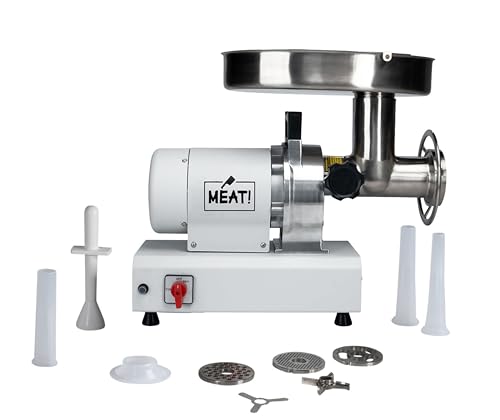
MEAT! built its brand by aiming directly at the processing hunter, and its 1 HP #22 is the spearhead: a pro-grade head, a full-horsepower motor, stainless construction, and — a detail that matters on processing day — both coarse and fine plates in the box, so the two-pass workflow (coarse for the first grind and chili, fine for sausage and burger) needs no additional purchase to begin. The machine’s design language is commercial: big switches, easy-clean surfaces, and a stance that belongs on a processing bench.
It suits hunters who take full advantage of a season — multiple deer, an elk, hogs when the opportunity comes — and homesteaders splitting whole animals with family. Against the LEM benchmark, the MEAT! argues value within the same performance class: comparable head size and motor class, an included two-plate kit, and a brand that answers to the processing community specifically.
Strengths
- Full #22 / 1 HP class with both working plates included from day one
- Pro-grade, easy-clean design aimed squarely at harvest processing
- Strong value position against the benchmark in its class
Trade-offs
- Single-pass dual-grind technology is the LEM’s; this is a conventional two-pass machine
- Brand ecosystem is younger and narrower than LEM’s decades-deep catalog
- Size and weight commit you to a bench, like all #22 machines
| Grinder size | #22 (per Amazon title) |
| Motor | 1 HP (per Amazon title) |
| Included plates | Coarse and fine grinding plates (per Amazon title) |
| Construction | Stainless steel (per Amazon title) |
In the garage, the MEAT! behaves the way its spec promises: it eats cubed venison and pork at a pace that keeps two people cutting, holds its composure as batches accumulate, and the coarse-to-fine two-plate routine is the classic workflow executed without friction. Hunters coming from #8 or #12 machines notice the throat first — bigger cubes, fewer cuts, a faster tray-to-grinder rhythm — and the motor’s refusal to bog when the meat is dense and cold.
The ownership question is the ecosystem one, and MEAT! has been building its answer: plates, knives, and processing accessories through its own channel, aimed at exactly this buyer. If you process seriously and the LEM’s premium stretches the budget past a stuffer or a vacuum sealer you also need, the MEAT! #22 is the allocation we would defend.
Best for: Serious hunters processing multiple animals who want #22 class at a challenger price / Not suited for: Buyers who rank a decades-deep parts catalog above all else
Check the current price on Amazon for the MEAT! 1 HP Pro #22.

Weston #12 Electric Meat Grinder & Sausage Stuffer, 1 HP — Best Mid-Size
Between the household #8 and the full-harvest #22 sits the #12, and Weston’s is the class’s most natural citizen. Weston is an old name in game processing — its catalog of grinders, stuffers, and sealers is built for this exact buyer — and this machine pairs the #12 head with a 750-watt, 1 HP-class motor whose maker rates it at four pounds per minute. That pace, sustained across a deer, turns processing day from an endurance event into a morning’s work, in a machine notably smaller and lighter than a #22.
It suits the one-to-three-deer hunter, the household that also grinds domestic meat in real batches, and anyone whose processing happens on a kitchen counter or a folding table rather than a dedicated bench. The die-cast aluminum body keeps it movable in a way the stainless #22s are not.
Strengths
- #12 pace in a movable, counter-friendly machine
- Maker-rated 4 lbs/min with stainless plates included
- Weston’s game-processing ecosystem behind it
Trade-offs
- Aluminum body, not stainless — a class below the #22 picks in build
- A very large harvest (elk plus deer in one weekend) will still test its duty cycle
- Not the dual-grind one-pass convenience of the top pick
| Grinder size | #12 (per Amazon title) |
| Motor | 750 watt, 1 HP (per Amazon title) |
| Maker-rated throughput | 4 lbs per minute (per Amazon title) |
| Plates | Stainless steel grinding plates included (per Amazon title) |
The #12 class is where most hunters’ real lives are lived, and the Weston understands the assignment: fast enough that grinding is never the slow step — cutting and packaging are — and sized so it stores on a shelf instead of annexing the garage. Its sausage-stuffer role is built into the design brief rather than bolted on, and Weston’s accessory range (plates, knives, stuffing gear) is stocked through the same channels hunters already use for the rest of processing season.
Choose it when your season is measured in a few animals and your space is measured in shelves. It is the grinder the one-deer-weekend tradition actually runs on, with headroom for the year you tag out twice.
Best for: One-to-three-deer hunters and dual-purpose households wanting #12 pace without #22 bulk / Not suited for: Elk-and-moose volume or multi-family processing operations
Check the current price on Amazon for the Weston #12 1 HP.

Valley Sportsman Commercial Meat Grinder 1.0 HP #22 — Best Commercial-Style Value
The Valley Sportsman takes the commercial template — #22 head, stainless body, industrial switchgear — and prices it for the home processing market. Its listing claims a 550 lb-per-hour throughput, and the honest translation is that such figures are maker ratings under ideal conditions; what matters for a hunting household is that the machine is genuinely in the #22 / 1 HP class, with the throat and plate size that class implies, plus an ETL listing that says its electrical build was examined by a real lab. Two plates and a sausage stuffer are in the box.
It suits value-driven processors who need full #22 capacity — a hunting camp, a family that splits an elk and several deer, a small farm — and whose budget must also cover the stuffer, sealer, and knives that a full processing setup demands. In that allocation argument, a value-class #22 is often the rational buy.
Strengths
- True #22 size and 1 HP class at a value position
- ETL listing — independently examined electrical safety
- Stuffer and two plates included; stainless construction
Trade-offs
- Maker throughput figures are ideal-condition ratings; expect real-world pace below the headline
- Brand support and parts depth trail LEM, MEAT!, and Weston
- Commercial styling and weight demand a permanent bench spot
| Grinder size | #22 (per Amazon title) |
| Motor | 1.0 HP / 750W class (per Amazon title) |
| Maker-rated throughput | 550 lbs/hr (per Amazon title) |
| Certification | ETL approved (per Amazon title) |
| Included | Sausage stuffer, 2 grinding plates (per Amazon title) |
Judged in the garage rather than on the spec sheet, the Valley Sportsman’s case is capacity per dollar. It takes #22-size cubes, runs the two-plate workflow, and stuffs — the full processing repertoire — and for a camp or family operation that processes hard for a few weekends a year, that repertoire at this tier frees budget for the vacuum sealer and the knives that finish the job. The ETL mark separates it from the unexamined end of the value market, which is the line that matters in this class.
Go in with the value-tier expectations set in our household guide: verify the box contents on delivery, keep the packaging through the first season’s first session, and register whatever warranty the seller offers. Do that, and this is the most #22 for the money in this guide.
Best for: Hunting camps and family operations needing full #22 capacity on a real budget / Not suited for: Buyers who prioritize brand ecosystem and finish refinement
Check the current price on Amazon for the Valley Sportsman #22.

VEVOR Meat Grinder #12, 750W / 1 HP Motor — Best Budget High-Capacity
VEVOR’s formula is industrial-adjacent equipment at disruptive prices, and its #12 grinder applies that formula to the processing bench: a #12 head, a 750W / 1 HP-class motor, two plates, three stuffing tubes, a kibbe kit, and an ETL listing. The 552 lbs/h figure is, like the Valley Sportsman’s, a maker rating to be read as ‘genuinely #12-class pace’ rather than a stopwatch promise. What you are buying is the class’s capacity and a full starter kit at the tier where a first-time processor can afford to find out whether this life is for them.
It suits new hunters facing their first whole-animal processing, budget-bound homesteads, and as a camp’s second grinder — the one that handles the coarse first grind while the flagship does the fine work. The kit completeness means the first processing day needs no second order.
Strengths
- #12 capacity and a full accessory kit at a budget tier
- ETL listing distinguishes it from unexamined no-name machines
- Three stuffing tubes cover the common casing sizes from the start
Trade-offs
- Value-tier fit and finish; expect utility, not refinement
- Long-term parts availability runs through the seller, not a dealer network
- Maker throughput ratings are ideal-condition figures
| Grinder size | #12 (per Amazon title) |
| Motor | 750W / 1 HP (per Amazon title) |
| Maker-rated throughput | 552 lbs/h (per Amazon title) |
| Included | Two plates, three stuffing tubes, kibbe kit (per Amazon title) |
| Certification | ETL listing (per Amazon title) |
The VEVOR’s honest role is the gateway #12. A first processing season is an education — in volumes, in workflow, in whether your household loves or merely tolerates the work — and this machine delivers that education at a price that leaves budget for the sealer, the knives, and the freezer the education also demands. Its grinding behavior at household-and-harvest scale is the class’s: keep meat cold, feed steadily, and it processes a deer without being the story of the day.
If the life sticks, most owners eventually anchor the bench with a LEM or MEAT! and the VEVOR becomes the camp machine or the coarse-grind station — a respectable second career. If it does not stick, the loss is the smallest in this guide. That asymmetry is the budget pick’s whole argument, and it is a good one.
Best for: New processors and budget homesteads wanting #12 class and a complete starter kit / Not suited for: High-volume veterans who will feel the value tier’s limits daily
Check the current price on Amazon for the VEVOR #12 grinder.

LEM BigBite #8 Meat Grinder, 0.5 HP — Best for Modest Harvests
Not every hunter needs a #22, and buying one for a single deer a year is how garages fill with monuments. The BigBite #8 is LEM’s quality answer at household-plus scale: the BigBite series’ aggressive auger and stainless construction, a 0.5 HP motor, and a #8 head that processes a deer in honest time while also serving as the household’s burger and sausage grinder the other fifty weeks of the year. It is the dual-purpose machine done by the brand that does both purposes best.
It suits the one-deer-a-year hunter, the upland and waterfowl household grinding smaller game and domestic meat, and anyone whose processing and household grinding are one machine’s job. Where our household guide’s LEM #8 Countertop is the kitchen-first version, this BigBite is the garage-first one: stainless, heavier-duty, and aimed at the season.
Strengths
- BigBite appetite and stainless build in a store-able #8
- One machine honestly serves both hunting season and household year-round
- Full LEM ecosystem: every plate and part, orderable for years
Trade-offs
- A multi-deer weekend will take longer than on the #22 picks — pace is the trade
- Premium for its size class; you pay for the line and the steel
- Still a two-pass machine for fine grinds
| Grinder size | #8 (per Amazon title) |
| Motor | 0.5 HP (per Amazon title) |
| Construction | Stainless steel (per Amazon title) |
| Line | BigBite series (per Amazon title) |
The BigBite auger is the detail that earns the name: it grabs and pulls meat through with an appetite that makes a #8 feel bigger than its plate size, and on a single deer — ground in two sittings with a chill between — the day never feels like it is waiting on the grinder. Stainless construction shrugs off the garage environment and the wash-down cleaning that processing day ends with.
This is the pick for the hunter whose volume is modest and whose standards are not. It costs more than its size suggests and justifies it the way LEM always does: in year eight, when it still runs like year one and the parts catalog still knows its name.
Best for: One-deer hunters and dual-purpose households wanting LEM quality at #8 scale / Not suited for: Multi-animal processors who need #22 throughput
Check the current price on Amazon for the LEM BigBite #8.
Comparison Table
| Pick | Badge | Key spec | Best for |
|---|---|---|---|
| LEM BigBite Dual Grind #22 Meat Grinder, 1.0 HP | Best Overall | #22 size, 1.0 HP, stainless, dual grind | Multi-animal hunters and homesteaders who process in bulk every season |
| MEAT! 1 HP Pro-Grade Meat Grinder #22 | Best for Full Harvests | #22 size, 1 HP, coarse + fine plates included | Serious hunters processing multiple animals who want #22 class at a challenger price |
| Weston #12 Electric Meat Grinder & Sausage Stuffer, 1 HP | Best Mid-Size | #12 size, 750W / 1 HP motor, 4 lbs/min maker rating | One-to-three-deer hunters and dual-purpose households wanting #12 pace without #22 bulk |
| Valley Sportsman Commercial Meat Grinder 1.0 HP #22 | Best Commercial-Style Value | #22 size, 1.0 HP class, ETL approved | Hunting camps and family operations needing full #22 capacity on a real budget |
| VEVOR Meat Grinder #12, 750W / 1 HP Motor | Best Budget High-Capacity | #12 size, 750W/1 HP motor, ETL listed | New processors and budget homesteads wanting #12 class and a complete starter kit |
| LEM BigBite #8 Meat Grinder, 0.5 HP | Best for Modest Harvests | #8 size, 0.5 HP, stainless | One-deer hunters and dual-purpose households wanting LEM quality at #8 scale |
How to Choose the Best Hunting Meat Grinders
Start with the harvest, counted honestly: animals per season, species and size, and how they arrive. One deer, processed in sittings, is #8 work. A few deer across a season, or one deer in a single determined day, is #12 work. Multiple deer in a weekend, an elk, or a family-and-friends processing operation is #22 work, full stop. Then choose the maker by ecosystem — plates, knives, and parts across decades — and only then compare the machines inside your class. Hunters who shop in that order rarely buy twice; hunters who shop by headline numbers often do.
Size classes in the field: #8 vs #12 vs #22
The class number is the head size, and it governs throat diameter, plate size, and appetite together. A #8 takes modest cubes and a steady feed; a #12 takes bigger cubes and sustains a two-person cutting-and-grinding rhythm; a #22 takes the roughest trim cuts and keeps a whole table busy. The step from #12 to #22 is the one hunters feel most, because it changes the day from ‘grinding in batches’ to ‘grinding as fast as we can cut.’ Match the class to the crew as much as to the animal: a #22 fed by one person is underused iron, while a #8 fed by four is a bottleneck with a motor.
Motors, duty cycle, and the afternoon test
A hunting grinder’s motor is not asked for a sprint; it is asked for an afternoon. Sustained ratings from the processing brands — LEM’s horsepower figures are the conservative convention — describe a motor that holds pace as it warms, hour over hour. That is the number that matters, and it is why this guide weights maker class over headline watts. In the field, manage the duty cycle like a professional: grind in waves with the packaging work, let the machine rest while meat re-chills, and never let a hot motor be the reason a batch smears. The grinders in this guide are built for the afternoon; the operator’s pacing is what lets them prove it.
Dual grind and the two-pass reality
Most grinds worth eating are made in two passes: a coarse first grind that breaks the meat down, a chill, then the working grind at the plate the recipe wants. The LEM dual-grind system at the top of this guide collapses that into one pass for many grinds — the category’s one genuine shortcut, bought with money and mechanism. Every other pick here is a two-pass machine, which is not a defect but a workflow to plan: tray space for the first grind, freezer room for the re-chill, and the coarse plate in the box. When you compare prices, compare them against the workflow each machine actually delivers on your biggest day.
The processing bench as a system
A grinder does not process an animal alone. The bench that works has the grinder, a stuffer for sausage day, a vacuum sealer, sharp knives, trays that fit the freezer, and a scale — and the budget that buys all six in balance beats the budget that buys one flagship and five regrets. This is the honest argument for the value picks in this guide: a camp that processes together may be better served by a Valley Sportsman #22 plus a good sealer than by a flagship grinder plus a hand-crank stuffer. Decide the system first; then let the grinder be the best component the remaining budget allows.
Venison, pork, beef, and blends: how species change the job
Not all meat asks the same of a grinder. Venison is lean and dense, grinds cleanly when cold, and usually wants fat added deliberately — pork fat or beef fat blended at the second pass is the classic move — because a lean grind cooks dry no matter how good the machine is. Pork shoulder is the forgiving teacher: self-basting fat content, cooperative texture, the meat on which to learn a new machine. Beef trim varies widest of all, from lean chuck to fatty brisket point, and rewards the trim-and-blend discipline. A grinder that will see all three across a year — the realistic hunting household — should be judged on its worst assignment, which is usually a big, warming batch of mixed trim at the end of a long day.
Blending is also where the head size quietly matters. Alternating lean and fat cubes through the hopper distributes a blend as it grinds; a larger throat makes that alternation practical with bigger cubes and fewer cuts. However you blend, write it down: species, ratio, plate, and the verdict at the table. Processing households that keep that notebook develop house blends — the venison-pork breakfast sausage, the deer-and-brisket burger — that become the reason the whole operation exists, and they develop them by record, not by luck.
Knives, plates, and the maintenance that decides year ten
Processing volume eats cutting edges faster than household use, so the maintenance discipline scales up: inspect the knife before season, not during it; keep a spare knife and your working plates’ replacements in the bench drawer; and learn the smear symptom cold, because mid-harvest is the worst classroom. After each session, wash, dry completely, and store the head parts dry and lightly protected — garage humidity is the rust vector, and a #22 plate scored by rust is an expensive lesson. The brands at the top of this guide sell every one of those parts; that, in the end, is what their premium buys.
How to Process a Deer Through Your Grinder: The Two-Pass Workflow
This is the workflow the machines in this guide are built for, from quarters to packaged grind. Adapt the details to your state’s regulations and your own practice; the sequence is the professional one.
- Chill and trim first: meat grinds best near-freezing and firm. Trim silver skin, glands, and shot-damaged or bloodshot meat before the grinder ever sees it — the grinder is not a filter, and what goes in comes out in the grind.
- Cube for your class: rough two-inch chunks for a #22, smaller for a #12 or #8. Keep species and blends separate and labeled as you work; grind day is the wrong time to rely on memory.
- First pass, coarse plate: run the whole batch through the coarse plate into a lug or tray. This breaks down the structure evenly and is the grind for chili and rustic sausage as it stands.
- Re-chill between passes: return the coarse grind to the cold until it is firm again. Skipping this step to save twenty minutes is how fine grinds smear — the most common quality failure in home processing.
- Second pass, working plate: grind at the plate your recipes want — medium for burger and general use, finer for sausage blends — mixing fat and lean cuts alternately as you feed so the blend distributes itself.
- Package the same day: portion, vacuum seal, label with species, blend, and date, and freeze flat for efficient storage. Grind that waits unportioned in a refrigerator is quality leaving by the hour.
Run that loop with cold discipline and any machine in this guide will produce grind you are proud to serve. The differences between the picks are pace, capacity, and how much of the afternoon they give back to you — which, on processing day, is the currency that matters.
End the day like a professional, because the next session starts with how this one finished: wash and dry every part the day it is used, inspect the knife while the season’s lessons are fresh, note any part that should be replaced while there is still off-season time to order it, and store the head dry. The hunters whose grinders run for twenty years are not luckier than the rest of us — they are the ones who treat the last twenty minutes of processing day as part of processing day. Your future self, standing over a fresh deer with a machine that starts clean and sharp, is the beneficiary.
Common Buying Mistakes
Buying the class by aspiration instead of harvest
A #22 for one deer a year is a monument; a #8 for a camp’s elk weekend is a crisis. Count last season’s animals, not next season’s dreams, and size the machine to the count.
Grinding warm meat on a deadline
The deadline pressure is exactly when the re-chill gets skipped, and exactly when it matters most — big batches warm fastest. Build the chill into the schedule and the grind stays clean.
Trusting headline throughput
Maker ratings are ideal-condition figures, measured with perfect meat at perfect temperature by people whose job is the number. A machine’s class, motor honesty, and feed behavior decide your real pace; a stopwatch on the first deer will tell you the truth about yours, and that truth — not the box — is what to plan the second deer’s day around.
Sending untrimmed meat through the head
Silver skin and sinew wrap the knife, smear the grind, and stall the machine. Trimming is not fussiness — it is the step that makes grinding work at all.
Neglecting the knife until mid-season
Inspect and, if needed, replace the knife before the season opens. Discovering a dull knife with a deer on the table is the processing year’s most preventable emergency.
Forgetting the rest of the system
A flagship grinder beside a toy sealer and dull knives is a bench out of balance. Budget the system — grinder, stuffer, sealer, knives, trays — as one purchase decision, and stage it in the workspace before the season: the middle of a processing weekend is the most expensive possible moment to discover that the sealer bags ran out or the stuffer’s tubes do not fit this year’s casings.
Processing on a warm day without a cold plan
Ambient temperature is a processing input. A warm garage shortens every working window in this guide — meat warms faster, re-chills take longer, and smearing arrives sooner. Serious processors schedule around the forecast, work early, keep a freezer rotation of trays and head parts, and treat a cold snap during season as the gift it is.
Final Recommendation
For the serious season, the LEM BigBite Dual Grind #22 is the benchmark: one-pass grinding, a true horsepower motor, and the ecosystem that makes it a last-grinder purchase. The MEAT! #22 delivers the same class with both plates in the box at a challenger’s price; the Weston #12 owns the sensible middle; the Valley Sportsman and VEVOR bring #22 and #12 capacity to real budgets; and the BigBite #8 is the quality answer when the harvest is one deer and the standards are not negotiable.
Size it by last season’s count, buy it before this season’s rush, and run the two-pass workflow cold. Processing day will still be work — it is supposed to be — but it will be the satisfying kind.
And a closing note for the hunter reading this with a first tag in their pocket: the grinder is the purchase that turns a harvest into a larder, and it repays deliberation more than almost any other gear you own — more than the rifle’s second scope, more than the fourth stand. The machines above span the honest range from a quality #8 to the dual-grind flagship, and every one of them, matched to its right harvest, will still be processing long after this season’s stories have been told into legend. Buy the one your count calls for, keep it cold and sharp, maintain it like the season depends on it — because it genuinely does — and it will keep your freezer full for decades to come, season after satisfying season, year after good year.
Keep researching the cluster: Best Household Meat Grinders Best Electric Meat Grinders Best 1hp Meat Grinders Best Game Meat Grinders Best Instant Meat Thermometers
Frequently Asked Questions
What size grinder do I need for deer?
One deer a season, processed in sittings: a quality #8 like the BigBite #8 handles it well. A few deer, or one deer in a single day: step to a #12 like the Weston. Multiple deer in a weekend, elk, or group processing: the #22 class — LEM, MEAT!, or Valley Sportsman — is the honest tool. Match the machine to your real count, not your best-case tag dreams.
Is one horsepower enough for elk?
In a #22 head with a sustained rating — the LEM and MEAT! in this guide — yes: elk is a volume and pacing challenge more than a power one, and a true 1 HP #22 works through it with cold discipline and sensible cubing. What an elk does punish is a small head and a light duty cycle, which is why the class matters more than the number.
What does dual grind actually do?
LEM’s dual-grind design adds a cutting stage ahead of the plate, so the machine breaks meat down and grinds it in a single pass instead of the conventional coarse-pass, chill, second-pass routine. On big processing days that saves hours of logistics. It is a genuine workflow advantage, priced into the flagship — the other picks here are excellent two-pass machines.
Should I grind twice?
For most finished grinds, yes — the two-pass workflow in this guide (coarse, re-chill, working plate) produces the cleanest texture and is how professionals do it. The exceptions are coarse products themselves: chili grind and rustic sausage often stop after the first pass. The re-chill between passes is not optional; warm second passes are where smearing happens.
Can a hunting grinder replace my household grinder?
The BigBite #8 was designed for exactly that dual life, and a #12 can serve a household that has the storage. The #22 machines are bench equipment — using one for a Tuesday burger batch is possible and faintly absurd. Most serious processors run the big machine in season and a household machine, or the #8, the rest of the year.
How do I keep a grinder from smearing the meat?
Cold meat, a cold head, a sharp knife, and trimming. Partially freeze the cubed meat until firm, chill the head parts, trim silver skin and hard sinew before grinding, and stop to re-chill if the output turns pasty. Smearing is a temperature and sharpness report — the motor is almost never the cause, whatever its size.
When should I buy a hunting grinder?
Before the season, not during it. Processing equipment sells through when tags are being filled, and the machine you want in November was easy to buy in August. Off-season buying also leaves time to run a domestic batch or two and learn the machine’s pace and cleaning before an animal depends on it.