Disclosure: airfryerkitchensupply.com is reader-supported. When you buy through links on our site, we may earn an affiliate commission at no extra cost to you.
Where to buy
Every grinder in this roundup of the best electric meat grinders is sold on Amazon, and grinders are a category where Amazon’s listings genuinely help: the verified titles state the head size, motor and included plates, and the Q&A sections are full of owners reporting real throughput on real meat. Use the links below to check price on Amazon for each pick. Before ordering, confirm the plate sizes and stuffing tubes included in the box on the listing itself — bundles shift between production runs, and the difference between two plates and five is the difference between burgers this weekend and burgers after another order arrives.
- LEM BigBite Dual Grind #22 Meat Grinder, 1.0 HP — Best Overall: check price on Amazon
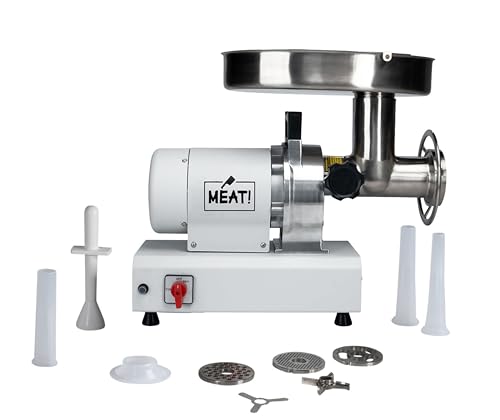
- MEAT! 1 HP Pro-Grade Meat Grinder #22 — Best for Heavy Batches: check price on Amazon
- Weston #12 Electric Meat Grinder & Sausage Stuffer, 750W — Best for Most Homes: check price on Amazon
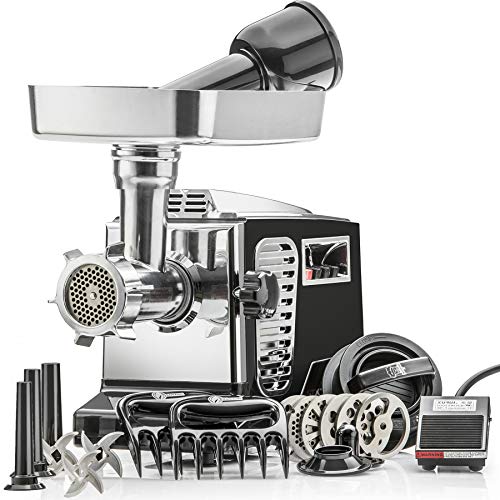
- STX International Turboforce 3000 Series 6-in-1 Electric Meat Grinder — Best Value and Accessories: check price on Amazon
- Sunmile SM-G50 ETL Electric Meat Grinder — Best Budget: check price on Amazon
- KitchenAid KSMMGA Metal Food Grinder Attachment — Best for Stand Mixer Owners: check price on Amazon
The best electric meat grinders turn the most supermarket-dependent part of cooking — ground meat — into something you control: the cut, the fat ratio, the freshness, the grind. Once you have ground your own chuck for burgers or your own pork shoulder for sausage, the plastic tray at the store loses its appeal permanently. This guide covers the full realistic field, from a 1 HP #22 workhorse that eats a hunting season’s harvest to a stand-mixer attachment that grinds a Saturday’s worth of meatballs.
Grinder shopping is confusing because the category mixes three different machines under one name. There are dedicated countertop grinders sized by head number (#8, #12, #22 — bigger number, bigger throat, plates and throughput). There are value multi-function units that grind, stuff and juice with a mountain of accessories. And there are attachments that borrow a stand mixer’s motor. Each type is the right answer for somebody, and the reviews below are organized around who that somebody is.
Every model here was matched against Amazon’s catalog data through our verification process before any link was attached. Motor figures, head sizes and included accessories quoted in the spec boxes come from the verified listings. Where a maker states a throughput figure in its own listing title, we attribute it to the maker — treat all such numbers as best-case claims with cubed, near-frozen meat, because that is what they are.
In this guide
Quick Picks
Six grinders, three machine types, one right answer for your kitchen — here is the short version before the deep reviews. Read the badges as batch-size labels: they tell you how much meat each machine wants to eat per session, which is the truest predictor of whether you will love it or list it for sale by spring.
Best Overall — LEM BigBite Dual Grind #22 Meat Grinder, 1.0 HP. a 1 HP #22 stainless grinder whose dual-grind head passes meat through two plates in one run — the fastest route to a finished grind — check price on Amazon via the product link.
Best for Heavy Batches — MEAT! 1 HP Pro-Grade Meat Grinder #22. another 1 HP #22 in stainless, with coarse and fine plates included — the traditional two-pass route done at full scale — check price on Amazon via the product link.
Best for Most Homes — Weston #12 Electric Meat Grinder & Sausage Stuffer, 750W. the #12 sweet spot: 750W/1 HP-class power, stainless plates and a maker’s rating of 4 lbs per minute, in a size normal kitchens can store — check price on Amazon via the product link.
Best Value and Accessories — STX International Turboforce 3000 Series 6-in-1 Electric Meat Grinder. the accessory avalanche: five grinding dies, three blades, stuffer, kubbe kit and a juicer in one value-priced box — check price on Amazon via the product link.
Best Budget — Sunmile SM-G50 ETL Electric Meat Grinder. the long-running budget benchmark: metal gears, reverse, a circuit breaker and stainless blade and plates where it counts — check price on Amazon via the product link.
Best for Stand Mixer Owners — KitchenAid KSMMGA Metal Food Grinder Attachment. a metal grinder head that borrows your stand mixer’s motor — tray, pusher, plates and stuffer tubes included — check price on Amazon via the product link.
How These Picks Were Chosen
We screened on the four things that decide grinder ownership. Head size and motor first: the pairing determines how fast meat moves and how large a cube the throat accepts, which decides whether grinding is a pleasure or a wrestling match. Metal gearing second: under load, gearboxes are where cheap grinders die, so we favored models whose listings and maker reputations support metal drive components. Plate and knife quality third, because a dull knife smears fat instead of cutting it, and smeared fat is what makes homemade ground meat taste like paste. Cleaning practicality fourth — every grinder is a pile of parts at the sink, and designs differ enormously in how much they fight you there.
The six picks divide by household type. Two are #22-class machines for hunters, homesteaders and batch cooks. One is the #12 sweet spot for most homes. One is the value accessory king. One is the honest budget grinder. And one is the attachment that makes sense only — but genuinely — if a stand mixer already lives on your counter. Each badge names its household, and the badge is consistent across Quick Picks, review headings and the comparison table.
We left hand-crank grinders and commercial deli units out of this guide entirely: the first belongs to off-grid and backup-kitchen conversations, the second to restaurant supply. Everything here plugs into a home kitchen outlet and stores in a home kitchen cabinet or pantry.
The 6 Best Electric Meat Grinders, Reviewed
Each review follows the same pattern: who the grinder suits, three strengths, three honest trade-offs, a spec box with verified listing details, a deeper analysis, and a bold verdict. Throughput figures, where mentioned, are the maker’s own listing claims — your mileage with warm, sinewy meat will be lower, and the guide sections explain how to get closest to the claims.

LEM BigBite Dual Grind #22 Meat Grinder, 1.0 HP — Best Overall
LEM built its name supplying hunters and homesteaders, and the BigBite #22 is the machine that reputation rests on: a 1.0 HP motor driving a #22 head in stainless steel, with the BigBite auger design that pulls meat in aggressively instead of waiting for you to push. The Dual Grind version adds a two-plate head that performs the coarse and fine grind in a single pass — traditionally a two-pass, chill-the-meat-in-between job.
It suits anyone who grinds in volume: deer season, whole-hog sausage days, the household that buys primals and breaks them down. If your grinding sessions are measured in tens of pounds, this is the class of machine that respects your time, and this is the best-executed example of it we can point to.
Strengths
- 1.0 HP motor and #22 head: the largest, fastest platform in this roundup, built for batch work
- Dual Grind head completes two grind stages in one pass, halving the handling on big sessions
- LEM’s parts and accessory ecosystem — plates, knives, stuffing tubes, replacement parts — is the deepest in home grinding
Trade-offs
- Size and weight: this is a store-it-where-it-lives machine, not a tuck-it-in-a-drawer appliance
- Premium tier positioning; casual once-a-month grinders will not use what they pay for
- A #22 head’s parts are correspondingly large at the sink — cleanup is easy but not small
| Specification | Detail |
|---|---|
| Head size | #22 |
| Motor | 1.0 HP |
| Construction | Stainless steel |
| Special feature | Dual Grind two-plate head; BigBite auger |
The dual-grind head is the feature to understand, because it changes the workflow, not just the spec sheet. A classic fine grind runs meat through a coarse plate, chills it, then runs it again through a fine plate — and the chilling matters, because warm fat smears. Passing through both plates in one run keeps the meat cold, keeps your hands out of the process, and produces a grind texture that holds together in sausage and burgers noticeably better than a rushed double pass.
The BigBite auger is the other half of the experience: it bites cubes and pulls them down, so the pusher becomes a guide rather than a ram. On sinewy wild game — the meat that stalls lesser grinders — that pull is the difference between a session and an ordeal. LEM’s stainless construction and the availability of every wear part (knives and plates are consumables on any grinder) make this a decade-scale purchase.
Who should not buy it: anyone grinding two pounds of chuck twice a month. The Weston #12 below will make you happier and leave money for the meat itself. The LEM is for volume, and it is honest about it.
Best for: hunters, homesteaders and batch cooks grinding tens of pounds per session / Not suited for: small kitchens or occasional two-pound grinding jobs
Check on Amazon — check the current price on Amazon before you buy, because listings, bundles and included accessories change over time.
MEAT! 1 HP Pro-Grade Meat Grinder #22 — Best for Heavy Batches
MEAT! is the newer challenger brand in serious home processing, and its 1 HP #22 makes a straightforward case: the same big-head, big-motor formula as the LEM, in stainless steel, with coarse and fine plates included for the classic two-pass workflow. Where the LEM innovates with its dual-grind head, the MEAT! competes on straightforward pro-grade execution.
It suits the same volume cook — hunter, homesteader, sausage maker — who prefers the traditional two-pass method (many sausage makers do, for texture control between passes) or who finds the MEAT! bundle and support offering more to their taste. Having two credible #22 machines in the category is good for buyers; this is the other one.
Strengths
- Full 1 HP motor and #22 head: batch-class throughput with big, forgiving throat capacity
- Coarse and fine plates included, covering burgers through sausage in the classic two-pass method
- Stainless construction suited to the wet, heavy reality of processing days
Trade-offs
- Two-pass grinding for fine textures means chilling between passes — plan the session accordingly
- A younger brand than LEM; its long-term parts ecosystem is still being proven
- Same storage reality as any #22: it needs a permanent home in the kitchen or pantry
| Specification | Detail |
|---|---|
| Head size | #22 |
| Motor | 1 HP |
| Construction | Stainless steel |
| Included plates | Coarse and fine grinding plates |
The choice between this and the LEM is a genuine fork, not a ranking failure. Two-pass grinding lets you inspect and re-chill the meat, adjust fat distribution, and season between passes if your sausage method calls for it — many traditional recipes do exactly that. The MEAT! supports that craft workflow at full #22 scale, and its included plate pair means the box opens ready for both burger-coarse and sausage-fine work.
Execution details are what to scrutinize on any #22: the fit of plate to knife (a gap smears fat), the auger’s pull on the first cube, and how the head disassembles at a sink full of meat fat. MEAT! has built its reputation quickly among processing enthusiasts by getting those details right and standing behind the machines; the brand’s community presence among hunters is a real, if informal, support asset.
Buy the LEM for the dual-grind shortcut and the deepest parts catalog; buy the MEAT! for the traditional workflow at the same scale. Either way, you are buying the last grinder class most households ever need.
Best for: volume processors who prefer traditional two-pass texture control / Not suited for: anyone wanting single-pass convenience or with limited storage
Check on Amazon — check the current price on Amazon before you buy, because listings, bundles and included accessories change over time.

Weston #12 Electric Meat Grinder & Sausage Stuffer, 750W — Best for Most Homes
If the #22 machines are the category’s trucks, the Weston #12 is its well-built sedan — and for most households, the sedan is the right vehicle. A 750-watt motor (1 HP class), a #12 head that accepts generous cubes, stainless steel grinding plates, and sausage-stuffing kit in the box, in a die-cast aluminum body that one person can lift onto the counter without a plan.
Weston rates it at 4 pounds per minute in its own listing; with properly chilled, cubed meat, home users find it brisk without being frantic. It suits the household that grinds weekly-to-monthly: burger blends, meatballs, pet food, a few pounds of sausage at a time — the real center of home grinding.
Strengths
- The #12 format balances throughput and storability better than any other size for home use
- Stainless steel grinding plates included — the wear parts are the good material from day one
- Weston’s long presence in home processing means plates, knives and support are easy to source
Trade-offs
- Die-cast aluminum body rather than full stainless — lighter and cheaper, less of a heirloom
- Batch hunters will outgrow it: a whole deer is a long session on a #12
- Like all grinders, the maker’s per-minute rating assumes ideal meat prep; sinew and warmth slow it down
| Specification | Detail |
|---|---|
| Head size | #12 |
| Motor | 750 watt (1 HP class) |
| Maker-stated rate | 4 lbs per minute |
| Body | Die-cast aluminum |
| Included | Stainless steel grinding plates; sausage stuffer kit |
The #12 head is the unsung hero specification of home grinding. Its throat takes the 1-inch cubes most recipes call for without extra trimming, its plates are big enough to move meat at a satisfying pace, and the whole machine still fits in a base cabinet. Most ‘my grinder is slow’ complaints come from #8 machines fed family-sized ambitions; most ‘my grinder is a hassle’ complaints come from #22 machines in small kitchens. The #12 is where both complaints go quiet.
Weston’s execution is sensible throughout: stainless where wear happens (plates), aluminum where weight matters (body), and a stuffing kit that turns the same machine into a sausage stuffer for the household’s first experiments. The accessory and replacement pipeline behind the brand is the quiet long-term value — a grinder is a 10-year purchase, and plates and knives are its tires.
For the household grinding up to about ten pounds at a time, this is the recommendation we would defend in any kitchen. Above that volume, step up to the #22 picks with our blessing.
Best for: most households grinding burgers, meatballs and small sausage batches regularly / Not suited for: hunters processing whole animals in single sessions
Check on Amazon — check the current price on Amazon before you buy, because listings, bundles and included accessories change over time.

STX International Turboforce 3000 Series 6-in-1 Electric Meat Grinder — Best Value and Accessories
The STX Turboforce 3000 approaches grinding from the opposite direction to the #22 machines: instead of one thing done massively, it does many things generously. The verified listing reads like an inventory — 6-in-1 functions, five grinding dies, three stainless blades, three speeds, sausage stuffer, kubbe maker and a juicer attachment — at a value tier that undercuts the dedicated machines.
A necessary honesty note on the motor: the ‘3000W’ in the name is a maximum/locked-rotor figure, the marketing convention of this segment; working power in normal grinding is a fraction of it, as with all grinders rated this way. Judge the STX on its throughput in real kitchens — which owners report as perfectly adequate for home batches — not on the badge number. It suits experimenters: the household that wants to try grinding, stuffing, kubbe and juicing before committing to dedicated machines.
Strengths
- Five grinding dies and three stainless blades included — texture range the dedicated machines charge extra to match
- Sausage stuffer, kubbe kit and juicer in the box: the fullest experiment kit in home grinding
- Three speeds give control that single-speed budget grinders lack, especially for stuffing
Trade-offs
- The 3000W nameplate is a max figure, not working power — set expectations by batch size, not by the number
- Accessory-rich means parts-rich at the sink; cleanup involves more pieces than a dedicated grinder
- Not built for hunting-season volume; it is a home-batch machine and happiest as one
| Specification | Detail |
|---|---|
| Functions | 6-in-1: grind, stuff, kubbe, juice and more |
| Included dies | 5 grinding dies |
| Blades | 3 stainless steel blades |
| Speeds | 3 |
| Nameplate | 3000W max (maker’s figure) |
The STX’s real product is optionality. Most households do not know, before they start, whether grinding will become a weekly ritual or a twice-a-year project — and the STX lets them find out with every texture and function available from the first weekend. Five dies is not a gimmick: the jump between a coarse burger grind, a fine sausage grind and a kubbe shell mixture is exactly the range home charcuterie explores.
Its limits are equally clear. The platform is a home-batch design; feed it cubed, well-chilled meat in sensible sessions and it rewards you, but it is not the tool for a freezer-filling harvest weekend. Parts are plentiful but lighter than the #22 machines’, and the sheer accessory count means a drawer or bin must be dedicated to keeping the kit together.
As a first grinder for the curious, and as a second machine for stuffing and specialty work in a keen kitchen, the value case is strong. Judge it as a versatile home appliance, not a processing plant, and it will not disappoint.
Best for: experimenters and first-time grinders who want every function in one box / Not suited for: high-volume processing or anyone who hates washing accessory piles
Check on Amazon — check the current price on Amazon before you buy, because listings, bundles and included accessories change over time.

Sunmile SM-G50 ETL Electric Meat Grinder — Best Budget
The Sunmile SM-G50 has been the budget recommendation in home grinding for years, and the verified listing shows why the formula works: metal gears (the component cheap grinders fake), a reverse function for clearing jams, a circuit breaker protecting the motor, and stainless steel for the cutting blade and plates — the parts that touch meat and determine grind quality.
The ‘Max 1.3 HP / 1000W’ in its name follows the same max-rating convention as the STX; the working reality is a capable home-batch grinder. It suits the budget buyer who grinds a few pounds at a time — burger nights, meatball batches, pet food — and wants the machine’s important bones to be metal even at a budget tier.
Strengths
- Metal gears and a circuit breaker: the two durability features that separate real budget grinders from toys
- Reverse function clears the inevitable sinew jam without disassembly
- Stainless cutting blade and plates keep grind quality honest at a budget tier
Trade-offs
- Home-batch capacity: long, heavy sessions will test its duty cycle — work in batches with rests
- Max-power naming, as across this segment, overstates working power; judge by batch behavior
- Accessory set is minimal next to the STX — it is a grinder first, not a 6-in-1
| Specification | Detail |
|---|---|
| Gearing | Metal gears |
| Features | Reverse; circuit breaker |
| Cutting parts | Stainless steel blade and plates |
| Certification | ETL, per listing |
| Nameplate | Max 1.3 HP / 1000W (maker’s max figure) |
Budget grinding is a minefield of plastic gears and heroic wattage claims, and the SM-G50’s longevity in the market comes from refusing the worst of both. Metal gears survive the shock loads that strip plastic ones the first time a piece of gristle hits the knife; the circuit breaker turns an overload from a burnt motor into a pause. These are unglamorous specifications that decide whether a budget grinder is a purchase or a rental from the landfill.
In use, it asks what all small grinders ask: cold meat, sensible cubes, a steady feed. Meet those terms and the grind quality from its stainless plate-and-knife set is genuinely good — clean-cut particles rather than smeared paste, which is the whole sensory difference between homemade and store-bought ground meat.
Buy it as the honest entry point. If grinding becomes a passion, it retires gracefully to backup and stuffing duty when a #12 or #22 arrives; many owners report it simply never gives them a reason to replace it.
Best for: budget buyers grinding small batches who still want metal where it matters / Not suited for: batch processors or accessory collectors
Check on Amazon — check the current price on Amazon before you buy, because listings, bundles and included accessories change over time.
KitchenAid KSMMGA Metal Food Grinder Attachment — Best for Stand Mixer Owners
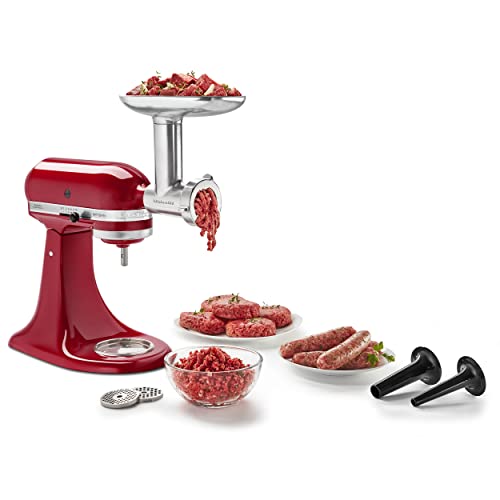
The KSMMGA makes an argument no standalone grinder can: you already own the motor. This metal food grinder attachment locks into the hub of any KitchenAid stand mixer and adds a food tray, pusher, grinding plates and sausage stuffer tubes, turning the counter’s resident appliance into a grinder that stores in a fraction of a standalone’s space.
It suits mixer owners who grind occasionally — a few pounds for burgers, a holiday sausage experiment — and who value cabinet space over session speed. If your mixer lives on the counter, the attachment is always thirty seconds from working; if you do not own the mixer, this pick does not exist for you, and the Weston above is your answer.
Strengths
- Metal construction — the upgrade over KitchenAid’s older plastic grinder that owners specifically seek out
- Zero additional motor to store: the attachment alone is compact, and the mixer does the work
- Tray, pusher, plates and stuffer tubes included, covering grinding and basic stuffing from one box
Trade-offs
- Throughput is mixer-paced: small batches shine, big sessions become a marathon for both machine and owner
- The grind height is the mixer’s hub height — filling and feeding ergonomics differ from a countertop grinder
- Completely dependent on owning a compatible KitchenAid stand mixer
| Specification | Detail |
|---|---|
| Type | Attachment for all KitchenAid stand mixers |
| Construction | Metal grinder body |
| Included | Food tray, pusher, grinding plates, sausage stuffer tubes and plate |
The attachment’s economics are unbeatable in one specific kitchen: the one where a stand mixer already sits out, used weekly. There, the marginal cost of grinding capability is the attachment alone, the storage cost is a shoebox, and the performance — driven by a serious mixer motor through a metal head — is honestly good for the batch sizes those kitchens produce. The metal body matters: it chills well (a cold head grinds cleaner), cleans easily, and lacks the flex of the plastic predecessor.
Its ceiling is equally specific. Mixer hubs are not designed for hour-long grinding sessions, the feed tray is sized for pounds rather than tens of pounds, and tying up the mixer means the mixer is not mixing. Households discovering a real grinding habit graduate from this attachment to a Weston or LEM — and typically describe the KSMMGA fondly as the gateway.
As a gift for a KitchenAid owner, it is one of the safest picks in this entire guide: useful, compact, and exactly matched to an appliance you know they own.
Best for: KitchenAid owners who grind small batches and value storage space / Not suited for: non-mixer households or anyone grinding in volume
Check on Amazon — check the current price on Amazon before you buy, because listings, bundles and included accessories change over time.
Comparison Table
Head size and machine type decide this category, so the table compares those first, with the honest note that maker throughput claims assume ideal prep. All specifications are from the verified listings. If two rows look similar, the deciding factors are usually the ones the table cannot show: how the head feels at the sink after a session, and how easily the maker sells you a replacement knife in year four.
| Pick | Badge | Key spec | Best for |
|---|---|---|---|
| LEM BigBite Dual Grind #22 Meat Grinder, 1.0 HP | Best Overall | #22 head, 1.0 HP, dual-grind stainless | hunters, homesteaders and batch cooks grinding tens of pounds per session |
| MEAT! 1 HP Pro-Grade Meat Grinder #22 | Best for Heavy Batches | #22 head, 1 HP, coarse + fine plates | volume processors who prefer traditional two-pass texture control |
| Weston #12 Electric Meat Grinder & Sausage Stuffer, 750W | Best for Most Homes | #12 head, 750W, stainless plates | most households grinding burgers, meatballs and small sausage batches regularly |
| STX International Turboforce 3000 Series 6-in-1 Electric Meat Grinder | Best Value and Accessories | 6-in-1, 5 dies, 3 speeds, stuffer + kubbe + juicer | experimenters and first-time grinders who want every function in one box |
| Sunmile SM-G50 ETL Electric Meat Grinder | Best Budget | Metal gears, reverse, stainless blade/plates | budget buyers grinding small batches who still want metal where it matters |
| KitchenAid KSMMGA Metal Food Grinder Attachment | Best for Stand Mixer Owners | Metal attachment, fits all KitchenAid mixers | KitchenAid owners who grind small batches and value storage space |
How to Choose an Electric Meat Grinder
Start with your honest batch size, because it selects the head size, and head size selects everything else. A few pounds at a time, monthly: a budget #8-class machine or the mixer attachment serves you. Up to ten pounds regularly: the #12 is your format. Tens of pounds, hunting harvests, whole animals: #22, no debate. Buyers most often err by purchasing one class too small (slow, frustrating, quickly replaced) rather than one too large.
Next, interrogate the drive train. Metal gears, a circuit breaker and a reverse function are the three specifications that predict a grinder’s lifespan and temperament. Plastic-geared grinders are cheap until the first gristle jam; reverse turns that jam into a two-second fix instead of a disassembly. Makers who specify metal gearing in their listings — as Sunmile and the dedicated brands do — are telling you where their money went; makers who headline only a wattage number are telling you the same thing, in the other direction.
Finally, price the ecosystem, not the machine. Plates and knives dull and are replaced; stuffing tubes, kubbe kits and specialty plates are bought over years. A grinder from a maker with a deep, available parts catalog (LEM, Weston, KitchenAid) costs less to own than an orphan with a cheaper sticker. Check the listing for what is included — plates especially — because a second plate set can erase a budget machine’s price advantage.
Grinder head sizes explained: #8, #12, #22
The number describes the diameter class of the grinding plate and throat. A #8 head takes small cubes and suits 1–3 pound batches. A #12 takes honest 1-inch cubes and moves family batches at a satisfying pace — the home sweet spot. A #22 takes larger cubes, moves meat roughly twice as fast again, and its parts are sized for processing days. Bigger heads also mean bigger parts at the sink and a bigger box in the cabinet; the number is a commitment in both directions.
Plate hole sizes matter as much as head size. Coarse plates (around 10mm) make chili grind and first passes; medium (around 6–7mm) is the burger and sausage workhorse; fine (around 4.5mm and below) makes smooth sausage and emulsified products. A grinder with two plates covers most kitchens; the STX’s five-die set covers the curious kitchen completely.
Wattage claims, translated
This category’s wattage numbers need a translator. Figures like ‘3000W max’ or ‘Max 1.3 HP’ describe locked-rotor or peak draw — the motor’s theoretical maximum at stall — not the power used while grinding, which is far lower. Honest comparisons use head size, gear material and observed batch behavior instead. As a rule: a #12 with metal gears and a few hundred working watts out-grinds a mystery machine advertising thousands, every weekend of the year. The picks in this guide were chosen on construction, and their listings’ max figures are labeled as such wherever they appear.
Grinding Meat Well: The Rules That Matter More Than the Machine
Cold is the first rule, and it is not close. Meat and fat should be near freezing — firm, frosty cubes — and the grinder’s head, plate and knife benefit from a turn in the freezer too. Warm fat smears instead of cutting, and smeared fat is the difference between juicy, distinct grind and dense paste. Every disappointing homemade grind you have ever tasted was probably a temperature failure wearing a machine’s blame.
Cut is the second rule: cubes sized to the throat (about 1 inch for #12, smaller for #8), with the worst sinew trimmed — grinders handle gristle poorly and knives dull on it. Third: feed steadily and let the auger work; forcing the pusher compacts meat and heats the head. Fourth: for fine grinds, chill between passes. A mid-tier grinder obeying these rules produces better meat than a #22 breaking all of them, which is why this guide spends as many words on method as on machines.
Fat ratio is the creative rule, and it is the reason many people buy a grinder at all. Burgers want roughly 80/20 lean-to-fat for juiciness; sausage making is a world of its own ratios by style; lean game benefits from added pork fat to stay moist. Store-bought ground meat fixes these decisions for you, opaquely. Your grinder hands them back — which means the guide’s last piece of advice is to keep notes. The blend you loved in October is only repeatable if October’s ratio, cut and plate size are written down somewhere more reliable than memory.
How to Grind Meat at Home, Step by Step
This sequence works for every machine in this guide, from the mixer attachment to the #22s. Follow it and the grinder you own will perform at its best.
- Cube the meat to throat size (about 1 inch for #12 heads, smaller for #8, larger for #22) and trim the heaviest sinew and silverskin.
- Spread the cubes on a tray and freeze 30–45 minutes, until firm and frosty at the edges but not rock solid; put the grinder head, plate and knife in the freezer too.
- Assemble the cold head with the plate your recipe needs — coarse for a first pass or chili grind, medium for burgers and sausage.
- Grind into a cold bowl set over ice for big batches, feeding steadily and letting the auger pull; use the pusher as a guide, never a ram.
- For a finer grind, re-chill the ground meat until firm, then pass it through the finer plate (or use a dual-grind head in a single pass).
- Season and mix only after grinding, working quickly and keeping the meat cold; for sausage, mix until the texture turns tacky and strands pull — that is the bind forming.
- Disassemble and wash parts promptly in hot soapy water, dry them completely, and store knives and plates lightly oiled or wrapped — they are the grinder’s edge, literally.
Safety notes that are not optional: keep fingers out of the throat — the pusher exists because augers do not negotiate — unplug before clearing any jam the reverse function cannot shift, and treat ground meat with the food-safety respect it demands: cold chain, clean surfaces, and prompt cooking or freezing.
Common Buying Mistakes
Mistake 1: Grinding warm meat. Warm fat smears, the grind turns to paste, and the machine takes the blame. Freeze the cubes and the head; it is the cheapest quality upgrade in the entire category.
Mistake 2: Buying by wattage headline. Max and locked-rotor watts are marketing numbers. Head size, metal gears and plate quality decide real performance — compare those instead.
Mistake 3: Undersizing the head. A #8 fed family ambitions is slow torture that ends in a second purchase. Match the head to your true batch size, with one size of headroom.
Mistake 4: Forcing the pusher. Ramming meat compacts it, heats the head and strains the gears. Steady feeding lets the auger do the work it was designed for.
Mistake 5: Skipping the re-chill between passes. The second pass on warm meat smears what the first pass cut cleanly. Thirty minutes in the freezer is the difference between sausage and spread.
Mistake 6: Neglecting knives and plates. Dull knives are the silent killer of grind quality. Replace or sharpen the knife-and-plate pair together, and never let them rattle loose in a drawer.
Final Recommendation
For most households, the Weston #12 is the grinder to buy: right-sized, honestly built, with stainless plates and a maker behind it. It will handle the real center of home grinding — burgers, meatballs, sausage experiments — for years without drama.
Step up to the LEM BigBite #22 if your sessions run to tens of pounds, or to the MEAT! #22 if you prefer the traditional two-pass craft at the same scale. Choose the STX if you want to experiment with everything at once, the Sunmile SM-G50 if the budget is firm and the batches are small, and the KitchenAid attachment if a mixer already owns your counter. Whichever you choose, keep the meat cold and check price on Amazon at the listing, because included plate sets — the detail that most affects first-month happiness — change between bundles.
Short on time? Start with these three:
- LEM BigBite Dual Grind #22 Meat Grinder, 1.0 HP — Best Overall
- MEAT! 1 HP Pro-Grade Meat Grinder #22 — Best for Heavy Batches
- Weston #12 Electric Meat Grinder & Sausage Stuffer, 750W — Best for Most Homes
Keep researching within this guide cluster: Best 1hp Meat Grinders Best Affordable Meat Grinders Best American Meat Grinders Best Electric Meat Grinders For Home Use Best Choice Meat Grinders
Frequently Asked Questions
What size meat grinder do I need for home use?
For most homes, a #12 head is the sweet spot: it takes 1-inch cubes, moves family-sized batches briskly, and still stores in a cabinet. Choose #8-class machines or the mixer attachment for small, occasional batches, and #22 machines when sessions regularly exceed ten pounds or involve game processing.
Is a meat grinder attachment as good as a standalone grinder?
For small batches, the metal KitchenAid attachment is genuinely good — a serious motor and a metal head produce clean grinds. Standalones win on throughput, feed ergonomics and session length. The attachment is the right buy for mixer owners grinding a few pounds at a time; it is the wrong buy as a plan for hunting season.
Why does my ground meat come out mushy?
Almost always temperature. Meat and fat must be near freezing and the head parts cold, or the fat smears instead of cutting into distinct particles. Contributing causes: a dull knife, forcing the pusher, and skipping the re-chill between passes. Fix the cold chain first — it resolves the great majority of texture complaints.
Can I grind bones in an electric meat grinder?
Soft, small bones (like chicken frames for pet food) are within some grinders’ ability, but hard bones — beef, pork leg, frozen solid bone — will damage plates, knives and gears on home machines, including the strong ones in this guide. Check the maker’s guidance for your model, and treat anything beyond soft poultry bone as a job for commercial equipment.
How often do grinder knives and plates need replacing?
With home use, a knife-and-plate pair lasts years; they dull gradually, announcing themselves through slower grinding and smeared texture. Replace or professionally sharpen them as a matched pair — a new knife on a worn plate still smears. Keeping them dry and lightly protected in storage doubles their life.
Is grinding your own meat cheaper than buying ground meat?
It can be, when you grind whole cuts bought on sale — chuck, pork shoulder — rather than paying the ground-meat premium, and it reliably wins on quality and control: you choose the cut, the fat ratio and the freshness. The machine pays for itself fastest in households that grind weekly or process their own game; occasional grinders should count freshness and control, not just savings, as the return.