Disclosure: airfryerkitchensupply.com is reader-supported. When you buy through links on our site, we may earn an affiliate commission at no extra cost to you.
Where to buy
Every grinder in this roundup was verified against Amazon’s catalog before it earned a place here, and the links below go straight to the exact model reviewed. Prices move with seasons and hunting-season demand, so check the current price on Amazon before you decide.
- LEM BigBite Dual Grind #22 (1.0 HP) — Check on Amazon
- MEAT! 1 HP Pro-Grade Grinder #22 — Check on Amazon
- MEAT! 1 HP Pro-Grade Dual Grinder #22 — Check on Amazon
- Valley Sportsman Commercial Grinder 1.0 HP #22 — Check on Amazon
- VEVOR Meat Grinder #12 (750W / 1 HP motor) — Check on Amazon
- Weston #12 Electric Meat Grinder & Sausage Stuffer (750 watt) — Check on Amazon
Introduction
If you are shopping for the best 1hp meat grinders, you are probably done with underpowered countertop machines that bog down halfway through a deer, smear fat instead of cutting it, and turn a Saturday processing session into an all-weekend chore. A true 1 horsepower grinder is the point where home processing stops feeling like a compromise: the motor has enough sustained torque to pull cold, partially frozen meat through a coarse plate without constant pushing, the throat is wide enough to accept big chunks, and a full animal becomes an hour of steady work instead of an afternoon of stops and starts.
There is a catch, and it is the single most important thing to understand before you buy: “1 HP” does not mean the same thing on every box. Serious processing brands — LEM, MEAT!, Weston Pro — rate their motors in continuous horsepower, the output the motor can sustain all day. Budget brands often print a peak wattage figure that converts to a flattering horsepower number the motor can only touch for a moment before a thermal cutout steps in. Both kinds of machine appear in this guide, and we label which is which, because a continuous-rated #22 grinder and a peak-rated #12 grinder behave very differently when 40 pounds of venison trim hits the tray.
Below you will find six verified 1 HP-class grinders, from dual-grind #22 workhorses built for hunters who process several animals a season, to an honest budget option for people who want the 1 HP label without the commercial price tier. Every pick was checked against Amazon’s own catalog data, and where a well-known 1 HP model is not actually sold on Amazon, we say so rather than inventing a link.
In this guide
Quick Picks
- LEM BigBite Dual Grind #22 — Best Overall. A 1.0 HP stainless #22 that grinds twice in one pass, so burger comes out finished in a single run. Check the current price on Amazon
- MEAT! 1 HP Pro-Grade Grinder #22 — Best for Hunters. A straightforward, powerful #22 with coarse and fine plates in the box and no gimmicks. Check the current price on Amazon
- MEAT! 1 HP Pro-Grade Dual Grinder #22 — Best for Sausage Makers. Dual-grind head plus stuffing gear for people whose grind goes straight into casings. Check the current price on Amazon
- Valley Sportsman Commercial Grinder 1.0 HP #22 — Best Commercial-Style Value. An ETL-approved #22 with a rated throughput aimed at farm and small-shop work. Check the current price on Amazon
- VEVOR Meat Grinder #12 — Best for Small Commercial Jobs. A 750W / 1 HP #12 with stuffing tubes and a kibbe kit, built for kitchens and restaurants. Check the current price on Amazon
- Weston #12 (33-1301-W) — Best Budget 1 HP. A 750 watt #12 whose maker rates the motor at 1 HP, in a die-cast aluminum body at a home-kitchen tier. Check the current price on Amazon
How These Picks Were Chosen
We started with a simple filter: the manufacturer itself must rate the machine at 1 horsepower, and the model must be verifiable in Amazon’s catalog, with a live listing and a title that matches the product on the maker’s own spec sheet. That filter quietly removes a lot of noise. Dozens of listings shout “3000W” or “1.3 HP max” in their titles; those are peak figures from small #8 or #12 home grinders, and while some of them are perfectly decent machines for five pounds of pork shoulder, they do not belong in a guide for people who specifically searched for 1 HP processing power.
From the verified shortlist we weighted four things. First, grinder head size: #22 heads dominate this class for a reason — the larger plate diameter and wider throat are what let a 1 HP motor actually express its torque. Second, motor honesty: continuous ratings from established processing brands scored above converted peak-watt claims. Third, the ownership picture — whether plates, knives and stuffing tubes are standard sizes you can replace in five years, and whether the brand sells parts at all. Fourth, the job the machine is really built for: a hunter grinding two deer and a hog each fall needs a different 1 HP grinder than a small café grinding lamb for kofta every morning.
One honest note: the Cabela’s Carnivore 1 HP is a legitimate member of this class and many hunters will ask about it, but it is sold through Bass Pro and Cabela’s channels rather than Amazon, so it appears here as a mention with no purchase link. If you already shop those stores, it belongs on your comparison list alongside the MEAT! and LEM #22 machines below.
The 6 Best 1HP Meat Grinders

1. LEM BigBite Dual Grind #22 — Best Overall
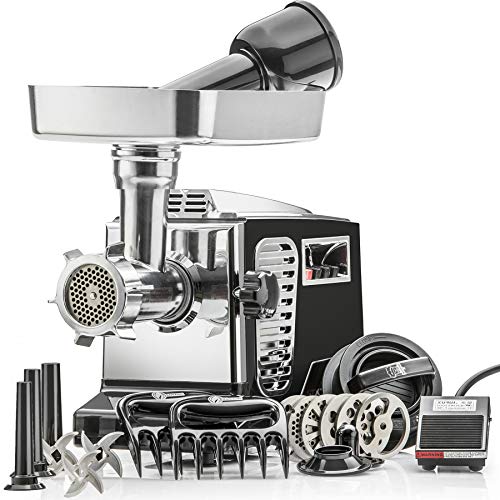
The BigBite Dual Grind #22 is what happens when a processing brand decides the second pass is the problem and engineers it away. A conventional grinder pushes meat through one plate; for fine burger or sausage grind, you chill everything, swap plates or re-feed the coarse grind, and lose twenty minutes and some texture to warming fat. This LEM runs the meat through two grinding stages in a single pass, so it comes out at a finished texture while it is still properly cold. For anyone who makes burger blends or fresh sausage in real volume, that is not a luxury feature — it is the difference between grind day being a task and being an ordeal.
Strengths
- True continuous 1.0 HP motor driving a full-size #22 stainless head — the torque is sustained, not a peak claim.
- Dual-grind design produces a finished fine grind in one pass, keeping meat colder and texture cleaner.
- LEM’s parts ecosystem is the deepest in home processing: plates, knives, tubes and accessories in standard #22 sizing, sold everywhere.
Trade-offs
- Premium tier pricing — it sits at the top of this roundup’s cost range, as flagship #22 machines do.
- Heavy and genuinely large; it wants a permanent home on a processing table, not a kitchen cabinet.
- Dual-grind head has more parts to wash than a single-stage head after a session.
| Spec snapshot (verified) | |
|---|---|
| Grinder size | #22 |
| Motor | 1.0 HP |
| Construction | Stainless steel |
| Grind style | Dual grind (two stages, one pass) |
The BigBite auger design deserves its own mention: LEM’s rifled head pulls meat into the knife with less reliance on the pusher, which matters most with the big, awkward chunks a #22 throat can swallow. In practice it means a steadier feed rate and fewer of the stop-and-prod moments that heat meat up. The stainless construction also matters for cleanup — a #22 head is a lot of metal to scrub, and stainless tolerates hot water and sanitizers without the seasoning rituals cast iron demands.
Who should skip it? If you grind ten pounds of chuck twice a year, this is three times the machine you need and it will mostly occupy space. But for hunters processing multiple animals, homesteaders doing whole-hog days, or raw feeders grinding weekly batches, it is the pick that ends the upgrade cycle.
Best for: high-volume home processors, hunters and sausage makers who grind weekly or process whole animals. / Not suited for: occasional small-batch grinding or tight storage.
2. MEAT! 1 HP Pro-Grade Grinder #22 — Best for Hunters
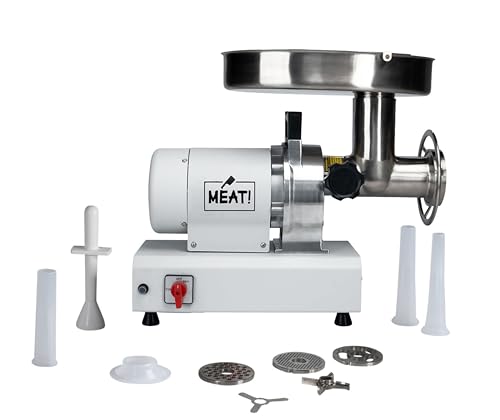
MEAT! built its name selling directly to the processing crowd, and the 1 HP Pro-Grade #22 is the brand in its purest form: a big stainless #22 head, a 1 HP motor, coarse and fine plates in the box, and nothing you have to decode. There is no app, no touchscreen, no marketing wattage — just a machine designed to turn deer, elk and hog trim into ground meat at a pace that respects your weekend.
Strengths
- Full #22 head with a genuine 1 HP motor — sized for whole-animal processing days.
- Coarse and fine grinding plates included, so it is ready for chili grind and burger grind out of the box.
- Stainless steel construction that cleans up fast and resists the corrosion processing gear lives with.
Trade-offs
- Single-pass grinding: fine textures mean a second run through the fine plate, the traditional way.
- Like every true #22, it is a substantial appliance to lift, store and wash.
- The accessory range is narrower than LEM’s — check tube and plate availability before you commit to specialty projects.
| Spec snapshot (verified) | |
|---|---|
| Grinder size | #22 |
| Motor | 1 HP |
| Construction | Stainless steel |
| Included plates | Coarse and fine grinding plates |
The honest appeal here is value inside the serious tier. The MEAT! undercuts the flagship dual-grind machines while giving up very little that matters on a processing day: the head size is the same, the motor class is the same, and the throughput difference only shows up if your workflow depends on one-pass fine grinding. For the classic hunter workflow — coarse grind everything, mix seasonings or fat, then a second pass through the fine plate — it gives up nothing at all.
It is also a sensible first serious grinder. The controls are a switch, the head assembles the way #22 heads have assembled for decades, and every wear part is a standard size. If your processing grows, plates and stuffing tubes are easy to add; if it doesn’t, the machine still holds its value in a way no-name grinders do not.
Best for: deer, elk and hog hunters who want a true #22 without flagship pricing. / Not suited for: buyers who specifically want one-pass dual grinding.

3. MEAT! 1 HP Pro-Grade Dual Grinder #22 — Best for Sausage Makers
If most of what you grind ends up in casings, the dual-grind version of MEAT!’s #22 deserves a hard look. Sausage is where texture is made or lost: the grind needs to be fine and even, the fat needs to stay cold and distinct, and every extra pass through a warm grinder smears fat into the lean and gives you a crumbly, dry finished sausage. A dual grinder takes meat from coarse to fine in one continuous run, and the emulsion-friendly texture that comes out is exactly what bratwurst, breakfast sausage and salami-style blends want.
Strengths
- Dual-grind #22 head delivers a finished fine grind in one pass — colder meat, cleaner fat particles, better sausage texture.
- 1 HP motor with the torque to keep the dual stage fed on big batches.
- Built for the stuffing workflow: grind and stuff in one session without re-chilling between passes.
Trade-offs
- Costs more than the single-stage MEAT! #22; the premium only pays off if you use the fine grind often.
- More head components to disassemble and wash after each session.
- If you mostly make coarse chili grind, the dual stage is capability you will rarely touch.
| Spec snapshot (verified) | |
|---|---|
| Grinder size | #22 |
| Motor | 1 HP |
| Construction | Stainless steel |
| Included plates | Coarse and fine grinding plates |
| Grind style | Dual grind (two stages, one pass) |
Think about your last sausage day honestly. The classic rhythm — grind coarse, chill, grind fine, chill, mix, stuff — eats an afternoon, and the chilling steps exist purely to undo the warming the grinding caused. Collapsing the two grinds into one pass removes the worst of that cycle. The meat spends less time in the danger zone, the fat stays as discrete particles, and the bind you get at mixing is noticeably better. For charcuterie-leaning home processors, that is worth real money.
The counter-argument is discipline: a dual head rewards organized work. You want your meat cubed, well chilled and staged before you start, because the machine will happily outrun a disorganized operator and leave you with a tray of finished grind and unmixed seasoning. That is a good problem to have.
Best for: sausage makers and charcuterie hobbyists who grind fine, often. / Not suited for: coarse-grind-only users or buyers on the tightest budget in this class.

4. Valley Sportsman Commercial Grinder 1.0 HP #22 — Best Commercial-Style Value
The Valley Sportsman is the industrial end of this roundup: a commercial-format #22 grinder with a 1.0 HP, 750W motor, an ETL approval, and a rated throughput of 550 pounds per hour. That number is a manufacturer rating under ideal conditions — cubed, chilled meat fed steadily — but even discounted generously, it signals what this machine is: a grinder built for farm processing, small shops, hunt clubs and community processing days where the line of coolers never seems to shrink.
Strengths
- Commercial #22 format with a rated 550 lbs/hr throughput for genuinely large sessions.
- ETL approved — relevant if the grinder will ever work in a shop, farm stand or inspected kitchen.
- Stainless steel construction and a sausage stuffer setup with two grinding plates included.
Trade-offs
- Commercial footprint and weight; it is equipment, not a kitchen appliance, and stores like it.
- The brand’s consumer parts and accessory network is thinner than LEM’s or Weston’s.
- Overkill in every dimension for a household grinding a few pounds at a time.
| Spec snapshot (verified) | |
|---|---|
| Grinder size | #22 |
| Motor | 1.0 HP / 750W |
| Rated throughput | 550 lbs/hr (manufacturer rating) |
| Certification | ETL approved |
| Included | Sausage stuffer, 2 grinding plates |
Where does a machine like this earn its keep? Think of the deer camp that processes six animals in a weekend, the small farm selling ground pork at a market, or the family that buys a whole steer and splits it with relatives. In those settings the bottleneck is never the freezer space — it is the grinding hour, and a #22 with commercial manners shortens it dramatically. The large tray and throat accept the kind of big, rough chunks that come off a primal breakdown without a second cubing pass.
The ownership caveat is real, though. Commercial-style imports live or die on whether you can get a replacement knife, plate or gear in year three. Before buying, confirm the plate size standard (#22 plates are widely shared) and keep the included plates as your spares baseline. If your use is serious but your setting is a home garage, the MEAT! or LEM above may be the safer long-term bet; if your use is semi-commercial, this is the value play in the class.
Best for: farm processing, hunt clubs and small shops grinding at commercial pace. / Not suited for: apartment kitchens or anyone who values a deep consumer parts network above throughput.

5. VEVOR Meat Grinder #12 — Best for Small Commercial Jobs
VEVOR’s #12 takes a different route to the 1 HP label: a 750W motor the maker rates at 1 HP, spinning a #12 head with a rated output of 552 pounds per hour. It ships with two plates, three stuffing tubes and a kibbe kit, and it carries an ETL listing — a combination aimed squarely at small restaurants, butcher counters, food trucks and serious home users who want commercial habits (all-metal drive, big tray, continuous duty manners) without stepping up to a #22.
Strengths
- 750W / 1 HP motor with a rated 552 lbs/h output — strong throughput for a #12 head.
- Complete starter kit: two plates, three stuffing tubes and a kibbe attachment included.
- ETL listed, which matters for any grinder that will work in a commercial kitchen.
Trade-offs
- #12 head: smaller throat and plates than the #22 machines above, so chunk size and peak pace are lower.
- Throughput figures are manufacturer ratings under ideal feed conditions — plan on less with warm or sinewy meat.
- VEVOR’s support model is marketplace-based; keep your documentation and expect self-service ownership.
| Spec snapshot (verified) | |
|---|---|
| Grinder size | #12 |
| Motor | 750W / 1 HP |
| Rated throughput | 552 lbs/h (manufacturer rating) |
| Certification | ETL listed |
| Included | 2 plates, 3 stuffing tubes, kibbe kit |
The use case writes itself: a small kitchen grinding lamb and beef daily for burgers, kofta or kibbeh, where the grinder runs twenty minutes every morning rather than six hours twice a year. The #12 head is actually an advantage there — plates and knives are cheap and everywhere, the machine fits a normal counter, and cleanup is a five-minute job instead of a production. The included kibbe kit and tube selection also make it the most ready-to-work package in this guide out of the box.
Just be clear-eyed about the ceiling. A #12 throat asks for smaller cubes, and long sessions of tough, sinewy trim will remind you this is the smallest head in the roundup. For home hunters doing one or two deer a year it is plenty; for a crew processing every weekend of the season, step up to a #22.
Best for: small restaurants, food trucks and home users wanting commercial habits in a #12 footprint. / Not suited for: whole-animal processing crews who need #22 throat capacity.

6. Weston #12 Electric Meat Grinder & Sausage Stuffer — Best Budget 1 HP
Weston’s 33-1301-W is the machine that proves the 1 HP conversation has two ends. Its 750 watt motor is rated by Weston at 1 HP, it drives a #12 head, and it is rated to grind 4 pounds per minute — respectable, honest numbers for a home grinder in a die-cast aluminum body. It is not built like the #22 stainless machines above, and it does not pretend to be: this is the pick for someone who wants a real brand, a real sausage stuffer and 1 HP-class performance for family-size batches, at the most accessible tier in this guide.
Strengths
- Weston rates the 750W motor at 1 HP, with a rated 4 lbs per minute grind pace suited to family batches.
- Stainless steel grinding plates and a proper sausage-stuffing function in one machine.
- Weston sells parts and accessories widely, so plates and tubes are easy to replace or add.
Trade-offs
- Die-cast aluminum body and #12 head: lighter duty than the stainless #22 machines in this roundup.
- The 1 HP figure is a motor rating on a smaller platform — sustained torque under heavy, warm loads will not match a #22.
- Not the choice for bone, heavy sinew or all-day processing sessions.
| Spec snapshot (verified) | |
|---|---|
| Grinder size | #12 |
| Motor | 750 watt, maker-rated 1 HP |
| Rated pace | 4 lbs per minute (manufacturer rating) |
| Body | Die-cast aluminum |
| Model | 33-1301-W |
Context is everything with this pick. If your grinding life is ten pounds of pork butt for breakfast sausage, a deer a year broken into burger and chili grind, and the occasional batch of chicken for homemade pet food, the Weston will do all of it without drama, and it will do it at a tier the #22 machines cannot touch. The stuffing function is genuinely useful at this scale — small batches of fresh sausage are exactly where a combination machine shines.
Where it will frustrate you is growth. Start processing for friends, add a second and third deer, or try to push partially frozen meat at #22 speed, and you will feel the difference in head size and body construction within one session. Buy it as the right-sized tool and it is a bargain; buy it as a cheap substitute for a #22 and it will feel like a false economy.
Best for: home users grinding family-size batches who want a trusted brand at the entry tier of this class. / Not suited for: high-volume or whole-season processing crews.
Comparison Table
| Pick | Badge | Key spec | Best for |
|---|---|---|---|
| LEM BigBite Dual Grind #22 | Best Overall | #22, 1.0 HP, dual grind, stainless | One-pass fine grinding at volume |
| MEAT! 1 HP Pro-Grade #22 | Best for Hunters | #22, 1 HP, coarse + fine plates | Whole-animal processing days |
| MEAT! 1 HP Dual Grinder #22 | Best for Sausage Makers | #22, 1 HP, dual grind | Sausage texture in a single pass |
| Valley Sportsman Commercial #22 | Best Commercial-Style Value | #22, 1.0 HP, rated 550 lbs/hr, ETL | Farm and small-shop throughput |
| VEVOR #12 | Best for Small Commercial Jobs | #12, 750W / 1 HP, ETL listed | Daily restaurant grinding |
| Weston #12 (33-1301-W) | Best Budget 1 HP | #12, 750W, rated 4 lbs/min | Family-size batches on a budget |
How to Choose a 1HP Meat Grinder
Start with the honest question: how many pounds, how often, and how cold? A 1 HP grinder earns its size when sessions run past 25–30 pounds or happen most weekends. Below that, you are buying capacity you will store more than use. Above that — a hunting family doing several deer, a homestead doing a hog and a steer, a raw-feeding household grinding weekly — the #22 class stops being a splurge and becomes the tool that makes the work sustainable.
Next, match head size to ambition. The number (#8, #12, #22, #32) describes the plate diameter family, and it governs everything: throat width, chunk size, plate cost and peak pace. In the 1 HP class, #22 is the sweet spot for home and semi-commercial work. #12 machines with 1 HP-rated motors (the VEVOR and Weston above) are fine tools, but the smaller throat means smaller cubes and a slower practical pace. #32 at this power level usually means stepping to 1.5 HP, which is a different budget conversation.
Then read the motor claim like a skeptic. “1 HP” from LEM or MEAT! is a continuous rating on a motor built to hold it. “1000W max” or “1.3 HP max” on a lightweight home grinder is a peak figure — the motor’s momentary ceiling, not its working output. A quick sanity check: a true 1 HP motor draws roughly 750 watts continuously, so a grinder whose entire power supply is a fraction of that cannot be delivering a sustained horsepower no matter what the box says. Neither kind of machine is a scam, but they are not the same product, and this guide separates them deliberately.
Finally, think about year three. Plates dull, knives chip, and stuffing tubes crack. The established processing brands sell every wear part individually and publish plate sizing, which turns a problem into a small order instead of a new grinder. If a listing cannot tell you the plate size standard it uses, treat that as your answer about long-term support.
Budget tiers in this class, in plain terms: the entry tier buys you a #12 machine with a 1 HP-rated motor and a light-duty body — fine for family batches. The mid tier is where honest #22 machines from the processing brands begin, and it is the tier most hunters should target. The premium tier buys dual-grind heads, all-stainless construction throughout, and the deepest parts support. What the tiers do not buy is magic: a premium grinder fed warm meat still smears, and an entry-tier grinder fed properly chilled meat still makes good burger. Spend first on head size and motor honesty, then on convenience features like dual grind — in that order — and the tier takes care of itself.
Grinder Head Size: Why #22 Rules This Class
The head size number is the least explained and most consequential spec on any grinder. A #22 plate is roughly 3.25 inches across; a #12 is about 2.75 inches; a #8 about 2.4 inches. That sounds like a small difference until you cube meat for each: the #22 throat takes rough 2-inch chunks that a #12 would choke on, and every extra cubing pass you skip is time and meat temperature saved. Throughput scales with plate area, which is why #22 machines are rated in hundreds of pounds per hour while #8 home grinders talk in pounds per minute.
There are costs. #22 heads are heavy castings, the machines around them weigh accordingly, and the plates and knives cost more than #12 equivalents. Storage is a real consideration — a #22 grinder is closer to a stand mixer in footprint than to a toaster. But at 1 HP, the motor has already made the commitment for you: pairing a continuous 1 HP motor with a small head wastes the torque you paid for. If your sessions are genuinely large, #22 is where this power class makes sense; if they are not, a good #12 or even #8 at a lower tier will serve you better than a strangled flagship.
How to Use a 1HP Meat Grinder: Setup, Grinding and Cleanup
Step 1 — Chill everything. Cube your meat into strips or chunks sized for the throat, spread them on sheet trays, and put them in the freezer until the edges are firm and the centers are cold — typically 30–45 minutes depending on thickness. Chill the head, auger, knife and plate too, assembled, in the freezer or fridge. Cold meat cuts; warm meat smears, and no motor size fixes smearing.
Step 2 — Assemble in order. Auger into the head, knife onto the auger shaft with the flat cutting face against the plate, plate seated on its locating pin, then the retaining ring snug — hand-tight plus a small fraction, never cranked down with a tool. A ring that is too loose lets the knife ride off the plate and shreds texture; too tight accelerates wear.
Step 3 — Stage your workflow. Meat on the left, a chilled receiving bowl or tub on the right, fat and seasoning pre-measured. With a 1 HP machine the grind will move faster than your hands at first — set up so you are never reaching across the machine or leaving it running empty while you hunt for a bowl.
Step 4 — Feed steadily, don’t force. Let the auger take each chunk; use the pusher to guide, not to ram. Ramming packs the throat, spikes the load and warms the meat. If the pace slows, the fix is colder meat or a sharper knife, not more pressure. Alternate lean and fat chunks so the mix distributes as it grinds.
Step 5 — For fine grinds, choose your path. Single-stage machines: run the coarse grind, re-chill briefly if it has warmed, swap to the fine plate and run again. Dual-grind machines: one pass does both stages — but the staging discipline in Step 3 matters even more, because there is no natural pause built into the process.
Step 6 — Stuff while it is cold. If sausage is the goal, mix seasonings and any liquid into the grind until it turns tacky and pulls in strands, then stuff promptly. A dedicated stuffer gives better control, but the stuffing tubes on these grinders handle fresh sausage batches perfectly well at home scale.
Step 7 — Clean immediately and dry completely. Disassemble, wash in hot soapy water, and dry every part fully before storage — trapped moisture is what dulls knives and spots plates. A light wipe of food-grade mineral oil on carbon-steel knives and plates prevents rust between sessions. Never run the head through a dishwasher unless the maker explicitly allows it, and never store the head assembled with the ring cranked tight.
Plates, Knives and Grind Sizes Explained
The plate is where texture is decided, and the hole size is the language to learn. Coarse plates (around 10–12mm holes) produce chili grind and the first pass for sausage. Medium plates (around 6–7mm) are the classic burger grind — loose enough to stay tender, fine enough to hold together. Fine plates (around 4.5mm and below) give you hot-dog and bologna territory, emulsified sausage bases, and the smooth grind some pet-food recipes call for. Most home processors live on two plates — a coarse and a medium — and add a fine plate when sausage enters the picture, which is why the picks above that include coarse and fine plates in the box are genuinely ready to work.
The knife matters just as much and gets replaced less often than it should. A grinder knife does not slice like a kitchen knife; it shears meat against the plate as it rotates, and it dulls by abrasion over hours of use. The symptoms of a dull knife are exactly the symptoms people blame on motors: slower pace, more pushing, smeared fat, meat warming up. A fresh knife and a plate that is flat and unworn will make a five-year-old grinder feel new, and on standard #12 and #22 sizes the pair costs a fraction of a new machine. Buy a spare set when you buy the grinder, rotate them, and have the working set professionally flattened and sharpened or replaced when the smearing starts.
One practical note on mixing sizes: plates and knives are matched to the head number, not the brand. A #22 plate fits #22 heads across makers in most cases, but tolerances vary — buy spares from the grinder’s maker or a reputable processing supplier, and test-fit before processing day, not during it.
Care and Maintenance: Making a 1 HP Grinder Last
A 1 HP grinder asks for very little, but it asks consistently. After every session: full disassembly, hot soapy wash, complete drying, and a whisper of food-grade mineral oil on any carbon-steel cutting parts before storage. Stainless heads forgive more, but the knife-and-plate interface on any grinder will spot with rust if it is put away damp, and a rusted plate face ruins texture before it ruins the part.
During the session, your maintenance job is temperature and load. If the head gets warm to the touch, stop and re-chill — you are not just protecting texture, you are protecting the motor from the rising load that warm, smeary meat creates. Listen to the machine: a healthy 1 HP grinder holds a steady note under load. A rising whine or a cycling sound means you are feeding faster than the head can clear, and the fix is a slower feed, not a harder push on the pusher.
Between seasons, store the head disassembled or loosely assembled, never with the retaining ring torqued down — constant pressure on the knife and plate faces accelerates wear and can warp the seal of the two surfaces. Keep plates and knives together as matched pairs, because a knife wears into its plate; swapping one without the other on an old set can leak meat around the cutting face and mimic a dull knife. Finally, once a year, check the power cord, switch and any foot-pedal accessory for damage before the first big session of the season — processing day is the wrong time to discover a frayed cord.
Common Buying Mistakes
Believing the biggest wattage number. “3000W max” describes a peak a small motor touches briefly. Sustained grinding is governed by continuous rating, head size and gearing. Buyers who chase peak watts end up with a loud #8 grinder that thermal-cycles through a deer.
Buying head size for the wrong session. A #22 for ten pounds a month is a storage burden; a #12 for six deer a season is a bottleneck. Match the machine to your real biggest day, not your average Tuesday or your most ambitious fantasy.
Ignoring the parts ecosystem. The grinder is a ten-year purchase; the knife is a consumable. If replacement plates in standard sizes are not easy to find, the machine’s lifespan is the lifespan of its first knife.
Skipping the temperature discipline. More “weak grinder” complaints are warm-meat complaints than motor complaints. A 1 HP grinder fed room-temperature trim will smear fat just like a cheap one — slightly faster.
Planning to grind bone. Standard 1 HP home and light-commercial grinders are not bone grinders. Soft poultry bones are the limit for a few specific models whose makers say so explicitly; hard bones will chip knives and can crack plates. If bone-in raw pet food is your goal, shop the dedicated bone-grinder category instead.
Forgetting the workspace. These machines are heavy, tall with the tray on, and happiest on a sturdy table at a height that lets you feed without stooping. Measure your storage shelf and your work surface before the box arrives.
Final Recommendation
For most people who searched for the best 1hp meat grinders, the LEM BigBite Dual Grind #22 is the buy-once answer: a true continuous 1.0 HP motor, a stainless #22 head, and a dual-grind design that removes the second pass entirely. If your workflow is the classic hunter’s two-pass rhythm and you want the same head size for less, the MEAT! 1 HP Pro-Grade #22 is the value pick of the serious tier, while sausage specialists should look at the MEAT! Dual Grinder #22. Semi-commercial users get their throughput from the Valley Sportsman or the VEVOR #12, and the Weston #12 is the honest entry point for family-size batches.
Keep exploring the cluster: Best Meat Grinders for the full category overview, Best 200 Meat Grinders if your budget sits lower, Best Meat Grinders For Deer and Best Meat Grinders For High Volume At Home for processing-day specific picks, Best Commercial Meat Grinders if you are stepping up a class, and Best Electric Meat Grinders For Home Use for the home-focused shortlist.
Related guides
Frequently Asked Questions
Is 1 HP enough for processing a whole deer?
Yes — comfortably. A continuous-rated 1 HP #22 grinder handles a whole deer, including the second fine pass, in well under an hour of actual grinding time. The limiting factor becomes your cubing and staging, not the motor. Even elk and moose trim are fine at this power level, provided the meat is well chilled and sinew is trimmed reasonably.
What is the difference between a #12 and a #22 grinder?
The number is the plate size family. A #22 plate is larger in diameter, the throat is wider, and the machine accepts bigger chunks and grinds faster. A #12 is smaller, lighter and cheaper to feed with plates and knives. At 1 HP, #22 is the natural pairing for volume work; #12 suits smaller commercial jobs and family batches.
Can a 1 HP meat grinder grind bones for pet food?
Not hard bones. The grinders in this guide are built for meat, fat and soft tissue. A few home models elsewhere are rated by their makers for soft poultry bones only, and that rating never extends to beef, pork or large poultry bones. For regular bone grinding, buy a machine sold specifically for that purpose.
Why do some “1 HP” grinders cost so much less than others?
Because the label is doing two jobs. Continuous-rated 1 HP motors in stainless #22 machines cost real money to build. Lower-priced “1 HP” models are usually #12 machines whose 750W motor carries a 1 HP rating, or lightweight grinders quoting peak wattage conversions. Head size, body material and motor duty explain nearly all of the gap — which is why this guide names the construction of every pick.
Do I need a dual-grind grinder?
Only if fine grinding is your default. Dual-grind heads (the LEM and the MEAT! Dual above) produce a finished fine texture in one pass, which keeps meat colder and saves a full re-chill cycle — a genuine advantage for sausage. If you mostly make coarse chili grind or do the traditional two-pass burger workflow without minding it, a single-stage #22 is simpler, cheaper to maintain and just as capable.
How long will a 1 HP grinder last?
The motor and body of a quality #22 should last well over a decade of seasonal use. The consumables are the knife and plate, which dull gradually and are inexpensive standard-size replacements on the major brands. Rinse-and-dry discipline after every session is the single biggest factor in how the head and cutting parts age.