Disclosure: airfryerkitchensupply.com is reader-supported. When you buy through links on our site, we may earn an affiliate commission at no extra cost to you.
Where to buy
All six grinders below were verified in Amazon’s catalog before being included, and each link goes to the exact model reviewed. This tier moves fast during hunting season and holiday sales, so check the current price on Amazon and confirm the model number matches before ordering.
- Weston #12 Electric Meat Grinder & Sausage Stuffer (750 watt) — Check on Amazon
- STX International Turboforce 3000 Series — Check on Amazon
- Sunmile SM-G50 ETL Electric Meat Grinder — Check on Amazon
- LEM #8 Countertop Meat Grinder (575 watt) — Check on Amazon
- Cuisinart Electric Meat Grinder, Stainless Steel — Check on Amazon
- KitchenAid KSMMGA Metal Food Grinder Attachment — Check on Amazon
Introduction
Shoppers hunting for the best 200 meat grinders — meaning the strongest machines you can buy at the $200 tier and under — are usually at a specific crossroads. You have outgrown borrowing a grinder or fighting with a food-processor workaround, you grind often enough to want your own machine, but the commercial-style #22 grinders in the next tier up feel like buying a truck to fetch groceries. The good news: this is one of the healthiest tiers in the whole category. Two hundred dollars, spent well, buys a genuinely capable home grinder with metal gearing, stainless cutting parts and enough pace for family-size batches, a deer a season, and regular sausage making.
The bad news is that this tier is also where spec-sheet honesty goes to die. Listings compete on giant “max watt” numbers that describe a split-second peak, not working power, and on horsepower conversions that would embarrass a physics teacher. A grinder advertised at several thousand max watts is not three times stronger than one rated at 750 honest watts — in sustained grinding it is usually weaker, because what matters is continuous torque, head size, gear material and how the machine sheds heat. This guide therefore ranks the six picks by what they are built from and what they can repeatably do, and every pick was verified against Amazon’s own catalog data before it was allowed in.
One transparency note before the picks: a couple of famous names in this category currently sit just above this tier — LEM’s MightyBite #8, for example, was above the $200 line when we verified this roundup — so rather than quietly including them and hoping prices cooperate, we left them out and chose six machines that genuinely live in this bracket. If you catch a sale that drops a bigger name into the tier, that is a bonus, not the plan.
In this guide
Quick Picks
- Weston #12 (33-1301-W) — Best Overall. A 750 watt #12 with a maker-rated 1 HP motor, stainless plates and a real stuffing function — the most complete grinder in this tier. Check the current price on Amazon
- STX Turboforce 3000 — Best Accessory Bundle. Three speeds, five grinding dies, three blades, sausage and kubbe gear — the box arrives ready for almost any recipe. Check the current price on Amazon
- Sunmile SM-G50 — Best Metal-Gear Workhorse. Metal gears, reverse, a circuit breaker and ETL certification — the durability pick of the tier. Check the current price on Amazon
- LEM #8 Countertop — Best for Parts and Support. A 575 watt #8 from the biggest name in home processing, with the deepest spare-parts shelf in the business. Check the current price on Amazon
- Cuisinart Electric Meat Grinder — Best for Beginners. A tidy stainless machine from a mainstream kitchen brand — simple controls, small footprint, easy cleanup. Check the current price on Amazon
- KitchenAid KSMMGA — Best for Stand Mixer Owners. An all-metal grinder attachment that turns the mixer you already own into a capable grinder and stores in a drawer. Check the current price on Amazon
How These Picks Were Chosen
We verified every candidate and applied three filters. First, tier honesty: the model had to sit in the $200-and-under bracket at verification time, judged by its catalog data — not by a hoped-for sale price. Second, construction: at this tier the difference between a three-year machine and a ten-year machine is gear material and cutting-part quality, so metal gears and stainless plates scored heavily, and all-plastic drive designs were cut. Third, ownership: could you buy a replacement knife, plate or stuffing tube for this exact model in five years? Brands with published parts — Weston, LEM, KitchenAid, Sunmile — passed easily; anonymous one-season listings did not make the cut at all.
We also deliberately mixed formats. Most buyers in this tier want a standalone countertop grinder, and four of the six picks are exactly that. But the Sunmile represents the value-engineered standalone school at its best, and the KitchenAid attachment represents a legitimate alternative: if a stand mixer already lives on your counter, an all-metal attachment can out-grind standalone machines at similar money while taking up a drawer instead of a shelf. Pretending that option does not exist would make this guide less useful, so it is here with its trade-offs stated plainly.
What did not survive the filters is worth a sentence: the flood of lookalike grinders sold under rotating brand names with identical housings and inflated wattage claims. Some of them grind fine for a season. None of them could show us a parts page, a consistent model history, or a manufacturer rating we could verify — and at $200, you should not have to gamble on any of that.
The 6 Best 200 Meat Grinders

1. Weston #12 Electric Meat Grinder & Sausage Stuffer — Best Overall
The Weston 33-1301-W wins this tier the boring way: by having no weak line on its spec sheet. The 750 watt motor carries Weston’s 1 HP rating, the head is a proper #12 — a size up from the #8 heads most of this tier uses — the grinding plates are stainless steel, the body is die-cast aluminum rather than plastic, and the rated pace of 4 pounds per minute is a number a home user can actually plan a processing day around. It grinds, it stuffs sausage with its own tubes, and it comes from a company that will still sell you a replacement knife when this one dulls.
Strengths
- #12 head in a tier dominated by #8 machines — bigger throat, faster pace, standard plate size.
- 750 watt motor rated at 1 HP by the maker, with a realistic 4 lbs/minute working pace.
- Stainless steel plates and full sausage-stuffing capability included, backed by Weston’s parts network.
Trade-offs
- Sits at the top of this tier’s pricing — it is the “spend the whole budget” option.
- Die-cast aluminum body is sturdy but not the stainless construction of the tier above.
- Not built for bone, heavy sinew, or all-day multi-animal sessions; it is a home machine, honestly sized.
| Spec snapshot (verified) | |
|---|---|
| Grinder size | #12 |
| Motor | 750 watt, maker-rated 1 HP |
| Rated pace | 4 lbs per minute (manufacturer rating) |
| Body | Die-cast aluminum |
| Model | 33-1301-W |
The #12 head is the detail to dwell on. Everything in grinding scales with plate size: the cubes can be cut bigger, the auger moves more meat per revolution, and the session shortens. For the household that grinds a deer plus a season’s worth of pork butts and chuck roasts, that difference is felt in the first hour. The Weston also handles the second pass for fine burger gracefully, which is where smaller #8 machines in this price range start to feel breathless and warm.
Who should look elsewhere? If your batches are genuinely small — a few pounds of chicken or pork at a time — the Cuisinart below does the job in a smaller, simpler package. And if your ambitions are multi-deer weekends, no machine in this tier is the right answer; that is what the 1 HP #22 class exists for. But as the single best use of a $200-tier budget for a typical home processor, this is the pick.
Best for: home processors who want one machine for grinding and stuffing, including a deer a season. / Not suited for: multi-animal processing crews or buyers who need commercial construction.

2. STX International Turboforce 3000 — Best Accessory Bundle
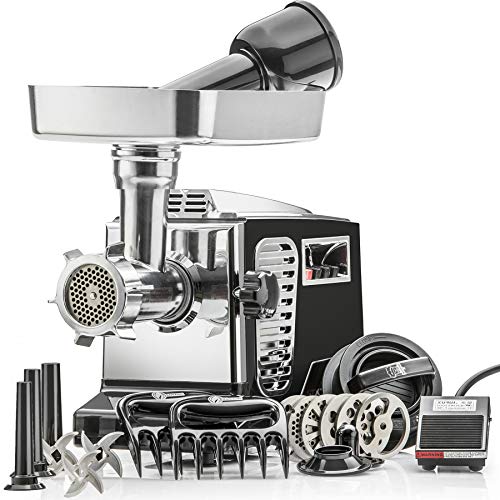
The Turboforce 3000’s strategy is completeness. Where most grinders in this tier include two plates and a single stuffing tube, the STX arrives with five grinding dies, three stainless steel cutting blades, a three-speed control, sausage stuffing gear and a kubbe maker — a box that covers burger, chili grind, fine sausage grind and stuffed specialties without a single follow-up order. For cooks whose grinding is recipe-driven and varied, that breadth is the product.
Strengths
- The deepest accessory set in the tier: 5 grinding dies and 3 stainless blades included.
- Three-speed control lets you slow down for stuffing and delicate work instead of running everything at full pace.
- Kubbe maker and full sausage kit included — specialty tools that are add-on purchases elsewhere.
Trade-offs
- The headline wattage is a “max” peak figure; judge this machine by its real-world pace, not the box number.
- More accessories means more parts to wash, dry and keep track of after every session.
- The accessory-led design is aimed at variety; for pure bulk grinding speed, the Weston above is the stronger tool.
| Spec snapshot (verified) | |
|---|---|
| Power claim | 3000W max (peak rating) |
| Speeds | 3-speed control |
| Included dies | 5 grinding dies |
| Blades | 3 stainless steel cutting blades |
| Extras | Sausage stuffer, kubbe maker, juicer function |
Let us be direct about the wattage, because STX’s marketing invites the misunderstanding. “3000W max” is the motor’s peak draw under stall-adjacent conditions, not its working output, and the machine should be compared to other home grinders on the evidence of its head, gearing and pace — where it performs as a solid mid-tier home grinder. Bought with that understanding, it is a good value: the three speeds are genuinely useful (stuffing at full speed is how casings burst), and having fine, medium and coarse dies plus spares of the wear parts from day one removes the most common friction in home grinding.
The buyer this suits is the experimenter: the cook making merguez one weekend, breakfast sausage the next, and kibbeh in between. If your grinding is one-note — burger, in bulk — the bundle’s breadth is wasted on you. If your recipe file is thick, this is the tier’s most enabling machine.
Best for: recipe-driven cooks who grind many styles and want every die and tube in the first box. / Not suited for: buyers who equate the peak wattage claim with commercial power.

3. Sunmile SM-G50 — Best Metal-Gear Workhorse
The SM-G50 is the grinder that value-focused buyers have recommended to each other for years, and the reasons are mechanical. Where much of this tier drives the auger through plastic or composite gears, the Sunmile uses metal gears — the component that decides whether a grinder survives its first encounter with a tough, sinewy batch. It adds a reverse function for clearing jams without disassembly, a circuit breaker to protect the motor, ETL certification, and stainless steel for both the cutting blade and the plates.
Strengths
- Metal gear drive — the single most important durability feature at this price point.
- Reverse function and circuit breaker: the two practical protections a home grinder actually needs.
- ETL certified, with stainless steel blade and plates rather than coated substitutes.
Trade-offs
- Power figures are “max” ratings (1000W max / 1.3 HP max) — real pace is solid home-tier, not commercial.
- Utilitarian fit and finish; it is built to a price and looks it next to the Cuisinart.
- Accessory set is functional rather than generous — plan on buying specialty tubes separately.
| Spec snapshot (verified) | |
|---|---|
| Power claim | 1000W max / 1.3 HP max (peak ratings) |
| Drive | Metal gears |
| Protections | Reverse function, circuit breaker |
| Cutting parts | Stainless steel blade and plates |
| Certification | ETL |
The ownership logic here is strong. Grinders in this tier rarely die from motor failure; they die from a stripped gear on a cold morning when someone fed a half-frozen chunk too aggressively. Metal gears, a breaker that trips before damage, and a reverse that backs a jam out instead of forcing it — that trio is a coherent answer to the actual failure modes of home grinding, and Sunmile deserves credit for spending its budget there instead of on a touchscreen.
Set expectations on pace and polish and the SM-G50 will not disappoint. It is a #8-class home machine: cube your meat to size, keep it cold, work in sensible batches, and it will return years of service. Push it like a #22 and you will find its limits — but those limits are thermal and geometric, not the sudden mechanical death that ends cheaper grinders.
Best for: durability-first buyers who grind regularly and maintain their tools. / Not suited for: buyers wanting premium finish or the fastest pace in the tier.

4. LEM #8 Countertop Meat Grinder — Best for Parts and Support
LEM is the name serious home processors graduate to, and this 575 watt #8 countertop model is the brand’s front door. The machine itself is straightforward — an aluminum #8 grinder sized for kitchen counters and family batches — but what you are really buying is the ecosystem behind it: LEM sells every plate, knife, tube and accessory in standard sizes, publishes the sizing, and has done so long enough that a grinder bought today will be supportable for as long as you care to own it.
Strengths
- LEM’s parts and accessory network is the deepest in home processing — nothing on this machine is orphaned.
- Honest 575 watt rating from a brand that rates conservatively across its whole line.
- #8 format is compact, light and quick to clean — sized for real kitchens, not processing sheds.
Trade-offs
- Aluminum construction rather than stainless at this model — rinse-and-dry discipline matters.
- #8 head means smaller cubes and a slower pace than the Weston #12 above.
- You pay a brand premium for the support network; raw spec-per-dollar hunters will find bigger numbers elsewhere.
| Spec snapshot (verified) | |
|---|---|
| Grinder size | #8 |
| Motor | 575 watt |
| Construction | Aluminum |
| Format | Countertop, home use |
Think of this pick as the low-drama option. The first time you need a finer plate for a sausage project, or a replacement knife before deer season, the LEM catalog has it, sized and labeled, with no detective work. That boring reliability is worth money in a category where the most common end-of-life event is not breakage but abandonment — a grinder that goes into a cupboard because an inexpensive part could not be found.
The honest limit is throughput. A #8 head fed by a 575 watt motor is a family-batch machine: five to fifteen pounds at a comfortable rhythm, with sensible rests on big days. Households grinding weekly for raw pet food or processing multiple deer should look at the Weston in this tier or step up a class entirely. For the mainstream home cook, though, this is the grinder least likely to ever give you a reason to replace it.
Best for: buyers who keep tools for a decade and value parts availability over headline specs. / Not suited for: high-volume processors who will outgrow a #8 head within a season.

5. Cuisinart Electric Meat Grinder — Best for Beginners
Not everyone wants a processing hobby; some people want to grind chuck for burgers on Friday and put the machine away. The Cuisinart is built for them: a stainless steel countertop grinder from a mainstream kitchen brand, with simple operation, a footprint that fits a normal kitchen, and the kind of fit and finish that does not look out of place next to the rest of your appliances. It is the least intimidating way into home grinding that this tier offers.
Strengths
- Mainstream brand with mainstream support channels — manuals, parts and help are easy to find.
- Stainless steel presentation and a compact footprint suited to ordinary kitchens.
- Simple, approachable operation — a genuine first-grinder experience without a learning curve.
Trade-offs
- Sized for small-to-medium batches; it is not the tool for a whole deer in one sitting.
- The accessory range is narrower than the STX bundle or the LEM ecosystem.
- Serious processors will outgrow its pace within a season or two of regular use.
| Spec snapshot (verified) | |
|---|---|
| Type | Standalone electric meat grinder |
| Finish | Stainless steel |
| Brand | Cuisinart |
The beginner case deserves respect rather than condescension. Most grinding disappointment comes from mismatched expectations, and the Cuisinart’s promise is modest and kept: fresh-ground burgers that ruin the store-bought kind for you, small sausage batches, ground chicken and pork for dumplings and meatballs — all at a pace and scale a weeknight can absorb. Cleanup is proportionate to the machine, which matters more than veterans admit; a grinder that takes twenty minutes to wash gets used twice a year.
If there is a hunter in the house or a raw-feeding routine on the calendar, start with the Weston or the Sunmile instead. But for the cook whose grinding ambitions are delicious rather than voluminous, this is the friendliest door into the category, from a brand that answers its phone.
Best for: first-time grinders and small-batch cooks who value simplicity and brand support. / Not suited for: hunters and high-volume households.
6. KitchenAid KSMMGA Metal Food Grinder Attachment — Best for Stand Mixer Owners
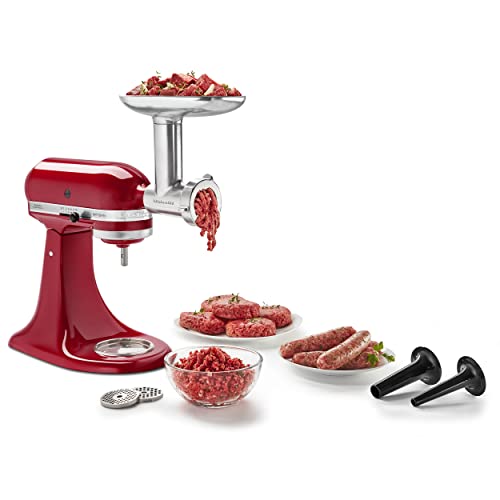
The KSMMGA asks a question the standalone machines cannot: why buy a second motor? If a KitchenAid stand mixer already lives on your counter, this all-metal attachment connects to its front hub and turns a powerful, well-geared motor you already own into a meat grinder — with a food tray, pusher, grinding plates and sausage stuffer tubes in the box. When the session ends, the whole thing washes and goes back in a drawer, which no standalone grinder in this roundup can claim.
Strengths
- Metal construction — the genuine KitchenAid metal attachment, not the plastic entry version.
- Uses your mixer’s motor and gearing: no second appliance to store, power or maintain.
- Complete kit included: tray, pusher, plates and sausage stuffer tubes and plate.
Trade-offs
- Requires a KitchenAid stand mixer — the attachment alone grinds nothing.
- Batch pace is set by the mixer’s hub drive; long, heavy sessions are not its home turf.
- The working height is your mixer’s height, which some users find awkward for big batches.
| Spec snapshot (verified) | |
|---|---|
| Type | Grinder attachment for KitchenAid stand mixers |
| Compatibility | All KitchenAid stand mixers (front hub) |
| Construction | Metal |
| Included | Food tray, pusher, grinding plates, sausage stuffer tubes and plate |
The economics are compelling in the right kitchen. Standalone money in this tier buys you a motor, a gearbox and a head; attachment money buys only the head — a better head, made of metal, with the motor budget spent on the mixer you already paid for. For the frequent baker who grinds a few pounds at a time, the KSMMGA is arguably the smartest purchase in this entire guide.
The boundaries are equally clear. Mixer hub drives are not rated for the marathon sessions a dedicated grinder shrugs off, and KitchenAid’s own guidance about rest periods applies. If grinding becomes a weekly, double-digit-pound routine, the attachment becomes the bottleneck and a standalone — the Weston or Sunmile above — is the correct next step. Until then, enjoy the drawer space.
Best for: KitchenAid owners who grind small-to-medium batches and prize storage space. / Not suited for: anyone without a stand mixer, or high-volume processors.
Comparison Table
| Pick | Badge | Key spec | Best for |
|---|---|---|---|
| Weston #12 (33-1301-W) | Best Overall | #12 head, 750W, rated 4 lbs/min | Grinding + stuffing, a deer a season |
| STX Turboforce 3000 | Best Accessory Bundle | 3 speeds, 5 dies, 3 blades, kubbe kit | Varied, recipe-driven grinding |
| Sunmile SM-G50 | Best Metal-Gear Workhorse | Metal gears, reverse, breaker, ETL | Durability-first regular use |
| LEM #8 Countertop | Best for Parts and Support | #8 head, 575W, aluminum | Decade-long ownership, family batches |
| Cuisinart Electric Grinder | Best for Beginners | Stainless, compact, simple controls | Small batches, first grinder |
| KitchenAid KSMMGA | Best for Stand Mixer Owners | Metal attachment, fits all KitchenAid mixers | Mixer owners, minimal storage |
How to Choose a Meat Grinder at the $200 Tier
Begin by ignoring the biggest number on every box. At this tier, wattage claims split into two families: honest continuous ratings (Weston’s 750 watts, LEM’s 575 watts) and “max” peaks (the STX and Sunmile figures). A peak number tells you what the motor can draw for a moment; a continuous rating tells you what it can hold while you grind. Neither family is automatically better — the SM-G50 is an excellent machine wearing a peak number — but you must compare within families or you will systematically overrate the loudest marketing.
Next, spend your attention on the drive train. Gears are the wear item that decides lifespan, and metal gears (Sunmile) or a major brand’s proven gearbox (Weston, LEM) are worth more than any feature on the control panel. Ask the same question about cutting parts: stainless steel plates and knives hold an edge, resist rust and are replaceable in standard sizes. Coated or mystery-metal cutting parts are where cheap grinders quietly become disposable.
Then be honest about batch size, because it selects your head size. Under ten pounds a session, any pick here will please you. Ten to twenty-five pounds regularly points to the Weston #12 — the extra head size is worth real minutes. Beyond that, or multiple deer a season, this whole tier is the wrong shelf: the honest move is saving toward the #22 class rather than burning out a home machine and buying twice.
Finally, decide your format. A standalone grinder is a commitment of counter or shelf space but works independently and at its own pace. The KitchenAid attachment inverts that: zero storage, shared motor, pace set by the mixer. Neither is superior — they are answers to different kitchens. The mistake is buying a standalone when your real constraint was space, or an attachment when your real ambition was volume.
What $200 Does Not Buy: Knowing This Tier’s Ceiling
Every tier has a ceiling, and naming it saves more money than any single pick. At $200 and under, you do not get a continuous-duty commercial motor, a #22 or #32 head, or a machine rated for hard bone. You do not get all-stainless construction throughout — aluminum and quality composites carry the bodies here, and that is fine. And you do not get stuffing performance equal to a dedicated vertical stuffer; grinder-based stuffing works well for fresh sausage in family quantities and becomes the bottleneck on twenty-pound salami projects.
What you do get, if you choose from verified models like the six above, is the full home-grinding experience with no asterisk: burgers with a texture grocery meat cannot match, sausage made to your own seasoning, control over fat ratios and freshness, and per-pound savings that repay the machine for anyone who grinds monthly. The ceiling only bites when buyers ask this tier to do the next tier’s job — whole-animal weekends, bone-in pet food, farmers-market volume. Recognize those jobs early and budget for the class built for them; everything else, this tier handles with room to spare.
How to Get the Best Grind from a Home Meat Grinder
Step 1 — Work cold, always. Cube meat into strips that fit your throat, spread on a tray, and freeze 30–45 minutes until the edges firm up. Chill the assembled head parts too. This one habit does more for grind quality than any upgrade you can buy: cold meat shears cleanly, warm meat smears into paste and coats the plate.
Step 2 — Trim with intent. Remove heavy silverskin and the toughest sinew, which wrap the knife and stall small heads. You do not need butcher-perfect trimming — just take the connective sheets that you can see will not break down. Distribute fat through the batch rather than grinding it all at the start or end.
Step 3 — Assemble correctly. Auger in, knife flat-face against the plate, plate seated on its pin, ring snug by hand. A loose ring is the hidden cause of most “my grinder makes mush” complaints: the knife lifts off the plate and tears instead of shearing.
Step 4 — Feed at the machine’s pace. Drop chunks steadily and let the auger pull; the pusher guides, it does not ram. If pace falls, check temperature and knife sharpness before blaming power. On machines with reverse (like the Sunmile), a one-second reverse clears most throat jams without opening the head.
Step 5 — Two passes for fine textures. Grind coarse first, re-chill if the meat has warmed, then pass through the fine plate. For sausage, mix seasoning and a little ice water into the coarse grind before the fine pass, and keep everything cold until it goes into casings.
Step 6 — Clean now, not later. Disassemble immediately, wash hot and soapy, dry completely. Dried meat in a head is a scrubbing project and a hygiene problem; a five-minute wash now prevents both. Oil carbon-steel cutting parts lightly before storage and keep plates and knives together as the matched pair they wear into.
Grind Sizes and Plate Choices for Home Grinders
The plate you choose changes the food more than the grinder does. A coarse plate — holes around 10–12mm — gives you chili grind: distinct, hearty pieces that hold up in a pot and make a loose, rustic burger. A medium plate, around 6–7mm, is the classic all-purpose burger and sausage grind, fine enough to bind, coarse enough to stay juicy and textured. A fine plate, around 4.5mm, is for emulsified sausages, smooth pâtés, and the second pass that turns a good bratwurst mix into a great one. Most home cooks need exactly two plates — coarse and medium — and add the fine plate the day sausage making stops being a thought and becomes a Saturday.
Two-plate workflows are the norm at this tier and worth understanding before you buy. Burger is usually a single pass through medium, or a coarse-then-medium double pass for a more defined texture. Sausage almost always wants two passes: coarse to break down, then fine after seasoning, so the spices distribute and the bind forms. This is why the accessory counts in this roundup matter — the STX’s five dies and the Weston’s plate set are not decoration; they are the difference between owning textures and renting them. When comparing models, price the plate set you will actually use, not the one in the headline photo.
Knives and plates wear as a pair, and they wear into each other. A new knife on a worn, dished plate will underperform a matched old pair, which is why experienced processors replace or resurface them together. On the standard #8 and #12 sizes used by every standalone pick in this guide, matched pairs are stocked by the makers and by processing suppliers — one more reason the supported brands dominate this tier. Keep the spare pair in the drawer from day one; the middle of deer season is the wrong time to discover your only knife is dull.
Storage, Cleaning and Making a $200-Tier Grinder Last
Home grinders at this tier die of neglect more often than of work. The routine that prevents it takes five minutes: disassemble fully, wash in hot soapy water, dry every part completely, and store the head unassembled or loosely assembled. The drying step is the one people skip and the one that matters most — a plate put away damp will spot with rust at the cutting face, and a rusted face tears meat instead of shearing it long before the part looks ruined. A light coat of food-grade mineral oil on steel knives and plates costs thirty seconds and prevents the problem entirely.
Storage format matters in this tier because most of these machines live in cupboards, not on processing tables. Standalone grinders store best with the head removed and the cord wrapped loosely — tight cord bends at the housing are the most common electrical failure on small appliances. The KitchenAid attachment wins this category outright, living in a drawer with the plates nested. Whichever format you own, store plates and knives in a way that keeps their faces from knocking against other metal; a folded towel or the original box inserts are enough. Cutting faces are precision surfaces, and they should be treated with the same respect as a good knife’s edge — because functionally, that is what they are.
Once a season, do the two-minute inspection: run the machine empty and listen for gear noise that was not there before, check the cord and plug, confirm the reverse and breaker (where fitted) still function, and test-fit your spare knife and plate. Catching a worn part in October is an errand; catching it during a processing session in November is a crisis. Treated this way, there is no reason a grinder from this roundup should not still be working in a decade — the motors and gearboxes in the better picks here are not the limiting factor. Habits are.
Duty Cycles, Noise and Counter Reality
Specifications never mention the three things owners talk about most: how long the machine can run before it needs a rest, how loud it is while doing it, and how much of your kitchen it occupies in between. Duty cycle first. Home grinders in this tier are intermittent-duty machines: they are designed for sessions measured in tens of minutes, with the motor’s thermal protection as the backstop. In practice this is rarely a limitation if you work the way good processors work anyway — grinding in batches, pausing to re-chill meat and swap plates — because those natural pauses are exactly the rests the motor wants. It becomes a limitation only when a buyer tries to run a home machine like a commercial line, which loops back to the tier-ceiling point made earlier.
Noise is the second reality. Meat grinders are not quiet appliances; gear drives and augers under load produce a working growl that carries through a house. Metal-gear machines tend to sound lower and more mechanical; lighter machines whine higher. None of the picks here are outliers in either direction, but if your grinding happens early in the morning in a small home, plan the session the way you would plan using a table saw — considerately, and not at dawn.
Finally, the counter reality: measure where the machine will live before it arrives. Standalone picks here range from genuinely compact (the Cuisinart, the LEM #8) to counter-committed (the Weston #12 with its tray fitted). Height under cabinets catches people out — a grinder plus its tray plus your hand feeding it needs more vertical room than the machine’s listed height suggests. The attachment pick sidesteps all of it, which is precisely why it earned its place: in small kitchens, storage is a specification too.
Common Buying Mistakes
Comparing peak watts to continuous watts. The fastest route to a disappointing purchase in this tier. Compare continuous ratings to continuous ratings, and judge peak-rated machines on gears, head size and build instead of the headline number.
Buying for the fantasy batch. A grinder sized for the one enormous session you imagine, but used for five-pound batches, mostly punishes you with storage and cleanup. Size for your real routine; borrow or step up when the exceptional day actually arrives.
Skipping the reverse function question. Jams happen in home grinding, especially while learning. A machine with reverse (or an easy-open head) turns a jam into a pause; a machine without one turns it into a disassembly with meat in the throat.
Forgetting the second-plate cost. Many grinders ship with one truly useful plate. If your plans include both burger and sausage, check what a full plate set costs for that model before buying — on supported brands it is a small, known number; on orphans it can be impossible at any price.
Grinding warm meat and blaming the motor. The most common failure in this category is thermal, not mechanical. Warm meat smears on a machine from this tier and on a premium machine alike. Chill the meat and the parts, every time, before concluding anything about power.
Planning to grind bones on a home grinder. None of the machines in this tier are bone grinders. Soft poultry frames are beyond most of them too, whatever a marketplace listing implies. If bone-in grinding is the goal, that is a dedicated category with reinforced heads — buy into it directly rather than sacrificing a good home grinder to learn the difference.
Final Recommendation
If you spend this tier’s budget once and spend it well, buy the Weston #12: the biggest head, the most honest power rating and the best all-round capability in the bracket. Durability-first buyers should take the Sunmile SM-G50 and its metal gears; variety cooks get the most enabling box in the STX Turboforce 3000; and KitchenAid owners should seriously consider never buying a standalone at all, because the KSMMGA turns the mixer on the counter into the grinder in the drawer. The LEM #8 is the decade-long ownership play, and the Cuisinart is the friendliest first step.
Related reading in this cluster: Best Meat Grinders for the full category, Best 1hp Meat Grinders for the step-up class, Best Meat Grinders Under $100 if the budget tightens, Best Affordable Meat Grinders for the value shortlist, Best Electric Meat Grinders for the electric-only view, and Best Home Meat Grinders for home-kitchen focused picks.
Related guides
Frequently Asked Questions
Can a grinder at this tier handle a whole deer?
One deer, yes — with the right pick and the right expectations. The Weston #12 in this roundup will process a deer in a sensible session with breaks to re-chill meat and parts. What this tier will not do happily is several deer back-to-back every weekend of the season; that workload is what the #22, 1 HP class exists for.
What does “3000W max” actually mean on a meat grinder?
It is a peak figure: the maximum electrical draw the motor can reach briefly, often near stall. It is not the power the grinder sustains while working, and it cannot be compared directly with continuous watt ratings. Judge peak-rated grinders by head size, gear material, cutting parts and brand support — the things that determine how they actually grind.
Is a #8 or a #12 head better for home use?
For most homes, either works; the difference is pace and cube size. A #12 accepts larger chunks and finishes sessions faster, which matters once batches pass fifteen pounds or so. A #8 is lighter, smaller, cheaper to feed with plates, and entirely sufficient for family-size grinding. Frequency and batch size, not quality, separate them.
Should I buy the KitchenAid attachment or a standalone grinder?
If you own a KitchenAid stand mixer and grind small-to-medium batches, the metal attachment is excellent value and stores in a drawer. If you do not own the mixer, or your batches are growing past what a mixer’s hub drive should do weekly, a standalone like the Weston or Sunmile is the better foundation. The attachment’s only real precondition is the mixer itself.
Can these grinders make sausage, or do I need a separate stuffer?
All six picks can stuff sausage — most include tubes, and the KitchenAid kit includes them as well. Grinder-based stuffing is slower and takes a second pair of hands for long runs, so dedicated stuffers exist for a reason, but for fresh sausage in family quantities the included setup is genuinely sufficient. Many home sausage makers never upgrade.
How do I know when the knife and plate need replacing?
Watch the grind, not the calendar. When output slows, the meat warms faster, fat starts smearing instead of cutting into distinct particles, and you find yourself pushing harder, the knife-and-plate pair is dull. On the supported brands in this guide, a fresh pair is an inexpensive standard-size part — and it makes the whole machine feel new again.