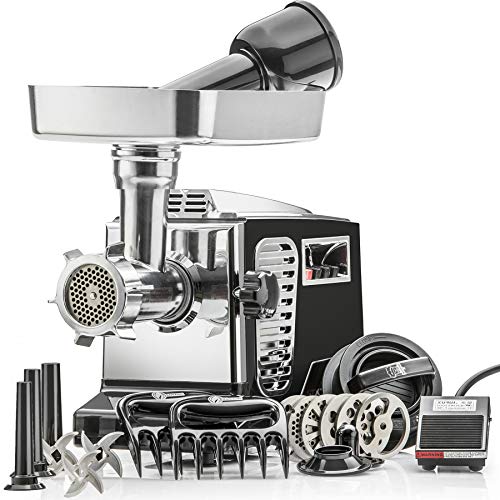
Disclosure: airfryerkitchensupply.com is reader-supported. When you buy through links on our site, we may earn an affiliate commission at no extra cost to you.
Where to buy
All six grinders below in this guide to the best electric meat grinders for home use are sold on Amazon, and home-use buyers should read the listings with one specific question in mind: what exactly is in the box? The verified titles state the plates, tubes and trays included, and for a first grinder those inclusions decide your first month. Use the links to check price on Amazon for each pick, and confirm the included plate sizes on the listing before ordering — a grinder that arrives with both a coarse and a medium plate is a grinder you can learn on; one that arrives with a single fine plate is a return waiting to happen.
- Weston #12 Electric Meat Grinder & Sausage Stuffer, 750W — Best Overall for Home Use: check price on Amazon
- LEM MightyBite #8 Meat Grinder, 500 Watt — Best Compact Premium: check price on Amazon
- Cuisinart Electric Meat Grinder, Stainless Steel (MG-100) — Best for Beginners: check price on Amazon
- KitchenAid KSMMGA Metal Food Grinder Attachment — Best for Mixer Owners: check price on Amazon
- Sunmile SM-G50 ETL Electric Meat Grinder — Best Budget for Home Use: check price on Amazon
- STX International Turboforce Cadet 2000 Series Electric Meat Grinder — Best Compact Accessory Kit: check price on Amazon
The best electric meat grinders for home use are not simply smaller versions of processing machines — they are answers to a specific set of domestic questions. Where will it live? How loud is it on a Sunday morning? How long does cleanup take after two pounds of chuck? And will a first-time user, following a burger recipe, succeed on the first try? This guide ranks six grinders by how well they answer those home questions, not by raw throughput.
Home use has a shape: batches of one to ten pounds, sessions measured in minutes rather than hours, storage in a cabinet rather than a workshop, and meat bought as whole cuts from a supermarket rather than harvested. The picks below fit that shape. They range from a #12 that handles a family’s monthly grinding in one calm session, through compact #8 machines and a beginner-friendly big-brand model, to the attachment that lets a stand mixer do the job.
Every model was matched against Amazon’s catalog data through our verification process before any link was attached, so the motors, head sizes and included accessories in the spec boxes come from the manufacturers’ listings. Where a listing uses a ‘max’ power figure — a common convention in this category — we label it as the maker’s max figure and judge the machine on its construction and batch behavior instead, and we recommend you do the same.
In this guide
Quick Picks
Six home grinders, ranked for kitchens, cabinets and weeknight patience — the short version first. A note on how to read this roundup: the badges are household descriptions, not a league table. The best home grinder is the one matched to your batch size, your storage and your experience, and a mismatched ‘better’ machine will lose to a matched lesser one every single week.
Best Overall for Home Use — Weston #12 Electric Meat Grinder & Sausage Stuffer, 750W. the home sweet spot: a #12 head that takes family batches calmly, stainless plates included, and a size a normal cabinet accepts — check price on Amazon via the product link.
Best Compact Premium — LEM MightyBite #8 Meat Grinder, 500 Watt. LEM’s home-sized machine: a compact #8 with a 500W motor and the pro brand’s parts support behind it — check price on Amazon via the product link.
Best for Beginners — Cuisinart Electric Meat Grinder, Stainless Steel (MG-100). the friendly first grinder: a big kitchen brand’s straightforward machine that teaches good habits without intimidation — check price on Amazon via the product link.
Best for Mixer Owners — KitchenAid KSMMGA Metal Food Grinder Attachment. grinding capability with no new appliance: a metal head for the mixer already on your counter, with tray, plates and stuffer tubes — check price on Amazon via the product link.
Best Budget for Home Use — Sunmile SM-G50 ETL Electric Meat Grinder. the budget machine with the right bones: metal gears, reverse, circuit breaker and stainless cutting parts — check price on Amazon via the product link.
Best Compact Accessory Kit — STX International Turboforce Cadet 2000 Series Electric Meat Grinder. a 5-in-1 home machine with four grinding plates, stainless blades, stuffer and kubbe kit — the experimenter’s compact — check price on Amazon via the product link.
How These Picks Were Chosen
Home use reorders the usual grinder criteria, so we screened in this order. Storage first: every pick had to fit a normal kitchen’s cabinet or counter reality, which immediately removed the #22 processing class to our companion guide. Cleanup second: home grinders live or die by the fifteen minutes after the grind, so part count, sink-friendliness and dishwasher tolerance weighed heavily. Learning curve third: a home grinder should forgive a beginner’s warm meat and uneven cubes at least once, and its instructions and included plates should teach the right habits. Raw speed came last — at home batch sizes, the difference between fast and very fast is two minutes; the difference between easy-clean and miserable-clean is whether you ever grind again.
The six picks divide the home territory deliberately: the all-round #12, a compact premium #8, the beginner’s big-brand choice, the mixer attachment, the honest budget machine, and a compact accessory kit for experimenters. Each badge names the home it suits, consistently across the Quick Picks, review headings and comparison table.
One category note: we treat ‘home use’ as a compliment, not a compromise. The machines here are built for the way homes actually cook — and a grinder matched to its kitchen gets used weekly, which is more than can be said for many a processing giant gathering dust in a garage.
The 6 Best Electric Meat Grinders for Home Use, Reviewed
Each review covers the household the grinder suits, three strengths, three trade-offs, a spec box of verified listing details, a deeper look at living with the machine, and a bold verdict. Storage and cleanup get explicit attention in every review — at home, those are specifications.
One reading tip: if you are torn between two adjacent picks, choose by the trade-off you mind least. Every machine here grinds well when the meat is cold; they differ in what they ask of your space, your patience and your sink, and those asks are what you will actually live with.

Weston #12 Electric Meat Grinder & Sausage Stuffer, 750W — Best Overall for Home Use
For a home that grinds regularly — burger blends on weekends, a meatball batch for the freezer, sausage a few times a year — the Weston #12 is the machine that fits the life. Its 750-watt motor drives a #12 head that swallows 1-inch cubes without trimming gymnastics, Weston rates it at 4 pounds per minute in its listing, and the whole unit still lifts with one hand and stores like a kitchen appliance rather than equipment.
It suits the committed home grinder: the household that has decided ground meat is a from-scratch ingredient from now on. The included stainless plates and stuffing kit mean the box opens with everything the first season of grinding requires.
Strengths
- #12 head size hits the home optimum: fast enough for ten-pound sessions, compact enough for a base cabinet
- Stainless steel grinding plates included — the wear parts start life as the good material
- Weston’s home-processing ecosystem makes replacement knives, plates and tubes easy to buy for years
Trade-offs
- Die-cast aluminum body keeps weight and cost down but lacks the heirloom feel of full stainless machines
- A family that discovers hunting or whole-animal buying will eventually want a #22 alongside it
- The maker’s per-minute rating assumes cold, cubed meat — warm meat slows any grinder, this one included
| Specification | Detail |
|---|---|
| Head size | #12 |
| Motor | 750 watt (1 HP class) |
| Maker-stated rate | 4 lbs per minute |
| Body | Die-cast aluminum |
| Included | Stainless plates; sausage stuffer kit |
Living with the Weston is the argument. It comes out of the cabinet without a grunt, sets up in a minute, and — the detail owners mention most — its parts wash up like normal kitchen equipment rather than like machinery. The head is big enough that meat moves through with a satisfying rhythm, small enough that the sink phase is a few pieces, not an expedition. For a weekly-use home tool, that ratio of work to fuss is exactly right.
Performance at home scale is calm rather than dramatic: chilled chuck cubes feed steadily, the auger pulls without heroic pushing, and a five-pound batch is a ten-minute event including pauses. The stuffing kit extends the machine into the household’s first sausage experiments without another purchase, which is how many home charcuterie habits begin.
Buy it if grinding is becoming a household routine. It is the pick in this guide we would hand to a friend furnishing a serious home kitchen, with no caveats beyond keeping the meat cold.
Best for: households grinding regularly — burgers, meatballs, sausage — at family scale / Not suited for: hunters and whole-animal processors, or the tiniest kitchens
Check on Amazon — check the current price on Amazon before you buy, because listings, bundles and included accessories change over time.

LEM MightyBite #8 Meat Grinder, 500 Watt — Best Compact Premium
The MightyBite is what happens when a processing brand designs for the home on purpose: a #8 head — the compact class — driven by a 500-watt motor, in an aluminum body sized for real cabinets, with LEM’s name and parts catalog standing behind it. The listing says ‘for Home Use’ and means it as a design brief.
It suits smaller households and smaller kitchens that still want a serious maker’s machine: couples grinding a few pounds at a time, apartment cooks, and anyone whose storage is a single shelf. What you give up versus the Weston is batch speed; what you gain is a grinder that disappears into the kitchen between uses.
Strengths
- Compact #8 footprint with a proper 500W motor — the small class done by a serious brand
- LEM’s accessory and replacement-parts ecosystem applies, rare at this size
- Light enough to move one-handed; stores on a shelf that would reject a #12
Trade-offs
- #8 throat takes smaller cubes and a slower feed — big family batches become a longer session
- Aluminum construction keeps it light; full-stainless seekers should look at LEM’s bigger machines
- Premium-for-its-size positioning: budget buyers get more raw capacity from the Sunmile below
| Specification | Detail |
|---|---|
| Head size | #8 |
| Motor | 500 watt |
| Body | Aluminum |
| Design brief | Compact, for home use, per listing |
The #8 class lives or dies on motor honesty, because a small throat fed by a weak motor is the classic disappointing grinder. The MightyBite’s 500 watts is a real working figure in a category full of inflated max numbers, and it shows in the feed: the auger pulls steadily, the machine does not whine down on fatty pork, and the session rhythm feels unhurried rather than strained. Cube size is the discipline it asks — trim to under an inch and the machine rewards you.
The LEM badge carries a practical dividend: when the knife dulls in year three, the replacement exists, is findable, and fits. Orphan grinders from anonymous brands fail exactly there. For a compact machine intended to serve a small household for a decade, that pipeline is worth more than a few extra watts.
Choose it when storage is tight and batches are modest but standards are not. It is the small grinder for people who read the big grinder guides and nodded along.
Best for: small households and kitchens wanting a compact grinder from a pro brand / Not suited for: family-scale batch grinding or stuffing marathons
Check on Amazon — check the current price on Amazon before you buy, because listings, bundles and included accessories change over time.

Cuisinart Electric Meat Grinder, Stainless Steel (MG-100) — Best for Beginners
First grinders have a special job: they must make a nervous beginner succeed. The Cuisinart MG-100 approaches it with the brand’s usual formula — a stainless-finished countertop machine, simple controls, and the reassurance of a company whose instruction manuals and customer service are built for people cooking their first batch of anything.
It suits the curious beginner precisely: the cook who wants fresher burgers and cleaner ingredient lists, who will grind a few pounds at a time, and who values a familiar brand’s support over a specialist’s spec sheet. As a first step into grinding, it is deliberately unthreatening — and that is a feature.
Strengths
- Big-brand approachability: clear instructions and support channels that beginners actually use
- Stainless steel presentation fits a countertop kitchen and wipes down easily after sessions
- Sized and powered for the small batches beginners actually grind while learning
Trade-offs
- Keen grinders will outgrow its pace and capacity — it is a first grinder, not a final one
- Specialist brands offer deeper plate and accessory catalogs for year-two ambitions
- As with all compact home units, meat prep discipline (cold, cubed) decides results more than the motor does
| Specification | Detail |
|---|---|
| Maker | Cuisinart |
| Model | MG-100 |
| Finish | Stainless steel |
| Class | Countertop home grinder |
Beginner success in grinding is 80 percent method — cold meat, right cubes, steady feed — and a beginner machine’s real job is to not punish the learning curve. The Cuisinart’s controls and assembly are intuitive enough that the first session can focus on the meat rather than the manual, and its scale matches the two-to-four-pound batches that teach the craft. Most owners’ first burgers from it are a revelation; that revelation is the product.
The honest ceiling: households that catch the grinding habit seriously — weekly big batches, sausage projects, game — will start eyeing the Weston or a LEM within a couple of seasons. That is not a failure of this machine; it is the natural graduation path, and the Cuisinart retires gracefully to a relative’s kitchen or backup duty.
Buy it to start. If you are already certain grinding is a permanent household ritual, skip a step and buy the Weston first.
Best for: beginners grinding small batches who want a familiar brand’s guidance / Not suited for: already-committed grinders who should buy their second machine first
Check on Amazon — check the current price on Amazon before you buy, because listings, bundles and included accessories change over time.
KitchenAid KSMMGA Metal Food Grinder Attachment — Best for Mixer Owners
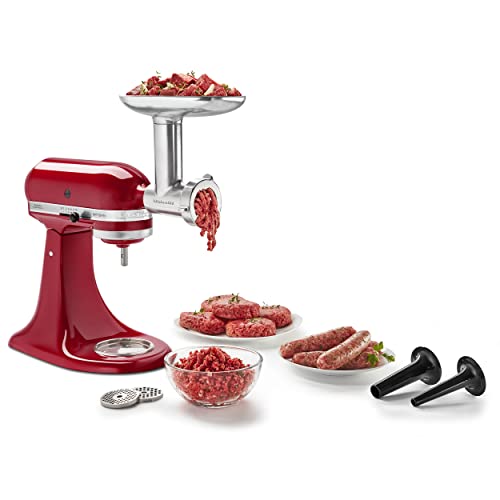
For the large tribe of KitchenAid households, the smartest home grinder may not be a grinder at all. The KSMMGA is a metal grinding head that locks into the mixer’s hub, borrowing a motor that already lives on the counter. The box includes the food tray, pusher, grinding plates and sausage stuffer tubes — a complete small-batch grinding station that stores in a shoebox.
It suits mixer owners who grind occasionally and guard their cabinet space fiercely. In a small kitchen, ‘no new appliance’ is not a compromise; it is the entire point, and the metal construction makes this the version of the attachment worth owning.
Strengths
- Stores in a fraction of a standalone grinder’s space — the small-kitchen champion
- Metal head chills well for cleaner grinding and cleans up easily
- Complete kit in the box: tray, pusher, plates and stuffing tubes for grinding and first sausages
Trade-offs
- Mixer-paced throughput: lovely for three pounds, tedious for thirteen
- Useless without a KitchenAid stand mixer — it is an attachment, not an appliance
- Feeding height is the mixer’s hub height, which some users find awkward over long sessions
| Specification | Detail |
|---|---|
| Type | Attachment, fits all KitchenAid stand mixers |
| Construction | Metal |
| Included | Tray, pusher, plates, stuffer tubes and plate |
Judge the attachment by the kitchens it serves: the mixer is out, the batch is tonight’s burgers, and the session is measured in minutes. There, it is superb — the head mounts in seconds, the mixer’s motor is more than adequate, the metal parts chill in the freezer beforehand for a clean grind, and everything washes and vanishes back into a drawer. No standalone at any price beats that storage math.
The limits arrive with ambition. A household that starts processing ten-pound batches will find the tray small, the pace slow and the mixer monopolized. That household graduates to the Weston — and typically keeps the attachment for small jobs, because for small jobs it remains the most convenient grinder they own.
As a gift for a mixer owner it is close to risk-free: you know the motor it mates with is already in their kitchen, being used and loved.
Best for: KitchenAid owners grinding small batches in space-conscious kitchens / Not suited for: non-mixer households or batch processors
Check on Amazon — check the current price on Amazon before you buy, because listings, bundles and included accessories change over time.

Sunmile SM-G50 ETL Electric Meat Grinder — Best Budget for Home Use
Home budgets are real, and the Sunmile SM-G50 is the budget grinder that respects them without insulting the buyer. Its verified listing leads with the specifications that predict survival — metal gears, a reverse function, a circuit breaker — and puts stainless steel on the blade and plates, the parts that decide grind quality. The ‘Max 1.3 HP’ naming is the segment’s usual max-figure convention; the machine underneath is a capable small-batch home grinder.
It suits the household grinding a few pounds at a time on a firm budget: burger nights, meatballs, pet food, the occasional sausage batch. It is also the classic ‘prove the habit first’ purchase — inexpensive enough that if grinding does not stick, little is lost, and solid enough that if it does stick, it may serve for years anyway.
Strengths
- Metal gears and circuit breaker at a budget tier — the durability specs that matter, present and accounted for
- Reverse function rescues jams in seconds, the feature beginners need most and budget machines most often omit
- Stainless blade and plates keep the grind clean-cut rather than smeared
Trade-offs
- Work in batches with short rests on big jobs; its duty cycle is a home duty cycle
- Minimal accessory set — it grinds and stuffs simply, without the STX’s carnival of attachments
- Max-power naming overstates working power, as across this segment; judge it by batch behavior
| Specification | Detail |
|---|---|
| Gearing | Metal gears |
| Features | Reverse; circuit breaker |
| Cutting parts | Stainless blade and plates |
| Certification | ETL, per listing |
The SM-G50’s long market life is the review, in a sense: budget grinders churn through model names yearly, and this one has outlasted generations of them by putting metal where failure lives. Gears are the obituary page of cheap grinders — the first hard gristle jam strips plastic teeth and the machine becomes e-waste. Metal gears plus a breaker that trips before the motor cooks turn that story into a pause and a reverse-button press.
At home scale its manners are good: it asks for cold, cubed meat (as they all do), feeds steadily, and produces the clean, distinct grind that makes homemade burgers taste like an upgrade rather than a project. Cleanup is compact-machine simple.
If the budget is the budget, buy this one without anxiety and spend the savings on better meat — the most delicious allocation of funds in this entire guide.
Best for: budget-conscious homes grinding small batches regularly / Not suited for: large batches, long sessions or accessory experimenters
Check on Amazon — check the current price on Amazon before you buy, because listings, bundles and included accessories change over time.

STX International Turboforce Cadet 2000 Series Electric Meat Grinder — Best Compact Accessory Kit
The Cadet 2000 is STX’s home-sized multi-tool: a 5-in-1 machine whose verified listing promises four grinding plates, stainless steel blades, a sausage stuffer and a kubbe maker, explicitly positioned ‘for home use.’ Where its bigger Turboforce 3000 sibling goes wide, the Cadet keeps the experiment kit and trims the footprint.
It suits the home experimenter: the cook who wants to try coarse burger grinds, fine sausage grinds and kubbe shells in the first month, in a kitchen that cannot house a fleet of single-purpose machines. One compact box, many first attempts — that is the Cadet’s honest proposition.
Strengths
- Four grinding plates included — texture range most home grinders only reach after accessory orders
- Stuffer and kubbe maker in the box: the full beginner’s charcuterie playground
- Compact home-use sizing that stores like a normal appliance
Trade-offs
- Accessory abundance means a parts pile at the sink and a bin to keep it in
- A multi-function home machine is not a batch processor; keep sessions domestic in scale
- As with all value multi-tools, individual functions are good rather than class-leading
| Specification | Detail |
|---|---|
| Functions | 5-in-1, for home use |
| Included plates | 4 grinding plates |
| Blades | Stainless steel |
| Extras | Sausage stuffer; kubbe maker |
The Cadet’s value is educational. Grinding is a craft of textures, and texture lives in plate choice; a machine that ships four plates teaches faster than a machine that ships one and a catalog. Add the stuffer and kubbe kit and the first season’s experiments are all available without a second purchase — which is exactly when experimentation either becomes a hobby or gets honestly retired.
Its home-use sizing is a virtue in the kitchens this guide serves: it stores like a food processor, sets up like one, and cleans like a slightly more involved one. The parts count is the tax — dedicate a small bin to the kit on day one and the tax becomes trivial.
Choose the Cadet over the Sunmile if curiosity outruns budget discipline; choose the Sunmile if you know you only want to grind. Both are defensible; they are answers to different questions about the same household.
Best for: home experimenters wanting plates, stuffing and kubbe in one compact box / Not suited for: single-purpose purists or batch processors
Check on Amazon — check the current price on Amazon before you buy, because listings, bundles and included accessories change over time.
Comparison Table
For home use, the deciding columns are head size, storage reality and what is in the box — the table compares those. Specifications are from the verified listings; max-power nameplate figures are labeled as maker figures in the reviews. One column the table cannot carry is temperament: how a machine behaves on its fifth use, with a tired cook and a sink already half full. That is what the reviews are for, and it is why the Weston and the MightyBite — the two calmest machines here — sit at the top of this guide’s affections.
| Pick | Badge | Key spec | Best for |
|---|---|---|---|
| Weston #12 Electric Meat Grinder & Sausage Stuffer, 750W | Best Overall for Home Use | #12 head, 750W, stainless plates included | households grinding regularly — burgers, meatballs, sausage — at family scale |
| LEM MightyBite #8 Meat Grinder, 500 Watt | Best Compact Premium | #8 head, 500W, compact aluminum | small households and kitchens wanting a compact grinder from a pro brand |
| Cuisinart Electric Meat Grinder, Stainless Steel (MG-100) | Best for Beginners | Big-brand countertop grinder, beginner-friendly | beginners grinding small batches who want a familiar brand’s guidance |
| KitchenAid KSMMGA Metal Food Grinder Attachment | Best for Mixer Owners | Metal mixer attachment, full kit included | KitchenAid owners grinding small batches in space-conscious kitchens |
| Sunmile SM-G50 ETL Electric Meat Grinder | Best Budget for Home Use | Metal gears, reverse, stainless cutting parts | budget-conscious homes grinding small batches regularly |
| STX International Turboforce Cadet 2000 Series Electric Meat Grinder | Best Compact Accessory Kit | 5-in-1, 4 plates, stuffer + kubbe included | home experimenters wanting plates, stuffing and kubbe in one compact box |
How to Choose a Meat Grinder for Home Use
Begin with your real batch, not your aspirational one. Write down the largest amount of meat you have actually ground — or honestly expect to grind — in one session this year. One to four pounds points to the compact machines and the attachment; five to ten points to the Weston #12; beyond ten, regularly, means this guide’s companion (the general electric grinders roundup) and its #22 class. Most households overestimate by a factor of three and buy storage problems.
Then walk the machine home in your mind. Where does it live — a base cabinet, a pantry shelf, the counter? How far is the carry to the sink? How many parts will you wash at 9 p.m.? Home appliances die of friction, not of specs: the grinder that is annoying to store and miserable to clean will be used twice. Every pick here was chosen partly on friction — part counts, weights and footprints a normal kitchen tolerates.
Finally, open the box on paper before you buy. The listing’s included plates and tubes decide your first month: two plates (coarse and medium) plus a stuffing tube is the complete starter kit. A grinder that needs an immediate accessory order to make burgers is more expensive than it looks, whatever its sticker says.
Noise, storage and cleanup: the home specifications
All electric grinders are loud in the way of small motors under load; the home-relevant differences are session length and pitch. Bigger heads finish faster (less total noise); well-built gear trains whine less. If your kitchen is open-plan and your household keeps gentle hours, shorter sessions on a #12 beat long ones on a compact machine — a practical argument for sizing up one class when in doubt.
For storage, measure the cabinet shelf before ordering and compare it with the listing’s dimensions, cord included. For cleanup, the rules are universal: rinse parts immediately (dried meat is the enemy), wash hot and soapy, dry completely — carbon-steel knives and plates rust if stored damp, stainless ones merely resent it — and store the small parts together in a bin so the kit survives as a kit.
What can a home grinder actually grind?
Beef, pork, lamb, poultry, venison in home quantities — all fair game, with the universal conditions: well chilled, cubed to the throat, heavy sinew trimmed. Fat is not the enemy; it is an ingredient, and grinders handle cold fat beautifully. What home grinders should not be asked to do: hard bones, frozen-solid blocks, and marathon sessions without pauses. Soft poultry frames for pet food sit at the edge of some models’ ability — check your maker’s guidance rather than the internet’s bravado.
Home Grinding Projects, Ranked by Ambition
Start where success is guaranteed: the burger blend. Chuck, ground medium, seasoned after grinding, cooked the same day — this single project justifies the machine for most households and teaches the cold-chain habits everything else depends on. Second project: the freezer meatball batch, where grinding your own pork-and-beef mix at a chosen ratio quietly upgrades a weeknight staple for months. Third: breakfast sausage, the friendliest entry into seasoning blends, forgiving of grind size and generous with feedback.
The intermediate tier is where the included plates and stuffers earn their place: bratwurst and Italian sausage in casings, kubbe with the STX kits, and pet food batches for households that cook for their animals. Each project adds one skill — stuffing, emulsifying, fine grinding — and the home machines in this guide all support the tier honestly, provided batches stay domestic and meat stays cold.
Know the tier above, too, so you can recognize if you outgrow this guide: whole-animal breakdowns, charcuterie at harvest scale, and farmers-market production belong to the #22 class in our general grinders roundup. There is no shame in graduating — most serious home processors started exactly where this guide starts, with a few pounds of chuck and a free afternoon.
Is a Home Grinder Worth It? An Honest Accounting
The quality case is immediate: you choose the cut (chuck over mystery trim), the fat ratio, the grind size and the freshness — ground minutes before cooking tastes different, and burgers are where everyone notices first. The control case matters to many households even more: single-cut grinding, no fillers, and knowing exactly what is in the meat your family eats.
The money case is slower and real: whole cuts on sale, ground at home, undercut premium ground meat, and game hunters transform their economics entirely. The honest caveat is frequency — a grinder used monthly takes a while to pay for itself in savings, though most owners say the quality paid them back long before the arithmetic did. If you expect to grind at least monthly, the machines in this guide are priced to be rational; if yearly, borrow one first and see whether the habit takes.
How to Use a Home Meat Grinder (First Session, Step by Step)
Your first session sets the habits that decide whether grinding becomes a ritual. Keep it small — two or three pounds of beef chuck — and follow this sequence exactly.
- Chill everything: cube the chuck into roughly 1-inch pieces, spread on a tray, and freeze 30 minutes until firm at the edges. Put the grinder’s head parts in the freezer too.
- Assemble the grinder with the medium plate for burgers, following the manual’s order — knife sharp edge facing the plate, always.
- Grind into a cold bowl, feeding cubes steadily and letting the auger pull; guide with the pusher, never your fingers, and never force.
- If a sinew wrap slows the feed, stop, unplug, and clear it — or use reverse briefly if your model has it. This is normal in session one; trimming better next time is the lesson.
- Season the ground meat gently and mix minimally for burgers; overworked meat cooks up dense. Form patties with a light hand and chill until cooking.
- Wash parts immediately in hot soapy water, dry them completely, and store the kit together. Note your ratio and plate choice somewhere — your second session will thank your first.
Food safety is the unglamorous core of home grinding: keep meat below refrigerator temperatures whenever it is not actively being ground, clean surfaces that touched raw meat before they touch anything else, and cook or freeze the grind promptly. The grinder gives you control of freshness — the cold chain is how you keep it.
Expect the second session to be half as slow as the first and twice as good. Grinding is a craft of small calibrations — cube size, chill time, feed rhythm, plate choice — and home cooks reliably report that by the third batch the machine feels less like equipment and more like a knife: simply the tool this job is done with. That is the moment the purchase justifies itself, usually somewhere around a truly excellent burger.
Common Buying Mistakes
Mistake 1: Buying a processing machine for a home kitchen. A #22 in a small kitchen is a storage crisis that grinds twice a year. Match the machine to the home; this guide’s six all fit domestic life.
Mistake 2: Grinding room-temperature meat. Warm fat smears and the texture turns pasty — the number one beginner disappointment, and it is a temperature problem, not a machine problem. Freeze the cubes and the head parts.
Mistake 3: Ignoring what’s in the box. A grinder with one fine plate cannot make a proper burger grind. Confirm the included plates and tubes on the listing before ordering, not after unboxing.
Mistake 4: Letting parts air-dry in the sink overnight. Knives and plates stored damp corrode and dull. Wash, dry fully, store together — five minutes that doubles the cutting parts’ life.
Mistake 5: Feeding with fingers or forcing the pusher. The pusher is the only thing that belongs in the throat. Forcing compacts meat, heats the head and strains gears; steady feeding is faster anyway.
Mistake 6: Seasoning before the first grind. Salt before grinding changes texture and complicates second passes. Grind plain, season after, and keep notes so the winning blend is repeatable.
Mistake 7: Storing the grinder assembled and damp in a dark cabinet. Assembled storage traps moisture against knives and plates and invites odors that greet the next session. Store it dry, disassembled or loosely assembled, with the small parts binned together — the machine you open next month should smell like nothing at all.
Final Recommendation
For the household ready to make grinding a routine, the Weston #12 is the home grinder to buy: right-sized, well-supported, stainless-plated and calm at family scale. It is the recommendation with the fewest asterisks in this guide.
The rest divide by household: the MightyBite #8 for compact premium quality, the Cuisinart for beginners who want a guiding hand, the KitchenAid attachment for mixer owners guarding their cabinets, the Sunmile for firm budgets, and the STX Cadet for experimenters who want every plate and toy in one box. Whichever you choose, keep the meat cold, confirm the box contents on the listing, and check price on Amazon before ordering.
Short on time? Start with these three:
- Weston #12 Electric Meat Grinder & Sausage Stuffer, 750W — Best Overall for Home Use
- LEM MightyBite #8 Meat Grinder, 500 Watt — Best Compact Premium
- Cuisinart Electric Meat Grinder, Stainless Steel (MG-100) — Best for Beginners
Keep researching within this guide cluster: Best Electric Meat Grinders Best 1hp Meat Grinders Best Affordable Meat Grinders Best American Meat Grinders Best Choice Meat Grinders
Related guides
Frequently Asked Questions
What is the best meat grinder size for home use?
A #12 head for households grinding five to ten pounds at a time; a #8 for smaller households and tighter storage. Head size sets cube size, speed and storage footprint all at once, which is why it is the first decision. Most homes that grind regularly land on the #12 and stay there for years.
Can a home meat grinder handle deer or other game?
A #12 like the Weston can process game in reasonable sessions with good prep — well-trimmed, very cold meat — and many hunters start there. Whole-animal, freezer-filling days are #22 work; our general electric grinders guide covers that class. Be honest about your harvest volume before choosing.
How long does it take to clean a home meat grinder?
About ten minutes once it is a habit: disassemble, rinse immediately, hot soapy wash, complete dry. The delay is what makes cleaning miserable — meat left to dry on parts turns a ten-minute job into a soaking project. Compact machines and the mixer attachment sit at the fast end; accessory-heavy sets take a few minutes more.
Do I need a separate sausage stuffer?
Not to start. Every pick here either includes stuffing tubes or a stuffer function, and vertical-stuffer ownership only becomes compelling when sausage making turns into a high-volume hobby. Learn on the grinder’s stuffer; upgrade when the hobby, not the marketing, demands it.
Is it safe to grind chicken at home?
Yes, with the standard raw-poultry discipline: keep it very cold, grind it separately, and clean and sanitize everything that touched it before other foods come near. Many home users grind chicken for meatballs and pet food; the grinder handles boneless chicken easily. Bones are the exception — leave hard bones out of home machines entirely.
Where should I store a home meat grinder?
Wherever it will actually be retrieved from: a base cabinet at knee height beats a high shelf for anything with real weight, and a pantry shelf beats both if the machine lives there assembled. Store the head parts together in a bin or bag so the kit survives as a kit, keep the cord loosely coiled rather than kinked, and — if counter space allows — consider letting a compact model live out permanently. The most-used grinder is the one that never has to be fetched, which is the mixer attachment’s whole argument.
How much meat can I grind in one session at home?
Comfortably: a few pounds on compact machines and the attachment, up to about ten pounds on a #12, working steadily with cold meat. Beyond that, pause and re-chill both meat and machine — home motors have home duty cycles, and respecting them is how a grinder lasts a decade instead of a season.