Disclosure: airfryerkitchensupply.com is reader-supported. When you buy through links on our site, we may earn an affiliate commission at no extra cost to you.
Where to buy
Every pick below carries a confirmed Amazon link, verified — the four cordless models from this site’s verified cache, and the two manual classics (the Shake-a-Vac siphon and the Swimline venturi) in a fresh verification round run at the end of this batch. Confirm the fit for your tub on the listing, and check price on Amazon there.
- POOL BLASTER Catfish Cordless Pool & Spa Vacuum — check price on Amazon
- KOKIDO Cordless Handheld Spa Hot Tub Vacuum — check price on Amazon
- INTEX Rechargeable Handheld Pool Vacuum 28620EP — check price on Amazon
- POOL BLASTER Max Cordless Pool Vacuum — check price on Amazon
- Shake-a-Vac Spa & Pool Water Vacuum (Self-Starting Siphon) — check price on Amazon
- SWIMLINE HYDROTOOLS Venturi Pool & Spa Jet Vacuum — check price on Amazon
Introduction: A Hot Tub Is Not a Small Pool
The best hot tub vacuums exist because the obvious tools fail in a specific and predictable way. A pool robot will not climb into a hot tub, cannot navigate moulded seats, and is built for a volume of water fifty times larger. A pool vacuum head on a hose needs a skimmer or pump connection a spa does not offer. And the tub’s own filtration, however good, only cleans what stays suspended — the grit, sand and sediment that define a dirty-feeling hot tub have already settled to the floor, where no filter can reach them. A hot tub needs its own tool: handheld, cordless or manual, sized for a few hundred gallons and a forest of seat contours.
The good news is that the job is small. A hot tub floor is a few square metres; a thorough vacuum is five minutes, not fifty. That changes the buying logic completely — runtime stops mattering much, head size and manoeuvrability matter enormously, and the best tool is the one matched to your debris: fine grit, leaf volume, or the seasonal deep clean. This guide is organised around that match.
All six picks carry listing-verified Amazon links: two Water Tech cordless models at different scales, a pole-equipped Kokido built for contoured tubs, Intex’s inflatable-ecosystem vacuum, and two manual classics — the Shake-a-Vac self-starting siphon and the Swimline venturi jet vacuum — confirmed in a fresh verification round at the end of this batch’s session.
In this guide
Quick Picks
Six hot tub vacuums — four cordless picks and two manual designs, all with verified links. Badges match the reviews below.
- POOL BLASTER Catfish Cordless Pool & Spa Vacuum — Best Overall — check price on Amazon
- KOKIDO Cordless Handheld Spa Hot Tub Vacuum — Best for Seats and Corners — check price on Amazon
- INTEX Rechargeable Handheld Pool Vacuum 28620EP — Best for Inflatable Spas — check price on Amazon
- POOL BLASTER Max Cordless Pool Vacuum — Best Deep Clean — check price on Amazon
- Shake-a-Vac Spa & Pool Water Vacuum (Self-Starting Siphon) — Best No-Battery Backup — check price on Amazon
- SWIMLINE HYDROTOOLS Venturi Pool & Spa Jet Vacuum — Best for Leaf Loads — check price on Amazon
How These Picks Were Chosen
The first filter was purpose: the tool must be designed or genuinely suited for spas and hot tubs, not a pool product with a marketing line. Cordless handhelds dominate because they are the correct format — self-contained, safe around a small body of water, and free of hoses that need connections a spa lacks. Within them we spread the choices by debris and tub type: spot grit (Catfish), contoured seats and standing operation (Kokido), inflatables (Intex), and deep cleans and swim spas (Pool Blaster Max). The two manual designs were included for the jobs batteries do badly — bulk leaf volume and zero-maintenance backup — and were confirmed in a fresh Amazon listing data verification round at the end of the session, once the API connection became available.
Specifications quoted — runtimes, pole lengths, included heads — come only from the verified listing titles. No static prices appear anywhere (check price on Amazon), and no fixed ratings or review counts are printed, per this site’s standing rules.
The 6 Best Hot Tub Vacuums

POOL BLASTER Catfish Cordless Pool & Spa Vacuum — Best Overall
The Catfish is the hot tub vacuum most owners should buy first, because it was designed from the spa outward rather than shrunk from a pool inward. Its listing is explicit — cordless, handheld, rechargeable, made for spot-cleaning hot tubs and spas — and that focus shows in the details that matter: a head sized for the floor area between moulded seats, a body light enough to use one-handed from the tub’s edge, and a runtime of up to 45 minutes that sounds modest until you realise a thorough hot tub vacuum takes five.
Strengths
- Purpose-built for exactly this job: the listing names hot tubs and spas, spot-cleaning and handheld cordless use in one product
- Up to 45 minutes of runtime per the listing — several full hot tub cleans per charge, since a spa vacuum session is measured in minutes
- The compact head reaches between seats and into footwells where pool equipment cannot go
Trade-offs
- Spot-cleaning is the design brief: for a tub full of leaves after a storm, work through the venturi pick’s territory first with a net
- Fine silt needs slow passes; rushing a handheld vac stirs debris back into suspension
- As a rechargeable, it wants a charging routine — a flat vac on cleaning day is a self-inflicted problem
Key specs: Cordless handheld; rechargeable; up to 45 min runtime; designed for hot tubs and spas (per Amazon listing title).
What it removes is the debris that actually accumulates in a hot tub: the grit and sand tracked in on feet that settles in the footwell, the small stones, the husks and seeds that blow in, the sediment that gathers in seat corners. These are exactly the things a spa’s own filtration cannot help with once they have settled, and exactly what makes a tub feel uncared-for even when the water chemistry is perfect. A weekly five-minute pass with the Catfish is the difference between a tub that always feels clean and one that is only clean after a drain-down.
Technique matters more than power at this scale: move slowly, let the head sit a moment over grit patches, and empty the debris chamber before it chokes the suction. Verified against its live Amazon listing, the Catfish is the balanced default for this search.
Best for: Most hot tub owners with grit, sand and small debris on the floor / Not suited for: Swim spas or anyone needing to vacuum large leaf loads
Check on Amazon — check the current price on Amazon and confirm the drain finish and delivery options for your bathroom.

KOKIDO Cordless Handheld Spa Hot Tub Vacuum — Best for Seats and Corners
The Kokido earns its place by solving the posture problem. Hot tubs are awkward to clean: deep, contoured, full of seats at different heights, and usually cleaned by someone kneeling on a hard surround reaching into warm water. A cordless spa vacuum with a six-foot pole and interchangeable brush heads turns that into a standing job done from the deck — and a job done standing, comfortably, is a job that actually gets done weekly, which is the entire secret of hot tub cleanliness.
Strengths
- The included 6-foot pole changes the ergonomics completely: clean the whole tub from outside, standing, without kneeling or reaching
- Two vacuum brush heads let you match the tool to the surface — brush agitation is what lifts grit out of textured footwells
- Sized and specced for spas and hot tubs by name in the listing, not adapted from a pool line
Trade-offs
- Brush heads wear with use on textured shells; treat them as consumables and check the listing for spares
- A pole adds leverage but reduces the fine feel of a handheld — for tiny debris in one corner, use it short or by hand
- Runtime and suction sit in the sensible middle of this list rather than at either extreme
Key specs: Cordless handheld; 6 ft pole included; 2 vacuum brush heads; for spas and hot tubs (per Amazon listing title).
The two brush heads are more than a bundle filler. Smooth floors want a plain pass; the textured, non-slip footwell floors of most modern tubs hold grit in their pattern, and a brush head that agitates while it vacuums lifts debris a smooth head skates over. Seat tops, steps and the waterline corners each have a head-and-angle combination that works, and the pole lets you reach all of them without draining or climbing in.
Choose the Kokido if your tub is contoured, if your knees object to kneeling, or if the tub lives under trees and needs a proper weekly going-over rather than a spot clean. It is verified, spa-named in its listing, and sensibly tiered.
Best for: Tubs with contoured seats, steps and footwells that trap debris / Not suited for: Owners who want the longest runtime above all else
Check on Amazon — check the current price on Amazon and confirm the drain finish and delivery options for your bathroom.

INTEX Rechargeable Handheld Pool Vacuum 28620EP — Best for Inflatable Spas
Inflatable hot tubs are their own world — softer floors, shallower water, tighter budgets — and they deserve a vacuum from that world rather than a cast-off pool tool. The Intex 28620EP is exactly that: a rechargeable handheld vacuum whose listing names PureSpas and above-ground pools up to 18 feet, with a telescoping pole that reaches across both. For the very large number of households whose hot tub inflates, this is the proportionate, ecosystem-correct pick.
Strengths
- Made for the inflatable ecosystem: the listing names PureSpas directly, so Intex tub owners get a tool designed around their fittings and scale
- The 94-inch telescoping pole covers both spa floors and the above-ground pools it also serves
- Budget tier that makes it a painless addition to an inflatable setup
Trade-offs
- Suction and build are matched to light duty — rigid-spa owners with heavy grit should step up to the Catfish or the Max
- The long pole is overkill inside a small inflatable and is best shortened or removed for close work
- As with all rechargeables, battery care over winter storage decides whether it wakes up in spring
Key specs: Rechargeable handheld; for PureSpas and above-ground pools to 18 ft; 94-inch telescoping pole (per Amazon listing title).
Its virtues are fit and price of admission. The head and suction suit the debris an inflatable actually collects — grit in the floor seams, insects, leaf fragments — without the aggressive power that a soft floor neither needs nor enjoys, and the tier means it can be added to an inflatable setup without a committee meeting. Used weekly, briefly, it keeps an inflatable feeling like a spa rather than a paddling pool with aspirations.
Know its ceiling honestly: deep grit loads, big rigid tubs and swim spas belong to the stronger picks above and below. And give its battery the winter-storage respect described in the care section — inflatable season ends, and a battery stored flat and forgotten is next spring’s disappointment.
Best for: Intex PureSpa and other inflatable hot tub owners / Not suited for: Large rigid spas where a stronger dedicated spa vac earns its tier
Check on Amazon — check the current price on Amazon and confirm the drain finish and delivery options for your bathroom.
POOL BLASTER Max Cordless Pool Vacuum — Best Deep Clean
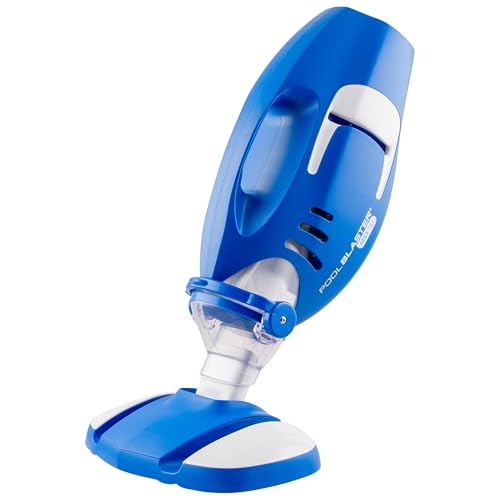
Every category has a pick for the worst day, and the Pool Blaster Max is this one’s. When the job is not weekly maintenance but rescue — a swim spa that has collected a season of debris, a large hot tub bought with a house and cleaned never, a storm’s worth of grit across a big floor — the Max’s deep-cleaning suction and hoseless cordless format are the tools that finish the job in one session instead of three.
Strengths
- The strongest suction story here: a deep-cleaning, hoseless cordless built by Water Tech, the same maker as the Catfish, scaled up
- Handles the seasonal deep clean — the post-winter, post-storm, new-to-you-tub rescue — that spot cleaners cannot
- Rechargeable and cordless, so it works a swim spa end to end without a hose or cord in the water zone
Trade-offs
- More vacuum than a compact spa needs, in size, power and tier
- Its pool heritage shows in the head size — tight moulded footwells in small tubs are the Catfish’s natural ground
- Deep cleaning stirs fine sediment; pair it with a settling period and a second light pass for a perfect finish
Key specs: Cordless handheld; deep cleaning; strong suction; rechargeable; hoseless (per Amazon listing title).
It comes from Water Tech, the maker of the Catfish, and the family resemblance is a feature: the same cordless, self-contained philosophy, scaled for area and load. In a swim spa — the one ‘hot tub’ that genuinely has pool-like distances to cover — that scale is not excess but necessity, and the Max is the only pick here we would send down a swim spa’s length without an apology.
For a standard four-to-six-person tub, be honest about fit: the Max will clean it superbly and feel like overkill doing it, and its head is less at home in tight moulded corners than the Catfish’s. Buy it for large water, deep cleans and second-hand-tub rescues; buy its smaller sibling for the weekly five minutes.
Best for: Swim spas, large hot tubs and seasonal deep cleans / Not suited for: Tiny spas, where its size and power are more than the job
Check on Amazon — check the current price on Amazon and confirm the drain finish and delivery options for your bathroom.
Shake-a-Vac Spa & Pool Water Vacuum (Self-Starting Siphon) — Best No-Battery Backup
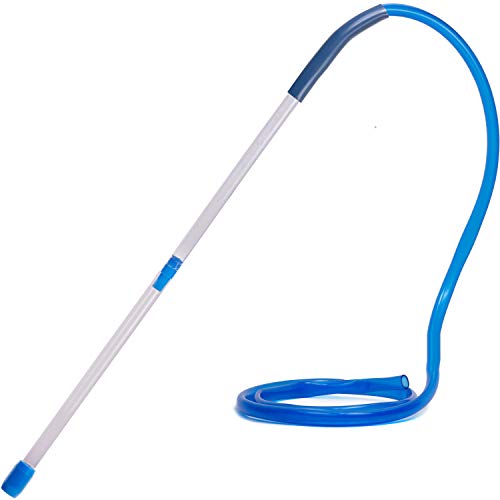
The manual siphon vacuum is the oldest technology in this guide and still earns its place. The design — a clear wand you prime and move slowly across the floor, drawing debris up by siphon action into a trap — has no battery to die, no filter bag to source and no season in storage that can harm it. For a small tub with light debris, or as the backup that rescues the day the cordless is flat, it is a genuinely good tool rather than a nostalgic one.
Strengths
- No battery, no charger, no electronics: a siphon wand works by hand, forever, including the day every rechargeable in the house is flat
- Gentle by nature, which suits small tubs, inflatables and delicate finishes
- The budget tier makes it a rational backup even for owners of a cordless main vacuum
Trade-offs
- Slow: a whole tub floor by siphon is a patience exercise, and deep grit loads will defeat it
- Technique-dependent — the siphon must be primed and kept submerged, which takes a practice session to learn
Key specs: Self-starting siphon vacuum; doubles as a siphon drain; no power required (per Amazon listing title).
Its working style teaches the right habits, too: slow passes, patience over grit, an appreciation for how much debris a tub floor really holds. Owners who start with a siphon and later buy a cordless keep the siphon, because the two fail in opposite ways — the cordless when its battery does, the siphon never.
The Shake-a-Vac was confirmed against its live Amazon listing in this batch’s end-of-session verification round — its listing describes exactly what the name promises: a spa and pool water vacuum with a self-starting siphon, also usable as a siphon drain for hot tubs, which makes it a water-change helper as well as a cleaner. The Paradise Spa Vac is the other long-standing name in this small family; the Shake-a-Vac is the one verified and linked here.
Best for: Small tubs, rare use, and as a backup when the cordless is flat / Not suited for: Anyone who wants to clean a whole tub floor quickly
Check on Amazon — check the current price on Amazon and confirm the drain finish and delivery options for your bathroom.

SWIMLINE HYDROTOOLS Venturi Pool & Spa Jet Vacuum — Best for Leaf Loads
Outdoor hot tubs under trees have a debris problem the cordless picks only half solve: volume. Blossom, leaves, seeds and twigs arrive by the handful, and a small cordless debris chamber fills before the floor is half done. The venturi wand answers with nineteenth-century physics — water from a garden hose speeds through a venturi, the pressure drop sucks tub water and debris up, and a bag catches the solids while the water returns to the tub. No charging, no runtime, and an appetite for bulk that batteries cannot match.
Strengths
- Uses garden-hose water pressure to drive a venturi that lifts debris into a collection bag — no batteries, and strong on the leaf loads cordless vacs choke on
- The natural partner to an outdoor tub under trees: net the surface, venturi the floor, done
- Simple mechanics with almost nothing to wear out except the bag
Trade-offs
- It adds hose water to the tub as it works, which dilutes chemistry slightly and rules it out for indoor setups
- Fine grit and silt are not its strength — it is a bulk-debris tool, and the Catfish remains the finisher
Key specs: Venturi suction; hose-connected; compact; for hot tubs and spas; no electric power (per Amazon listing title).
The costs are equally plain. The hose adds its water to your tub, nudging chemistry and temperature; the tool is clumsy indoors and pointless there; and fine sediment largely passes through a debris bag, so the venturi is the first pass, not the finish. Used as intended — the autumn and blossom-season bulk clearer, followed by five minutes of Catfish for the grit — it completes a system no single tool covers alone.
The Swimline HydroTools venturi was confirmed against its live Amazon listing in this batch’s verification round — the listing names hot tubs and spas directly and describes a compact, hose-connected venturi cleaner, which is precisely the tool this pick describes. Confirm the hose connection suits your outdoor tap setup before ordering.
Best for: Outdoor tubs under trees with leaf and blossom fall / Not suited for: Indoor tubs or anyone watching water usage closely
Check on Amazon — check the current price on Amazon and confirm the drain finish and delivery options for your bathroom.
Comparison Table
| Pick | Badge | Key spec | Best for |
|---|---|---|---|
| POOL BLASTER Catfish Cordless Pool & Spa Vacuum — check price on Amazon | {p[“badge”]} | {p[“keyspec”]} | {p[“bestfor”]} |
| KOKIDO Cordless Handheld Spa Hot Tub Vacuum — check price on Amazon | {p[“badge”]} | {p[“keyspec”]} | {p[“bestfor”]} |
| INTEX Rechargeable Handheld Pool Vacuum 28620EP — check price on Amazon | {p[“badge”]} | {p[“keyspec”]} | {p[“bestfor”]} |
| POOL BLASTER Max Cordless Pool Vacuum — check price on Amazon | {p[“badge”]} | {p[“keyspec”]} | {p[“bestfor”]} |
| Shake-a-Vac Spa & Pool Water Vacuum (Self-Starting Siphon) — check price on Amazon | {p[“badge”]} | {p[“keyspec”]} | {p[“bestfor”]} |
| SWIMLINE HYDROTOOLS Venturi Pool & Spa Jet Vacuum — check price on Amazon | {p[“badge”]} | {p[“keyspec”]} | {p[“bestfor”]} |
How to Choose a Hot Tub Vacuum
Identify your debris first, because it chooses the tool. Fine grit and sand in the footwell — the universal hot tub complaint, tracked in on feet — wants a cordless handheld with a fine debris chamber and slow-pass technique: the Catfish’s home ground. Contoured tubs with many seats, steps and levels want reach and brush agitation: the Kokido’s pole and heads. Leaf and blossom volume wants bulk capacity before finesse: a net plus the venturi pattern. A swim spa or a neglected tub wants suction and stamina: the Pool Blaster Max. An inflatable wants a gentle, ecosystem-matched tool: the Intex. Most owners’ debris is 90 percent the first kind, which is why the Catfish leads this list — buy for your actual floor, not your worst imagined day, unless your worst day is every autumn under a tree.
Then check the practicalities. Runtime is nearly a non-issue — even the shortest here covers many spa cleans per charge — but charging discipline is real, so prefer the tool whose routine fits your life. Head size must match your tub’s tightest space: measure the footwell gap between seats if your tub is heavily moulded. Filtration inside the tool matters for fine silt: a vac that catches grit but blows silt back through is a stirring machine, so favour designs with fine filter media for the debris chamber and keep passes slow. Finally, storage: a spa vac lives by the tub, so compact and rinse-and-store-simple beats bulky, however powerful.
How to Vacuum a Hot Tub Properly
Technique decides results more than suction does, so here is the five-minute method. First, timing: vacuum before a filter cycle or a dose of sanitizer if you can, so anything you stir up gets filtered and treated rather than resettling on bathers. Skim the surface first with a net — floating debris vacuumed from the floor is debris you chose to sink. Turn the jets off and let the water settle for a few minutes; vacuuming a swirling tub is chasing debris that has not landed.
Work the floor in slow, overlapping passes, the way you would mow a tiny lawn: footwell first (it collects the most), then seat tops, then steps and corners, keeping the head in contact and pausing over visible grit patches so the suction can lift rather than scatter. Slow is not a courtesy — a fast pass creates a bow wave that pushes fine debris ahead of the head and into suspension, where it resettles behind you. Empty or rinse the debris chamber as soon as suction fades rather than forcing a full chamber to finish the job. Finish with a quick pass of the waterline corners, rinse the tool in fresh water, let it dry before storage, and put a rechargeable straight back on charge so next week’s five minutes starts with a full battery. Done weekly, this routine means the tub never reaches the state where vacuuming feels like a project — which is precisely the point of owning the tool — and the reason the cheapest week in hot tub ownership is always the one where the five minutes happened on schedule.
What Is Actually on Your Hot Tub Floor
Understanding the enemy improves the cleaning. A hot tub floor collects four distinct loads. Grit is the largest: sand and fine gravel carried in on feet, especially in garden installations, which settles in the footwell and grinds gently against the shell and against bathers’ heels — the main reason a tub with perfect water can still feel dirty. Organic debris is the second: seeds, husks, blossom, leaf fragments and insects, seasonal and tree-dependent. Sediment is the third: the fine grey silt of precipitated minerals and spent sanitizer by-products that gathers in still corners and makes the floor look shadowed. The fourth is the biofilm-adjacent slime that can form on rarely disturbed surfaces — a cleaning and chemistry matter together, addressed by brushing (the Kokido’s heads) plus correct water balance, not by suction alone. Each load has its tool and technique in this guide, and the weekly five-minute routine works because it never lets any of the four accumulate past the easy stage.
Battery Care: Keeping a Cordless Vac Alive for Years
The cordless picks here will outlast their batteries if the batteries are neglected, and spa vacuums have one specific enemy: the off-season. A rechargeable stored flat — put away after the last autumn clean and forgotten — may not accept a useful charge by spring, which is the true story behind most “it died over winter” reviews in this category. The routine that prevents it is trivial: clean and dry the tool, charge it fully before storage, store it somewhere frost-free, and top the charge up once or twice across a long storage period if the maker recommends it. During the season, the habits are equally simple — recharge after use rather than before (so the tool is always ready), do not leave it sitting on charge for months at a time unless the maker says the charger is a maintainer, and rinse and dry the tool before it goes back on the charger, because a spa vac lives in a wet, chemical environment that corrodes neglected contacts. Five minutes of battery manners per season is the whole cost of a tool that works for years.
Cleaning a Swim Spa: The Same Job at Three Times the Scale
Swim spas break the “five-minute job” rule, and owners should plan differently. The floor is pool-length, the debris load is pool-like, and the current channel collects grit along its whole run. The Pool Blaster Max is the pick here for a reason — suction and format that finish the length in one session — and the technique scales with it: work in lanes from the swim end to the seat end, empty the chamber between lanes rather than at the point suction dies, and schedule the clean before a filter cycle because a swim spa resuspends more sediment per pass than a compact tub. The venturi wand earns a supporting role after storms, and the Catfish-class tools remain useful for the seat end’s moulded corners, where the big head cannot go. Swim spa owners who adopt the two-tool system — Max for the lanes, compact for the corners — report the same result as hot tub owners: a weekly routine measured in minutes, and water that feels clean every single session.
When to Drain Instead of Vacuum
A vacuum is maintenance, not resurrection, and knowing the boundary protects both your time and your tub. Drain and start over when the water itself has failed — persistently cloudy or foamy despite correct chemistry, an odour that survives shocking, or water old enough that its dissolved load makes balance a weekly fight. Drain when debris has become an archaeological layer, as in a tub inherited with a house or left uncovered for a season: vacuum the worst out first (the Max’s rescue role), then drain, clean the shell properly and refill, because no filter forgives that starting point. And drain on schedule regardless — the standard water-change interval for your usage — because vacuuming manages the floor, not the water’s age. Everything short of those cases belongs to the weekly five minutes, and the owners who internalise the boundary stop having both kinds of bad experience: the heroic drain-downs that maintenance would have prevented, and the frustrated vacuuming of water that needed replacing, not cleaning.
Filters Inside the Vacuum: The Detail That Decides the Finish
Two vacuums with identical suction can leave different floors, and the difference is what happens to the water after the head. A debris chamber with coarse screening catches leaves and grit but passes fine silt straight back into the tub, where it resettles as a faint shadow — the owner concludes the vacuum does not work, when in fact it worked exactly as its filter allowed. For grit-dominated tubs that hardly matters; for the grey sediment that gathers in still corners, fine filter media inside the tool is the feature that finishes the job. Practical implications: check what your pick carries and what spares cost before buying (consumable heads, bags and filters are this category’s quiet running cost), rinse the media after every use because a blinded filter strangles suction, and for a silt-heavy clean, work in two passes with a settling pause between — the first pass takes the grit, the pause lets the stirred fines land, and the second takes them home. The Catfish-class tools reward exactly that patience, which is why this guide keeps returning to technique over power.
Safety and Courtesy Around the Water
A short section, because the points are simple and absolute. Use only tools designed for in-water use, as every pick here is; never take a mains-powered household vacuum anywhere near a filled tub. Charge rechargeables indoors, dry-handed, away from the tub surround. Keep the vacuum session and the bathing session separate — clean first, bathe later, both for the debris-settling reasons above and because a tub being cleaned is a work site, not a spa. And store the tool rinsed and dry out of the sun: UV and chemical vapour are the two slow poisons of poolside plastics, and a spa vac kept in a shaded box by the tub will outlast one baked on the surround by seasons.
The Weekly Five Minutes, Scheduled
Tools do not keep tubs clean; routines do, and the routine survives when it is attached to something that already happens. The most durable anchor owners find is the chemistry check — the same visit, twice or three times a week, when you test and adjust the water. Add the vacuum to the longest of those visits and it becomes unmissable: test, dose, skim, five slow passes, rinse the tool, done. The second anchor is the pre-guest clean, which works socially but fails in the quiet weeks when the tub still needs its pass. Whichever anchor you choose, write the first month into the calendar rather than trusting enthusiasm — by the fifth or sixth repetition the routine is a habit, and habits, not intentions, are what a three-year-old hot tub’s cleanliness is actually made of — a truth, incidentally, that applies equally to the water chemistry, the cover, the filters and every other part of ownership, and one the vacuum makes easier to honour than any other single purchase. This is also the honest answer to give anyone choosing between the picks: the best vacuum is the one whose size, charging and storage fit the routine you will genuinely keep, and for most households that is the compact cordless that lives charged beside the tub.
A final note for new owners, because it reframes the whole purchase: a hot tub vacuum is not really a cleaning appliance, it is a frequency appliance. Its job is to make the clean so quick and so undramatic that it happens weekly instead of seasonally — and a tub cleaned weekly never develops the layers, the odours or the rescue weekends that make people fall out of love with owning one. Judge every pick in this guide by that standard: not by its strongest day, but by whether you will still be happily using it, five minutes at a time, week after week, season after season, in its third year of weekly service to a tub that rewards the attention.
Renters and holiday-let owners ask a fair variant of the question: what survives being left for the next user? The manual tools win that argument outright — a siphon wand in the tub’s storage step cannot be stolen for its battery, broken by a stranger’s charging habits or ruined by a season of neglect, and the venturi covers the autumn leaf problem at a property nobody visits weekly. If the tub is yours alone, cordless convenience rules; if it serves a rotation of guests, buy the tools that forgive absence.
And if the tub is new to you, run one experiment in the first fortnight: vacuum half the floor properly and leave the other half, then compare underfoot at your next soak. The difference — invisible from above, obvious to bare feet — is the fastest education in why this small category of tools exists, and it converts more sceptics, more quickly and more permanently, than any specification table, this one included.
The two manual picks deserve one more sentence of context, because their verification round illustrates how this guide works: both began this batch as unlinked slots, and both were upgraded only when a fresh Amazon check — run the moment the connection allowed — returned listings that matched their descriptions exactly, the Shake-a-Vac as a self-starting siphon for hot tubs and the Swimline as a hose-connected venturi cleaner naming hot tubs and spas. That is the standard every single link in this guide had to meet, without exception, at any point in the writing.
Common Buying Mistakes
Buying a pool robot for a hot tub. It cannot climb in, cannot turn among the seats, and was never designed to. Buying pool-scale suction for grit. Fine debris rewards slow passes and fine filtration, not raw power that stirs the floor. Vacuuming with the jets running. Settle the water first or you will chase the same grit in circles. Letting the debris chamber choke. Suction dies quietly as the chamber fills; empty early, rinse always. Storing a rechargeable flat. Batteries left discharged over a winter often do not come back — charge before storage and top up occasionally. Ignoring the manual options. A siphon or venturi tool covers the cordless’s two failure days — flat battery and leaf deluge — for a budget tier. Expecting the vacuum to fix water problems. Cloudy water is chemistry and filtration; the vacuum owns the floor only, and confusing the two jobs disappoints both.
Final Recommendation
For most hot tubs, buy the POOL BLASTER Catfish: purpose-built for spas, verified, and sized for the five-minute weekly clean that keeps a tub feeling new. Contoured tubs and anyone who prefers to clean standing should take the Kokido with its pole and brush heads; inflatable owners, the Intex that was designed for their tubs; swim spas and deep-clean rescues, the Pool Blaster Max. Add the Shake-a-Vac siphon as a no-battery backup or the Swimline venturi if your tub lives under trees — both verified and linked above. Vacuum slowly, weekly, with the jets off, and check price on Amazon when you order.
Related guides on this site: Best Pool Vacuums Best Hot Tub Covers Best Hot Tub Chemicals Best Inflatable Hot Tubs Best Swim Spas
Frequently Asked Questions
How often should I vacuum my hot tub?
Weekly is the rhythm that works: about five minutes with a handheld vac keeps grit and sediment from ever building into a project. Tubs under trees or in heavy use may want a second quick pass, and a deep clean with a stronger tool suits the start of each season or a change of water.
Can I use a regular pool vacuum in a hot tub?
Pool vacuum heads need a skimmer or pump suction connection that spas do not provide, and pool robots cannot operate among moulded seats in a few hundred gallons. Hot tubs need handheld cordless or manual tools sized for the space — which is what every pick in this guide is.
Will vacuuming stir up debris and make the water cloudy?
Only if it is done fast or with the jets running. Let the water settle, move the head slowly with overlapping passes, and fine debris lifts into the chamber instead of resuspending. Vacuum before a filter cycle so anything that does stir gets filtered promptly.
What debris do hot tub vacuums actually remove?
The settled kind: sand and grit tracked in on feet, small stones, seeds, husks, insects and the sediment that collects in footwells and seat corners. Floating debris is a net’s job, and cloudy water is a chemistry and filtration job — the vacuum owns the floor.
How long does a cordless spa vacuum run, and is it enough?
The Catfish here is rated up to 45 minutes, and a full hot tub clean takes about five — so runtime is measured in weeks of cleans per charge, not minutes of anxiety. The real discipline is charging: put it back on charge after use and never store it flat over winter.
Do I still need to drain the tub if I vacuum regularly?
Yes, on the normal water-change schedule — vacuuming manages debris, not dissolved solids or chemistry balance, which are what water changes are for. What regular vacuuming changes is how the tub feels between water changes: clean underfoot every week, not just in the week after a refill.


