Disclosure: airfryerkitchensupply.com is reader-supported. When you buy through links on our site, we may earn an affiliate commission at no extra cost to you.
Where to buy
Every linked pick in this guide to the best german pressure cookers was checked against a live Amazon listing before publication, and only models with a confirmed listing carry a buy link. Prices on appliances move constantly, so we never print a fixed price here — use the links to check the current price on Amazon and confirm the exact configuration before you order. Picks marked as unlinked are real, relevant products that did not have a confidently matched Amazon listing at review time; we explain where they are normally sold instead of inventing a link.
Fissler Vitaquick Premium Pressure Cooker, 4.8 Quart — Check the current price on Amazon
Fissler Vitaquick Premium Pressure Cooker, 3.7 Quart — Check the current price on Amazon
WMF Perfect Pressure Cooker Line — unlinked pick: sold through the brand’s own channels and specialist kitchen retailers in the US; no confidently matched Amazon listing was verified for this guide, so no link is printed rather than a guessed one.
WMF Perfect Plus Pressure Cooker Line — unlinked pick: sold through the brand’s own channels and specialist kitchen retailers in the US; no confidently matched Amazon listing was verified for this guide, so no link is printed rather than a guessed one.
Silit Sicomatic Pressure Cooker Line — unlinked pick: sold through the brand’s own channels and specialist kitchen retailers in the US; no confidently matched Amazon listing was verified for this guide, so no link is printed rather than a guessed one.
Kuhn Rikon DUROMATIC Stovetop Pressure Cooker, 5.0L (Swiss — Not German) — Check the current price on Amazon
The best german pressure cookers come from a country that treats the pressure cooker as precision equipment. Germany’s makers — Fissler above all, with WMF and Silit beside it — built their reputations on spring-valve engineering, heavy stainless steel and safety systems designed like the products of an instrument industry, because in German kitchens the Schnellkochtopf is not a gadget but a weekly staple that has held its place for generations. This guide covers that tradition honestly: what is verifiably German, what is merely German-branded, and where the evidence for each claim actually stands.
That honesty needs one paragraph of method before the picks. We only attach the word ‘German’ where the evidence carries it. The lead pick’s own verified listing states ‘Built in Germany’ — that is what a checkable origin claim looks like. Fissler and WMF are German companies whose premium pressure lines are their home-market flagships; where a specific model’s listing could not be verified for this guide, the pick is not linked and says so, rather than borrowing a link it did not earn. And the one non-German pick — a Swiss Kuhn Rikon — is labelled Swiss in its badge, its review and this introduction, included because buyers in this category cross-shop it constantly and deserve the comparison made openly.
The verified core of the list is Fissler’s Vitaquick Premium line in two sizes, both confirmed against live Amazon listings. Around them sit the WMF Perfect tradition and Silit’s Sicomatic line as unlinked entries — real German alternatives a buyer should know exist, with the route to buy them explained — and the Swiss alternative for comparison. If your priority is a German cooker you can order today with a verified listing, the Fisslers are your shortlist. If your priority is understanding the whole German landscape before spending, the prose picks and the guide sections earn their space.
In this guide
Quick Picks
If you only read one section, read this one. These are the six best german pressure cookers we would shortlist first, each with a clear job. The detailed reviews below explain who each one suits, where it compromises, and which buyers should walk past it.
- Best Overall German: Fissler Vitaquick Premium Pressure Cooker, 4.8 Quart — the verified flagship — ‘Built in Germany’ in its own listing, 18/10 stainless, two pressure settings, induction-ready. — Check the current price on Amazon
- Best Compact German: Fissler Vitaquick Premium Pressure Cooker, 3.7 Quart — the same German line in the small format — three-level safety, 18/10 stainless, and the fastest route to pressure for one to three people. — Check the current price on Amazon
- Best German Classic: WMF Perfect Pressure Cooker Line — the other great German name — WMF’s long-running Perfect line, the spring-valve classic of German home kitchens. — unlinked (see the review for where to buy it)
- Best German Handle-Control Design: WMF Perfect Plus Pressure Cooker Line — WMF’s handle-centred variant — the Perfect family’s control philosophy gathered into the handle, for one-hand operation. — unlinked (see the review for where to buy it)
- Best German Alternative: Silit Sicomatic Pressure Cooker Line — Silit’s Sicomatic — the German line known for its colour and its own valve tradition, from WMF’s sister brand. — unlinked (see the review for where to buy it)
- Best Swiss Alternative (Not German): Kuhn Rikon DUROMATIC Stovetop Pressure Cooker, 5.0L (Swiss — Not German) — included openly as the neighbouring comparison — Swiss-made, 18/10 stainless, the quiet spring-valve benchmark. — Check the current price on Amazon
How These Picks Were Chosen
Origin evidence was the first gate, applied more strictly here than in any other guide in this batch. A pick could be presented as German only if the brand is German and — for linked picks — the verified listing supports the claim, ideally in its own words. The Fissler Vitaquick Premium 4.8-quart’s listing states ‘Built in Germany’ outright; that sentence is the standard the whole article is calibrated against. German brand heritage alone, without a verifiable listing, earned an unlinked place rather than a buy link.
The second gate was the engineering this category exists for: spring-valve pressure regulation rather than a jiggle-top weight, a clear pressure indicator, a locking lid with layered safety, and 18/10 stainless construction with a base that browns properly and works on induction. German pressure cookery’s whole identity is control — of pressure levels, of release, of temperature — so picks were judged on the quality of that control, not on capacity or novelty features.
The third gate was ownership in the US, stated plainly wherever it pinches. German premium cookers sold through US channels carry US support; models bought through importers or marketplaces may not. Gaskets and valve parts are the long-term question for any pressure cooker, and the reviews note, for each pick, how that question is answered — because a cooker designed to serve for twenty years only does so if its wear parts remain obtainable.
The 6 Best German Pressure Cookers

Fissler Vitaquick Premium Pressure Cooker, 4.8 Quart — Best Overall German
This is the pick the whole keyword exists for, and its listing makes the claim other brands only imply: built in Germany. The Vitaquick Premium in 4.8 quarts is Fissler’s flagship format for a household of two to four — big enough for a family stew or a full batch of beans, compact enough to come to pressure quickly on weeknight quantities. The construction is 18/10 stainless steel, the valve is a spring system with two pressure settings, and the base is induction-compatible.
Two pressure settings is the feature that defines the German school. The gentle setting treats vegetables, fish and delicate grains with restraint; the full setting delivers the speed pressure cooking is famous for on beans, braises and stocks. A single-pressure cooker forces one temperament on every food; the Vitaquick’s pair of settings is the difference between a blunt instrument and a controlled one, and it is why German cooks use these pots for far more of the menu than beans alone.
Strengths
- German manufacture stated in the verified listing itself
- Two pressure settings cover delicate and dense foods properly
- Premium 18/10 stainless build with induction compatibility
Trade-offs
- Premium tier — the committed end of stovetop pressure pricing
- 4.8 quarts will not serve a crowd or a canning-day batch
- German sizing and part names take one manual-read to learn
| Capacity | 4.8 quart |
| Origin | Built in Germany (stated in the verified listing) |
| Material | 18/10 stainless steel |
| Pressure settings | Two |
| Compatibility | Induction (per verified listing) |
The safety and control hardware follows the Fissler pattern described in our high-pressure guide: a clear pressure indicator so the pot’s state is never a guess, a lid that locks against opening under pressure, and layered release paths. In daily use the experience is quiet — spring valves hold pressure with minimal venting, so kitchens stay calm and cooking liquid stays in the pot, which concentrates flavours in a way jiggle-top owners notice immediately on switching.
Buy this size if your household is two to four and pressure cooking will be a weekly rhythm. It is the most complete expression of the German approach that can be bought through a verified listing today, and the one pick in this guide with nothing to caveat.
Best for: households of two to four who want the definitive German pressure cooker, verified and buyable / Not suited for: batch cooks needing 8+ quarts, or buyers shopping the value tier
Check the current price on Amazon
Fissler Vitaquick Premium Pressure Cooker, 3.7 Quart — Best Compact German
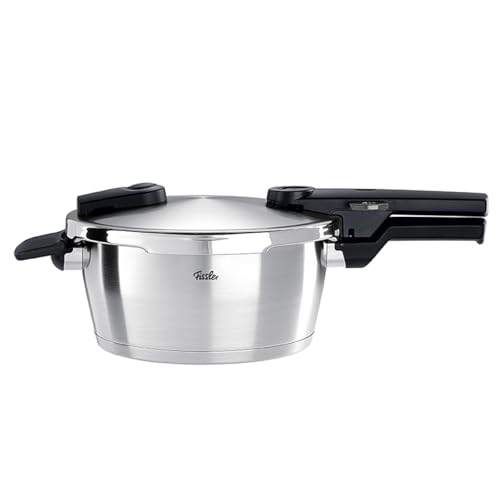
The 3.7-quart Vitaquick Premium is the same German instrument as the flagship pick, scaled for smaller households and smaller jobs: side dishes, grains, vegetables, a stew for two with leftovers. Its listing leads with the line’s three-level safety system and 18/10 stainless construction, and with the standard pressure-cooking claim of cooking up to 70% faster than conventional methods — a figure that, for dense foods, small pots actually deliver most convincingly, because there is less mass and less liquid to bring to pressure.
Small pressure cookers are underrated in exactly the kitchens that would love them. A single cook or a couple does not need six quarts to get pressure’s benefits; they need a pot that pressurises in minutes, cooks a pot of lentils or a few artichokes perfectly, and rinses clean in a small sink. That is this Vitaquick’s entire brief, executed at the premium level.
Strengths
- Full German premium engineering in the compact format
- Fast to pressure on small quantities — the speed advantage at its best
- Three-level safety and induction compatibility
Trade-offs
- Too small for family batch cooking
- Premium price for a small pot requires valuing the engineering, not the volume
- A second, larger cooker may join it later if the household grows
| Capacity | 3.7 quart |
| Material | 18/10 stainless steel |
| Safety | Three-level safety system |
| Compatibility | Induction compatible (per verified listing) |
Consider it also as the second cooker in a serious kitchen: the big pot handles the braise while the little Fissler runs the grains or vegetables at its gentler setting, both landing together. Two-cooker households sound extravagant until the first meal where every component was pressure-cooked properly, in parallel, at its own pressure level.
Choose the 3.7 if your cooks are small and frequent. Choose its 4.8-quart sibling if there is any doubt — in pressure cookers, the cost of one size too big is a little patience, while one size too small is a hard ceiling.
Best for: singles, couples and small households wanting German premium quality at the right scale / Not suited for: families, batch cooks, or anyone whose typical cook exceeds a few servings
Check the current price on Amazon
WMF Perfect Pressure Cooker Line — Best German Classic
No honest guide to German pressure cookers can omit WMF, the Geislingen giant whose Perfect line has been a fixture of German kitchens for decades. The Perfect formula is the German school in its most classic form: heavy stainless construction, a spring-valve system with pressure indication built into the handle area, and a design language so settled that gaskets and parts have remained consistent across long production runs — the kind of continuity that makes a twenty-year ownership plan realistic.
Why is it unlinked here? Because our rule is absolute: no verified listing, no buy link. WMF’s US distribution for its pressure lines runs through the brand’s own channels and specialist retailers rather than the marketplace listings this program verifies, and on the day of writing, API access issues prevented a fresh check. Rather than guess an ASIN — the one sin this program does not commit — the Perfect stands here as what it is: a first-rank German alternative to research through WMF’s own storefront, where the current US range, sizes and support terms are stated by the brand itself.
Strengths
- One of Germany’s defining pressure cooker lines, with decades of continuity
- Classic spring-valve control in heavy stainless steel
- Long production runs mean a strong wear-parts tradition
Trade-offs
- No verified Amazon listing for this guide — purchase runs through brand or specialist channels
- US support terms vary by channel; confirm before buying
- Without a listing here, sizes and configurations must be checked at the source
The buyer for the Perfect is the researcher: someone who has narrowed the field to ‘German, spring-valve, stainless’ and wants to compare the two great houses before committing. Fissler’s Vitaquick, verified above, is the buy-it-today answer; WMF’s Perfect is the compare-it-first answer, and the comparison itself — valve feel, handle design, size ladder — is legitimately a matter of hand and habit.
If you go this route, buy through a channel that states its warranty and parts support in writing, and order the spare gasket with the cooker. That single habit, as this guide repeats in several places, is what turns a premium cooker into a twenty-year one.
Best for: research-minded buyers who want to compare Germany’s two great pressure houses before buying / Not suited for: buyers who want a verified one-click purchase today
Unlinked pick — no verified Amazon link for this model at review time. sold through the brand’s own channels and specialist kitchen retailers in the US; no confidently matched Amazon listing was verified for this guide, so no link is printed rather than a guessed one.
WMF Perfect Plus Pressure Cooker Line — Best German Handle-Control Design
The Perfect Plus is WMF’s answer to a usability question: how much of a pressure cooker’s operation can live in one handle? In this line, the family’s control and indication are centred in the handle assembly, so opening, closing, pressure selection and release are managed from one grip. For cooks with limited hand strength, and for anyone who has wrestled a bayonet lid on a lesser cooker, that concentration of controls is a genuine ergonomic argument — and a very German one, solving the problem with mechanism.
It shares the Perfect family’s foundations — stainless construction and the spring-valve philosophy — so the choice between the lines is about interface, not cooking quality. That makes the Plus the connoisseur’s branch of an already connoisseur category, and the guide treats it with corresponding honesty: it is not linked for the same verification reason as its sibling, and its natural buyer is someone already committed to the WMF route who is choosing within it.
Strengths
- Handle-centred controls suit cooks who value one-hand operation
- Same German stainless and spring-valve foundations as the Perfect
- A considered ergonomic answer within the premium German class
Trade-offs
- Unlinked here — brand or specialist channels only
- More mechanism in the handle means more to keep clean and serviced
- A refinement purchase; first-time buyers should start with the core lines
Judge the Plus the way you would judge any interface refinement: by your hands. If handles, grips and one-handed operation are deciding factors in your kitchen — for mobility reasons or simple preference — the line exists for you and rewards a showroom visit or a careful read of WMF’s own materials. If they are not, the standard Perfect or the verified Fisslers deliver the same cooking with less mechanism.
Either way, the channel discipline from the Perfect’s review applies unchanged: stated warranty, stated parts route, spare gasket in the first order.
Best for: WMF-committed buyers for whom handle ergonomics are a deciding factor / Not suited for: first-time pressure buyers, or anyone wanting a verified online listing
Unlinked pick — no verified Amazon link for this model at review time. sold through the brand’s own channels and specialist kitchen retailers in the US; no confidently matched Amazon listing was verified for this guide, so no link is printed rather than a guessed one.
Silit Sicomatic Pressure Cooker Line — Best German Alternative
Silit is the name German cooks mention third, and its Sicomatic pressure line has run for decades under a philosophy slightly different from its rivals: where Fissler and WMF speak the language of instruments, Silit historically added colour and a friendlier face, in enamelled and stainless finishes that made the pressure cooker a designed kitchen object rather than a purely technical one. Silit sits within the WMF group, so the engineering seriousness behind the friendliness is corporate-family deep.
The Sicomatic’s interest for a US buyer is partly that difference itself. If the German category appeals but the instrument aesthetic does not, Silit is where to look. Its US availability is the most channel-dependent in this guide — importers and specialist retailers rather than mainstream listings — which is exactly why it stands unlinked here, with the route described rather than a link invented.
Strengths
- A genuine German line with its own long pressure-cooking tradition
- Design-led finishes for buyers who find the instrument look cold
- WMF-group engineering heritage behind the styling
Trade-offs
- The most channel-dependent availability of any pick here
- US parts and service must be confirmed carefully before purchase
- No verified listing — research starts at the brand and its importers
Silit rewards the deliberate buyer: confirm the exact model, its gasket availability in the US, and the importer’s support terms, in writing, before money moves. Do that diligence and the Sicomatic is a legitimate third answer to the German question — not a compromise, a preference.
Skip it if you want the simplest ownership story in the category. That story belongs to the verified Fisslers at the top of this guide, and there is no disgrace in choosing it.
Best for: design-minded buyers committed to a German cooker who will do the channel research / Not suited for: buyers who want mainstream availability and the simplest parts story
Unlinked pick — no verified Amazon link for this model at review time. sold through the brand’s own channels and specialist kitchen retailers in the US; no confidently matched Amazon listing was verified for this guide, so no link is printed rather than a guessed one.

Kuhn Rikon DUROMATIC Stovetop Pressure Cooker, 5.0L (Swiss — Not German) — Best Swiss Alternative (Not German)
This pick carries its disclaimer in its name, its badge and now its review: Kuhn Rikon is Swiss, this cooker is Swiss-made per its verified listing, and it is not a German pressure cooker. It appears in this guide for one honest reason — buyers researching the German premium class cross-shop it constantly, because it competes for exactly the same kitchen: a quiet spring-valve cooker in 18/10 stainless, engineered to instrument standards, in a 5.0-litre size that suits most households.
On the merits, the DUROMATIC’s reputation is earned. The spring valve works near-silently, the locking lid is a studied piece of safety design, and Swiss production gives it the same buy-for-decades character as the German flagships. In a blind test of cooking behaviour alone, most cooks could not separate it from the Fisslers — which is precisely why the origin label matters, and why this guide insists on it rather than letting a fine Swiss cooker borrow a German keyword.
Strengths
- Swiss-made premium engineering, verified listing
- Quiet spring-valve operation and an exemplary locking lid
- 5.0L is the most versatile single size in this guide
Trade-offs
- It is not German — if origin is the point, the Fisslers are the answer
- Premium tier, as with all the European spring-valve class
- Saucepan-adjacent proportions differ from stockpot-shaped rivals
| Capacity | 5.0 litre, 22cm |
| Origin | Swiss made (stated in the verified listing) — NOT German |
| Material | 18/10 stainless steel |
| Lid | Safe locking lid |
Choose the Kuhn Rikon if your real priority is the class — quiet, precise, European spring-valve pressure cooking — and the specific flag on the box matters less than the instrument. Choose Fissler if the priority is genuinely German manufacture, which is a legitimate preference this guide respects and has served with two verified picks.
Either way you are buying into the same philosophy: pressure as a controlled, quiet, everyday tool. The flags differ; the engineering values, in this corner of Europe, are cousins.
Best for: buyers who want the European spring-valve class and are happy for it to be Swiss / Not suited for: buyers for whom German manufacture specifically is the requirement
Check the current price on Amazon
Comparison Table
| Pick | Badge | Key spec | Best for |
|---|---|---|---|
| Fissler Vitaquick Premium Pressure Cooker, 4.8 Quart | Best Overall German | 4.8 quart, built in Germany, 18/10 stainless, 2 pressure settings | households of two to four who want the definitive German pressure cooker, verified and buyable |
| Fissler Vitaquick Premium Pressure Cooker, 3.7 Quart | Best Compact German | 3.7 quart, 18/10 stainless, three-level safety, induction compatible | singles, couples and small households wanting German premium quality at the right scale |
| WMF Perfect Pressure Cooker Line | Best German Classic | German brand; spring-valve line sold via brand and specialist channels | research-minded buyers who want to compare Germany’s two great pressure houses before buying |
| WMF Perfect Plus Pressure Cooker Line | Best German Handle-Control Design | German brand; handle-control variant of the Perfect family | WMF-committed buyers for whom handle ergonomics are a deciding factor |
| Silit Sicomatic Pressure Cooker Line | Best German Alternative | German brand (WMF group); Sicomatic line via brand channels | design-minded buyers committed to a German cooker who will do the channel research |
| Kuhn Rikon DUROMATIC Stovetop Pressure Cooker, 5.0L (Swiss — Not German) | Best Swiss Alternative (Not German) | 5.0L, Swiss made, 18/10 stainless, safe locking lid | buyers who want the European spring-valve class and are happy for it to be Swiss |
How to Choose the Best German Pressure Cookers
Begin with the evidence standard, because this category invites loose claims. ‘German’ can mean a German company, a German design, or manufacture in Germany, and those are three different products wearing one adjective. The strongest claim — and the one this guide’s lead pick carries in its own listing — is built in Germany. If origin matters to you, shop for that sentence, in the manufacturer’s own words, and treat anything vaguer as a prompt to ask the seller a direct question.
Then choose size by the fill rules that govern all pressure cooking: two-thirds full at most, half for foaming foods. A 4.8-quart cooker therefore delivers roughly three usable quarts — family stews, a full batch of beans — while 3.7 quarts serves small households and side dishes, and 5.0 litres is the versatile middle. German cookers reward right-sizing more than most, because their speed advantage is greatest when the pot’s contents match its volume.
Finally, plan the ownership before the purchase: confirm the gasket and valve parts route for your exact model in the US, and order the spare gasket with the cooker. German premium cookers are twenty-year instruments whose only consumable is that ring; securing it on day one is the entire maintenance strategy in miniature.
The German School: Spring Valves, Two Pressures and Quiet Kitchens
What makes a pressure cooker ‘German school’ is not the flag but the engineering philosophy, and three traits define it. First, the spring valve: instead of a loose weight that jiggles and vents steam, a calibrated spring holds pressure precisely and almost silently, losing minimal liquid and keeping flavours concentrated. Second, two pressure levels: a gentle setting for vegetables, fish and grains, and a full setting for beans and braises — one instrument with two temperaments. Third, indication: the cook can see the pressure state at a glance, from a pin or a marked valve, rather than judging by sound and habit.
The cumulative effect is a different relationship with pressure. Jiggle-top cooking is an event — noise, steam, attention. Spring-valve cooking is a background process: quiet enough for an open-plan evening, precise enough for foods that punish a blunt instrument. German households’ habit of pressure-cooking several times a week, across the whole menu, is built on exactly this calm — the technology disappeared into the routine, which is the highest compliment kitchen equipment can earn.
None of this makes other traditions wrong. The American jiggle-top is cheaper, simpler and repairable forever; the electric multi-cooker automates what the German pot asks you to supervise. The German school simply optimises for control, and buyers who cook attentively tend to recognise themselves in it quickly.
German Brands, Mapped Honestly: Fissler, WMF, Silit and the Neighbours
Fissler, from Idar-Oberstein, is the specialist: a company whose identity is cookware, whose Vitaquick line is the modern flagship of German pressure design, and whose premium manufacture the verified listing in this guide states plainly. If one brand is the German pressure cooker, it is Fissler. WMF, from Geislingen, is the giant: a broader houseware empire whose Perfect lines brought spring-valve pressure cooking to the German mainstream and kept it there across decades of production continuity.
Silit, now within the WMF group, is the design-led sibling — the Sicomatic line carried the category into colour and friendlier forms without leaving the engineering family. Together the three form the complete German landscape this search describes, and the guide’s structure mirrors their US reality: Fissler verifiable and buyable here today, WMF and Silit present through brand and specialist channels and therefore described, not linked.
And the neighbours deserve their honest sentence. Switzerland’s Kuhn Rikon builds to the same philosophy across a nearby border and is cross-shopped constantly — included here, labelled Swiss every time. Austria and France have their own traditions. The map matters because ‘European premium’ is a real class with real shared values, and a buyer who understands it can choose a flag deliberately instead of by accident.
Safety Systems in the German Tradition
German pressure cookers helped define the modern safety stack, and its layers are worth naming because buyers compare marketing phrases — ‘three-level’, ‘5-point’ — without a map. Layer one is the locking lid: the cooker cannot be opened while pressurised, and cannot pressurise unless correctly closed. Layer two is indication: the cook can see whether pressure is present before touching anything. Layer three is regulation: the spring valve holds the chosen pressure and vents the excess in a controlled way. Layer four is redundancy: if the main valve is obstructed, a secondary path releases pressure before it can climb dangerously, with the gasket itself as the final, harmless vent.
The user’s layers are simpler and are the same in every tradition: never fill past the stated lines — two-thirds, or half for foaming foods; keep the valve and vent clean, rinsing the lid works after use; replace the gasket when it hardens, leaks or ages out; and never force a lid that resists. German engineering makes the appliance forgiving; those four habits make the cook worthy of it.
Release technique completes the picture. The two-level spring valve allows a controlled, gradual release that suits delicate foods, alongside natural release for braises and beans. Foaming foods should never be fast-released in any cooker, German or otherwise — the valve is a steam path, not a foam path, and the manuals of every pick in this guide say so in their own way.
Owning a German Cooker in the US: Channels, Parts and Gaskets
The ownership question for European premium cookware in America is never the product — it is the pipeline behind the product. Before buying any pick in this guide, confirm three things about your exact model: the warranty route in the US, the availability of its gasket and valve parts from a US source, and the expected life of that support. The verified Fissler listings simplify the first purchase; the unlinked brands demand the questions be asked of their channels directly, which is why their reviews insist on written answers.
Gaskets deserve their ritual paragraph. The sealing ring is a wear part with a service life of roughly one to three years of regular use; its symptoms — rim steam, slow pressurising — are an order form, not a diagnosis of doom. Owners of German cookers develop one habit that pays for decades: a spare ring, bought with the cooker, stored flat and dark with the manual. When the fitted ring tires, the swap takes a minute and dinner never notices.
Care otherwise is stainless-steel ordinary: wash, dry, avoid abusing the valve with scouring tools, and check the indicator’s free movement when you rinse the lid. These are instruments built to be maintained by their owners, and the maintenance is measured in seconds per cook.
Budget Tiers for German Pressure Cookers
No prices are printed in this program — they change too often to print honestly — but this category’s tiers are simple to describe. The German premium class is a single broad tier: Fissler, WMF, Silit and their Swiss cousin all live in committed-purchase territory, where the buyer is paying for manufacture, machining and decades of service rather than for features. Within it, size and line move the figure more than brand does.
The honest value comparison is per decade, not per purchase. A premium German cooker used weekly for twenty years — the lifespan its makers design for — costs less per cook than a budget cooker replaced three times, and cooks better throughout. A cooker used twice a year for beans reverses that arithmetic completely, and its buyer should take the mainstream route in our high-pressure guide instead. Frequency, as in most of this program’s categories, is the specification that decides the tier.
How to Use a German Spring-Valve Pressure Cooker: The Two-Level Method
Learn the two levels first, because they are the instrument. The gentle level — the lower setting on a Fissler-style valve — is for vegetables, fish, eggs and delicate grains: foods whose texture is the point. The full level is for beans, lentils, tough cuts, stocks and anything dense. Choosing the level is the German method’s core decision, made before the lid closes, and the indicator pin or valve marking will confirm which level the pot has reached.
Load with the fill discipline the safety section describes — two-thirds at most, half for beans and grains — and with at least the minimum liquid your manual states, because spring-valve cookers lose so little steam that their recipes run leaner than jiggle-top habits suggest. Brown in the open pot first if the dish wants it; the heavy bases on these cookers are built for exactly that, and it is why they double as superb ordinary pots.
Bring the cooker up over a strong heat until the indicator shows your chosen level, then reduce the heat to the lowest setting that holds the indicator there — on a well-made spring-valve cooker that is a whisper of heat, which is where the format’s energy efficiency comes from. Time from the moment the level is reached, not from when the heat went on.
Release by food, not by impatience: natural release for beans, braises and anything that foams; a gradual valve release for vegetables and delicate foods once their short time is done; and never a fast release for a pot of grains. Open only when the indicator confirms pressure has fully fallen — the locking lid will enforce this anyway — rinse the lid works, and leave the pot’s next twenty years exactly as promising as its first cook.
Common Buying Mistakes
Trusting the word ‘German’ without asking which kind. German brand, German design and built in Germany are different claims. The verified lead pick states its manufacture in its own listing — hold every candidate to that standard of evidence.
Buying an import with no parts pipeline. A premium cooker without a US gasket source is a countdown timer. Confirm the parts route, and order the spare ring with the cooker.
Using full pressure for everything. The gentle level exists for vegetables, fish and grains. One-temperament cooking in a two-level instrument wastes the engineering you paid for.
Overfilling a small premium pot. A 3.7-quart cooker at the half line for beans is a feature of physics, not a design flaw. Size the pot to the batch before blaming the format.
Fast-releasing foaming foods. Beans and grains sputter through any valve. Natural release is part of their cooking, in German cookers as in all others.
Scouring the valve assembly. The valve is the instrument’s heart. Rinse it, brush it softly, check its movement — never attack it with abrasives.
Final Recommendation
The shortlist is short because the evidence standard was strict. The Fissler Vitaquick Premium 4.8-quart is the German pressure cooker to buy — German manufacture stated in its own verified listing, two pressure settings, 18/10 stainless — with the 3.7-quart as its compact twin for smaller households. WMF’s Perfect lines and Silit’s Sicomatic are the genuine German alternatives to research through their own channels, and the Kuhn Rikon stands as the openly-labelled Swiss comparison for buyers whose priority is the class rather than the country.
Whichever route you take, buy the spare gasket in the same order, learn the two levels, and let the quiet do its work. A German pressure cooker bought well is a twenty-year kitchen instrument, and twenty years of weekly cooks is the arithmetic that justifies every part of this guide. Check the current price on Amazon for the Fissler models before you decide.
Fissler Vitaquick Premium Pressure Cooker, 4.8 Quart — Check the current price on Amazon
Fissler Vitaquick Premium Pressure Cooker, 3.7 Quart — Check the current price on Amazon
Kuhn Rikon DUROMATIC Stovetop Pressure Cooker, 5.0L (Swiss — Not German) — Check the current price on Amazon
Best High Pressure Cookers Best Home Pressure Cookers Best Fast Pressure Cookers Best Healthy Rice Cookers Best Ever Pressure Cookers
Related guides
Frequently Asked Questions
Are German pressure cookers really made in Germany?
Some are, and the honest ones say so specifically. This guide’s lead pick, the Fissler Vitaquick Premium 4.8-quart, states ‘Built in Germany’ in its own verified listing. Other German brands manufacture different lines in different places, which is why the guide insists on checking the claim model by model rather than trusting a brand’s nationality alone.
What is the difference between Fissler and WMF pressure cookers?
Both are German houses building spring-valve, stainless pressure cookers to the same philosophy. Fissler is the cookware specialist whose Vitaquick line leads this guide because its listings could be verified; WMF is the larger houseware group whose Perfect lines are the German mainstream classic. In practice the choice comes down to size ladders, handle and valve feel, and — in the US — channel and parts support for the exact model.
Why are some picks in this guide unlinked?
Because this program never prints a buy link it has not verified. WMF and Silit pressure cookers are genuine German products, but their US sales run mainly through brand and specialist channels, and no listing for them could be confidently verified on the day of writing. They are included, honestly labelled, because a guide to German pressure cookers that omitted them would mislead by silence.
Is a spring valve better than a jiggle-top regulator?
It is quieter, loses less liquid, and usually offers two pressure levels — the control advantages that define the German school. A jiggle-top is simpler, cheaper and repairable almost forever, and cooks the same beans. ‘Better’ depends on whether you value control and calm, which German-cooker buyers generally do.
What size German pressure cooker should I buy?
Apply the fill rules: you will use about two-thirds of the pot, half for beans. The 4.8-quart Fissler serves households of two to four for most cooks; the 3.7-quart suits singles, couples and side dishes; the 5.0-litre Swiss alternative is the versatile middle. Buy for your typical batch, not your largest imaginable one.
How long will a German pressure cooker last?
The pots are designed for decades — heavy stainless bodies with replaceable wear parts. The realistic maintenance is a gasket every one to three years of regular use and a valve kept clean. Longevity in the US depends on parts availability for your model, which is why this guide repeats one instruction: confirm the parts route and buy the spare gasket with the cooker.


