Disclosure: airfryerkitchensupply.com is reader-supported. When you buy through links on our site, we may earn an affiliate commission at no extra cost to you.
Where to buy
Every linked pick in this guide to the best healthy rice cookers was checked against a live Amazon listing before publication, and only models with a confirmed listing carry a buy link. Prices on appliances move constantly, so we never print a fixed price here — use the links to check the current price on Amazon and confirm the exact configuration before you order. Picks marked as unlinked are real, relevant products that did not have a confidently matched Amazon listing at review time; we explain where they are normally sold instead of inventing a link.
AROMA CoreCoat Digital Rice Cooker (8 Cups Cooked, 4 Cups Uncooked) — Check the current price on Amazon
COSORI Rice Cooker 10 Cup with Ceramic Coating Inner Pot — Check the current price on Amazon
AROMA 6-Cup (Cooked) One-Touch Rice Cooker with CoreCoat — Check the current price on Amazon
BLACK+DECKER 6-Cup Rice Cooker with Ceramic Nonstick Pot — Check the current price on Amazon
Midea 12-in-1 Electric Pressure Cooker, 8 Quart, Stainless Steel Inner Pot — Check the current price on Amazon
Instant Pot Duo Plus 9-in-1 Electric Pressure Cooker — Check the current price on Amazon
The best healthy rice cookers are not magic health devices, and this guide will not pretend otherwise. Rice is rice. What a buyer means by ‘healthy’ in this category is real but specific: they want control over what the rice cooks in — an inner pot made of stainless steel or a ceramic-coated surface rather than a conventional nonstick coating — and they want cooking features that support the way they eat, like good brown-rice and whole-grain programs. Judged on those honest terms, the category has clear winners, and that is exactly how the picks below were chosen.
Here is the market reality, stated plainly. The traditional rice cooker world runs on aluminium inner pots with a nonstick coating, and the premium Japanese and Korean machines that cook the finest rice mostly still do. The alternatives form three routes: ceramic-coated pots, which several brands now offer including PFAS-free formulations stated in their listings; stainless steel pots, found in some dedicated cookers and — the route many buyers actually take — in pressure multi-cookers with a rice program; and clay, which exists in niche electric clay cookers that are hard to verify consistently on Amazon and so are discussed honestly in this guide rather than padded into the picks.
Every linked pick below was verified against a live Amazon listing. You will find two ceramic-coated AROMA models at different sizes, a large fuzzy-logic COSORI with a ceramic-coated pot, a budget ceramic BLACK+DECKER, and two stainless-pot pressure multi-cookers for the buyers who want steel and are happy to cook rice under pressure. The guide sections then do the deeper work: what the materials actually are, what the labels do and do not mean, and how cooking method changes the bowl far more than marketing does.
In this guide
Quick Picks
If you only read one section, read this one. These are the six best healthy rice cookers we would shortlist first, each with a clear job. The detailed reviews below explain who each one suits, where it compromises, and which buyers should walk past it.
- Best Overall: AROMA CoreCoat Digital Rice Cooker (8 Cups Cooked, 4 Cups Uncooked) — a ceramic-coated pot, a dedicated brown-rice design focus, and family size in the mainstream digital format. — Check the current price on Amazon
- Best Large Capacity: COSORI Rice Cooker 10 Cup with Ceramic Coating Inner Pot — fuzzy logic, a ceramic-coated pot and 10-cup capacity, with an 18-function program set and a stainless steamer basket. — Check the current price on Amazon
- Best Small and Simple: AROMA 6-Cup (Cooked) One-Touch Rice Cooker with CoreCoat — the listing states it plainly — a PFAS-free nonstick ceramic surface in a simple one-touch pot for one to three people. — Check the current price on Amazon
- Best Budget Ceramic: BLACK+DECKER 6-Cup Rice Cooker with Ceramic Nonstick Pot — a ceramic nonstick pot, a steaming basket and automatic keep warm at the entry tier of the ceramic route. — Check the current price on Amazon
- Best Stainless Pot, Large: Midea 12-in-1 Electric Pressure Cooker, 8 Quart, Stainless Steel Inner Pot — the steel route at family scale — an 8-quart pressure multi-cooker whose listing leads with its stainless steel inner pot and rice function. — Check the current price on Amazon
- Best Stainless Multi-Cooker: Instant Pot Duo Plus 9-in-1 Electric Pressure Cooker — the household-name multi-cooker — a dedicated rice program among its 9 functions, and the stainless-pot route with the biggest recipe ecosystem. — Check the current price on Amazon
How These Picks Were Chosen
The first gate was verification, as in every guide in this program: a pick needed a confident Amazon listing data match for this site, which is where every ASIN and product title here comes from. The second gate was the pot. Each pick’s inner-pot material had to be identifiable from its verified listing — ceramic coating stated in the title, a PFAS-free claim stated in the title, or a stainless steel inner pot stated in the title — because the pot is the entire premise of this search, and a guide that guessed at materials would be worthless.
The third gate was cooking competence, because a virtuous pot that cooks mediocre rice helps nobody. We favoured models with a dedicated brown-rice or whole-grain program — whole grains are where most households’ rice habits actually improve — plus fuzzy-logic or equivalent control on the larger models, and a keep-warm that holds rice safely and palatably for the length of a family evening rather than drying it into crust.
Two honest exclusions deserve stating. Clay-pot electric cookers are a real niche and the guide discusses them, but listings for them could not be verified consistently enough to carry buy links, so they appear as guidance, not picks. And conventional nonstick flagships — however beautifully they cook — are excluded by the search’s own premise; readers who decide the pot material does not matter to them after all will find superb machines in our general electric rice cooker guide, linked at the end.
The 6 Best Healthy Rice Cookers

AROMA CoreCoat Digital Rice Cooker (8 Cups Cooked, 4 Cups Uncooked) — Best Overall
AROMA is the workhorse brand of American rice cookers, and its CoreCoat line is its answer to the materials question: a nonstick ceramic coating in place of the conventional coating its classic models use. This digital model wraps that pot in the format most families want — 4 cups uncooked capacity, which is a genuine family-of-four size, digital programs, and a steamer function that turns the rice cooker into a two-part meal machine.
The listing’s own emphasis is brown rice, and that is the right emphasis for this search. Brown and other whole grains are where rice cookers earn a ‘healthy’ reputation honestly — not through the pot, but by making the grains people intend to eat easy enough to cook on a Tuesday. A cooker that handles brown rice’s longer, thirstier cycle properly, without a separate soak-and-guess routine, changes what a household actually eats.
Strengths
- Ceramic-coated pot answers the materials question at a mainstream tier
- Brown-rice capability is central, not an afterthought
- Steamer function cooks vegetables or fish over the rice
Trade-offs
- Ceramic coatings are less durable than conventional nonstick — treat the pot gently
- Mid-size capacity will not serve a crowd or a rice-heavy large family
- Ceramic coating is still a coating; buyers wanting bare metal should look at the stainless picks
| Capacity | 4 cups uncooked / 8 cups cooked |
| Inner pot | CoreCoat nonstick ceramic coating (per verified listing) |
| Programs | Digital rice cooker and steamer, designed for brown rice |
Living with a ceramic-coated pot asks for two habits: serve and wash with soft tools — a rice paddle and a sponge, never a metal spoon or scourer — and avoid thermal shock by letting the pot cool before washing. In return the surface releases rice cleanly, including the sticky short-grain styles that test coatings hardest.
Choose this AROMA as the default healthy-materials pick. Choose the COSORI below if your household is bigger or you want fuzzy logic; choose the stainless multi-cookers if a coating of any kind is the thing you are avoiding.
Best for: families of three to five who want a ceramic-coated pot and proper brown-rice cooking / Not suited for: buyers who want bare stainless or clay, or very large households
Check the current price on Amazon

COSORI Rice Cooker 10 Cup with Ceramic Coating Inner Pot — Best Large Capacity
COSORI’s rice cooker is the big, clever end of the ceramic route: a 10-cup capacity for large families and batch cooks, fuzzy-logic control that adjusts the cook as it goes rather than following a fixed timer, and a ceramic-coated inner pot. The 18-in-1 program set — sauté, slow cook and more, per the listing — makes it a small multi-cooker wearing a rice cooker’s clothes, and the stainless steel steamer basket is a thoughtful touch in a guide about materials: the part that touches steamed food is steel, not plastic.
Fuzzy logic deserves its plain-English moment. A basic cooker heats until a sensor says the water is gone. A fuzzy-logic cooker monitors the temperature curve and adjusts power and time in response, which forgives imperfect water ratios and handles mixed grains, porridge and older rice noticeably better. In a household cooking rice daily, that forgiveness is the feature you feel.
Strengths
- Largest capacity here with a ceramic-coated pot
- Fuzzy logic forgives imperfect water ratios and mixed grains
- Stainless steamer basket and broad program set add real versatility
Trade-offs
- Big footprint and big batches — wasted on small households
- Ceramic coating needs the same gentle care as any coated pot
- 18 functions is more menu than most rice cooks will ever open
| Capacity | 10 cup |
| Inner pot | Ceramic coating inner pot (per verified listing) |
| Control | Fuzzy logic |
| Programs | 18-in-1, including sauté and slow cook; 24-hour keep warm and delay timer |
| Accessory | Stainless steel steamer basket |
The 24-hour keep-warm and delay timer in the listing suit the way family rice actually works: load it in the morning, eat at seven, hold leftovers safely warm through the evening. Used with restraint — rice held for many hours is a quality compromise even when it is a safe one — the COSORI is the most complete family package in this guide.
Buy it if rice is a daily staple for four or more people. The AROMA above is the same idea at a calmer scale and tier.
Best for: larger families and daily rice eaters who want fuzzy logic and a ceramic-coated pot / Not suited for: small households, or buyers who want the simplest possible one-button cooker
Check the current price on Amazon
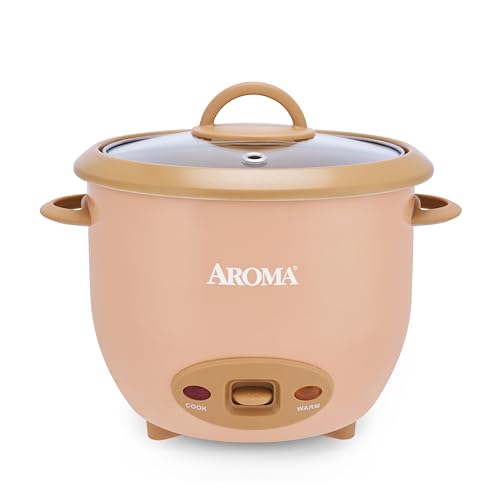
AROMA 6-Cup (Cooked) One-Touch Rice Cooker with CoreCoat — Best Small and Simple
This is the pick for the buyer who has read the labels and wants the clearest statement in the category: AROMA’s own listing describes the CoreCoat surface on this model as PFAS-free nonstick ceramic. We print that claim exactly as the manufacturer states it, in the listing’s own words, because in a category full of vague ‘eco’ and ‘green’ language, a specific, checkable claim from the brand is what honest shopping looks like.
The cooker around that pot is deliberately simple: a pot-style, one-touch machine that cooks 6 cups of rice and keeps it warm, with no menu to learn. For one to three people, in a small kitchen, that simplicity is a feature — it is the rice cooker equivalent of a good knife, bought for the one job done well.
Strengths
- PFAS-free ceramic surface stated explicitly in the manufacturer’s listing
- One-touch simplicity — nothing to learn, nothing to mis-set
- Compact size suits small kitchens and small households
Trade-offs
- No fuzzy logic or grain-specific programs at this simplicity tier
- 6 cups cooked is a hard ceiling for guests
- Ceramic surface still requires soft-tool care
| Capacity | 6 cups cooked / 1.5 quart |
| Inner pot | CoreCoat PFAS-free nonstick ceramic surface (per verified listing) |
| Controls | One-touch, pot style |
Brown rice in a one-touch cooker follows the classic method: the right water ratio for the grain, the cook cycle, and a rest before opening. It asks a fraction more attention than the programmed models above and repays it with the smallest, cheapest route into ceramic-pot rice cooking in this guide.
Choose it for a small household that wants the clearest materials statement available. Choose its bigger digital sibling if programs and capacity matter more than simplicity.
Best for: one to three people who want a PFAS-free ceramic pot and one-touch operation / Not suited for: families, grain enthusiasts, or anyone who cooks rice for guests regularly
Check the current price on Amazon

BLACK+DECKER 6-Cup Rice Cooker with Ceramic Nonstick Pot — Best Budget Ceramic
BLACK+DECKER’s small cooker is the budget door into ceramic-pot rice cooking: a 6-cup machine with a ceramic nonstick pot, a steaming basket in the box and automatic keep warm. It covers the complete basic brief — rice, steamed vegetables or dumplings above it, warmth held until serving — without a digital panel or a program menu.
Budget honesty applies here as everywhere: at this tier you are buying the pot material and the basics, not refinement. The cook will be a simple on-off cycle, water ratios are yours to get right, and the pot’s ceramic surface deserves the same gentle handling as the premium versions — arguably more, since a replacement pot at this tier is a larger fraction of the machine’s value.
Strengths
- Ceramic pot at the most accessible tier in this guide
- Steamer basket included for one-pot meals
- Simple controls with automatic keep warm
Trade-offs
- Basic cook cycle — no fuzzy logic or grain programs
- Small capacity caps it at small households
- Entry-tier build; treat it as a careful owner, not a workhorse
| Capacity | 6-cup (cooked) |
| Inner pot | Ceramic nonstick pot (per verified listing) |
| Features | Steaming basket, automatic keep warm |
As a first rice cooker, or a second one for a cabin, office kitchen or student flat, it makes a tidy case: the material the buyer came for, the functions they will actually use, and nothing they will not. Households that discover they cook rice four times a week will eventually graduate to the AROMA digital or the COSORI — and will do so knowing exactly why.
Pick it to test the ceramic route cheaply and honestly. Skip it if rice is already a daily staple at volume in your home.
Best for: small households and first-time buyers who want a ceramic pot on a budget / Not suited for: daily high-volume rice cooking, or buyers wanting programmed grain cycles
Check the current price on Amazon

Midea 12-in-1 Electric Pressure Cooker, 8 Quart, Stainless Steel Inner Pot — Best Stainless Pot, Large
For buyers whose answer to the materials question is ‘no coating at all’, the realistic route is a pressure multi-cooker with a stainless inner pot — and this Midea states that pot in the first line of its listing. At 8 quarts with 12 presets including a rice function and a sauté mode, it cooks rice the pressure way: sealed, fast, and with a texture that runs slightly softer and stickier than a dedicated rice cooker, which some households prefer and others use as their cue to adjust the water down a fraction.
The trade is explicit and worth understanding. You gain a bare stainless pot that can be scrubbed, scoured and used for decades, plus a pressure cooker, sauté pot and slow-cooker-in-one. You give up the dedicated rice cooker’s finesse — the gentle curve, the perfect keep-warm, the crust-free bottom on plain white rice. Households that cook rice inside mixed dishes, grains, and one-pot meals feel the trade least; white-rice purists feel it most.
Strengths
- Bare stainless inner pot — no coating to wear, ever
- 8-quart capacity covers big families and batch cooking
- Pressure, sauté and rice functions in one appliance
Trade-offs
- Pressure-cooked rice texture differs from a dedicated rice cooker
- Big, heavy pot is overkill for a cup of rice for one
- Stainless pots can stick at the bottom without the right water ratio and rest
| Capacity | 8 quart |
| Inner pot | Stainless steel inner pot (per verified listing) |
| Programs | 12-in-1 with 12 preset menus, sauté function, rice cooker function |
The technique that makes stainless-pot rice work is the rest: when the program ends, leave the lid closed for ten minutes so the bottom layer releases in the steam, then fluff. Cooks who skip the rest conclude stainless sticks; cooks who rest it wonder what the fuss was about. The guide’s how-to section walks through the full method.
Choose the Midea if steel is non-negotiable and the household is large. Choose the Instant Pot below if the same idea at a smaller scale and the deepest accessory ecosystem appeals more.
Best for: larger households committed to a stainless pot who also want pressure cooking / Not suited for: white-rice purists, or small households cooking a cup at a time
Check the current price on Amazon

Instant Pot Duo Plus 9-in-1 Electric Pressure Cooker — Best Stainless Multi-Cooker
The Instant Pot Duo Plus is the appliance that put pressure multi-cookers — and their stainless inner pots — into millions of kitchens, and it earns its place in this guide as the mainstream steel route. Its rice function is one of nine built-in programs in the verified listing, alongside pressure cooking, slow cooking, steaming, sautéing and yogurt making, which makes it the most versatile appliance in this lineup by a wide margin.
The ecosystem is a genuine part of the product. No small appliance in history has accumulated more recipes, timing charts and community knowledge, and for rice specifically that means tested water ratios and timings for every grain a household is likely to try — brown, jasmine, basmati, wild blends, steel-cut oats — all calibrated to this exact style of pot.
Strengths
- Stainless-pot route with the deepest recipe and accessory ecosystem available
- Nine functions replace several appliances, rice included
- Huge community knowledge base for grain timings and ratios
Trade-offs
- Rice is one of nine jobs — dedicated cookers still finesse plain rice better
- Pressure rice texture runs softer; ratios need a first-cook adjustment
- Takes counter or cupboard space sized for its versatility, not just for rice
| Functions | 9-in-1: pressure cooker, slow cooker, rice cooker, steamer, sauté, yogurt maker, warmer and sterilizer (per verified listing) |
| Format | Electric pressure multi-cooker |
Buy the Duo Plus if the household’s real need is broader than rice — the Tuesday pressure stew, the weekend yogurt, the slow-cooked Sunday sauce — and rice rides along very competently on a steel pot. Buy a dedicated ceramic cooker from the top of this list if rice is the main event and you want it cooked by a specialist.
Either way, this pick is the proof of the guide’s central point: the ‘healthy pot’ question is really a materials-and-method question, and the market’s honest answers are ceramic coatings and stainless steel, each with a cooking style attached. Choose the style you will enjoy, and the material follows.
Best for: households wanting one stainless-pot appliance for rice plus pressure, slow and yogurt duties / Not suited for: rice specialists who want a dedicated cooker’s finesse for plain rice
Check the current price on Amazon
Comparison Table
| Pick | Badge | Key spec | Best for |
|---|---|---|---|
| AROMA CoreCoat Digital Rice Cooker (8 Cups Cooked, 4 Cups Uncooked) | Best Overall | Ceramic-coated pot, 8 cups cooked, brown rice program | families of three to five who want a ceramic-coated pot and proper brown-rice cooking |
| COSORI Rice Cooker 10 Cup with Ceramic Coating Inner Pot | Best Large Capacity | 10-cup, fuzzy logic, ceramic-coated pot, 18-in-1 | larger families and daily rice eaters who want fuzzy logic and a ceramic-coated pot |
| AROMA 6-Cup (Cooked) One-Touch Rice Cooker with CoreCoat | Best Small and Simple | 6 cups cooked, PFAS-free ceramic surface (per listing), one-touch | one to three people who want a PFAS-free ceramic pot and one-touch operation |
| BLACK+DECKER 6-Cup Rice Cooker with Ceramic Nonstick Pot | Best Budget Ceramic | 6-cup, ceramic nonstick pot, steamer basket included | small households and first-time buyers who want a ceramic pot on a budget |
| Midea 12-in-1 Electric Pressure Cooker, 8 Quart, Stainless Steel Inner Pot | Best Stainless Pot, Large | 8 quart, stainless steel inner pot, 12 presets, rice function | larger households committed to a stainless pot who also want pressure cooking |
| Instant Pot Duo Plus 9-in-1 Electric Pressure Cooker | Best Stainless Multi-Cooker | 9-in-1, dedicated rice cooker function, pressure and slow cook | households wanting one stainless-pot appliance for rice plus pressure, slow and yogurt duties |
How to Choose the Best Healthy Rice Cookers: Start With the Pot
Every buying decision in this category hangs off one component, so inspect it the way you would inspect a pan you plan to keep for a decade. Ask three questions of any model. What is the pot made of — aluminium with a conventional nonstick coating, aluminium or steel with a ceramic coating, bare stainless steel, or clay? Is that material stated plainly by the manufacturer, in words you can check, or wrapped in vague wellness language? And can the pot be replaced when it wears, because every coated pot wears eventually?
Then size and program the cooker around your grains. Capacity in this category is quoted in cups — uncooked on some listings, cooked on others, and the two differ by a factor of about two, which is the most common sizing mistake in the category. A ‘6-cup cooked’ cooker makes dinner for two or three; a ’10-cup’ uncooked cooker feeds a crowd. Match the number to your household using the cooked figure, and if your household eats brown rice, quinoa or mixed grains regularly, put a dedicated whole-grain capability — a program, fuzzy logic, or at minimum a long enough cycle — on the must-have list.
Finally, decide your route before you compare models: ceramic-coated convenience, or bare stainless versatility. The routes cook slightly differently and ask different care, and comparing across them muddles buyers. The next sections take each material in turn.
Inner Pot Materials, Honestly: Ceramic Coating, Stainless Steel, Clay and Conventional Nonstick
Ceramic coatings — the sol-gel, silica-based surfaces sold under names like CoreCoat — are the industry’s main answer to buyers who want a nonstick-style release without a conventional PTFE coating. They release rice well, clean easily, and in specific models carry an explicit PFAS-free statement from the manufacturer, as one pick in this guide does. Their honest weakness is lifespan: ceramic surfaces typically lose their slickness faster than conventional nonstick, over a few years of regular use, and they dislike metal tools, scourers and thermal shock. Treat one gently and it serves well; treat it like steel and it will not.
Stainless steel is the permanence answer. A bare steel pot has no coating to wear, tolerates any tool and any scrub, and lasts as long as the appliance around it. Its costs are behavioural: rice can catch at the bottom if the water ratio is off or the rest is skipped, and steel pots live mostly in pressure multi-cookers rather than dedicated rice machines, so the cooking style changes with the material. For buyers whose priority is ‘buy it once, scrub it forever’, steel is the only honest answer in the category.
Clay is the romantic answer — unglazed or glazed earthenware pots, traditional in several Asian cooking cultures, sold in electric form by niche makers. Clay cooks gently and devotees love the texture. Its realities are fragility, weight, slow response and — in this market — inconsistent availability from verifiable sellers, which is why this guide discusses clay with respect but does not link it. Conventional nonstick, finally, remains the best pure rice-cooking surface ever put in these machines, and the flagship Japanese and Korean cookers still use it; it is excluded here only because this search’s buyers have already decided it is not what they want.
What the Labels Mean: PFAS-Free, Ceramic and ‘Chemical-Free’ Claims
Label literacy matters more in this category than in most, because the marketing runs ahead of the standards. ‘Ceramic’ on a rice cooker pot almost always means a ceramic coating over metal — a real and useful thing — not a solid ceramic pot. ‘PFAS-free’, where a manufacturer states it as AROMA does for one pick here, is a specific claim about the coating’s chemistry that you can hold the brand to. ‘Non-toxic’ and ‘chemical-free’ are not regulated specifications at all — everything is chemicals, including rice and water — and a listing that leads with those words instead of naming its material is telling you something.
The practical rule this guide used, and the one we recommend, is to buy the claim you can verify: a material named in the manufacturer’s own listing title or specification, in plain words. ‘Ceramic coating inner pot.’ ‘Stainless steel inner pot.’ ‘PFAS-free nonstick ceramic surface.’ Those sentences are checkable, comparable and honest. Vague wellness adjectives are none of the three, and no purchase in this category should rest on them.
One more clarification, because it causes real confusion: a coating being PFAS-free and a coating being ceramic are related but separate statements, and neither says anything about the rest of the appliance — its housing, its steamer basket, its lid liner. Buyers who care about materials should read the whole product’s material story, which is why details like the COSORI’s stainless steamer basket earned explicit mention in its review.
Cooking Method Matters More Than Marketing: Grains, Water and the Rest
Here is the section most ‘healthy rice cooker’ content avoids: the largest differences in the bowl come from what you cook and how, not from the pot. Choosing brown rice, red rice, black rice, quinoa or mixed grains over polished white rice changes the fibre and nutrient profile of the meal more than any appliance decision. Rinsing rice until the water runs mostly clear removes surface starch for separate, fluffy grains. And the ten-minute rest after the cycle — lid closed, steam settling — improves texture in every pot material ever made.
Water ratios are the craft. White rice in a dedicated cooker typically wants roughly equal volumes, adjusted for the grain and your preference; brown rice wants noticeably more water and more time; pressure-cooked rice wants slightly less water than the same grain in a vented cooker, because nothing evaporates. Every model in this guide rewards one experiment: cook, note the result, adjust by a small amount next time, and write your ratio on a card kept with the cooker. Three cooks in, your rice will beat any restaurant’s, in any pot.
Keep-warm deserves a sober word. All the picks here hold rice warm, which is convenient and, used within a few hours, perfectly sensible. Rice held warm for very long periods dries and degrades in quality in any cooker; the household habit that works best is cooking closer to mealtime — the delay timers on the digital picks exist for exactly this — and refrigerating leftovers promptly for tomorrow’s fried rice, which is a destination, not a compromise.
Care for Coated and Steel Pots: Making the Material Last
A ceramic-coated pot’s life is decided by small habits. Serve with the paddle or a soft spoon, never a metal one. Wash with a sponge and ordinary detergent, not a scourer. Let the pot cool before it meets cold water. Do not use the pot on a hob or under a grill — it belongs to its cooker. Followed consistently, these habits give a coated pot years of slick service; ignored, they can age it in a season, and no warranty treats that as a defect.
A stainless pot asks the opposite personality: scrub it as hard as you like, soak it overnight without a thought, and use barkeeper’s-style cleaners when the base rainbows from heat. Its one technique is preventive — the right water ratio and the full rest before fluffing keep the bottom layer releasing cleanly, and a brief soak handles the rare occasion when it does not.
For both materials, the cooker around the pot wants the same basics: wipe the lid and its liner, empty and wash any condensation collector, and keep the rim and sensor area clean, because dried rice starch on a sensor is the quiet cause of many ‘my cooker undercooks now’ complaints.
Budget Tiers for Healthy Rice Cookers
We do not print prices — they change too often to print honestly — but the tier structure here is clear. The entry tier buys the material without the intelligence: one-touch ceramic cookers like the small AROMA and the BLACK+DECKER, where your water ratios do the work. The mid tier buys programs and polish — the digital AROMA’s grain handling, in a family size. The upper tier buys fuzzy logic and capacity in the COSORI, or a second appliance’s worth of functions in the stainless multi-cookers.
The value question in this category is really a lifespan question. A coated pot is a consumable on a multi-year clock, so a replaceable pot — or a low enough tier that replacing the cooker is painless — protects the budget. A stainless pot removes the question entirely, which is part of what its higher tier is buying. Decide which kind of owner you are before you decide which tier to shop.
How to Cook Better Rice in Any Pot: Ratios, Resting and Whole Grains
Rinse first. Put the rice in the pot, cover with water, swirl, and drain through a sieve or by hand, repeating until the water runs mostly clear — usually three or four changes. This removes surface starch, which is the difference between separate grains and a gummy mass, and it matters in every material from clay to steel.
Measure by ratio, then adjust by notes. Start with the cooker’s own guide for your grain — as working starting points, white rice near one-to-one water by volume in a dedicated cooker, brown rice nearer one-to-one-and-a-half with its longer program, and pressure-cooked rice with a little less water than the same grain vented. Cook once, judge honestly, and adjust the next pot by a tablespoon or two rather than reinventing the ratio each time.
Rest before you open. When the cycle ends, leave the lid closed for ten minutes. The rice finishes steaming, the bottom layer releases from the pot — steel pots especially — and the texture sets. Then fluff with a paddle, cutting and lifting rather than stirring, and serve. Skipping the rest is the single most common cause of ‘this cooker is not as good as my old one’ verdicts, in every category of cooker we test.
For whole grains and mixed grains, soak when you can: thirty minutes to a few hours in the cooking water, inside the pot, evens out brown and wild grains noticeably — and a delay timer turns that soak into a schedule rather than a chore. Salt, a knob of butter or a teaspoon of oil are seasoning choices, not requirements; the grains, the ratio and the rest are the method.
Common Buying Mistakes
Buying the marketing words instead of the material. ‘Chemical-free’ is not a specification. Buy a pot whose material is named plainly — ceramic coating, stainless steel, a stated PFAS-free claim — and skip listings that will not say.
Misreading cup sizes. Cooked and uncooked cup figures differ twofold, and rice-cooker cups are not standard measuring cups. Check which figure a listing quotes before deciding a cooker is too big or too small.
Scouring a ceramic-coated pot. Metal tools and abrasive pads age ceramic surfaces fast. Soft tools and a soak keep the coating slick for years.
Skipping the rest and blaming the pot. Rice opened the second the cycle ends is wet on top and stuck below in any material. Ten closed minutes fixes both.
Expecting the cooker to make rice ‘healthy’ by itself. The bowl changes when the grains change — brown, red, black and mixed grains, cooked well. The pot material is a preference about surfaces, and this guide treats it as exactly that.
Holding rice warm all day. Quality fades and the texture suffers. Cook closer to the meal with a delay timer, and refrigerate leftovers promptly instead.
Final Recommendation
Start with the AROMA CoreCoat Digital if you want the balanced answer: a ceramic-coated pot, family size and proper brown-rice handling at a mainstream tier. Take the COSORI if the household is bigger and rice is daily; the little AROMA one-touch if you want the clearest PFAS-free statement in the simplest machine; and the BLACK+DECKER if you are testing the ceramic route on a budget. If no coating of any kind is acceptable, the stainless route is real and well served — the Midea at family scale, the Instant Pot Duo Plus as the versatile household name.
Whichever route you take, spend as much attention on the grains and the method as on the pot: rinse, ratio, rest. That trio, plus a material you are comfortable cooking in for years, is the whole honest content of the phrase ‘healthy rice cooker’. Check the current price on Amazon for the exact model before you decide.
AROMA CoreCoat Digital Rice Cooker (8 Cups Cooked, 4 Cups Uncooked) — Check the current price on Amazon
COSORI Rice Cooker 10 Cup with Ceramic Coating Inner Pot — Check the current price on Amazon
AROMA 6-Cup (Cooked) One-Touch Rice Cooker with CoreCoat — Check the current price on Amazon
Best Electric Rice Cookers Best High Pressure Cookers Best German Pressure Cookers Best Freestanding Electric Cookers Best Rice Cookers
Frequently Asked Questions
What makes a rice cooker ‘healthy’?
In honest terms, two things: the inner pot’s material — ceramic-coated or stainless steel instead of a conventional nonstick coating, for buyers who prefer those surfaces — and features that help you cook whole grains well, like a brown-rice program or fuzzy logic. No rice cooker changes the nature of rice itself; the meaningful differences are the cooking surface and the grains you choose.
Is a ceramic-coated rice cooker pot better than nonstick?
It is different, with a different balance: ceramic coatings offer a nonstick-style release without a conventional PTFE coating, and some models carry an explicit PFAS-free claim from the manufacturer. Their trade-off is durability — ceramic surfaces generally lose slickness sooner and need gentler handling. Which is ‘better’ depends on whether the coating chemistry or the lifespan matters more to you.
Does a stainless steel pot cook rice as well as a dedicated rice cooker?
Very well, with a small technique adjustment. Stainless pots live mostly in pressure multi-cookers, where rice cooks sealed and slightly softer; a fraction less water and a full ten-minute rest before fluffing produce excellent results. Dedicated rice cookers still hold an edge in keep-warm quality and plain-white-rice finesse, which is why this guide offers both routes.
Are clay pot rice cookers a good option?
They are a genuine traditional niche — gentle cooking and devoted fans — but they are fragile, slow, and inconsistently available from verifiable sellers on Amazon, so this guide discusses them without linking picks. Buyers set on clay do best with a specialist retailer who can state the pot’s composition and offer a replacement if it cracks.
What is the healthiest rice to cook in a rice cooker?
Speaking purely about the grain rather than making medical claims: whole grains such as brown, red and black rice and mixed-grain blends retain the bran and germ that polishing removes, and they are the choice of most households thinking about this question. A cooker with a proper brown-rice program — or the patience for the right ratio and rest — makes those grains easy enough to become the default.
How do I stop rice sticking to a stainless pot?
Use the right water ratio for the grain, avoid lifting the lid during the cook, and always rest the rice for ten minutes with the lid closed when the program ends — the steam releases the bottom layer. Fluff gently with a paddle afterwards. A brief soak clears the rare stubborn case; the pot itself can be scrubbed as hard as you like.


