Disclosure: airfryerkitchensupply.com is reader-supported. When you buy through links on our site, we may earn an affiliate commission at no extra cost to you.
Where to buy
Every linked pick in this guide to the best high pressure cookers was checked against a live Amazon listing before publication, and only models with a confirmed listing carry a buy link. Prices on appliances move constantly, so we never print a fixed price here — use the links to check the current price on Amazon and confirm the exact configuration before you order. Picks marked as unlinked are real, relevant products that did not have a confidently matched Amazon listing at review time; we explain where they are normally sold instead of inventing a link.
Presto 01362 6-Quart Stainless Steel Pressure Cooker — Check the current price on Amazon
Fissler Vitaquick Premium 3.7 Quart Stovetop Pressure Cooker — Check the current price on Amazon
Kuhn Rikon Duromatic Stainless Steel Pressure Cooker, 5 Quart — Check the current price on Amazon
Presto 01282 8-Quart Aluminum Pressure Cooker — Check the current price on Amazon
T-fal Secure Trendy Stainless Steel Pressure Cooker, 8.5 Quart — Check the current price on Amazon
Peterboo Stainless Steel Pressure Cooker, 10 Quart — Check the current price on Amazon
The best high pressure cookers share one defining trait: they cook at the full pressure that made pressure cooking famous — the stovetop class built around the long-standing standard of roughly 15 pounds per square inch above atmospheric pressure, hot enough to turn dried beans tender without a soak and a tough braise into an hour’s work. That is the category this guide shops, and it is worth saying plainly what it excludes: most electric multi-cookers cook at a somewhat lower working pressure, which is one reason their timings differ from stovetop recipes. Neither is ‘wrong’ — but they are different instruments, and this search belongs to the high-pressure originals.
Why choose high pressure in a world of plug-in convenience? Speed at the top end, control at the stove, and longevity. A good stovetop pressure cooker has no electronics to fail, works on any hob including induction in the right base, doubles as an ordinary stockpot with its lid ajar, and routinely serves for decades with nothing more than replacement gaskets. For canning-adjacent batch cooking, big braises and bean cookery at volume, the format remains unmatched.
All six picks below were verified against live Amazon listings. They span the class honestly: the mainstream American standard from Presto in two sizes and materials, the German and Swiss premium end from Fissler and Kuhn Rikon where pressure cooking is engineered almost to jewellery standards, a large T-fal with a multi-point safety system, and a genuinely big stainless model for batch cooks.
In this guide
Quick Picks
If you only read one section, read this one. These are the six best high pressure cookers we would shortlist first, each with a clear job. The detailed reviews below explain who each one suits, where it compromises, and which buyers should walk past it.
- Best Overall: Presto 01362 6-Quart Stainless Steel Pressure Cooker — the American standard — 6 quarts of stainless steel from the brand that defined home pressure cooking. — Check the current price on Amazon
- Best Premium: Fissler Vitaquick Premium 3.7 Quart Stovetop Pressure Cooker — German engineering in 18/10 stainless — a three-level safety system and induction-ready build in a compact 3.7 quarts. — Check the current price on Amazon
- Best Quiet Luxury: Kuhn Rikon Duromatic Stainless Steel Pressure Cooker, 5 Quart — the Swiss saucepan-style cooker — silent spring valve, 5 quarts, and a design that looks like cookware, not equipment. — Check the current price on Amazon
- Best Budget Large: Presto 01282 8-Quart Aluminum Pressure Cooker — 8 quarts of classic aluminium Presto — the canning-season and big-batch workhorse at the gentlest tier here. — Check the current price on Amazon
- Best Large for Families: T-fal Secure Trendy Stainless Steel Pressure Cooker, 8.5 Quart — 8.5 quarts of stainless with a 5-point safety system and 2 cooking modes — big, modern and induction-ready. — Check the current price on Amazon
- Best Extra-Large: Peterboo Stainless Steel Pressure Cooker, 10 Quart — 10 quarts of stainless for the biggest batches — pressure indicator and safeguard devices, on gas or induction. — Check the current price on Amazon
How These Picks Were Chosen
Verification came first: each pick had to return a confident Amazon listing data match for this site, which is where every ASIN and product title here comes from. Beyond that gate, this category demanded a safety-first screen. A pressure cooker is a pressure vessel, so we only included established designs from makers with a track record, a visible pressure indicator, and a multi-layer safety system — the modern standard of a locking lid that cannot open under pressure, a primary regulating valve, and at least one backup release.
We also checked the practical ownership details that listings bury. Gasket availability, because the silicone or rubber ring is a wear part you will replace every year or two of regular use, and a cooker whose gasket cannot be found is a cooker with an expiry date. Base construction, because a thin base scorches beans and a clad or encapsulated base spreads hob heat evenly and unlocks induction compatibility. And honest capacity: a pressure cooker should only be filled two-thirds at most — half for beans and grains that foam — so a ‘6-quart’ cooker delivers about four usable quarts, a fact the reviews state rather than hide.
Electric multi-cookers were deliberately left out of the picks, and the guide explains why in its own section: they are excellent appliances, but their working pressure is typically lower than the stovetop standard this search describes, and mixing the two classes in one ranking misleads exactly the buyers who came here for high pressure. Readers who decide electric suits them better will find the honest comparison below and internal links to the electric guides at the end.
The 6 Best High Pressure Cookers

Presto 01362 6-Quart Stainless Steel Pressure Cooker — Best Overall
If one cooker represents high-pressure cooking in America, it is this one. Presto has made pressure cookers longer than almost anyone, and the 01362 is its stainless steel 6-quart in the classic jiggle-top tradition: a heavy pot, a locking lid, and a pressure regulator weight that rocks gently when the cooker is at pressure — an audible, visible signal cooks have read by ear for generations.
Six quarts is the size we recommend most households start with. It takes a whole chicken, a family pot roast with vegetables, or a serious batch of beans, while staying light enough to move full and small enough to store. The stainless construction shrugs off acidic tomato braises that pit aluminium, and washes without the discolouration that plagues cheaper metals.
Strengths
- The proven mainstream design with unmatched parts availability
- Stainless steel handles acidic foods and decades of use
- Regulator weight gives an audible at-pressure signal
Trade-offs
- Jiggle-top regulators vent some steam and need the hob adjusted by ear
- No multi-level pressure settings — it is a full-pressure instrument
- Stainless body without a premium clad base on this class of model
| Capacity | 6 quart (about 4 quarts usable at the two-thirds fill line) |
| Material | Stainless steel |
| Type | Stovetop pressure cooker |
| Model | Presto 01362 |
The ownership case is the strongest in this guide. Presto gaskets, regulators and handles are stocked everywhere, cheaply, and will be for the foreseeable future — a pressure cooker is a 20-year purchase, and parts support is what makes that real rather than hopeful. The learning curve is one cook: bring it to pressure until the weight rocks steadily, turn the hob down to the gentlest rock, and start your timer.
Choose the 01362 as the default high-pressure cooker. Step up to Fissler or Kuhn Rikon for quieter, spring-valve refinement; step up in size to the 8-quart Presto or the T-fal if your batches demand it.
Best for: most households wanting a proven, full-pressure stovetop cooker at a mainstream tier / Not suited for: cooks who want silent spring-valve operation or multiple pressure levels
Check the current price on Amazon
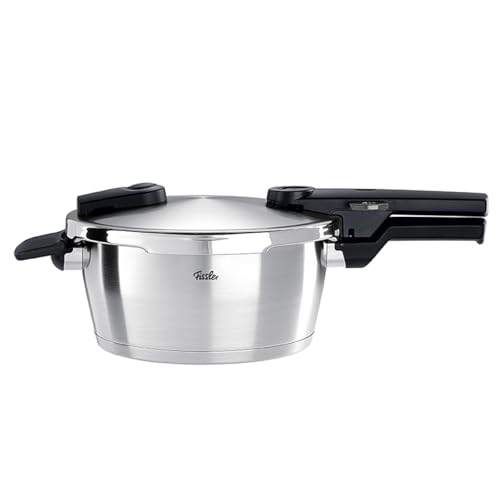
Fissler Vitaquick Premium 3.7 Quart Stovetop Pressure Cooker — Best Premium
Fissler is the name German home cooks reach for, and the Vitaquick Premium shows the national approach to pressure cooking: quiet spring valves instead of jiggling weights, a traffic-light-style pressure indicator tradition in the range, and a three-level safety system, all machined into 18/10 stainless steel. The listing’s claim of cooking up to 70% faster is the standard pressure-cooking comparison against conventional boiling — realistic for the dense foods pressure cookers exist for.
At 3.7 quarts this is the compact premium pick, sized for one to three people, side dishes, grains and small braises. Small pressure cookers have a real advantage beyond storage: less liquid and less mass to bring to pressure means the speed advantage of the format is at its most dramatic on weeknight quantities.
Strengths
- Spring-valve operation is quiet and precise compared with jiggle-tops
- Three-level safety system and premium 18/10 stainless build
- Induction compatible, suiting modern hobs
Trade-offs
- Premium tier — the most committed purchase in this guide per quart
- 3.7 quarts is too small for batch cooking or big families
- European sizing and parts channels take slightly more effort in the US
| Capacity | 3.7 quart |
| Material | 18/10 stainless steel |
| Safety | Three-level safety system |
| Compatibility | Induction compatible (per verified listing) |
The Vitaquick’s refinement shows in the release: spring-valve cookers hold pressure with minimal steam loss, so foods cook in less added liquid and flavours stay concentrated, and the valve’s settings let you treat delicate foods more gently than a single-pressure jiggle-top allows. For vegetables and fish — the foods beginners ruin in pressure cookers — that control is the difference between a tool you trust and one you avoid.
Buy it if pressure cooking will be a weekly habit and you value the instrument itself. The Presto cooks the same beans; the Fissler makes the process quieter, tighter and more pleasurable, which over a decade of weekly use is a rational thing to pay for.
Best for: smaller households and keen cooks who want the quiet, precise, premium end of stovetop pressure / Not suited for: batch cooks, big families, or budget-first buyers
Check the current price on Amazon

Kuhn Rikon Duromatic Stainless Steel Pressure Cooker, 5 Quart — Best Quiet Luxury
Kuhn Rikon’s Duromatic is the pressure cooker for people who dislike pressure cookers — or at least the rattling, steaming image of them. The Swiss design works like a handsome saucepan: a spring-loaded valve in the lid holds pressure silently, with the pin indicator rising to show the level, and no jiggling weight venting steam across the kitchen. In an open-plan home, that silence is not a luxury detail; it is the difference between cooking at pressure while life happens and banishing the cooker to noisy occasions.
Five quarts in a saucepan format also changes the storage and serving story. It pours, it goes to the table more gracefully than a stockpot-shaped cooker, and it earns its cupboard space on non-pressure days as a genuinely good saucepan with the pressure lid left off.
Strengths
- Near-silent spring-valve operation suits open-plan homes
- Saucepan format stores, pours and serves better than stockpot shapes
- Swiss build quality with a long service tradition
Trade-offs
- Premium tier pricing
- Saucepan shape gives a smaller base diameter for browning big batches
- US parts are available but less ubiquitous than Presto’s
| Capacity | 5 quart |
| Material | Stainless steel |
| Style | Saucepan-format pressure cooker |
| Brand | Kuhn Rikon (Swiss) |
Duromatic ownership runs on the same gasket discipline as every cooker here — rinse the valve, keep the rim clean, replace the ring when it hardens — and rewards it with one of the calmest cooking experiences in the category. The two pressure levels typical of the Duromatic design let you choose full pressure for beans and braises or a gentler level for vegetables and delicate grains.
Choose it if the cooker will live in a design-conscious, open kitchen and be used several times a week. Choose the Fissler if you prefer the German take on the same refinement in a smaller size; choose the Presto if refinement ranks below value and parts ubiquity.
Best for: open-plan kitchens and frequent cooks who want silent, elegant pressure cooking / Not suited for: budget buyers, or cooks who regularly brown large batches before pressurising
Check the current price on Amazon
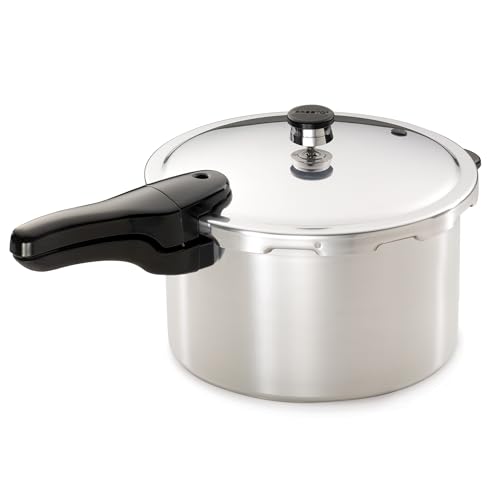
Presto 01282 8-Quart Aluminum Pressure Cooker — Best Budget Large
The 8-quart aluminium Presto is the cooker that shows up in farmhouse kitchens and canning-season garages across the country, and its formula is unchanged because it works: a big, light, fast-heating aluminium pot with Presto’s proven regulator system, at the most accessible tier of any full-size pick in this guide. Eight quarts means double batches of beans, stock from two carcasses, or a braise that feeds a crowd with leftovers.
Aluminium deserves its honest paragraph. It heats fast and evenly and keeps the big pot liftable when full — no small thing at eight quarts. Its costs are reactivity and finish: long acidic cooks can discolour it and pick up a metallic note, and it will never look as handsome as stainless after a decade. For stock, beans, grains and steaming, those costs barely register; for tomato braises, choose stainless.
Strengths
- Big capacity at the most accessible tier in this guide
- Light for its size and fast to heat
- Presto parts ecosystem — gaskets and regulators everywhere
Trade-offs
- Aluminium reacts to long acidic cooking and discolours over time
- Not the choice for induction hobs
- Classic regulator design needs the same by-ear adjustment as the 6-quart
| Capacity | 8 quart (about 5 quarts usable at the two-thirds fill line) |
| Material | Aluminum |
| Type | Stovetop pressure cooker |
| Model | Presto 01282 |
This is also the entry many pressure canners start with for pressure cooking before graduating to a dedicated canner — and the distinction matters: this is a pressure cooker, and low-acid canning belongs in a tested pressure canner used to current guidelines, a point the safety section below makes properly. As a cooker, though, the big Presto’s value per quart is unbeatable in this lineup.
Buy it for volume on a budget. If your cooking is acidic, your hob is induction, or your batches are small, the stainless picks serve you better.
Best for: batch cooks, stock makers and big households wanting maximum quarts per dollar / Not suited for: induction owners, or cooks whose pressure repertoire is mostly tomato-based
Check the current price on Amazon

T-fal Secure Trendy Stainless Steel Pressure Cooker, 8.5 Quart — Best Large for Families
The T-fal Secure Trendy is the modern family answer at the big end: 8.5 quarts of stainless steel, a five-point safety system, two cooking modes, and induction compatibility in the verified listing. The two modes matter in a family kitchen — a full-pressure mode for the beans and braises, and a gentler mode that keeps vegetables and delicate foods from blowing out to mush while a parent is answering the door.
Five-point safety, in plain terms, means the lid’s security does not rest on one mechanism: controlled opening and closing, pressure indication, and redundant release paths are layered so that no single failure and no single moment of user impatience can defeat them all. On a cooker this size, holding this much pressurised volume, that layering is exactly what a family buyer should be shopping for.
Strengths
- Largest stainless capacity here with induction compatibility
- Two cooking modes protect delicate foods
- 5-point safety system suits family kitchens
Trade-offs
- Big and heavy when full — a two-hand lift, always
- Family size is wasted on one- or two-person households
- More safety hardware means more parts to keep clean and check
| Capacity | 8.5 quart |
| Material | Stainless steel |
| Safety | 5-point safety system |
| Modes | 2 cooking modes |
| Compatibility | Induction (per verified listing) |
In use, the big T-fal settles into the batch rhythm: a Sunday pot of beans, a midweek stew that becomes two dinners, stock that fills the freezer. Its size also makes it the best steamer in this guide — a trivet and a few inches of water turn 8.5 quarts into a tamale and pudding steamer of real capacity.
Choose it if your household is four-plus and your hob includes induction. Choose the Presto 8-quart if budget outranks stainless and modes; choose the 6-quart Presto if 8.5 quarts would mostly heat air.
Best for: families of four or more wanting a big, modern, induction-ready stainless cooker / Not suited for: small households, or anyone who finds a full 8.5-quart pot hard to lift
Check the current price on Amazon

Peterboo Stainless Steel Pressure Cooker, 10 Quart — Best Extra-Large
Ten quarts is where pressure cookers stop being family appliances and become production tools: community kitchens, large multi-generational households, hunters and gardeners processing a harvest, and cooks who batch a month of beans and stock in one session. The Peterboo answers with stainless steel construction, a pressure indicator, safeguard devices, and compatibility with both gas and induction hobs per its verified listing.
Honesty about the brand is required: Peterboo does not carry the decades-long US track record of Presto, Fissler or Kuhn Rikon, and long-term gasket availability is less certain. The pick earns its place on capacity and specification for buyers who need ten quarts in stainless at a sane tier — a genuinely scarce combination — with eyes open about the trade.
Strengths
- The largest capacity in this guide, in stainless steel
- Works on gas and induction hobs
- Pressure indicator and safeguard devices fitted
Trade-offs
- Newer brand — long-term parts support is a calculated risk
- A full 10-quart cooker is a serious lift; plan the sink run
- Too much cooker for ordinary family meals
| Capacity | 10 quart (about 6.5 quarts usable at the two-thirds fill line) |
| Material | Stainless steel |
| Features | Pressure indicator, safeguard devices |
| Compatibility | Gas and induction (per verified listing) |
If you buy it, buy the insurance that costs almost nothing: order spare gaskets and any wear parts at the same time as the cooker, while the listing is current, and store them with the manual. That single habit neutralises most of the parts risk for any cooker from a smaller brand.
Used at its scale, the Peterboo is formidable — a harvest of beans, a whole batch of stock, a festival-sized stew — at full stovetop pressure, with the speed that makes big-batch cooking practical rather than a day-long project.
Best for: very large households, community and batch cooks who truly need 10 quarts / Not suited for: typical families, or buyers who rank brand longevity above capacity
Check the current price on Amazon
Comparison Table
| Pick | Badge | Key spec | Best for |
|---|---|---|---|
| Presto 01362 6-Quart Stainless Steel Pressure Cooker | Best Overall | 6-quart, stainless steel, stovetop | most households wanting a proven, full-pressure stovetop cooker at a mainstream tier |
| Fissler Vitaquick Premium 3.7 Quart Stovetop Pressure Cooker | Best Premium | 3.7 quart, 18/10 stainless, three-level safety, induction compatible | smaller households and keen cooks who want the quiet, precise, premium end of stovetop pressure |
| Kuhn Rikon Duromatic Stainless Steel Pressure Cooker, 5 Quart | Best Quiet Luxury | 5 quart, stainless steel, saucepan style | open-plan kitchens and frequent cooks who want silent, elegant pressure cooking |
| Presto 01282 8-Quart Aluminum Pressure Cooker | Best Budget Large | 8 quart, aluminum, stovetop | batch cooks, stock makers and big households wanting maximum quarts per dollar |
| T-fal Secure Trendy Stainless Steel Pressure Cooker, 8.5 Quart | Best Large for Families | 8.5 quart, stainless, 5-point safety, 2 modes, induction | families of four or more wanting a big, modern, induction-ready stainless cooker |
| Peterboo Stainless Steel Pressure Cooker, 10 Quart | Best Extra-Large | 10 quart, stainless, gas & induction compatible | very large households, community and batch cooks who truly need 10 quarts |
How to Choose the Best High Pressure Cookers
Size first, and size honestly. A pressure cooker works at two-thirds full at most — half for foaming foods like beans and grains — so divide your real batch by 0.6 and buy the size that matches. Four usable quarts (a 6-quart cooker) covers most family meals; two to three-person households thrive with 3.7 to 5 quarts; only genuine batch cooks should look at 8.5 and 10. Too big is not harmless: an oversized cooker needs more liquid to build pressure and heats a lot of air for a small stew.
Material second. Stainless steel is the default for a reason — non-reactive, durable, dishwasher-tolerant, and available with induction-ready bases. Aluminium is lighter and cheaper and heats beautifully, and it remains a rational choice for stock, beans and steaming, but it dislikes long acidic cooks and most induction hobs. Premium stainless from Fissler and Kuhn Rikon adds heavier bases and finer valves, which you feel in browning and in control.
Valve style third. Jiggle-top regulators (Presto’s classic system) are simple, audible and repairable forever, and they vent a little steam as they work. Spring valves (Fissler, Kuhn Rikon, T-fal) are quiet, lose less liquid, and often offer two pressure levels. Neither is more ‘correct’ — they are different relationships with the same physics, and the guide’s picks are explicit about which you are getting.
What ‘High Pressure’ Actually Means: PSI, Temperature and Time
Pressure cooking works because a sealed vessel raises the boiling point of water. At sea level, an open pot cannot exceed 100°C / 212°F no matter how hard it boils. Add the stovetop standard of roughly 15 psi of pressure above the atmosphere and the liquid inside can reach about 121°C / 250°F — and that temperature jump, not the pressure itself, is what cooks food two to four times faster. Beans that simmer for two hours cook in well under one; a beef braise that needs an afternoon lands in about an hour.
This is also the honest frame for the electric comparison. Most electric multi-cookers work at a lower pressure than the stovetop standard — commonly in a band noticeably below 15 psi — so their internal temperature is a few degrees lower and their recipes run longer. The difference per meal is often ten or fifteen minutes, which many owners happily trade for push-button convenience. But a buyer who specifically wants high pressure, or who cooks from stovetop pressure recipes, should know the classes differ, because timings are not interchangeable without adjustment.
Altitude is the variable nobody prints. At altitude, atmospheric pressure is lower, so a cooker’s working temperature drops and times lengthen; high-altitude cooks traditionally add time and, on weight-regulated cookers, use the heavier regulator setting where provided. If you live in the mountains, favour models with clear pressure indication and consult the manual’s altitude guidance rather than sea-level charts.
Stovetop vs Electric Pressure Cooking: An Honest Comparison
Choose stovetop — this guide’s class — if you want full pressure and the fastest times, a vessel that browns properly over real hob heat before the lid goes on, a pot that doubles as a stockpot, and an appliance with no electronics that will still be working, gasket swaps aside, in twenty years. Stovetop asks for your attention in return: you set the heat, you listen or watch for pressure, you time the cook.
Choose electric if you want to press a button and walk away, if your kitchen time is fragmented by children or work, or if the built-in programs — rice, yogurt, slow cook — match how you actually cook. The modern electric multi-cooker is a genuinely good appliance; it is simply a lower-pressure, more automated one, and buyers deserve that sentence stated plainly rather than discovered from a recipe that runs long.
Many serious kitchens end up with both: the electric for weeknight automation, the stovetop for beans, stock and the big weekend braise at full pressure. If budget forces one choice, let your scarcest resource decide — if it is time-at-the-stove, go electric; if it is speed, capacity and longevity, go stovetop.
Safety Systems on Modern Pressure Cookers, Explained
The pressure cooker of reputation — the rattling pot of your grandparents’ cautionary tales — is not the appliance in this guide. Modern stovetop cookers layer their safety: a lid that locks and physically cannot be opened while the vessel is pressurised; a pressure indicator that shows the state of the pot before you touch anything; a primary regulating valve that holds working pressure; a secondary release that vents if the primary is blocked; and a gasket designed to give way as a final, harmless vent rather than letting pressure climb. The T-fal’s ‘5-point’ system and Fissler’s ‘three-level’ system are brands naming this same layered philosophy.
Your part of the system is small and specific. Keep the valve and vent clean — a blocked vent is the one failure that defeats the design, and it is prevented by rinsing the lid works after use and never overfilling, especially with foaming foods. Inspect the gasket: if it is cracked, hardened or no longer seals without fiddling, replace it. And never force a lid: if it resists, pressure remains, and the correct move is to wait or cool the pot, never to lean on the handle.
One more reassurance belongs here, because first-time buyers ask for it: a cooker that is hissing gently at the regulator, or showing its indicator pin, is not ‘about to’ do anything dramatic — it is doing its ordinary job of holding a set pressure by venting the excess. The sounds and signs of normal operation become familiar within two or three cooks, and the cookers in this guide were chosen partly because their signals are clear enough to learn quickly.
Release methods are the last safety skill. Natural release — off the heat, untouched — suits braises and beans and finishes cooking gently. Cold-water release, running the pot (never the valve area of an electric, and only as the manual directs for stovetop) under a tap, drops pressure fast for vegetables. Quick steam release is for the models and foods the manual allows. Matching release to food is both a quality and a safety habit: foaming foods released too fast can sputter through the valve.
Pressure Canning: The Line This Guide Will Not Blur
Because big stovetop cookers and pressure canners look alike, this distinction belongs in any honest high-pressure guide. Pressure cooking prepares food to eat now. Pressure canning preserves low-acid food — vegetables, meats, soups — in sealed jars for shelf storage, and it is a tested, specification-driven process: it requires a dedicated pressure canner of sufficient size, a gauge or weighted system verified for accuracy, and current tested recipes and processing times from an authoritative source such as the USDA or the National Center for Home Food Preservation.
None of the cookers in this guide is sold or rated here as a canner, whatever their size, and using a cooker as a canner — or following heirloom canning timings — is exactly the kind of shortcut that food-safety guidance exists to prevent. If canning is your goal, buy a canner for canning and a cooker for cooking; several households in this category’s audience happily own both, for the same reason a kitchen owns both a knife and a cleaver.
Gaskets, Valves and Long-Term Care
A stovetop pressure cooker has exactly one consumable that matters: the sealing ring. Expect one to three years of regular use from it, and treat the symptoms — steam leaking from the rim, pressure that builds slowly or not at all, a ring that feels hard or looks cracked — as a replacement order, not a personality trait. Store the ring loose or in the inverted lid rather than compressed in a closed pot, and it will live longer.
The valve assembly wants a rinse after every use and a proper clean on schedule: remove what the manual allows you to remove, clear the vent with a soft brush or a stream of water, and confirm the indicator pin moves freely. Food residue in a vent is the root of nearly every pressure-cooker malfunction story, and it is entirely preventable in thirty seconds at the sink.
The pot itself is ordinary good cookware care: avoid thermal shock, do not scour stainless with anything that would wound it, and dry aluminium rather than leaving it wet. Do those things and the cookers in this guide are measured in decades — which, per meal cooked, makes even the premium picks some of the cheapest appliances in the kitchen.
Budget Tiers for High Pressure Cookers
We do not print prices, which change too often to print honestly, but the tiers here are unusually legible. The value tier is aluminium and mainstream stainless from Presto — full pressure, proven designs, minimal refinement. The mid tier buys stainless at larger sizes and modern safety systems, the T-fal’s territory. The premium tier — Fissler and Kuhn Rikon — buys spring-valve silence, two pressure levels, heavier bases and finer machining.
Spend according to frequency. A cooker used monthly for beans is perfectly served by the value tier for decades. A cooker used four times a week repays the premium tier in control and pleasure surprisingly fast, because the differences are in the parts you touch every single cook — the valve, the lid action, the base’s browning. Capacity, by contrast, should never be bought ‘just in case’: unused quarts are a cost at every single meal.
How to Use a Stovetop Pressure Cooker: Your First Bean Cook, Step by Step
Start with the forgiving classic: dried beans, which pressure cookers transform more dramatically than any other food. Rinse a pound of dried beans — no soak required at full pressure, though a soak shortens the cook further — and add them to the cooker with water to cover by a couple of inches, a splash of oil (which tames foaming), salt and aromatics. Check the total against the half-full line: beans foam, and the half line, not the two-thirds line, is their limit.
Close and lock the lid exactly as your manual shows, set the cooker over high heat, and wait for the signs of pressure — the indicator rising, or the regulator beginning its steady rock. That moment, not the moment you turned on the heat, is when timing starts. Reduce the heat to the lowest setting that keeps the regulator rocking gently or the indicator up, and cook black beans roughly twenty to twenty-five minutes at full pressure, chickpeas longer — your cooker’s chart is the authority for your exact model.
Release naturally for at least ten minutes — beans split and sputter under a fast release — then open the lid away from your face once the indicator confirms pressure is gone. Taste: the beans should be tender all through, the liquid seasoned and rich. Adjust salt now, simmer a few minutes open if you want the liquid thicker, and note your time in the margin of the manual. That note is the beginning of your own chart, calibrated to your cooker, your hob and your altitude.
Wash the lid works, rinse the valve, dry the gasket, and store the lid inverted. Total active effort for a pot of beans that would have taken an afternoon: about ten minutes. That ratio is the entire argument for high-pressure cooking, made in one meal.
Common Buying Mistakes
Overfilling past the line. Two-thirds maximum, half for beans, grains and anything that foams. Overfilling risks blocking the vent — the one failure the safety design cannot fully forgive.
Timing from when the heat goes on. Pressure-cooking times start when the cooker reaches pressure. Timing from cold adds unpressurised minutes and undercooks everything.
Forcing the lid when it resists. Resistance means pressure. Wait, or cool the pot as the manual directs. A lid that needs force is telling you something important.
Quick-releasing foaming foods. Beans, grains and porridge sputter through valves under a fast release. Natural release is part of their recipe, not a delay.
Ignoring a tired gasket. Steam at the rim and slow pressure are a worn ring asking to be replaced. It is the cheapest part on the cooker and the one everything depends on.
Using a cooker as a canner. Pressure canning low-acid food requires a dedicated canner and current tested procedures. Size and shape do not make a cooker into a canner.
Final Recommendation
For most households the Presto 01362 is the high-pressure cooker to buy first: full pressure, stainless steel, and a parts ecosystem that will outlive us all. The Fissler Vitaquick and Kuhn Rikon Duromatic are the connoisseur’s versions — quieter, finer, worth it if you cook at pressure weekly. The T-fal is the modern family big pot, the aluminium Presto the budget batch champion, and the Peterboo the honest answer when nothing under ten quarts will do.
Whichever you choose, learn the three habits that make pressure cooking safe and great: respect the fill lines, time from pressure, and keep the valve clean and the gasket fresh. Do that, and a high-pressure cooker becomes the hardest-working pot in the kitchen. Check the current price on Amazon for the exact model — and consider ordering a spare gasket in the same basket.
Presto 01362 6-Quart Stainless Steel Pressure Cooker — Check the current price on Amazon
Fissler Vitaquick Premium 3.7 Quart Stovetop Pressure Cooker — Check the current price on Amazon
Kuhn Rikon Duromatic Stainless Steel Pressure Cooker, 5 Quart — Check the current price on Amazon
Best German Pressure Cookers Best Home Pressure Cookers Best Fast Pressure Cookers Best Ever Pressure Cookers Best Electric Pressure Cookers With Stainless Steel Inner Pot
Frequently Asked Questions
What pressure does a stovetop pressure cooker actually reach?
The stovetop class is built around a long-standing standard of roughly 15 psi above atmospheric pressure at sea level, which lets the contents reach about 121°C / 250°F. Individual models indicate pressure with a weight, a spring valve or a pin; consult your model’s manual for its specific settings, as premium cookers often offer a gentler second level below the full standard.
Are modern pressure cookers safe?
Yes — a modern cooker from an established maker layers its protection: a lid that cannot open under pressure, a pressure indicator, a regulating valve, a backup release, and a gasket designed to vent safely as a last resort. The user’s part is simple: do not overfill, keep the valve clean, replace a worn gasket, and never force a lid.
Why do electric pressure cooker recipes differ from stovetop ones?
Because most electric multi-cookers work at a lower pressure than the stovetop standard, so their internal temperature is slightly lower and foods need longer. Recipes are written for one class or the other; when converting, add time for electric and subtract for stovetop, and always keep the same fill limits and liquid minimums your manual specifies.
How long does a pressure cooker gasket last?
Typically one to three years of regular use. Steam leaking from the rim, slow pressure build-up, or a ring that feels hard or looks cracked all mean it is time. Gaskets are inexpensive wear parts — for Presto models they are stocked almost everywhere, and ordering a spare with the cooker is a habit this guide recommends for every brand.
What size pressure cooker should a beginner buy?
For most households, a 6-quart stovetop cooker is the right first size: about four usable quarts under the fill rules, enough for a whole chicken or a family braise, without the weight and minimum-liquid demands of the big pots. Households of one or two who cook small quantities several times a week are often happier with the 3.7 to 5-quart premium models, which come to pressure faster on small amounts. Buy the second, bigger cooker later only if batch cooking genuinely enters your life — by then you will know exactly which size is missing.
Can I use a pressure cooker for canning?
A pressure cooker is not a pressure canner. Safe canning of low-acid foods requires a dedicated canner of adequate size and current, tested processing procedures from an authoritative food-safety source. Use the cookers in this guide for cooking — for canning, buy and use a canner as directed.


