Disclosure: airfryerkitchensupply.com is reader-supported. When you buy through links on our site, we may earn an affiliate commission at no extra cost to you.
Where to buy
Shopping for the best home pressure cookers starts with verified listings, not guesswork. Every pick in this guide was cross-checked against the Amazon listing data returned by the retailer’s own Amazon product listings, so the model names and capacities below match what is actually sold. Buy from the Amazon listings linked here so you get the exact configuration reviewed, the correct inner pot and lid for that model, and the manufacturer’s warranty support that comes with a new unit.
Shop the verified picks on Amazon: Instant Pot Duo 6 Qt 7-in-1 Electric Pressure Cooker; Instant Pot Duo Plus 6 Qt 9-in-1 Electric Pressure Cooker; COSORI 6QT Pressure Cooker, 9-in-1; Presto 01362 6-Quart Stainless Steel Pressure Cooker; Instant Pot Rio Mini 4 Qt 7-in-1 Electric Pressure Cooker; Presto 01264 6-Quart Aluminum Pressure Cooker. Use the links to check price on Amazon for each model, because listings, included accessories and availability change over time.
If you are shopping for the best home pressure cookers, the first honest thing to know is that the market splits cleanly in two: electric multi-cookers that pressure cook, slow cook, steam and sauté from one countertop unit, and classic stovetop pressure cookers that do one job — pressure — with no electronics at all. Both styles are well represented on Amazon right now, in sizes from a compact 4-quart mini up to family-size 6-quart workhorses, and every model named in this guide was verified against live listing data before it earned a place here.
The six picks below were chosen for home kitchens specifically, not for canning, not for commercial volume and not for feeding a crowd at a church hall. That means realistic weeknight capacity, controls a tired cook can operate at 6 p.m., parts that can be replaced when a sealing ring wears out, and safety systems that work quietly in the background. Two picks are stovetop models for cooks who distrust electronics or cook on gas; four are electric multi-cookers for households that want set-and-forget pressure cooking.
Read the Quick Picks for the shortlist, the detailed reviews for who each cooker genuinely suits, and the buying guide further down for the sizing maths that matters more than any feature list: a pressure cooker should never be filled more than two-thirds full, and only half full for beans and grains that foam, so the size printed on the box is never the amount of food you can actually cook.
One more framing before the picks: a home pressure cooker is a time machine for specific ingredients. Dried beans without soaking, stewing cuts that braise in a third of the oven time, stock with a depth that usually takes an afternoon, rice that frees a burner — judge every model below against the dishes you will actually pressure cook, because a cooker that matches your three most-cooked recipes will be used weekly, and one bought for imagined recipes will gather dust by spring.
In this guide
Quick Picks
Best Overall — Instant Pot Duo 6 Qt 7-in-1 Electric Pressure Cooker
The default recommendation for most homes: a 6-quart electric multi-cooker that pressure cooks, slow cooks, makes rice and yogurt, steams, sautés, warms and sterilizes, in a stainless steel build that has become the reference point every rival is measured against. Check price on Amazon
Best for Extra Functions — Instant Pot Duo Plus 6 Qt 9-in-1 Electric Pressure Cooker
A step up from the standard Duo with nine functions instead of seven, for cooks who actually use the extras — the same 6-quart stainless platform with a broader program set for households that cook varied food all week. Check price on Amazon
Best for Safety-First Buyers — COSORI 6QT Pressure Cooker, 9-in-1
The challenger pick: a 6-quart, 9-in-1 electric pressure cooker with a ceramic-coated inner pot and a listing that leads with its 12 safety features — the one to shortlist if pressure cooking still makes you slightly nervous. Check price on Amazon
Best Stovetop — Presto 01362 6-Quart Stainless Steel Pressure Cooker
The classic stovetop answer: a 6-quart stainless steel pressure cooker from the brand that defined the category, with no electronics to fail, nothing to plug in, and a design that works on gas, electric and camp stoves alike. Check price on Amazon
Best for Small Households — Instant Pot Rio Mini 4 Qt 7-in-1 Electric Pressure Cooker
The small-household pick: a 4-quart, 7-in-1 mini that slow cooks, makes rice, steams, sautés, makes yogurt and keeps food warm — the full electric pressure experience scaled for one or two people and small counters. Check price on Amazon
Best Budget Stovetop — Presto 01264 6-Quart Aluminum Pressure Cooker
The budget stovetop route into pressure cooking: a 6-quart aluminum Presto that does the same pressure work as its stainless sibling for less money, heating fast and light in the hand, in exchange for more careful cleaning. Check price on Amazon
How These Picks Were Chosen
Each candidate was checked against the manufacturer’s listing data returned through Amazon product listings: model name, capacity, construction material and headline functions all had to match the product we intended to describe. Models that could not be matched with confidence were left out rather than guessed at, and no price, star rating or review count appears anywhere in this guide because those figures change constantly and would mislead you within weeks.
The criteria that separated the six finalists from the long list were practical. Capacity had to suit home cooking — 4 to 6 quarts covers singles through families of five. Electric models needed a stainless or quality coated inner pot, a replaceable sealing ring and a lid that locks and vents predictably. Stovetop models needed a heavy base that sits flat, a clear pressure indicator and a regulator system with spares available. We also weighted how each cooker behaves at the boring jobs — rice, beans, stock, tough stewing cuts — because that is what a home pressure cooker does ninety percent of the time.
The 6 Best Home Pressure Cookers for Real Kitchens

Instant Pot Duo 6 Qt 7-in-1 Electric Pressure Cooker — Best Overall
This is the cooker to buy if you want one appliance that quietly replaces a slow cooker, a rice cooker and a steamer while doing the pressure work. It suits families of three to five, batch cooks who make stock and beans weekly, and anyone who wants proven behaviour rather than novelty. It is less suited to a one-person household with a tiny counter — the 4-quart Rio Mini further down is the smarter footprint there.
Strengths
- Seven functions in one unit genuinely retire separate appliances for most households
- Stainless steel inner pot handles sautéing before pressure cooking without a coating to baby
- Enormous recipe ecosystem, including the brand’s own app library, matched to this exact model’s programs
Trade-offs
- The 6-quart size is generous for a family but bulky on a small counter or in a shallow cupboard
- Like all multi-cookers, the slow-cook function runs differently from a dedicated crock — expect a learning curve
- The sealing ring absorbs strong food odours over time and becomes a periodic replacement item
| Capacity | 6 quart |
| Functions | 7-in-1: pressure cook, slow cook, rice, yogurt, steam, sauté, warm/sterilize (per listing) |
| Construction | Stainless steel (per listing) |
Why does this model keep winning the best overall slot years after launch? Because the basics are right. The stainless pot means you can brown meat hard on sauté, deglaze, and pressure cook in the same vessel with no flavour carry-over worries and no nonstick surface to scratch with a metal spoon. The 6-quart capacity is the sweet spot for home use: big enough for a whole chicken or a double batch of chilli, small enough that a Tuesday-night pot of rice does not look lost in it.
In daily use the Duo pattern is simple — load, lock, set the program, walk away. Pressure builds, the timer runs, and the keep-warm function holds the food safely afterwards, which is exactly the behaviour a home cook needs on a work night. The yogurt and sterilize functions sound like brochure filler until the first time you proof dough, make a batch of yogurt for a fraction of the shop price, or sterilize jars for jam; then they stop being filler.
Long-term ownership is the quiet strength. Sealing rings, inner pots, lids and float valves for this model family are easy to source, so a worn gasket in year three is a small parcel, not a new appliance. If you only buy one pressure cooker this decade, this is the safest pair of hands.
Ownership detail worth knowing: the Duo’s pot and lid are shared across a wide accessory ecosystem, so a second inner pot — one for savoury, one for yogurt and desserts — is a cheap, genuinely useful addition that owners of less common models cannot always find.
Also note the keep-warm behaviour: it holds food safely for hours without overcooking most braises, which quietly changes weeknight logistics for households whose members eat at different times.
Best for: most households wanting one proven electric multi-cooker for everyday pressure cooking / Not suited for: very small kitchens, or cooks who only ever pressure cook and want zero electronics
Check on Amazon — check the current price on Amazon before you decide.

Instant Pot Duo Plus 6 Qt 9-in-1 Electric Pressure Cooker — Best for Extra Functions
Choose the Duo Plus if your cooking genuinely ranges wider than the basics: more grains, more steaming, more one-pot experimenting, and a household that will use the additional programs rather than admire them. If your week is rice, beans and stew on repeat, the standard Duo above does the same job and the Plus premium buys you nothing you will touch.
Strengths
- Nine programs cover a wider range of everyday dishes without menu-diving guesswork
- Same 6-quart stainless steel pot and lid ecosystem as the core Duo line, so accessories interchange
- Pressure, slow cook, rice, yogurt, steam and sauté in one footprint for varied weekly cooking
Trade-offs
- The extra functions only pay off if your cooking is genuinely varied — basic routines never touch them
- Slightly more programs means slightly more scrolling for the two or three you use daily
- Same counter footprint as the standard Duo, so it solves no space problems
| Capacity | 6 quart |
| Functions | 9-in-1: pressure cook, slow cook, rice, yogurt, steam, sauté, warm, sterilize (per listing) |
| Construction | Stainless steel (per listing) |
The honest way to frame the Duo Plus is as the Duo with headroom. The pressure cooking core — the part that determines whether beans are tender and brisket slices cleanly — is the same proven platform. What the Plus adds is breadth: more dedicated programs tuned for specific foods, which matters if you regularly cook the foods those programs target and resent fudging times from a generic setting.
For a household cooking across cuisines — rice most nights, steamed fish on Fridays, yogurt on Sundays, a slow braise when the weather turns — that breadth removes friction. Each program is a tested time-and-pressure starting point, and starting points are what turn a pressure cooker from a weekend project into a weeknight habit.
The trade-off is discipline: a longer program list tempts owners into novelty cooking for a fortnight, then back to three favourites. Buy the Plus because your actual menu is wide, not because a longer list feels like better value. Judged that way, for the right kitchen, it earns its place.
The Plus also rewards households that cook grains beyond plain rice: the broader program set gives tested starting points for mixed grains and steamed vegetables, which is where multi-cooker owners quietly save the most weeknight time.
If your household cooks for guests often, the Plus’s broader program set handles the ‘second dish’ problem well — grains or vegetables pressure-cooked while the main course rests.
Best for: varied weekly cooking that will actually use nine programs / Not suited for: simple rice-beans-stew routines that never leave the basic settings
Check on Amazon — check the current price on Amazon before you decide.
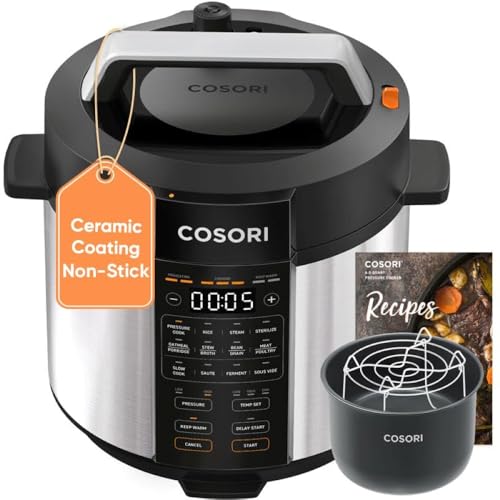
COSORI 6QT Pressure Cooker, 9-in-1 — Best for Safety-First Buyers
The COSORI suits cooks who want electric pressure cooking with the safety story front and centre, and anyone who prefers a ceramic-coated pot for everyday release of rice and grains. Sous vide in the function list is a genuine bonus for steak-and-eggs households. It is a poorer fit if you are hard on cookware with metal utensils, since any coated pot rewards gentler tools.
Strengths
- Listing highlights 12 safety features — the most safety-forward pitch in this roundup
- Ceramic-coated pot releases rice, oats and eggs with minimal soaking
- Sous vide function adds a technique no other pick here offers
Trade-offs
- Coated pot needs non-metal utensils and will not last as long as bare stainless under rough use
- A smaller ownership base than the Instant Pot line means fewer model-specific recipes online
- Ceramic coating and pressure lids still need the same gasket care as any electric model
| Capacity | 6 quart |
| Functions | 9-in-1 including rice cooker, slow cook, sous vide, sauté (per listing) |
| Inner pot | Ceramic coating (per listing) |
| Power | 1100W (per listing) |
Plenty of people quietly avoid pressure cookers because of stories from the stovetop era. The COSORI is built for them. Twelve listed safety features — lid locks, pressure release safeguards, overheat protection and the rest of the modern checklist — do not make pressure cooking risk-free, but they do make the failure modes boring, which is what you want. The lid will not open under pressure, the unit will not pressurize unsealed, and the release is controlled rather than theatrical.
The ceramic-coated pot is the other half of the appeal. Rice slides out, oatmeal does not weld itself to the base, and cleanup after a grain-heavy week is a soak-and-wipe instead of a scrub. The honest cost is longevity: coatings age, stainless does not. Treat the pot kindly and it serves for years; treat it like a stockpot and you will be shopping for a replacement pot sooner than the stainless crowd.
Add sous vide — genuinely useful, not a gimmick, for thick steaks and precise eggs — and this is the most interesting alternative to the default pick in the guide.
COSORI’s sizing is honest in use: the 6-quart pot takes a family batch without crowding, and the ceramic surface proves its worth most on day three of a rice-heavy week, when a stainless pot would be soaking and this one simply rinses.
Cleaning is a COSORI strength worth stating: the coated pot and the lid’s components rinse down fast, and the gasket removes easily for the wash it periodically needs.
Best for: nervous first-time pressure cooks and households wanting a ceramic pot plus sous vide / Not suited for: cooks who use metal utensils aggressively or want a decades-long inner pot
Check on Amazon — check the current price on Amazon before you decide.

Presto 01362 6-Quart Stainless Steel Pressure Cooker — Best Stovetop
Pick the Presto if you cook on gas and like controlling heat yourself, if you distrust appliances with circuit boards, or if you want a pressure cooker that can also live in a cabin or RV kitchen. It asks more of the cook — you manage the heat to hold pressure — so first-timers who want to press a button and leave should stay with the electric picks above.
Strengths
- No electronics: nothing to wear out except the gasket and regulator, both replaceable
- Stainless steel body shrugs off decades of use and any heat source, including open flame
- Faster to pressure and to release than most electrics once you learn your stove
Trade-offs
- You are the thermostat — heat must be adjusted to hold steady pressure without venting
- No timer, no keep-warm, no walk-away convenience of any kind
- Stovetop technique has a real learning curve for the first few cooks
| Capacity | 6 quart |
| Type | Stovetop pressure cooker |
| Construction | Stainless steel (per listing) |
A stovetop pressure cooker is a skill, and the Presto 01362 is the straightforward tool for learning it. The routine is tactile: bring it up over high heat until the regulator rocks gently, ease the burner down until it just maintains that rhythm, and time from there. Within a few sessions it becomes second nature, and you gain something electrics cannot give — instant response. Need to stop cooking now? A cold-water release drops pressure in under a minute.
Stainless steel is the right material choice here. It tolerates the high initial heat, does not react with tomato-heavy braises, and cleans up without ceremony. The 6-quart size matches the electric sweet spot: a family pot of beans, a batch of stock from a chicken carcass, or a corned beef with room for vegetables added after a first pressure cycle.
Longevity is the closing argument. This design’s wear parts are a rubber gasket and a small regulator — cheap, available and user-replaceable. Bought once and maintained lightly, a stovetop Presto is the pressure cooker most likely to be handed down rather than thrown out.
Stovetop technique tip that transforms this cooker: once the regulator settles into its gentle rhythm, mark the burner position with a mental note. Every stove has a ‘pressure setting’ for a given pot, and finding yours ends the hovering that puts beginners off stovetop cooking.
A regulator-weight Presto stores its spare gasket inside the lid for many owners — a small habit that means the replacement is always in the kitchen, not in a forgotten drawer.
Best for: gas-stove cooks who want full manual control and buy-it-for-life simplicity / Not suited for: anyone who wants set-and-forget, timed, walk-away cooking
Check on Amazon — check the current price on Amazon before you decide.

Instant Pot Rio Mini 4 Qt 7-in-1 Electric Pressure Cooker — Best for Small Households
The Rio Mini is for singles, couples, students in house-shares and anyone whose 6-quart cooker mostly cooks air. Four quarts is the honest size for two generous portions plus leftovers, a small batch of rice, or a soup for tonight and tomorrow’s lunch. Families of four should skip it — you will run it twice and resent it.
Strengths
- Right-sized capacity means food cooks in a sensible depth instead of a thin layer in a big pot
- Full 7-in-1 function set — nothing important was cut to shrink it
- Takes meaningfully less counter and cupboard space than 6-quart models
Trade-offs
- A whole chicken or a big batch of stock is simply beyond it
- Batch cooking for the freezer is limited by the 4-quart ceiling and the two-thirds fill rule
- Per-portion value is worse than a 6-quart if you regularly cook for guests
| Capacity | 4 quart |
| Functions | 7-in-1: slow cook, rice, steam, sauté, yogurt, keep warm (per listing) |
| Finish | Black (per listing) |
Undersized pressure cooking is an underrated pleasure. In a 4-quart pot, a cup of rice sits at the depth the program expects, a small pork shoulder braises in its own juices instead of swimming, and the unit comes to pressure noticeably faster because there is less volume to heat. For one or two people, the Mini is not a compromise version of the big cooker — it is the correct tool.
The function list matters here: this is a true 7-in-1, so the small household loses nothing in capability. Yogurt for two, steamed dumplings, a sautéed base for soup, slow cooking on a Sunday — all present. The keep-warm function also suits irregular schedules, holding dinner safely while a partner’s train is late.
Be honest about the ceiling before buying. The two-thirds fill rule means roughly 2.5 usable quarts, which is dinner for two with leftovers, not a meal-prep marathon. If your life is small-batch and your kitchen is small too, that ceiling will never bother you — and the counter space you save is real, every single day.
The Mini also shines as a second cooker in a larger household — rice or vegetables in the Mini while the main pot handles the braise — which is why some 6-quart owners end up buying it as a companion rather than a replacement.
The Mini’s smaller lid and pot are also easier to wash in a small sink — a mundane virtue that compact-kitchen owners feel daily and reviewers rarely mention.
Best for: singles, couples and small kitchens cooking dinner-sized batches / Not suited for: families, freezer batch cooking or whole-chicken ambitions
Check on Amazon — check the current price on Amazon before you decide.

Presto 01264 6-Quart Aluminum Pressure Cooker — Best Budget Stovetop
Choose the aluminum Presto if price is the deciding factor, if you want a lighter pot to lift when full, or as a second cooker for beans while the main pot is busy. Skip it if you cook a lot of acidic, tomato-heavy dishes and hate hand-washing, because aluminum asks for a gentler cleaning routine than stainless.
Strengths
- The most affordable way into real pressure cooking in this guide
- Aluminum heats quickly and the full pot is noticeably lighter to move
- Same simple, repairable stovetop design language as the stainless Presto
Trade-offs
- Aluminum can discolour with acidic foods and prefers hand washing
- Not the choice for induction hobs — check your stove type before ordering
- Softer metal dents more easily than stainless under clumsy storage
| Capacity | 6 quart |
| Type | Stovetop pressure cooker |
| Construction | Aluminum (per listing) |
Aluminum pressure cookers are the originals — the design that fed families for generations before stainless became the default — and the 01264 keeps that tradition at the friendliest price in this roundup. The physics are on its side: aluminum conducts heat eagerly, so the pot reaches pressure quickly and responds fast when you trim the burner, and the whole unit, full of stew, is kinder to wrists than a steel equivalent.
The compromises are about care, not cooking. Acidic ingredients can darken the interior over time — cosmetic, but real — and the dishwasher is unkind to aluminum, so this is a hand-wash pot. It also will not work on an induction hob, which rules it out for a growing number of kitchens; on gas or a conventional electric element it is completely at home.
As a first pressure cooker on a budget, or a dedicated bean pot alongside another cooker, it makes excellent sense. You are buying the same pressure, the same safety architecture and the same replaceable gaskets as the stainless model — just in the lighter, thriftier metal.
Aluminum care tip: wash this pot by hand with a soft sponge and dry it promptly, and the interior stays bright for years. The darkening that alarms new owners after a tomato cook is cosmetic oxidation, not damage, and a simmer of water with a spoon of cream of tartar lifts most of it.
As a second cooker for beans — the role many owners buy it for — the aluminum Presto’s speed to pressure is a genuine workflow gift: beans started when the main dish goes in, done when it rests.
Best for: budget buyers and anyone wanting a light, fast-heating stovetop cooker / Not suited for: induction kitchens or dishwasher-only households
Check on Amazon — check the current price on Amazon before you decide.
Comparison Table
| Pick | Badge | Key spec | Best for |
|---|---|---|---|
| Instant Pot Duo 6 Qt 7-in-1 Electric Pressure Cooker | Best Overall | 6 Qt, 7-in-1 electric multi-cooker, stainless steel build | most households wanting one proven electric multi-cooker for everyday pressure cooking |
| Instant Pot Duo Plus 6 Qt 9-in-1 Electric Pressure Cooker | Best for Extra Functions | 6 Qt, 9-in-1 electric multi-cooker, stainless steel build | varied weekly cooking that will actually use nine programs |
| COSORI 6QT Pressure Cooker, 9-in-1 | Best for Safety-First Buyers | 6QT, 9-in-1, ceramic-coated pot, 12 safety features (per listing) | nervous first-time pressure cooks and households wanting a ceramic pot plus sous vide |
| Presto 01362 6-Quart Stainless Steel Pressure Cooker | Best Stovetop | 6-quart stovetop, stainless steel | gas-stove cooks who want full manual control and buy-it-for-life simplicity |
| Instant Pot Rio Mini 4 Qt 7-in-1 Electric Pressure Cooker | Best for Small Households | 4 Qt mini, 7-in-1 electric, black finish (per listing) | singles, couples and small kitchens cooking dinner-sized batches |
| Presto 01264 6-Quart Aluminum Pressure Cooker | Best Budget Stovetop | 6-quart stovetop, aluminum | budget buyers and anyone wanting a light, fast-heating stovetop cooker |
How to Choose the Best Home Pressure Cookers for Your Kitchen
The first decision is electric versus stovetop, and it is really a decision about how you cook. Electric multi-cookers manage pressure, timing and keep-warm automatically; they suit busy households, nervous beginners and anyone who wants dinner to handle itself. Stovetop cookers give you speed, searing power and total control, and they suit confident cooks, gas-stove kitchens and anyone who keeps appliances for decades. Neither is objectively better — the wrong choice is the one that fights your habits.
Size comes next, and the fill rules discipline the maths. A pressure cooker is filled to two-thirds at most, and only halfway for foaming foods like beans, lentils and grains. So a 6-quart cooker really delivers about 4 quarts of stew or 3 quarts of beans — perfect for a family of four with leftovers. A 4-quart mini delivers dinner for two. Buying bigger ‘just in case’ backfires: small quantities cook poorly in an oversized pot, and the unit colonises your cupboard.
Finally, look at the inner pot and the wear parts. Stainless pots sear better and last indefinitely; coated pots release grains and clean faster but age. Whatever you choose, confirm that sealing rings and gaskets for that exact model are sold separately — a pressure cooker with an unavailable gasket is a pressure cooker with an expiry date.
- Electric for automation and keep-warm; stovetop for control, speed and longevity
- Size for your real batch, remembering the two-thirds and one-half fill rules
- Stainless inner pot for searing and lifespan; coated pot for easy-release grains
- Check that gaskets, rings and regulators for the model are sold as spares
- Match the cooker to your hob: aluminum stovetop models do not suit induction
Electric vs Stovetop: What Changes at the Stove
Electric models trade raw speed for certainty. They take a little longer to reach pressure, but the pressure they hold is steady, the timing is exact, and the keep-warm safety net means a delayed dinner is still a safe dinner. Their lids pack in the safety systems — locking pins, pressure sensors, controlled release — that make modern pressure cooking a non-event.
Stovetop models are faster and more responsive, and they sear with a ferocity electrics cannot match, because the burner under them is far more powerful than any countertop element. The cost is attention: you regulate the heat, you watch the clock, and you decide when dinner is done. For cooks who enjoy that involvement, a stovetop cooker is the more satisfying tool; for cooks who want to load a pot at lunch and eat at six, it is the wrong one.
A practical middle path many households land on: an electric multi-cooker as the daily driver, and — only if pressure cooking becomes a serious habit — a stovetop pot later for stock, beans and canning-adjacent volume work. Start with the style that matches your temperament and the second purchase, if it ever happens, will make itself obvious.
Sizing, Fill Lines and the Two-Thirds Rule in Practice
The fill rules printed inside every pressure cooker are the most ignored instructions in the kitchen, and they explain most disappointing results. Liquid expands, starches foam and proteins release juices as they cook, so the space above the food is not headroom — it is the steam reservoir the cooker runs on. A pot filled to the brim cannot build clean pressure, vents starchy foam through its valves, and cooks unevenly because the steam cannot circulate.
In practice the working capacities of this guide’s sizes are: a 6-quart cooker delivers about 4 quarts of finished stew, soup or chilli, or 3 quarts of dried beans cooked from scratch. A 4-quart mini delivers about 2.5 quarts of finished food — dinner for two with leftovers, or a side dish for a family meal cooked in a second cooker. Plan menus against those working numbers, not the box numbers, and the cooker will never feel too small.
One more sizing nuance: tall, narrow loads cook differently from wide, shallow ones. A whole chicken in a 6-quart pot leaves room for steam around it; the same chicken wedged into a 4-quart mini touches the lid and cooks unevenly. When a recipe matters — a holiday brisket, a cheesecake in a springform — leave the extra inch. Pressure cooking is forgiving about many things, but not about physics.
What to Cook First: A New Owner’s First Three Weeks
Week one is for trust-building: the water test, then rice, then hard-boiled eggs if your model steams. These cooks teach the machine’s sounds — the hiss before the valve seals, the silence of full pressure, the voice of the quick release — with ingredients that forgive everything. By the third cook, the appliance stops being an event and becomes a tool.
Week two is for the ingredient pressure cooking was invented for: dried beans. A pot of black beans or chickpeas from dry, in under an hour, with texture no tin delivers, converts more sceptics than any other dish. Follow with a batch of stock from a roast chicken carcass and you have justified the purchase twice over, in flavour and in the freezer’s new contents.
Week three is for the celebration cook: the tough cut transformed. Short ribs, a pork shoulder, a brisket — the dishes that used to own a Sunday afternoon, done on a weeknight. Cook one, and the cooker’s place in the kitchen is permanent. Owners who follow this arc rarely return their machines; owners who start with a complicated layered recipe sometimes do, which is a sequencing failure, not a product failure.
How to Use a Home Pressure Cooker Safely, Step by Step
Pressure cooking is safe when the routine is respected. Whether your cooker is electric or stovetop, the sequence below is the habit that keeps it boring in the best way.
- Check the gasket and valves before every use: the sealing ring should be supple and seated evenly, and the steam release and float valve should move freely with no food debris in the channels.
- Add food and liquid, respecting the fill lines — never above two-thirds full, and only half full for beans, grains and other foaming foods. Always include the minimum liquid the manual specifies so the cooker can generate steam.
- Lock the lid fully and confirm the seal: on electrics, the lid chime or indicator; on stovetop models, the handles aligned and the lid seated as the manual describes.
- Bring the cooker to pressure — start the program on an electric model, or use high heat on a stovetop model until the regulator signals pressure, then reduce heat to the lowest setting that maintains it.
- Time the cook from the moment full pressure is reached, not from when you switched the unit on.
- Release pressure the way the recipe directs: natural release (leave it alone) for meats and foaming foods, quick release (venting steam carefully, hands and face clear) for vegetables and delicate foods.
- Open the lid away from your face once the float valve has dropped or the stovetop cooker shows no pressure, and confirm with a gentle nudge of the valve if you are ever unsure.
- Wash the lid, gasket and valves after use, dry the gasket fully before storing, and store the lid upside down on electrics so the ring is not compressed and odour-trapped.
Two safety habits deserve emphasis. Never force a lid: if it resists, pressure remains, and the correct response is patience, not strength. And never leave a stovetop cooker unattended at high heat during the come-up phase — that is the one window where your attention is genuinely part of the safety system.
Common Buying Mistakes
Overfilling past the line. It is the classic beginner error and the cause of sputtering valves and undercooked centres. Respect the two-thirds rule, and halve it for beans and grains.
Buying capacity for imaginary guests. A cooker sized for a hypothetical dinner party cooks badly for Tuesday’s two portions. Size for your weekly reality; a second small batch beats a cavernous pot.
Ignoring the gasket. A hardened or nicked sealing ring causes slow pressure loss that owners misdiagnose as a dying cooker. Inspect it, wash it, and replace it when it stiffens — it is a consumable.
Quick-releasing everything. Foaming foods and large cuts of meat need natural release; venting them fast can clog the valve and toughen the meat. Match the release to the food.
Skipping the water test. Every new cooker deserves one trial run with plain water before food goes in. It teaches you the sounds, the timing and the release behaviour with zero stakes.
Final Recommendation
If you want one recommendation: the Instant Pot Duo 6 Qt is the cooker most homes should buy — proven, stainless, right-sized and supported by the deepest recipe ecosystem. Nervous first-timers and ceramic-pot fans should look hard at the COSORI, whose safety-forward design and sous vide function make it the most interesting alternative. Gas-stove traditionalists get the Presto 01362 in stainless, budget buyers the aluminum 01264, small households the Rio Mini, and wide-ranging cooks the Duo Plus.
Whichever you choose, run the water test first, learn its sounds, and give it three ordinary weeknight cooks before judging it. Pressure cookers reward a short apprenticeship with years of faster beans, better stock and tougher cuts turned tender on a Tuesday.
Start with the top pick here: Instant Pot Duo 6 Qt 7-in-1 Electric Pressure Cooker — check price on Amazon, confirm the configuration on the listing, and order once you have matched it against the checks in this guide.
Keep researching within this cluster: Best 10 Quart Pressure Cookers Best Cookware Sets For Gas Ranges Best Cookware Sets For Glass Top Best Hot Dog Roller Cookers Best Cookware Sets For Family Camping.
Frequently Asked Questions
What size pressure cooker is best for a family of four?
A 6-quart model is the sweet spot. With the two-thirds fill rule it delivers about 4 quarts of finished stew, soup or chilli — dinner for four with leftovers — and it still handles a whole chicken or a double batch of beans. Go 8-quart only if you regularly batch cook for the freezer.
Are electric pressure cookers safer than stovetop ones?
Modern versions of both are safe when used as directed, but they fail differently. Electrics layer in automatic locks, sensors and controlled release, so there is less for the cook to get wrong. Stovetop models rely on the cook to regulate heat, but offer faster response and simpler, repairable mechanics. Choose based on your habits, not fear.
Can I cook frozen meat in a pressure cooker?
Yes — that is one of its best tricks. Frozen chicken pieces, stew meat and even a small frozen joint can go straight in; add roughly half again to the usual cooking time and ensure the pieces are separated enough for steam to circulate. Always check the internal temperature of poultry and large cuts before serving.
Why does my cooker take so long to come to pressure?
Come-up time depends on volume and temperature: a full, cold pot can take 10–20 minutes before the timer starts, which is normal and is not cooking time lost — food is heating throughout. A worn gasket leaking steam around the lid rim is the common fault when come-up suddenly gets much slower than it used to be.
How often should I replace the sealing ring?
Inspect it every few months and replace it when it stiffens, cracks, stays stretched or holds odours that survive washing — typically every 12–24 months in regular use. Many owners keep a spare and dedicate separate rings to savoury and sweet cooking.
Can a pressure cooker replace a slow cooker and rice cooker?
For most households, an electric multi-cooker genuinely can: the picks above slow cook, cook rice and steam as well as pressure cook. Purists will find small differences — slow-cook heat patterns differ from a ceramic crock, and dedicated rice cookers edge out grains — but for everyday food the consolidation is real and the cupboard space saved is significant.


