Disclosure: airfryerkitchensupply.com is reader-supported. When you buy through links on our site, we may earn an affiliate commission at no extra cost to you.
Where to buy
Finding the best furnace filter for smokers is really about one specification: a pleated filter rated MERV 13 or higher, ideally with activated carbon in the frame for odour. Every pick below is a current, verified listing in the common residential sizes, and the right one for you depends on your filter slot size and depth — measure before you order, because a filter that almost fits filters nothing around its edges.
- Filterbuy 20x25x1 MERV 13 Smoke & Allergy Defense (6-Pack) — check price on Amazon; choose the listing sold or shipped by Amazon or the brand’s own store, and confirm the exact model name before you order.
- Filtrete 20x25x1 Air Filter, MERV 13, MPR 1900 (2-Pack) — check price on Amazon; choose the listing sold or shipped by Amazon or the brand’s own store, and confirm the exact model name before you order.
- BNX TruFilter 20x25x1 MERV 13 Smoke, Allergy, Pet Defense (6-Pack) — check price on Amazon; choose the listing sold or shipped by Amazon or the brand’s own store, and confirm the exact model name before you order.
- Filtrete 20x25x4 Air Filter, MERV 13, MPR 1900 (2-Pack) — check price on Amazon; choose the listing sold or shipped by Amazon or the brand’s own store, and confirm the exact model name before you order.
- Filterbuy 16x25x1 MERV 10 Odor & Allergy Defense with Activated Carbon (4-Pack) — check price on Amazon; choose the listing sold or shipped by Amazon or the brand’s own store, and confirm the exact model name before you order.
- Filtrete 20x25x1 Air Filter, MERV 14, MPR 2800 (2-Pack) — check price on Amazon; choose the listing sold or shipped by Amazon or the brand’s own store, and confirm the exact model name before you order.
If someone smokes indoors in your home, the best furnace filter for smokers is the hardest-working consumable in your HVAC system. Tobacco smoke is made of extremely fine particles, and the cheap fibreglass panel filters fitted to many furnaces were designed to protect the blower from lint and hair, not to catch fine particulate. A modern pleated filter rated MERV 13 captures far more of that fine material as air circulates, and versions built with activated carbon also adsorb a share of the odour compounds that make a house smell stale. This guide is about choosing that filter correctly — the right rating, the right size, and a change schedule that keeps it working.
Two honest limits belong up front. First, no furnace filter cleans a room while someone is actively smoking in it; filtration works over hours of air circulation, and it reduces lingering particles and odour — it does not erase them, and this guide makes no health claims for any filter. Second, a stronger filter is not automatically a better filter: higher ratings resist airflow, and a system that cannot pull air through a dense filter will heat and cool worse, not better. The picks below balance capture against airflow, and the guide sections explain how to tell where your own system sits.
The six picks cover the mainstream 20×25 and 16×25 slots in both 1-inch and deep 4-inch formats, from a value six-pack to a maximum-filtration option for homes that need it. All are verified listings; sizes are stated in the listing titles themselves, and the actual dimensions — always slightly smaller than the nominal size — are quoted in the spec boxes so you can compare them against the filter you pull out of your own slot.
In this guide
Quick Picks
- Best Overall — Filterbuy 20x25x1 MERV 13 Smoke & Allergy Defense (6-Pack): the filter this category is named for — a MERV 13 electrostatic pleated design sold as a smoke defence line, in a six-pack that covers a year and a half of quarterly changes. Check on Amazon
- Best Widely Available Brand — Filtrete 20x25x1 Air Filter, MERV 13, MPR 1900 (2-Pack): 3M’s Filtrete at the same MERV 13 working rating, sold under its MPR 1900 label — the pick for buyers who want the biggest name in filtration and easy reordering. Check on Amazon
- Best Value Six-Pack — BNX TruFilter 20x25x1 MERV 13 Smoke, Allergy, Pet Defense (6-Pack): the same MERV 13 smoke specification as the leaders, in a value six-pack — the pick for households that change on schedule and buy by the case. Check on Amazon
- Best Deep-Pleat, Long Life — Filtrete 20x25x4 Air Filter, MERV 13, MPR 1900 (2-Pack): for homes with a 4-inch media cabinet — deep pleats hold far more captured smoke particulate, and the listing rates service life at twelve months instead of three. Check on Amazon
- Best for Odour — Filterbuy 16x25x1 MERV 10 Odor & Allergy Defense with Activated Carbon (4-Pack): the odour specialist — a carbon-loaded pleated filter in the 16×25 size, trading some particle rating for the activated carbon that stale smoke smell actually responds to. Check on Amazon
- Best Maximum Filtration — Filtrete 20x25x1 Air Filter, MERV 14, MPR 2800 (2-Pack): one step beyond MERV 13 — ultrafine particle reduction for homes that need the most capture a 1-inch filter offers, with an airflow warning that must be read first. Check on Amazon
How These Picks Were Chosen
Each pick was verified: we searched the manufacturer’s product data, matched the returned listing title — including its size, MERV rating and pack count — against the filter we intended to recommend, and only then printed a buy link. That verification matters more in this category than most, because filter listings are a swamp of near-identical sizes and ratings, and ordering a 20×25 when your slot takes a 16×25 is the most common failure in the entire category.
Selection then balanced four things: filtration rating appropriate for fine smoke particles (MERV 13 is the working standard; MERV 14 appears once, with its airflow caveat stated plainly), activated carbon where odour control is the priority, pack economics — filters are a subscription you pay forever — and format coverage, so both the common 1-inch slot and the deeper 4-inch media cabinet are served. No pick is a medical device, none is marketed here with health promises, and the guide says clearly what filtration can and cannot do for a home where people smoke.
The 6 Best Furnace Filter for Smokers Options, by Slot and Need

Filterbuy 20x25x1 MERV 13 Smoke & Allergy Defense (6-Pack) — Best Overall
Filterbuy’s Smoke & Allergy Defense line is the rare filter actually engineered and labelled for this exact job, and it earns the top badge on fit rather than novelty. The MERV 13 electrostatic pleated media is the correct specification for fine smoke particles: the pleats multiply surface area so the filter can hold more captured material before airflow suffers, and the electrostatic charge helps the media grab particles smaller than the gaps between fibres. In a 20x25x1 slot — the most common residential size in North American furnaces — this is the default recommendation.
It suits the majority of homes where people smoke: a standard 1-inch slot, a system in decent health, and a household willing to change filters on schedule. The six-pack format matters more than it looks — filtration only works if changes actually happen, and a box in the closet removes the shopping trip from the equation. It does not suit systems already struggling for airflow, where the deep-pleat 4-inch pick below is the smarter route, or homes whose main complaint is odour rather than particles — that is the carbon pick’s job.
Strengths
- MERV 13 pleated media matched to fine smoke particle sizes
- Electrostatic media captures beyond simple mechanical sieving
- Six-pack keeps a year-plus of scheduled changes on hand
Trade-offs
- 1-inch depth loads faster than deep-pleat filters in smoky homes
- No activated carbon — particles are its job, odour is secondary
- 20×25 size only helps if your slot actually measures 20×25
| Nominal size | 20x25x1 in |
| Actual size | 19.50 x 24.50 x 0.75 in (per listing title) |
| Rating | MERV 13 (per listing title) |
| Media | Electrostatic pleated (per listing title) |
| Pack | 6 filters (per listing title) |
Change discipline is where this filter succeeds or fails. In a home with regular indoor smoking, treat the printed three-month guidance as a ceiling, not a target: inspect monthly, and change when the media greys and the pleats look loaded, which in a smoky home can be closer to six or eight weeks. A loaded filter does double damage — it stops capturing efficiently and it strangles airflow, making the whole system work harder to move less air. Write the install date on the frame with a marker; memory is not a maintenance system.
Fit check before the box is opened: pull your current filter and read its frame. The nominal 20x25x1 on this listing corresponds to an actual 19.50 x 24.50 x 0.75 in per the title, which is normal — filters are always undersized slightly to slide in. If your old filter’s actual dimensions differ meaningfully, or it sits loose with gaps at the edges, order by your slot’s measured size instead. Air takes the path of least resistance, and a gap at the frame is a highway around all that MERV 13 media.
Best for: most homes with a 20x25x1 slot that want the correct smoke-rated filter without drama / Not suited for: odour-first complaints, weak-airflow systems, or slots of any other size
Check on Amazon — check the current price on Amazon before you order.
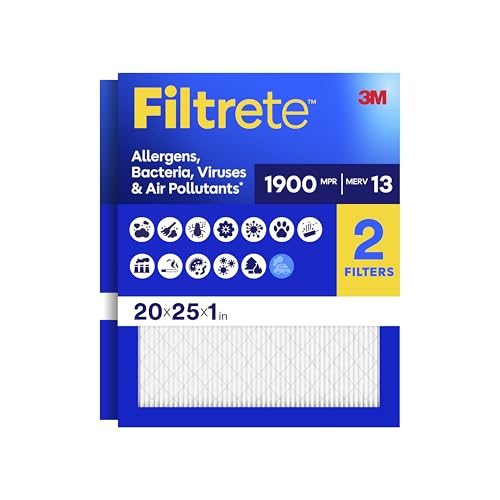
Filtrete 20x25x1 Air Filter, MERV 13, MPR 1900 (2-Pack) — Best Widely Available Brand
Filtrete is the brand most people meet first in filtration, and this is its correct model for a smoker’s home: MERV 13, expressed in 3M’s own MPR system as 1900. The two ratings describe the same job — capturing fine particles including smoke particulate as air recirculates — and the listing states a three-month service life per filter, which in a smoking household should be treated as the outer limit. The electrostatically charged media is designed to attract particles actively rather than merely sieve them, which helps most in the first weeks of a filter’s life.
It suits buyers who value brand support, consistent sizing and a filter they can also grab at any hardware store when a delivery is late. The two-pack is a reasonable starting quantity if you are upgrading from fibreglass for the first time and want to see how your system handles the denser media before committing to a case. It does not suit bulk buyers — per-filter economics favour the six-packs in this guide — or odour-first households, since this line is particle-focused.
Strengths
- MERV 13 / MPR 1900 rating appropriate for fine smoke particles
- Backed by the category’s most established manufacturer
- Consistent sizing and availability across retailers
Trade-offs
- Two-pack is the least economical way to buy a forever consumable
- No activated carbon layer for odour compounds
- Three-month rating is optimistic in a home with daily indoor smoking
| Nominal size | 20x25x1 in |
| Actual size | 19.62 x 24.62 x 0.78 in (per listing title) |
| Rating | MERV 13, MPR 1900 (per listing title) |
| Service life | 3 months (per listing title) |
| Pack | 2 filters (per listing title) |
The MPR-versus-MERV confusion is worth settling once: MERV is the industry standard test, MPR is 3M’s proprietary scale, and this filter carries both numbers on its listing — MERV 13 and MPR 1900 — so you can compare it directly against other brands’ MERV figures. What you cannot compare is a bare MPR number from a listing that hides its MERV; this one does not hide, which is part of why it is here.
Practical note for smoking households: because smoke particles are at the fine end of what filters catch, the pressure drop across this filter rises steadily as it loads. If your vents whisper weaker in week six than week one, the filter is telling you it is done regardless of what the calendar says. In a smoker’s home the filter’s condition, not its birthday, is the change signal — inspect it monthly against a light and you will never guess wrong.
Best for: brand-loyal buyers upgrading from fibreglass panels for the first time / Not suited for: bulk-value shoppers or households whose main issue is smoke odour
Check on Amazon — check the current price on Amazon before you order.

BNX TruFilter 20x25x1 MERV 13 Smoke, Allergy, Pet Defense (6-Pack) — Best Value Six-Pack
BNX built its name on exactly this proposition: name-brand filtration specifications at direct-brand pricing, sold in the pack sizes people actually consume. The TruFilter’s listing is admirably explicit — MERV 13, cross-referenced to MPR 1900 and FPR 12, electrostatic pleated media, made for smoke among its stated targets — so there is no detective work in comparing it to the Filterbuy and Filtrete above. On paper it matches them; in the budget it undercuts the small packs decisively.
It suits disciplined households that change filters on a calendar and want a case in the closet, landlords maintaining a rental where a tenant smokes (with the lease conversation handled separately), and anyone whose 20x25x1 slot eats four to six filters a year. It does not suit buyers who want carbon odour treatment in the same product, or systems that need the gentler airflow of a lower rating — this is a full MERV 13, with the airflow resistance that implies.
Strengths
- Full MERV 13 smoke-rated spec at value six-pack pricing
- Listing states MERV, MPR and FPR cross-references openly
- Electrostatic pleated media, made in the USA per the listing
Trade-offs
- Value brand — less retail presence if you need one today
- No carbon layer for odour
- Same 1-inch loading limits as any thin filter in a smoky home
| Nominal size | 20x25x1 in |
| Actual size | 19.69 x 24.69 x 0.75 in (per listing title) |
| Rating | MERV 13, MPR 1900 & FPR 12 (per listing title) |
| Media | Electrostatic pleated (per listing title) |
| Pack | 6 filters (per listing title) |
The honest question with value filters is construction: does the frame seal, do the pleats stay spaced, does the media survive three months of humid return air without sagging? Pleat support and frame rigidity are what separate a cheap filter from a good value one, and they are exactly what to inspect when the box arrives — pleats should be even and firm, the frame square, the media bonded at the edges. If any filter in any brand arrives crushed or warped, it will bypass air at the edges and should go back.
For a smoking household the arithmetic favours this pack strongly. You will change filters more often than a non-smoking home — that is the physics of fine particulate loading — so the per-change cost dominates the five-year cost of filtration. A value six-pack at the correct rating, changed on time, outperforms a premium filter changed late, every single time. Filtration is a schedule with a product attached, and this pick is built for the schedule.
Best for: scheduled changers and multi-filter households buying MERV 13 by the case / Not suited for: odour-first needs or anyone who wants a filter from a physical shelf today
Check on Amazon — check the current price on Amazon before you order.

Filtrete 20x25x4 Air Filter, MERV 13, MPR 1900 (2-Pack) — Best Deep-Pleat, Long Life
If your furnace takes a 4-inch filter, you own the solution to the 1-inch filter’s core problem: loading. Depth buys pleat area — this Filtrete packs several times the media surface of its 1-inch sibling into the same face size — so it captures at MERV 13 while resisting airflow less and holding far more material before it needs changing. The listing rates it at twelve months of service, and while a smoking household should inspect rather than trust any calendar, the deep format genuinely does outlast thin filters by a wide margin in smoky air.
It suits homes with a media cabinet or a deep slot, owners who hate quarterly filter chores, and systems whose blowers dislike the pressure drop of a loaded 1-inch MERV 13 — the deep pleats are kinder to airflow at the same rating. It absolutely does not suit a 1-inch slot: a 4-inch filter cannot be cut, folded or forced, and a slot conversion is an HVAC technician’s job, not a Saturday improvisation.
Strengths
- Deep pleats hold far more particulate before airflow suffers
- Twelve-month rated life — the lowest-maintenance pick here
- MERV 13 capture with gentler pressure drop than thin filters
Trade-offs
- Only fits 4-inch slots and media cabinets — no exceptions
- Higher per-filter cost (offset by the longer life)
- A neglected deep filter hides a lot of loading before it shows symptoms
| Nominal size | 20x25x4 in |
| Actual size | 19.75 x 24.63 x 4.31 in (per listing title) |
| Rating | MERV 13, MPR 1900 (per listing title) |
| Service life | 12 months (per listing title) |
| Pack | 2 filters (per listing title) |
The twelve-month figure deserves the same scepticism as every rating in this guide, adjusted for format: deep media genuinely degrades more gracefully, because captured material distributes across far more surface. In a home with daily indoor smoking, plan on inspecting at six months and changing when the media is visibly loaded — which may be month eight or may be month twelve. The failure mode to avoid is forgetting the filter exists precisely because it lasts so long; put the inspection dates in a calendar the day you install it.
This is also the pick that makes the strongest case for a one-time HVAC upgrade conversation. If your system has a 1-inch slot and your household smokes indoors, a technician-fitted media cabinet that accepts filters like this one converts filtration from a quarterly chore with mediocre capacity into a twice-yearly non-event with better airflow. That is a home-improvement decision beyond this guide’s scope, but for this specific household profile it is the correct long-term answer.
Best for: homes with 4-inch media cabinets that want MERV 13 capture with minimal chores / Not suited for: 1-inch slots — it physically cannot fit, and no workaround is safe
Check on Amazon — check the current price on Amazon before you order.

Filterbuy 16x25x1 MERV 10 Odor & Allergy Defense with Activated Carbon (4-Pack) — Best for Odour
Particles and odour are different problems with different tools. The fine particles in smoke are caught mechanically by MERV 13 media; the stale smell that lingers in a smoker’s home rides on gas-phase compounds that sail straight through particle media — and activated carbon is the household technology that adsorbs them. This Filterbuy pairs a MERV 10 pleated particle stage with carbon in a 16x25x1 frame, and for households whose complaint is the smell when they walk through the door, it is the most relevant pick in this guide.
It suits 16×25-slot homes — the second most common residential size — where odour is the headline issue: a smoker who has quit and left the smell behind, a home being prepared for sale or guests, a landlord turning a unit over. The MERV 10 particle stage still captures far more fine material than a fibreglass panel. It does not suit particle-first priorities — for maximum particulate capture at this size, the honest route is a MERV 13 in 16×25 from the same brands above — or anyone expecting carbon to work forever: carbon saturates, and when the odour returns, the filter is done even if it looks clean.
Strengths
- Activated carbon targets the odour compounds particle filters miss
- Covers the common 16×25 slot the other picks do not
- MERV 10 media is gentler on airflow than MERV 13
Trade-offs
- Lower particle rating than the MERV 13 picks
- Carbon saturates invisibly — odour return is the change signal
- Carbon capacity in a 1-inch frame is modest; heavy odour needs source control too
| Nominal size | 16x25x1 in |
| Actual size | 15.50 x 24.50 x 0.75 in (per listing title) |
| Rating | MERV 10 (per listing title) |
| Media | Pleated with activated carbon (per listing title) |
| Pack | 4 filters (per listing title) |
Set expectations precisely, because carbon filters are oversold everywhere else. A carbon furnace filter reduces circulating odour over days of runtime; it does not deodorise a room during or immediately after smoking, and it cannot pull smell out of curtains, upholstery and paint, which is where entrenched smoke odour actually lives. In a former smoker’s home, this filter is one leg of a three-legged job — deep cleaning of soft furnishings, sealing paint where needed, and carbon filtration for the air itself. Sold that way, it performs; sold as a miracle, it disappoints.
Change timing works differently here too: judge this filter by your nose at the return vent, not by its colour. In an actively smoking home the carbon stage may exhaust in weeks, which is the honest cost of odour control and why the four-pack format exists. If odour is mild and particles are the worry, save the carbon money and buy the MERV 13 picks; if the smell is the whole problem, this is your filter and the schedule is part of the deal.
Best for: 16×25-slot homes where lingering smoke odour is the main complaint / Not suited for: maximum particle capture, or anyone expecting instant deodorising
Check on Amazon — check the current price on Amazon before you order.

Filtrete 20x25x1 Air Filter, MERV 14, MPR 2800 (2-Pack) — Best Maximum Filtration
MERV 14 is where residential filtration gets serious about the finest particles, and this Filtrete — MPR 2800 in 3M’s scale, listed for ultrafine particle reduction — is the strongest 1-inch option in this guide. For a home where smoking happens indoors daily and the occupants want the maximum particulate capture a standard slot can deliver, this is the ceiling of sensible: beyond it lie specialty systems, not filters. The listing states a three-month life; in a smoky home, inspect at six weeks.
It suits newer or well-maintained systems with strong blowers, homes that have already run MERV 13 without airflow complaints, and particle-first priorities where odour is handled separately. It does not suit older systems, long duct runs, or any setup where MERV 13 already weakened the vents — stepping up a rating on a struggling system trades air quality for heating and cooling performance, and can stress the blower. The guide section below explains the simple tests that tell you which side of that line your system is on.
Strengths
- Highest particulate capture available in a standard 1-inch filter
- Ultrafine focus matches the finest smoke particle sizes
- Same trusted Filtrete sizing and construction as the MERV 13 pick
Trade-offs
- Greatest airflow resistance here — wrong for weak or older systems
- Loads fastest in smoky homes; inspection discipline is mandatory
- Premium tier per filter, in a two-pack
| Nominal size | 20x25x1 in |
| Actual size | 19.69 x 24.69 x 0.81 in (per listing title) |
| Rating | MERV 14, MPR 2800 (per listing title) |
| Focus | Ultrafine particle reduction (per listing title) |
| Service life | 3 months (per listing title) |
| Pack | 2 filters (per listing title) |
The physics is unforgiving: finer capture means denser media, denser media means pressure drop, and pressure drop is paid by your blower on every cycle. A system designed with MERV 14 in mind shrugs this off; a system designed around a fibreglass panel may move noticeably less air, run longer cycles and still capture beautifully at the filter while conditioning the house worse. That is not a defect in this filter — it is a matching problem, and it is why this pick carries a warning label in prose while the MERV 13 picks do not.
If you step up to this filter, monitor the first month like a trial: vents should feel as strong as before, cycles should not lengthen obviously, and there should be no new whistling at the return. Pass those checks and you own the strongest filtration in this guide. Fail any of them and drop back to MERV 13 without regret — the difference between the two ratings is real but modest, while the difference between a healthy system and a strangled one is neither.
Best for: strong, modern systems in homes with daily indoor smoking and particle-first priorities / Not suited for: older or airflow-marginal systems — try MERV 13 first and step up only if it thrives
Check on Amazon — check the current price on Amazon before you order.
Comparison Table
Compare the picks on the three facts that decide fit: nominal size and depth, filtration rating from the listing, and the job each filter does best in a home where people smoke. Measure your existing filter before ordering any of them.
| Pick | Badge | Key spec | Best for |
|---|---|---|---|
| Filterbuy 20x25x1 MERV 13 Smoke & Allergy Defense (6-Pack) | Best Overall | 20x25x1, MERV 13, electrostatic pleated, 6-pack | most homes with a 20x25x1 slot that want the correct smoke-rated filter without drama |
| Filtrete 20x25x1 Air Filter, MERV 13, MPR 1900 (2-Pack) | Best Widely Available Brand | 20x25x1, MERV 13 / MPR 1900, 3-month life | brand-loyal buyers upgrading from fibreglass panels for the first time |
| BNX TruFilter 20x25x1 MERV 13 Smoke, Allergy, Pet Defense (6-Pack) | Best Value Six-Pack | 20x25x1, MERV 13, MPR 1900 equivalent, 6-pack | scheduled changers and multi-filter households buying MERV 13 by the case |
| Filtrete 20x25x4 Air Filter, MERV 13, MPR 1900 (2-Pack) | Best Deep-Pleat, Long Life | 20x25x4, MERV 13, 12-month deep media | homes with 4-inch media cabinets that want MERV 13 capture with minimal chores |
| Filterbuy 16x25x1 MERV 10 Odor & Allergy Defense with Activated Carbon (4-Pack) | Best for Odour | 16x25x1, MERV 10 with activated carbon | 16×25-slot homes where lingering smoke odour is the main complaint |
| Filtrete 20x25x1 Air Filter, MERV 14, MPR 2800 (2-Pack) | Best Maximum Filtration | 20x25x1, MERV 14 / MPR 2800, ultrafine capture | strong, modern systems in homes with daily indoor smoking and particle-first priorities |
How to Choose the Best Furnace Filter for Smokers in Your Home
Three decisions decide this purchase, in order: size, depth and rating. Size is non-negotiable and measured, not guessed — pull your current filter and read its frame, then measure the slot itself, because the frame’s nominal size is a category, not a measurement. Every listing in this guide states actual dimensions in its title for exactly this reason. Depth comes second: a 1-inch slot takes 1-inch filters, a 4-inch media cabinet takes deep filters, and the two never substitute for each other. Only once size and depth are fixed does rating become a choice rather than a gamble.
On rating, the working answer for smoke is MERV 13. Smoke particles concentrate at the fine end of the particle spectrum, and MERV 13 is the rating at which pleated residential media captures the bulk of that fine fraction while remaining compatible with most healthy systems. MERV 11 and below leave too much of the fine fraction circulating; MERV 14 captures more and is the right step-up only for systems that have already proven they breathe well through MERV 13. Ratings above that belong to specialty housings, not standard slots.
- Measure the slot and read the old filter’s frame before ordering anything.
- Match depth exactly: 1-inch and 4-inch filters are different products, not sizes of one product.
- Default to MERV 13 for smoke particles; step to MERV 14 only on a proven-strong system.
- Choose carbon when odour is the complaint, particle rating when particles are.
- Buy packs, not singles — a filter in the closet is a change that actually happens.
Finally, budget honestly for the schedule, not the filter. In a home where people smoke indoors, any filter in this guide is a consumable measured in weeks-to-months, and the five-year cost of filtration is the per-filter price multiplied by disciplined changes. A value six-pack changed on time beats a premium filter stretched past its life on every measure that matters — capture, airflow and system health alike.
MERV, MPR and FPR: Reading Filter Ratings Without a Decoder Ring
MERV — Minimum Efficiency Reporting Value — is the industry-standard scale, awarded under a common test method, and it is the only number directly comparable across every brand. Higher MERV means finer capture and, unavoidably, more airflow resistance. MPR is 3M Filtrete’s proprietary scale and FPR is a retail scale used by some chains; both roughly track MERV but neither converts exactly, which is why the honest listings in this guide print their MERV alongside any house scale. When a listing shows only a house number, treat it as marketing until you find the MERV.
What the numbers mean for smoke specifically: the particles that make smoke visible and persistent are predominantly sub-micron to a few microns across. Fibreglass panels and low-MERV synthetics are nearly transparent to that fraction. Pleated media at MERV 11 begins to engage it; MERV 13 captures it substantially; MERV 14 extends capture further into the ultrafine range. No residential filter captures gases — that is carbon’s separate job — and no rating printed on any box changes those physics. Buy the rating your system can breathe through, at the highest level it tolerates happily.
Airflow: The Test That Decides Between MERV 13 and MERV 14
Your system will tell you its filtration ceiling if you listen. Fit the MERV 13 first — it is the correct default — and live with it for a full cycle of weather. Vents should blow with their usual strength, heating and cooling cycles should run their usual length, and the return grille should not develop a new whistle or a visible bow in the filter when you inspect it. Pass all of that and your system is a candidate for the MERV 14 step-up if you want it.
Fail any of it and the answer is not a stronger blower or a prayer — it is a lower-resistance route to the same capture: a deep-pleat 4-inch conversion if a technician confirms the cabinet fits, or MERV 13 changed more often so it never reaches the loaded state where resistance peaks. A half-loaded MERV 13 breathes easier than a fresh MERV 14 in many real systems, which is the kind of unglamorous truth that decides whether filtration helps your home or quietly taxes it.
How to Install and Maintain a Furnace Filter in a Smoker’s Home
Installation takes five minutes and no tools beyond, occasionally, a step stool. The discipline around it — inspection rhythm, dating, sealing gaps — is what separates homes where filtration works from homes where a good filter sits strangled or bypassed. Work through the sequence once and it becomes habit.
- Turn the system off at the thermostat or switch before opening the filter slot; a running blower can pull a loose filter into the duct.
- Slide the old filter out and note its condition and the airflow arrow on its frame — the arrow points toward the furnace, and the new filter goes in the same way.
- Read the old frame’s size and compare it with the new filter’s actual dimensions before unwrapping anything else.
- Inspect the slot: wipe loose dust from the rails, and check for gaps around the frame where air can bypass the media entirely.
- Slide the new filter in with the airflow arrow toward the furnace, fully seated, frame flush on all four sides.
- Write the install date on the frame edge with a marker, facing out, so the next inspection starts with information.
- Restore power, run the blower, and feel two or three vents — airflow should match what you felt before the change.
- Set two reminders now: an inspection in four to six weeks (sooner in a heavily smoking home) and a hard change date at the filter’s rated life.
Between changes, the highest-value habit in a smoker’s home is running the blower. Filtration only happens when air moves: set the thermostat’s fan to circulate or run it for periods each day, especially in the hours after smoking happens indoors, so the air in the rooms actually passes through the filter instead of settling into the soft furnishings. A great filter under a blower that never runs is furniture. Pair the runtime with source habits that cost nothing — smoking near an exhaust or a cracked window where possible — and the filter’s job shrinks to what it can genuinely do well.
Common Buying Mistakes
The champion mistake in this category is ordering by nominal size from memory and discovering — filter in hand, system open — that the slot is the other common size. Measure first; the picks above cover 20×25 and 16×25 precisely because those two sizes dominate, and they are not interchangeable. Second is the rating leap: jumping from a fibreglass panel straight to the densest filter on the shelf, then blaming filtration when the house stops heating evenly.
- Installing the filter backwards — the airflow arrow exists because media is layered, and reversed filters shed and underperform.
- Stretching a filter to a year because the house ‘seems fine’, while capture and airflow quietly collapse.
- Buying carbon for a particle problem or MERV for an odour problem — they are different tools.
- Leaving the plastic wrap or cardboard shipping sleeve on a new filter (it happens more than anyone admits).
- Ignoring a bowed or sucked-in filter at inspection — that is the system reporting excess resistance.
- Expecting any filter to make an actively smoked-in room smell fresh in real time. It works over hours, not minutes.
And the quietest mistake: forgetting that the filter protects the system as much as the air. A smoking household loads filters with fine, sticky particulate that also coats blower wheels and coils when filtration fails, turning a cheap consumable schedule into an expensive service call. The filter is the cheapest insurance in the entire HVAC system — keep it current.
Final Recommendation
For most homes, the answer is the Filterbuy MERV 13 six-pack: the correct rating for smoke particles, in the most common size, in the pack format that keeps changes happening. Filtrete’s MERV 13 is the equal alternative for brand-loyal buyers, BNX’s six-pack is the value play at the same specification, and the deep-pleat Filtrete is the upgrade for 4-inch cabinets. Choose the carbon Filterbuy when the smell is the problem, and the MERV 14 Filtrete only when your system has already proven it breathes happily through MERV 13.
Whatever you install, write the date on the frame and set the inspection reminder before you close the slot. In a home where people smoke, the best furnace filter is not a product so much as a rhythm — the right rating, changed on time, with air actually moving through it.
- Filterbuy 20x25x1 MERV 13 Smoke & Allergy Defense (6-Pack) — best overall pick; check price on Amazon.
- Filtrete 20x25x1 Air Filter, MERV 13, MPR 1900 (2-Pack) — best widely available brand pick; check price on Amazon.
- BNX TruFilter 20x25x1 MERV 13 Smoke, Allergy, Pet Defense (6-Pack) — best value six-pack pick; check price on Amazon.
Keep exploring the cluster: Best Food Smokers Best 20 X 20 X 1 Air Filter For Smokers Best Gas Meat Smokers Best Gas Grill Smokers Best Gas Smokers Under $300
Frequently Asked Questions
What MERV rating is best for cigarette smoke?
MERV 13 is the working standard for smoke particles in a residential furnace: it captures the fine fraction that dominates tobacco smoke while remaining compatible with most healthy HVAC systems. MERV 14 captures more of the ultrafine fraction and suits strong, modern systems. Below MERV 11, most fine smoke particulate passes through largely untouched.
Will a furnace filter remove the smell of smoke from my house?
Partially, and slowly. Particle filters do not address odour at all; activated-carbon filters adsorb some odour compounds from circulating air over hours and days. Entrenched smoke smell also lives in curtains, upholstery, carpets and paint, which no filter can reach — those need cleaning or sealing. A filter is one part of the answer, not the whole of it.
How often should I change the filter in a home where people smoke?
More often than the box suggests. Inspect a 1-inch filter monthly and change it when the media is visibly loaded — in an actively smoking home that is often every six to eight weeks rather than three months. Deep 4-inch filters last far longer; inspect at six months. The filter’s condition, not the calendar, is the true signal.
Can a high-MERV filter damage my furnace?
It cannot damage it directly, but an overly dense filter on a system that cannot move air through it causes longer cycles, weaker heating and cooling, and extra blower strain. That is a matching problem: start at MERV 13, confirm airflow stays healthy, and only then consider stepping up. A bowed or whistling filter is the system asking you to step back down.
Does filter size really matter if it is close?
Yes — completely. Air takes the easiest path, and a filter that leaves gaps at the frame lets unfiltered air bypass the media entirely, which defeats the rating you paid for. Measure the slot, compare actual dimensions (always slightly under the nominal size, and printed in each listing here), and never cut or force a filter to fit.
Should I run my fan continuously to help filtration?
Running the fan on circulate for periods each day genuinely helps, because filtration only occurs while air moves through the filter — it matters most in the hours after smoking happens indoors. Continuous full-speed fan is rarely necessary; a circulation setting that moves air periodically captures most of the benefit at a fraction of the energy.


