Disclosure: airfryerkitchensupply.com is reader-supported. When you buy through links on our site, we may earn an affiliate commission at no extra cost to you.
Where to buy
If you are shopping for the best food mixers for cake making, start with the shortlist below. Every linked model in this guide was checked against Amazon’s own catalogue data for this site before it earned a link, and the listing is where you confirm the exact bowl size, colour and included attachments for the configuration you want. Prices move often in this category, so use the listing rather than any roundup to see what a model costs today.
- KitchenAid Artisan 5-Qt Tilt-Head Stand Mixer KSM150PS — check the current price on Amazon and confirm the exact configuration on the listing before you order.
- KitchenAid 5.5-Qt Bowl-Lift Stand Mixer KSM55 — check the current price on Amazon and confirm the exact configuration on the listing before you order.
- Cuisinart Precision Master 5.5-Quart Stand Mixer SM-50 — check the current price on Amazon and confirm the exact configuration on the listing before you order.
- KitchenAid Artisan Mini 3.5-Qt Tilt-Head Stand Mixer KSM3316 — check the current price on Amazon and confirm the exact configuration on the listing before you order.
- SMEG SMF04 Classico 5-Qt Stand Mixer — check the current price on Amazon and confirm the exact configuration on the listing before you order.
- KitchenAid 9-Speed Hand Mixer KHM926 — check the current price on Amazon and confirm the exact configuration on the listing before you order.
Start with the honest definition: the best food mixers for cake making are not simply the most powerful mixers you can buy. Cake batter is not dough. Where bread rewards torque, cake rewards control — the ability to cream butter and sugar into an aerated paste, to whip egg whites to a peak that stands but does not break, and then to fold flour through that foam at a speed slow enough to keep the air you worked so hard to create. A mixer that does those three things well will make better cake than a stronger machine with a crude low speed and a head you dread opening to scrape the bowl.
That is why this guide judges mixers through a cake-making lens rather than a general one. Bowl size is matched to real cake quantities — the standard layer cake, the dozen cupcakes, the family sponge — rather than headline capacity. Speed ranges are judged at the bottom as much as the top. Access matters: cake making is a stop-and-scrape discipline, so how a machine opens, and how its bowl handles, shapes your results as surely as its motor does. The six machines below cover the full landscape, from a drawer-sized hand mixer to a bowl-lift frame for celebration cakes.
One market truth before the picks: there is no bad machine on this list, but there are wrong-sized ones. Most disappointing mixer purchases in cake making are capacity mistakes — a small-batch baker wrestling a cavernous bowl, or an ambitious baker doubling batter in a machine that was never meant for it. Read the verdicts with your actual repertoire in mind: the cakes you bake monthly, not the one you baked once. The right-sized mixer, used weekly, beats the flagship used resentfully every time.
In this guide
Quick Picks
Short on time? These are the best food mixers for cake making worth a serious look, each chosen for a different kind of baker, budget and counter. The badge beside each name is the same badge used in its full review further down, so you can jump straight to the model that matches how you actually bake.
- Best Overall — KitchenAid Artisan 5-Qt Tilt-Head Stand Mixer KSM150PS: The safest all-round cake machine: a tilt-head body that makes bowl scraping easy, ten speeds with a genuinely gentle low end, and a 5-quart bowl sized for standard layer-cake batters.
- Best for Big Layer Cakes — KitchenAid 5.5-Qt Bowl-Lift Stand Mixer KSM55: A bowl-lift machine with 11 speeds and a stainless 5.5-quart bowl for bakers who scale up: taller layer cakes, bigger buttercream batches and stiffer batters without head flex.
- Best Value — Cuisinart Precision Master 5.5-Quart Stand Mixer SM-50: Twelve speeds, a 5.5-quart stainless bowl and a full three-attachment kit at a mid-range tier — the cake-making essentials with none of the flagship cost.
- Best for Small Batches — KitchenAid Artisan Mini 3.5-Qt Tilt-Head Stand Mixer KSM3316: The Artisan formula shrunk for small kitchens and small cakes: a 3.5-quart bowl that suits single layers, small sponges and half-batches where big bowls underperform.
- Best Design-Led Pick — SMEG SMF04 Classico 5-Qt Stand Mixer: A 600W, 10-speed planetary mixer in SMEG’s 1950s styling with smooth-start and steady-mix systems — for bakers who want the machine displayed, not stored.
- Best Hand Mixer for Cakes — KitchenAid 9-Speed Hand Mixer KHM926: Nine speeds with a soft-start, a pro whisk and dough hooks — the hand mixer that handles cake batters, foams and cream in any bowl you own, then lives in a drawer.
How These Picks Were Chosen
Every model in this guide was checked against Amazon’s catalogue data through this site’s own verification system before it was given a purchase link, and the specifications quoted — bowl capacities, speed counts, included attachments — are the ones confirmed in that listing data, not copied from marketing roundups. Models that could not be confirmed were left out or written about without a link. Prices were deliberately not printed: they change too often in this category to be useful in print, so each pick links to its live listing with a prompt to check the current price on Amazon.
The judging criteria were cake-specific. First, low-speed quality: can the machine stir and fold gently, or does its slowest setting still spin like a whisk? Second, aeration tools: a proper wire whisk or whip, and beaters shaped to incorporate air during creaming. Third, bowl practicality — capacity matched to standard cake quantities, a shape that scrapes cleanly, and handling that suits pouring batter into tins. Fourth, access: how easily the head or bowl opens for the repeated scraping cake making demands. Fifth, honest sizing across budgets, from a hand mixer to a bowl-lift frame, so the list maps to real kitchens rather than a single price point.
The 6 Best Food mixers for cake making

Best Overall: KitchenAid Artisan 5-Qt Tilt-Head Stand Mixer KSM150PS
Cake making asks different things of a mixer than bread does. The work is aeration, not brute force: creaming butter and sugar until the mixture pales and traps air, whipping egg whites or cream to precise peaks, then folding dry ingredients through without undoing that work. The Artisan earns the top spot here because its speed range is honest at both ends — the low settings genuinely creep, which is what folding demands, and the top end whips cream quickly and evenly. The tilt-head design matters more for cakes than for almost any other job, because you are in and out of the bowl constantly: scraping down, checking texture, adding eggs one at a time.
Strengths
- Tilt-head access makes the stop-scrape-fold rhythm of cake making fast and tidy
- Low speeds are slow enough to fold flour in without knocking out the air you just whipped in
- Huge attachment and colour ecosystem, so the machine grows with your baking
Trade-offs
- Tilt-head hinge can develop a slight wobble after years of heavy use if the hinge pin is not checked
- Bowl has no handle on some configurations, which matters when pouring thin batter
- Not the choice for double batches of dense batter — step up to a bowl-lift model instead
| Bowl capacity | 5 quart |
| Design | Tilt-head |
| Speeds | 10 speed settings |
| Included | Pouring shield for mess-free mixing |
In practical terms, the 5-quart bowl is the right size for the standard repertoire — a two- or three-layer cake, a batch of cupcakes, a Swiss roll sponge — without so much empty volume that a small genoise batter gets lost under the beater. The planetary action, where the beater shaft orbits the bowl while spinning, reaches the sides well enough that creaming is even, though no stand mixer fully eliminates scraping, and this one is no exception. Plan on two proper scrapes during creaming and one during folding; the tilt head makes each one a five-second job instead of a wrestling match.
Where the Artisan shows its limits is at the extremes of the cake repertoire. A doubled batter for a tall celebration cake pushes the bowl close to its working limit, and very stiff mixtures — a dense fruit cake batter late in mixing, for example — will make the head work harder than a bowl-lift machine would. Neither is a reason to avoid it for cake making specifically; they are reasons to size honestly. If your cake making is standard domestic baking done well and often, this is the machine the rest of the list is measured against, and its enormous colour range means it can live on the counter, which is exactly where a cake mixer gets used most.
Best for: home bakers making layer cakes, sponges and buttercream every week / Not suited for: bakers who routinely double recipes or knead stiff dough in the same machine
Check the current price on Amazon for the KitchenAid Artisan 5-Qt Tilt-Head Stand Mixer KSM150PS in the colour and configuration you want.

Best for Big Layer Cakes: KitchenAid 5.5-Qt Bowl-Lift Stand Mixer KSM55
When cake making scales up — a four-layer birthday cake, a wedding-cake trial, a bake-sale run of cupcakes — the limiting factor stops being aeration and becomes capacity and rigidity. The KSM55 answers both. Its bowl-lift frame clamps the 5.5-quart stainless bowl between two arms, so heavy batter cannot rock the head the way it can on a tilt-head machine, and the 11-speed range keeps the gentle low end that folding still requires even at this size. It arrives with the full cake-making kit: flat beater for creaming, wire whip for foams and cream, and a dough hook for the days the same machine has to earn its keep on bread.
Strengths
- Bowl-lift frame stays rigid with large, heavy batters that make tilt-heads nod
- 11 speeds include a soft half-speed style low end for folding delicate foams
- Generous bowl swallows doubled cake batters and big buttercream batches
Trade-offs
- Taller than a tilt-head — measure your cabinet clearance before ordering
- Bowl removal is a lift-and-twist motion that takes a few uses to become automatic
- Overkill for single small sponges, where much of the bowl sits empty
| Bowl capacity | 5.5 quart, stainless steel |
| Design | Bowl-lift |
| Speeds | 11 mixing speeds |
| Included | Flat beater, dough hook, wire whip |
The detail cake bakers will appreciate most is speed control at the bottom of the dial. Folding flour into a whipped sponge is where home bakers lose volume, usually because the mixer’s lowest speed is still too aggressive and they compensate by under-mixing, leaving flour pockets. A true slow speed lets the machine do the first folds evenly while you finish the last few by hand with a spatula — the professional sequence, and one this machine supports properly. The stainless bowl also chills well, which helps when you are stabilising whipped cream or working with buttercream in a warm kitchen.
The compromises are physical. Bowl-lift machines are taller and heavier than tilt-heads, and this one wants a permanent home on the counter rather than a life in a cupboard; check the clearance under your wall cabinets with the bowl raised. Removing the bowl means lifting it off its pins, which is secure but slower than tilting a head back. For the baker whose cake making regularly means big, tall or multiple cakes, those are fair trades for a frame that never feels strained — and for everyone else, they are the reason the Artisan above exists.
Best for: bakers who make celebration cakes, doubled batters and large frosting batches / Not suited for: small kitchens with low wall cabinets or bakers who mostly make one small cake at a time
Check the current price on Amazon for the KitchenAid 5.5-Qt Bowl-Lift Stand Mixer KSM55 in the colour and configuration you want.

Best Value: Cuisinart Precision Master 5.5-Quart Stand Mixer SM-50
The SM-50 is the machine for the baker who has read the flagship reviews, agrees with them, and would still rather spend the difference on ingredients. What Cuisinart gets right is that nothing cake-critical is cut: the bowl is a full 5.5 quarts in stainless steel, the speed count is twelve — more granular than most rivals — and the box contains the chef’s whisk for foams, the mixing paddle for creaming and batters, a dough hook, and a splash guard with a pour spout that turns out to be the attachment you will use most, because adding flour to a spinning bowl without a guard is how kitchens get dusted.
Strengths
- 12-speed dial gives fine control for creaming and for slow folding
- Splash guard with pour spout is genuinely useful when adding flour to a moving batter
- Full attachment set in the box — whisk, paddle and hook — with nothing essential sold separately
Trade-offs
- Lighter build than the KitchenAid bowl-lift models, so very stiff mixes can walk it slightly
- Accessory ecosystem is far smaller than KitchenAid’s hub system
- Dial control is less tactile than a lever when your hands are floury
| Bowl capacity | 5.5 quart stainless steel bowl |
| Speeds | 12 speeds |
| Included | Chef’s whisk, mixing paddle, dough hook, splash guard with pour spout |
For cake technique specifically, the wide speed range is the story. Creaming sits comfortably in the middle speeds where the paddle can work butter and sugar to a pale, aerated paste; egg-white foams want the top end with the whisk; and the lowest speeds are slow enough for the machine to start a fold before you finish by hand. The paddle’s coverage of the bowl is good, though, as with every machine in this guide, disciplined scraping still separates a fine crumb from a merely fine one. The machine’s lighter frame only announces itself with unusually stiff mixtures, which are rare in cake making proper.
Think of the SM-50 as the rational default for a first serious cake mixer: it covers the whole domestic repertoire — sponges, layer cakes, cupcakes, meringues, buttercream — with controls that help rather than hinder technique, at a tier below the big names. Bakers who know they will bake weekly for a decade may still prefer the heavier metal construction higher up this list, and attachment collectors should look at KitchenAid’s hub. Everyone else can buy this, bake well, and never feel the compromise while a cake is in the bowl.
Best for: value-focused bakers who want full stand-mixer cake capability without flagship pricing / Not suited for: bakers invested in a wide attachment ecosystem or who mix very stiff doughs weekly
Check the current price on Amazon for the Cuisinart Precision Master 5.5-Quart Stand Mixer SM-50 in the colour and configuration you want.
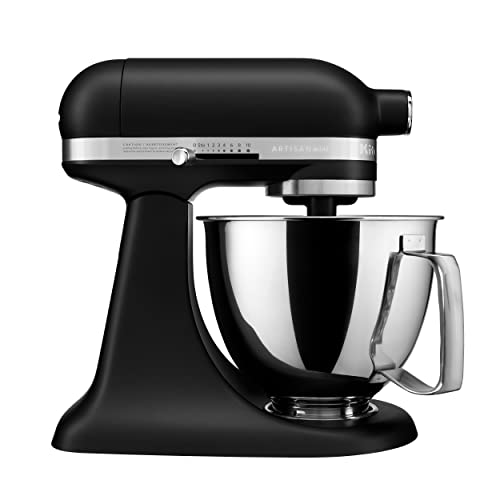
Best for Small Batches: KitchenAid Artisan Mini 3.5-Qt Tilt-Head Stand Mixer KSM3316
Big mixers have a quiet flaw that rarely makes the reviews: a half-batch in a 5-quart bowl spreads thin across the base, the beater skims over it, and creaming a small amount of butter becomes an exercise in scraping. The Artisan Mini exists for the opposite kitchen — one or two people, cakes baked small and fresh, a counter where every centimetre is argued over. Its 3.5-quart bowl keeps ingredients where the attachments can work them, so a single sponge, a small batch of cupcakes or a half-recipe of buttercream mixes the way the recipe intended.
Strengths
- Small bowl keeps beaters properly engaged with half-batches and single-egg foams
- Same 10-speed control and tilt-head ease as the full-size Artisan
- Lighter and shorter — fits under cabinets and lifts into a cupboard without a struggle
Trade-offs
- A standard two-layer cake batter is close to its comfortable ceiling
- Fewer colour and bundle options than the full-size Artisan line
- Serious bakers will outgrow it; it is a deliberate small-batch specialist
| Bowl capacity | 3.5 quart |
| Design | Tilt-head |
| Speeds | 10 speeds |
| Fit | Made for smaller batches and smaller counters |
Crucially, KitchenAid did not dumb the machine down to shrink it. The Mini keeps ten speeds with the same gentle bottom end, the same tilt-head access for scraping, and compatibility with the standard hub attachments, so it behaves like a proper cake mixer that happens to be small rather than a toy that happens to mix. For the techniques that define cake making — creaming, whipping, folding — it performs them at exactly the scale a small household needs, and its lighter body means it can live in a cupboard and come out without the reluctance a heavy machine inspires.
The boundary is capacity, and it is a hard one. A standard two-layer cake batter is near the top of what the bowl handles gracefully; anything doubled belongs in a bigger machine. Buy the Mini because your baking is genuinely small-batch — tea cakes, small celebration cakes, weekly little bakes — and it will serve you better than a flagship loafing in an oversized bowl. Buy it as a cheaper way into the Artisan line while planning big cakes, and you will replace it within a year. Sized honestly, it is one of the most satisfying machines in this guide.
Best for: small households, small kitchens and bakers who make modest cakes often / Not suited for: anyone whose standard bake is a full-size layer cake or doubled recipe
Check the current price on Amazon for the KitchenAid Artisan Mini 3.5-Qt Tilt-Head Stand Mixer KSM3316 in the colour and configuration you want.

Best Design-Led Pick: SMEG SMF04 Classico 5-Qt Stand Mixer
Some cake mixers are bought with the head; the SMEG is bought with the eyes first — and the useful truth is that the engineering underneath the 1950s styling is serious. A 600W motor drives a planetary action through ten speeds, and two control features matter directly to cake technique: Smooth Start ramps speed up gently so a bowl of flour-topped batter does not erupt, and the Steady Mix system holds the selected speed as resistance changes, which is precisely what happens as a creaming mixture thickens or a batter comes together. Speed that surges and fades is a hidden cause of over-mixed cake; speed that holds is a quiet quality feature.
Strengths
- Smooth Start and steady-mix control reduce the flour-cloud and speed surging that plague delicate batters
- Strong motor keeps creaming speeds consistent as batter thickens
- Design and finish are the point — it is the mixer most likely to live proudly on the counter
Trade-offs
- You pay a real premium for design; bakers indifferent to looks get more mixer per money elsewhere
- Accessory range is narrower than KitchenAid’s
- Retro styling divides opinion and dominates a small kitchen visually
| Bowl capacity | 5 quart stainless steel bowl |
| Motor | 600W |
| Speeds | 10 speeds with Smooth Start |
| Action | Planetary mixing with Steady Mix system |
The 5-quart stainless bowl puts it in the same practical class as the Artisan for standard layer cakes, sponges and buttercream batches, and the machine’s fit and finish — the weight of the controls, the paint depth, the detailing — are a class above the mid-range. Cake making is a hobby people do at the counter, visibly, often with family around; a machine that makes the counter look better genuinely gets used more, and used-more is the only feature that improves baking by itself.
The honest trade-off is value arithmetic. Bakers who do not care how a mixer looks can match or beat this specification for less money elsewhere in this guide, and SMEG’s attachment world is a side street compared with KitchenAid’s highway. But as a cake-making machine in its own right — controlled speeds, strong motor, proper bowl — it gives up nothing in the bowl. Choose it because you love it and will keep it out; that is a legitimate, even wise, buying reason for the most-used appliance in a baker’s kitchen.
Best for: design-conscious bakers who bake cakes regularly and keep the mixer on display / Not suited for: budget-led buyers or anyone who stores appliances away between uses
Check the current price on Amazon for the SMEG SMF04 Classico 5-Qt Stand Mixer in the colour and configuration you want.

Best Hand Mixer for Cakes: KitchenAid 9-Speed Hand Mixer KHM926
A hand mixer in a cake-making guide is not a consolation prize; it is a different tool with real advantages. It works in whatever bowl the recipe wants — the bowl of a double boiler for a Swiss meringue, a small jug for a two-egg foam, a saucepan for a boiled frosting — and it stores in a drawer, which in a small kitchen can be the difference between owning a mixer and not. The KHM926 is the cake-capable end of the category: nine speeds, a soft start that keeps flour in the bowl, stainless Turbo Beater II accessories, dough hooks for light work, and a pro whisk that is the right shape for trapping air in egg whites and cream.
Strengths
- Works in any bowl — ideal for small foams, double-boiler work and single-layer batters
- Nine speeds with soft start give unusual finesse for a hand mixer, including a true slow stir
- Pro whisk whips egg whites and cream faster than beaters alone
Trade-offs
- Your arm is the stand: long creaming sessions are tiring compared with any stand mixer
- Not suited to stiff or doubled batters — it will labour and so will you
- Creaming large butter quantities is slow work versus a paddle in a stand mixer
| Speeds | 9 speeds |
| Included | Pro whisk attachment, Turbo Beater II accessories, dough hook |
| Storage | Accessories are dishwasher-safe; mixer stores in a drawer |
For cake tasks, match the tool to the stage. Whipping whites or cream: excellent, arguably better than a stand mixer for small quantities because the whisk moves through the whole bowl. Cake batters of standard size: entirely workable, with the discipline of moving the mixer slowly around the bowl and scraping twice. Creaming a large block of butter and sugar to full aeration: possible but slow, and this is where the stand mixers above earn their counter space. The hand mixer rewards bakers whose cake making is occasional, small-scale or foam-focused — a pavlova baker may honestly prefer it.
It is also the smartest second mixer in this guide. Many committed bakers end up owning both: a stand mixer for batters and buttercream, this hand mixer for the quick foam, the small ganache, the single-layer weeknight cake. Bought in that spirit, the KHM926 is not a compromise at all. Bought as your only machine while planning a weekly layer-cake habit, it will teach your shoulder why stand mixers exist — so read your own baking honestly before choosing.
Best for: occasional cake bakers, small kitchens and anyone who wants a second mixer for foams and small jobs / Not suited for: weekly layer-cake bakers, who will feel the absence of a stand within a month
Check the current price on Amazon for the KitchenAid 9-Speed Hand Mixer KHM926 in the colour and configuration you want.
The Three Cake Techniques Your Mixer Must Support
It helps to judge every machine in this guide against three named techniques, because recipes assume them silently. The first is creaming: butter and sugar beaten to a pale, aerated paste that becomes the cake’s primary lift in any recipe without whipped eggs. Creaming needs a paddle with good bowl contact, a steady medium speed and patience — most home bakers under-cream by half. The second is the foam method: whole eggs or whites whipped with sugar to the ribbon or peak stage, the entire structure of sponges and chiffons. Foams need a whisk, a scrupulously clean bowl and a top speed that is fast without being violent in the first seconds.
The third technique is the one recipes describe in a single throwaway word — fold — and the one mixers are worst at by default. Folding preserves a foam while distributing flour or melted chocolate through it, and a machine can only ever start the job: a few turns at the lowest speed to bring the mixture together, then a spatula by hand. When you read the reviews above, that is the real ranking underneath the badges: how honestly each machine creams, how well it whips, and how gently it can begin a fold. Everything else — colour, capacity, ecosystem — is secondary to those three behaviours, and a mixer that does them well will make your current recipes taste better before you change a single ingredient.
Comparison Table
| Pick | Badge | Key spec | Best for |
|---|---|---|---|
| KitchenAid Artisan 5-Qt Tilt-Head Stand Mixer KSM150PS | Best Overall | 5-qt tilt-head, 10 speeds | home bakers making layer cakes, sponges and buttercream every week |
| KitchenAid 5.5-Qt Bowl-Lift Stand Mixer KSM55 | Best for Big Layer Cakes | 5.5-qt bowl-lift, 11 speeds | bakers who make celebration cakes, doubled batters and large frosting batches |
| Cuisinart Precision Master 5.5-Quart Stand Mixer SM-50 | Best Value | 5.5-qt, 12 speeds, splash guard included | value-focused bakers who want full stand-mixer cake capability without flagship pricing |
| KitchenAid Artisan Mini 3.5-Qt Tilt-Head Stand Mixer KSM3316 | Best for Small Batches | 3.5-qt tilt-head, 10 speeds | small households, small kitchens and bakers who make modest cakes often |
| SMEG SMF04 Classico 5-Qt Stand Mixer | Best Design-Led Pick | 5-qt, 600W, 10 speeds, retro design | design-conscious bakers who bake cakes regularly and keep the mixer on display |
| KitchenAid 9-Speed Hand Mixer KHM926 | Best Hand Mixer for Cakes | 9 speeds, pro whisk included | occasional cake bakers, small kitchens and anyone who wants a second mixer for foams and small jobs |
Specifications above are limited to figures confirmed in the manufacturer listing data checked for this guide. Where a maker sells the same model in several sizes or bundles, the listing for the exact version is the final word, which is one more reason to check price on Amazon on the precise configuration rather than relying on a headline number.
How to Choose the Best Food Mixers for Cake Making
Choose for the three jobs every cake asks of a mixer, in the order cakes ask them. Creaming comes first in most recipes: butter and sugar beaten until pale and fluffy, a stage that needs a flat beater or paddle, a mid-range speed held steadily, and a bowl the beater actually sweeps. Whipping comes second: egg whites, yolks or cream taken to soft or firm peaks, which needs a wire whisk and a top speed that is genuinely fast. Folding comes last and is where cakes are lost: dry ingredients incorporated at the lowest possible speed, or by hand, so the foam survives. A mixer that advertises twenty speeds but cannot creep is a worse cake mixer than one with nine honest ones.
Bowl size should be chosen by your standard bake, not your largest-ever bake. A 3.5-quart bowl is the sweet spot for single layers, small sponges and half-batches; 4.5 to 5.5 quarts covers the standard two- and three-layer cake, a dozen cupcakes and a family-sized buttercream batch; beyond that you are buying for doubled recipes and celebration work. Remember that batter needs headroom to move — a bowl filled past two-thirds mixes unevenly no matter how good the planetary action is — and that small quantities in a big bowl mix worse, not better, because the beaters cannot gather them.
Tilt-head or bowl-lift for cakes?
For cake making specifically, tilt-head machines hold a real advantage: you open them constantly — to scrape, to add an egg, to check a foam — and tilting a head is faster and more natural than lowering and lifting a bowl. Bowl-lift machines answer with rigidity and capacity, and they come into their own when batters get large and heavy or when the same machine must also knead. Occasional and standard bakers should default to tilt-head; celebration and high-volume bakers should default to bowl-lift. Hand mixers sit outside this debate as the flexible second tool: any bowl, any quantity small enough, zero counter cost.
Budget tiers, honestly framed
This guide does not print product prices, because they move — but the tiers are stable. The budget tier buys you a capable hand mixer or a compact stand mixer that handles standard cakes with some patience. The mid-range tier is where cake making gets properly comfortable: full-size tilt-heads and value stand mixers with complete attachment sets. The premium tier buys rigidity, capacity, design and longevity rather than categorically better cake — a mid-range machine in skilled hands will out-bake a flagship in careless ones. Spend first on the size you need, then on the speed control you will feel every bake, and only then on finish and brand ecosystem.
Attachments That Actually Matter for Cake
Three attachments do nearly all cake work. The flat beater or paddle creams, mixes batters and makes buttercream; it is the default tool and the one whose bowl coverage matters most. The wire whisk or whip is the aeration specialist — egg foams, whipped cream, meringues — and its wire count and shape decide how fast and how fine the foam is. The dough hook, often bundled, is a bonus for the enriched doughs at cake’s edge — brioche, panettone, cinnamon-roll dough — rather than a cake tool proper. A flex-edge beater, which scrapes the bowl as it turns, is the one upgrade genuinely worth considering for creaming-heavy bakers, because it cuts scraping stops roughly in half.
Beyond the core three, judge extras sceptically. Pouring shields and splash guards earn their place the first time you add flour to a moving batter. Extra bowls — a second bowl in steel, or a glass bowl for melting and microwaving stages — suit bakers who make multi-component cakes. Pasta rollers, grain mills and meat grinders say nothing about cake; buy a mixer for its cake tools and treat the hub ecosystem as a long-term bonus, not a reason to overspend today.
How to Use a Stand Mixer for Better Cakes: The Creaming-to-Folding Sequence
Most mixer disappointment in cake making is sequence, not machinery. Follow this order with any machine in this guide and your crumb will improve before your equipment does.
- Bring ingredients to the right state first: butter soft enough to dent with a finger but not melt, eggs at room temperature so they emulsify instead of curdling the creamed mixture. Cold ingredients defeat good mixers.
- Cream butter and sugar with the flat beater on a medium speed until the mixture is visibly paler and fluffy — several minutes, not one. Stop twice to scrape the bowl and beater; unmixed butter at the base becomes streaks in the crumb.
- Add eggs one at a time, mixing each in fully before the next, with a spoonful of the recipe’s flour alongside if the mixture threatens to split. A split emulsion now means a coarse cake later.
- For whipped components — whites, yolks or cream — switch to the whisk, a clean dry bowl, and the higher speeds. Judge by peaks, not by the clock: soft peaks curl, firm peaks stand.
- Fold dry ingredients in at the mixer’s lowest speed for only the first few turns, then finish by hand with a spatula, cutting down the middle and folding over, until no flour streaks remain. Over-mixing here develops gluten and tunnels the crumb.
- Scrape the bowl one final time before dividing batter between tins, and level the tins by weight if you have scales — even layers bake evenly and stack straight.
Storage and care follow the same practical logic: wash beaters and bowls promptly so dried batter does not set, dry stainless bowls before storing to keep them bright, and check a tilt-head’s hinge pin every few months — a pin that has crept out is the usual cause of a wobbling head, and pushing it home is a ten-second fix. Keep the mixer where you will use it. A cake mixer stored at the back of a deep cupboard is, in practice, a hand whisk with a power cord.
Common Buying Mistakes
Buying for the biggest cake you have ever imagined. Capacity should match your monthly baking, not your once-a-year ambition. An oversized bowl mixes small everyday batters badly, and an undersized one makes your standard layer cake a strain. Both errors are avoidable by counting what you actually baked in the last three months.
Judging a mixer by its top speed. Cake quality is decided at the bottom of the dial. A machine whose lowest speed is frantic will deflate foams and over-mix batters no matter how impressive its maximum is. Look for soft starts, half-speed settings and honest slow stirring.
Skipping the scrape. No planetary action reaches every millimetre of bowl. Bakers who never stop to scrape get marbled batters, butter streaks and uneven rise, then blame the machine. Build two scrapes into creaming and one into folding as fixed habits.
Creaming cold butter and wondering why the cake is dense. The mixer cannot aerate butter that is fridge-hard; it can only smear it. Equally, melted butter cannot hold air at all. The creaming stage fails before the mixer is switched on if the butter is the wrong temperature.
Filling the bowl past two-thirds. Batter needs room to circulate. An overfilled bowl mixes unevenly, throws mixture over the rim at speed, and strains the motor with loads it was not sized for. Split the batch or size up the machine — do not just slow down and hope.
Buying attachments before technique. A flex-edge beater helps, but no attachment fixes over-mixed batter or un-scraped bowls. Master the creaming-to-folding sequence on the standard tools first; upgrades then make a good process faster rather than disguising a weak one.
Final Recommendation
If you buy one machine from this guide, buy the KitchenAid Artisan: it is the most complete cake-making tool here, with the access, speed control and bowl size that standard baking rewards, bake after bake. Bakers who regularly scale up should step straight to the KSM55 bowl-lift and skip the intermediate regret, while value-led buyers lose remarkably little with the Cuisinart SM-50. Small households should take the Artisan Mini seriously rather than treating it as a compromise — for small-batch baking it is functionally the better machine.
Foam specialists and small kitchens should not overlook the KHM926 hand mixer, and bakers for whom the kitchen itself is a pleasure should look at the SMEG with clear eyes: it costs more for its design, and it mixes cakes properly. Whichever you choose, size it to your real repertoire, learn the creaming-to-folding sequence in the how-to section, and check the current price on Amazon on the exact configuration — colour and bundle change the listing, and the listing is where the truth lives.
- Best Overall: KitchenAid Artisan 5-Qt Tilt-Head Stand Mixer KSM150PS — home bakers making layer cakes, sponges and buttercream every week.
- Best for Big Layer Cakes: KitchenAid 5.5-Qt Bowl-Lift Stand Mixer KSM55 — bakers who make celebration cakes, doubled batters and large frosting batches.
- Best Value: Cuisinart Precision Master 5.5-Quart Stand Mixer SM-50 — value-focused bakers who want full stand-mixer cake capability without flagship pricing.
- Best for Small Batches: KitchenAid Artisan Mini 3.5-Qt Tilt-Head Stand Mixer KSM3316 — small households, small kitchens and bakers who make modest cakes often.
- Best Design-Led Pick: SMEG SMF04 Classico 5-Qt Stand Mixer — design-conscious bakers who bake cakes regularly and keep the mixer on display.
- Best Hand Mixer for Cakes: KitchenAid 9-Speed Hand Mixer KHM926 — occasional cake bakers, small kitchens and anyone who wants a second mixer for foams and small jobs.
Related guides in this series: Best Food Mixers For Cakes; Best Food Mixers For Dough; Best Food Stand Mixers; Best Food Mixers For Baking; Best Food Mixers Under $100; Best Freestanding Kitchen Mixers.
Frequently Asked Questions
What type of mixer is best for cake making?
A stand mixer with a flat beater, a wire whisk and a genuinely slow lowest speed suits most cake bakers best, because cakes need controlled creaming and gentle folding more than raw power. Tilt-head models suit standard baking thanks to easy bowl access; bowl-lift models suit large or doubled batches. A good hand mixer remains a legitimate choice for small, occasional or foam-heavy baking.
Is a hand mixer enough for making cakes?
For standard batters, small sponges and whipped components, yes — a multi-speed hand mixer with a whisk attachment handles them well. Its limits are endurance and scale: creaming large amounts of butter is slow, doubled batters are hard work, and your arm is the stand. Weekly layer-cake bakers will be happier with a stand mixer; occasional bakers may never need one.
What size stand mixer do I need for layer cakes?
A 4.5 to 5.5-quart bowl covers the standard two- and three-layer cake, a dozen cupcakes and a normal buttercream batch with room to mix properly. Choose 3.5 quarts for deliberate small-batch baking, and 5.5 quarts or more in a bowl-lift frame if you regularly double recipes or bake celebration cakes.
Why did my cake come out dense even with a good mixer?
The usual causes are technique, not machinery: butter too cold to aerate at the creaming stage, eggs added too fast so the emulsion split, or flour mixed too long at too high a speed, which develops gluten and knocks out air. Follow the creaming-to-folding sequence — medium-speed creaming with scrapes, eggs one at a time, flour folded at the lowest speed and finished by hand.
Tilt-head or bowl-lift: which is better for cakes?
For most home cake making, tilt-head, because you open the machine constantly to scrape and add ingredients, and tilting is the faster, more natural motion. Bowl-lift wins when batches get big and heavy, where frame rigidity matters more than access speed. Neither is universally better; match the frame to your batch sizes.
Can I knead bread dough in a cake mixer?
Most stand mixers here include a dough hook and can knead moderate doughs, but capacity and stiffness limits apply — rich or stiff doughs in large quantities are the home ground of dedicated dough machines and bowl-lift models. If bread becomes a weekly habit alongside cakes, size for the dough, not the cake, and read the dough-focused guide linked in the final recommendation.


