Disclosure: airfryerkitchensupply.com is reader-supported. When you buy through links on our site, we may earn an affiliate commission at no extra cost to you.
Where to buy
If you are shopping for the best freestanding kitchen mixers, start with the shortlist below. Every linked model in this guide was checked against Amazon’s own catalogue data for this site before it earned a link, and the listing is where you confirm the exact bowl size, colour and included attachments for the configuration you want. Prices move often in this category, so use the listing rather than any roundup to see what a model costs today.
- KitchenAid Classic Series 4.5-Qt Tilt-Head Stand Mixer K45SS — check the current price on Amazon and confirm the exact configuration on the listing before you order.
- KitchenAid Artisan Mini 3.5-Qt Tilt-Head Stand Mixer KSM3316 — check the current price on Amazon and confirm the exact configuration on the listing before you order.
- SMEG SMF05 Forte 5-Qt Stand Mixer — check the current price on Amazon and confirm the exact configuration on the listing before you order.
- Kenwood Chef Titanium 5-Qt Kitchen Machine — check the current price on Amazon and confirm the exact configuration on the listing before you order.
- Aucma Stand Mixer 6.5-QT 660W Tilt-Head — check the current price on Amazon and confirm the exact configuration on the listing before you order.
- Cuisinart Precision Master 5.5-Quart Stand Mixer SM-50 (Ruby Red) — check the current price on Amazon and confirm the exact configuration on the listing before you order.
Freestanding is the word for a mixer that stands on its own — not built in, not stored away, but resident on the counter as a permanent working citizen of the kitchen. The best freestanding kitchen mixers are therefore judged by a double standard the other guides in this series do not apply: they must mix well, and they must live well. A resident machine is measured in cabinet clearances and counter inches as much as in quarts and speeds, because the best mixer in the world is worthless in a kitchen it does not fit.
So this guide adds a spatial lens to the usual one. Every pick below was chosen with its footprint, its working height and its storage personality in mind: the compact machine for the small counter, the design piece for the kitchen that is looked at, the big budget bowl for the family whose batches are large and whose counter can take it. The mixing judgements are the series’ usual ones — verified specifications, honest capacities, controls judged at the gentle end — but they are applied to machines as residents, not as specifications.
Start, before the reviews, with a tape measure. Note your counter depth, the height from counter to the underside of your wall cabinets, and the largest clear run of counter you can honestly give a machine. Those three numbers will eliminate half the market for you, correctly, and they will make the right pick below feel obvious — which is what good measuring does.
A note on vocabulary, because the search term hides a small confusion worth clearing: ‘freestanding kitchen mixer’ is sometimes used by retailers to mean any stand mixer, and sometimes specifically to mean the larger, floor-adjacent machines of commercial kitchens. This guide uses the domestic sense — a self-contained stand mixer that lives on a home counter — and every pick is a home machine. Readers equipping a bakery should start from this series’ commercial-capacity picks in the dough and stand-mixer guides instead, where NSF certification and duty cycles are the governing criteria.
In this guide
Quick Picks
Short on time? These are the best freestanding kitchen mixers worth a serious look, each chosen for a different kind of baker, budget and counter. The badge beside each name is the same badge used in its full review further down, so you can jump straight to the model that matches how you actually bake.
- Best Overall Freestanding — KitchenAid Classic Series 4.5-Qt Tilt-Head Stand Mixer K45SS: The freestanding benchmark: metal build, 4.5-quart bowl and a footprint that fits standard counters and cabinets while covering everyday mixing completely.
- Best for Small Counters — KitchenAid Artisan Mini 3.5-Qt Tilt-Head Stand Mixer KSM3316: A genuinely smaller freestanding mixer — 3.5-quart bowl, ten speeds — for counters where a full-size machine would crowd out cooking itself.
- Best Design Statement — SMEG SMF05 Forte 5-Qt Stand Mixer: A 750W, 10-speed freestanding mixer with steady-mix control and smooth start — the counter statement piece that also happens to mix at flagship level.
- Best European Freestanding — Kenwood Chef Titanium 5-Qt Kitchen Machine: An 800W European kitchen machine with electronic variable speed in stainless steel — a powerful, system-minded alternative to the American mainstream.
- Best Large Capacity on a Budget — Aucma Stand Mixer 6.5-QT 660W Tilt-Head: A 660W tilt-head with a big 6.5-quart bowl and the standard three tools — family and batch capacity at a budget-friendly tier.
- Best Mid-Size All-Rounder — Cuisinart Precision Master 5.5-Quart Stand Mixer SM-50 (Ruby Red): The 5.5-quart, 12-speed all-rounder in a finish made for counter life — complete kit, splash guard and family capacity in the mainstream’s middle size.
How These Picks Were Chosen
Verification followed the series standard: every linked model was confirmed against Amazon’s catalogue data through this site’s own checking system, and all specifications — bowl sizes, motors, speeds, included tools — are the confirmed listing details. Unverifiable models were not linked. Prices are not printed anywhere in this guide; follow a pick’s link and check the current price on Amazon for the exact finish and configuration, which matters more than usual here because freestanding machines are sold in many colours and bundles.
Beyond the usual mixing criteria, selection weighted residence: footprint against standard counter geometry, closed and working heights against typical cabinet gaps, weight against the reality of moving a machine for cleaning, and the included kit against the mess a resident machine makes or avoids. The result spans the spatial spectrum on purpose — one compact, one mainstream, one design statement, one European system machine, one capacity bargain and one mid-size all-rounder — because freestanding kitchens differ first in space and only then in taste.
The 6 Best Freestanding kitchen mixers

Best Overall Freestanding: KitchenAid Classic Series 4.5-Qt Tilt-Head Stand Mixer K45SS
Freestanding is a promise about place: the mixer stands on its own, on your counter, as a permanent resident rather than a guest fetched from storage. The Classic is the resident most kitchens were practically designed around — a 4.5-quart tilt-head in durable metal, with a footprint that sits comfortably on standard counter depth and a closed height that fits beneath typical wall cabinets. Its ten speeds and 59-point planetary action cover the everyday repertoire without qualification, which is what a resident machine must do: everything, weekly, without negotiation.
Strengths
- Proportions suit standard kitchen geometry — counter depth and cabinet height
- Metal construction rewards permanent counter residence with decades of service
- Complete everyday performance: batters, creams, frostings, moderate doughs
Trade-offs
- Working height with head open still needs a cabinet check in older kitchens
- Not the largest capacity — batch bakers should look at the Aucma or bowl-lifts
- Weight makes it a resident, not a traveller between cupboards
| Bowl capacity | 4.5 quart |
| Design | Tilt-head, durable metal construction |
| Speeds | 10 speeds |
| Mixing action | 59 touchpoints around the bowl |
Residence changes how a mixer should be judged. A stored machine is judged on performance alone; a resident is also furniture — its silhouette is in your eye line at breakfast, its wiping-down is part of clearing up, its bowl lives in the sink’s rotation. The Classic’s design has been stable for years precisely because it passes those domestic tests: compact visual mass, surfaces that wipe clean, controls that never need explaining to a partner or a teenager pressed into service.
Its boundaries are the mainstream’s boundaries. Batch bakers will find the bowl honest but not generous; kitchens with unusually low wall cabinets must measure the open-head height like any tilt-head; and its weight declares it a resident — if your plan is cupboard storage, the Mini below is the honest version of that plan. As the default freestanding answer, though, it remains the machine against which the idea of a counter mixer is measured.
Best for: households giving a mixer a permanent, standard-sized counter home / Not suited for: very low cabinets, tiny counters or batch-scale baking
Check the current price on Amazon for the KitchenAid Classic Series 4.5-Qt Tilt-Head Stand Mixer K45SS in the colour and configuration you want.
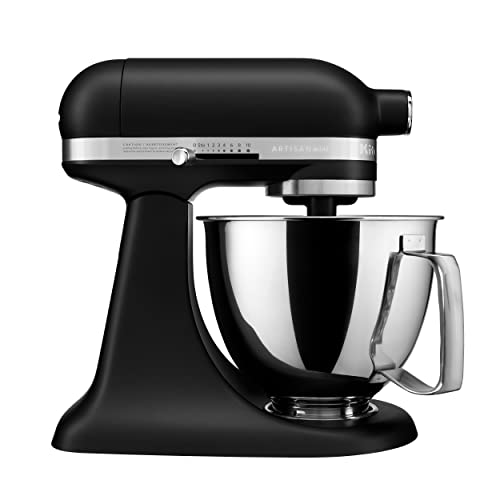
Best for Small Counters: KitchenAid Artisan Mini 3.5-Qt Tilt-Head Stand Mixer KSM3316
The small kitchen’s dilemma is that freestanding mixers are sized for other people’s counters. The Artisan Mini resolves it without surrendering the category: a 3.5-quart tilt-head with the full ten-speed range and hub compatibility of its big sibling, in a body that takes meaningfully less counter, fits tighter cabinet gaps and can actually be lifted aside when the counter must become a workspace. For a small household, that is not a reduced mixer; it is the correctly sized one.
Strengths
- Smallest footprint here that still behaves like a full stand mixer
- Lower working height suits tighter cabinet gaps
- Light enough to move for cleaning or occasional storage without a struggle
Trade-offs
- Capacity ceiling is real: standard two-layer batters are its upper limit
- Same ecosystem, fewer colour choices than the big Artisan
- Keen bakers in growing households may outgrow it
| Bowl capacity | 3.5 quart |
| Design | Tilt-head, compact body |
| Speeds | 10 speeds |
| Fit | Made for smaller batches and counters |
In use, its smallness cuts the other way from what sceptics expect. Small batters — the single sponge, the half-batch of frosting, the two-egg foam — engage the beaters properly in the Mini’s bowl where they would smear around a 5-quart base. If your baking is genuinely small-batch, the Mini does not merely fit your kitchen better; it mixes your recipes better. Its lighter body also makes the wipe-down-and-shift routine of small counters painless rather than a weightlifting footnote.
The ceiling is capacity, stated plainly so nobody discovers it mid-recipe: a standard two-layer batter is the top of its comfort, and growth — a family, a new celebration-cake habit — will outgrow it. Buy it for the kitchen and household you have, and it is the most satisfying freestanding machine in this guide. Buy it as a cheaper route to big-machine dreams and it becomes a stepping stone you paid full price for.
Best for: small kitchens, flats, and one- to two-person households baking small and often / Not suited for: families or anyone whose standard bake is large
Check the current price on Amazon for the KitchenAid Artisan Mini 3.5-Qt Tilt-Head Stand Mixer KSM3316 in the colour and configuration you want.
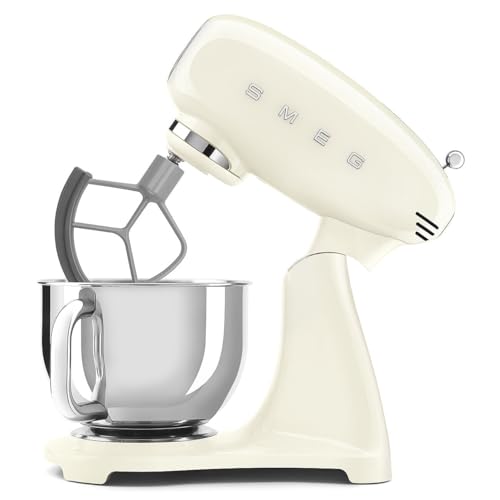
Best Design Statement: SMEG SMF05 Forte 5-Qt Stand Mixer
A freestanding mixer is the most visible appliance in most kitchens, and the SMEG SMF05 Forte is the pick for buyers who refuse to pretend otherwise. It is a serious machine first — a 750W motor, ten speeds, planetary mixing, a 5-quart stainless bowl, a flex-edge beater in the specification — with two control systems that matter in daily use: Steady-Mix, which holds your chosen speed as the load changes, and Smooth Start, which ramps up gently instead of erupting a flour-topped bowl across the counter it was bought to beautify.
Strengths
- The strongest motor in this freestanding list, with speed held steady under load
- Smooth Start protects counters and mixtures from the flour-cloud start
- As a permanent resident, its design is the point — and it delivers it fully
Trade-offs
- Premium tier pricing driven substantially by design
- Footprint is full-size; small counters should choose the Mini
- Accessory ecosystem is narrower than KitchenAid’s
| Bowl capacity | 5 quart stainless steel bowl |
| Motor | 750W |
| Speeds | 10 speeds |
| Systems | Steady-Mix system, Smooth Start, planetary mixing, flex-edge beater included in listing data |
As a resident, it earns its place the way furniture does: you will look at it every day, and it repays looking. But the design case only works because the mixing case is closed first — capacity for standard family baking, speed control that handles both folding and whipping honestly, and power that keeps creaming consistent as mixtures thicken. This is not a styled shell over a modest machine; it is a flagship that happens to be beautiful, which is a rarer combination than the market suggests.
The compromises are the premium’s usual ones: you pay for the design in real money, the footprint is full-size, and the attachment world is smaller than the mainstream’s. If the mixer will live in a cupboard, every one of those compromises is wasted money — buy the Mini or the Classic. If it will live on your counter for a decade, in a kitchen you care about looking at, the SMEG is the freestanding pick that treats that fact as a feature instead of an accident.
Best for: design-led kitchens where the mixer is a permanent, visible centrepiece / Not suited for: budget-led buyers or cupboard-storage plans
Check the current price on Amazon for the SMEG SMF05 Forte 5-Qt Stand Mixer in the colour and configuration you want.

Best European Freestanding: Kenwood Chef Titanium 5-Qt Kitchen Machine
Kenwood’s Chef line is the European answer to the same freestanding question, and the Titanium’s specification announces its intent: an 800W motor under electronic variable speed control, a 5-quart stainless bowl, and a kitchen-machine philosophy that treats the mixer as the hub of a system rather than a single-purpose appliance. In the bowl, the electronic control is the felt difference — speed is governed, not merely selected, so creaming and mixing proceed at a pace the machine maintains as resistance changes.
Strengths
- 800W motor with electronic speed control that holds pace under load
- Kitchen-machine philosophy: a system built to accept a wide tool range
- Stainless build and European design language distinct from US rivals
Trade-offs
- Less common in US kitchens — community knowledge and parts are thinner than KitchenAid’s
- Full-size footprint and weight: a committed resident
- Interface and cues differ from the American mainstream; expect an adjustment
| Bowl capacity | 5 quart, stainless steel |
| Motor | 800W |
| Control | Electronic variable speed control |
| Design | Chef Titanium kitchen machine |
As a freestanding resident it has a distinct character: stainless, architectural, less retro than the SMEG and less familiar than the KitchenAids. European bakers have kept Chef machines at the centre of kitchens for generations, and the platform’s tool range reflects that system thinking. For a US buyer it offers a genuine alternative axis — power and system depth over ecosystem familiarity — rather than a variation on the mainstream theme.
The trade is support geography. In the US, KitchenAid’s parts, bowls and second-hand knowledge are everywhere; Kenwood’s are present but thinner, and a buyer who values being able to source a replacement beater in any city should weigh that honestly. Buyers who value the machine itself — its power, its control, its difference — will find the Titanium the most interesting freestanding resident in this guide.
Best for: buyers who want a powerful European system machine as their counter’s resident / Not suited for: buyers who value the deepest US parts and accessory network above all
Check the current price on Amazon for the Kenwood Chef Titanium 5-Qt Kitchen Machine in the colour and configuration you want.

Best Large Capacity on a Budget: Aucma Stand Mixer 6.5-QT 660W Tilt-Head
Capacity is usually where the money goes in a freestanding mixer, which is what makes the Aucma interesting: a 6.5-quart bowl on a 660W tilt-head frame, with dough hook, wire whip and beater included, at a tier the big bowls from famous brands cannot approach. For the large family — the double batter, the big frosting batch, the dough for a week of lunches — it converts an unaffordable specification into a purchasable one, and in the bowl it does the work: mixtures have room, the motor has headroom, and standard recipes stop requiring split batches.
Strengths
- Capacity per money is unmatched in this list — true batch room
- 660W motor handles family-size mixtures without strain
- Tilt-head familiarity: no new system to learn
Trade-offs
- Fit and finish are a tier below the premium residents
- Large footprint — measure before assuming it fits a modest counter
- Brand support and parts depth are thinner than the big names
| Bowl capacity | 6.5 quart |
| Motor | 660W |
| Design | Tilt-head |
| Included | Dough hook, wire whip and beater (per listing) |
As a counter resident it is unapologetically functional. The tilt-head operation is the familiar mainstream pattern, so there is no apprenticeship; the size is the thing to plan around, because a 6.5-quart machine is a substantial object that should be measured into its home rather than discovered not to fit. Finish and detailing sit a clear tier below the SMEG and KitchenAid residents — the money went to capacity and motor, visibly and deliberately.
That allocation is exactly right for its buyer and wrong for others. If your constraint is batch size against budget, this is the freestanding answer, and its compromises are cosmetic. If your constraint is a beautiful small kitchen or a thirty-year parts horizon, the constraint points elsewhere in this list. Judge it as what it is — the capacity pick — and it is one of the most useful machines here.
Best for: large families and batch bakers whose budget rules out premium capacity / Not suited for: design-led kitchens or buyers prioritising decades-long parts support
Check the current price on Amazon for the Aucma Stand Mixer 6.5-QT 660W Tilt-Head in the colour and configuration you want.
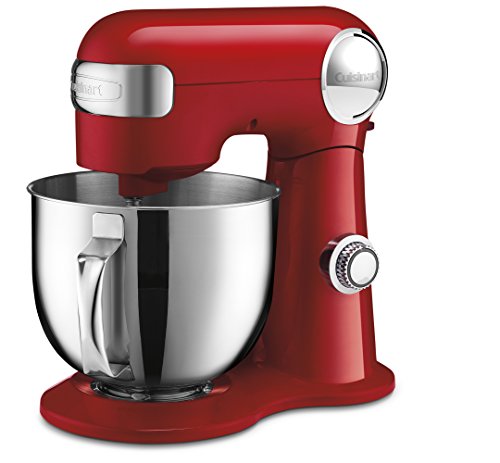
Best Mid-Size All-Rounder: Cuisinart Precision Master 5.5-Quart Stand Mixer SM-50 (Ruby Red)
Most freestanding mixers live in the middle: family recipes, weekly baking, a permanent counter spot in a kitchen that is used hard and tidied often. The SM-50 in Ruby Red is the middle executed completely — a 5.5-quart stainless bowl for family quantities, twelve speeds spanning a gentle fold to a confident whip, and the full kit in the box: whisk, paddle, dough hook and the splash guard whose pour spout quietly keeps a resident mixer’s counter cleaner than any rival without one.
Strengths
- The middle size done completely: capacity, speeds and kit in one box
- Splash guard suits resident life — less mess on the counter around it
- Twelve speeds give fine control for both folding and whipping
Trade-offs
- Lighter frame than premium residents under the stiffest loads
- Ecosystem smaller than KitchenAid’s for long-term platform buyers
- Colour-led configurations vary — confirm the exact listing before ordering
| Bowl capacity | 5.5 quart stainless steel bowl |
| Speeds | 12 speeds |
| Included | Chef’s whisk, mixing paddle, dough hook, splash guard with pour spout |
Residence is where its details compound. The guard means flour additions do not dust the worktop the machine lives on. The dial is readable at a glance across the kitchen. The size — a step up from the 4.5-quart mainstream — means the standard family recipe and its frosting fit the same bowl across an afternoon’s baking, and the finish is chosen for a machine that will be seen daily, because a resident in a colour you enjoy is a resident you maintain.
Its limits are the mid-range’s honest ones: a lighter frame than the premium bowl-lifts under maximum loads, and a smaller long-term accessory world than the biggest name. Within the life it is designed for — the family counter, the weekly bake, the decade of ordinary excellence — those limits rarely appear. It is the freestanding pick for buyers who want the decision to be easy and the machine to be complete.
Best for: families wanting one mid-size resident mixer that covers everything well / Not suited for: heavy dough specialists or the smallest counters
Check the current price on Amazon for the Cuisinart Precision Master 5.5-Quart Stand Mixer SM-50 (Ruby Red) in the colour and configuration you want.
The Resident Test: How a Mixer Earns Its Counter
There is a simple audit that predicts whether a freestanding mixer will still be loved in year three, and it has nothing to do with its specifications. In the first month, count how many times the machine is used without being ‘got out’ — because it was already there, plugged in, bowl on, ready. Residents pass this test by existing; every use is pure baking, with no setup tax. The machines in this guide were chosen to pass it in their respective kitchens: sized to stay out, finished to be looked at, and simple enough that reaching for them is never a decision.
The corollary is the saddest sight in home baking: the flagship in the garage, the premium machine behind the slow cooker, bought with love and exiled by geometry. Nothing in this guide’s reviews matters more than the measurements in its how-to section, because they are what keep the machine you choose on the counter — where freestanding mixers, alone among appliances, do their quiet work of turning ‘we should bake’ into baking.
Comparison Table
| Pick | Badge | Key spec | Best for |
|---|---|---|---|
| KitchenAid Classic Series 4.5-Qt Tilt-Head Stand Mixer K45SS | Best Overall Freestanding | 4.5-qt tilt-head, counter-friendly footprint | households giving a mixer a permanent, standard-sized counter home |
| KitchenAid Artisan Mini 3.5-Qt Tilt-Head Stand Mixer KSM3316 | Best for Small Counters | 3.5-qt compact tilt-head | small kitchens, flats, and one- to two-person households baking small and often |
| SMEG SMF05 Forte 5-Qt Stand Mixer | Best Design Statement | 5-qt, 750W, 10 speeds, design-led | design-led kitchens where the mixer is a permanent, visible centrepiece |
| Kenwood Chef Titanium 5-Qt Kitchen Machine | Best European Freestanding | 5-qt, 800W, electronic variable speed | buyers who want a powerful European system machine as their counter’s resident |
| Aucma Stand Mixer 6.5-QT 660W Tilt-Head | Best Large Capacity on a Budget | 6.5-qt tilt-head, 660W | large families and batch bakers whose budget rules out premium capacity |
| Cuisinart Precision Master 5.5-Quart Stand Mixer SM-50 (Ruby Red) | Best Mid-Size All-Rounder | 5.5-qt, 12 speeds, counter-ready finish | families wanting one mid-size resident mixer that covers everything well |
Specifications above are limited to figures confirmed in the manufacturer listing data checked for this guide. Where a maker sells the same model in several sizes or bundles, the listing for the exact version is the final word, which is one more reason to check price on Amazon on the precise configuration rather than relying on a headline number.
How to Choose the Best Freestanding Kitchen Mixers
Measure first, in the order the machine will complain if you do not. Counter depth: the machine’s base must sit fully on the counter with room behind for its cord and in front for you. Cabinet clearance: measure from countertop to the underside of the wall cabinets, then compare it not with the machine’s closed height but with its working height — head tilted fully open on a tilt-head, bowl raised on a bowl-lift — because that is the position you will use daily. Clear run: a resident mixer wants its own territory, not a nightly negotiation with the toaster. Kitchens that pass all three measurements can choose freely; kitchens that fail one should let that failure lead the shortlist.
Then decide the machine’s domestic status, honestly. A permanent resident should be bought like furniture: finish and silhouette matter, metal construction repays its cost, and the wipe-down routine becomes part of the kitchen’s rhythm. A semi-resident — out for the weekend bake, back in a cupboard — should be bought like luggage: weight and handles matter more than finish, and compact machines win. Most freestanding disappointment is a status mismatch: a heavyweight bought for a cupboard life, or a featherweight asked to anchor a serious counter.
Size and capacity, in counter terms
Bowl capacity and footprint grow together, roughly but relentlessly. The 3.5-quart class is the small-counter answer; 4.5 to 5.5 quarts is the mainstream that standard kitchens were built around; 6.5 quarts and above is a commitment of territory that should be made deliberately, with the tape measure’s blessing. Match capacity to your standard recipes as the other guides advise — fill no more than two-thirds, beware small batches in big bowls — and then check that the winning capacity’s body fits the winning counter. Both conditions must hold; either one alone is a return waiting to happen.
Budget tiers for resident machines
Residence changes the value maths. A stored machine’s price buys performance only; a resident’s price also buys finish, quiet competence and the daily pleasure of a tool that suits its room — which is why the premium tier is more defensible here than in any other guide in this series, and why the budget tier should be judged on whether its lighter build suits a lighter life. Check the current price on Amazon for each finalist in the finish you actually want, because colour and bundle move listings in this category more than most.
Freestanding, Built-In and Stored: Placing the Mixer in the Kitchen
Freestanding is one of three philosophies. Built-in and lift-assisted solutions hide the machine entirely and suit renovation budgets and minimal counters, at the cost of flexibility — the machine’s home is fixed forever. Stored machines cost no counter at all and pay for it in friction: every bake begins with a lift and ends with a put-away, and usage quietly declines. Freestanding is the middle philosophy and, for most kitchens, the sweet one: zero renovation, zero friction, at the price of a measured patch of counter. This guide exists because that patch, chosen well, is the best-value real estate in the kitchen.
Whichever philosophy you choose, one rule survives all of them: the machine’s home should be decided before the machine is. Buyers who measure first and choose second almost never return a mixer; buyers who fall for a finish and improvise a home often do. The tape measure is the first accessory every freestanding mixer needs.
Counter Materials, Light and Noise: The Residence Details Nobody Lists
Three residence factors never appear on a specification sheet and are felt every day. The first is the worktop itself: glossy stone and polished wood let a working mixer travel a few millimetres under load, while matte surfaces grip. The fix, where needed, is a thin non-slip mat — but choose the spot with the surface in mind and you may never need one. The second is light. A mixer stationed in the kitchen’s darkest corner makes judging a batter’s colour and a foam’s peak harder than it should be; the resident spot wants the same good light you would choose for a chopping board, because mixing is visual work.
The third is noise in an open-plan home. All freestanding mixers are audible; geared machines under load are more so, and a resident machine lives acoustically in the room it stands in. There is no silent pick in this guide, but there is a practical hierarchy: machines working within their capacity sound composed, while any machine straining at an oversized load sounds like a complaint. Sizing honestly, as every section of this guide urges, is therefore also the noise strategy — the right-sized resident is the quiet one, whatever its badge.
None of these details should lead the decision; all of them should be allowed to settle ties. When two machines pass the measurements and match your recipes, the one whose spot has light, grip and a socket — and whose sound your household can live with at breakfast — is the one that will still be resident, and used, in year five.
How to Measure Your Kitchen and Install a Freestanding Mixer Properly
Fifteen minutes with a tape measure and a level counter will decide whether your mixer feels made for your kitchen or merely parked in it. Do this before ordering, and repeat the placement steps when it arrives.
- Measure the counter-to-cabinet height at the exact spot the mixer will occupy — heights vary along a run of cabinets more than most people expect, and the machine only cares about its own address.
- Measure counter depth and the clear run: base depth plus working room in front for a bowl, a scale and your hands. Mark the footprint with painter’s tape and live with the tape for a day if the kitchen is tight; tape is a cheap way to discover a bad fit.
- Check the working height: for a tilt-head, add the open-head height; for a bowl-lift, the raised-bowl height. If either collides with your cabinets, slide the machine’s spot forward or choose a lower design — do not plan to ‘just pull it out each time’ unless you truly will.
- Confirm the socket: the cord should reach without crossing the hob or the sink, and without an extension lead as a permanent arrangement. Rearrange the counter’s residents now, on paper, rather than in frustration later.
- On arrival, set the machine on a non-slip mat if your worktop is very smooth, level it by its feet if adjustable, and run it empty through its speeds in place. Watch for walking at high speed with an empty bowl — a mat or a small reposition usually ends it.
- Register the machine’s permanent address by putting its tools in the bowl or the nearest drawer, and keep nothing stored on top of it. A freestanding mixer that becomes a shelf stops being an appliance and starts being furniture you resent.
The final placement test is a recipe, not a measurement: bake your most familiar cake within the first week. You will learn the machine’s clearances, reach and rhythm in one session, and any placement mistake will announce itself while returns are still easy.
Common Buying Mistakes
Measuring the shelf instead of the workspace. Closed height is the number listings print; working height — head open, bowl raised — is the number your cabinets enforce. Buyers who measure only the first own mixers that cannot open in their own kitchens.
Giving the mixer the leftover counter. The spot nobody else wanted — behind the sink, beside the hob’s splatter zone — is where resident machines go to be resented. Claim a real address with light, reach and socket access.
Ignoring weight in a cupboard plan. A heavyweight freestanding machine stored in a low cupboard is, in practice, an unused machine. If storage is the plan, let weight veto before features seduce.
Choosing capacity before measuring footprint. The 6.5-quart bargain is only a bargain if it fits. Capacity and footprint must be confirmed together, in that order reversed from how most people shop.
Forgetting the cord and the socket. A perfect fit with a cord stretched across the hob is not a fit. Socket position is a placement specification, and it eliminates more ‘perfect’ spots than any other measurement.
Treating finish as frivolous — or as everything. For a resident machine, finish is a legitimate daily pleasure and a legitimate tiebreaker. It is a poor foundation. Fit, capacity and controls first; then, among the machines that pass, by all means buy the beautiful one.
Final Recommendation
For the standard kitchen, the answer is the Classic: the freestanding mainstream at its most proven, sized for the counters and cabinets most homes actually have. Small counters should take the Artisan Mini without a flicker of compromise — it is the better machine for small-batch life. Design-led kitchens get the SMEG Forte, system-minded buyers the Kenwood Chef Titanium, large families on a budget the Aucma’s capacity, and families wanting the complete middle the Cuisinart SM-50.
Measure your kitchen before you choose, check the current price on Amazon for the exact finish, and give the winner a permanent address with light and socket access. A freestanding mixer chosen that way stops being an appliance purchase and becomes what it should be: a fixed, friendly feature of how your kitchen works.
If your measurements eliminate every full-size pick, do not read that as a failed search — read it as the search working. A compact machine that fits, lives out and gets used will out-bake a flagship exiled to a cupboard in every week that matters, and the small-counter pick in this guide exists precisely for kitchens honest enough to measure themselves. The freestanding ideal is not the biggest machine; it is the machine whose home and whose work fit each other, in your kitchen, on your counter, starting with the first bake.
- Best Overall Freestanding: KitchenAid Classic Series 4.5-Qt Tilt-Head Stand Mixer K45SS — households giving a mixer a permanent, standard-sized counter home.
- Best for Small Counters: KitchenAid Artisan Mini 3.5-Qt Tilt-Head Stand Mixer KSM3316 — small kitchens, flats, and one- to two-person households baking small and often.
- Best Design Statement: SMEG SMF05 Forte 5-Qt Stand Mixer — design-led kitchens where the mixer is a permanent, visible centrepiece.
- Best European Freestanding: Kenwood Chef Titanium 5-Qt Kitchen Machine — buyers who want a powerful European system machine as their counter’s resident.
- Best Large Capacity on a Budget: Aucma Stand Mixer 6.5-QT 660W Tilt-Head — large families and batch bakers whose budget rules out premium capacity.
- Best Mid-Size All-Rounder: Cuisinart Precision Master 5.5-Quart Stand Mixer SM-50 (Ruby Red) — families wanting one mid-size resident mixer that covers everything well.
Related guides in this series: Best Food Stand Mixers; Best Food Mixers For Cakes; Best Food Mixers For Cake Making; Best Food Mixers Under $100; Best German Made Stand Mixers; Best Glass Bowls For Kitchenaid Stand Mixers.
Frequently Asked Questions
What does freestanding mean for a kitchen mixer?
It means the mixer stands on its own on the countertop as a self-contained appliance — not built into cabinetry and not a hand mixer stored in a drawer. Freestanding mixers are designed for permanent or semi-permanent counter residence, which is why footprint, height and finish matter so much in choosing one, and why this guide judges them as residents of a specific kitchen rather than as abstract specifications on a page.
How much counter space does a stand mixer need?
Plan on the machine’s full base footprint plus working room in front for bowls and ingredients, and vertical clearance for its working height — head open or bowl raised. Compact models suit small counters; 6.5-quart class machines need a deliberate territory. Measuring your specific counter and cabinets is the only reliable answer, which is why this guide leads with a tape measure.
Will a stand mixer fit under my kitchen cabinets?
Most mainstream tilt-head and compact models are designed with standard cabinet gaps in mind, but gaps vary, especially in older kitchens. Compare your counter-to-cabinet measurement with the machine’s working height, not just its closed height, before ordering.
Is it better to leave a mixer on the counter or store it?
Counter residence wins on usage: machines that are visible and reachable get used weekly, while stored machines — especially heavy ones — get used rarely. Storage wins only where counter space is genuinely scarce, and then a lighter, compact machine is the honest choice.
What is the best freestanding mixer for a small kitchen?
A compact tilt-head in the 3.5-quart class, with full speed range and hub compatibility — the profile of this guide’s small-counter pick. It fits tighter footprints and cabinet gaps, moves easily for cleaning, and mixes small batches better than an oversized machine does.
Do freestanding mixers need a non-slip mat?
On very smooth worktops, a mat helps any mixer stay planted during heavy work, and lighter machines benefit most. It is a small, optional stabiliser — not a requirement — and many kitchens never need one.
Can a freestanding mixer go in a corner?
Corners are tempting dead space, but judge carefully: you need to see into the bowl, reach the controls and open the head or raise the bowl without turning the machine. A corner that passes those three tests is a fine home; a corner that fails any of them will quietly reduce how often the mixer gets used, which defeats the purpose of freestanding residence.

