Disclosure: airfryerkitchensupply.com is reader-supported. When you buy through links on our site, we may earn an affiliate commission at no extra cost to you.
Where to buy
The best external vacuum sealers are sold in configurations that range from bare machines to full starter kits, and the box contents decide real value. Buy through the verified listing for the exact model and confirm what is included — starter bags, rolls, hoses, and cutters — before ordering. Every linked pick below was matched to Amazon catalog data for this site at verification time; check price on Amazon on the listing page, where the current configuration is stated.
- FoodSaver FM2100 Vacuum Sealer Machine — Check on Amazon
- FoodSaver V4400 2-in-1 Vacuum Sealer — Check on Amazon
- Nesco Deluxe VS-12 Vacuum Sealer — Check on Amazon
- MEGAWISE Vacuum Sealer Machine (80kPa) — Check on Amazon
- Bonsenkitchen Vacuum Sealer Machine (Silver) — Check on Amazon
- FoodSaver PowerVac Compact VS0150 — Check on Amazon
A quick note on how this guide handles recommendations: every product named below was cross-checked against Amazon catalog data for this site before a link was added. Where a model could not be matched with confidence, it appears as a mention without a link with no buying link, and the reason is recorded rather than hidden.
The best external vacuum sealers all share one architecture: the bag stays outside the machine, a pump draws air out of it, and a heated bar seals it shut. That simple design is why external sealers own the home market — they are compact, affordable, and good at the jobs households actually have. This guide ranks the format’s best current examples, from the full-featured FoodSaver FM2100 to compact machines that live in a drawer, and it is equally direct about what the format cannot do, because choosing an external sealer well means understanding its one real rival: the chamber sealer.
The distinction matters. A chamber sealer vacuums an entire chamber with the bag inside it, which lets it seal free liquids — soups, marinades, sauces — without any workaround, and it is the format delis and serious processors use. It is also large, heavy, and priced in a different world. External sealers ask for embossed bags and a little technique around liquids, and in exchange they fit in kitchens and budgets. For the overwhelming majority of homes — portioning, freezing, sous vide, pantry protection — external is the correct format, and this guide assumes you have made that call or are about to.
Within the format, the differences that matter are workflow differences: how bags are stored and cut, how the cycle starts, whether jars and containers can join the system through an accessory port, how the machine stores when idle, and whether its modes respect the difference between dry rice and a marinated steak. Those are the axes this guide ranks on, because suction numbers alone have never sealed a bag of soup. Read the reviews with your own routine in mind — the right sealer is the one whose strengths land on the steps you will repeat most often, in the kitchen you actually have.
In this guide
Quick Picks
- FoodSaver FM2100 Vacuum Sealer Machine — Best Overall: One-touch sealing, roll storage and cutter built in, an accessory port and hose, and starter bags and a roll in the box — the complete external sealer. — Check on Amazon
- FoodSaver V4400 2-in-1 Vacuum Sealer — Best Automatic Detection: Automatic bag detection starts the cycle when the bag is inserted, and the 2-in-1 design adds handheld sealing for containers. — Check on Amazon
- Nesco Deluxe VS-12 Vacuum Sealer — Best for Serious Home Volume: 130 watts and a viewing lid in a compact silver body — the external sealer for garden harvests, game and warehouse runs. — Check on Amazon
- MEGAWISE Vacuum Sealer Machine (80kPa) — Best Value External Sealer: 80kPa suction with dry, moist and fresh modes plus an external vacuum system — strong, complete sealing without the premium tier. — Check on Amazon
- Bonsenkitchen Vacuum Sealer Machine (Silver) — Best Compact External Sealer: A compact multi-mode machine with an external vacuum system and starter bags — full external sealing that fits in a drawer. — Check on Amazon
- FoodSaver PowerVac Compact VS0150 — Best Vertical-Storage Design: FoodSaver’s compact machine stores vertically like a book — the external sealer designed for kitchens with no drawer to spare. — Check on Amazon
How These Picks Were Chosen
Every model here was verified against Amazon catalog data through this site’s verification process, and only confident matches received buying links. We then ranked on the workflow axes that decide ownership satisfaction: bag handling (in-machine roll storage and cutters ranked highest), cycle start (automatic detection ranked highest), system breadth (accessory ports and handheld components), storage design, and mode intelligence for moist foods.
We required every pick to handle the format’s core jobs credibly: portioning raw proteins, freezing leftovers, protecting dry goods, and preparing sous vide bags. Machines were also judged on their bag supply — a sealer is a consumables appliance, and formats backed by widely stocked bags and rolls, FoodSaver’s above all, scored accordingly. Prices are not printed anywhere in this guide; bundles and configurations change, and the live listing is the only reliable source, so each linked pick says to check price on Amazon there.
One more filter deserves stating: honesty about the format. Each review names its machine’s limits — session pace, bag width, liquid technique — rather than dressing a home appliance as a commercial one. External sealers are excellent within their design brief, and this guide’s job is to match you to the one whose brief matches your kitchen.
The 6 Best External Vacuum Sealers

1. FoodSaver FM2100 Vacuum Sealer Machine — Best Overall
The FoodSaver FM2100 is the external vacuum sealer in its most complete home form. It builds roll storage and a cutter into the machine itself, seals with one touch, handles dry and moist foods, and adds an accessory port and hose for jars and containers — with starter bags and a roll included so the system works the day it arrives. For sous vide cooking, bulk storage, and everyday leftovers alike, this is the machine that defines what a full-featured external sealer should be, and it is the benchmark the rest of this guide is measured against.
| Spec | Detail |
|---|---|
| Operation | One-touch sealing |
| Storage | Built-in roll storage and cutter |
| Food types | Dry and moist food |
| Extras | Accessory port and hose; starter bags and roll included |
Strengths
- Roll storage and cutter in the machine — custom bags with zero counter clutter
- Accessory hose extends sealing to jars, canisters and marinating containers
- One-touch operation that the whole household can use correctly
Trade-offs
- Full-featured size — it needs a permanent counter or cabinet home
- Rich features reward reading the manual once, properly
- Occasional sealers may never use the accessory system they paid for
Integration is the FM2100’s argument. External sealers live or die on workflow: find a bag, size it, fill it, seal it. By storing the roll inside the machine and cutting it to length at the point of use, the FM2100 removes the two fiddliest steps — no separate cutter rolling around a drawer, no pre-cut bag that’s always the wrong size. Across hundreds of seals, that smoothness is the difference between a machine that gets used for a single chicken breast and one that only comes out for projects.
The accessory port is the second half of the case. With the hose, the same machine that seals bags also vacuums jars of coffee, canisters of flour, and containers of leftovers, and supports the quick-marinating accessories FoodSaver sells. That breadth turns one purchase into the kitchen’s whole air-removal system. If you want one external sealer that does everything the format can do, this is it — the deserved overall pick.
Best for: Households that want the complete external sealing system — bags, rolls, jars and containers — in one machine / Not suited for: Minimalists who only ever seal a few pre-cut bags
Check on Amazon — check price on Amazon before you buy, because countertop oven pricing moves often and the listing is the only place to confirm the current configuration, included accessories, and delivery options.
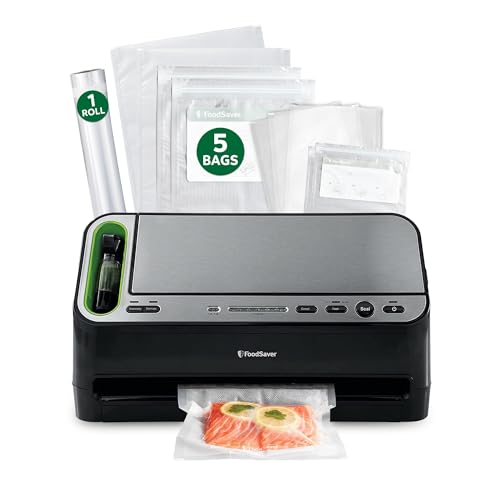
2. FoodSaver V4400 2-in-1 Vacuum Sealer — Best Automatic Detection
The FoodSaver V4400 2-in-1 attacks the external sealer’s clumsiest moment: the start. Its automatic bag detection senses the bag as you insert it and begins the vacuum-and-seal cycle without a button hunt, which sounds like a luxury and behaves like a genuine usability upgrade when your other hand is holding a bag of marinated chicken upright. The 2-in-1 design adds a handheld component for containers and zipper bags, and a starter kit is included. For households that seal often, this is the most frictionless external sealer in the guide.
| Spec | Detail |
|---|---|
| Detection | Automatic vacuum sealer bag detection |
| Design | 2-in-1: countertop sealer plus handheld component |
| Extras | Starter kit included |
| Brand | FoodSaver |
Strengths
- Bag detection removes the fiddliest step of every seal
- Handheld component covers containers and resealable bags
- Starter kit gets the system running immediately
Trade-offs
- The most feature-rich format here — more to learn and more to store
- 2-in-1 versatility is wasted on bag-only households
- Sits at the premium end of the external category
Watch a new user with a standard sealer and you will see the same dance: bag in one hand, food sliding inside it, free hand hunting for the start button while the bag tilts. Automatic detection deletes the dance. The bag goes in, the machine notices, the cycle runs. Across a bulk-sealing session of thirty bags, that is thirty small frustrations removed — and it is also thirty chances for a tilted, badly started seal removed, which is why detection is a seal-quality feature and not just a convenience.
The handheld half earns its keep in the fridge rather than the freezer: resealing deli bags, vacuuming containers of cut fruit or cheese, keeping the everyday rotation fresher. Households that cook and graze continuously — rather than batch-freezing monthly — will use the handheld weekly. Buy the V4400 if your sealing is frequent, varied, and spread across bags and containers alike.
Best for: Frequent sealers who want the smoothest start to every cycle and container sealing in the same system / Not suited for: Bag-only, occasional users who will not touch the handheld features
Check on Amazon — check price on Amazon before you buy, because countertop oven pricing moves often and the listing is the only place to confirm the current configuration, included accessories, and delivery options.

3. Nesco Deluxe VS-12 Vacuum Sealer — Best for Serious Home Volume
The Nesco Deluxe VS-12 is the external sealer for people whose sealing sessions have a guest list: the garden’s tomato glut, the hunting season, the fishing trip, the warehouse-club haul. It brings 130 watts of sealing power, a viewing lid so bag placement is verified rather than hoped for, and kit bags in the box, all in a compact silver body that still stores like a home appliance. Among external sealers — a category built for homes — this is the one that behaves most like it respects volume.
| Spec | Detail |
|---|---|
| Power | 130 watts |
| Lid | Viewing lid |
| Extras | Kit bags included |
| Design | Compact, silver |
Strengths
- Sustained power keeps late-session seals as strong as the first
- Viewing lid catches wrinkles and misalignment before they become failures
- Compact footprint for its capability class
Trade-offs
- Power is headroom light users will not use
- Session sealing still benefits from brief cooling pauses
- Standard household bag widths only
Volume sealing exposes two weaknesses in lesser external machines: seal bars that fade as they heat, and lids you cannot see through, which turn every bag placement into a small act of faith. The VS-12 answers both. The wattage sustains consistent seals deep into a session, and the viewing lid lets you confirm the bag lies flat and clean across the bar before committing — the single most effective failure-prevention habit in vacuum sealing, built into the hardware.
It remains an external sealer, with the format’s honest limits: embossed bags, headroom above the food, and the freeze-first trick for liquids. Within those limits, this is the pick for the household that measures its sealing in dozens of bags and its food budget in seasons. Gardeners freezing a harvest and hunters portioning game will understand it immediately.
Best for: Gardeners, hunters, anglers and bulk buyers who seal in long, serious sessions / Not suited for: Light users sealing a handful of bags a month
Check on Amazon — check price on Amazon before you buy, because countertop oven pricing moves often and the listing is the only place to confirm the current configuration, included accessories, and delivery options.
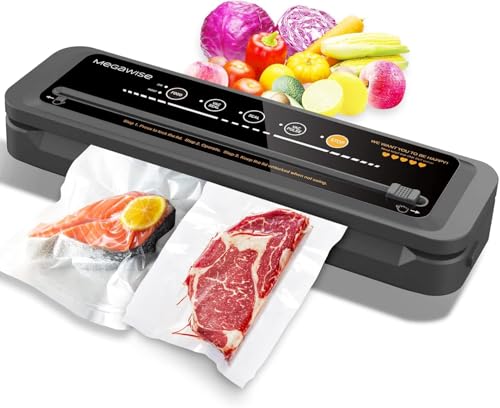
4. MEGAWISE Vacuum Sealer Machine (80kPa) — Best Value External Sealer
Value in an external sealer means the essentials done properly, and the MEGAWISE 80kPa machine is this guide’s proof. Its suction rating is strong for its class, its modes distinguish dry, moist, and fresh foods — the distinction that decides seal survival — and it carries an external vacuum system for containers alongside the bag work, with bags and a cutter included. It omits the flagship integrations of the FoodSaver picks above and keeps everything that determines whether food survives the freezer. For most kitchens, that trade is the smart one.
| Spec | Detail |
|---|---|
| Suction | 80kPa |
| Modes | Dry, moist and fresh |
| Extras | External vacuum system; bags and cutter included |
| Operation | One-touch automatic, compact body |
Strengths
- Strong suction paired with genuinely useful food modes
- External vacuum system covers jars and containers, not just bags
- Cutter and bags included — no hidden starter costs
Trade-offs
- No built-in roll storage — rolls live in a drawer
- Compact body, standard bag widths
- Brand ecosystem is smaller than FoodSaver’s
The mode set deserves emphasis because it is where value machines usually cut corners. A single blunt vacuum cycle treats a marinated steak and a bag of rice identically, and the steak’s seal pays for it. Dry, moist, and fresh modes adjust the cycle to the food, which is the difference between seals that look fine and seals that are fine three months later. Add 80kPa of draw — enough to pull bags properly tight around dense foods — and the MEGAWISE covers the technical core of external sealing without apology.
Its external vacuum system quietly widens the machine’s week: jars of nuts, canisters of coffee, containers of prepped vegetables all join the bags in the freshness system. If your budget has a ceiling but your standards do not, this is the external sealer that respects both.
Best for: Value-focused households that want strong, mode-aware sealing for bags and containers / Not suited for: Buyers who want roll storage built into the machine itself
Check on Amazon — check price on Amazon before you buy, because countertop oven pricing moves often and the listing is the only place to confirm the current configuration, included accessories, and delivery options.
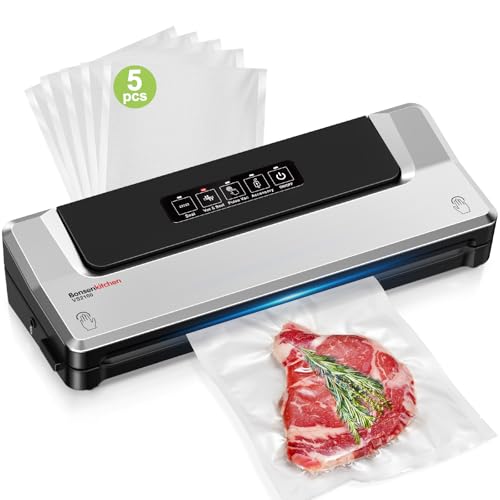
5. Bonsenkitchen Vacuum Sealer Machine (Silver) — Best Compact External Sealer
The Bonsenkitchen Vacuum Sealer in silver is the compact answer in this guide: multiple modes for meal prep, an external vacuum system, and five starter bags, in a body small enough to live in a kitchen drawer. Compactness is not a compromise to apologize for in an external sealer — it is the feature that decides whether the machine is present for the small, everyday seals (half an onion, a block of cheese, two leftover portions) that make up most of a household’s food waste. A sealer within reach gets used; this one is built to be within reach.
| Spec | Detail |
|---|---|
| Modes | Multiple modes for meal prep |
| Extras | External vacuum system; 5 vacuum bags included |
| Design | Compact, silver |
| Use | Food storage and sous vide preparation |
Strengths
- Drawer-sized body keeps sealing within everyday reach
- External vacuum system included despite the compact size
- Starter bags included for immediate first seals
Trade-offs
- Compact class pace and bag widths
- Five starter bags go quickly — order a roll early
- Not the tool for marathon processing sessions
External sealers span a size range, and buyers reflexively equate bigger with better. The Bonsenkitchen argues the opposite case for most homes: sealing is a habit, habits follow convenience, and convenience follows size and storage. A compact machine that lives in the drawer under the counter seals the Tuesday leftovers that a full-size machine in the pantry never meets. Its multiple modes keep those everyday seals competent across dry and moist foods, and the external vacuum system means jars and containers join the routine too.
Its limits are the honest ones of its class: batch sessions take longer, and bag width is household standard. But as the compact external pick — for apartments, small kitchens, RVs, and anyone whose sealing is frequent and small-scale — it covers the format’s real work in the smallest footprint here.
Best for: Apartments, small kitchens and everyday small-batch sealing / Not suited for: High-volume processors or wide-bag requirements
Check on Amazon — check price on Amazon before you buy, because countertop oven pricing moves often and the listing is the only place to confirm the current configuration, included accessories, and delivery options.
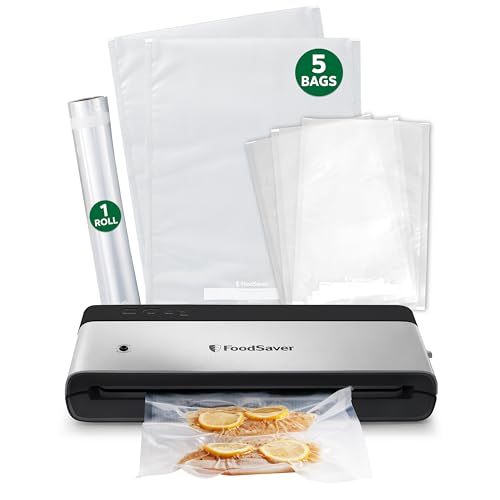
6. FoodSaver PowerVac Compact VS0150 — Best Vertical-Storage Design
The FoodSaver PowerVac Compact VS0150 solves the external sealer’s oldest problem — where it lives — with a simple idea: it stores vertically. In stainless steel and black, the VS0150 stands on a counter edge or upright in a cabinet, occupying the footprint of a hardcover book instead of a serving platter. It brings FoodSaver’s bag ecosystem with it, so the compact body sacrifices nothing in supply availability. For kitchens where every drawer is spoken for, this design is not a detail; it is the whole decision.
| Spec | Detail |
|---|---|
| Storage | Vertical storage design |
| Finish | Stainless steel and black |
| Model | VS0150 (PowerVac Compact) |
| System | FoodSaver bags, rolls and accessories |
Strengths
- Vertical storage fits kitchens no other format can
- FoodSaver ecosystem keeps bags and rolls effortless to source
- Compact sealing for the everyday household load
Trade-offs
- Compact class — not built for marathon sessions
- Upright storage still needs a stable, reachable spot
- Full-size FoodSaver features like in-machine roll storage are not here
Storage design sounds like marketing until you map a real small kitchen: drawers hold cutlery and tools, cabinets hold pans and food, and a flat sealer the size of a laptop has nowhere honest to go — so it goes to a closet, and then it goes unused. The VS0150’s vertical stance was designed against exactly that failure. Standing beside the cookbooks or at a counter’s end, it stays visible, reachable, and therefore used, which is the only performance metric that compounds over years.
As a sealer it is a compact FoodSaver in the proper sense: reliable seals for portions, leftovers, cheese, and sous vide bags, fed by the most available bag supply in the category. Choose it when your kitchen’s constraint is space rather than volume, and when you want the ecosystem insurance of the category’s biggest name in the smallest standing footprint.
Best for: Space-starved kitchens that need a sealer stored upright and always within reach / Not suited for: Session sealers who need full-size pace and features
Check on Amazon — check price on Amazon before you buy, because countertop oven pricing moves often and the listing is the only place to confirm the current configuration, included accessories, and delivery options.
Comparison Table
The table compares the six on the workflow features that separate them. All six are external, bag-style sealers; the differences are in bag handling, automation, system breadth, and storage.
| Pick | Badge | Key spec | Best for |
|---|---|---|---|
| FoodSaver FM2100 Vacuum Sealer Machine | Best Overall | Roll storage + cutter, accessory port and hose | Households that want the complete external sealing system — bags, rolls, jars and containers — in one machine |
| FoodSaver V4400 2-in-1 Vacuum Sealer | Best Automatic Detection | Automatic bag detection, 2-in-1 handheld | Frequent sealers who want the smoothest start to every cycle and container sealing in the same system |
| Nesco Deluxe VS-12 Vacuum Sealer | Best for Serious Home Volume | 130W, viewing lid | Gardeners, hunters, anglers and bulk buyers who seal in long, serious sessions |
| MEGAWISE Vacuum Sealer Machine (80kPa) | Best Value External Sealer | 80kPa, dry/moist/fresh modes | Value-focused households that want strong, mode-aware sealing for bags and containers |
| Bonsenkitchen Vacuum Sealer Machine (Silver) | Best Compact External Sealer | Compact, external vacuum system | Apartments, small kitchens and everyday small-batch sealing |
| FoodSaver PowerVac Compact VS0150 | Best Vertical-Storage Design | Vertical storage, compact FoodSaver | Space-starved kitchens that need a sealer stored upright and always within reach |
What is an external vacuum sealer, and how does it work?
An external vacuum sealer — also called an edge sealer or suction sealer — works from outside the bag. You place the open end of an embossed bag into the machine’s slot or across its seal bar; the pump draws air out through the bag’s textured channels; and when the air is gone, a heated bar melts the bag’s mouth into a permanent seal. The whole cycle takes seconds, and the result is a tight, air-free package that resists freezer burn and keeps food in its best state far longer than ordinary wrapping.
The embossed bag is not an accessory detail; it is half the technology. The tiny channels pressed into the plastic are the air’s escape routes — a smooth bag would collapse and seal itself shut at the mouth before the air inside could leave. That is why external sealers need their specific bag type, and why the chamber sealers, which equalize pressure around the whole bag, can use smooth bags instead. Understanding that one fact explains most compatibility questions in this category.
External vs chamber vacuum sealers: which do you actually need?
Choose external — the format of every pick in this guide — if your sealing is the normal household repertoire: proteins, produce, cheese, leftovers, dry goods, sous vide bags. External machines are compact, quick, inexpensive to buy and feed, and store in drawers and cabinets. Their two constraints are real but manageable: free liquids must be frozen first or managed with technique, and bag width tops out at household sizes.
Choose chamber if liquids are your staple — a soup business, a marinade-heavy process, a small food operation — or if you seal at genuine volume daily and want smooth, cheaper bags. Accept in exchange a machine that lives permanently on a counter, weighs like a microwave full of bricks, and costs multiples of any pick here. Most households that flirt with chamber machines are better served by an excellent external sealer and the freeze-first trick; this site’s chamber sealer guide covers the other path for the minority who truly need it.
The decision in one pass
- Mostly dry and moist solids, home volumes — external sealer, this guide
- Frequent free liquids, sauces, marinades as the main job — chamber sealer
- Sous vide at home — external sealer is the standard, proven choice
- Commercial throughput — chamber or commercial external units, not home models
Which features separate good external sealers from frustrating ones?
Start with bag handling. In-machine roll storage with a built-in cutter — the FM2100’s signature — turns bag-making into a five-second, one-machine act; machines without it are fine but add a drawer, a cutter, and a step to every custom bag. Next, the cycle start: automatic bag detection, as on the V4400, removes the button hunt and the tilted starts that follow it. Then system breadth: an accessory port and hose extend the machine to jars, canisters, and marinating, multiplying the jobs one purchase covers.
Modes are the quiet quality feature. A moist setting that adjusts seal behavior for wet-edged bags prevents the category’s most common failure, and manual or gentle vacuum control protects delicate foods. Finally, judge storage: a machine that fits your kitchen’s actual empty space — a drawer, a cabinet shelf, a vertical slot — will out-seal a superior machine stored in another room. Features are only valuable in the room where the food is.
There is a useful hierarchy when budgets force choices. Spend first on seal reliability — modes, gasket quality, a bar that heats evenly — because every other feature is decoration on a failed seal. Spend second on the workflow piece you will touch most: roll storage if you cut custom bags weekly, detection if you seal in sessions, an accessory port if your pantry is jar-based. Spend last on cosmetic upgrades. Buyers who follow that order rarely regret an external sealer; buyers who reverse it own beautiful machines with unreliable seals, which is the category’s one genuinely bad outcome.
How do you seal liquids and marinades with an external sealer?
Technique, three ways. The reliable classic is freeze-first: pour the soup or marinade into the bag (or a tray), freeze it solid, then seal the frozen block at leisure — the vacuum never meets liquid. The quick method is gravity: let the filled bag hang over the counter’s edge so the liquid pools at the bottom while the pump works on the air above it, and stop or seal just before liquid reaches the bar. The tidy method is headroom and vigilance: generous empty bag length, a paper towel strip near the top to intercept creeping moisture, and a finger ready on the seal button.
Whichever method you use, the seal edge must finish clean and dry — inspect it, and if liquid reached the bar, wipe, dry, and reseal below the first line with a second seal. Double-sealing liquid-adjacent bags is cheap insurance that experienced external-sealer owners apply automatically. Master these habits and the format’s one famous weakness becomes a minor skill you learned in a weekend.
How to maintain an external vacuum sealer so seals stay strong
Maintenance is measured in minutes per month. Keep the seal bar and gaskets clean: wipe the bar after messy sessions, because a crumb or a film of fat on the bar or in the drip area is a leak waiting for its moment. Inspect the foam gaskets — they are the machine’s lungs; if they are compressed, cracked, or food-stained, seals weaken no matter how strong the pump is, and on major brands they are replaceable parts. Store the machine unlatched where the design allows, so the gaskets rest uncompressed and keep their shape between uses.
Mind the drip tray if your model has one: it catches the liquid that escapes bags during moist cycles, and it needs emptying and washing like any food-contact part. Finally, give the seal bar its cooling pauses during long sessions — heat is both the tool and the wear mechanism — and your machine will produce year-five seals indistinguishable from week-one seals.
Bag sizes and roll strategy for external sealers
Build your supply around two formats: a wide roll for custom bags — whole chickens, roasts, odd shapes — and pre-cut quart and gallon bags for the daily traffic of portions and leftovers. Rolls win on cost per bag and on fit; pre-cuts win on speed. Most households settle near a pattern of rolls for projects and pre-cuts for weeknights, and the starter kits bundled with several picks in this guide are sized to teach you your own ratio in the first month.
Cut roll bags with the machine’s cutter where one is built in — the FM2100’s integration exists precisely because a clean, square cut seals better than a scissored angle. Whatever you cut, cut generously: the headroom rules in this guide apply double to roll bags, because the temptation to save plastic by cutting short is the roll user’s version of overfilling. Plastic is cheap; the food inside it is not.
Where external sealers earn their keep: five household systems
First, the bulk-buy system: warehouse and market bargains portioned the day they come home, labeled, and frozen flat — the sealer converts a cheap Saturday shop into a month of ready proteins. Second, the leftover system: cooked food sealed in single portions becomes a private stock of lunches and emergency dinners instead of a science experiment at the back of the fridge. Third, the pantry system: accessory-port jars and canisters keep coffee, flour, nuts, and spices in low-air storage that holds quality far longer than clips and hope.
Fourth, the sous vide system, where the sealer is half the appliance — bags sealed in the afternoon cook unattended in the evening bath. Fifth, the non-food system, which owners discover late and love: important documents, emergency clothing, batteries, and travel kits sealed against water and air. A machine bought for chicken thighs ends up organizing a household, which is why external sealers have some of the highest long-term satisfaction of any small appliance category — and why buying a good one the first time matters more than buying a cheap one twice.
How to Get a Perfect Seal Every Time with an External Vacuum Sealer
Most seal failures are technique failures, and they are all preventable. This routine — used by butchers, meal preppers, and every experienced home sealer — takes seconds longer than the careless version and eliminates nearly every bad seal.
- Build in headroom: Give every bag three to four inches of empty length above the food. The machine needs that material to grip, and the seal needs a clean zone to form in.
- Cuff the bag while filling: Fold the top few inches of the bag outward like a cuff before adding food. The cuff keeps the seal zone clean; unfold it before sealing and the strip that matters never touched the food.
- Flatten and arrange: Spread contents into an even, flat layer. Flat bags vacuum more completely, stack in the freezer like files, and thaw faster and more evenly.
- Dry the seal strip: Before loading, wipe the inside of the bag’s mouth. A dry, clean strip is the single strongest predictor of a seal that survives the freezer.
- Align flat, then commit: Lay the bag’s mouth flat and smooth across the seal bar with no wrinkles or folds, confirm alignment — a viewing lid helps — and run the correct mode for the food’s moisture level.
- Inspect, then label: Check the finished seal for a continuous, even band; tug it lightly. Then label contents and date, freeze flat, and file the bag upright once solid.
Common Buying Mistakes
Using smooth bags in an external sealer
Smooth bags are chamber bags. In an external machine they collapse at the mouth and trap air. Embossed bags are not an upsell — they are how the format breathes.
Sealing free liquid without a plan
Liquid drawn into the seal zone ruins the seal and can be pulled toward the pump. Freeze liquids first, hang the bag, or stop the cycle early — but never just hope.
Skipping the mode choice
Running a marinated steak on the dry setting is how seals quietly fail. Moist modes exist because moisture changes sealing physics; use them every time the food is wet.
Overfilling and under-heading bags
Food to the brim leaves no grip length and no clean seal zone. Headroom feels like wasted plastic and is actually the cheapest reliability you can buy.
Storing the machine out of reach
An external sealer in a far cupboard seals nothing. The compact and vertical-storage picks in this guide exist so the machine can live where the food is — choose the size your kitchen can host.
Final Recommendation
If you want the complete external sealing system in one machine, the FoodSaver FM2100 is the pick: roll storage and a cutter built in, an accessory hose for jars and containers, and one-touch operation that makes the whole workflow smooth. If your sealing is frequent and varied, the V4400’s automatic bag detection and handheld half make it the most frictionless choice, and serious session sealers — gardeners, hunters, bulk buyers — should go straight to the Nesco VS-12’s power and viewing lid.
On value, the MEGAWISE 80kPa covers the technical core — strong suction, the right modes, an external vacuum system — without the flagship tier. For small kitchens, choose your storage: the Bonsenkitchen disappears into a drawer, and the FoodSaver VS0150 stands vertically where no drawer exists. Confirm the box contents on the listing for the model you choose, and check price on Amazon there.
The shortlist to act on first: FoodSaver FM2100 Vacuum Sealer Machine (Best Overall) — Check on Amazon; FoodSaver V4400 2-in-1 Vacuum Sealer (Best Automatic Detection) — Check on Amazon; Nesco Deluxe VS-12 Vacuum Sealer (Best for Serious Home Volume) — Check on Amazon. Open the listing for the one that matches your kitchen, confirm the configuration and accessories included, and check price on Amazon there.
Keep researching within this site’s guides before you decide: Best Economical Vacuum Sealers Best Bags For Vacuum Sealers Best Chamber Vacuum Sealers Best Affordable Vacuum Sealers Machines Best Commercial Vacuum Sealers
Frequently Asked Questions
What is the difference between an external and a chamber vacuum sealer?
An external sealer draws air from a bag held outside the machine and seals it at the edge; it is compact, affordable, and the home standard. A chamber sealer encloses the whole bag in a chamber, handles free liquids natively, and is larger, heavier, and far more expensive. Most households need external; liquid-heavy or commercial work needs chamber.
Can external vacuum sealers handle liquids?
Not free-flowing liquid directly — the pump draws it toward the seal. The standard workarounds work well: freeze the liquid solid in the bag first, hang the bag over the counter edge so gravity holds the liquid down, or stop the vacuum just before liquid reaches the bar and seal. With those techniques, soups and marinades seal reliably.
Why do external sealers need special embossed bags?
The embossed channels in the bag are the air’s escape paths. A smooth bag collapses at the mouth and traps air inside, so the vacuum never completes. Embossed bags and rolls are the format’s one non-negotiable supply — the good news is they are inexpensive and stocked everywhere, especially in the FoodSaver format.
How long will vacuum-sealed food keep?
Far longer than conventionally stored food, because removing air prevents freezer burn and slows degradation. Dense proteins keep for many months in the freezer with quality intact; delicate items keep for shorter but still much-extended periods. A clean, intact seal and honest date labels are what make those gains real.
Are external vacuum sealers good for sous vide?
Yes — they are the standard home choice. A properly sealed bag keeps water out and food submerged through long baths. Keep the seal zone dry before sealing, use bags suited to cooking, and double-seal for long or high-temperature cooks as cheap insurance. Seasoning goes in the bag before sealing, and because the vacuum presses aromatics against the food, most cooks find they can use a lighter hand with salt and strong herbs than in open cooking — start modestly and adjust on the next cook.
How do I know if my external sealer is losing suction or seal quality?
Watch for the pattern, not a single bag: seals that look cloudy or uneven, bags that relax and admit air within days in the freezer, or cycles that run noticeably longer than they used to. Work through the cheap causes first — a dirty seal bar, tired or compressed gaskets, a full drip tray, bags from a bad batch — because most ‘dead’ sealers are dirty or gasket-tired rather than pump-dead. If a clean machine with fresh gaskets and fresh bags still fails consistently, the machine itself has earned replacement.
What does an accessory port do on an external sealer?
It connects a hose that lets the machine vacuum more than bags: jars with special lids, storage canisters, and marinating containers. It turns the sealer into the kitchen’s general air-removal system — coffee, flour, cut produce, and leftovers all keep better — and it is one of the features that separates full-system picks like the FM2100 from bag-only machines.

