Disclosure: airfryerkitchensupply.com is reader-supported. When you buy through links on our site, we may earn an affiliate commission at no extra cost to you.
Where to Buy
If you are shopping for the best espresso and steamer machines, start with the verified shortlist below. This guide is about steam as a system: the boiler or thermoblock that makes it, the wand that delivers it, and whether the machine can steam and extract at the same time. Every pick was verified in Amazon’s catalog before it earned a link, and the reviews judge steam performance — pressure, dryness, recovery and wand design — as the primary criterion, with espresso quality as the necessary second.
- Rancilio Silvia (Best Steam Power, Single Boiler) — Check the current price on Amazon
- Breville Dual Boiler (BES920XL) (Best Simultaneous Steam) — Check the current price on Amazon
- Ascaso Steel DUO (V3) (Best Thermoblock Steam) — Check the current price on Amazon
- Gaggia Classic Pro (RI9380/47) (Best Value Real Steam) — Check the current price on Amazon
- De’Longhi La Specialista Arte (EC9155M) (Best Guided Steaming) — Check the current price on Amazon
- Breville Barista Pro (BES878) (Fastest from Cold) — Check the current price on Amazon
The best espresso and steamer machines are defined by what happens in the sixty seconds after the shot. Steam is not a feature bolted onto an espresso machine; it is a second system with its own physics. A boiler stores steam under pressure and delivers it in a sustained, dry blast. A thermoblock makes steam on demand, ready instantly but with less reserve. A single boiler must choose between brewing temperature and steaming temperature, imposing a wait between the two. Those architectures — not the wand’s shape alone — decide whether your milk textures in twenty seconds or ninety, and whether a second drink starts immediately or after a recovery pause.
This guide ranks six verified machines as steaming systems. The Rancilio Silvia is the traditionalist’s answer, a single boiler famous for steam pressure out of proportion to its size. The Breville Dual Boiler and Ascaso Steel DUO eliminate the brew-steam compromise entirely with twin heating systems. The Gaggia Classic Pro and La Specialista Arte represent the capable middle, and the Barista Pro shows how far a thermocoil design can go. If your household’s drinks are mostly milk, read this guide before the others in the cluster — the steamer is the machine you actually live with.
One scope note: this guide judges machines as steamers, which occasionally inverts the verdicts of our other guides. A machine with a superb automatic espresso side and a mediocre wand ranks lower here than a plainer machine whose steam is magnificent, because the reader who searched for a steamer machine is telling us which half of the appliance they live with. If your drinks are mostly black espresso, the pump and E61 guides will rank your priorities more accurately; if milk is the medium of your mornings, you are in the right place.
In this guide
Quick Picks
The Silvia steams like a café machine, the Dual Boiler and Steel DUO steam while they brew, and the Barista Pro is the fastest from cold. Pick by how many milk drinks your mornings hold.
- Best Steam Power, Single Boiler: Rancilio Silvia — a commercial-derived boiler and an articulating steam wand famous for pressure that embarrasses bigger machines. — Check price on Amazon
- Best Simultaneous Steam: Breville Dual Boiler (BES920XL) — a dedicated steam boiler means the wand is at full pressure while the shot extracts — the production-line home machine. — Check price on Amazon
- Best Thermoblock Steam: Ascaso Steel DUO (V3) — dual thermoblocks give steam on demand with no boiler wait and no brew-steam conflict — plus PID and volumetric dosing. — Check price on Amazon
- Best Value Real Steam: Gaggia Classic Pro (RI9380/47) — a commercial-style wand on a boiler machine at a mid price — and a famous first upgrade when you want more. — Check price on Amazon
- Best Guided Steaming: De’Longhi La Specialista Arte (EC9155M) — a manual wand with a guided ecosystem — smart tamping, active temperature control and a cold-extraction trick for summer drinks. — Check price on Amazon
- Fastest from Cold: Breville Barista Pro (BES878) — a thermojet system ready in seconds and a capable manual wand — steam with almost no warm-up ritual. — Check price on Amazon
How These Picks Were Chosen
Machines were evaluated as steam systems first: wand type (commercial ball-joint, fixed, or automatic), steam source (single boiler, dual boiler, thermoblock or thermocoil), whether steaming and extraction can happen simultaneously, and recovery time between drinks. Every candidate was verified through its Amazon listing, and any machine whose steam came from a panarello-only budget wand with no manual control was excluded — this category is for real steam.
We also weighed steam dryness, because wet steam dilutes milk and ruins texture. Boiler machines with proper pressure and thermoblock designs with well-tuned steam modes scored ahead of designs known for sputtering. The final list spans the price ladder deliberately, because steam quality does not scale linearly with price — the Silvia’s reputation exists precisely because it out-steams machines costing far more.
The 6 Best Espresso and Steamer Machines
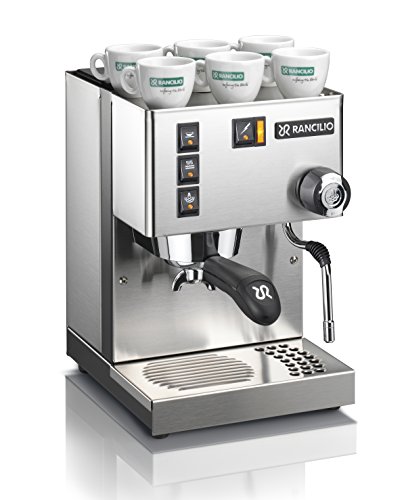
Rancilio Silvia — Best Steam Power, Single Boiler
The Silvia’s legend is a steam legend. Built on an iron frame with stainless panels by a commercial machine maker, it carries a substantial brass boiler and a fully articulating, commercial-style steam wand. When the boiler reaches steam temperature, the wand delivers a dry, forceful blast that rolls a pitcher of milk in seconds — the benchmark against which home steam has been judged for over two decades.
It suits the milk-drink enthusiast who accepts the single-boiler ritual: extract, flip to steam, wait for the climb, texture, then cool the boiler back down. It does not suit impatient households — there is no shortcut in its workflow, no built-in grinder, and temperature surfing is part of ownership unless you add a PID.
Strengths
- Commercial-style articulating wand with genuinely powerful, dry steam
- Brass boiler and iron frame give thermal stability and decades-long durability
- 58mm commercial portafilter standard with a huge accessory ecosystem
Trade-offs
- Single boiler imposes a heat-up wait between brewing and steaming, and a cool-down after
- No built-in grinder and no factory PID — both are owner additions
- Steam power is unforgiving while learning; milk overheats fast
| Specification | Detail |
|---|---|
| Frame | Iron frame with stainless steel side panels, per Amazon listing title |
| Footprint | 11.4 by 13.4 inches, per Amazon listing title |
| Boiler capacity note | 0.3 liters as listed in Amazon title |
Steam quality is about pressure sustained, not pressure advertised, and the Silvia sustains. The boiler’s mass means the wand does not fade halfway through a large pitcher — the classic failure of lesser machines — and the ball-joint articulation lets you set the pitcher angle that produces a proper whirlpool instead of a frothy boil. Owners who master it produce microfoam indistinguishable from a café’s, on a machine that has not fundamentally changed in years because it did not need to.
The workflow tax is real and should be bought knowingly. A round of two lattes involves temperature transitions that dual-boiler owners never think about, and the machine rewards a deliberate, almost ceremonial pace. For the drinker who makes one or two milk drinks with full attention, the Silvia’s steam-per-dollar remains unmatched. For a family production line, it is the wrong tool — see the twin-system machines below.
A practical note on living with the Silvia’s power: use a smaller pitcher than you think you need. Its steam overwhelms large volumes of milk before beginners can react, while a modest pitcher gives the whirlpool time to form and the temperature time to be judged. Owners also swear by the timer plug — the boiler’s mass wants twenty minutes of heat before the steam is at its best, and waking to a ready Silvia converts its one workflow tax into a non-event. Configured that way, the machine’s ritual becomes the pleasure its owners describe.
Best for: milk-drink enthusiasts who want café steam pressure and a machine built to be kept / Not suited for: households wanting simultaneous brew-and-steam or push-button workflow
Check the current price on Amazon

Breville Dual Boiler (BES920XL) — Best Simultaneous Steam
The dual boiler architecture exists to answer one question: why not both at once? The BES920XL runs a brew boiler at a precise, adjustable temperature and a separate steam boiler that keeps the wand ready at full pressure, so milk textures while espresso extracts and the second drink starts the second the first ends. Its steam wand is a proper manual, multi-hole design with the power to roll large pitchers.
It suits households making several milk drinks daily and hosts who entertain. It demands counter space, a separate grinder budget, and descaling discipline for two boilers — and it is wasted on a household that drinks one espresso a day.
Strengths
- Independent steam boiler delivers full-pressure steam during extraction
- Precise, adjustable brew temperature with low-pressure pre-infusion
- Steam wand power handles large pitchers without fading
Trade-offs
- Premium price plus a mandatory separate grinder
- Two boilers double the descaling and maintenance attention
- Large footprint and longer full heat-up than thermoblock rivals
| Specification | Detail |
|---|---|
| Boilers | Dual boiler, per product name and Amazon listing |
| Display | LCD display, per Amazon listing title |
| Drinks | Espresso shots, lattes and cappuccinos, per Amazon listing title |
Simultaneity changes the social physics of home espresso. With steam always ready, drinks for four arrive in a flowing sequence instead of a stutter of waits, and the operator can texture milk while watching the shot — the workflow cafés use, at home scale. Steam dryness is excellent because the boiler is sized for the job rather than borrowed from brewing duty.
The machine’s depth shows in repeatability: temperature is a setting, not a surf, so milk drinks taste the same on Sunday as Saturday. That consistency, plus genuine steam reserves, is why dual boilers are the endgame for milk-drink households. Buy it when the morning queue is real, and its cost divides across years of drinks that no longer involve waiting for a boiler to change its mind.
The Dual Boiler’s less discussed virtue is shot logging. Its display reports extraction time and brew temperature shot by shot, so the owner tunes by data rather than memory — a discipline that compounds into genuinely better espresso over a year of mornings. It also holds value in the used market better than almost any home machine, because its capabilities have no expiry date: temperature control, pre-infusion and dual boilers were the destination specification a decade ago and remain it. Bought once and maintained, it is the cheapest premium machine here on a cost-per-year basis.
Best for: households steaming milk for several drinks daily, and hosts / Not suited for: single-espresso drinkers or small counters
Check the current price on Amazon

Ascaso Steel DUO (V3) — Best Thermoblock Steam
The Steel DUO makes the modern case against boilers: two independent thermoblocks, one for brewing under PID control and one dedicated to steam, so steam is available on demand, at any moment, without heating a tank of water or disturbing brew temperature. Add programmable volumetric dosing — the machine stops the shot at your set volume — and it is the most systems-engineered steamer in this guide.
It suits the drinker who wants dual-system workflow with instant readiness and lower energy idle than boilers. Steam from a thermoblock has a slightly different character — very responsive, marginally less bottomless than a big boiler’s reserve — and purists raised on boiler steam sometimes prefer the Silvia’s feel.
Strengths
- Dedicated steam thermoblock: steam on demand, simultaneous with brewing
- PID temperature control and programmable volumetric shot dosing
- Heats in minutes with no large boiler to keep hot or descale
Trade-offs
- Thermoblock steam reserve is finite on very large pitchers
- Premium pricing from a smaller Spanish maker with a boutique dealer network
- No built-in grinder — budget separately
| Specification | Detail |
|---|---|
| Heating | Dual thermoblock, per Amazon listing title |
| Control | PID, programmable, volumetric controls, per Amazon listing title |
| Power | 120V (Black), per Amazon listing title |
The DUO’s steam story is responsiveness. From a cold machine to textured milk is a matter of a couple of minutes, and between drinks there is no recovery calculation at all — the steam thermoblock simply makes more steam. For households whose drinks arrive unpredictably through the morning rather than in one batch, that on-demand character beats a boiler’s stored reserve in daily satisfaction.
Volumetric dosing quietly improves the milk drinks too: while you steam, the machine ends the shot at the programmed volume, so the two halves of the drink finish together without babysitting either. It is the thinking person’s steamer — engineered rather than traditional — and for buyers who value readiness and control over boiler romance, it is the strongest pick in this guide.
The Steel DUO’s steam has one more property worth understanding: because a thermoblock makes steam on demand rather than storing it, its character is consistent from the first second to the last — no initial blast that fades, no building pressure curve. Some boiler loyalists miss the drama; production-minded drinkers prefer the flat line. It also means the machine idles cold and cheap between drinks, an ownership cost advantage over boilers that compounds quietly across years of electricity bills.
Best for: drinkers wanting instant, simultaneous steam with PID and volumetric precision / Not suited for: boiler traditionalists or buyers wanting a built-in grinder
Check the current price on Amazon

Gaggia Classic Pro (RI9380/47) — Best Value Real Steam
The Classic Pro’s steam wand is a proper commercial-style design — no panarello frothing aid, just a steel wand and boiler pressure — which makes it the least expensive route in this guide to learning real steaming technique on real hardware. Its boiler gives steam with genuine body, and the wand’s two-hole tip rolls milk correctly once you find the angle.
It suits learners who want authentic steam technique without the Silvia’s price or intensity. Its single boiler imposes the same brew-then-steam wait, stock steam pressure is a notch below the Silvia’s, and many owners eventually fit the well-known wand and PID upgrades the community has documented for years.
Strengths
- True manual steam wand — real technique, no frothing shortcuts
- Boiler steam has more reserve and dryness than budget thermoblocks
- Enormous upgrade and knowledge community specific to this machine
Trade-offs
- Single-boiler temperature wait between shots and steam
- Steam pressure is capable rather than class-leading in stock form
- No grinder included; plan the budget accordingly
| Specification | Detail |
|---|---|
| Capacity | 1.3 liters, per Amazon listing title |
| Finish | Cherry Red (other finishes under separate listings) |
As a steaming teacher, the Classic Pro is nearly ideal: the wand does nothing for you, so every improvement in your milk is yours — angle, depth, whirlpool, temperature judgment. The boiler supplies enough pressure to make those lessons stick, and the machine’s forgiving scale (a small pitcher, a single drink) matches how beginners actually practice.
Its ceiling is throughput and stock steam force. Two drinks are comfortable; four involve boiler management. But judged as the value entry to genuine steam — a machine whose wand teaches a transferable café skill and whose boiler does not embarrass the lesson — it earns its place in this guide beside far pricier steamers.
Steam technique on the Classic Pro rewards one specific setup choice: start steaming a few seconds before the boiler’s ready light would cycle, catching the heating element still driving pressure upward. It is the kind of machine-specific craft the owner community documents exhaustively, and learning it converts the Gaggia’s steam from adequate to genuinely strong. That a mid-priced machine has this depth of discoverable technique is precisely why it anchors so many long-term home setups.
Best for: learners who want authentic manual steaming at a mid-range price / Not suited for: households steaming for a crowd every morning
Check the current price on Amazon

De’Longhi La Specialista Arte (EC9155M) — Best Guided Steaming
La Specialista Arte approaches steam as part of a guided workflow: the machine manages dose and temperature actively, and its manual My LatteArt-style wand is shaped for controlled texturing rather than raw power. For the steamer who wants results with guardrails — consistent temperature, a wand that cooperates — it is the most assisted manual steaming experience in this guide.
It suits milk drinkers who want hands-on steaming with training wheels that do not feel like toys. Its single thermoblock system still sequences brewing and steaming rather than truly overlapping them, and power users will find its guidance occasionally paternal.
Strengths
- Manual wand tuned for controlled microfoam with guided temperature management
- Active temperature control keeps extraction stable drink after drink
- Integrated grinding and smart tamping shorten the whole drink workflow
Trade-offs
- Steam and brewing share one heating system — sequential, not simultaneous
- Guided features reduce the free-form control hobbyists seek
- Proprietary ecosystem of parts and accessories
| Specification | Detail |
|---|---|
| Model | EC9155M, per Amazon listing title |
| Finish | Stainless steel, per Amazon listing title |
The Arte’s steam personality is precision over force. The wand textures a small pitcher beautifully, with a tip design that makes the whirlpool easy to find and hold — the moment beginners usually struggle. Combined with the machine’s temperature discipline, milk drinks come out consistent in a way that flatters households still building their routine.
Where it yields to the twin-system machines is pace: steam waits for the thermoblock to switch roles, so a queue of lattes moves at a guided stroll rather than a café hustle. As a steamer for one or two people’s daily drinks, executed with unusual polish and forgiveness, it is exactly right — and its cold-extraction feature gives summer milk drinks a second act most rivals lack.
The Arte’s guided character extends to how it handles the end of steaming: its temperature management prevents the scorched-milk overshoot that ruins a beginner’s pitcher in the last five seconds, which is where most home milk actually dies. For households where several people of different skill levels use the machine, that guardrail produces a consistency no purely manual machine in this guide can promise — the worst drink of the week stays close to the best one.
Best for: milk drinkers who want guided, forgiving manual steaming / Not suited for: hosts needing simultaneous steam for a queue of drinks
Check the current price on Amazon
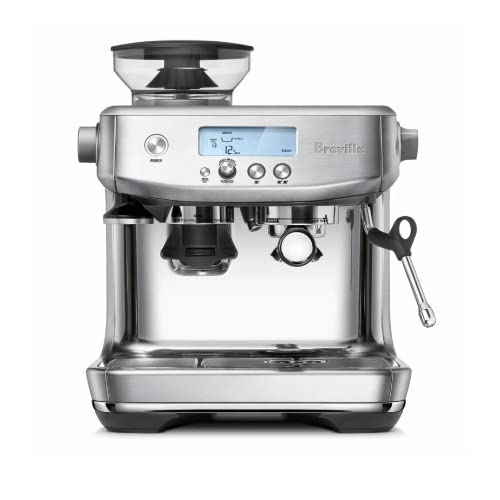
Breville Barista Pro (BES878) — Fastest from Cold
The Barista Pro’s ThermoJet heating is the steamer for impatient people: ready to brew and steam within seconds of switching on, with a manual steam wand that produces proper microfoam and a built-in grinder feeding the whole operation. In steam terms it trades the boiler machines’ deep reserve for immediacy — and for most home pitchers, immediacy wins.
It suits households whose milk drinks happen on weekday schedules, one or two at a time. It cannot brew and steam simultaneously, and very large pitchers will find the thermocoil’s steam reserve thinner than a boiler’s — entertainers should take the Dual Boiler instead.
Strengths
- Near-instant heat-up for both brewing and steam
- Manual wand textures genuine microfoam; strong steam for its class
- Built-in grinder and intuitive interface keep the whole drink in one machine
Trade-offs
- Single heating circuit — no simultaneous extraction and steaming
- Steam reserve fades on oversized pitchers compared with boiler machines
- 54mm accessory ecosystem rather than the 58mm commercial standard
| Specification | Detail |
|---|---|
| Grinder | Built-in grinder, per Amazon listing title |
| Drinks | Espresso shots, lattes and cappuccinos, per Amazon listing title |
| Finish | Brushed stainless steel, per Amazon listing title |
The Pro’s steam is a study in enough: enough pressure to roll a 350ml pitcher into gloss, delivered instantly, every time, without a boiler’s warm-up tax. For the realistic home pattern — a latte now, maybe another in an hour — that profile beats stored steam you rarely use. The wand’s single-hole tip is beginner-friendly, slowing the process just enough to learn control.
Its limits appear exactly where the Dual Boiler’s strengths begin: volume and simultaneity. Judge it by your queue. If your household’s steaming is serial and spontaneous, the Pro is the most liveable steamer here; if it is parallel and scheduled, pay for the second boiler and never wait again.
The Barista Pro’s steam readiness changes household behavior in a measurable way: because there is no warm-up penalty, milk drinks get made at odd moments — a single afternoon flat white, a late cappuccino — that a boiler household would skip rather than heat a machine for. Utilization is a real specification. A steamer that is always ready gets used daily, and daily use is what justifies every machine in this guide; the Pro’s immediacy is therefore a quality feature, not merely a convenience.
Best for: weekday households wanting instant-on steam for one or two drinks at a time / Not suited for: hosts steaming large pitchers back to back
Check the current price on Amazon
Comparison Table
| Pick | Badge | Key Spec | Best For |
|---|---|---|---|
| Rancilio Silvia | Best Steam Power, Single Boiler | Commercial articulating wand + brass boiler | milk-drink enthusiasts who want café steam pressure and a machine built to be kept |
| Breville Dual Boiler (BES920XL) | Best Simultaneous Steam | Dedicated steam boiler — steam during extraction | households steaming milk for several drinks daily, and hosts |
| Ascaso Steel DUO (V3) | Best Thermoblock Steam | Dual thermoblock — dedicated on-demand steam | drinkers wanting instant, simultaneous steam with PID and volumetric precision |
| Gaggia Classic Pro (RI9380/47) | Best Value Real Steam | Commercial-style manual wand + boiler steam | learners who want authentic manual steaming at a mid-range price |
| De’Longhi La Specialista Arte (EC9155M) | Best Guided Steaming | Guided manual wand + active temperature control | milk drinkers who want guided, forgiving manual steaming |
| Breville Barista Pro (BES878) | Fastest from Cold | ThermoJet instant heat + manual microfoam wand | weekday households wanting instant-on steam for one or two drinks at a time |
How to Choose the Best Espresso and Steamer Machines: Boilers, Blocks and Wands
Map the steam source to your drink pattern. Single boilers (Silvia, Classic Pro) store real steam and deliver it with authority, but must change temperature between brewing and steaming — ideal for one or two deliberate drinks. Dual boilers (Breville Dual Boiler) and dual thermoblocks (Ascaso Steel DUO) remove the wait entirely and suit queues. Single thermoblock and thermocoil designs (La Specialista Arte, Barista Pro) heat instantly and steam competently in sequence — the weekday compromise most households actually prefer.
Judge the wand separately from the boiler. A commercial-style articulating wand with a fine tip gives control and teaches transferable skill; a panarello-sleeved wand makes foam for you and caps the texture; an automatic wand splits the difference with sensors. Steam dryness matters too: systems that sputter water into the milk will always texture worse than their pressure figures suggest, which is why this guide favors designs with proven steam manners over spec-sheet claims.
Finally, think in pitchers per morning. Steam reserve — how much milk the system can texture before pressure fades — is the hidden spec. One 300ml pitcher: everything here copes. A litre of milk across four drinks: only the twin-system machines and the Silvia’s boiler keep their composure. Buy for your real queue, not your aspirational one.
Steam Wand Technique: The Skills Every Machine Here Rewards
All manual wands in this guide obey the same physics. Purge first — every wand spits condensed water for a second, and that water does not belong in your milk. Start with the tip just breaking the surface and the pitcher angled so the steam drives a whirlpool; the gentle tearing sound is air entering, and five to ten seconds of it is enough for a latte. Then sink the tip below the surface and let the vortex fold the air through the milk until the pitcher is hand-hot. The two errors are symmetric: too much surface time makes stiff foam that sits on top; too little makes hot milk with no texture at all.
Wand design changes the learning curve, not the principles. Single-hole tips (Barista Pro, Classic Pro) stretch milk more slowly and forgive clumsy hands. Multi-hole commercial tips (Silvia, Dual Boiler) work fast and punish hesitation — milk can go from cold to scalded in twenty seconds. Automatic wands remove the judgment calls but still reward cold milk, a sensible fill level and a prompt pour.
Care is part of technique. Milk bakes onto a hot wand within minutes and inside the tip within a day. Wipe with a damp cloth the moment the pitcher comes off, purge a one-second blast to clear the tip, and soak the tip weekly if your machine’s manual allows. Every steamer in this guide will texture beautifully for years if those thirty seconds become reflex — and every one will degrade into sputtering if they do not.
How to Set Up a Steamer Machine for Its First Milk Drinks
- Flush and heat the steam path. On first use and after any idle week, run water through the brew path, then open the steam wand for ten seconds to clear the system before milk goes anywhere near it.
- Learn your machine’s changeover. Single boilers: note how long yours takes from brew-ready to steam-ready, and from steaming back down to brew temperature (run water through the group to speed the cool-down). Twin systems: confirm both heaters are enabled in settings.
- Calibrate with water, then cheap milk. Practice the whirlpool with water and a drop of dish soap — it mimics milk’s behavior and costs nothing — then graduate to milk for two practice pitchers before your first real drink.
- Set your pitcher system. One pitcher sized to your usual drink, filled to the spout base with cold milk, beats three sizes used randomly. Consistency of vessel is consistency of result.
- Build the wipe-and-purge reflex from drink one. Wand wiped, steam purged, every time, before you taste the drink. Future-you, descaling a clean machine, sends thanks.
After setup, keep a tiny log for the first fortnight: milk volume, stretch seconds, result. Steam skill looks mysterious from outside and is mostly pattern recognition from inside; a log turns twenty drinks into a visible learning curve and shows exactly when your machine’s particular wand angle clicks for you.
Steam Capacity by the Numbers That Matter: Pitchers, Recovery and Duty Cycle
Manufacturers rarely publish steam capacity honestly, so judge by architecture and by three practical questions. How large a pitcher can the system texture before pressure visibly fades — a single 350ml pitcher is the home standard every pick here meets, while the twin-system machines and the Silvia handle double that. How long until steam is back after a drink — seconds on the Ascaso and Dual Boiler, a temperature changeover on the single boilers. And how the tenth drink of a brunch compares with the first — the question that separates stored-steam systems from on-demand ones at volume.
Duty cycle is the related idea: home machines are designed for bursts, not café queues. Even the strongest pick here wants a breath between drinks, and running any of them like a commercial line shortens component life. Households that genuinely entertain at café volume should either accept the twin-boiler tier as the floor or plan the social workflow — shots first, milk in batches — that home machines reward.
For the realistic household — two to four milk drinks, sometimes six on a weekend — every architecture in this guide suffices, and the choice returns to temperament: the single boilers’ ritual, the thermoblocks’ immediacy, the twins’ indifference to queues. Steam capacity, honestly assessed against your real mornings, is a solved problem at every tier here; it only becomes a problem when the machine is bought for a household it was never sized for.
Wand Care and Steam Safety: The Short Chapter That Saves Machines
Milk is a food that cooks onto hot metal. The care routine is therefore food hygiene, not fussiness: wipe the wand with its own damp cloth — kept for that purpose — the instant the pitcher comes off; purge a second of steam to clear the tip; and once a week, soak the tip in hot water with a milk-line cleaner if your machine’s maker recommends one, checking the tip’s holes with the tool or pin the maker supplies. Machines whose wands are neglected do not usually die; they sputter, texture badly and get blamed — the saddest failure mode in this entire cluster of guides, because it is wholly preventable.
Safety deserves its sentence: steam at boiler pressure scalds instantly, and the correct habits are mechanical — never reach across a live wand, keep children’s hands briefed and away during steaming, and treat the purge blast as a hazard zone for fingers and faces. Articulating wands should be moved by their insulated sections. None of this is difficult, and all of it is easier taught on day one than after the first burn.
Finally, water quality returns for its usual role: scale forms fastest exactly where water flashes to steam, so wand tips and steam paths are the first places hard water announces itself. The filtered-water discipline recommended throughout this cluster protects the steam system first of all — one more reason the habit pays for itself.
Matching Steamer to Household: Three Mornings, Three Machines
Consider the solo ritualist: one person, one flat white, full attention, weekends slower. For this morning, the single boilers are not a compromise but a match — the Silvia’s steam character or the Classic Pro’s teaching wand, a small pitcher, a drink made like a craft. The twin-system machines would spend their lives idling their advantage. The correct purchase is the characterful one, and this guide’s badge for the Silvia exists for exactly this kitchen.
Consider the weekday pair: two drinks, a schedule, occasional guests. Here the Barista Pro’s immediacy and the La Specialista Arte’s guidance earn their places — steam ready when the alarm’s echo fades, textures achieved without a learning curve eating the morning. The single boilers still work, but their changeover wait is paid twice daily, and the arithmetic of annoyance favors the fast machines.
Consider the hosting household: weekend brunches, four to six milk drinks, a queue at the counter. This is the twin-system brief, full stop — the Dual Boiler’s simultaneity or the Steel DUO’s on-demand steam, sized pitchers, a workflow that flows. Buying a single boiler for this household and resenting it is the most common steamer mistake in this cluster’s research; the queue, honestly counted, is the specification that should have decided.
Common Buying Mistakes
- Buying steam pressure by the brochure. Sustained, dry steam matters; a headline number with a sputtering wand textures worse than a modest boiler with manners.
- Ignoring the brew-steam wait. Single boilers are wonderful for one drink and tedious for five. Count your morning queue before choosing the architecture.
- Choosing a panarello when you wanted to learn. Frothing sleeves make foam, not skill. If latte art is the goal, the wand must be a real wand.
- Skipping the purge habit. Most ‘my steam died’ stories are milk baked into a tip. The fix is thirty seconds of care per drink, starting on day one.
- Oversizing the pitcher. A wand cannot whirlpool a half-full oversized jug. Match pitcher to drink size and steam improves instantly.
Final Recommendation
Choose the Silvia if steam character matters most and your drinks are made one or two at a time with attention; it remains the steam benchmark of the home market. Choose the Breville Dual Boiler or the Ascaso Steel DUO if your household steams in queues — simultaneity is a genuine quality-of-life upgrade, and the Ascaso adds instant readiness to it. The Gaggia Classic Pro is the value route to real wand technique, the La Specialista Arte the guided one, and the Barista Pro the instant-on weekday machine whose steam is ready before you have decided what to drink.
Whichever system you buy, cold milk, a purged wand and a wiped tip will do more for your drinks than the next tier of machine would. Steam rewards ritual; build the ritual and every machine here performs.
A final calibration for the reader weighing two finalists: steam quality reveals itself in the second month, not the second drink. In month one, every wand feels awkward and every boiler feels moody, because the skill is being built, not the machine judged. By month two, the architecture you bought is the ceiling you live under — the changeover you tolerate, the reserve you lean on, the wand angle your hands have memorized. Buy for that second month. Choose the system whose daily character — ritual, immediacy or simultaneity — you will still enjoy when the novelty is gone, and the steamer will repay you in the currency this whole guide is denominated in: milk drinks your household asks for by name.
The shortlist, if you are deciding today: Rancilio Silvia, Breville Dual Boiler (BES920XL), Ascaso Steel DUO (V3) — check price on Amazon for each before you buy, as espresso pricing moves with promotions.
Best Espresso And Latte Machines Best Espresso Cappuccino Machines Best E61 Grouphead Espresso Machines Best Electric Pump Espresso Machines Best Entry Level Espresso Machines
Frequently Asked Questions
What is the difference between a steam wand and a panarello frother?
A steam wand injects steam through a fine tip, letting you control aeration and texture — it can make anything from latte microfoam to dry cappuccino foam. A panarello is a sleeve over the wand that draws in air automatically; it makes easy, coarse foam but cannot produce fine microfoam or teach technique. This guide’s picks use real wands or automatic wand systems.
Why does my steam wand sputter water into the milk?
The first second of any wand’s output is condensed water sitting in the steam path — purge it into the drip tray before the pitcher goes under. Persistent sputtering through the whole steam usually means the boiler or thermoblock has not reached full steam temperature, or the tip is partially blocked with baked milk.
Can I steam and brew at the same time on a single boiler machine?
No. A single boiler holds one temperature at a time, and brewing and steaming need different temperatures. Dual boiler and dual thermoblock machines — the Breville Dual Boiler and Ascaso Steel DUO here — exist specifically to remove that limitation.
How long should steaming a pitcher of milk take?
On a powerful boiler machine, twenty to forty seconds for a typical latte pitcher; on thermoblock systems, somewhat longer. If your milk takes two minutes, the system is underpowered for that volume or the tip is fouled. If it takes ten seconds, slow down — you are likely overheating before texturing.
What is steam dryness and why does it matter?
Dry steam is steam with minimal liquid water mixed in. Wet steam dilutes the milk, cools the drink and breaks foam structure. Boiler machines with proper pressure and well-designed thermoblocks deliver drier steam, which is a major reason the Silvia and the twin-system machines texture noticeably better than budget designs.
How do I stop milk baking onto the wand?
Wipe the wand with a damp cloth immediately after every steam — before you pour, before you taste — and purge a short blast to clear the tip. Baked milk is only ever a problem of minutes: fresh residue wipes off, hour-old residue needs soaking and scraping, and day-old residue blocks the tip.
Is more steam pressure always better?
No — control beats force past a household threshold. Very powerful steam in a small pitcher overheats milk before a beginner can texture it, which is why the Silvia rewards small pitchers and quick hands. What matters is sustained, dry pressure matched to your pitcher size and skill, with an upgrade path in technique as you improve. Every pick here clears the household threshold; they differ in temperament, not adequacy.
What size milk pitcher should I buy?
One pitcher sized so your usual milk volume fills it a third to halfway — for a single latte, that means the small size sold for one drink, not the family jug. A pitcher too large will not whirlpool at small volumes; too small and the milk climbs out during the stretch. Spout shape matters second: a classic pointed spout pours both plain and art drinks well. Buy one good pitcher in the right size before buying a second in any size.


