Disclosure: airfryerkitchensupply.com is reader-supported. When you buy through links on our site, we may earn an affiliate commission at no extra cost to you.
Where to Buy
If you are shopping for the best entry level espresso machines, start with the verified shortlist below. Entry level is where espresso shopping goes wrong most often, so every machine linked below was verified in Amazon’s catalog first, and the list deliberately mixes the two honest starter paths: simple pump machines with forgiving pressurized baskets, and one true beginner platform — the Breville Bambino — that grows with you. Start here for the shortlist, then read the reviews to see which learning curve fits your patience.
- Breville Bambino (BES450) (Best Overall for Beginners) — Check the current price on Amazon
- De’Longhi Stilosa (EC260) (Best Budget Starter) — Check the current price on Amazon
- CASABREWS 3700 Essential (Best Learning Feedback) — Check the current price on Amazon
- De’Longhi ECP3420 (Best Simple Workhorse) — Check the current price on Amazon
- CASABREWS CM5418 (Best Compact with Gauge) — Check the current price on Amazon
- De’Longhi Dedica Arte (EC885) (Best Slim Starter) — Check the current price on Amazon
Searching for the best entry level espresso machines means sorting real starter machines from toys wearing espresso costumes. A genuine entry level machine has an electric pump, a portafilter, and enough temperature stability to extract a sweet shot; the toys at the bottom of the market run on steam pressure and produce bitter, scorched coffee no technique can rescue. Everything in this guide clears the real-machine bar, and the picks are ordered around how beginners actually learn: forgiving first, upgradeable second.
The central beginner decision is baskets. Pressurized (dual-wall) baskets build pressure artificially, so they forgive pre-ground coffee, uneven tamping and a cheap grinder — at the cost of a ceiling on shot quality. Standard baskets demand a real espresso grinder and consistent technique, and reward both with café-level results. The Bambino ships with both styles in the box, which is why it anchors this list; the other five picks lean forgiving, cost less, and are honest about what they are. None of them requires experience to make a drinkable first cappuccino this weekend.
It is worth stating the entry-level bargain plainly: your first machine’s job is to teach your hands and your palate, in that order, while producing drinks good enough to keep you practicing. Every pick here does that job. None of them is the machine an experienced barista would choose with an unlimited budget, and that is not a criticism — it is the definition of the category, priced accordingly, and the reason the guide can recommend its cheapest pick without a single asterisk.
In this guide
Quick Picks
The Bambino is the starter machine we would hand a friend. The Stilosa and CASABREWS 3700 cost less and forgive more, the Dedica Arte fits anywhere, and the ECP3420 and CM5418 round out the honest budget bench.
- Best Overall for Beginners: Breville Bambino (BES450) — instant-on heating, automatic pre-infusion and both basket styles in the box — the beginner machine that is not a toy. — Check price on Amazon
- Best Budget Starter: De’Longhi Stilosa (EC260) — the lowest-cost way to own a real 15-bar pump and stainless boiler — espresso’s honest front door. — Check price on Amazon
- Best Learning Feedback: CASABREWS 3700 Essential — a pressure gauge on a budget starter — see what your grind is doing instead of guessing. — Check price on Amazon
- Best Simple Workhorse: De’Longhi ECP3420 — a long-running 15-bar pump design with a self-priming system that is always ready — set it up and stop thinking about it. — Check price on Amazon
- Best Compact with Gauge: CASABREWS CM5418 — the gauge-and-steam-wand formula in an even smaller stainless footprint for tight counters. — Check price on Amazon
- Best Slim Starter: De’Longhi Dedica Arte (EC885) — six inches wide, three temperature levels and a latte-art wand — the design-led starter for tiny kitchens. — Check price on Amazon
How These Picks Were Chosen
To qualify as entry level here, a machine had to meet four tests: a real electric pump (verified in its Amazon listing), a first-week success rate high enough that a total beginner makes drinkable espresso without a tutor, a milk system simple enough to learn on, and a total cost of ownership — including any grinder the buyer still needs — that stays in starter territory. Machines that were merely cheap failed the first or second test and were cut.
We also weighed the exit ramp. A good entry level machine either grows with its owner (standard baskets, standard parts) or is inexpensive enough that replacing it in two years is painless. The picks below state plainly which of those two each one is, so nobody mistakes a stepping stone for a destination or pays destination money for a stepping stone.
One more selection note, because beginners ask it constantly: we did not require a built-in grinder of any pick. At entry prices, bundled grinders vary enormously, and a machine that excels with pre-ground coffee in a pressurized basket — most of this list — is a more honest starter than a machine whose weak grinder undermines fresh beans. The Bambino earns its top place by succeeding in both modes, not by bundling a grinder it does not have.
The 6 Best Entry Level Espresso Machines
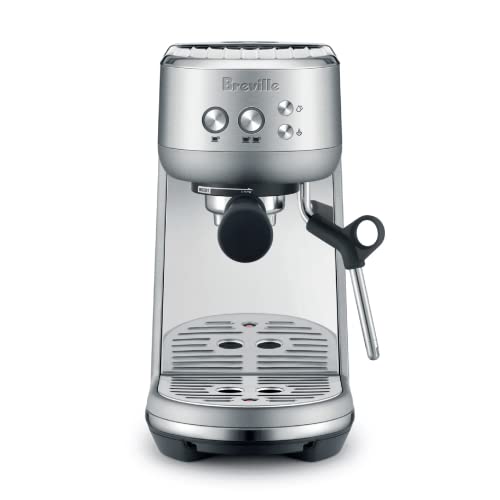
Breville Bambino (BES450) — Best Overall for Beginners
Breville designed the Bambino specifically at the beginner problem, and its listing says so outright. The thermoblock-style heating is ready almost immediately, low-pressure pre-infusion wets the puck before full pressure so first shots channel less, and the box includes both pressurized baskets for week one and standard baskets for when a real grinder arrives. No other starter machine covers the whole learning arc like that.
It suits the beginner who suspects they will love espresso and wants equipment that will not need replacing when they do. It costs more than the budget picks here, and it still needs a grinder to unlock its standard baskets — buyers on the tightest budget should start with the Stilosa instead.
Strengths
- Both pressurized and standard baskets included, so it teaches in stages
- Near-instant heat-up removes the warm-up wait that kills weekday routines
- Automatic low-pressure pre-infusion forgives uneven distribution
Trade-offs
- Steam wand is fully manual — milk technique must be learned, not delegated
- No built-in grinder, so the starter budget must include one for best results
- Compact drip tray and tank suit one or two drinkers, not a crowd
| Specification | Detail |
|---|---|
| Positioning | Beginner-friendly, per Amazon listing title |
| Drinks | Espresso, lattes and cappuccinos, per Amazon listing title |
| Format | Compact manual espresso machine, per Amazon listing title |
The Bambino’s beginner genius is sequencing. Week one: pressurized basket, pre-ground or coarsely ground coffee, decent shots and a win. Month two: the same machine with a proper grinder and the standard basket becomes a genuinely capable espresso setup that owners keep for years. Most starter machines force that upgrade by replacement; the Bambino absorbs it by configuration, which is why experienced owners recommend it to friends without caveats.
Daily life is easy: it heats before the kettle boils, the wand is a proper single-hole manual design that textures milk well once you learn the whirlpool, and the footprint fits the counters beginners actually have. The limits are throughput and automation — milk is manual, and back-to-back drinks for four guests will test your patience. For one or two people learning espresso, nothing at the tier is more complete.
One underappreciated beginner feature is the Bambino’s shot consistency aids working together: the low-pressure pre-infusion, the fast stable heating and the included distribution-friendly baskets mean a beginner’s tenth shot tastes like their ninth, so cause and effect stay legible while learning. On many cheap machines every variable wobbles at once and the learner cannot tell what changed. That legibility — boring as it sounds — is the difference between a hobby that compounds and one that gets abandoned by February, and it is the deepest reason this machine tops the list.
Best for: beginners who want one machine for the whole learning journey / Not suited for: buyers wanting push-button milk drinks or the lowest possible spend
Check the current price on Amazon
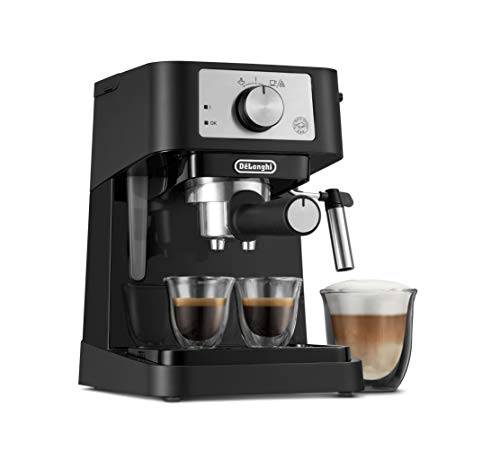
De’Longhi Stilosa (EC260) — Best Budget Starter
Every beginner guide needs a floor, and the Stilosa is it: a true pump machine with a stainless steel boiler at the bottom of the price ladder. Its pressurized baskets are deliberately forgiving, its frother is a simple manual wand, and there is almost nothing on it to break or misunderstand. For someone unsure whether home espresso is a hobby or a passing idea, it answers the question at the lowest possible cost.
It suits students, first apartments and gift purchases where the budget is firm. It does not suit the beginner who already knows they want unpressurized, grinder-driven espresso — that buyer should stretch to the Bambino and skip a step.
Strengths
- Real pump extraction with a stainless boiler at the entry price floor
- Pressurized baskets make pre-ground coffee taste genuinely decent
- Simple controls — almost nothing to configure wrong
Trade-offs
- Shot quality ceiling is set by the pressurized basket design
- Small boiler runs short on steam for several large milk drinks
- Plastic trim and light body reflect the budget tier
| Specification | Detail |
|---|---|
| Pump pressure | 15 bar, per Amazon listing title |
| Boiler | Stainless steel, per Amazon listing title |
| Frother | Manual milk frother, per Amazon listing title |
What the Stilosa teaches a beginner is the shape of the ritual — dose, tamp, extract, steam — without punishing early mistakes. Because the basket builds pressure for you, the variables that ruin shots on advanced machines barely matter here, and a newcomer tastes recognizable espresso on day one. That early success is pedagogically valuable: people persist with hobbies that reward them quickly.
The ceiling arrives when the owner buys a good grinder and starts chasing sweetness in light roasts; the pressurized system simply cannot express those differences. Treat the Stilosa as a one-to-two-year apprenticeship appliance and it is excellent value. Treat it as a forever machine and you will be shopping this guide again — which the article says plainly so the choice is yours, made with open eyes.
Practical ownership notes: the Stilosa’s small footprint and simple layout make it the machine most likely in this guide to survive a house move, a dorm year or a stint as the office espresso station. Its pressurized system also tolerates the supermarket pre-ground coffee that real life sometimes substitutes for the good beans, which matters more to its actual buyers than any spec. Descale it on a calendar rhythm rather than waiting for symptoms, because small boilers scale quietly, and this one’s longevity depends almost entirely on that single habit.
Best for: absolute beginners and gift buyers on a firm budget / Not suited for: beginners already committed to fresh-ground, unpressurized espresso
Check the current price on Amazon

CASABREWS 3700 Essential — Best Learning Feedback
Beginners quit espresso when every bad shot is a mystery. The 3700 Essential attacks that problem with the analog pressure gauge most starter machines omit: choke the shot and the needle pins; grind too coarse and it never climbs. Combined with a 20-bar Italian pump, stainless body and a family-size 43.9oz tank, it is the budget starter that behaves like a teaching tool.
It suits the analytically minded beginner who wants feedback while learning, and households that refill tanks reluctantly. Buyers who want the deepest long-term parts network should lean toward the De’Longhi and Breville names on this list instead.
Strengths
- Pressure gauge makes grind diagnosis visible from the first week
- Large 43.9oz removable tank — fewer refills than rival starters
- Stainless steel body feels a class above its tier
Trade-offs
- Younger brand with a thinner service network than the heritage makers
- Pressurized-style stock baskets cap ultimate refinement
- Steam is single-drink paced; queues form at breakfast for four
| Specification | Detail |
|---|---|
| Pump | 20-bar Italian pump, per Amazon listing title |
| Water tank | 43.9oz removable, per Amazon listing title |
| Steam wand | Fitted, for cappuccino and latte, per Amazon listing title |
In practice the gauge changes the beginner experience more than any other single feature at this tier. Instead of tasting a sour shot and wondering which of five variables failed, you watch extraction pressure and isolate the grind as the culprit nine times out of ten. Owners report the dial-in process taking days rather than the weeks a gauge-less budget machine can demand, and the skill transfers directly to any future machine.
The rest of the package is sensibly judged: steam strong enough for one latte, a body that wipes clean, a footprint that suits small counters. It will not outlast a Gaggia, and it is not trying to — it is trying to make your first hundred shots instructive instead of discouraging, and at that job it is the best value in this guide.
Two ownership traits stand out after the first month. The removable tank’s size changes behavior: owners refill weekly rather than daily, and machines that are easy to keep watered get descaled less desperately and used more often. And the gauge keeps paying rent — every new bag of beans dials in within a shot or two because the needle reports what changed. For a budget machine, that combination of low chore load and high feedback is exactly the profile that turns a trial purchase into a settled habit.
Best for: beginners who learn fastest with visible feedback / Not suited for: buyers prioritizing a decades-deep parts and service network
Check the current price on Amazon

De’Longhi ECP3420 — Best Simple Workhorse
The ECP3420 has survived in De’Longhi’s range for years because it solves the beginner’s practical problems: a self-priming pump system that does not need coaxing after standing idle, a swivel frother that reaches into any pitcher, and a removable tank and tray that make cleaning a two-minute job. It is the starter machine for people who want espresso as a beverage, not as a project.
It suits households that drink espresso and cappuccino casually and value reliability over adjustability. The enthusiast beginner will find its controls coarse and its baskets pressurized — that buyer belongs with the Bambino or a Gaggia.
Strengths
- Self-priming operation — ready whenever you are, no priming ritual
- Temperature control and a frother that handles latte and cappuccino foam
- Removable tank and tray make the cleaning routine genuinely easy
Trade-offs
- Coarse controls give little room to fine-tune extraction
- Pressurized baskets set the same quality ceiling as other budget starters
- Design has been in the range for years and feels utilitarian
| Specification | Detail |
|---|---|
| Pump | 15-bar pump, per Amazon listing title |
| Controls | Temperature control, per Amazon listing title |
| Drinks | Espresso, latte, cappuccino and iced coffee, per Amazon listing title |
Ownership is where the ECP3420 wins its fans. Machines that sit unused for a week often punish their owners with airlocks and priming dances; this one’s self-priming system simply starts. The frother produces the drier, airier foam cappuccinos want with minimal technique, and the whole machine tolerates the irregular descaling schedules real households keep better than fussier designs.
As a learning platform it is deliberately limited: you will make good drinks, and you will not learn much about why they are good. For the large group of beginners who honestly want the drink rather than the discipline, that is the right trade, and the machine’s long production run means filters, gaskets and replacement parts are easy to find years later.
The ECP3420’s secondary virtue is repairability by simplicity. Its design has been in production long enough that independent repair shops know it, its consumables are generic De’Longhi parts, and its failure modes are the documented, fixable kind — a pump, a gasket, a thermostat — rather than board-level mysteries. For a beginner machine bought on a budget, that serviceability is worth real money: the cheapest machine is the one you do not have to replace when a forty-dollar part wears out in year three.
Best for: casual drinkers who want a dependable, low-fuss starter / Not suited for: beginners who want to study extraction and fine-tune variables
Check the current price on Amazon

CASABREWS CM5418 — Best Compact with Gauge
The CM5418 takes the same beginner-friendly formula as its 3700 sibling — 20-bar pump, built-in pressure gauge, real steam wand — and trims the body down for counters where every centimeter is negotiated. For the apartment beginner it is often the deciding combination: feedback while learning, milk drinks without a separate frother, and a machine that does not evict the toaster.
It suits space-limited beginners who still want to learn technique rather than push a button. Households making drinks for three or more people every morning will feel its compact tank and single-boiler pacing, and should look at the larger picks.
Strengths
- Built-in pressure gauge in a genuinely compact body
- Steam wand produces proper milk texture for lattes and cappuccinos
- Stainless steel finish at a budget tier
Trade-offs
- Compact dimensions mean a smaller tank and drip tray
- Single heating system paces milk drinks one at a time
- Brand service network is younger than the heritage makers
| Specification | Detail |
|---|---|
| Pump | 20-bar pump, per Amazon listing title |
| Gauge | Built-in pressure gauge, per Amazon listing title |
| Steam wand | Milk frothing steam wand, per Amazon listing title |
Side by side with the 3700, the CM5418 trades tank size for footprint, and everything else about the learning experience carries over: watch the needle, adjust the grind, taste the difference. Its steam wand is a true manual wand rather than an auto-frother, so the beginner learns the actual skill — pitcher angle, whirlpool, temperature by touch — that transfers to every future machine.
The honest caveats are stamina and scale. Steam recovery between drinks is measured in patience, and the whole machine is happiest serving one or two people. Within that brief it is a remarkably complete starter, and its compactness means it stays on the counter — the single strongest predictor of whether a beginner’s espresso habit survives the first month.
The CM5418 also deserves credit for its honest steam wand placement: angled for a small pitcher, reachable without moving the machine, and powerful enough that the whirlpool forms where the manual says it should. Beginners often blame themselves for geometry their machine made impossible; here the geometry cooperates. Keep a small pitcher as your daily driver, steam milk in single-drink quantities, and the compact system performs like a machine twice its price — right up to the moment a third guest asks, which is the boundary this pick has always stated plainly.
Best for: apartment beginners short on counter space / Not suited for: families brewing several milk drinks back to back
Check the current price on Amazon

De’Longhi Dedica Arte (EC885) — Best Slim Starter
Some beginners are not short on ambition, only on kitchen. The Dedica Arte is the starter that respects both: a slim thermoblock machine with a 15-bar pump, three extraction temperatures — a real learning variable most starters hide — and the My LatteArt wand, a manual wand shaped to roll milk into microfoam rather than the coarse froth auto-wands make.
It suits design-conscious apartment dwellers who want to learn latte art from their first machine. Buyers with ample counters and upgrade plans should choose the Bambino’s standard baskets and broader accessory world instead.
Strengths
- Slimmest body in this guide — fits counters nothing else here can
- Three temperature settings teach roast-to-temperature matching early
- Manual latte-art wand builds real milk skill from day one
Trade-offs
- Small tank and tray demand frequent attention
- 51mm pressurized system limits the long-term upgrade path
- Light chassis can twist when the portafilter is locked hard
| Specification | Detail |
|---|---|
| Pump | 15-bar pump, per Amazon listing title |
| Temperature | 3-level temp control, per Amazon listing title |
| Wand | My LatteArt steam wand, per Amazon listing title |
The Dedica’s teaching value hides in its temperature settings. Beginners usually meet extraction temperature as an abstract concept; here it is a button they can A/B between a dark and a light roast in the same morning, which builds intuition fast. The thermoblock’s near-instant readiness also fits apartment life — on, shot, off — without the warm-up ceremony boiler machines ask for.
Milk is the second lesson: the Arte wand rewards the same whirlpool technique used on café machines, so the skill compounds. What you give up is headroom — the pressurized 51mm system will eventually cap a keen learner, and the small tank is a daily tax. As a first machine for a small kitchen, though, it starts more real skills than any rival its size.
The Dedica’s ownership detail worth knowing is cup clearance and workflow order. Its adjustable drip tray handles espresso cups and medium glasses, and the fast thermoblock means the sensible routine is milk first or shot first with no penalty either way — a flexibility boiler machines do not offer. In small kitchens it also earns a second job as the household’s hot-water and steam station for tea drinkers, which spreads its cost across more of the day than a wider machine that only makes espresso could justify.
Best for: small-kitchen beginners who want to learn latte art and temperature basics / Not suited for: learners planning a 58mm accessory collection
Check the current price on Amazon
Comparison Table
| Pick | Badge | Key Spec | Best For |
|---|---|---|---|
| Breville Bambino (BES450) | Best Overall for Beginners | Dual basket styles + automatic pre-infusion | beginners who want one machine for the whole learning journey |
| De’Longhi Stilosa (EC260) | Best Budget Starter | 15-bar pump + stainless boiler at the price floor | absolute beginners and gift buyers on a firm budget |
| CASABREWS 3700 Essential | Best Learning Feedback | 20-bar Italian pump + analog pressure gauge | beginners who learn fastest with visible feedback |
| De’Longhi ECP3420 | Best Simple Workhorse | 15-bar self-priming pump system | casual drinkers who want a dependable, low-fuss starter |
| CASABREWS CM5418 | Best Compact with Gauge | 20-bar pump + gauge in a compact body | apartment beginners short on counter space |
| De’Longhi Dedica Arte (EC885) | Best Slim Starter | 15-bar pump + 3-level temperature in a slim body | small-kitchen beginners who want to learn latte art and temperature basics |
How to Choose the Best Entry Level Espresso Machines Without Buying Twice
Decide first which of the two beginner paths you are on. Path one is convenience-first: pressurized baskets, pre-ground or simply ground coffee, drinkable results in week one, and a machine inexpensive enough to replace without regret. The Stilosa, ECP3420 and the CASABREWS pair live here. Path two is craft-first: a machine like the Bambino that starts forgiving but accepts standard baskets and a real grinder, so the same box serves year three. Neither path is smarter — but paying path-two money while wanting path-one effort, or path-one money while expecting path-two results, is how beginners end up buying twice.
Budget honestly for the whole system. A grinder-less starter plus no grinder equals pressurized-basket coffee forever, which is fine if chosen deliberately. If you plan to grind fresh, reserve a meaningful share of the budget for an espresso-capable burr grinder; the machine cannot express what the grinder cannot produce. Add the small consumables — a tamper that fits, a milk pitcher, descaler, and filters if your water is hard — so the first month runs smoothly.
Finally, measure your counter and your mornings. A machine that fits gets used; a machine stored in a cupboard gets sold. Warm-up time matters at 7 a.m.: thermoblock starters like the Bambino and Dedica are ready almost immediately, while small boilers take a few minutes. And be honest about milk: if every drink is a latte, the steam system’s ease matters as much as the shot quality.
Pressurized vs Standard Baskets: The Beginner Decision That Matters Most
A pressurized (dual-wall) basket has a second wall with a tiny exit hole, so pressure builds in the basket itself rather than depending on the coffee puck. That is why it forgives stale pre-ground coffee, coarse grinds and sloppy tamping — the basket does the resisting. The cost is extraction quality: the puck never experiences a true, even pressure profile, so shots taste good rather than great, and crema is partly foam created by the basket’s jet.
A standard (single-wall) basket resists only through the coffee itself. Grind size, dose, distribution and tamp all become real variables, which is why beginners’ first standard-basket shots often run too fast or choke entirely. It is also why, once dialed in, they taste unmistakably better — sweeter, clearer, with real texture. The learning curve is roughly two weeks of mornings.
The practical advice: start pressurized if you have no grinder, switch to standard the week a capable grinder arrives, and keep the pressurized basket for decaf and pre-ground emergencies. Machines that include both — the Bambino above all — let you climb that ladder without a second purchase, which is the single most valuable feature an entry level machine can offer.
How to Make Your First Espresso: A Beginner Routine That Works
- Warm the machine and the cup. Let the machine heat fully, run a blank shot into your cup, and discard the water. Warm ceramic keeps a small drink hot.
- Fill the basket evenly. Spoon or grind coffee to just below the basket rim, level it with a fingertip sweep, and avoid shaking it into mounds.
- Tamp flat. Press down evenly on a flat surface. At entry level, level matters far more than force — a crooked tamp channels every time.
- Extract and time it. Start the pump and watch: a good beginner target is a steady, honey-like stream producing your shot in roughly 25–30 seconds. Gushing means grind finer or dose more; dripping means the opposite.
- Steam milk gently. Start with the wand tip just under the surface to add air for a few seconds, then sink it to heat through. Stop when the pitcher feels hot to hold — overheated milk tastes scalded and will not pour.
- Clean immediately. Knock out the puck, rinse the basket, wipe and purge the wand. Two minutes now prevents the rancid buildup that ruins week two’s drinks.
Expect the first bag of coffee to be tuition. Every beginner sacrifices early shots to dialing in, and that is normal — change only the grind between attempts, keep the dose constant, and taste everything, even the failures. Sour means under-extracted (grind finer or run longer); bitter and hollow means over-extracted (grind coarser or run shorter). That two-flavor compass is genuinely most of espresso diagnosis.
Your First Month: A Realistic Beginner Timeline
Week one is for the ritual, not the result. Set the machine up, run the pressurized basket if you have one, and make a drink every day without judging it against the café’s. Learn where everything lives, how the wand behaves, and how long your machine takes to be ready. By the end of the week the sequence should feel boring — boring is the goal, because boring means the routine has room in it for attention to the coffee itself.
Week two is for the compass. Taste every shot before milk goes in, and sort them into sour (under-extracted: grind finer, run longer) and bitter (over-extracted: the opposite). Change one variable per day. Most beginners find the drinkable zone inside this week and are surprised how narrow the distance was between their worst and best attempts — usually two grind steps and a level tamp.
Weeks three and four are for milk and repetition. Steam on every drink, even espresso days — small pitchers of practice are tuition well spent — and settle your household’s standard drinks. By the end of the month, the honest beginner on any machine in this guide is making drinks their household prefers to the drive to a café, which is the only graduation certificate entry level espresso offers.
When to Upgrade — and When Your Starter Is Actually Enough
Upgrade when you can name the limitation in a sentence. ‘My pressurized basket will not let this light roast taste right’ is a reason. ‘My steam runs out at the second guest’ is a reason. ‘I want the shiny one’ is a feeling, and feelings are allowed — but they should be purchased knowingly, at feeling prices, rather than disguised as needs. The Bambino path exists precisely for the first kind of upgrader: its standard baskets and accessory world let the same machine absorb the next two years of ambition.
Equally, recognize when the starter is enough. A household drinking two pleasant cappuccinos a day from a Stilosa or an ECP3420 is not failing at espresso; it has solved its problem at the lowest cost in this guide, and the correct upgrade is a bag of better beans. The espresso hobby’s loudest voices are its most equipped, which skews every forum’s sense of normal. Your household’s satisfaction is the metric — the machines here were ranked to serve it at every level of ambition.
Accessories That Actually Matter at Entry Level (and Those That Do Not)
Buy four things with or soon after the machine. A milk pitcher sized to your usual drink — steaming in an oversized jug is the beginner’s most common unforced error. A tamper that actually fits your basket, since the plastic disc many machines bundle is a placeholder, not a tool. A kitchen scale with gram resolution, because dose consistency is the cheapest extraction upgrade in existence. And a knock box or a sturdy container, so puck disposal stops being a sink-side negotiation.
Defer the rest with confidence. Distribution tools, precision baskets, bottomless portafilters and upgraded shower screens all have their day — after your tenth week, when you can taste what each one changes. Bought in week one, they multiply variables exactly when the beginner’s whole task is reducing them. The exception is water: if your tap water is hard, a simple filter solution belongs in the first purchase, because scale does not wait for your skills to develop.
The accessory that outearns all of them costs nothing: a notebook or phone note for dose, time and taste. Entry level is a learning phase, and learners with records improve at multiples of the rate of learners with impressions. Every machine in this guide becomes a better teacher the moment its student starts writing things down.
Common Buying Mistakes
- Buying a steam toy. If the listing never mentions a pump, it is not an espresso machine, whatever the box art claims. Every pick here names its pump.
- Spending the whole budget on the machine. A starter plus a grinder beats a premium machine fed with pre-ground coffee on pressurized baskets you never escape.
- Chasing bar numbers. 15 vs 20 bar on the box tells you almost nothing; basket style and temperature stability decide your results.
- Skipping the descale schedule. Entry machines die young from scale, not wear. Start filtered water and calendar reminders on day one.
- Judging by the first shot. The first shot on any new machine is a calibration exercise. Judge a starter by its tenth drink, not its first.
Final Recommendation
If you can stretch to it, start on the Breville Bambino: it is the only pick that is simultaneously a forgiving first-week machine and a credible third-year one. On a firm budget, the De’Longhi Stilosa is the honest floor, the CASABREWS 3700 adds a teaching gauge and a big tank, and its CM5418 sibling shrinks the same idea for tight counters. The ECP3420 is the low-fuss workhorse for casual drinkers, and the Dedica Arte is the slim, design-led starter that still teaches real milk and temperature skills.
Whichever you choose, buy fresh beans from a local roaster, change one variable at a time, and give the routine two weeks to become muscle memory. Entry level done right is not a compromise — it is where the habit, and the palate, are built.
One last word to the beginner reading this at midnight with a cart open: the difference between the best and worst outcome here is not which of these six machines you choose — it is whether the machine you choose gets used every day for the first month. Every pick in this guide can anchor that month. Pick the one whose price does not make you anxious, whose size fits the counter you actually have, and whose routine matches the patience you honestly own at 7 a.m. Then close the comparison tabs, buy the beans, and start the clock on week one. Espresso rewards the household that begins far more than the one that optimizes, and the best entry level machine is, in the end, the one that is on your counter tomorrow morning with coffee in it.
The shortlist, if you are deciding today: Breville Bambino (BES450), De’Longhi Stilosa (EC260), CASABREWS 3700 Essential — check price on Amazon for each before you buy, as espresso pricing moves with promotions.
Best Electric Pump Espresso Machines Best Espresso And Latte Machines Best Espresso Cappuccino Machines Best Affordable Espresso Machines Best Espresso Capsule Machines
Frequently Asked Questions
What makes a machine ‘entry level’ rather than just cheap?
An entry level machine is a real pump espresso machine designed to forgive beginner technique — usually with pressurized baskets, simple controls and fast heat-up. Cheap steam-driven pots are not entry level espresso machines at all, because no amount of skill makes them extract at true espresso pressure.
Can a beginner make good espresso on the first day?
Yes, with a pressurized basket and decent coffee, every machine in this guide produces a drinkable, recognizable espresso on day one. Making excellent espresso — sweet, balanced, repeatable — takes roughly two weeks of adjusting the grind one step at a time, which is the normal learning curve, not a defect.
Do entry level machines need a grinder?
Not immediately. Pressurized baskets are designed for pre-ground coffee. A burr grinder becomes necessary the moment you switch to standard baskets, and it is the single upgrade that improves results most. If you plan that switch, the Bambino’s included standard baskets make it the natural pick.
How long should an entry level machine last?
With filtered water and descaling on schedule, the starters here serve for years. Budget models are built to a price, so treat them as two-to-five-year appliances; the Bambino-class machines commonly run much longer because their owners maintain them like the hobby equipment they become.
Is a pod machine a better start than an entry level pump machine?
Pods win on pure convenience and consistency, and our capsule guide covers the best of them. Pump machines win on cost per drink, freshness and skill-building. Choose pods if mornings are chaos; choose a pump starter if you enjoy the ritual even slightly — that enjoyment is what keeps the machine in use.
Why does my beginner espresso taste sour?
Sour almost always means under-extraction: the water passed too quickly. Grind finer, dose slightly more, or let the shot run a little longer, changing one thing at a time. Also confirm the machine and cup were fully warm — a cold group head sours shots even with a perfect grind.
Should my first machine be new or used?
Used can be excellent value in the repairable classes — a serviced Gaggia-class machine often outlasts a new budget box — but a beginner cannot yet judge a used machine’s health, and a sick first machine teaches despair instead of espresso. Buy new at the budget end, where warranties replace judgment, and consider used only when buying a known, serviceable model you can test with a live shot before money changes hands.
What coffee should a beginner buy first?
A fresh medium-roast espresso blend from a local roaster, bought in a small bag and used within a few weeks. Medium roasts are the most forgiving to extract — sweet over a wide window, tolerant of the grind imperfections a beginner produces — while very light roasts punish under-extraction with sourness and very dark roasts turn bitter at small errors. Tell the roaster it is for a first home machine; they will grind it for the basket style you own or sell you beans matched to the grinder you are saving for, and that conversation is worth more than any single accessory.


