Disclosure: airfryerkitchensupply.com is reader-supported. When you buy through links on our site, we may earn an affiliate commission at no extra cost to you.
Where to Buy
If you are shopping for the best electric pump espresso machines, start with the verified shortlist below. Every machine in this guide uses an electric pump to push water through the coffee puck, and every linked pick below was verified against Amazon’s own catalog data before it earned a link. Use the links in this section for a fast shortlist, then read the full reviews further down before you commit — pump type, boiler design and grinder provision matter more than the headline bar number on the box.
- Breville Barista Express (BES870XL) (Best Overall) — Check the current price on Amazon
- Gaggia Classic Pro (RI9380/47) (Best for Tinkerers) — Check the current price on Amazon
- De’Longhi Stilosa (EC260) (Best Budget) — Check the current price on Amazon
- De’Longhi Dedica Arte (EC885) (Best for Small Kitchens) — Check the current price on Amazon
- CASABREWS 3700 Essential (Best Value with Gauge) — Check the current price on Amazon
- Breville Dual Boiler (BES920XL) (Best Premium Pump Machine) — Check the current price on Amazon
If you are shopping for the best electric pump espresso machines, it helps to know what the phrase actually separates you from. Espresso can be made three ways at home: by hand with a lever, by steam pressure in an inexpensive stovetop-style electric pot, or by an electric pump. The pump machines are the ones that can genuinely reach and hold the pressure window espresso needs, shot after shot, without your arm doing the work. That is why almost every serious home espresso machine sold today is an electric pump machine, whether it costs the same as a nice dinner out or as much as a used motorcycle.
Inside the category there are two pump families. Vibratory pumps are compact, affordable and fitted to most home machines; they ramp pressure gradually, which is forgiving for beginners. Rotary pumps are larger, quieter and built for plumbed-in or prosumer machines that pull shot after shot. Layered on top of the pump question are the boiler question (single boiler, heat exchanger, dual boiler or thermoblock) and the grinder question (built in or separate). This guide ranks six verified electric pump machines across those designs, explains what each choice changes in the cup and on your counter, and is honest about where the cheap end of the pump market still cuts corners.
One clarification before the picks: ‘electric pump’ describes how the water moves, not how the coffee tastes, and the machines below differ wildly in temperament despite sharing the label. A pump machine can be a thirty-second weekday appliance or a fifteen-minute ritual object. This guide treats both as legitimate and ranks them by how completely each fulfills its own intention — so read the badges as job descriptions, not as a single ladder, and choose the intention that matches your kitchen before you choose the machine.
In this guide
Quick Picks
Six electric pump machines, six different answers to the same question. The short version: the Barista Express is the most complete starter package, the Stilosa is the honest budget floor, and the Gaggia Classic Pro is the one tinkerers keep for a decade.
- Best Overall: Breville Barista Express (BES870XL) — the complete electric pump starter kit — thermocoil heating, a built-in conical burr grinder and a proper steam wand in one footprint. — Check price on Amazon
- Best for Tinkerers: Gaggia Classic Pro (RI9380/47) — a commercial-style 58mm group, a real boiler and a solenoid valve — the pump machine hobbyists modify and keep for years. — Check price on Amazon
- Best Budget: De’Longhi Stilosa (EC260) — a true 15-bar pump and a stainless boiler at the lowest tier — the honest entry point to pump espresso. — Check price on Amazon
- Best for Small Kitchens: De’Longhi Dedica Arte (EC885) — a pump machine barely wider than a paperback, with a proper latte-art wand and three temperature levels. — Check price on Amazon
- Best Value with Gauge: CASABREWS 3700 Essential — a 20-bar Italian pump, a real pressure gauge and a stainless body at a budget tier. — Check price on Amazon
- Best Premium Pump Machine: Breville Dual Boiler (BES920XL) — two boilers, precise temperature control and low-pressure pre-infusion — the pump machine for shot perfectionists. — Check price on Amazon
How These Picks Were Chosen
Picks were chosen by pump and boiler architecture first, because that is what defines an electric pump machine. Each candidate had to use a true pump (not steam pressure), hold a standard portafilter or a well-supported proprietary one, and be verifiable in Amazon’s catalog — only models whose listing title matched the machine we intended to review received a purchase link. We weighted real-world shot consistency, steam capability for milk drinks, warm-up time, and the availability of parts and community knowledge, since pump machines are appliances owners keep and repair for years.
We deliberately spread the list across designs: a thermoblock machine with a built-in grinder, two classic single-boiler machines, a slim thermoblock for small kitchens, and two high-pressure budget pumps. Prices move constantly on espresso equipment, so this guide uses check-price links instead of printed prices, and positions each machine by tier — budget, mid-range or premium — so the ranking stays useful between sales events.
The 6 Best Electric Pump Espresso Machines

Breville Barista Express (BES870XL) — Best Overall
The Barista Express is the machine most home baristas actually start on, and its electric pump setup explains why. A vibratory pump feeds a thermocoil heating system that is ready in about a minute, and the built-in grinder removes the single biggest barrier to decent espresso: stale, pre-ground coffee. Everything a beginner needs — dosing, tamping, extraction, steaming — happens on one counter-friendly chassis.
It suits households making two to six milk drinks a day who want to learn real technique without buying three separate appliances. It is less suited to high-volume entertaining, because a single heating circuit means brewing and steaming take turns.
Strengths
- Built-in conical burr grinder with dose control, so no separate grinder purchase is needed to start
- Fast thermocoil warm-up and a swivel steam wand that produces genuinely glossy microfoam
- Huge owner community, cheap spare parts and accessories in every size the 54mm basket needs
Trade-offs
- Single heating circuit cannot brew and steam at the same moment
- The built-in grinder is good, not great — serious upgraders eventually replace it
- 54mm portafilter accessories are plentiful but not the commercial 58mm standard
| Specification | Detail |
|---|---|
| Heating system | Thermocoil (per manufacturer design) |
| Grinder | Built-in conical burr, per Amazon listing title |
| Drink range | Espresso, lattes and cappuccinos, per Amazon listing title |
In daily use the Express rewards a simple routine: fresh beans, a consistent dose, and thirty seconds of patience while the pump ramps. The vibratory pump’s gradual pressure rise acts like built-in pre-infusion, which forgives slightly uneven tamping and makes the machine noticeably easier to dial in than its price suggests. Shots from medium-roast beans come out sweet and balanced once the grind is set, and the pressure gauge on the face gives beginners a target to aim at while they learn.
The honest limitation is throughput. Because one thermocoil handles both brewing and steam, a run of four flat whites involves pauses the dual-boiler machines in this guide do not impose. For a couple’s morning routine that pause is trivial; for a dinner party it is the difference between this machine and stepping up a tier. Ownership costs stay low: backflush tablets, water filters and the occasional group gasket are the whole maintenance budget.
Ownership rhythm is where the Express quietly wins. The drip tray lifts out for the sink, the tank fills from the front, and the cleaning cycle is a button sequence rather than a workshop project, so the machine stays pleasant in year three rather than becoming a chore with a power cord. Paired with a mid-range roast and the stock baskets, it produces the kind of forgiving, chocolate-leaning shots that keep a household off the café run — and when an owner does outgrow the built-in grinder, the machine accepts a better external one without complaint, extending its life well past the usual starter-machine arc.
Best for: beginners and couples who want one box that grinds, brews and steams properly / Not suited for: hosts pulling back-to-back drinks for a crowd, or purists who demand a 58mm commercial group
Check the current price on Amazon

Gaggia Classic Pro (RI9380/47) — Best for Tinkerers
The Classic Pro is the electric pump machine for people who like machines. Its vibratory pump pushes water through a traditional boiler and a commercial-style 58mm chromed brass group — the same basket size cafés use — and a three-way solenoid valve dries the puck after the shot so knock-out is clean. It has been in production in evolving forms for decades, which means every wear part is replaceable and every problem has been solved publicly by another owner.
It suits the buyer who wants to learn espresso as a craft and is comfortable adding a grinder and, later, popular upgrades like a PID kit. It does not suit anyone who wants push-button milk drinks, because the steam wand is manual and the boiler must switch temperatures between brewing and steaming.
Strengths
- Commercial 58mm portafilter and brass group give access to the full pro accessory ecosystem
- Three-way solenoid valve for dry pucks and cleaner back-to-back shots
- Steel housing, simple internals and decades of parts support make it genuinely repairable
Trade-offs
- No built-in grinder — budget for a capable espresso grinder alongside it
- Single boiler means a wait between pulling a shot and steaming milk
- Stock temperature control is basic; enthusiasts often add a PID
| Specification | Detail |
|---|---|
| Capacity | 1.3 liters, per Amazon listing title |
| Finish | Cherry Red (other finishes sold under separate listings) |
Shot quality is the Classic Pro’s argument. The brass group holds temperature through the extraction in a way plastic groups cannot, and the pump delivers a steady extraction once you pair it with a grinder that can go fine enough. Owners who weigh their dose and time their shots consistently report café-level results from this unassuming box, which is exactly why it anchors so many home setups for five or ten years.
The workflow is deliberately old-school: flip a switch, watch the shot, flip to steam, wait for the boiler to climb. That rhythm teaches you espresso rather than hiding it, but it also means the Classic Pro asks more of its owner every single morning than any automatic on this list. Treat that as the trade you are making — control and longevity in exchange for convenience.
Steam technique on the Classic Pro rewards one specific setup choice: start steaming a few seconds before the boiler’s ready light would cycle, catching the heating element still driving pressure upward. It is the kind of machine-specific craft the owner community documents exhaustively, and learning it converts the Gaggia’s steam from adequate to genuinely strong. That a mid-priced machine has this depth of discoverable technique is precisely why it anchors so many long-term home setups.
Best for: hobbyists who want a repairable, upgradeable pump machine with a commercial group / Not suited for: anyone who wants one-touch drinks or dislikes a manual morning ritual
Check the current price on Amazon
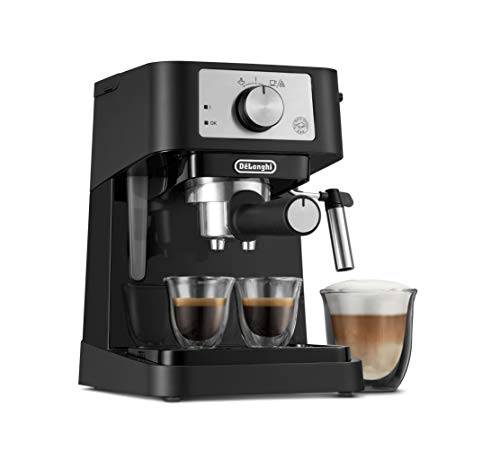
De’Longhi Stilosa (EC260) — Best Budget
Most machines at the Stilosa’s tier cheat: they are steam toys that cannot build real extraction pressure. The Stilosa does not cheat. Its electric pump is rated at 15 bar per the manufacturer’s listing, it heats with a stainless steel boiler rather than a plastic thermoblock, and it accepts both ground coffee and ESE pods. That combination makes it the cheapest defensible answer to ‘what is the least I can spend on real pump espresso?’
It suits a first-timer testing whether home espresso is for them, a dorm or office corner, or a household that drinks one or two cappuccinos on weekends. It will not suit daily double-shot drinkers chasing café nuance — the pressurized baskets that make it forgiving also cap how refined the shot can get.
Strengths
- True pump extraction at a budget tier, with a stainless steel boiler
- Pressurized baskets forgive pre-ground coffee and inconsistent tamping while you learn
- Manual panarello-style frother handles cappuccino foam without any automation cost
Trade-offs
- Pressurized baskets limit ultimate shot quality compared with the unpressurized machines here
- Small boiler means temperature and steam run out quickly on multiple drinks
- Plastic-heavy build feels like the budget tier it is
| Specification | Detail |
|---|---|
| Pump pressure | 15 bar, per Amazon listing title |
| Boiler | Stainless steel, per Amazon listing title |
| Frother | Manual milk frother, per Amazon listing title |
Used within its limits, the Stilosa makes a sweet, crema-topped shot from decent pre-ground espresso — something no steam-driven toy can claim. The pump does the real work: it forces water through the puck at pressure rather than relying on steam buildup, so extraction tastes like espresso instead of strong, scorched coffee. The frother produces the airy foam cappuccinos want with a little practice on wand angle.
Where the budget shows is stamina and refinement. Steam pressure fades on the second large latte, the drip tray is small, and the pressurized basket design means swapping to fresh-ground, finely tuned shots hits a ceiling quickly. As a first pump machine or a second machine for a holiday home it is easy to recommend; as a five-year daily driver for an espresso enthusiast, it is a stepping stone and priced like one.
Practical ownership notes: the Stilosa’s small footprint and simple layout make it the machine most likely in this guide to survive a house move, a dorm year or a stint as the office espresso station. Its pressurized system also tolerates the supermarket pre-ground coffee that real life sometimes substitutes for the good beans, which matters more to its actual buyers than any spec. Descale it on a calendar rhythm rather than waiting for symptoms, because small boilers scale quietly, and this one’s longevity depends almost entirely on that single habit.
Best for: first-time buyers who want genuine pump espresso at the lowest sensible spend / Not suited for: daily enthusiasts who will outgrow pressurized baskets within months
Check the current price on Amazon

De’Longhi Dedica Arte (EC885) — Best for Small Kitchens
The Dedica Arte answers a specific problem: most electric pump machines are countertop hogs, and small kitchens get left with pod machines. At roughly six inches wide it keeps a real 15-bar pump, a fast thermoblock and — unusually for the slim class — a manual My LatteArt steam wand shaped for microfoam rather than the auto-frothing panarello most compact machines settle for.
It suits apartment dwellers and anyone whose counter is measured in centimeters, provided they accept the Dedica’s pressurized-basket approach and its small water tank. Buyers with room for a full-size machine and ambitions for unpressurized baskets should look at the Gaggia or Breville picks instead.
Strengths
- Slimmest footprint of any true pump machine in this guide
- Thermoblock heats in well under a minute and offers three extraction temperatures
- Manual latte-art wand textures milk properly instead of just foaming it
Trade-offs
- Compact tank and drip tray need frequent emptying and refilling
- Pressurized baskets and a 51mm portafilter limit the upgrade path
- Lightweight body can shift when locking in the portafilter firmly
| Specification | Detail |
|---|---|
| Pump pressure | 15-bar pump, per Amazon listing title |
| Temperature control | 3-level temp control, per Amazon listing title |
| Steam wand | My LatteArt steam wand, per Amazon listing title |
The Dedica’s party trick is how little the slim shape costs you in the cup. The thermoblock holds a stable brew temperature across a double shot, the pump ramps smoothly, and the three temperature settings let darker and lighter roasts each get a fair extraction. Milk work is the surprise: the Arte wand, with a single hole and a proper angle, rolls milk into the glossy texture flat whites need — rare praise for a machine this small.
Compromises are physical. The tank is small because the machine is small, the cup clearance excludes tall travel mugs, and vibration from the pump is more noticeable in a light chassis. None of that matters in a studio kitchen where the alternative is no espresso at all, which is precisely the buyer this machine serves best.
The Dedica’s ownership detail worth knowing is cup clearance and workflow order. Its adjustable drip tray handles espresso cups and medium glasses, and the fast thermoblock means the sensible routine is milk first or shot first with no penalty either way — a flexibility boiler machines do not offer. In small kitchens it also earns a second job as the household’s hot-water and steam station for tea drinkers, which spreads its cost across more of the day than a wider machine that only makes espresso could justify.
Best for: small kitchens and apartments that refuse to give up real pump espresso / Not suited for: high-volume households or buyers planning an unpressurized-basket upgrade path
Check the current price on Amazon

CASABREWS 3700 Essential — Best Value with Gauge
The 3700 Essential is what happens when a value brand reads the enthusiast forums. It pairs a 20-bar Italian pump with the one teaching tool budget machines usually omit — an analog pressure gauge — and wraps it in stainless steel with a 43.9oz removable tank, a capacity many pricier compacts do not match. For learners, watching the gauge teaches extraction faster than any manual.
It suits budget buyers who still want feedback while they learn, and households that value a bigger tank and a metal body over brand heritage. It will not suit buyers who prioritize long-term parts availability, where the long-established brands in this guide have deeper support networks.
Strengths
- Pressure gauge turns dialing-in from guesswork into a visible target
- Generous 43.9oz removable tank reduces refill trips
- Stainless housing and a capable steam wand at a budget tier
Trade-offs
- Newer brand with a thinner service and parts network than De’Longhi or Breville
- Stock baskets are pressurized-style; serious learners will budget for upgrades
- Pump is louder than the rotary machines in higher tiers
| Specification | Detail |
|---|---|
| Pump | 20-bar Italian pump, per Amazon listing title |
| Water tank | 43.9oz removable, per Amazon listing title |
| Steam | Steam wand for cappuccino and latte, per Amazon listing title |
The gauge is not a gimmick. On a pump machine without one, a choked shot and a gushing shot look identical until you taste them; on the 3700 you see the needle sit low or pin high and you adjust the grind accordingly. That feedback loop shortens the beginner phase by weeks, and it is the main reason this machine earns a place beside the Stilosa rather than behind it — the Stilosa is simpler and cheaper, the CASABREWS teaches more.
Steam performance is honest for the tier: enough pressure for one latte’s worth of milk, with a pause before the second. The stainless shell wipes clean and feels a class above the price, while the compact footprint suits the same small counters as the Dedica. Buy it as a learning machine with real feedback, and it returns more skill per dollar than anything else here.
Two ownership traits stand out after the first month. The removable tank’s size changes behavior: owners refill weekly rather than daily, and machines that are easy to keep watered get descaled less desperately and used more often. And the gauge keeps paying rent — every new bag of beans dials in within a shot or two because the needle reports what changed. For a budget machine, that combination of low chore load and high feedback is exactly the profile that turns a trial purchase into a settled habit.
Best for: budget learners who want a pressure gauge and a metal body / Not suited for: buyers who rank decades-long parts support above features
Check the current price on Amazon

Breville Dual Boiler (BES920XL) — Best Premium Pump Machine
At the top of the home pump market sits the dual boiler layout: one boiler holds brew water at a precise, adjustable temperature while a second makes steam on demand. The BES920XL is Breville’s statement of that design, adding low-pressure pre-infusion, an LCD that reports shot time and temperature, and a commercial-style steam wand with real power. Its pump works with the calm consistency that separates prosumer machines from starter ones.
It suits the committed home barista pulling multiple milk drinks daily who has outgrown a single-boiler machine. It does not include a grinder and does not suit anyone still deciding whether espresso is a hobby — it is the destination machine, not the discovery one.
Strengths
- Separate brew and steam boilers allow simultaneous extraction and steaming at stable temperatures
- Adjustable brew temperature and pre-infusion give genuine shot-tuning control
- Powerful steam wand textures milk as fast as café equipment
Trade-offs
- Premium tier pricing, and a capable separate grinder is still required
- Larger footprint and longer heat-up than thermoblock machines
- More systems to descale and maintain than any single-boiler pick here
| Specification | Detail |
|---|---|
| Boilers | Dual boiler, per product name and Amazon listing |
| Display | LCD display, per Amazon listing title |
| Drinks | Espresso shots, lattes and cappuccinos, per Amazon listing title |
What the second boiler buys is not just speed, it is repeatability. Brew temperature stops being a variable you surf and becomes a number you set, so the only thing changing between shots is the variable you intended to test. Pre-infusion wets the puck gently before full pump pressure, which visibly reduces channeling on light-roast coffees that punish lesser machines. For an owner who tastes critically, that consistency is the entire argument.
The costs are size, warm-up and upkeep: two boilers want descaling discipline and counter depth. But as an electric pump machine in the purest sense — pump, boilers, group, steam, nothing automated away — the Dual Boiler is the reference point the rest of this list is measured against, and the machine least likely to be replaced by its owner.
The Dual Boiler’s less discussed virtue is shot logging. Its display reports extraction time and brew temperature shot by shot, so the owner tunes by data rather than memory — a discipline that compounds into genuinely better espresso over a year of mornings. It also holds value in the used market better than almost any home machine, because its capabilities have no expiry date: temperature control, pre-infusion and dual boilers were the destination specification a decade ago and remain it. Bought once and maintained, it is the cheapest premium machine here on a cost-per-year basis.
Best for: experienced home baristas who brew and steam simultaneously and tune by temperature / Not suited for: beginners, small counters, or anyone wanting a built-in grinder
Check the current price on Amazon
Comparison Table
| Pick | Badge | Key Spec | Best For |
|---|---|---|---|
| Breville Barista Express (BES870XL) | Best Overall | Thermocoil + built-in conical burr grinder | beginners and couples who want one box that grinds, brews and steams properly |
| Gaggia Classic Pro (RI9380/47) | Best for Tinkerers | 58mm commercial-style group + solenoid valve | hobbyists who want a repairable, upgradeable pump machine with a commercial group |
| De’Longhi Stilosa (EC260) | Best Budget | 15-bar pump + stainless steel boiler | first-time buyers who want genuine pump espresso at the lowest sensible spend |
| De’Longhi Dedica Arte (EC885) | Best for Small Kitchens | 15-bar pump in a slim thermoblock body | small kitchens and apartments that refuse to give up real pump espresso |
| CASABREWS 3700 Essential | Best Value with Gauge | 20-bar Italian pump + pressure gauge | budget learners who want a pressure gauge and a metal body |
| Breville Dual Boiler (BES920XL) | Best Premium Pump Machine | Dual boilers + adjustable temperature and pre-infusion | experienced home baristas who brew and steam simultaneously and tune by temperature |
How to Choose the Best Electric Pump Espresso Machines for Your Kitchen
Start with the heating system, because it dictates your morning rhythm. Thermoblock and thermocoil machines like the Barista Express and Dedica Arte heat in about a minute and suit households that switch the machine on for two drinks and off again. Single boilers like the Gaggia Classic Pro and Stilosa take a few minutes and must change temperature between brewing and steaming, which adds a pause per milk drink. Dual boilers remove the pause entirely but add cost, size and warm-up time. Heat-exchanger machines, common in the prosumer tier, brew and steam simultaneously through one boiler with a loop — capable, but they ask for a cooling flush routine that beginners find confusing.
Next, the pump itself. Vibratory pumps dominate home machines: they are compact and affordable, and their gradual pressure ramp is forgiving. Rotary pumps are quieter, deliver pressure instantly and are built for plumbed water lines and heavier daily use, but they live in premium machines. Ignore headline bar numbers beyond a sanity check — espresso extracts around nine bars at the puck, and a pump rated 15 or 20 bar simply has headroom; what matters is steady delivery, not the biggest number on the box.
Finally, decide the grinder question before the machine question. Espresso lives or dies on grind quality. All-in-one machines like the Barista Express bundle a workable grinder and are the fastest route to good drinks. Machines without grinders — the Gaggia, the Dual Boiler — demand a separate espresso-capable grinder in the budget, and in return let you upgrade the grinder independently later. Neither answer is wrong; buying a grinder-less machine without budgeting for the grinder is the only real mistake.
Vibratory vs Rotary Pumps, Explained Plainly
A vibratory pump moves water with an oscillating piston driven by an electromagnet. It is small, inexpensive and self-priming, which is why it appears in everything from the Stilosa to the Gaggia Classic Pro. Its pressure builds over a few seconds — a quirk that doubles as gentle pre-infusion and helps beginners avoid harsh, channeled shots. The costs are noise (a distinct buzz while extracting) and a service life measured in years of home use rather than café abuse.
A rotary pump uses a motor-driven vane, the same design as commercial café machines. It reaches full pressure almost instantly, runs far more quietly, and can draw from a plumbed line so the tank never needs refilling. Rotary pumps appear in prosumer machines and some dual boilers; they cost more and make the machine heavier. For a home pulling under ten shots a day, a vibratory pump is not a compromise that shows in the cup — the difference is refinement and longevity, not extraction quality.
One more term worth knowing: the over-pressure valve (OPV) sets the ceiling the pump works against. Machines with an adjustable OPV let owners cap extraction pressure at the traditional nine bars, which many enthusiasts prefer for sweeter shots. Fixed-OPV home machines are tuned at the factory and are fine for most drinkers; an adjustable valve is a hobbyist feature, not a requirement.
How to Pull Your First Good Shot on a Pump Machine
- Heat everything. Run the machine until it is fully warm, then pull a blank shot through the empty portafilter to heat the group and cup. Cold metal steals heat and sours the shot.
- Dose and distribute. Weigh your ground coffee — a double basket typically takes a dose in the high-teens of grams. Distribute the grounds evenly before tamping; clumps become channels.
- Tamp level, lock in immediately. Press straight down with firm, even pressure. A tilted tamp is the most common cause of a lopsided extraction. Start the pump right away so the puck does not sit under a hot group.
- Watch time and yield. Aim for the liquid to weigh about twice the dose, arriving in roughly 25–30 seconds from pump start. Too fast and sour means grind finer; too slow and bitter means grind coarser.
- Steam after, purge always. Texture milk until the pitcher is just too hot to hold comfortably, then wipe the wand and purge a burst of steam so milk never bakes inside it.
Change one variable at a time. Beginners often adjust grind, dose and temperature in the same morning and learn nothing; the discipline of single changes is what turns the first month with a pump machine from frustrating to genuinely fun. Keep a small notebook or phone note of dose, time and yield for the first few weeks — patterns appear quickly, and the gauge-equipped and LCD-equipped machines in this guide make that logging easier.
Pressure, Explained Honestly: What the Pump Numbers on the Box Really Mean
Espresso extraction happens in a narrow pressure window at the coffee puck — conventionally around nine bars. A home pump rated at 15 or 20 bars is not extracting at that pressure; the rating is the pump’s maximum capability, and an internal over-pressure valve bleeds the excess so the puck sees its regulated share. This is why the 20-bar CASABREWS and the 15-bar De’Longhis in this guide can produce equally correct extractions, and why choosing between them on the bar number alone is choosing on a marketing figure rather than a brewing one.
What does differ between pumps is delivery character. Vibratory pumps build pressure over a few seconds, which pre-wets the puck gently and forgives distribution errors. Rotary pumps arrive at full pressure almost immediately and demand better puck preparation, rewarding it with cafe-style immediacy. Neither is better in the cup for home use; they are different temperaments, and the forgiving one suits most households’ first years.
The practical shopping rule: confirm the machine has a real pump and a regulated extraction — every pick in this guide does — then spend your attention on heating system, baskets and grinder. Those decide your espresso. The pump, competently specified by any serious maker, simply shows up and works.
Water and Scale: The Maintenance That Decides a Pump Machine’s Lifespan
More pump machines die of scale than of every mechanical failure combined. Hard water deposits mineral inside boilers, thermoblocks and the narrow group passages until flow strangles and temperatures wander; the symptoms — slow shots, weak steam, sour extractions — get blamed on the machine’s quality months before anyone suspects the water. Every architecture in this guide is vulnerable, and the defense is identical for all of them: start with filtered or softened water, and descale on a schedule based on your water’s hardness rather than on symptoms.
Practical rhythm: households on moderately hard water descale roughly quarterly; on soft or filtered water, twice a year is a common cadence — and your machine’s manual outranks any general guide, so read its schedule and put it in a calendar. Use the maker’s recommended descaling approach for boiler machines, and never let a descaler sit longer than directed.
The second maintenance habit is backflushing where the machine supports it — the Gaggia and the Breville Dual Boiler in this guide do — which keeps the group’s exhaust path clear of the coffee oils that turn rancid and flavor every shot. Five minutes monthly. Between water discipline and backflushing, a pump machine’s lifespan stops being luck and becomes arithmetic.
A Pump Machine Troubleshooting Field Guide
Shot runs too fast and tastes sour: the puck offered too little resistance. Grind finer first, then check dose, then check that the coffee is not stale — in that order, one change at a time. Shot drips and tastes bitter: the opposite resistance problem; grind coarser, and confirm you are not tamping a double dose into a single basket. Shot starts well then gushes midway: channeling — the water found a crack — and the fix is distribution, leveling the grounds before the tamp rather than pressing harder.
Weak or fading steam: on boiler machines, confirm the machine reached steam temperature fully; on all machines, check the wand tip for milk blockage before suspecting the boiler — a pin and a soak cure most ‘dead steam’ reports. Pump suddenly loud or intermittent: check the tank is seated and full, because a pump sucking air is both noisy and unhappy, and run a descale if the machine’s flow has been slowing for weeks.
Nothing here requires a technician until it does: leaks inside the case, electrical smells, or a boiler that will not heat are stop-and-call faults. Everything else on this list is the ordinary craft of pump ownership, and it is learnable in a month of mornings — which is, in the end, what this category of machine is for.
Common Buying Mistakes
- Buying by bar number. A 20-bar badge does not out-extract a well-set 15-bar machine; pressure at the puck is regulated, and steadiness beats headline numbers.
- Forgetting the grinder budget. Half the machines in this category ship without one. A pump machine fed by a blade grinder or stale pre-ground will underperform a cheaper machine fed properly.
- Choosing steam toys by accident. Inexpensive ‘espresso’ pots that run on steam pressure are not pump machines and cannot make true espresso; check that the listing names a pump, as every pick here does.
- Ignoring water. Scale is the number one killer of boilers and thermoblocks. Filtered water and scheduled descaling protect the machine you just bought.
- Buying for the dinner party, not the weekday. Size, warm-up time and workflow should match your normal two-drink morning, not the twice-a-year crowd.
Final Recommendation
For most households, the Breville Barista Express is the electric pump machine to buy: it removes the grinder problem, heats fast, and teaches real technique while forgiving beginner mistakes. Budget buyers should choose between the De’Longhi Stilosa for the simplest honest pump setup and the CASABREWS 3700 if a pressure gauge and a bigger tank appeal. Small kitchens belong to the Dedica Arte. Hobbyists who value a commercial group and a machine they can repair forever should take the Gaggia Classic Pro, and the already-committed should step straight to the Breville Dual Boiler and stop shopping.
Whichever pump design you choose, pair it with fresh beans and filtered water, and give yourself two weeks of single-variable practice. The machine is only half the system; the routine you build around it is the other half.
The shortlist, if you are deciding today: Breville Barista Express (BES870XL), Gaggia Classic Pro (RI9380/47), De’Longhi Stilosa (EC260) — check price on Amazon for each before you buy, as espresso pricing moves with promotions.
Best E61 Grouphead Espresso Machines Best Entry Level Espresso Machines Best Espresso And Steamer Machines Best Espresso Cappuccino Machines Best Espresso Capsule Machines
Related guides
Frequently Asked Questions
What is the difference between a pump espresso machine and a steam espresso machine?
A pump machine uses an electric pump to force water through the coffee at controlled pressure, which produces true espresso with a stable extraction. A steam machine relies on boiling-water pressure, runs hotter and less consistently, and makes a strong coffee that is not really espresso. Every machine in this guide is a genuine pump design.
Is 15 bar or 20 bar better for home espresso?
Neither number decides quality. Espresso extracts at around nine bars at the puck; the pump’s higher rating is headroom, and an internal valve regulates what the coffee actually sees. Steady pressure delivery, good temperature stability and a proper grinder matter far more than the headline figure.
Do I need a separate grinder with an electric pump machine?
Only if the machine does not include one. Models like the Barista Express bundle a grinder; machines like the Gaggia Classic Pro and Breville Dual Boiler require a separate espresso-capable grinder, which must be included in the budget. Pre-ground coffee works in pressurized baskets but limits how good the shot can be.
How long do vibratory pump machines last?
With filtered water and regular descaling, a well-built home pump machine runs for many years. Vibratory pumps are wear items but are inexpensive and replaceable on serviceable designs like the Gaggia. Scale damage, not pump wear, is the most common cause of early failure.
Can a pump machine make regular coffee as well?
It can make an Americano — espresso lengthened with hot water — which most drinkers find close in spirit to drip coffee. If your household wants full pots of filter coffee too, look at the espresso and single-serve or combination machines covered in our sibling guides rather than forcing one machine to do both jobs badly.
Why does my pump machine sound so loud?
Vibratory pumps buzz by design, and lightweight countertops amplify them. A mat under the machine, keeping the tank seated firmly, and ensuring the drip tray is pushed home all reduce the noise noticeably. Rotary-pump machines are quieter but live in the premium tier.
How do I know when my pump machine needs descaling?
The early signs are slowing water flow, a shot that takes longer to start, steam that weakens, and extractions that drift sour despite an unchanged grind. Do not wait for all four: descale on a calendar rhythm based on your water hardness — quarterly for hard water, twice yearly for filtered — and treat any two simultaneous symptoms as an immediate prompt. Descaling late is how a maintenance task becomes a repair bill.

