Disclosure: airfryerkitchensupply.com is reader-supported. When you buy through links on our site, we may earn an affiliate commission at no extra cost to you.
Where to Buy
If you are shopping for the best espresso and latte machines, start with the verified shortlist below. A latte is two-thirds steamed milk, so this guide judges machines as milk systems first and espresso machines second. Every pick below was verified in Amazon’s catalog before receiving a link, and the list spans the three ways lattes get made at home: automatic milk carafes that froth at a button press, one-touch integrated milk tanks, and manual steam wands for drinkers who want café microfoam and are willing to learn it.
- Philips 3200 Series with LatteGo (EP3241/54) (Best Overall for Lattes) — Check the current price on Amazon
- Philips 4400 Series with LatteGo (EP4444/90) (Best for Iced Lattes) — Check the current price on Amazon
- De’Longhi Dinamica LatteCrema (ECAM35075SI) (Best Carafe Alternative) — Check the current price on Amazon
- Breville Bambino Plus (BES500) (Best Automatic Steam Wand) — Check the current price on Amazon
- Nespresso Vertuo Creatista by Breville (Best Capsule Latte Machine) — Check the current price on Amazon
- De’Longhi Magnifica Evo with LatteCrema (automatic frother) (Best Value Automatic) — Check the current price on Amazon
The best espresso and latte machines are not simply espresso machines with a frother bolted on. A latte lives or dies on microfoam — milk steamed to a glossy, paint-like texture with bubbles too fine to see — and machines differ enormously in whether they produce that texture automatically, produce a coarser foam instead, or hand the whole job to you with a proper steam wand. Choosing between those approaches is the real decision in this category, and it should be made by how your household actually drinks on a weekday morning, not by the longest feature list.
Automatic systems like Philips’ LatteGo and De’Longhi’s LatteCrema store milk in a fridge-ready carafe, dose it into the cup and rinse clean in seconds — the right answer for households making several lattes before work. Manual-wand machines like the Breville Bambino Plus and the Nespresso Vertuo Creatista demand a minute of technique per drink and repay it with texture no carafe matches. This guide verifies six machines across both camps, explains the milk science that separates them, and is blunt about the trade: convenience systems cost more per machine and less per minute; wands cost less money and more attention.
A note on what this guide counts as a latte, because the word has drifted. We mean the café standard: a double espresso under steamed milk with a thin, glossy layer of microfoam — a drink where milk and coffee are integrated, not stacked. Machines that merely produce hot milk and foam in separate layers make a pleasant milky coffee, and several were excluded from this list for exactly that reason. The six below all make the integrated drink, by carafe, by automatic wand or by capsule-plus-wand, and are judged against that standard throughout.
In this guide
Quick Picks
LatteGo machines win weekday mornings, the Creatista and Bambino Plus win on texture, and the Dinamica LatteCrema splits the difference with a carafe system on a bean-to-cup platform.
- Best Overall for Lattes: Philips 3200 Series with LatteGo (EP3241/54) — the LatteGo carafe snaps on, froths at a touch and rinses under a tap — the easiest real lattes in this guide. — Check price on Amazon
- Best for Iced Lattes: Philips 4400 Series with LatteGo (EP4444/90) — twelve hot and iced presets on the LatteGo platform, with quieter brewing and quick start for rushed mornings. — Check price on Amazon
- Best Carafe Alternative: De’Longhi Dinamica LatteCrema (ECAM35075SI) — De’Longhi’s LatteCrema carafe dials foam density on the container itself — one system for lattes and cappuccinos alike. — Check price on Amazon
- Best Automatic Steam Wand: Breville Bambino Plus (BES500) — automatic milk texturing on a real steam wand — set temperature and texture, and it steams like you practiced for months. — Check price on Amazon
- Best Capsule Latte Machine: Nespresso Vertuo Creatista by Breville — a Breville barista steam wand on a Vertuo capsule platform — pod convenience with real latte-art milk. — Check price on Amazon
- Best Value Automatic: De’Longhi Magnifica Evo with LatteCrema (automatic frother) — seven one-touch recipes and a built-in grinder on De’Longhi’s high-volume automatic platform. — Check price on Amazon
How These Picks Were Chosen
Picks were selected on milk performance first: the texture each system can produce, how much milk it wastes, how the milk path cleans, and how many drinks it can make before refilling or reheating. Espresso quality was the second filter — every pick had to be a genuine espresso platform, verified through Amazon listing for the exact model reviewed. We deliberately included both carafe automatics and manual wands, because recommending only one camp would mislead the half of latte drinkers who belong in the other.
Cleaning burden was weighted heavily, because milk residue is the number one reason latte machines get abandoned. Systems whose milk containers go in the fridge between uses and rinse or dishwasher clean scored ahead of designs with tubes that need daily dismantling, and that judgment is reflected in the ranking and in each review’s trade-offs.
The 6 Best Espresso and Latte Machines

Philips 3200 Series with LatteGo (EP3241/54) — Best Overall for Lattes
The LatteGo system is the most beginner-proof milk design in home espresso: a two-piece carafe with no tubes, which clicks onto the front of the machine, froths milk directly into the cup, then goes back in the fridge until the next drink and rinses clean in seconds when empty. On the Philips 3200 it sits atop a fully automatic platform with a ceramic grinder and one-touch recipes, so a latte is genuinely a single button press from beans to cup.
It suits households making lattes daily who will not tolerate a fiddly milk path. It does not produce the silkiest café microfoam — the LatteGo texture is a fine, soft foam that is excellent for lattes and flat-white-adjacent drinks but a touch airy for competition latte art — and purists who want to pour art should choose a wand machine below.
Strengths
- LatteGo carafe has no tubes, stores in the fridge and rinses clean in seconds
- True one-touch lattes with adjustable coffee strength via My Coffee Choice
- Ceramic grinder and AquaClean filter support a low-maintenance routine
Trade-offs
- Foam texture is soft and fine rather than the glossy microfoam a manual wand achieves
- Fully automatic platform means less control over extraction variables
- Milk carafe capacity suits households, not entertaining for a crowd
| Specification | Detail |
|---|---|
| Milk system | LatteGo milk frother, per Amazon listing title |
| Grinder | 100% ceramic grinder, per Amazon listing title |
| Recipes | 5 coffee varieties, per Amazon listing title |
What makes the 3200 the latte pick is repeatability under real conditions: half-awake, the carafe comes out of the fridge, clicks on, and the machine delivers the same drink it made yesterday. The espresso underneath is honest bean-to-cup quality from the ceramic grinder, and because the milk system has no hidden tubes, the hygiene anxiety that kills other automatics never builds. Owners actually keep using it daily, which is the metric that matters for a latte machine.
The ceiling is texture and control. LatteGo foam integrates well and tastes sweet, but it will not pour a rosetta, and the brew group is a sealed automatic unit you maintain with rinses and periodic greasing rather than tune. If your latte standard is ‘tastes like the café chain, zero effort’, this is the machine. If your standard is the independent café’s glossy pour, read on to the wand machines.
A detail that shapes daily satisfaction: the LatteGo doses milk before the coffee by default in its latte recipe, so the drink arrives layered and integrated the way cafés serve it, and the strength setting genuinely changes the coffee-to-milk balance rather than just the cup volume. Households with one strong-latte drinker and one mild-latte drinker can each land their version without a second machine or a manual workaround — the quiet personalization that makes shared automatics survive contact with real families.
Best for: households wanting one-touch lattes with the easiest milk cleanup in the category / Not suited for: latte-art hobbyists who need true manual microfoam control
Check the current price on Amazon
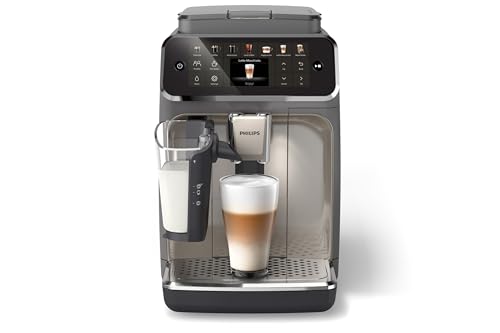
Philips 4400 Series with LatteGo (EP4444/90) — Best for Iced Lattes
The 4400 takes the same tube-free LatteGo milk system and wraps it in a more complete machine: twelve hot and iced presets, a quick-start routine that shortens the morning wait, and SilentBrew engineering that keeps the pump and grinder from waking the house. For latte drinkers whose menu rotates — hot latte on weekdays, iced latte on weekends — the preset library does the recipe math for you.
It suits households that will actually use the variety and value quiet operation in open-plan homes. Buyers who make one drink style forever are paying for presets they will never touch, and should take the 3200 instead.
Strengths
- 12 hot and iced presets cover the full latte menu without manual recipes
- LatteGo system keeps the same fridge-store, rinse-clean milk routine
- SilentBrew and Quick Start suit early, quiet household starts
Trade-offs
- Premium tier over the 3200 buys variety and quiet, not better foam texture
- Preset-driven drinks offer less manual control than wand machines
- Larger feature set means more menus to learn initially
| Specification | Detail |
|---|---|
| Milk system | LatteGo milk system, per Amazon listing title |
| Presets | 12 hot & iced coffee pre-sets, per Amazon listing title |
| Pump | 15-bar pressure, per Amazon listing title |
Iced lattes are where preset engineering earns its keep: the extraction and milk ratios that work hot taste washed out over ice, and the 4400’s iced recipes compensate automatically. Hot lattes come out with the same dependable LatteGo texture as the 3200, while the machine’s quieter cycle and faster readiness remove the two frictions — noise and waiting — that push households back to cafés.
Judge it as a convenience flagship rather than a barista tool. The espresso is consistent bean-to-cup quality, the milk is set-and-forget, and the machine asks only for beans, water and a weekly rinse rhythm. Households that entertain latte drinkers with different tastes will use profiles and presets daily; single-drink households should save the difference and buy the 3200.
The 4400’s user profiles deserve emphasis for latte households specifically. Milk volume is the most personal variable in the drink — one drinker’s latte is another’s milky coffee — and profiles store it alongside strength, so the machine stops producing the household compromise and starts producing each person’s actual drink. Combined with the quick-start routine, that is what removes the last argument for the café down the street: your latte, your ratio, ready before the kettle, without waking anyone.
Best for: households rotating hot and iced lattes who value quiet, fast mornings / Not suited for: single-recipe drinkers who would never use the preset library
Check the current price on Amazon

De’Longhi Dinamica LatteCrema (ECAM35075SI) — Best Carafe Alternative
LatteCrema is De’Longhi’s answer to the same problem LatteGo solves, with one extra idea: a dial on the carafe lid that sets foam density, so the same system pours the denser milk a latte wants and the airier foam a cappuccino demands. On the Dinamica platform it pairs with a built-in steel burr grinder and one-touch recipes, and the carafe self-cleans with a steam rinse when you turn the dial to clean.
It suits households split between latte and cappuccino drinkers — the dial makes one machine serve both honestly. It has more small parts in the milk path than LatteGo, so buyers who rank absolute cleaning simplicity first should stay with Philips.
Strengths
- Foam-density dial on the carafe adapts one system to lattes and cappuccinos
- Automatic milk frothing with a self-cleaning carafe routine
- Built-in grinder and one-touch recipes keep the workflow fully automatic
Trade-offs
- Milk path has more components to rinse than the tube-free LatteGo design
- Foam, while adjustable, still trails manual-wand microfoam for latte art
- Premium pricing over the brand’s manual-frother models
| Specification | Detail |
|---|---|
| Milk system | LatteCrema automatic milk frother, per Amazon listing title |
| Grinder | Built-in grinder, per Amazon listing title |
| Drinks | Latte and cappuccino, per Amazon listing title |
The dial is not decoration. Latte milk and cappuccino foam genuinely differ — one wants a thin layer of dense microfoam, the other a deep cap of airy foam — and most carafe systems pick one and approximate the other. LatteCrema’s adjustable density is the closest an automatic gets to serving both drinks properly, and in testing routines it is the feature owners mention most after the first month.
Underneath, the Dinamica’s espresso is the familiar De’Longhi bean-to-cup profile: rich, consistent, tuned for milk. The carafe stores in the fridge like its rival, and the clean cycle handles the milk path with steam so daily effort stays low. Choose it over the Philips pair if your household drinks across the milk menu; choose Philips if lattes alone rule and you want the simplest possible carafe.
Ownership reporting on LatteCrema systems converges on one habit: run the carafe’s clean dial after the last drink of the session, every session, and the milk path stays sweet indefinitely; skip it for a weekend and the system tells you about it in the next drink. That thirty-second discipline is the entire maintenance personality of this machine. The Dinamica underneath asks only the standard automatic rhythm — rinse the brew group, empty the pucks, descale on prompt — making the whole package one of the lowest-attention routes to daily lattes in this guide.
Best for: households split between lattes and cappuccinos wanting one automatic milk system / Not suited for: buyers who want the absolute simplest milk path to clean
Check the current price on Amazon

Breville Bambino Plus (BES500) — Best Automatic Steam Wand
The Bambino Plus occupies the clever middle ground of latte machines: a genuine steam wand, but with automatic milk texturing. You set the milk temperature and the texture level, push the pitcher under the wand, and the machine steams and stops at temperature — producing the glossy microfoam lattes actually need, with a consistency beginners take months to reach manually. The espresso side is the Bambino’s fast-heating, pre-infusion platform in a compact body.
It suits latte drinkers who want real texture and eventual manual control — the wand also works fully manually — without a rough first month. It requires a separate grinder for best results and serves one or two drinkers at a time, so high-volume automatic households belong with the carafe machines.
Strengths
- Automatic milk texturing delivers true microfoam without manual skill
- Manual mode on the same wand lets skills develop when you are ready
- Fast heat-up and compact footprint fit weekday routines and small counters
Trade-offs
- One drink at a time — steaming is automatic but still sequential
- No built-in grinder; budget for one to reach the machine’s potential
- Automatic texturing still needs the pitcher positioned sensibly
| Specification | Detail |
|---|---|
| Format | Compact semi-automatic, per Amazon listing title |
| Drinks | Espresso, lattes and cappuccinos, per Amazon listing title |
| Audience | Home baristas, per Amazon listing title |
The auto-steam is the feature that converts latte skeptics. Manual texturing fails beginners in a specific way — milk gets hot before it gets silky — and the Bambino Plus removes that failure mode entirely while keeping the wand geometry that makes real microfoam possible. The result pours with the glossy surface that holds latte art, which no carafe system in this guide can claim, and the drink tastes integrated rather than layered.
As an espresso machine it is the Bambino formula: near-instant readiness, gentle pre-infusion, honest shots from fresh-ground coffee. The compromises are scale and the grinder budget. For a one-or-two-latte household that cares about texture above automation, it is the sweet spot of this entire category — the machine baristas recommend to friends who ask about lattes specifically.
The Bambino Plus also handles the second-drink problem better than its size suggests. Its heating system recovers almost immediately, so a latte for you and a flat white for a partner arrive in one continuous workflow rather than two sessions — the practical line between a personal machine and a household one. Add the fact that its automatic texturing has a manual override that works exactly like a professional wand, and the machine occupies a niche of one: automation that teaches, rather than automation that replaces, the skill it performs.
Best for: latte drinkers who want café microfoam without months of steam practice / Not suited for: households making many lattes back to back every morning
Check the current price on Amazon

Nespresso Vertuo Creatista by Breville — Best Capsule Latte Machine
The Creatista answers the capsule drinker’s oldest frustration: pods make the espresso easy and the milk disappointing. Breville’s fix is to bolt its automatic barista steam wand — the same texturing technology as its pump machines — onto a Vertuo capsule brewer with a 30-second heat-up. You get one-touch capsule espresso and milk textured for actual latte art, in a brushed stainless body that looks like equipment rather than an appliance.
It suits capsule loyalists who drink lattes daily and refuse the foam quality of frother cups. It locks you into the Vertuo capsule ecosystem and its per-drink cost, and hands-on espresso lovers will miss grind control — those buyers belong with the Bambino Plus.
Strengths
- Barista steam wand textures milk for latte art — unique among capsule machines
- 30-second heat-up and one-touch brewing keep the pod workflow effortless
- Vertuo system brews multiple cup sizes from espresso to full coffee
Trade-offs
- Capsule cost per drink is the highest in this guide
- Vertuo capsules are a closed ecosystem with no third-party grind freedom
- Espresso character is capsule-consistent rather than freshly ground nuanced
| Specification | Detail |
|---|---|
| Steam wand | Barista steam wand for latte art, per Amazon listing title |
| Heat-up | 30 second heat-up, per Amazon listing title |
| Brewing | One touch brewing, per Amazon listing title |
Milk is where the Creatista embarrasses other capsule machines. The wand textures to the same glossy standard as Breville’s pump models, with automatic temperature control, so a Vertuo latte pours and tastes like a drink made by a person who practiced. For households committed to pods for the coffee side, it removes the last good reason to visit a café for lattes.
The trade is the ecosystem: capsule prices, capsule waste, and a flavor ceiling set by pre-ground coffee sealed in pods. Within those rules the machine is superbly executed — fast, handsome, consistent — and its drinks are honestly better than what most beginners produce on a pump machine in month one. Choose it when convenience is non-negotiable but milk quality still matters.
The Creatista’s brushed stainless body is not vanity — capsule machines live on counters permanently, and this one was designed to be looked at like equipment. Its drip tray, capsule container and tank are all sized for a two-drinker household rather than a showroom, and the wand’s automatic purge reminders handle the one hygiene habit capsule owners are most likely to skip. In a category built on convenience, it is the machine that also respects the milk.
Best for: capsule households that want real latte-art milk without a pump machine / Not suited for: drinkers who want fresh-ground control or low per-cup costs
Check the current price on Amazon

De’Longhi Magnifica Evo with LatteCrema (automatic frother) — Best Value Automatic
The Magnifica Evo is the value end of serious automatic latte machines: a built-in grinder, seven one-touch recipes and an automatic milk frother, on the Magnifica platform De’Longhi has refined across more machines than any rival. Its personalization lets each drinker save a signature drink — the household latte, tuned once and repeated at a touch.
It suits families who want automatic lattes at a mid-range tier and value the platform’s maturity and parts availability. Texture chasers will find its froth a step behind the Bambino Plus wand and the Creatista, and should pay for those instead.
Strengths
- Seven one-touch recipes including personalized signature drinks
- Built-in grinder on a mature, widely supported automatic platform
- Automatic frother keeps weekday lattes to a single button press
Trade-offs
- Froth texture is good rather than glossy — latte art is not its strength
- Automatic brew group needs the standard rinse and care routine
- Recipe automation leaves little room for extraction experimentation
| Specification | Detail |
|---|---|
| Recipes | 7 one-touch recipes, per Amazon listing title |
| Grinder | Built-in grinder, per Amazon listing title |
| Milk | Automatic milk frother, per Amazon listing title |
The Evo’s argument is the whole package at the tier: beans in, lattes out, with enough personalization that two drinkers with different tastes stop compromising. The espresso is the dependable Magnifica profile — full-bodied, milk-friendly — and the frother produces the soft, integrated foam most latte drinkers actually prefer, even if it will not win a pouring contest against the wand machines.
Ownership follows the automatic pattern: keep the brew group rinsed, empty the grounds bin, descale on schedule, and the machine repays with years of unremarkable, reliable service — which for a family latte machine is the highest praise available. It is the pick for households that measure a machine by drinks made per unit of attention demanded.
The Evo’s signature-drink feature changes household politics in a way worth naming: once each drinker’s latte is saved, the machine stops being one person’s appliance that others borrow and becomes shared infrastructure. That social detail, plus the Magnifica platform’s enormous installed base — which means filters, gaskets and advice are available everywhere — makes the Evo the lowest-risk automatic purchase in this guide, even where a rival edges it on a single specification.
Best for: families wanting automatic lattes and personalization at a mid-range tier / Not suited for: latte-art learners who need a true steam wand
Check the current price on Amazon
Comparison Table
| Pick | Badge | Key Spec | Best For |
|---|---|---|---|
| Philips 3200 Series with LatteGo (EP3241/54) | Best Overall for Lattes | LatteGo tube-free milk carafe system | households wanting one-touch lattes with the easiest milk cleanup in the category |
| Philips 4400 Series with LatteGo (EP4444/90) | Best for Iced Lattes | LatteGo + 12 hot & iced presets | households rotating hot and iced lattes who value quiet, fast mornings |
| De’Longhi Dinamica LatteCrema (ECAM35075SI) | Best Carafe Alternative | LatteCrema carafe with foam-density dial | households split between lattes and cappuccinos wanting one automatic milk system |
| Breville Bambino Plus (BES500) | Best Automatic Steam Wand | Automatic milk texturing steam wand | latte drinkers who want café microfoam without months of steam practice |
| Nespresso Vertuo Creatista by Breville | Best Capsule Latte Machine | Breville steam wand + Vertuo capsule brewing | capsule households that want real latte-art milk without a pump machine |
| De’Longhi Magnifica Evo with LatteCrema (automatic frother) | Best Value Automatic | 7 one-touch recipes + built-in grinder | families wanting automatic lattes and personalization at a mid-range tier |
How to Choose the Best Espresso and Latte Machines: Milk System First
Choose the milk system before the machine. Carafe automatics (LatteGo, LatteCrema) store milk in the fridge, froth into the cup and clean with a rinse — they suit households making lattes daily at speed, and their foam is a fine, soft texture that drinks beautifully even if it pours imperfectly. Automatic steam wands (Bambino Plus, Creatista) texture fresh milk in a pitcher to genuine microfoam; they suit drinkers who care about texture and latte art and accept a minute of hands-on time per drink. Manual wands offer the most control and the steepest learning curve, covered in our steamer-focused guide.
Then check the milk path’s cleaning design, because it decides whether the machine is still used in month six. Tube-free carafes rinse in seconds; carafes with internal channels need their clean cycles run faithfully; wands need a wipe and purge after every drink. None is onerous, but each fails differently when neglected — sour milk in a forgotten carafe is the classic — so pick the routine you will actually keep.
Finally, match capacity to your household. Carafe volume, tank size and heat-up design should fit your real morning: two lattes before work is a different machine from six drinks for a weekend houseful. And remember the espresso side still matters — a built-in grinder with fresh beans lifts every system in this guide above the same machine fed with stale pre-ground coffee.
Microfoam, Explained: What Your Latte Milk Should Actually Look Like
Microfoam is milk whose air has been incorporated as bubbles too small to see, giving it the texture of wet paint or melted ice cream. It pours in a ribbon, integrates with the espresso instead of floating on it, and tastes sweeter because the milk’s proteins and sugars are evenly distributed and properly heated. Foam with visible bubbles — the kind auto-frothing jugs and panarello wands often make — sits on top in a stiff cap; that is cappuccino territory, and in a latte it reads as a manufacturing error.
Making it requires two phases: a short stretch, where the wand tip sits at the surface and draws in air with a gentle tearing sound, and a longer roll, where the tip sinks and a whirlpool folds that air through the milk until the pitcher is hot to the touch. Automatic wands like the Bambino Plus and Creatista perform both phases with sensors; carafe systems approximate the result with a venturi that mixes steam, milk and air in a chamber — consistent and tasty, but with a slightly coarser bubble structure.
Temperature is the silent variable. Milk sweetens as it heats and turns thin and scalded past the point where the pitcher becomes uncomfortable to hold. Every system in this guide stops or signals near the right zone; your job is simply not to re-steam milk twice, which breaks the foam and flattens the sweetness no matter which machine made it.
How to Steam Milk for a Latte (Works on Any Wand in This Guide)
- Start cold. Cold milk in a cold pitcher gives you the longest working window. Fill to just below the spout base — milk expands as it foams.
- Purge the wand. A two-second blast clears condensed water so your milk is not diluted.
- Position and stretch. Tip just under the surface, slightly off-center. Open the steam fully; you want a soft tearing sound for the first few seconds as the level rises.
- Sink and roll. Lower the pitcher so the tip sits deeper and a whirlpool forms. The vortex folds the foam through the milk — this is where microfoam is actually made.
- Stop at hand-hot. When the pitcher is just too hot to hold comfortably, close the steam. Overheated milk will not pour and tastes cooked.
- Swirl, tap, pour promptly. Swirl to a glossy shine, tap out any surface bubbles, and pour immediately in a steady stream, finishing with a wiggle if you are attempting art.
On automatic wands, steps two through five are handled for you — your job reduces to cold milk, sensible fill level and a prompt pour. On carafe systems, skip straight to pouring technique: hold the cup at an angle, pour into the center, and let the machine’s milk integrate as it lands. Either way, wipe the wand or rinse the carafe the moment the drink is poured; milk residue waits for no one.
Milk, Cups and Ratios: The Latte Details Machines Cannot Decide for You
Whole milk is the latte’s default for a reason: its fat carries flavor and its proteins build stable foam, and every system in this guide is tuned assuming it. Lower-fat milks foam more easily but thinner, and taste watery against a double shot; plant milks vary by brand formulation, with barista editions engineered with added fats and stabilizers that genuinely work in both carafes and wands, while standard versions often split or refuse to texture. If your household drinks plant milk, buy the barista edition of your preferred brand and judge any machine in this guide by its performance with that milk, not with dairy.
Cup size is the silent ratio-breaker. A latte built on a double shot belongs in a cup that leaves the milk as the supporting act; pour the same drink into an oversized mug and top it up, and the espresso drowns politely. Choose two or three cup sizes your household actually uses, set the machines’ drink volumes to those cups, and the ratio discipline that cafés enforce with crockery enforces itself at home.
Temperature of the cup matters as much as temperature of the milk. A cold ceramic cup steals the first ten degrees from a small drink; the cup warmers on some of these machines, or a rinse of hot water in the cup, are worth the ten seconds. Lattes are served at drinking temperature, not at spectacle temperature — protect that warmth at every step the machine cannot control for you.
Latte Art: A Realistic Path From Heart to Rosetta
Latte art is a pouring skill built on a milk skill, in that order. Until your milk is consistently glossy — the wet-paint texture the microfoam section describes — patterns will not form no matter how the pitcher moves, so the first month of practice is texture-only: steam, swirl, pour a plain white latte, taste the improvement. Automatic wands like the Bambino Plus and Creatista shorten this phase by making the texture repeatable while you learn the pour.
The heart is the honest first pattern: pour high to sink the milk, lower the pitcher to lay the foam, finish with a pull-through. Most learners pour a recognizable heart inside twenty attempts once the texture is right. The rosetta adds a wiggle and a slower pour; the tulip adds stops and pushes. Each is a variation on the same pour, which is why baristas insist — correctly, if annoyingly — that there is one skill here, practiced at increasing resolution.
Set expectations by system. Wand machines, manual or automatic, can take you the whole way. Carafe systems produce foam that will hold a simple heart on a good day and should be judged by taste instead — their lattes drink beautifully and pour plainly, and for most households that trade is the correct one, made deliberately.
Troubleshooting Lattes: Five Drinks Gone Wrong and Their Fixes
The separated latte — milk below, foam floating like a raft — means the milk was foamed too dry or poured too timidly. Steam to a glossier texture, pour from a height first to drive milk under the espresso, then finish low. The scalded latte, sweet-less and flat, means the milk went past hand-hot; there is no rescue, only the lesson, and automatic-wand owners should check their temperature setting has not crept upward. The weak latte is a ratio problem: a single shot drowning in a large cup’s milk — go double, or go smaller cup.
The bubbly latte, with visible foam bubbles on the surface, was poured too late or steamed with the tip too high for too long. Swirl the pitcher until it shines, tap it once on the counter, and pour immediately; bubbles are a timing fault more than a technique fault. The bitter latte is rarely the milk’s fault at all: taste the shot alone. If the espresso is over-extracted, no milk quality will hide it in a drink that is two-thirds milk — fix the grind, and the latte follows.
Notice the pattern: four of the five failures are milk handling, one is extraction, and none are the machine. That ratio is why this guide ranked milk systems first. A household that masters cold milk, prompt pouring and a double shot in the right cup will make excellent lattes on every pick here — and will know, when a drink disappoints, exactly which of the five stories it is telling.
Common Buying Mistakes
- Buying a wand machine for a household that wanted a button. Be honest about weekday patience; an unused steam wand textures nothing.
- Ignoring the milk path’s cleaning design. Count the parts you must wash. If the routine looks tiresome in the showroom, it will be skipped at home.
- Judging foam by cappuccino photos. A tall stiff cap is wrong for a latte. Look for glossy, pourable microfoam in demonstrations instead.
- Forgetting milk waste. Carafe systems dose exactly; wand steaming wastes a little milk per drink while learning. Factor your household’s milk usage honestly.
- Re-steaming milk. No machine fixes twice-steamed milk. Steam fresh, every drink.
Final Recommendation
For most latte households the Philips 3200 with LatteGo is the answer: one-touch drinks, a carafe that rinses in seconds, and foam that satisfies everyone except art competitors. The Philips 4400 adds iced presets and quiet running for varied menus; the De’Longhi Dinamica LatteCrema serves mixed latte-and-cappuccino households with its foam dial; and the Magnifica Evo brings the same automatic convenience to a mid-range tier. If texture is your religion, the Bambino Plus and the capsule-based Creatista are the two machines whose milk genuinely pours like a café’s.
Whichever camp you choose, use cold fresh milk, keep the milk path clean, and never re-steam. A latte is a simple drink that punishes exactly those three shortcuts and rewards everything else generously.
The shortlist, if you are deciding today: Philips 3200 Series with LatteGo (EP3241/54), Philips 4400 Series with LatteGo (EP4444/90), De’Longhi Dinamica LatteCrema (ECAM35075SI) — check price on Amazon for each before you buy, as espresso pricing moves with promotions.
Best Espresso Cappuccino Machines Best Espresso And Steamer Machines Best Entry Level Espresso Machines Best Espresso Capsule Machines Best E61 Grouphead Espresso Machines
Frequently Asked Questions
What is the difference between a latte machine and a cappuccino machine?
The machines overlap, but the drinks differ: a latte is mostly steamed milk with a thin layer of microfoam, while a cappuccino is equal thirds of espresso, steamed milk and airy foam. Latte-focused machines emphasize smooth, dense milk texture; cappuccino-focused systems emphasize foam volume. Our cappuccino guide ranks machines by that second standard.
Can automatic milk carafes really make latte-quality foam?
Yes, within their design intent. Systems like LatteGo and LatteCrema produce a fine, soft foam that integrates well and tastes right in a latte. What they cannot do is the ultra-glossy microfoam needed for detailed latte art — for that you need a steam wand, automatic or manual.
How do I clean a milk carafe system properly?
Empty and rinse the carafe daily if it held milk, run the machine’s clean cycle as directed, and store the carafe in the fridge between uses rather than on the counter. Tube-free designs like LatteGo rinse under a tap; systems with internal channels rely on their steam clean cycle, which should never be skipped.
Why does my latte taste watery?
Usually one of three causes: the milk was overheated and thinned, the espresso under-extracted so it cannot stand up to the milk volume, or the ratio drifted — too much milk for a single shot. Use a double shot for larger cups, stop steaming at hand-hot, and check your extraction time.
Is a capsule machine a good choice for lattes?
It can be, if the milk system is serious. Most capsule machines pair with frother cups that make cappuccino-style foam; the Vertuo Creatista is the exception with a real steam wand, and it is the only capsule route we recommend for drinkers who care about latte texture.
How much milk does each latte waste?
Carafe systems dose close to exactly what the drink needs. Wand steaming needs enough milk to submerge the tip and form a whirlpool, so small drinks waste a little until technique improves. Budget roughly an extra splash per drink while learning, and none once your pitcher sizing matches your cup.
Why do cafés’ lattes taste sweeter than mine with the same milk?
Usually temperature and texture, not ingredients. Milk steamed to the glossy stage and stopped at hand-hot concentrates its perceived sweetness; milk pushed hotter turns thin and loses it. Cafés also pull a fresh double shot under the milk rather than letting it sit. Reproduce those two disciplines — glossy texture, prompt assembly — and the sweetness gap closes on any machine in this guide.


