Disclosure: airfryerkitchensupply.com is reader-supported. When you buy through links on our site, we may earn an affiliate commission at no extra cost to you.
Where to buy
Start your search for the best dj mixers with filters with the six verified listings below. All six mixers below are listed on Amazon and every one has a real, performance-grade filter story — a per-channel filter knob, a voltage-controlled filter (VCF), or both. Use the links to check price on Amazon for each model, and read the filter notes in each review carefully: ‘has a filter’ can mean a gentle sweep knob or a resonant VCF you can practically play like an instrument, and those are very different purchases.
- Pioneer DJ DJM-450 (Best Overall) — check price on Amazon
- Allen & Heath Xone:23 (Best Analogue VCF on a Budget) — check price on Amazon
- Allen & Heath Xone:92 Mk2 (Best for Filter Artists) — check price on Amazon
- Pioneer DJ DJM-250MK2 (Best Budget Filter Mixer) — check price on Amazon
- Numark Scratch (Best for Scratch DJs Who Filter) — check price on Amazon
- Allen & Heath Xone:43 (Best 4-Channel VCF Value) — check price on Amazon
Ask a room of DJs about the best dj mixers with filters and you will start an argument, because the word ‘filter’ hides three different tools. There is the per-channel filter knob, swept during transitions to carve one track out of the mix. There is the resonant VCF on Allen & Heath’s Xone mixers, a proper analogue filter with resonance you can ride like a synth. And there are the colour FX on Pioneer mixers, where one knob blends a filter with other effects. The best dj mixers with filters are the ones whose filter matches the way you actually mix.
This roundup covers all three philosophies across two, four and scratch formats. Pioneer brings the club-standard approach: a Sound Color FX filter on every channel of the DJM-250MK2 and DJM-450, ready for the booth at any venue. Allen & Heath brings the analogue purist route with the Xone:23, Xone:43 and the dual-filter Xone:92 Mk2, the mixer that defined filter-led mixing in techno and house. Numark’s Scratch covers the open-format DJ who wants filter knobs plus FX paddles on a battle mixer.
Every model here was verified before earning a link, and the filter behaviour described in each review is the behaviour that model is known for — no invented features, no borrowed spec sheets from bigger siblings. If a filter is assignable rather than per-channel, or shared rather than dedicated, we say so, because that distinction is exactly what you are shopping for.
In this guide
Quick Picks
Six mixers where the filter is a headline feature, not a checkbox. Badges here match the badges in the full reviews below.
- Pioneer DJ DJM-450 — Best Overall. The club 2-channel standard: per-channel Sound Color FX with a proper filter, Beat FX, Magvel crossfader and rekordbox DVS — the filter most DJs will meet in the wild. — Check on Amazon
- Allen & Heath Xone:23 — Best Analogue VCF on a Budget. The entry ticket to real VCF mixing: one voltage-controlled filter with resonance, assignable across channels, in a compact 2+2 analogue mixer. — Check on Amazon
- Allen & Heath Xone:92 Mk2 — Best for Filter Artists. The legend, updated: two independent VCF filters, four-band EQ and the analogue sound that defined a generation of techno mixing. — Check on Amazon
- Pioneer DJ DJM-250MK2 — Best Budget Filter Mixer. The cheapest way into Pioneer’s exact club filter: Sound Color FX with the same filter curve as the flagship mixers, plus a free rekordbox DVS unlock. — Check on Amazon
- Numark Scratch — Best for Scratch DJs Who Filter. A battle mixer with dedicated filter knobs, FX paddles and full Serato DJ Pro plus DVS included — the open-format player’s filter toolkit. — Check on Amazon
- Allen & Heath Xone:43 — Best 4-Channel VCF Value. Four-plus-one channels of analogue Xone mixing with the famous VCF filter system, at the sensible end of the Xone range. — Check on Amazon
How These Picks Were Chosen
The filter came first in our selection. A mixer only qualified if its filter is genuinely usable in performance: smooth sweep with no zipper noise or level jumps, a frequency range that reaches from sub-bass cut to full top-end removal, and — for VCF models — resonance that stays musical instead of squealing into self-oscillation at the first nudge. Mixers whose ‘filter’ was a fixed preset effect were excluded.
Around that core we judged the rest of the mixer as a mixer: sound quality of the phono preamps and summing, EQ behaviour, fader and crossfader quality, DVS and USB provision for digital setups, and booth/master output flexibility. A great filter on a mixer that sounds thin is a demo unit, not a recommendation.
As always on this site, ASINs were verified for the airfry catalogue before any purchase link was written, no prices are printed (check price on Amazon), and no review counts or ratings appear anywhere. All six picks verified cleanly, so every pick below is linked.
The 6 Best DJ Mixers With Filters

Pioneer DJ DJM-450 — Best Overall
The DJM-450 suits the home or small-booth DJ who wants the exact filter workflow used on Pioneer’s flagship club mixers, shrunk to two channels. If you play out on house gear, your hands already know this mixer.
Strengths
- Sound Color FX per channel with a smooth, musical filter sweep
- Beat FX section with its own level/depth control for filter-plus-effect blends
- Magvel crossfader and rekordbox DVS support via the built-in interface
Trade-offs
- Two channels only — four-deck ambitions need the bigger siblings
- Colour FX filter is shared per channel rather than a resonant VCF
- Premium positioning within the 2-channel class
| Format | 2-channel DJ mixer |
| Filter | Sound Color FX per channel (filter plus assignable colour effects) |
| FX | Beat FX with level/depth |
| Software | rekordbox DVS-ready, built-in audio interface |
The DJM-450’s filter is the one most working DJs mean when they say ‘mixer filter’. Turn the colour knob left and you get a low-pass sweep that melts a track out of the mix; turn it right and the high-pass thins it to a whisper. The curve is tuned for transitions rather than sound design, which is precisely why it works in a dark booth at 1 a.m. — predictable, forgiving and identical to what the big DJM mixers do.
Around the filter, the 450 is a complete modern 2-channel mixer: clean phono stages, a licensed-feeling Magvel crossfader, send/return for external FX, and a USB interface that unlocks rekordbox DVS with control vinyl. If your filter use is 90% transitions and 10% drama, this is the most transferable skill set in the roundup.
A detail gigging DJs appreciate: the DJM-450’s send/return lets you patch an external effects unit or a guitar-style pedal chain into the mix, so the filter story can grow beyond the onboard colour FX as your taste develops. The mixer also carries a proper booth output with its own level — a small thing at home, a lifesaver in a venue where the DJ monitors and the room PA need separate control.
Best for: club-style DJs who want the industry-standard filter workflow in 2 channels / Not suited for: analogue purists who want a resonant VCF, or four-channel mixers
Check on Amazon — check the current price on Amazon before you buy, as bundles and included accessories change over time.
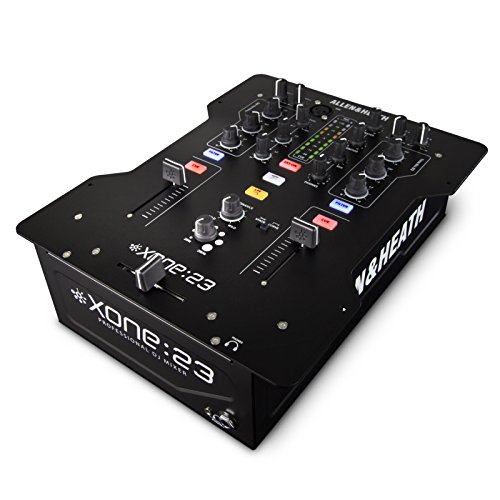
Allen & Heath Xone:23 — Best Analogue VCF on a Budget
The Xone:23 is for the house and techno DJ who has heard what a resonant filter does to a long blend and wants that sound without flagship money. It is also a fine first ‘serious’ mixer for vinyl DJs.
Strengths
- Genuine analogue VCF with resonance control — the filter is an instrument here
- Filter can be assigned per channel and swept across the mix
- Allen & Heath analogue sound: warm summing, musical EQ
Trade-offs
- One shared filter section rather than a filter per channel
- No built-in USB audio interface for DVS without extra hardware
- 2+2 channel format is compact — two main channels plus two returns
| Format | 2+2 channel analogue DJ mixer |
| Filter | Voltage-controlled filter (VCF) with resonance, channel-assignable |
| Crossfader | User-replaceable, curve-adjustable |
The Xone:23’s party trick is that its filter is not a DJ effect at all — it is a voltage-controlled filter of the kind found on analogue synths, with a resonance control that adds a peak at the cutoff frequency. Sweep it slowly over a rolling techno blend and the mix breathes; push the resonance and it sings. No knob-per-channel colour FX replicates that behaviour, at any price.
The compromise is sharing: one filter section serves the mixer, assigned to channels as needed, which suits long two-track blends — the Xone way of mixing — better than rapid-fire multi-channel tricks. The rest of the mixer is honest Allen & Heath analogue: clean gain staging, a replaceable crossfader and a record output for capturing sets. For filter-led mixing on a sane budget, this is where the ladder starts.
Ownership note: the Xone:23’s crossfader is user-replaceable and its curve adjustable, unusual generosity at this level, and the filter’s frequency control is paired with a dedicated resonance knob placed for the right hand’s natural fall. DJs coming from Pioneer should expect one adjustment week: the Xone way is to mix with gains and EQ more and faders less, and the 23 teaches that discipline whether you planned to learn it or not.
Best for: house and techno DJs who blend long and want true VCF character / Not suited for: DVS-first digital DJs or anyone needing a filter knob on every channel
Check on Amazon — check the current price on Amazon before you buy, as bundles and included accessories change over time.

Allen & Heath Xone:92 Mk2 — Best for Filter Artists
The Xone:92 Mk2 is for the committed analogue DJ — the one whose sets are built from four-band EQ and twin filters, who plays long, and who considers the mixer an instrument. It is overkill for everyone else, gloriously so.
Strengths
- Two independent VCF filters that can be combined and played against each other
- Four-band EQ gives surgical control no 3-band mixer matches
- Mk2 updates refine the classic: improved faders, refined filter behaviour, modernised details
Trade-offs
- Fully analogue signal path — no USB interface or DVS built in
- Size, weight and price class are all flagship
- Four-band EQ and dual filters reward skill and punish sloppy gain staging
| Format | 4-channel analogue DJ mixer |
| Filters | Dual voltage-controlled filters with resonance |
| EQ | 4-band per channel |
There is a reason the Xone:92’s silhouette is tattoo-famous in techno culture. Two VCFs mean you can filter the outgoing track down while the incoming track opens up, resonance riding on both, and build transitions that are compositions rather than crossfades. The Mk2 keeps that architecture and polishes the details a working DJ touches: fader feel, filter response and the small ergonomic lessons of two decades.
Buying one is a commitment to an analogue workflow. There is no sound card inside, so DVS means an external interface; there are no digital FX, so your effects are the filters, the EQ and whatever you patch into the sends. DJs who think in those terms will find nothing here or anywhere that does it better. Everyone else should buy the DJM-450 and spend the difference on records.
The Mk2 revision is worth understanding: it is not a reinvention but a craftsman’s pass over a classic — refined fader action, tightened filter behaviour and details like improved cueing that working DJs feel in the first hour. If you are cross-shopping a used original 92, the Mk2’s case rests on those touches plus a factory warranty and decades of expected service ahead of it, rather than on any change to the formula that made the original famous.
Best for: analogue-first DJs who perform with filters and four-band EQ / Not suited for: digital or DVS DJs wanting an all-in-one USB mixer
Check on Amazon — check the current price on Amazon before you buy, as bundles and included accessories change over time.

Pioneer DJ DJM-250MK2 — Best Budget Filter Mixer
The DJM-250MK2 is the practice-rig and budget-booth mixer for DJs who play on Pioneer club gear and want their home setup to behave identically — filter included — without DJM-450 money.
Strengths
- Sound Color FX filter per channel, the genuine club-standard sweep
- Built-in interface unlocks rekordbox DVS free — rare at this level
- Layout, EQ and fader feel mirror the bigger DJM mixers
Trade-offs
- No Beat FX section — the filter works alone
- Fewer outputs and no send/return compared with the DJM-450
- Two channels, firmly
| Format | 2-channel DJ mixer |
| Filter | Sound Color FX filter per channel |
| Software | rekordbox DVS unlock included via built-in interface |
The 250MK2’s filter is not a watered-down imitation: the Sound Color FX knob carries the same filter character Pioneer puts on its flagship mixers, one per channel, with the parameter tied to the single big knob your hand finds without looking. For learning transition craft that transfers to any club booth, that authenticity is the entire value proposition.
What you give up versus the DJM-450 is the Beat FX engine and some connectivity; what you keep, remarkably, is the DVS unlock through the built-in interface. A vinyl DJ can run control records into rekordbox on this mixer with no extra licence or box. As a filter-first budget pick, it is the easiest recommendation in this guide to defend.
One underappreciated strength: because the 250MK2’s layout, EQ curves and filter are the same language as the DJM-900-class mixers installed in clubs, every hour of home practice on it is rehearsal for the booth. DJs who play out weekly often own exactly this as the home twin of the venue’s rig — the cheapest pick here may be the most professionally strategic one in the entire guide.
Best for: budget and practice rigs that must match club Pioneer filter behaviour / Not suited for: DJs who need onboard Beat FX or more than two channels
Check on Amazon — check the current price on Amazon before you buy, as bundles and included accessories change over time.

Numark Scratch — Best for Scratch DJs Who Filter
The Scratch serves the open-format and hip-hop DJ whose mixing is cuts, drops and quick blends, and who still wants a filter on hand for smooth-outs and builds — plus software that is fully licensed from day one.
Strengths
- Dedicated filter control on each channel strip for fast sweeps mid-routine
- FX paddles bring performance effects under your fingertips
- Serato DJ Pro and DVS licences included — no software upsell
Trade-offs
- Filter is a mixing tool here, not a resonant VCF for long blends
- Two channels only, battle layout prioritises the crossfader zone
- Analogue purists will prefer the Xone sound and EQ
| Format | 2-channel DJ scratch mixer |
| Crossfader | Innofader |
| Software | Serato DJ Pro included, DVS licence included |
| Extras | FX paddles, pad mode, loop encoder, plug-and-play USB |
On a battle mixer the filter has a different job: not ten-minute blends but punctuation — a quick high-pass to thin a track before a drop, a low-pass sweep to exit a routine cleanly. The Scratch puts that control on the channel strip where a working DJ’s hand already lives, and backs it with FX paddles for echoes and flangers fired in rhythm.
It earns its place in a filter roundup honestly rather than as a token scratch entry: plenty of battle mixers omit per-channel filters or bury them in software. Here the filter is hardware, immediate, and paired with the strongest software bundle in this guide. If your sets are 80% cuts and 20% blends, this is your filter mixer.
Filter placement deserves a second look: on the Scratch, the filter controls sit in the channel strips where a scratch DJ’s hands already work, so a sweep can be thrown in mid-routine without the reach across the mixer that a central FX section demands. Combined with the FX paddles — which fire effects in rhythm rather than toggling them — the Scratch treats the filter as part of a performance vocabulary, and that integration is why it belongs in a filter roundup at all.
Best for: open-format and scratch DJs who use filters as punctuation / Not suited for: long-blend house DJs who need VCF resonance and four channels
Check on Amazon — check the current price on Amazon before you buy, as bundles and included accessories change over time.

Allen & Heath Xone:43 — Best 4-Channel VCF Value
The Xone:43 suits the DJ who has outgrown two channels — three decks and a sampler, or a hybrid vinyl/digital rig — and wants the Xone filter sound across a full-size mixer without Xone:92 money.
Strengths
- Xone VCF filter with resonance, assignable across the four main channels
- 4+1 channel analogue layout handles multi-deck and hybrid rigs
- Xone sound quality and headroom at a mid-range position in the line
Trade-offs
- Single shared VCF section rather than the 92’s dual filters
- No built-in USB interface — analogue in the classic sense
- Three-band EQ, not the 92’s four-band
| Format | 4+1 channel analogue DJ mixer |
| Filter | VCF with resonance, channel-assignable |
| EQ | 3-band per channel |
The Xone:43 is the pragmatic filter mixer. You get the essential Xone ingredient — the resonant VCF, assignable so any channel can be swept — spread across a 4+1 layout that accommodates the way modern DJs actually rig up: two main decks, a third for acapellas or a drum machine, and the +1 channel for a mic or return.
Against the 92 Mk2 you trade the second filter and the fourth EQ band for a substantially friendlier position in the range, and for most DJs that trade is correct: one well-played VCF beats two under-used ones. Sound, headroom and build are unmistakably from the same family. This is the filter mixer for working DJs who need channels more than they need legend status.
A practical virtue: the Xone:43’s +1 channel is a full utility channel with its own EQ, ideal for the microphone at a wedding set, a return from an effects unit, or the drum machine in a hybrid live rig. Many four-channel mixers strand that extra source on a bare line input; here it is a citizen. For working DJs whose bookings vary, that flexibility quietly outperforms a second filter across a year of real gigs.
Best for: multi-deck and hybrid DJs wanting Xone VCF sound on four channels / Not suited for: DJs who need dual independent filters or a built-in audio interface
Check on Amazon — check the current price on Amazon before you buy, as bundles and included accessories change over time.
Comparison Table
| Pick | Badge | Key spec | Best for |
|---|---|---|---|
| Pioneer DJ DJM-450 | Best Overall | 2-channel, Sound Color FX filter per channel | Club-standard transitions |
| Allen & Heath Xone:23 | Best Analogue VCF on a Budget | 2+2 analogue, VCF with resonance | Filter-led long blends |
| Allen & Heath Xone:92 Mk2 | Best for Filter Artists | 4-channel analogue, dual VCF, 4-band EQ | Performance filter mixing |
| Pioneer DJ DJM-250MK2 | Best Budget Filter Mixer | 2-channel, Sound Color FX filter, DVS unlock | Budget club-style practice |
| Numark Scratch | Best for Scratch DJs Who Filter | 2-channel battle mixer, per-channel filter knobs | Scratch plus filter workflows |
| Allen & Heath Xone:43 | Best 4-Channel VCF Value | 4+1 analogue, VCF with resonance | Four-channel filter mixing |
How to Choose the Best DJ Mixers With Filters for Your Mixing Style
Name your filter job first. If your transitions are blends of ten seconds or less, a per-channel colour/filter knob — Pioneer style — is the fastest tool: one knob, both directions, zero thought. If your sets are built on minute-long blends, you want resonance: a VCF whose peak at the cutoff adds harmonics and movement, which is the Allen & Heath philosophy. If you scratch, the filter is punctuation and must sit on the channel strip, as on the Numark Scratch.
Then count filters, not just channels. A shared VCF (Xone:23, Xone:43) filters one signal path at a time and suits two-track blending. Dual filters (Xone:92 Mk2) let you close one track while opening another — the deepest technique in filter mixing. Per-channel knobs (Pioneer, Numark) are independent but non-resonant in the DJM implementation. Each architecture rewards a different style; buy the one your hands will actually exploit.
Finally, integrate the rest of your rig. DVS users should note which mixers carry an interface (DJM-450, DJM-250MK2, Numark Scratch) and which are analogue-only (the Xones), because an external interface is a real extra cost and another box in the bag. Vinyl-only DJs can ignore that entirely and buy purely on sound and filter feel.
- Filter type: per-channel knob, shared VCF, or dual VCF
- Resonance: essential for blend-led styles, optional for transition-led styles
- Channels: two for most, four for multi-deck rigs
- Interface: built-in USB/DVS vs analogue-only
- EQ: 3-band standard; 4-band on the Xone:92 for surgical mixing
VCF vs Sound Color FX: The Two Great Filter Philosophies
A VCF — voltage-controlled filter — is an analogue circuit component, and its sound comes from physics: as you close the low-pass filter, a resonance peak emphasises frequencies right at the cutoff, so the sweep itself has tone and movement. DJs describe it as ‘creamy’ or ‘vocal’. The technique it enables is slow, expressive riding — opening a hi-hat line over eight bars, letting a bassline melt rather than stop.
Pioneer’s Sound Color FX takes the opposite bet: consistency and speed. The filter curve is fixed and musical, identical on every DJM from the 250MK2 to the flagship, and the same knob can be reassigned to other colour effects. You lose resonance theatre; you gain a transition tool that works the same in every booth on earth, under stage lighting, at speed.
Neither is ‘better’ in the abstract — they are answers to different questions, which is why this guide refuses to crown one philosophy. It is also why filter choice should be made by listening to your own mixes: if your transitions are events, go VCF; if they are punctuation between tracks, go colour FX.
Filter Technique: Four Moves Worth Practising
The exit sweep: in the last eight bars of a blend, slowly low-pass the outgoing track while its level stays up. The track appears to sink underwater rather than fade, and the incoming track takes the full frequency range without a volume war. Works on every mixer in this guide.
The resonance ride (VCF only): set moderate resonance, park the cutoff just above the bassline’s top harmonics, and nudge it in rhythm. The filter becomes a third hand playing the track. This is the Xone party trick and the reason dual filters exist — you can ride two tracks in opposite directions.
The high-pass thin-out: before a drop or a scratch routine, high-pass the playing track for two bars. The energy dips, the crowd leans in, and whatever you do next lands harder. On battle mixers like the Numark Scratch this is a one-knob move on the channel strip.
The filter handover: assign the shared VCF to the incoming track, start it fully closed, and open it as you close the outgoing track with EQ. Shared-filter mixers reward this choreography — practise it and a Xone:23 will sound like it has two filters.
Analogue, Digital and Everything Between: Sound Expectations
The Xone mixers in this guide are analogue designs, and their fans buy them for summing character and headroom: push them and they saturate gently rather than clip harshly. Pioneer and Numark mixers route audio through digital conversion for their FX and interfaces, which buys DVS, effects and consistency, and in blind tests most listeners in a club cannot tell you which is which over a PA.
At home, over good monitors, the differences are easier to hear — and easier to overvalue. Phono preamp quality matters more for vinyl DJs than the analogue/digital badge: a clean, quiet phono stage preserves the record you paid for. All six mixers here have phono stages appropriate to their class; the Xones and DJM-450 are the standouts for serious vinyl use.
Buy the workflow first and the sound signature second. A filter you play every transition shapes your sets more than a summing bus you might detect in a quiet room.
Filter Curves, Resonance and Other Specs That Actually Matter
Three numbers describe a DJ filter better than any marketing word. The first is range: a useful low-pass must close far enough to leave only sub-bass warmth, and a useful high-pass must open far enough to leave only air — every mixer here clears that bar. The second is taper: how the frequency maps to knob rotation. Musical filters spend the middle of the knob’s travel in the frequencies transitions live in, rather than racing through them; Pioneer’s colour curve and the Xone VCF both do this, in different accents. The third is resonance behaviour: fixed and gentle on the DJM implementation, adjustable and expressive on the Xones.
What does not matter much: whether the filter is labelled ‘analog’ or ‘digital’ in isolation. Implementation decides quality — a well-designed digital filter (as in the DJM line) outperforms a careless analogue one, and the Xones earn their reputation from circuit design, not from the word analogue. Judge by the sweep, in a shop or on a returnable listing, with a track you know by heart.
Building a Filter-First Practice Routine
Dedicate one practice session a week to the filter alone. Session one: transitions using nothing but the filter — no EQ, no fader rides — until you can hand over a mix without the listener detecting the tool. Session two: the resonance study, VCF owners only, finding the exact resonance setting where your favourite track’s bassline starts to sing, and marking the knob position with a dot of tape. Session three: failure practice — deliberately mistime a sweep, then recover with EQ, because booths are dark and hands slip.
Record these sessions. Filter mistakes are unusually audible on playback — a too-fast sweep that felt fine in the moment announces itself immediately on speakers — and that feedback loop is the fastest teacher the filter has. Within a month, most DJs find their filter use becoming slower, rarer and far more effective, which is the professional pattern in miniature.
Playing Out With Filter Skills: Booth Etiquette and House Mixers
If you play in venues, your filter technique will meet house mixers you did not choose, and the professional skill is adaptation. Arrive in soundcheck, identify the mixer’s filter architecture in the first two minutes — per-channel colour knobs, a shared VCF, or a DJM-style FX section — and run one practice transition of each type you rely on. The DJs who sound seamless on any rig are not more talented; they are the ones who rehearsed the unfamiliar filter before the room filled.
Booth etiquette around filters is simple: the filter is a spice, and the headliner’s set is not your audition. Support-slot DJs who spend forty minutes demonstrating resonance tricks teach the room to notice the DJ instead of the music. Play the filter the way the picks in this guide reward — as transition craft in service of the tracks — and your sets will be invited back, which is the only review that pays.
One more practical note: filters expose sloppy gain staging mercilessly, because a swept track that was too quiet disappears entirely and one that was too loud shouts as it opens. The discipline of trimming every incoming track to the same meter point before you touch the filter is the unglamorous foundation under every beautiful filter mix you have ever heard in a club.
One Mixer or Two? The Home-and-Booth Two-Mixer Strategy
Many working DJs quietly run a two-mixer strategy, and this guide’s picks divide naturally into the roles. The home mixer is where taste lives — for filter lovers, a Xone, chosen for sound and the pleasure of the sweep, used for practice, recorded sets and home listening where its character is audible and appreciated. The booth-proof mixer is the Pioneer twin: the DJM-250MK2 or DJM-450 at home as a practice mirror of the venue’s installed rig, or simply the skill set carried in your hands to whatever the venue provides.
The economics work because the two roles age differently. A Xone bought for love is a decade-plus possession whose cost divides into irrelevance; a Pioneer bought for work pays for itself in fluency every time you step into an unfamiliar booth and the filter is exactly where your hands expect it. DJs who try to make one mixer serve both masters usually end up compromising the role they care about more.
If budget forces a sequence, buy for the room you play in most this year. Bedroom producers and recorded-set DJs: the Xone first. Weekly booth residents: the DJM first, and let the Xone be the reward the gigs eventually fund. Either order is defensible; the mistake is pretending the two jobs are one job, and then wondering why a superb mixer feels strangely wrong on Saturday nights.
How to Use a Mixer Filter in Your First Month of Practice
Filters punish random knob-twiddling and reward slow, deliberate practice. This routine builds filter control in four weekly stages, on any mixer in this guide.
- Week one — learn the range: play one track alone and sweep the filter fully in both directions at very low resonance (or colour knob only). Memorise where the bass disappears and where only hats remain.
- Set a ‘home’ position: practise returning the knob to exactly centre (or fully open) without looking, until your hand does it automatically.
- Week two — exit sweeps only: in every practice transition, remove the outgoing track with the filter instead of the fader. Slow, eight bars, no exceptions.
- Week three — entrances: bring the incoming track in fully filtered and open it over eight bars while the outgoing track plays untouched. Combine with the exit sweep in week four.
- On VCF mixers, add resonance in small steps only after the sweeps are clean; resonance amplifies sloppy timing as faithfully as good timing.
- Record one practice set per week and listen specifically for filter moves that call attention to themselves — the goal is transitions the listener feels but cannot point at.
A useful rule from working DJs: if a listener can hum your filter sweep afterwards, it was too fast or too resonant. The mixers above all have the range for subtlety — the practice is in your hand, not the hardware.
Common Buying Mistakes
Buying a filter count instead of a filter type. Two resonant VCFs, one shared VCF and four colour knobs are different instruments. Match the architecture to your mixing style, not to a spec-sheet number.
Cranking resonance to maximum. High resonance self-oscillates and screams. It has its moment in a build-up, but as a default setting it fatigues a room fast. Moderate resonance, moved slowly, is the professional sound.
Forgetting the interface question. The Xone mixers here are analogue-only. If you run DVS, budget an external interface with them, or choose a DJM or the Numark Scratch with the interface built in.
Filtering and EQ-cutting the same track at once. Stacking a low-pass sweep on top of a full bass cut double-removes the low end and leaves a hole when you bring it back. Choose one tool per transition.
Assuming the club will have your mixer. If you play out on house Pioneer gear, a Xone at home builds skills that only partly transfer. Many DJs practise on the DJM workflow and keep the Xone love for home and recorded sets — decide which room matters more.
Final Recommendation
For most DJs, the DJM-450 is the answer: the club-standard filter, Beat FX to blend with it, DVS built in, in a 2-channel format that covers the majority of real-world mixing. It is the filter workflow the world runs on, and learning it is never wasted.
Choose the Xone path if filters are your instrument rather than your transition tool: the Xone:23 for two channels and a first VCF, the Xone:43 when you need four channels, and the Xone:92 Mk2 when you want the dual-filter, four-band flagship and will build your whole technique around it. Scratch and open-format DJs should take the Numark Scratch and its included Serato licences, while the DJM-250MK2 remains the smart budget route into Pioneer’s exact filter at practice-rig money.
Check price on Amazon for the two or three models that match your style, confirm the channel count against your rig, and buy the filter your hands will still be playing in five years.
Shop the linked picks again here: Pioneer DJ DJM-450, Allen & Heath Xone:23, Allen & Heath Xone:92 Mk2, Pioneer DJ DJM-250MK2, Numark Scratch, Allen & Heath Xone:43 — each opens its Amazon listing so you can check the current price and the exact bundle on offer.
Keep researching the cluster: Best Dj Mixers Under $500 Complete Software Best Dj Mixers Under $500 Best 2 Channel Dj Mixers Best 4 Channel Dj Mixers Best Dj Rotary Mixers Best Dj Mixers For Vinyl
Frequently Asked Questions
What is the difference between a VCF and a normal DJ filter knob?
A VCF is an analogue voltage-controlled filter with adjustable resonance — a peak at the cutoff frequency that gives sweeps a vocal, musical character. A typical DJ colour/filter knob (Pioneer’s Sound Color FX) is a fixed-curve filter optimised for fast, predictable transitions. VCFs reward slow, expressive play; colour filters reward speed and consistency.
Which mixer here has the best filter for techno?
For filter-led techno mixing, the Allen & Heath Xone:92 Mk2 is the reference: dual VCFs plus four-band EQ. On a smaller budget the Xone:23 delivers the same VCF character in a 2+2 format, and the Xone:43 spreads it across four channels.
Do the Pioneer DJM mixers have filters on every channel?
Yes. Both the DJM-250MK2 and DJM-450 carry a Sound Color FX knob per channel, and the filter is one of the assignable colour effects. The DJM-450 adds a Beat FX section on top; the 250MK2 keeps the filter working solo.
Can I use these filters with vinyl, or are they digital only?
All six mixers handle analogue vinyl through their phono inputs, and the filters work on that signal — on the Xone models the entire path is analogue. The Pioneer and Numark models additionally carry USB interfaces for DVS control vinyl with rekordbox or Serato.
Is one shared filter (Xone:23) a real limitation?
For two-track blending, rarely — you filter one side of a transition at a time, and the filter can be assigned per channel. It limits simultaneous two-track filter choreography, which is what the Xone:92 Mk2’s dual filters exist for. Most DJs never need both at once.
Which of these is best for a beginner who loves filter effects?
The DJM-250MK2: its Sound Color FX filter is the genuine club tool, it is forgiving to learn on, and the included rekordbox DVS unlock keeps your options open as you grow. If your heart is set on the resonant analogue sound, the Xone:23 is the beginner-priced way into that world.
Do I need a filter if my DJ software has one built in?
Software filters work, and for laptop-only controller setups they are the only option — but a hardware filter is instant, tactile and available even when the laptop is busy or absent, which is why mixer-based DJs insist on it. There is also a sound argument: the Xone VCF’s analogue resonance is a circuit behaviour software approximates rather than duplicates. If your mixer has the knob, your hand will find it faster than any mouse.
Can I add a filter to a mixer that does not have one?
Partially. External effects units and DJ effectors patched through a mixer’s send/return can add filter effects, and some DJs run a standalone filter box on the master output. What you cannot retrofit is the per-channel integration — filtering one deck while the other plays on — which is the main event. If filter mixing is central to your style, it is cleaner to buy the mixer that has it, as this guide’s picks do.


