Disclosure: airfryerkitchensupply.com is reader-supported. When you buy through links on our site, we may earn an affiliate commission at no extra cost to you.
Where to buy
Every mixer in this guide to the best dj mixers under 500 was verified against current retailer catalogue data before it earned a purchase link, so the buttons below lead to the exact models reviewed — no lookalikes, no substituted listings. Prices move constantly in DJ gear, so check price on Amazon for the current figure on each pick before you decide. If a pick shows as unavailable in your region, the comparison table further down will point you to the closest alternative in the same guide.
- Pioneer DJ DJM-250MK2 — Best Overall Under $500: check price on Amazon
- Numark Scratch — Best for Scratching: check price on Amazon
- Behringer DJX900USB — Best Feature Set: check price on Amazon
- Numark M6 USB — Best 4-Channel Value: check price on Amazon
- Behringer DJX750 — Best for Big Rigs on a Budget: check price on Amazon
- Numark M2 — Best Analog Pick: check price on Amazon
The best dj mixers under 500 dollars are where DJ gear gets serious. This is the first tier where the ecosystems open: Pioneer’s club-standard layout with a rekordbox DVS unlock, a genuine InnoFader battle mixer with Serato DJ Pro included, and a five-channel FX mixer with a contact-free crossfader and USB. Buyers here are not shopping for toys — they are choosing the centre of a rig they intend to keep.
Our six verified picks were confirmed against current retailer catalogue data before receiving links, and their pricing was checked against the $500 frame. They split into three strategies: ecosystem mixers (DJM-250MK2, Numark Scratch) that unlock software worlds, feature maximalists (DJX900USB, DJX750) that pile on channels and FX, and honest workhorses (M6 USB, M2) that prove a lower price spent well beats a higher price spent badly.
Notice what this guide does not do: pad the list with near-$500 mediocrity to fill six slots. Two picks cost far less than the ceiling and earned their places outright. That is what a buying guide owes you at this tier — judgement, not just a price ladder.
One more piece of honesty for this tier: the jump from $300 to $500 buys identity more than capability. The under-$300 workhorses in our companion guide mix real gigs without apology. What this tier adds is belonging — to the Pioneer club standard, to the Serato battle ecosystem, to the contactless-fader future. Belonging is worth money when it matches your actual DJ life, and a waste when it does not. The scenarios below exist to tell those two situations apart before the money moves.
Key Takeaways
- Under $500 is ecosystem money: choose Serato, rekordbox or standalone analog before choosing a model.
- Count total cost — included Serato DJ Pro, DVS licenses and rekordbox unlocks routinely reverse sticker-price rankings.
- Crossfader strategy matters: contactless longevity, replaceable economy, or club-standard feel — pick consciously.
- Two picks cost far below the ceiling and won their places on merit; judgement beats ladder-climbing.
In this guide
Quick Picks
Short on time? These are the six best dj mixers under 500 that matter, in the order most buyers should consider them. Each badge below is repeated at the top of that mixer’s full review, so you can jump straight to the one that matches your style.
- Pioneer DJ DJM-250MK2 — Best Overall Under $500. The 250MK2 is the under-$500 default for a reason: it is the real Pioneer club workflow — layout, colour FX, sound — plus a USB soundcard that unlocks rekordbox DVS, at the tier’s most accessible Pioneer price. Check price on Amazon
- Numark Scratch — Best for Scratching. For scratch DJs this is the tier’s champion and it is not close: a true InnoFader, pads, FX paddles and Serato DJ Pro with DVS included. Check price on Amazon
- Behringer DJX900USB — Best Feature Set. The feature maximalist: five channels, digital FX, USB audio and a contact-free Infinium crossfader engineered to outlast conventional faders. Check price on Amazon
- Numark M6 USB — Best 4-Channel Value. The M6 USB remains the four-channel value king — full EQ, USB recording, replaceable fader — at a price that leaves half this budget for decks, speakers or records. Check price on Amazon
- Behringer DJX750 — Best for Big Rigs on a Budget. Five channels and club-style FX for notably less than the DJX900USB, trading the contactless fader and USB for savings. Check price on Amazon
- Numark M2 — Best Analog Pick. The analog pick survives at this tier on merit: metal, serviceable, honest. Check price on Amazon
How These Picks Were Chosen
Under-$500 mixers were ranked on ecosystem value first — what software, DVS and workflow each unlocks — then on crossfader quality and longevity, channels and FX, and total cost of ownership including included software. Verified pricing was checked against the $500 frame at verification time. A mixer only displaced a cheaper pick by offering something the cheaper one structurally cannot: a DVS unlock, a contactless fader, or the club-standard layout that transfers to professional booths.
Verification discipline matters as much as judgement. Every linked product in this guide was confirmed through the retailer’s own catalogue data — brand and model searched, the returned title matched to the product under review, and the identifier taken from that confirmed response. Products that could not be confirmed that way were never given purchase links; where a famous model failed confirmation, it is discussed honestly in the text as context, so you know exactly what we could and could not stand behind. No prices are printed in this guide because DJ gear pricing shifts with sales, bundles and stock — each pick links to its live listing so you always see the real current figure.
A closing note on confidence at this tier: every mixer here has a multi-year track record in real rigs, which is precisely what your money buys beyond features — predictability. There are no experiments in this guide. If your shortlist after reading is two models, the tiebreaker is almost always ecosystem and hands: which software world are your library and venues in, and which fader did your fingers prefer in the shop? Answer those two questions honestly and the ‘wrong’ choice becomes nearly impossible — both finalists will serve you for years.
The 6 Best dj mixers under 500

Pioneer DJ DJM-250MK2 — Best Overall Under $500
The 250MK2 is the under-$500 default for a reason: it is the real Pioneer club workflow — layout, colour FX, sound — plus a USB soundcard that unlocks rekordbox DVS, at the tier’s most accessible Pioneer price. Skills practised on it transfer to every club booth on earth.
Strengths
- The cheapest way into the genuine Pioneer club workflow
- Sound Color FX filter is instantly musical and addictive
- USB soundcard with rekordbox DVS unlock for control vinyl
Trade-offs
- No Beat FX section like the DJM-450
- Basic cueing and metering compared with bigger DJMs
- Two channels only
| Channels | 2 |
| FX | Sound Color FX filter |
| Software | rekordbox DVS unlock included |
The DJM-250MK2 is the entry ticket to Pioneer’s club ecosystem, and it is smarter than its price suggests. You get the essential DJM layout, per-channel Sound Color FX — the filter knob that becomes most DJs’ favourite control within a week — and a built-in USB soundcard that unlocks rekordbox DVS, so two turntables and control vinyl turn it into a full digital rig. For vinyl buyers that dual personality is the point: real records and a laptop library share one small, well-built mixer, and the skills you practise on it transfer directly to the DJM-450, A9 and club installs. Sound quality and fader feel are recognisably Pioneer, a step above generic budget mixers. What you do not get is the Beat FX section of its bigger siblings, elaborate metering, or a flagship crossfader — though the fitted fader is perfectly capable for mixing and basic cuts. Measured against the under-$500 field, nothing else combines brand-standard layout, DVS and this build quality at the price. It is the default recommendation for Pioneer-curious DJs on a budget.
Owners consistently report the same arc with the 250MK2: bought as a starter, kept as the beloved home mixer long after a flagship arrives. The colour FX knob becomes a signature — visitors ask about the filter sweep within one track. Set up the rekordbox DVS unlock on day one even if you mostly play real records; the first time a friend brings only a laptop library, you will be glad. It sips space and power, asks for a dust cover, and holds its value stubbornly well.
Around the 250MK2, build the learner’s complete dojo: two turntables, the included rekordbox DVS path set up from day one, real records alongside control vinyl, and headphones honest enough to teach cueing. Its colour FX will train your filter hand for every Pioneer booth in your future. Because it holds value, buy the case now and keep the box; when the DJM-450 or a flagship eventually calls, this mixer funds part of the move or stays as the beloved home unit. Either outcome is a win.
Best for: buyers who want overall under $500 done properly. / Not suited for: no beat fx section like the djm-450.
Check on Amazon — Pioneer DJ DJM-250MK2 (check price on Amazon for the current figure).

Numark Scratch — Best for Scratching
For scratch DJs this is the tier’s champion and it is not close: a true InnoFader, pads, FX paddles and Serato DJ Pro with DVS included. It is a complete battle station whose total cost undercuts rivals that charge extra for the software.
Strengths
- Real InnoFader crossfader — the part scratch DJs care about most — at a mid price
- Serato DJ Pro and DVS included, so there is nothing extra to unlock
- FX paddles and 8 pads cover modern performance workflows
Trade-offs
- Build is good rather than flagship-tough
- EQ and layout are simpler than Pioneer or Rane flagships
- No onboard screen or dual-USB changeover hub
| Channels | 2 |
| Crossfader | InnoFader |
| Audio | 24-bit |
| Software | Serato DJ Pro included, DVS license |
| Pads | 8 performance pads |
Numark’s Scratch is the mixer that proved a battle-ready crossfader does not have to cost flagship money. Its InnoFader — a name scratch DJs respect on its own — delivers the sharp cut and light action that crab scratches and flares demand, and it is the single component most rivals at this price get wrong. Around it, Numark built a modern, honest feature set: eight performance pads, FX paddles, 24-bit audio, and — crucially — Serato DJ Pro with a DVS license included, so control vinyl works out of the box with nothing left to buy. That completeness is the story: open the box, plug in turntables, and you are scratching on the same software the pros use. The compromises live in refinement rather than function. The chassis and knobs feel good rather than luxurious, the EQ is straightforward, and there is no screen or dual-USB hub. For learners, home battlers and gigging DJs who would rather spend the savings on vinyl, needles and a second turntable, those are the right compromises. It is the value benchmark every other budget battle mixer is measured against.
Ownership of the Scratch is refreshingly uncomplicated: unbox, install Serato, calibrate your decks and practise. The InnoFader’s adjustment options repay ten minutes of experimentation — small cut-in changes transform how flares feel. Because the mixer is affordable, owners tend to actually take it places: house sessions, battles, lessons. That portability is a training advantage no flagship matches. Keep the included software credentials safe; they are part of the product’s value if you ever sell it on.
The Scratch’s ideal partners are the ones its savings enable: a second turntable sooner, better cartridges, a growing control-vinyl stack. Run it with Serato on any reasonably modern laptop, keep a spare stylus pair matched to your cartridges, and add a basic microphone for practice-room hosting. Because everything needed is in the box, resist accessory creep — the correct second purchase after this mixer is records and needles, then a case. That discipline is exactly the ownership style this mixer was designed to reward.
Best for: buyers who want for scratching done properly. / Not suited for: build is good rather than flagship-tough.
Check on Amazon — Numark Scratch (check price on Amazon for the current figure).
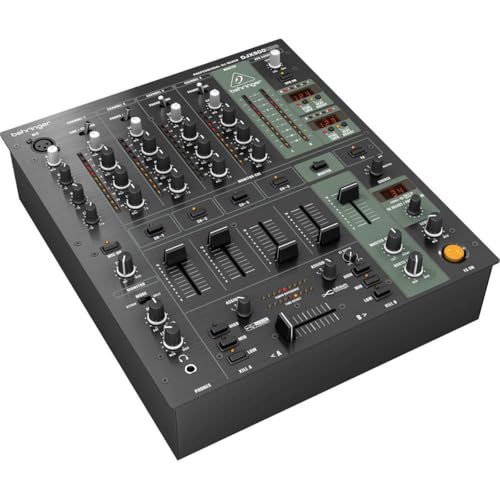
Behringer DJX900USB — Best Feature Set
The feature maximalist: five channels, digital FX, USB audio and a contact-free Infinium crossfader engineered to outlast conventional faders. If your rig is big and your software needs are your own business, nothing under $500 packs more in.
Strengths
- Contact-free Infinium crossfader should outlast conventional faders
- USB interface adds recording and laptop playback
- Five channels plus FX at a mid-budget price
Trade-offs
- Bigger and heavier than 2-channel rivals
- FX section takes menu patience
- Not a certified Serato/rekordbox DVS mixer — check your software plan
| Channels | 5 |
| Crossfader | Infinium contact-free VCA |
| Interface | USB/audio interface |
| FX | Digital effects |
The DJX900USB upgrades the DJX750 formula where it counts for longevity and laptops: the crossfader becomes Behringer’s Infinium contact-free VCA design, which eliminates the wear track that eventually makes conventional faders crackle, and a USB interface joins the five channels and digital FX. For under-$500 buyers that combination is unique — club-style channel count, effects, computer audio and a crossfader engineered to survive years of cuts. In a home or mobile rig it records sets to a laptop, plays digital files alongside vinyl or media players, and still behaves as a fully standalone analog mixer when no computer is present. Caveats keep expectations honest: it is not a certified DVS mixer for Serato or rekordbox performance modes, so control-vinyl users should verify their software route; the FX reward patience rather than offering flagship polish; and its size suits a permanent setup better than a backpack. As the feature ceiling of the under-$500 class, though, it makes rivals look sparsely equipped — five channels, FX, USB and a contactless crossfader is a specification nothing else here matches.
The DJX900USB rewards DJs who set it up once, properly: USB routing configured, favourite FX marked, the contactless crossfader’s curve dialled to taste. After that evening it simply presents a big, capable surface every session. Its size argues for a fixed home in your setup rather than weekly transport. Owners who record through its USB interface build the practice-review habit almost by accident — and that habit, more than any feature, is what this mixer will do for your DJing.
The DJX900USB rewards a set-up-once rig: USB routing configured for recording, decks and media players resident on their channels, FX favourites marked. It pairs with home studios and fixed mobile bases rather than weekly backpack transport. Because its crossfader is contact-free, heavy practice schedules suit it; because its software role is audio rather than DVS unlocking, pair it with sources that stand alone — vinyl, media players, standalone players — and let the laptop be the recorder and library, not the master.
Best for: buyers who want feature set done properly. / Not suited for: bigger and heavier than 2-channel rivals.
Check on Amazon — Behringer DJX900USB (check price on Amazon for the current figure).

Numark M6 USB — Best 4-Channel Value
The M6 USB remains the four-channel value king — full EQ, USB recording, replaceable fader — at a price that leaves half this budget for decks, speakers or records. Working DJs buy these in pairs: one to use, one as the spare that never gets used.
Strengths
- Four full channels with 3-band EQ at a two-channel price
- USB interface records sets straight to a laptop
- Replaceable crossfader extends the mixer’s working life
Trade-offs
- USB is for audio I/O, not full DVS control
- No onboard FX or pads
- Larger footprint than compact 2-channel mixers
| Channels | 4 |
| EQ | 3-band per channel |
| Interface | Built-in USB audio interface |
| Crossfader | Replaceable, slope-adjustable |
The Numark M6 USB might be the most sensible mixer in this entire guide: four channels, three-band EQ on every channel, a built-in USB audio interface for recording and laptop playback, a microphone input, and a replaceable, slope-adjustable crossfader — at a price many brands charge for two channels. For powered-speaker rigs it is a natural hub: every source you own connects at once, levels live under your fingers, and the USB side captures your sets without extra hardware. The replaceable crossfader deserves emphasis, because it converts the most common mixer failure into a cheap, user-serviceable part — mobile DJs and venues keep M6s running for years because of it. What it is not is a performance scratch mixer or a DVS-certified box: the USB handles audio in and out, not control-vinyl software unlocking, and there are no pads or FX. It is a workhorse, judged on reliability, channel count and sound-per-dollar, and on those measures it embarrasses mixers costing far more. For under-$300 and under-$500 lists alike, it is the pick we recommend to people who ask for ‘just a good mixer, please’.
The M6 USB is the mixer that disappears into competence: everything connected, everything labelled, recordings a button away, and a crossfader you can replace yourself the day it eventually tires. Mobile DJs keep one as the main and often a second as the spare, because the workflow never changes between them. Label the USB cable, keep the spare fader in the case, and this is as close to a fit-and-forget professional tool as DJ gear gets.
The M6 USB is a hub and should be partnered like one: every source you own cabled permanently, the USB connected to the household or studio computer for one-touch recording, a microphone living on its channel, and a spare crossfader in the case. It pairs with powered speakers for events, with turntables for home practice, and with owners who label things. Mobile teams standardise on it because any M6 in any venue behaves identically — buy it as infrastructure and it will repay you in uneventful, professional nights.
Best for: buyers who want 4-channel value done properly. / Not suited for: usb is for audio i/o, not full dvs control.
Check on Amazon — Numark M6 USB (check price on Amazon for the current figure).

Behringer DJX750 — Best for Big Rigs on a Budget
Five channels and club-style FX for notably less than the DJX900USB, trading the contactless fader and USB for savings. Source-heavy party and event rigs that do not need computer audio should take the deal.
Strengths
- Five channels and digital FX at a price rivals charge for two channels
- Club-style layout makes it a cheap way to learn big-mixer workflow
- Plenty of inputs for decks, media players and mics
Trade-offs
- FX quality is fun rather than studio-grade
- Long-term fader feel trails Pioneer/Allen & Heath
- No USB audio interface for DVS
| Channels | 5 |
| FX | Digital effects |
| Extra | BPM counter |
The DJX750 is Behringer’s maximalist answer to budget mixing: five channels, digital effects and a BPM counter in a club-style layout that mimics mixers costing far more. For DJs building a powered-speaker rig on a ceiling budget, the channel count is transformative — decks, media players, a laptop and a microphone all stay connected, and the master section drives active speakers directly with room to spare. The FX section, while not studio-grade, gives echo and filter tricks that lift transitions at parties and school dances, and the big-mixer layout teaches the workflow of professional booths. Honest trade-offs: there is no USB audio interface, so DVS and direct laptop recording need extra hardware; the faders feel a notch below Pioneer or Allen & Heath equivalents; and five channels of features mean a larger, heavier box. None of that dents its value proposition. If your priority list reads channels first, effects second and price always, the DJX750 has been the default answer for years — and for small-venue and mobile rigs feeding powered speakers, it still is.
Living with the DJX750 means your rig stops saying no: a second media player, a guest’s laptop, a singer’s mic — there is a channel waiting. Spend one evening learning which three FX you actually like; the rest are party tricks you will reach for twice a year. Its size suits a semi-permanent setup, so give it a home with ventilation and labelled cables. Treated as infrastructure rather than a toy, it returns years of unglamorous, essential service.
Surround the DJX750 with sources — that is what it is for: decks, media players, a laptop, a microphone, all resident. It pairs with a semi-permanent installation mindset: labelled cables, ventilation, a power strip with surge protection, and a laminated note of your favourite FX settings. In mobile life it wants a rack or a generous case. Its partners should be numerous but organised; five channels of spaghetti is a choice, and the DJs who thrive with this mixer are the ones who cable-manage like it matters — because at five channels, it does.
Best for: buyers who want for big rigs on a budget done properly. / Not suited for: fx quality is fun rather than studio-grade.
Check on Amazon — Behringer DJX750 (check price on Amazon for the current figure).

Numark M2 — Best Analog Pick
The analog pick survives at this tier on merit: metal, serviceable, honest. Vinyl purists who would rather spend on cartridges and records than software ecosystems will respect the M2 more in five years than any screen in this guide.
Strengths
- Replaceable, slope-adjustable crossfader — rare at this price
- Full 3-band EQ per channel for proper blending, not just cutting
- Rack-mountable metal chassis suits mobile and install rigs
Trade-offs
- Analog only — no USB audio interface or DVS support
- Crossfader is good, not InnoFader/Magvel class
- No onboard FX or performance pads
| Channels | 2 |
| EQ | 3-band per channel |
| Crossfader | Replaceable, slope-adjustable |
| Extra | Mic input, rack-mountable |
The Numark M2 is old-school in the best sense: a two-channel analog scratch mixer with a metal chassis, full three-band EQ on each channel, a microphone input and — the detail that matters — a replaceable crossfader with adjustable slope. Crossfaders are wear parts on any scratch mixer, and at this price most rivals solder in a fader you cannot easily service; the M2 treats it as the consumable it is, which is why these mixers survive for years in mobile rigs, bars and practice rooms. The adjustable curve lets you tighten the cut for scratching or smooth it for blending. There is no USB, no DVS, no FX and no pads: your technique, your turntables and your records do all the work, which many purists consider a feature. Sound is clean and honest, the layout is instantly familiar to anyone who learned on classic battle mixers, and rack-mount ears make it a natural install mixer. Buy it for real-vinyl scratching, as a bombproof backup, or as the mixer that teaches you fundamentals without software crutches.
The M2 asks for old-school habits and rewards them: wipe the fader slot weekly, keep a spare crossfader in the drawer, and mark your favourite gain positions with a grease pencil if the rig is shared. Its simplicity makes it the easiest mixer here to lend, install or troubleshoot — there is nothing to update and nothing to crash. DJs who learn gain discipline and EQ blending on an M2 carry those fundamentals to every mixer they will ever touch.
The M2 belongs in an analog ecosystem: two turntables with honest phono outputs (or line outputs matched to line inputs), a growing record collection, and a spare crossfader in the drawer from day one. It pairs beautifully with a simple powered-speaker setup for home and small events, needing nothing digital anywhere in the chain. Add a stylus scale and a record brush before any other accessory — on an analog rig, setup accuracy and clean vinyl are the sound quality, and the M2 will faithfully report both.
Best for: buyers who want analog pick done properly. / Not suited for: analog only.
Check on Amazon — Numark M2 (check price on Amazon for the current figure).
Comparison Table
| Pick | Badge | Key spec | Best for |
|---|---|---|---|
| Pioneer DJ DJM-250MK2 | Best Overall Under $500 | 2 channels | Best Overall Under $500 |
| Numark Scratch | Best for Scratching | 2 channels | Best for Scratching |
| Behringer DJX900USB | Best Feature Set | 5 channels | Best Feature Set |
| Numark M6 USB | Best 4-Channel Value | 4 channels | Best 4-Channel Value |
| Behringer DJX750 | Best for Big Rigs on a Budget | 5 channels | Best for Big Rigs on a Budget |
| Numark M2 | Best Analog Pick | 2 channels | Best Analog Pick |
Read the table as a shortlist, not a ranking shortcut: the right row is the one whose badge matches your style, your software world and your rig. The full reviews above explain the trade-offs the table cannot.
How to Choose the Right Mixer for Your Setup
Ecosystems are the tier’s dividing line
Under $500 you are really choosing between three worlds: rekordbox (DJM-250MK2), Serato (Numark Scratch) and standalone analog (everyone else). Software DJs must pick their world first — the mixer follows. Analog DJs skip the toll entirely and buy channels, faders and build.
Total cost, not sticker cost
Add software unlocks, control vinyl, a case and spare faders to every candidate before comparing. The Numark Scratch’s included Serato DJ Pro and DVS, and the DJM-250MK2’s included rekordbox DVS unlock, routinely reverse the ranking that sticker prices suggest.
Crossfader longevity maths
Scratch and heavy-use DJs should price fader futures: contactless designs (DJX900USB’s Infinium) promise years without wear; replaceable faders (M6, M2) promise cheap renewal; sealed budget faders promise a repair bill. At this tier, all three strategies exist — choose consciously.
Under $500: Where Hobby Money Becomes Professional Money
Something psychological happens at this tier: the mixer stops being an accessory and becomes the rig’s identity. Decks change, speakers upgrade, laptops rotate — the mixer, its layout and its ecosystem persist. That is why this guide weights transferability so heavily. A DJM-250MK2 teaches the layout of the world’s booths; a Numark Scratch teaches the Serato performance language; both compound in value every time you play anywhere else.
It is also why the honest cheap picks matter. An M6 USB bought under budget funds the second turntable, the better cartridges, the speaker stands — the unglamorous purchases that separate working rigs from wish lists. The under-$500 mistake is not underspending or overspending; it is spending on the wrong axis. Decide your axis — ecosystem, features or fundamentals — and this tier will reward you with a mixer you keep for a decade.
Protecting a $500-Class Mixer: Cases, Spares and Insurance Habits
The case is part of the purchase
A mixer at this tier should travel in a fitted case or, at minimum, under a decksaver-style cover inside a padded bag. Faders and screens die from transport knocks, not from DJing. Buy the case in the same order as the mixer; ‘later’ has a way of arriving after the first dent. At home, a cover keeps dust — the crossfader’s slow enemy — out of the slots between sessions.
Spares and records that save gigs
Keep a photograph of your receipt and serial number, the software license details for included unlocks, and one spare crossfader (for replaceable designs) in the case. Note your firmware and driver versions alongside your laptop’s OS version; when an update looms before a big gig, that note tells you whether to update or freeze. Professionals are not luckier than amateurs — they are simply documented.
How to Set Up DVS on an Under-$500 Mixer
Digital vinyl systems feel magical when they work and cursed when they do not. This order of operations prevents nearly every common DVS failure on mixers like the DJM-250MK2 and Numark Scratch.
- Install the DJ software and any mixer drivers first, before connecting hardware. Reboot. DVS hates being introduced to a computer mid-chaos.
- Connect turntables to the mixer’s phono inputs with ground wires attached, and the mixer to the laptop by USB. Select the mixer’s soundcard inside the software.
- Set the software’s input mode to control vinyl (timecode), drop the needle on the control record, and watch the signal scope: a clean circle means healthy cables, cartridges and levels. A squashed or wandering scope means fix the hardware first.
- Calibrate each deck, then set your software latency as low as your laptop sustains without audio dropouts — scratch DJs feel every millisecond.
- Map your emergency: know the single switch or menu step that flips a channel from DVS to real vinyl. When (not if) a laptop hiccups mid-set, that switch is your dignity.
- Keep one real record in each crate, always. The analog fallback has saved more professional sets than any software update.
Practise the DVS-to-vinyl flip until it is boring. In a real set, with a room watching, boring is exactly what you want your emergency skills to be — the music should be the only dramatic thing happening.
Ecosystem-Era Terms, Decoded
DVS unlock
The mixer’s built-in authorisation for control-vinyl modes in DJ software. An unlocked mixer (Numark Scratch for Serato, DJM-250MK2 for rekordbox) removes a purchase and a dongle from your rig — real money and real simplicity, priced into this guide’s rankings.
Sound Color FX
Pioneer’s per-channel effect knob — filter and friends — that became the most-touched control on modern DJM mixers. Its presence on the DJM-250MK2 is a large part of that mixer’s claim to teach the genuine club workflow.
Infinium crossfader
Behringer’s contact-free VCA crossfader design, fitted to the DJX900USB. By eliminating the wearing contact track, it promises flagship-style fader longevity in a mid-price, feature-stacked mixer — a different longevity strategy from replaceable faders.
Total cost of ownership
Mixer price plus software, unlocks, control vinyl, case, spare faders and the occasional service, summed over the years you will own it. This tier cannot be judged without it; two of this guide’s rankings reverse when it is applied.
Club layout transfer
The degree to which skills practised on a home mixer apply in professional booths. It is the DJM-250MK2’s core value proposition and the reason ecosystem mixers command their premium over equally capable standalone rivals.
Common Buying Mistakes
Choosing a mixer before choosing software
Serato and rekordbox are commitments. Picking the mixer first and discovering your library, your friends’ USBs and your venues live in the other ecosystem is the tier’s most expensive mistake.
Ignoring what’s in the box
Included Serato DJ Pro, DVS licenses and rekordbox unlocks are worth real money. Two mixers $50 apart on the shelf can be $200 apart in total cost.
Buying channels instead of a fader — or the reverse
Battlers need fader quality; event DJs need channels. The under-$500 range punishes mismatched priorities because it contains genuine champions of both kinds.
No case, no spare, no plan
A $500-class mixer deserves a case and a fader plan (spare or contactless confidence) from day one. Protecting the centre of the rig is not paranoia; it is professionalism.
Ownership at the Ecosystem Tier
Your configuration is an asset
On ecosystem mixers, value lives partly in setup: pad mappings, FX preferences, DVS calibration, library links. Back these up like music — exported settings with your crates, screenshots of critical pages, license details in your password manager. A replacement mixer restored from your backups in twenty minutes is a professional system; the same mixer rebuilt from memory at soundcheck is a gamble.
Resale, upgrades and the flagship question
This tier holds value well because the next buyer always exists: learners graduating, mobile DJs standardising, battlers equipping a second rig. Keep the box, the included software credentials and the mixer cased, and your upgrade to a DJM-450, DJM-S5 or a four-channel flagship later will be part-funded by the mixer that taught you. That is the ecosystem tier’s quiet promise — bought well, it is rarely a sunk cost, and often a down payment on the flagship era of your DJing.
Which Under-$500 Mixer Fits Your Situation?
The club-track DJ
The DJM-250MK2 is your apprenticeship in a box: the standard layout, the standard FX language, a rekordbox DVS unlock to bridge your records and your library. Every hour on it compounds into booth fluency — the closest thing DJ gear offers to a guaranteed return.
The battler on a budget
The Numark Scratch, and the decision is already made: InnoFader, pads, paddles and Serato DJ Pro with DVS included. Put the savings toward turntables, cartridges and entry fees. Your flagship era can start later; your technique era starts now.
The big-rig independent
The DJX900USB if you want the contactless fader and USB, the DJX750 if channels and FX suffice, the M6 USB if four honest channels beat five flashy ones. Your ecosystem is your own rig — buy the surface that runs it best.
Under-$500 Buying Checklist
Run this list against any finalist — including mixers not in this guide — before money moves. A mixer that fails two or more items for your situation is the wrong mixer at any price.
- Software ecosystem chosen first: Serato, rekordbox, or standalone
- Included software and DVS unlocks valued in the total cost
- Crossfader strategy chosen: contactless, replaceable, or club-standard
- Channel count matched to the rig’s next two years, not last year’s
- Case bought in the same order as the mixer
- Spare fader or longevity plan in place for heavy use
- DVS emergency switch (to real vinyl) located and practised
- Verified price inside the $500 frame at purchase time
Final Recommendation
Under $500, the crown splits by tribe and this guide will not pretend otherwise: the DJM-250MK2 for club-ecosystem DJs, the Numark Scratch for battlers, the DJX900USB for feature maximalists, and the M6 USB for everyone who values channels and reliability over ecosystems. The DJX750 and M2 complete the list as the big-rig bargain and the analog conscience respectively.
Choose your tribe honestly, count the total cost including software, and buy once. This is the tier where a DJ mixer becomes a long-term partner — all six of these have the track record to deserve that status.
Ready to buy? Start with the three most-chosen picks in this guide — Pioneer DJ DJM-250MK2, Numark Scratch, Behringer DJX900USB — and check price on Amazon for the current figure on each.
Keep exploring the cluster: Best Dj Mixers · Best Dj Mixers Under $300 · Best Dj Mixers Under $200 · Best Dj Mixers For Scratching · Best Dj Mixers Of Last 10 Years 2 Channel
Frequently Asked Questions
What is the best DJ mixer under $500 overall?
For most buyers, the Pioneer DJM-250MK2 — club-standard layout, colour FX and a rekordbox DVS unlock make it the most transferable skill investment in the tier. Scratch-first DJs should take the Numark Scratch instead.
Is the Numark Scratch really a pro-level battle mixer?
Its InnoFader, pads and included Serato DJ Pro with DVS are genuinely the tools working battlers use. Flagships add screens, dual USB and finer build, but the Scratch’s core scratching experience is professional, full stop.
Does the DJM-250MK2 work with real vinyl as well as DVS?
Yes — it has proper phono inputs for records alongside its USB soundcard, and channels switch between vinyl and control-vinyl duties. Hybrid sets are its home turf.
Which under-$500 mixer has the most channels?
The Behringer DJX900USB and DJX750, with five channels each. The Numark M6 USB offers four. Channel count matters for media players, extra decks, samplers and microphones in event rigs.
Can I use the DJX900USB with Serato or rekordbox DVS?
It has a USB audio interface for recording and playback, but it is not a certified DVS unlock box for those platforms’ performance modes. DVS-first buyers should choose the Numark Scratch (Serato) or DJM-250MK2 (rekordbox).
Is it worth stretching beyond $500 to the DJM-450 or DJM-S5?
If you play Pioneer booths weekly (450’s Beat FX and refinements) or battle seriously in Pioneer’s ecosystem (S5), yes. For home, mobile and hybrid rigs, this tier already buys complete, professional tools.


