Disclosure: airfryerkitchensupply.com is reader-supported. When you buy through links on our site, we may earn an affiliate commission at no extra cost to you.
Where to buy
Digital mixers are configuration-sensitive purchases — channel count, recording format and bundle contents vary by listing — so buy on Amazon where the exact model and kit are stated. Every pick below links to its verified listing; use the links to check price on Amazon, because digital console pricing moves with bundles and promotions and we do not print static prices. Note that one pick below is sold as a kit with a microphone package; the review flags it, and the listing confirms the contents.
- Zoom LiveTrak L-20 Mixer/Recorder — Best Overall Digital Mixer: check price on Amazon
- Zoom LiveTrak L-12 12-Channel Digital Mixer Multitrack Recorder (ZDM-1 Kit) — Best for Small Bands: check price on Amazon
- Zoom LiveTrak L-8 Battery Powered Mixer/Recorder — Best for Podcasters and Small Acts: check price on Amazon
- Zoom LiveTrak L6 Mixer/Recorder — Best Portable Digital Mixer: check price on Amazon
- Zoom LiveTrak L12next Mixer/Recorder — Best New-Generation Digital: check price on Amazon
- Behringer Powerplay P16-HQ 16-Channel Digital Personal Monitoring Mixer — Best Digital Personal Monitoring Add-On: check price on Amazon
The best digital audio mixers have absorbed jobs that used to need a rack of equipment: they mix, they record multitrack, they store scenes, they run effects that once required outboard hardware, and several in this guide do it all while running on batteries in a rehearsal room. The category’s center of gravity has shifted from the giant front-of-house desk to the band-sized digital mixer-recorder — and the Zoom LiveTrak family, which dominates this guide, is the reason why.
An honest note on scope: we verified every pick, and the digital mixers with confirmed, current Amazon listings cluster around the mixer-recorder format plus personal monitoring. Large-format digital consoles from the touring world are sold through specialist channels with configurations that resist simple listing verification, so rather than invent specifications for them, this guide covers the digital mixers a band, church, studio or creator can actually buy, verify and use — and says so plainly.
What digital buys you, across all six picks: recall (scenes that restore an entire mix), recording (multitrack capture built in, not bolted on), processing per channel, and — in the LiveTrak line — the ability to give every musician a personal headphone mix from the same box. Those are the capabilities the reviews weigh.
In this guide
Quick Picks
Six verified digital mixers: three sizes of Zoom LiveTrak for bands and recording, the compact 32-bit float L6, the next-generation L12next, and Behringer’s P16-HQ for digital personal monitoring.
- Zoom LiveTrak L-20 Mixer/Recorder — Best Overall Digital Mixer. The band-scale digital centerpiece: 20 inputs, 22 channels, multitrack recording, 6 headphone outputs for personal mixes and wireless iOS control. Check price on Amazon.
- Zoom LiveTrak L-12 12-Channel Digital Mixer Multitrack Recorder (ZDM-1 Kit) — Best for Small Bands. The 12-channel LiveTrak in a kit with Zoom’s ZDM-1 recording package — small-band mixing and multitrack recording with a microphone solution in the same box. Check price on Amazon.
- Zoom LiveTrak L-8 Battery Powered Mixer/Recorder — Best for Podcasters and Small Acts. The creator-sized LiveTrak: 6 combo inputs plus 2 stereo inputs, 4 headphone outputs, sound pads and a phone input — battery powered for anywhere recording. Check price on Amazon.
- Zoom LiveTrak L6 Mixer/Recorder — Best Portable Digital Mixer. The compact LiveTrak with clip-free 32-bit float recording: 10 channels, combo and stereo inputs, MIDI and effects in a battery-powered portable. Check price on Amazon.
- Zoom LiveTrak L12next Mixer/Recorder — Best New-Generation Digital. The LiveTrak line’s next step: 12 channels with 32-bit float master recording, 14-track capture at 96kHz, scenes and personal monitoring built in. Check price on Amazon.
- Behringer Powerplay P16-HQ 16-Channel Digital Personal Monitoring Mixer — Best Digital Personal Monitoring Add-On. The monitoring half of a digital system: 16 channels of personal mix control at each musician’s position, completing what a digital console starts. Check price on Amazon.
How These Picks Were Chosen
Every pick was verified against a live listing — model, channel count and headline capabilities confirmed before writing. That verification discipline shaped the guide: the Zoom LiveTrak family dominates because it dominates the verifiable digital mixer market on Amazon, spanning podcast desks to 20-input band rigs.
We attempted to verify large-format digital consoles and rack-format digital mixers from other brands during research; repeated connection failures to the verification service meant those models could not be confirmed to the standard this guide requires, so they were excluded rather than described from memory. If your shortlist includes a touring-format console, verify its current listing and configuration directly before purchase.
Selection within the verified shortlist balanced scale (6 to 22 channels), recording philosophy (standard multitrack versus 32-bit float), and role (mixing versus monitoring), so the six picks form a system-level map of digital mixing rather than six near-duplicates.
The 6 Best Digital Audio Mixers
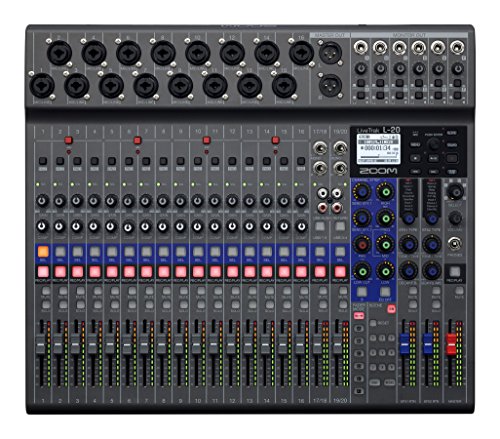
Zoom LiveTrak L-20 Mixer/Recorder — Best Overall Digital Mixer
Badge: Best Overall Digital Mixer. The LiveTrak L-20 is the digital mixer as a band’s entire infrastructure. Twenty inputs and 22 channels feed a mixer that records multitrack to SD while it runs the show, offers six headphone outputs so every musician can have a personal mix, and accepts wireless control from an iOS device for soundchecking from the room instead of behind the desk. Check the current price on Amazon.
Strengths
- Multitrack recording built in — the gig is the session
- 6 headphone outputs deliver personal mixes without extra hardware
- Wireless iOS control for mixing from anywhere in the room
Trade-offs
- The largest commitment in size and spend in this guide
- Feature depth demands setup time and a learning investment
- Over-specified for podcasting and small acoustic acts
| Spec | Detail |
|---|---|
| Inputs | 20 inputs / 22 channels |
| Recording | Multitrack recorder |
| Monitoring | 6 headphone outputs |
| Control | Wireless iOS control, USB audio interface |
The L-20’s insight is that a working band needs three products — a live mixer, a multitrack recorder and a personal monitoring system — and that one box doing all three changes the economics and the logistics. Rehearsals become recordings; gigs become live albums; every musician’s headphone mix is a fader, not a negotiation.
Wireless control completes the picture for the band that runs its own sound: set levels from the stage, walk the room during soundcheck, adjust from the audience’s perspective. For a self-contained act at this scale, there is no more complete single purchase in the category.
The L-20’s scene and project workflow rewards bands that treat it as infrastructure: build the rehearsal scene, the gig scene and the recording scene once, and the desk stops being a variable. Groups that invest that first weekend report the mixer ‘disappearing’ — the highest state a live tool can reach.
Best for: full bands, worship teams and venues wanting mix + record + monitor in one box / Not suited for: solo creators or small acoustic setups
Check on Amazon if this pick matches your kitchen and the way you actually cook.

Zoom LiveTrak L-12 12-Channel Digital Mixer Multitrack Recorder (ZDM-1 Kit) — Best for Small Bands
Badge: Best for Small Bands. The LiveTrak L-12 is the format’s sweet spot for small bands: 12 channels of digital mixing with multitrack recording and per-musician headphone mixes, in a footprint a four-piece can carry in one trip. This listing bundles it with Zoom’s ZDM-1 recording kit, adding a broadcast-style microphone package to the setup — verify the full kit contents on the listing, as bundles are the configuration detail that matters here. Check the current price on Amazon.
Strengths
- 12 channels sized for real small bands
- Multitrack recording of every rehearsal and gig
- Kit bundle adds a microphone package to the core mixer
Trade-offs
- Bundle pricing reflects the kit, not just the mixer — compare carefully
- Headphone mixes share the family’s learning curve
- Bands that outgrow 12 channels outgrow the box
| Spec | Detail |
|---|---|
| Channels | 12 |
| Type | Digital mixer / multitrack recorder |
| Bundle | With Zoom ZDM-1 recording kit (per listing) |
Twelve channels is the honest size of a working small band: drums in stereo or summed, bass, two guitars or keys, two or three vocals, and a spare. The L-12 covers it while recording every channel — the rehearsal tape that settles arguments and the live recording that becomes content.
The kit framing suits bands starting their recording journey from zero: mixer and microphone arrive together and the first session can happen the same week. Established bands with microphone lockers should compare the kit price against mixer-only listings before deciding.
The ZDM-1 kit component deserves a practical note: a broadcast-style dynamic microphone package is precisely what a band or podcast starting from zero needs for vocals and spoken word, and dynamic microphones forgive untreated rooms. The bundle is coherent, not a random add-in — but buyers with a microphone locker should still price the mixer alone.
Best for: small bands building a mix-and-record rig / Not suited for: large ensembles or buyers who need mixer-only pricing
Check on Amazon if this pick matches your kitchen and the way you actually cook.

Zoom LiveTrak L-8 Battery Powered Mixer/Recorder — Best for Podcasters and Small Acts
Badge: Best for Podcasters and Small Acts. The L-8 scales the LiveTrak idea down to the desk and the duo: six combo inputs and two stereo inputs, four headphone outputs so a full podcast panel hears itself properly, sound pads for intros and effects, a dedicated phone input for call-ins, and battery power that frees the whole rig from the wall. Check the current price on Amazon.
Strengths
- 4 headphone outputs — multi-guest podcasting done properly
- Sound pads and phone input are creator features, not afterthoughts
- Battery power enables location recording anywhere
Trade-offs
- Input count caps larger bands
- Small-format controls reward setup discipline
- Battery runtime must be managed on long sessions
| Spec | Detail |
|---|---|
| Inputs | 6 combo + 2 stereo inputs |
| Monitoring | 4 headphone outputs |
| Features | Sound pads, phone input, battery powered, USB audio interface |
Most podcast mixers fail at headphone outputs — one or two for a four-person panel. The L-8’s four outputs, each with its own mix potential, are why podcasters adopted a ‘band’ product: every guest hears the show properly, and the recording is multitrack for real editing afterward.
Battery operation is the second adoption driver: interviews in the field, acoustic sessions in a barn, a duo’s gig in a café with one free outlet. The L-8 treats location as normal, and for creators whose work happens outside a studio, that is the whole ballgame.
Podcasters should note the L-8’s phone input in particular: it brings a remote guest into the room’s headphone mix and the multitrack recording cleanly, with the mix-minus handling that prevents the guest hearing their own echo. That single feature replaces a tangle of adapters and software routing that defeats many home studios.
Best for: podcast panels, duos and location recordists / Not suited for: full bands needing double-digit mic inputs
Check on Amazon if this pick matches your kitchen and the way you actually cook.

Zoom LiveTrak L6 Mixer/Recorder — Best Portable Digital Mixer
Badge: Best Portable Digital Mixer. The L6 is the digital mixer for musicians and podcasters who move: 10 channels in a battery-powered body, with 32-bit float recording that makes clipping a problem of the past — set the performance, not the gain staging, and capture it clean. MIDI connectivity and built-in effects complete a portable that behaves like a studio tool. Check the current price on Amazon.
Strengths
- 32-bit float recording is effectively clip-proof
- Battery-powered portability with real channel count
- MIDI integration for electronic musicians
Trade-offs
- Compact surface means menu-driven depth
- 10 channels is a ceiling for growing bands
- 32-bit float workflow needs compatible software habits
| Spec | Detail |
|---|---|
| Channels | 10 |
| Recording | 32-bit float |
| Inputs | 2 combo + 4 stereo inputs (per listing) |
| Features | MIDI, effects, battery powered |
Thirty-two-bit float deserves the emphasis: it records such a wide dynamic range that a shouted chorus and a whispered verse both survive without gain riding. For live and location work — where there is no second take — that safety net is worth more than any effect in the box.
Electronic and hybrid musicians are the L6’s second constituency: MIDI keeps synths and drum machines in the family, stereo inputs respect line-level instruments, and the whole rig fits in a backpack with room for the instruments’ cables. Portable no longer means compromised.
The L6’s MIDI is more than a spec for electronic musicians: it lets the mixer sit inside a synchronized rig where sequencers, drum machines and effects start together. In a portable format, that integration turns a backpack of separate devices into one performance system with one recording of everything it did.
Best for: mobile musicians, electronic acts and safety-first recordists / Not suited for: large bands or engineers wanting a big control surface
Check on Amazon if this pick matches your kitchen and the way you actually cook.

Zoom LiveTrak L12next Mixer/Recorder — Best New-Generation Digital
Badge: Best New-Generation Digital. The L12next is where the LiveTrak line is heading: 12 channels, a 32-bit float master for clip-free capture, 14-track recording at up to 96kHz, scene recall, personal monitoring and effects in one current-generation machine. For a band or studio buying today with a long horizon, it is the forward-looking pick. Check the current price on Amazon.
Strengths
- 32-bit float master removes clipping anxiety
- 14-track recording at 96kHz for serious capture
- Scenes restore entire setups instantly
Trade-offs
- Newest model — premium positioning and a thinner field-report base
- High-resolution recording consumes storage quickly
- Capability exceeds casual users’ needs
| Spec | Detail |
|---|---|
| Channels | 12 |
| Recording | 14-track at 96kHz, 32-bit float master |
| Features | Scenes, personal monitoring, effects |
Scene recall is the feature working bands feel first: the worship setup, the acoustic setup and the full-band setup each become one recall instead of a re-patch and re-balance. Combined with personal monitoring, the L12next behaves like infrastructure — set it up once per configuration, then just perform.
The 96kHz, 32-bit float recording path targets users who treat live capture as masters, not documentation. If your recordings feed releases and content, that headroom is the argument; if they feed rehearsal review, the L-12 covers you for less commitment.
Storage planning is the L12next’s one operational homework: 14 tracks at 96kHz consume card space at a rate that surprises analog-era intuition. Buy fast, large cards, offload after every session, and the high-resolution promise stays a pleasure instead of an interruption.
Best for: bands and studios buying a long-horizon digital centerpiece / Not suited for: casual recordists or the tightest budgets
Check on Amazon if this pick matches your kitchen and the way you actually cook.

Behringer Powerplay P16-HQ 16-Channel Digital Personal Monitoring Mixer — Best Digital Personal Monitoring Add-On
Badge: Best Digital Personal Monitoring Add-On. A digital mixer guide is incomplete without the monitoring layer, and the P16-HQ is its verified representative: a 16-channel digital personal monitoring mixer that takes the channels a digital system distributes and hands each musician their own mix — levels, pans and EQ at their stand. It is the add-on that turns a digital console into a personal monitoring rig. Check the current price on Amazon.
Strengths
- Per-musician mix control ends wedge compromises
- 16 channels match full band distributions
- Current-generation unit for new system builds
Trade-offs
- Requires a host distribution system — not a standalone mixer
- Per-seat cost multiplies across a band
- Wired positions suit stationary performers best
| Spec | Detail |
|---|---|
| Channels | 16 |
| Type | Digital personal monitoring mixer |
The synergy is the story: a LiveTrak-class console or another digital desk captures and mixes the show, while P16 seats give every performer ownership of what they hear. Singers protect their voices, drummers get their click, and the house mix stops fighting stage volume.
Spec it as a system: console, distribution, one seat per musician, headphones or in-ears per seat. Budgeted that way, personal monitoring is the highest-impact upgrade a performing group can make — and the P16-HQ is the current Behringer seat to build it on.
Churches and schools — the P16 system’s heartland — should note the training dividend: once musicians own their mixes, volunteer sound teams stop rebuilding monitor worlds weekly and can focus on the house mix. The personal layer is as much a workflow purchase as an audio one.
Best for: bands and worship teams adding personal monitoring to a digital rig / Not suited for: standalone buyers — it needs a host system
Check on Amazon if this pick matches your kitchen and the way you actually cook.
Comparison Table
Channel count and recording format separate these six. Match your ensemble size and your recording ambitions to the table, then confirm in the reviews.
| Pick | Badge | Key spec | Best for |
|---|---|---|---|
| Zoom LiveTrak L-20 Mixer/Recorder | Best Overall Digital Mixer | 20-input digital mixer/recorder, 6 headphone outs | full bands, worship teams and venues wanting mix + record + monitor in one box |
| Zoom LiveTrak L-12 12-Channel Digital Mixer Multitrack Recorder (ZDM-1 Kit) | Best for Small Bands | 12-channel digital mixer/recorder, kit | small bands building a mix-and-record rig |
| Zoom LiveTrak L-8 Battery Powered Mixer/Recorder | Best for Podcasters and Small Acts | 8-input mixer/recorder, 4 headphone outs, battery | podcast panels, duos and location recordists |
| Zoom LiveTrak L6 Mixer/Recorder | Best Portable Digital Mixer | 10-channel, 32-bit float, battery | mobile musicians, electronic acts and safety-first recordists |
| Zoom LiveTrak L12next Mixer/Recorder | Best New-Generation Digital | 12-channel, 32-bit float, 96kHz 14-track | bands and studios buying a long-horizon digital centerpiece |
| Behringer Powerplay P16-HQ 16-Channel Digital Personal Monitoring Mixer | Best Digital Personal Monitoring Add-On | 16-channel digital personal mixer | bands and worship teams adding personal monitoring to a digital rig |
How to Choose the Best Digital Audio Mixers for Your Setup
Count mic inputs honestly — drums are the multiplier. A five-piece band with a fully mic’d kit can consume ten inputs before vocals; an acoustic trio needs four. Then decide how much recording you truly do: every pick here records multitrack, but 32-bit float models forgive the gain mistakes that live work guarantees, and higher track counts at higher sample rates serve release-quality capture.
Monitoring is the second axis. Mixers with multiple headphone outputs (the LiveTrak design) build personal mixes internally; larger or installed rigs add dedicated personal mixers per seat. Finally, weigh control: touchscreens, apps and scene recall are digital’s gifts — if your setup changes between acts or services, scenes alone justify the digital move.
- Count mic inputs including the drum kit, then add two spares
- Choose 32-bit float if you record live with no second takes
- Decide monitoring: built-in headphone mixes or per-seat personal mixers
- Value scene recall if your configurations change often
- Budget storage — multitrack recording consumes cards quickly
Digital vs Analog Mixers: What Actually Changes
Digital replaces knobs-per-function with processing-per-channel: full EQ, compression and gates on every input, effects without outboard racks, and total recall of the entire desk state. It also integrates recording — the multitrack capture in this guide would be a separate recorder and interface in the analog world.
Analog counters with immediacy: every control visible, no menus, nothing to boot or update. The modern answer for most bands and creators is the hybrid reality of this guide — digital brains with physical faders, giving recall and recording without surrendering hands-on mixing. Buy digital when you record, recall or process heavily; those are the dividends.
Understanding 32-Bit Float and Multitrack Recording
Standard recording demands gain discipline: set levels too hot and peaks clip permanently; too low and noise creeps in. Thirty-two-bit float recording captures such an enormous dynamic range that both errors become recoverable in editing — the practical meaning is that live recording stops requiring a dedicated engineer watching meters.
Multitrack means every input is recorded separately, not just the stereo mix. The rehearsal becomes remixable, the gig becomes an album project, and a mistake on one channel stops ruining the whole capture. If you record at all, multitrack is the feature that changes what your recordings can become — and it is standard across this guide’s picks.
Digital Mixer Workflow: Scenes, Projects and the Discipline of Saving
Digital mixers reward a file discipline analog never demanded. Name scenes by purpose and date, keep a master ‘start’ scene you trust, and treat the recording card like film: offload, verify, then format in the mixer. Bands that adopt this liturgy get digital’s full dividend — instant recall, every show recorded, nothing lost. Bands that do not, lose takes and rebuild mixes, and blame the technology.
The same discipline applies to firmware and apps: update between engagements, never before a show; keep the control app on the device you actually carry; and export your scenes to a second location. A digital desk is a computer that mixes — the care habits of computing, applied lightly, keep it as reliable as the analog desks it replaced.
Live Sound With a Mixer-Recorder: One Box Running the Whole Night
The mixer-recorder format changes a band’s night structurally. Soundcheck is recorded, so the engineer — often the guitarist — can listen back from the room’s perspective. The show is recorded as a matter of routine, not as a special project. Content for the band’s channels, a live EP, a rehearsal archive: all by-products of simply turning up and playing through the same box.
It also changes failure planning. A single box is a single point of failure, and professional habits apply: a spare card, a backup power supply, and a saved scene on a second device. The format’s convenience is real, and so is the responsibility that comes with consolidation — this guide recommends the format wholeheartedly, with its disciplines attached.
Digital Audio Mixers for Churches, Schools and Community Stages
Institutions are digital mixing’s quiet majority, and their requirements map neatly onto this guide’s picks: volunteer operators who need scenes because every week has a different pair of hands; services and assemblies that change configuration and need recall; and recordings of everything for the community that could not attend. A LiveTrak-class desk with saved scenes turns a volunteer rota from a risk into a roster.
Personal monitoring completes the institutional picture — a worship band on P16 seats stops competing with the room, and the congregation’s mix improves as stage volume falls. For a church or school speccing its first digital system, the combination of a mixer-recorder and personal seats is the architecture this guide’s picks were, in effect, designed to form.
Digital Mixers and Livestreaming: The Hybrid Gig
The modern performance is often two shows at once: the room and the stream. Mixer-recorders serve both from one desk — the main mix feeds the PA, an aux or the USB feed carries a stream mix, and the multitrack recording captures the archive. Bands that stream their gigs should build a dedicated stream scene: slightly more compression, the audience’s perspective replaced by a close, present balance.
The discipline is to mix the stream deliberately rather than accepting the room mix as a by-product; listeners at home have no room energy to fill the gaps. The LiveTrak family’s USB interface and scene recall make that second mix a stored decision instead of a nightly improvisation — one more place where digital’s recall quietly outperforms analog habit.
Maintaining a Digital Mixer: Firmware, Cards and Connectors
Digital desks ask for a light maintenance liturgy. Keep firmware current between engagements and read the release notes — updates in this product class routinely add real features. Format SD cards in the mixer itself, use reputable fast cards sized generously for multitrack work, and offload sessions the same night. Exercise the faders and encoders occasionally on stored units, and keep connectors clean and capped.
None of this exceeds ten minutes a month, and it buys the reliability the format promises. The digital mixers in this guide are working tools for working musicians; treated as such, they return the favor across years of shows, services and sessions.
Digital Mixers in the Rehearsal Room: The Unglamorous Superpower
Rehearsal is where bands are made, and the digital mixer-recorder quietly revolutionizes it. Every practice is recorded without anyone deciding to record; the argument about whether the bridge dragged is settled by playback, not memory; the new song’s arrangement is documented the night it is written. Groups that adopt an always-recording desk improve faster, because their feedback loop stops depending on anyone’s impression of how it went.
Personal mixes complete the rehearsal upgrade: each musician hears the balance that lets them play their best, at volumes that let a three-hour practice end without ringing ears. The LiveTrak format’s combination — multitrack always on, headphone mixes for everyone — is why rehearsal rooms have become the digital mixer’s fastest-growing habitat, ahead of many stages.
The setup discipline is light: a saved rehearsal scene, a card with space, a thirty-second test recording. In exchange, the room gains a memory. Ask bands a year into owning one what changed and they rarely mention sound quality first; they mention that nothing good is ever lost anymore.
Choosing Between the LiveTrak Sizes: A Decision Walk-Through
Start with your largest simultaneous source count, counted honestly at the biggest event you actually play. A duo with two instruments and a playback device lives entirely inside the L-8, with podcasting headroom to spare. A four-piece with a sensibly mic’d kit lands on twelve channels — the L-12 for value, the L12next for 32-bit float masters and scene-driven work. A full band with a fully mic’d kit, keys in stereo and three backing vocals is L-20 territory, and no amount of clever submixing makes a smaller desk the right buy.
Then apply the second filter: recording ambition. Rehearsal documentation thrives at any size; release-quality live capture argues for the float-equipped models; content creation with panels and call-ins argues for the L-8’s creator fittings regardless of band size. Musicians whose work spans both worlds — the gigging podcaster is a real species — should weight the headphone outputs, because both jobs live or die by how many people can hear themselves properly.
Finally, the growth question: digital desks are kept for years, and ensembles grow. One size above today’s count is wisdom; two sizes above is a tax on every session in size, setup and minimums. The ladder in this guide is deliberately climbable — start where you are, and let the family’s consistency carry your scenes and habits upward when the band does.
Digital Mixers for Solo Performers and Duo Acts: Right-Sizing the Revolution
Solo performers and duos are digital mixing’s fastest converts, because they were always their own sound engineers — digital simply gave them an engineer’s tools. A performer with an L-8 carries their entire production: scenes per venue type, effects tuned to their voice, a recording of every show, and headphone monitoring that ends the feedback roulette of borrowed wedges. The one-person load-in that once meant compromise now means control.
Right-sizing is the discipline: the solo act does not need twenty inputs, and the money and setup time saved by the smaller desk fund the things audiences actually notice — better microphones, better lights, a second instrument. The L-8 and L6 in this guide exist precisely at that scale, and their battery power removes the last venue variable. For the working soloist, a right-sized digital desk is not a smaller version of the band rig; it is a different, complete instrument.
Duos should count the headphone outputs twice: two personal mixes from the same box, no splitter compromises, is the feature that turns a good duo rig into a settled one. It is the kind of detail this guide’s comparisons exist to surface — invisible in a headline spec, decisive in a hundred soundchecks.
The Economics of Digital: What the Box Replaces
Price a digital mixer against what it deletes from the shopping list: a multitrack recorder, an audio interface, a rack of channel processing, a personal monitoring system in the LiveTrak configuration, and the snake of cables that connected their analog ancestors. The comparison is not mixer versus mixer; it is system versus pile of systems, and on that ledger the digital desk is frequently the cheapest item on the page.
The running costs invert too: no tape, no outboard maintenance, scenes instead of a sound engineer’s day rate for repeat engagements, recordings that become content and product. Bands that do this arithmetic stop asking whether they can afford to go digital and start asking how they afforded not to — usually around the second gig where the recording of the night pays for the month’s fuel. Buy the size your sources demand, keep the disciplines this guide lists, and the economics take care of themselves.
Digital Mixers and the Next Five Years of Your Sound
A digital mixer bought today will be shaped by updates as much as by its shipping firmware: features arrive, apps improve, recording formats evolve. That is an argument for buying within a living product family — the LiveTrak line’s continuity across sizes means your habits, scenes and accessories travel as you scale — and for treating the mixer as a platform decision in the same way this guide treats stand mixers and their ecosystems. The desk is the hub; everything else in your rig will orbit it for years.
It is also an argument for buying the current generation when the price difference is survivable: the L12next’s float recording and scene architecture are where the category is heading, and a five-year horizon rewards arriving early. Balance that against the proven depth of the established models, and the choice becomes the familiar one this guide keeps posing — your workload, your horizon, your call, made with the facts on the table.
Signing Off: The Digital Desk as a Band Member
Bands joke that the mixer-recorder is the most reliable member: it arrives every night, remembers every setting, records every song and never asks for a solo. The joke contains the purchasing truth. A digital mixer is not an accessory to the music; it is infrastructure the music stands on, and it should be bought with infrastructure seriousness — sized honestly, set up carefully, maintained lightly, and trusted completely. Do that with any pick in this guide and it will repay you the way good band members do: by making everyone else sound better.
One More Consideration: Power, Spares and the Gig Bag
Digital desks consolidate a rig, and consolidation deserves a spares discipline borrowed from touring: a backup power supply or the battery option where the model allows, two formatted SD cards beyond the one in the slot, a spare XLR and USB cable, and the control app installed on a second device. The whole kit fits in the same bag as the mixer and converts most show-stopping failures into thirty-second swaps.
Add a printed one-page setup sheet — input list, scene names, gain notes — because the night the tablet dies is the night paper earns its keep. None of this diminishes the digital format’s convenience; it is the professionalism that lets the convenience be trusted on the nights that count.
Closing Note: Record Everything, Regret Nothing
If one habit survives this guide, let it be the thirty-second test recording and the card that is always ready. Digital mixers have made capture nearly free; the only remaining cost is remembering to start it. Bands, churches and creators who build that reflex own an archive of their own becoming — and that, more than any specification compared above, is what the best digital audio mixers are really for.
How to Set Up a Digital Mixer for a Band Session or Recording
Start from a scene or a zeroed desk: connect inputs in a consistent order (drums, bass, guitars or keys, vocals), label channels in the mixer’s scribble strips, and set gains so the loudest expected moment peaks healthily. Build the main mix first, then build each musician’s headphone or personal mix from their perspective, and save the result as a named scene before anyone touches anything.
- Keep a permanent input list — consistency is speed
- Gain-stage for the loudest moment, not the average
- Build monitor mixes with the musicians present and playing
- Save scenes per configuration: rehearsal, gig, service, stream
- Start the multitrack recording before the first note, every time
- Back up recordings and scenes — digital convenience cuts both ways
For recording sessions, do a 30-second test capture and play it back before the real take. That single habit prevents the category’s saddest sentence: the performance was great and the recording does not exist.
Common Buying Mistakes
Digital mixers fail their owners through process, not hardware: no scenes saved, no test recording, gains set for the quiet soundcheck and clipped by the loud show. The mistakes list is a checklist against exactly those moments.
- Buying channels for the band you imagine instead of the one you have
- Skipping the test recording before a real performance
- Setting gains at soundcheck volume and clipping at show volume
- Never saving scenes, then rebuilding the mix from memory weekly
- Ignoring monitoring until the singers complain
- Forgetting storage: multitrack sessions fill cards faster than expected
Final Recommendation
The digital mixer decision resolves by scale. Full bands and worship teams: the LiveTrak L-20’s combination of inputs, recording and six personal headphone mixes is the complete infrastructure. Small bands: the L-12, or the L12next if 32-bit float and scenes fit your horizon. Podcasters and small acts: the L-8’s headphone outputs and creator features. Mobile recordists: the L6’s clip-free portability. And any digital rig graduates with P16-HQ seats when the musicians are ready to own their mixes.
Count inputs, protect the recording, save the scene — digital mixing rewards exactly those habits.
Ready to decide? Start with the shortlist: Zoom LiveTrak L-20 Mixer/Recorder, Zoom LiveTrak L-12 12-Channel Digital Mixer Multitrack Recorder (ZDM-1 Kit), Zoom LiveTrak L-8 Battery Powered Mixer/Recorder.
Keep exploring the cluster: Best Desktop Personal Mixers Best 16 Channel Digital Mixers List Best 12 Channel Audio Mixers Best 10 Channel Mixers Best 2 Mic Mixers For Podcasting
Frequently Asked Questions
What does a digital mixer do that an analog mixer cannot?
Three headline things: it stores and recalls complete mixes as scenes, it applies full processing — EQ, compression, gates, effects — on every channel without outboard gear, and it typically records multitrack directly. The picks in this guide all combine mixing with multitrack recording, which is the modern digital mixer’s defining advantage.
How many channels do I need for a band?
Count every microphone and line source, with drums as the multiplier: a fully mic’d kit alone can take 4 to 8 inputs. A typical five-piece band lands between 12 and 20 channels — which is why this guide’s band picks are the 12-channel L-12 and L12next and the 20-input L-20. Add spare channels for guests and growth.
What is 32-bit float recording and do I need it?
It is a recording format with such wide dynamic range that clipping is effectively impossible and quiet signals stay clean — you can fix levels in editing instead of perfecting them live. If you record performances with no second take, it is one of the most valuable features in modern mixers; the L6 and L12next in this guide offer it.
Can a digital mixer replace my audio interface?
The LiveTrak models here double as USB audio interfaces, so for most band and creator setups, yes — the mixer is the interface. Studios with specialized conversion or monitoring chains may keep both, but the combined workflow is the norm at this scale.
Are personal monitor mixers part of a digital mixer setup?
They are its monitoring layer. A digital console or distribution hub sends the channels; a personal mixer like the P16-HQ at each musician’s position lets them build their own headphone mix. Systems can also use a LiveTrak’s multiple headphone outputs for simpler personal mixing without separate seats.
Do digital mixers need firmware updates and apps?
Many use companion apps for remote control and receive firmware updates that add features or fixes. It is light maintenance — an occasional update with real benefits, like the L-20’s wireless iOS control. Keep the app installed and check for updates before important sessions, not during them.


