Disclosure: airfryerkitchensupply.com is reader-supported. When you buy through links on our site, we may earn an affiliate commission at no extra cost to you.
Where to buy
Designed teapots are bought with the eye, which makes verification more important, not less: the market is full of sculptural photographs attached to pots that dribble, scald and stain. Every pick below was verified against Amazon’s catalog data before earning a link — maker, material, capacity and hardware confirmed — so the design you fall for is attached to the teapot described in its review. Read the capacity in each review before ordering, because design-led pots range from a 150-personal gongfu scale to full family size, and the photograph will not tell you which you are holding.
- Hario ChaCha Kyusu Maru Tea Pot, 700 ml (Best Overall Design) — check price on Amazon
- Steinzeit Design Ceramic Teapot with Infuser, 44 oz, Black (Best Modern Minimalist) — check price on Amazon
- HVH Porcelain Teapot with Stainless Steel Infuser, 40 oz, Wabi Sabi Striped (Best Wabi-Sabi Aesthetic) — check price on Amazon
- suyika Japanese Tetsubin Cast Iron Teapot, 22 oz / 650 ml (Best Traditional Craft Design) — check price on Amazon
- SILINE Artisan Yixing Clay Tea Set, Xishi Zhuni Red, 7.8 oz, with 2 Cups (Best Sculptural Form) — check price on Amazon
- Tea Forte Fiore Ceramic Teapot with Infuser, Stone Blue, 24 oz (Best Contemporary Elegance) — check price on Amazon
The best designed teapots prove that a teapot is an industrial design problem disguised as a kitchen object. Balance in the hand when full, a spout that pours in a clean arc and stops without a dribble, a lid that stays seated at full tilt, a handle that keeps knuckles off hot ceramic, leaves room to expand and a strainer that does not clog — solve all of that beautifully and you have the six pots in this guide. They span the great design languages of tea: Japanese kyusu precision, modernist black ceramic, wabi-sabi imperfection, cast-iron craft, the sculptural Xishi form, and contemporary floral elegance. Each is reviewed as design first — and as a brewer always, because a teapot that fails at tea is a sculpture with a spout.
A note on judging design honestly. Good teapot design is not the same as striking styling. Styling is what a pot looks like in a photograph; design is what happens at the third pour, with wet hands, at full capacity, six months in. This guide therefore weights the invisible decisions — spout geometry, handle clearance, infuser sizing, weight distribution — as heavily as the visible ones, and each review separates the two. Where a listing gives no evidence on a point, the review says so rather than inventing praise.
The six also make a useful argument by contrast. Japanese design pursues precision and lightness of touch; the wabi-sabi pot pursues texture and honest irregularity; the modernist Steinzeit pursues reduction — nothing on the pot that is not needed. None of these philosophies is the correct one. The right design language is the one that matches how you brew and what your kitchen already says, and the guide sections below will help you locate yours.
In this guide
Quick Picks
Six design philosophies, six working brewers. The Hario leads for precision, the Steinzeit for modern minimalism, and the wabi-sabi HVH for texture — read the reviews to find your language.
- Hario ChaCha Kyusu Maru Tea Pot, 700 ml — Best Overall Design: Japan’s benchmark glassmaker interprets the kyusu — the side-handled form refined over centuries for green tea — in clean modern glass. Precision you can feel in the pour. — Check on Amazon
- Steinzeit Design Ceramic Teapot with Infuser, 44 oz, Black — Best Modern Minimalist: A 44 oz black ceramic pot with infuser and removable strainer, designed — and named — as a design object. Modernist reduction at family capacity. — Check on Amazon
- HVH Porcelain Teapot with Stainless Steel Infuser, 40 oz, Wabi Sabi Striped — Best Wabi-Sabi Aesthetic: A 40 oz porcelain pot in a striped Wabi Sabi finish — designed imperfection, hand-made character — with a stainless infuser and six-cup capacity. — Check on Amazon
- suyika Japanese Tetsubin Cast Iron Teapot, 22 oz / 650 ml — Best Traditional Craft Design: A cast iron tetsubin-form pot with enameled interior and stainless infuser — a design language forged, literally, over centuries of Japanese ironwork. — Check on Amazon
- SILINE Artisan Yixing Clay Tea Set, Xishi Zhuni Red, 7.8 oz, with 2 Cups — Best Sculptural Form: A handmade zisha pot in the Xishi form — the most beloved silhouette in Chinese teapot design — in Zhuni red clay, with two cups completing the composition. — Check on Amazon
- Tea Forte Fiore Ceramic Teapot with Infuser, Stone Blue, 24 oz — Best Contemporary Elegance: A 24 oz ceramic pot in stone blue with stainless infuser and ceramic lid, from a brand that designs tea as a visual experience — contemporary elegance that is also dishwasher safe. — Check on Amazon
How These Picks Were Chosen
All picks were verified against Amazon’s catalog data: maker, material, capacity and included hardware confirmed from listing data before any link was added. Design objects attract imitators, and an unverified ‘inspired-by’ pot is the commonest disappointment in this category; verification is how this guide avoids recommending one.
Selection judged design on evidence: form lineage (does the shape descend from a real brewing tradition or a styling exercise?), proportion and material honesty, the presence and sizing of brewing hardware such as infusers and multi-hole outlets, and the maker’s track record in tea specifically. Pots from dedicated tea makers — Hario in glass, the Yixing tradition in clay, Tea Forte in contemporary ceramic — anchor the list because design in tea is accumulated knowledge, not decoration.
The list deliberately spans opposed aesthetics so that the comparison itself teaches the category: precision against imperfection, reduction against craft ornament, East against West. A reader who finishes this guide should be able to walk past any teapot, anywhere, and read its design intentions fluently.
The 6 Best Designed Teapots Reviewed
Each review reads the pot as a designed object — form, material, hardware, hand feel — and then gives the honest trade-offs, because every design philosophy buys its virtues with a specific cost.

1. Hario ChaCha Kyusu Maru Tea Pot, 700 ml — Best Overall Design
The kyusu is arguably the most considered teapot form in existence: a side handle aligned with the spout so the wrist rotates rather than lifts, a body low and wide for leaf expansion, and proportions tuned for short, controlled infusions. Hario — Japan’s benchmark glass company — renders that form as the ChaCha Kyusu Maru, a 700 ml pot whose design intelligence is entirely in service of brewing. Nothing on it is decorative. The glass exists so the brewer can watch the leaves and the liquor; the form exists so the pour obeys. It is the clearest example in this guide of design as accumulated knowledge.
Strengths
- Kyusu ergonomics give the most controlled pour of any form here — the wrist rotates, the stream obeys
- Glass body turns brewing into observable process: leaf expansion and liquor color are the controls
- Hario’s manufacturing finish — rims, handle joins, lid fit — is the benchmark in glass tea ware
Trade-offs
- Glass is fragile and loses heat quickly; this is a design for attentive, short-infusion brewing
- The green-tea orientation is real — the form’s virtues matter least to bag-and-mug households
- 700 ml is a solo-to-two-person scale, not a family pot
| Specification | Detail |
|---|---|
| Maker | Hario |
| Form | Kyusu (side-handle), Maru (round) |
| Capacity | 700 ml |
| Material | Glass (maker’s specialty) |
Spend a week with a kyusu and Western pots start to feel oddly thoughtless: the top handle that swings, the spout that demands a high lift and a hopeful tilt. The side handle changes the physics — the pot rotates around the wrist’s natural axis, so a two-ounce pour and a full pour use the same calm motion, and stopping mid-pour is clean because the rotation reverses instantly. For green teas brewed in repeated short infusions, that control is not a luxury; it is the technique. The Maru’s round body adds the leaf room those teas need to open fully.
Hario’s contribution is execution. Glass tea ware fails at its joins and rims — wavy lips, strained handle attachments, lids that rock. Hario’s production discipline is why the company supplies laboratories as well as kitchens, and in a pot you will handle daily, that precision reads as calm: everything fits, nothing rattles, the lid seats with a small, exact sound. Design prizes are usually given to stranger objects, but on the evidence of use, this is the best-designed teapot in the guide.
Best for: green tea brewers and anyone who values precision and process / Not suited for: households wanting capacity, ruggedness or heat retention
Check the current price on Amazon.
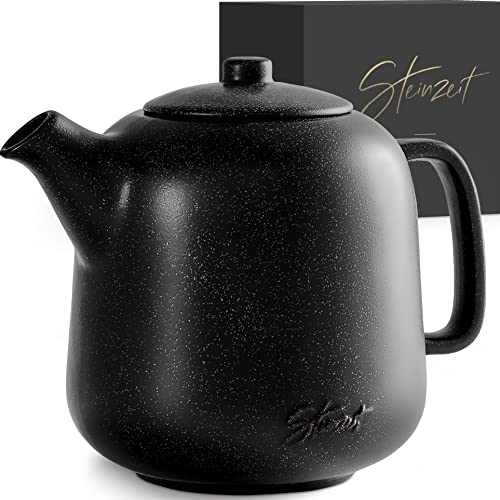
2. Steinzeit Design Ceramic Teapot with Infuser, 44 oz, Black — Best Modern Minimalist
Steinzeit puts its intention in its name: this is a design-led pot, a 44 oz ceramic brewer in black with an infuser and removable strainer, positioned as a premium design piece. Its language is modernist reduction — a confident, unadorned body in a single matte-dark finish, sized generously rather than delicately. Where most design teapots go small and precious, this one goes large and architectural, which makes it the rare design object that also answers a family’s actual tea consumption. On a modern counter, among espresso machines and steel, it looks like it was always there.
Strengths
- Reductionist black form integrates with modern kitchens better than any traditional shape
- 44 oz capacity makes the design object genuinely useful at family scale
- Infuser with removable strainer gives it complete loose leaf hardware, not just looks
Trade-offs
- Black shows water spots, dust and fingerprints more than any other finish
- A full 44 oz ceramic pot is a serious two-handed lift
- Minimalism is unforgiving of chips and scratches — damage has nowhere to hide
| Specification | Detail |
|---|---|
| Material | Ceramic |
| Capacity | 44 oz |
| Infuser | Included, with removable strainer (per listing) |
| Finish | Black (per listing) |
| Positioning | Premium design teapot (per listing) |
Minimalist design lives or dies on proportion, because there is nothing else to look at. A pot like this succeeds when the body’s curve, the spout’s emergence and the handle’s negative space are in quiet agreement — and fails obviously when they are not, since no pattern distracts the eye. Steinzeit’s pot holds together at the large scale, which is the hard part: scaling a teapot up usually produces a swollen parody of the small version, while this keeps its poise at nearly a litre and a half. That is a real design achievement, and it is why the pot anchors modern kitchens rather than decorating them.
The practical dividend of reduction is cleaning and coordination: no pattern to match, no theme to tire of, a silhouette that suits loose leaf service, bag service and plain hot water alike. The honest cost is maintenance visibility — black ceramic narrates every hard-water spot — and the discipline of the two-handed pour. Buyers who accept those terms get the most architecturally confident pot in this guide.
Best for: modern kitchens, design-conscious families, and high-volume tea households / Not suited for: traditional interiors and anyone wanting a light, one-handed pour
Check the current price on Amazon.
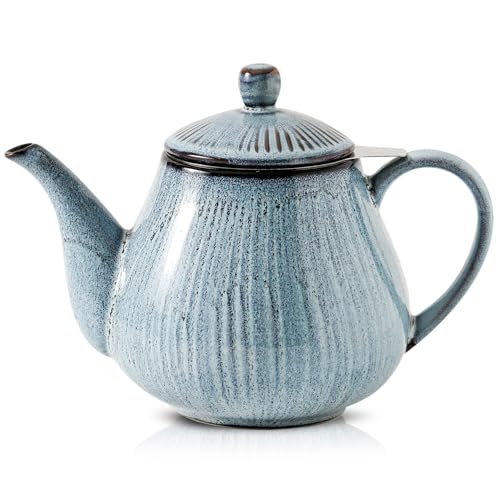
3. HVH Porcelain Teapot with Stainless Steel Infuser, 40 oz, Wabi Sabi Striped — Best Wabi-Sabi Aesthetic
Wabi-sabi is the Japanese aesthetic of imperfect, transient, honest things — and the HVH brings it to a full-size porcelain teapot: 40 oz, enough for six cups, with a stainless steel infuser, finished in a striped Wabi Sabi design whose irregularity is the point. Where the Steinzeit pursues perfection by reduction, this pot pursues character by variation: stripes that breathe, a surface that admits a human process made it. It is also, beneath the philosophy, a generously sized, fully equipped loose leaf brewer — the aesthetic costs nothing in function, which is exactly how wabi-sabi is supposed to work.
Strengths
- Wabi-sabi striped finish gives the pot handmade character no two production runs repeat exactly
- 40 oz six-cup capacity makes the art piece a real gathering brewer
- Stainless steel infuser included — full loose leaf function under the aesthetic
Trade-offs
- Designed irregularity divides taste: buyers wanting crisp uniformity should choose the Steinzeit or Sweese-style porcelain
- The striped, textured presentation will fight busy table linens and patterned china
- Porcelain at 40 oz needs the usual two-handed respect when full
| Specification | Detail |
|---|---|
| Material | Porcelain (per listing) |
| Capacity | 40 oz (enough for 6 cups, per listing) |
| Infuser | Stainless steel, included |
| Finish | Striped series, Wabi Sabi (per listing) |
The wabi-sabi idea translates surprisingly well to a daily object. A perfectly uniform pot shows every chip and stain as damage; a pot designed around variation absorbs the marks of use into its character, aging the way wooden tables and leather bags age — visibly, and better for it. For households that find pristine minimalism slightly anxious-making, this is the humane design philosophy, and at six-cup capacity it is applied to the most social object in the kitchen, the gathering pot. There is a pleasing rightness in the match.
Functionally, porcelain is the connoisseur’s neutral: it contributes nothing to flavor, cleans completely between teas, and suits a household that brews greens and blacks in the same pot across a day. The stainless infuser keeps the hardware modern. Judge this pot as the guide’s gathering pick with a soul — and if its stripes make you slightly happy every time you see them, understand that this reaction is the design working as intended.
Best for: gathering hosts who love handmade character and Japanese aesthetics / Not suited for: uniformity seekers and minimalist purists
Check the current price on Amazon.

4. suyika Japanese Tetsubin Cast Iron Teapot, 22 oz / 650 ml — Best Traditional Craft Design
Some designs are invented; the tetsubin was forged — refined over centuries in Japan’s ironworking regions until the form settled: a compact, heavy, balanced vessel whose beauty is entirely the beauty of a difficult material mastered. This suyika interpretation — 22 oz / 650 ml, enameled interior, stainless steel infuser, stovetop safe — keeps the traditional silhouette and thermal virtues while adding a practical interior for daily brewing. As design, it represents the craft pole of this guide: ornament inseparable from process, in an object that will outlast every other pick here.
Strengths
- Centuries-refined form with balance and presence no styling exercise can imitate
- Cast iron’s thermal mass is itself a design decision — the pot is its own warmer
- Enameled interior and stainless infuser make the traditional form practical daily
Trade-offs
- Heavy in the hand, especially full — a real consideration for some users
- 22 oz is a one-to-two-person scale
- Iron requires a dry-after-use habit that glass and porcelain forgive
| Specification | Detail |
|---|---|
| Material | Cast iron, enameled interior |
| Capacity | 22 oz / 650 ml |
| Infuser | Stainless steel, included |
| Stovetop | Stovetop safe (per listing) |
Cast iron design begins from constraint: the material is heavy, casts with limited delicacy, and rusts if neglected. The tetsubin form turns each constraint into the aesthetic — the weight becomes steadiness and heat retention, the casting texture becomes the surface, the care ritual becomes part of ownership’s pleasure. Picking one up teaches the design faster than any description: the balance point sits where the hand expects it, the short spout pours a tight, controlled stream, and the whole object communicates permanence in a category of disposable things.
The enameled interior is the modern negotiation with tradition — purists’ kettles are bare iron, but a brewing pot benefits from an inert surface, and the enamel lets this pot brew any tea without flavor carry-over while keeping the exterior’s craft character. Treat it as the guide’s heirloom pick: the design least likely to date, because it was already old when every other style here was new.
Best for: craft lovers, slow tea drinkers, and buyers of lifetime objects / Not suited for: large households and anyone who finds iron too heavy
Check the current price on Amazon.
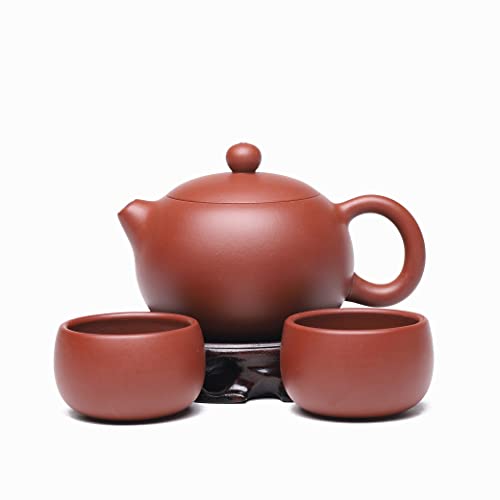
5. SILINE Artisan Yixing Clay Tea Set, Xishi Zhuni Red, 7.8 oz, with 2 Cups — Best Sculptural Form
The Xishi is the Venus de Milo of teapot forms: a round, soft, full-bodied silhouette with a short spout and inverted knob, named for a legendary beauty and refined by generations of Yixing potters into an ideal of proportion. This SILINE set renders it handmade in Zhuni red zisha clay, with two cups that complete the sculptural group. Judged purely as designed objects, Yixing pots carry a claim no other tradition matches — the form, the material and the hand of the maker are a single decision, and the object improves with use as the clay takes on its seasoned luster.
Strengths
- The Xishi silhouette is a canonical design — the reference form of its tradition
- Handmade zisha in Zhuni red develops a living patina no static finish can copy
- The pot-and-cups set composes as a complete sculptural group for display
Trade-offs
- 7.8 oz is gongfu scale — a design for small infusions, not family service
- Unglazed clay demands the no-detergent, single-tea discipline of its tradition
- Handmade variation means your pot is an individual, not a machined duplicate
| Specification | Detail |
|---|---|
| Material | Yixing zisha clay, Zhuni red |
| Form | Xishi |
| Capacity | 7.8 oz |
| Set | Teapot with 2 cups |
| Construction | Handmade (per listing) |
What distinguishes sculptural design from styling is that the Xishi’s beauty is structural: the curve of the body is the curve the clay wants, the short spout pours fast and clean for gongfu timing, and the proportions that please the eye are the same ones that balance the pot in the hand. Zhuni clay adds the material dimension — dense, fine, warm in color, and famous for the glow it develops as oils from the hand and tea season its surface. Owners describe the pot changing across its first year, and that slow transformation is a design feature no manufactured finish offers.
The two cups matter more than they appear to. Gongfu service is a composition — pot, cups, and the small scale of each infusion — and a matched set lets a beginner experience the design as a whole rather than as a lone pot among mismatched mugs. As the guide’s sculptural pick, this set is the one to give a design lover who drinks tea: an object that belongs in a design museum’s shop and a daily ritual at once.
Best for: design lovers, gongfu drinkers, and collectors of handmade objects / Not suited for: family brewers and low-maintenance households
Check the current price on Amazon.

6. Tea Forte Fiore Ceramic Teapot with Infuser, Stone Blue, 24 oz — Best Contemporary Elegance
Tea Forte designs tea the way perfumers design scent — as a complete aesthetic experience — and the Fiore teapot is its hardware expression: 24 oz of ceramic in a soft stone blue, with a stainless steel loose leaf infuser and a ceramic lid, the gentle curves of its name (Fiore: flower) drawn into the body. Its design register is contemporary elegance: quieter than the Steinzeit’s modernism, warmer than the Hario’s precision. And it carries a practical credential rare among design pots — it is listed as dishwasher and microwave safe, so the elegance is cleared for daily duty.
Strengths
- Cohesive contemporary design from a brand whose whole identity is tea aesthetics
- Dishwasher and microwave safe per its listing — design that tolerates real kitchens
- Stainless infuser and ceramic lid complete the object in matching materials
Trade-offs
- 24 oz serves two — elegance at couples’ scale only
- Understated design will not satisfy buyers wanting drama or pattern
- Premium brand positioning means a higher tier than plain ceramic pots
| Specification | Detail |
|---|---|
| Maker | Tea Forte |
| Material | Ceramic |
| Capacity | 24 oz |
| Infuser | Stainless steel loose leaf infuser, included |
| Care | Dishwasher and microwave safe (per listing) |
Contemporary elegance is the hardest register to hold, because it must be interesting without being loud and simple without being plain. The Fiore manages it through proportion and color: the stone blue is the kind of shade that harmonizes with wood, steel, marble and linen alike, which is why this pot photographs well in every kitchen and clashes with none. The matching ceramic lid — a detail cheaper designs cheapen with plastic or steel — keeps the object materially honest from every angle, including the top, which is the angle its owner sees most.
The dishwasher safety is a design decision too, and a brave one: it declares that the object belongs to daily life rather than to ceremony. Combined with the two-cup scale, it makes the Fiore the design pick for real routines — the pot a couple actually uses every evening, looking composed on the counter between times. Design that survives Tuesday is worth more than design that only survives display.
Best for: design-conscious couples and gift buyers wanting contemporary elegance / Not suited for: hosts needing capacity and lovers of bold statement pieces
Check the current price on Amazon.
Comparison Table
The table maps each design language to its material and best use. Choose the language first; the pot follows.
| Pick | Badge | Key spec | Best for |
|---|---|---|---|
| Hario ChaCha Kyusu Maru Tea Pot, 700 ml | Best Overall Design | Glass kyusu form, 700 ml, Hario manufacture | green tea brewers and anyone who values precision and process |
| Steinzeit Design Ceramic Teapot with Infuser, 44 oz, Black | Best Modern Minimalist | Black ceramic, 44 oz, infuser with removable strainer | modern kitchens, design-conscious families, and high-volume tea households |
| HVH Porcelain Teapot with Stainless Steel Infuser, 40 oz, Wabi Sabi Striped | Best Wabi-Sabi Aesthetic | Porcelain, 40 oz, stainless infuser, wabi-sabi striped finish | gathering hosts who love handmade character and Japanese aesthetics |
| suyika Japanese Tetsubin Cast Iron Teapot, 22 oz / 650 ml | Best Traditional Craft Design | Cast iron tetsubin form, enameled interior, 22 oz | craft lovers, slow tea drinkers, and buyers of lifetime objects |
| SILINE Artisan Yixing Clay Tea Set, Xishi Zhuni Red, 7.8 oz, with 2 Cups | Best Sculptural Form | Handmade zisha, Xishi form, Zhuni red, 7.8 oz set | design lovers, gongfu drinkers, and collectors of handmade objects |
| Tea Forte Fiore Ceramic Teapot with Infuser, Stone Blue, 24 oz | Best Contemporary Elegance | Ceramic, 24 oz, stainless infuser, stone blue | design-conscious couples and gift buyers wanting contemporary elegance |
How to Judge Teapot Design: The Five Tests
Test one, the pour: a designed spout delivers a smooth, laminar stream that starts when you tilt and stops when you level, without a trailing dribble down the body. Spout tip height relative to the rim and the vent hole in the lid decide this more than any styling. Test two, the balance: a full pot should feel centered over the handle, not nose-heavy; your wrist will grade this honestly within one pour. Test three, the lid: it should seat securely at full tilt — a lid that threatens the cup is a design failure regardless of beauty. Test four, the handle: clearance for knuckles, insulation from the body’s heat, and a grip that works with wet hands. Test five, the brew: leaves need room, water needs to reach them, and the straining system — infuser, wall holes, outlet holes — must not clog on the teas you actually drink.
Apply the five tests in that order and most ‘designer’ teapots fail by test two. The six in this guide were chosen from makers and traditions with the accumulated knowledge to pass all five — which is why this list leans on forms refined over decades and centuries rather than on this season’s sculptural experiments. Novelty has its place in tea, but it is not at the spout.
Design Languages of Tea: Precision, Imperfection, Reduction, Craft
Japanese precision design, in the Hario kyusu, treats the teapot as an instrument: every element serves the brew, and beauty emerges from fitness. Wabi-sabi, in the HVH, treats imperfection as honesty: the handmade trace is the beauty, and the object relaxes its owner. Modernist reduction, in the Steinzeit, removes until only proportion remains, trusting the eye to enjoy pure form. Craft tradition, in the tetsubin and the Yixing Xishi, locates design in lineage — forms perfected anonymously across generations, where the maker’s skill is measured by fidelity and touch rather than invention.
None of these languages is superior; they suit different temperaments and interiors. The practical advice is to collect within one language at a time. A shelf mixing precision glass, rustic iron and modernist black can work in a confident eclectic kitchen, but a beginner’s eye is better served by coherence: two pieces speaking the same language teach you to hear it, and your third purchase will be the best-judged thing you own.
Materials as Design Decisions
Every teapot material is a bundle of designed consequences. Glass declares that the process is the spectacle and accepts fragility and fast cooling as its price. Porcelain declares neutrality — the tea, not the pot, is the flavor — and offers the finest rims and easiest cleaning. Glazed ceramic declares presence: color, weight, capacity. Cast iron declares permanence and thermal patience. Unglazed Yixing clay declares participation: the pot will change with you, record your tea, and demand your care in return.
When a design disappoints in use, the cause is usually a material chosen for its photograph against the owner’s actual habits — glass in a chaotic household, iron in a weak wrist, clay in a detergent-heavy kitchen. The fix is honesty at the point of purchase: choose the material whose consequences you will enjoy living with, and the design will take care of itself, because in teapots the material is most of the design.
Designed Teapots as Gifts and Collection Anchors
A designed teapot is among the strongest gifts in the entire home category, because it is simultaneously useful, beautiful and personal — the giver’s taste is legible in the choice. Match the language to the recipient: precision for the methodical, wabi-sabi for the artist, modernist black for the minimalist, craft iron or Yixing for the traditionalist. The Fiore exists in this guide largely as the elegant safe answer when the recipient’s language is unknown: contemporary, harmonious, complete.
As collection anchors, designed pots behave like furniture: one strong piece organizes everything around it. Start with the pot whose language you love, then let cups, trays and a second pot answer it. The mistake to avoid is buying five competing statements at once; design collections, like rooms, need a hierarchy — one voice leading, the rest in conversation.
How to Test a New Teapot’s Design at Home
Run these tests in the first days, while a return is still easy. The water test: fill the pot to its working capacity with plain water and pour into a cup at serving height. Watch the stream — it should be smooth, aimable and quick to stop — and check the body below the spout for the tell-tale dribble trail. Repeat at half capacity, because some spouts behave when full and dribble when low. Then tilt the pot to its fullest pouring angle and confirm the lid stays seated without your finger’s help; a lid that needs holding is a design flaw you will resent daily.
The hand test: with the pot full of hot water, grip the handle as you naturally would and note knuckle clearance and heat creep over a full minute. Set the pot down and pick it up three times — the handle should welcome the hand the same way every time. The brew test: make your most-drunk tea and watch for the practical failures: infuser too small for the leaves to open, strainer holes clogging on fine leaf, a pour that disturbs the last cup with sediment. Finally, the wash test: clean it as you honestly will — if the care routine already annoys you on day two, believe that feeling and exchange the pot, because design you will not maintain is design you will not keep.
Keep notes if you are building a collection: what the pour felt like, what the care costs, what guests say. Design judgment is a skill, and your own recorded experience with these six languages — precision, reduction, imperfection, craft — is the curriculum. The next teapot you buy, anywhere, will be bought with educated hands.
A Short History of Teapot Design, From Yixing to Modernism
Teapot design begins, for practical purposes, in Yixing in the Ming dynasty, when loose leaf tea replaced powdered tea and demanded a small pot in which leaves could steep and be strained. The zisha clay of the region made those pots objects of connoisseurship almost immediately: scholars commissioned forms, potters signed work, and the design conversation — proportion, clay, the feel of a lid’s fit — that continues in this guide’s Xishi pick began five centuries ago. Every later tradition is, in part, a reply to Yixing’s founding idea that a brewing vessel could be a work of art.
Japan developed the conversation in two directions at once: the kyusu’s ergonomic precision for sencha, and the iron tetsubin’s craft permanence, both grounded in a culture that treats utensils as worthy of lifelong attention. Europe, arriving with the tea trade, contributed porcelain manufacture and the pattern-based design of the English table, where the teapot became the centerpiece of a designed social ritual. The twentieth century added the modernist reply — reduction, honest materials, form following function — and the contemporary era, represented here by Tea Forte and Steinzeit, has been synthesizing: traditional competence in modern visual languages.
Knowing this arc changes how a shelf looks. The six picks in this guide are not six random beauties; they are six positions in a five-hundred-year argument about what a teapot should be. Choosing among them is choosing which chapter of that argument you want on your counter — and there is no wrong chapter, only unread ones.
Common Buying Mistakes
- Judging design from photographs alone: Photographs show styling, not design. The pour, balance, lid and handle only reveal themselves in the hand — buy from verified listings with return options, and run the home tests in this guide.
- Choosing a sculptural shape that cannot pour: Extreme silhouettes usually sacrifice spout geometry. If a pot’s form delights you but its tradition is novelty rather than brewing, expect a dribble and buy it as an ornament, honestly.
- Ignoring capacity in design pieces: Design pots span 7.8 oz to 44 oz in this guide alone. The most beautiful pot in the wrong size is the wrong pot.
- Mixing design languages at random: Five competing statements make visual noise. Collect within one language until your eye is trained, then mix deliberately.
- Neglecting the material’s care contract: Iron wants drying, clay wants loyalty, black ceramic shows every spot. A design whose upkeep you resent will end up stored, not displayed.
- Paying for a famous silhouette in an unverified copy: Design icons attract imitations with none of the original’s geometry or finish. Verification — applied to every pick here — is the difference between the design and its silhouette.
The deepest mistake is treating design as the opposite of function. In teapots, the traditions that produced the most beautiful objects — kyusu, tetsubin, Yixing — did so by pursuing function across centuries until the useful form became the beautiful one. Trust that lineage when a stark choice appears between a pot that looks designed and a pot that is designed: the second kind is beautiful at the third pour, on the hundredth morning, in a way the first kind rarely survives to see.
One more consideration for buyers torn between two languages: buy the pot for the ritual you actually perform most, not the one you admire most abstractly. A household that brews green tea daily will love the kyusu in a way it will never love the iron pot, however much it respects it; a household of slow Sunday breakfasts will reverse that verdict. Design appreciation deepens fastest through daily use, and the most-designed object in any kitchen is, in the end, the one that is always in your hand.
Storage, finally, is a design issue: a beautiful pot stored invisibly might as well be a plain one. Give the chosen pot a visible home — a shelf end, a tray by the kettle, the corner of the counter it will be used from — with room around it and nothing stacked against it. Designed objects repay display with daily pleasure, and the small discipline of an uncluttered home is what keeps both the object and the pleasure intact for years.
Final Recommendation
If one pot must represent designed tea at its best, choose the Hario ChaCha Kyusu Maru: no object in this guide unites form, function and manufacture more completely. For a modern interior, the Steinzeit’s black reduction is the confident anchor; for texture and soul, the HVH wabi-sabi; for permanence, the suyika tetsubin; for sculpture that brews, the SILINE Xishi; and for contemporary elegance that survives daily life, the Tea Forte Fiore.
Whichever language you choose, buy the verified object, run the home tests, and let the pot earn its place at your table daily. Design, in a teapot, is not what it looks like on the shelf. It is what happens in your hand, at the pour, every time — and these six were chosen because, in that moment, they are beautiful where it counts.
Best Collectible Teapots Best Cute Teapots Best Cordless Teapots Best Ceramic Teapots Best Chinese Teapots
Frequently Asked Questions
What is the best-designed teapot form overall?
The Japanese kyusu has the strongest claim: centuries of refinement produced ergonomics — the side handle, the rotating pour — that no other form matches for control, and Hario’s ChaCha Kyusu Maru executes it in modern glass. The Yixing Xishi is the sculptural counterpart: the most beloved silhouette in Chinese design, with proportions that are simultaneously beautiful and functional.
Does a designed teapot brew better tea?
A well-designed one does, measurably in the ways that matter: leaves get room to expand, water reaches them evenly, the pour stops extraction cleanly, and the strainer does not clog. These are design properties, not price properties — which is why this guide judges forms and makers rather than tiers.
Why do design teapots vary so much in size?
Because design traditions serve different rituals: gongfu brewing wants 100–250 ml pots for repeated infusions, Japanese green tea wants the kyusu’s mid-size control, and Western service wants a litre or more. Size is part of a design’s intent; match it to your ritual rather than treating it as a specification to maximize.
What is wabi-sabi design in a teapot?
It is the deliberate embrace of irregularity and handmade character — finishes that vary, stripes that breathe, surfaces that record use gracefully instead of showing damage. The HVH pick in this guide applies it to a full-size porcelain brewer. Owners who find perfect uniformity cold tend to find wabi-sabi objects the most livable in the long term.
Are handmade teapots better designed than manufactured ones?
Differently designed. Handmade pots — the Yixing picks here — carry individual proportion and touch, and improve with seasoning, but vary piece to piece. Manufactured design — Hario above all — delivers precision and consistency no hand can match at scale. The right choice depends on whether you value the individual’s character or the instrument’s exactness.
How do I keep a design teapot looking its best?
Follow its material’s contract: dry cast iron after use, never use detergent on Yixing clay, rinse fine-mesh infusers promptly, and expect black finishes to need a wipe for water spots. Store display pieces unstacked with lids seated loosely. Most design damage happens in sinks and cupboards, not at tables.

