Disclosure: airfryerkitchensupply.com is reader-supported. When you buy through links on our site, we may earn an affiliate commission at no extra cost to you.
Where to buy
The quickest way to buy any of the best delonghi superautomatic espresso machines recommended below is Amazon, where every linked pick can be checked for current availability in one place. Prices move with promotions and stock, so this guide never prints a fixed figure — use the links to check price on Amazon at the moment you shop.
- De’Longhi Magnifica Evo — Best Overall: check price on Amazon.
- De’Longhi Eletta Explore — Best Premium / Cold Drinks: check price on Amazon.
- De’Longhi Dinamica Plus — Best Personalisation: check price on Amazon.
- De’Longhi Magnifica Start — Best Value Modern Pick: check price on Amazon.
- De’Longhi Dinamica (ECAM35020B) — Best No-Frills One-Touch: check price on Amazon.
- De’Longhi Magnifica S (ECAM22110B) — Best Classic Budget: check price on Amazon.
The best delonghi superautomatic espresso machines share one promise — real beans, ground fresh, brewed and frothed at the touch of a button — and differ in everything that decides daily happiness: how the milk system works, how much of the drink you can personalise, how the machine cleans itself, and how much counter it commands while doing it. De’Longhi is the world’s largest maker of these machines, and its range is wide enough to contain both the honest entry point and the flagship that froths cold milk for iced lattes.
This guide compares six machines from across that range, all verified against their Amazon listings through our API check: the long-running Magnifica S that defined the category’s value, the modern Magnifica Start and Magnifica Evo, the two Dinamica generations, and the Eletta Explore flagship with its hot-and-cold foam system. The reviews are frank about the superautomatic bargain — you are trading the last increment of shot quality and all of the ritual for consistency, speed and a machine the whole household can use.
One clarification before the picks: ‘superautomatic’ means the machine grinds, doses, tamps, brews and (on milk models) froths with no manual steps. If you enjoy the process of making espresso, this entire category is a beautifully engineered answer to a question you are not asking — read the consumer espresso guide instead. If your household wants café drinks on school mornings, stay here: this is De’Longhi’s home turf, and these six machines are its best current answers.
A note on expectations that will save every buyer in this category money and disappointment: a superautomatic’s espresso is a different product from a café’s, optimised for consistency and convenience rather than for the last degree of extraction nuance. Owners who understand that trade in advance are delighted for years; owners who expected a robot barista with a world-championship palate feel short-changed by machines that are, in truth, doing exactly their designed job superbly. This guide’s rankings assume the honest version of the bargain.
In this guide
Quick Picks
Six De’Longhi superautomatic espresso machines made the cut. Each one carries a badge for the job it does best, and the same badge follows it into the full review further down the page.
- De’Longhi Magnifica Evo — Best Overall. Seven one-touch recipes, the LatteCrema milk system and modern touch controls — the range’s balanced centre. Check price on Amazon.
- De’Longhi Eletta Explore — Best Premium / Cold Drinks. Hot foam, cold foam and cold extraction — the flagship that treats iced coffee as a first-class citizen. Check price on Amazon.
- De’Longhi Dinamica Plus — Best Personalisation. Four user profiles, twenty-four-plus recipes and app control — the machine that remembers how each person takes it. Check price on Amazon.
- De’Longhi Magnifica Start — Best Value Modern Pick. The current entry point done right: five one-touch recipes, LatteCrema milk and a panel a guest can read. Check price on Amazon.
- De’Longhi Dinamica (ECAM35020B) — Best No-Frills One-Touch. One-touch espresso and coffee with a manual frother for the occasional cappuccino — the purist’s superautomatic. Check price on Amazon.
- De’Longhi Magnifica S (ECAM22110B) — Best Classic Budget. The machine that defined affordable superautomatics — dial-based, wand-frothed, and still honestly capable. Note: stock fluctuates on this long-running model. Check price on Amazon.
How These Picks Were Chosen
Every machine here was verified connection to Amazon — brand and model searched, listing title matched — including a fresh check on the Magnifica S, whose long-running listing we confirmed despite its intermittent stock. Links attach only to confirmed listings, and the S review flags its availability honestly rather than pretending a veteran model is always on the shelf.
Ranking within a single brand’s range turns on the milk system, personalisation depth and interface generation, because the core brew group and grinder philosophy are shared across the line. We weighted daily-drink reality — what a household will actually press on a Tuesday — over recipe-count maximalism, which is why the balanced Evo outranks the broader Dinamica Plus for most buyers, and why the Eletta’s premium is credited specifically to its cold-drinks capability rather than to flagship status alone.
Best delonghi superautomatic espresso machines — The Six Full Reviews

De’Longhi Magnifica Evo — Best Overall
The Evo is the De’Longhi most households should buy: full one-touch milk drinks, a colour-icon control panel anyone can operate, and personalisation enough to tune a house drink without menu archaeology.
Strengths
- LatteCrema automatic milk carafe delivers proper one-touch cappuccinos and lattes
- Seven one-touch recipes with adjustable aroma and milk quantity
- Compact brew group rinses clean; carafe stores in the fridge between uses
Trade-offs
- Shot ceiling is the superautomatic ceiling — good, consistent, not hobbyist-grade
- Grinder adjustment is stepped and modest in range
- Plastic milk carafe feels a tier below the machine’s price
| Type | Superautomatic bean-to-cup |
| Milk | LatteCrema automatic carafe |
| Recipes | 7 one-touch |
| Grinder | Built-in steel conical burr |
The Evo is where De’Longhi’s range clicks into focus: the LatteCrema system produces milk foam with the dense, glossy texture that earlier superautomatics fumbled, the touch panel reads at a glance across a dark kitchen, and the machine remembers enough of your preferences to make the morning drink a single press. Guests can operate it without a tutorial, which is a superautomatic’s whole social point.
Maintenance is equally considered — the brew unit slides out for a weekly rinse, the carafe goes in the fridge and its parts in the dishwasher, and descale prompts arrive before scale becomes a problem. As an ownership experience, the Evo is the least demanding route to daily lattes in this entire guide.
The Evo’s control panel is worth a sentence of its own, because superautomatics live or die by whether the whole household uses them. Its colour icons are legible to a guest, a grandparent or a teenager without a briefing — press the picture of the drink you want. That sounds trivial until you have owned a machine with a cryptic menu: the Evo is the model in this range most likely to actually replace the café run for everyone under the roof, which is the economic case for the entire category.
The Evo’s carafe routine, stated plainly for the undecided: fill with milk, dock, press the drink, return the carafe to the fridge. Weekly, its parts wash in minutes. That is the complete labour of one-touch lattes on this machine — measure every rival against that paragraph.
In one line: the Evo is the centre of the range in every sense — the milk system that matters, the interface everyone can use, the price that respects the household. When a guide like this one says ‘most people should buy this’, the Evo is what the sentence looks like as a product.
Best for: most households wanting one-touch milk drinks without flagship pricing / Not suited for: espresso purists who drink straight shots only
Check the current price on Amazon

De’Longhi Eletta Explore — Best Premium / Cold Drinks
The Eletta Explore is for the household whose drinks menu runs all year: hot lattes in January, cold-foam iced lattes in July, and a travel mug brewed straight into the cup on the way out the door.
Strengths
- Two milk systems: LatteCrema Hot and LatteCrema Cool for cold foam and iced drinks
- Cold Extraction Technology brews cold drinks in minutes rather than hours
- Fifty-plus one-touch recipes with user profiles and a companion app
Trade-offs
- Flagship pricing — the most expensive machine in this guide by a wide margin
- Feature depth most households will only partially explore
- Large footprint and a lot of technology to maintain
| Type | Superautomatic, flagship |
| Milk | LatteCrema Hot + Cool carafes |
| Recipes | 50+ one-touch |
| Extras | Cold extraction, travel-mug brewing, app control |
Every flagship must answer “why” in one sentence, and the Eletta’s answer is cold drinks. Cold foam with real texture — not the sad bubbles other machines manage — plus a genuine cold-extraction brew cycle make it the only superautomatic that treats the iced half of modern café menus seriously. The hot side loses nothing: the full LatteCrema repertoire, profiles per user, and De’Longhi’s most refined interface.
The price of pioneering is literal: this is a flagship-tier purchase, and its value concentrates in households that actually drink iced coffee weekly. Hot-only households should save the difference and buy the Evo or Dinamica Plus — a recommendation this guide makes cheerfully, because the Eletta’s premium is for a specific, real capability.
The travel-mug function sounds like a bullet point and behaves like a lifestyle feature: the machine adjusts its drip tray and brews a full travel mug in one touch, which makes it the rare flagship whose party trick fires every single workday morning. Paired with the cold-extraction cycle for afternoon iced drinks, the Eletta covers more of a household’s actual drinking day than any rival — the premium buys hours of coverage, not just drinks.
The Eletta’s app earns a specific mention for recipe exploration: the long tail of its fifty-plus drinks is genuinely easier to browse on a phone than on any machine panel, and seasonal drinks surface there that owners would never find by menu-diving. It is connectivity with a purpose.
In one line: the Eletta is a flagship with an actual thesis — cold drinks are half the modern café menu, and this is the machine that refuses to treat them as an afterthought. If your household drinks iced coffee weekly, the thesis is worth its price.
Best for: households that drink iced and cold-foam drinks year-round / Not suited for: hot-drinks-only buyers watching the budget
Check the current price on Amazon

De’Longhi Dinamica Plus — Best Personalisation
The Dinamica Plus is built for the multi-drinker household where “my coffee” means something different at every seat: profiles store each person’s strength, size and milk settings, and the app adds recipe discovery on top.
Strengths
- Up to four user profiles with individual drink settings
- LatteCrema milk system with one-touch milk drinks
- Touch display plus app connectivity for recipes and control
Trade-offs
- Profiles and app features overlap — some households will use one and ignore the other
- Sits a clear tier above the Evo in price
- Same core brew ceiling as the rest of the range
| Type | Superautomatic |
| Profiles | Up to 4 users |
| Recipes | 24+ |
| Milk | LatteCrema automatic |
Personalisation is the Dinamica Plus’s whole thesis, and in a four-person household it stops being a bullet point and becomes the product: nobody re-adjusts anybody else’s settings, nobody’s flat white becomes somebody else’s milky accident. The touch interface is De’Longhi’s most polished short of the Eletta, and the app earns its place for exploring the longer recipe list.
Against the Evo, the Plus asks a premium for profiles and breadth; against the Eletta, it declines the cold-drinks arms race. Households of one or two with settled tastes should save with the Evo. Households of three-plus with opinions should buy exactly this.
App control divides owners, so let the record show what it is genuinely for: discovering the long tail of the recipe list, adjusting drinks from the sofa while the machine warms, and receiving maintenance prompts in plain language. Households that ignore the app lose nothing essential — every function exists on the machine itself — which is the correct way to build connectivity. The Plus remains, connected or not, the range’s best answer to the multi-drinker problem.
Four profiles also future-proof the Plus against household change: the teenager who drinks hot chocolate-adjacent lattes today is the double-espresso drinker of three years from now, and the machine simply grows a new profile instead of being replaced.
In one line: the Plus is peace in a multi-drinker household — four profiles, no setting wars, no compromised drinks. Its premium buys domestic harmony measured in mornings, which any shared kitchen will tell you is not a trivial currency.
Best for: multi-user households with different drink preferences / Not suited for: single-drinker homes
Check the current price on Amazon

De’Longhi Magnifica Start — Best Value Modern Pick
The Magnifica Start is the new-buyer’s De’Longhi: everything the category promises — fresh beans, one-touch milk drinks, easy cleaning — in the current design language, at the range’s friendliest modern tier.
Strengths
- LatteCrema milk system at the entry tier — no manual frothing required
- Five one-touch recipes with simple strength and size adjustment
- 13-setting grinder and a clean, modern control panel
Trade-offs
- Fewer recipes and no user profiles versus the Evo and Dinamica Plus
- Iced-drink support is basic next to the Eletta Explore
- Newer model with a shorter long-term track record
| Type | Superautomatic |
| Milk | LatteCrema automatic |
| Recipes | 5 one-touch |
| Grinder | 13 grind settings |
The Start replaces a decade of confusing entry models with a clear proposition: the good milk system, the essential drinks, modern controls, no filler. Its panel uses colour icons a first-time user reads instantly, and its drinks — espresso, coffee, cappuccino, latte macchiato, hot water — are the five that entry buyers actually rotate.
Choose it over the Evo when the budget is firm and the household is small; choose the Evo when you want the broader recipe set and finer adjustment. Either way, the Start proves the entry tier no longer means a manual frothing wand and a compromise — the modern De’Longhi range starts properly here.
The Start’s grinder deserves the spotlight for a moment: thirteen settings is a wider useful range than entry superautomatics historically offered, and it lets the machine cope with both dense espresso blends and softer medium roasts without choking or gushing. Entry buyers often blame themselves for a first machine’s sour shots when the grinder’s range was the real culprit; the Start removes that failure mode at the tier where it matters most.
The Start’s hot-water and coffee recipes cover the non-espresso drinkers in a household gracefully — a superautomatic that serves the tea-and-long-coffee members too is one that never gets resented as a single-purpose monument on the counter.
In one line: the Start is the entry point grown up — LatteCrema milk, modern controls and a real grinder, without a single feature included to justify a brochure. First-time superautomatic buyers should start their comparison here and demand a reason to move.
Best for: new superautomatic buyers wanting the modern entry point / Not suited for: households wanting profiles or many recipes
Check the current price on Amazon

De’Longhi Dinamica (ECAM35020B) — Best No-Frills One-Touch
The original Dinamica suits the black-coffee household: espresso, long coffee and americanos fully automatic, with a manual steam wand kept for the weekend cappuccino rather than a carafe to maintain.
Strengths
- True one-touch espresso and coffee with a steel burr grinder
- Manual frother means no milk carafe to refrigerate or deep-clean
- Proven platform with years of ownership data behind it
Trade-offs
- Milk drinks are a manual skill here — no one-touch lattes
- Interface predates the current touch generation
- Iced-coffee button is a brew-over-ice mode, not cold extraction
| Type | Superautomatic (manual milk) |
| Grinder | Steel conical burr |
| Milk | Manual panarello-style frother |
| Drinks | Espresso, coffee, long, iced coffee mode |
There is a real household type the Dinamica serves better than its fancier siblings: people who drink black coffee ninety percent of the time. For them, an automatic milk carafe is a fridge tenant and a cleaning chore, while the Dinamica’s wand appears exactly when needed and rinses in seconds. Its one-touch coffee — a longer, gentler extraction than an americano — is a quiet highlight many owners prefer to drip.
It is also the range’s elder statesman, which cuts both ways: proven reliability and parts availability, beside an interface that shows its generation. Black-coffee households will not care; milk-drink households should step directly to the Evo.
The Dinamica’s ‘coffee’ recipe — its long, gentler extraction — is the sleeper feature of this entire guide. Many households buy a superautomatic for espresso and discover they drink mugs of coffee daily; the Dinamica’s dedicated long recipe serves that reality better than a watered-down espresso does. Add the manual wand’s zero-maintenance milk for weekends, and the machine’s supposedly plain specification resolves into a coherent philosophy: automate the daily, manualise the occasional.
The Dinamica’s steel burr grinder is worth naming at its tier: steel outlasts and out-grinds the ceramic sets in some rivals for espresso purposes, and its adjustment range suits the medium roasts the machine prefers. Small specification, daily consequence.
In one line: the Dinamica is the black-coffee household’s superautomatic — the long coffee recipe, the steel grinder, the wand that appears when needed and vanishes when not. It automates the daily and respects the occasional, which is wisdom disguised as a spec sheet.
Best for: black-coffee households wanting occasional manual milk / Not suited for: daily one-touch latte drinkers
Check the current price on Amazon
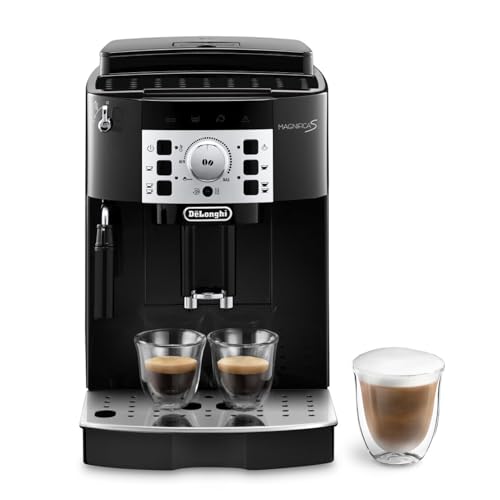
De’Longhi Magnifica S (ECAM22110B) — Best Classic Budget
The Magnifica S is for the value hunter who accepts a manual frothing wand and a dial-and-button panel in exchange for the lowest entry into genuine De’Longhi bean-to-cup brewing. Check availability — this veteran model’s stock comes and goes.
Strengths
- The proven compact brew group that made De’Longhi’s reputation
- Simple dial controls with nothing to learn and nothing to break
- Smallest footprint and longest parts history in the range
Trade-offs
- Manual panarello wand — milk drinks take practice and a pitcher
- No one-touch milk recipes; panel predates the touch era
- Availability fluctuates; if it is out of stock, the Magnifica Start is the modern successor
| Type | Superautomatic (manual milk) |
| Controls | Dial and buttons |
| Milk | Manual frothing wand |
| Brew group | Compact removable, rinse-clean |
The Magnifica S is the machine a generation of owners learned superautomatics on, and its virtues are durability and simplicity: the same removable brew group the whole range still uses, a grinder with honest adjustment, and controls a person can operate half-asleep. Its espresso — the core job — is recognisably the same cup its modern siblings pour.
Its compromises are equally clear: milk is manual, the panel is dated, and our verification found its availability intermittent, as befits a model in its second decade. Buy it when it is in stock at its classic value position; when it is not, the Start carries the same brief in modern dress. Either way, the S remains the benchmark every budget superautomatic is measured against.
Longevity data is the Magnifica S’s final argument: this platform has been in homes for well over a decade, its brew group is the same user-removable design the modern range inherited, and its wear parts remain stocked because the installed base is enormous. A buyer who finds it in stock at its classic position is buying the most de-risked superautomatic in the world. A buyer who finds it absent should not chase it at inflated prices — the Start is standing by with the same brief and a better milk system.
A final S note for the second-hand market: because the platform is ancient and understood, used Magnifica S machines are among the safest used purchases in espresso — provided the brew group rinses clean and the grinder runs true. Check those two things and the rest is consumables.
In one line: the Magnifica S is the platform’s founding document — still capable, still supported, still the value benchmark when stocked at its classic position, and the ancestor every other machine in this guide is quietly descended from.
Best for: value hunters comfortable frothing milk manually / Not suited for: one-touch latte households
Check the current price on Amazon
Comparison Table
| Pick | Badge | Key spec | Best for |
|---|---|---|---|
| De’Longhi Magnifica Evo | Best Overall | LatteCrema, 7 one-touch recipes | most households wanting one-touch milk drinks without flagship pricing |
| De’Longhi Eletta Explore | Best Premium / Cold Drinks | Hot + cold foam, 50+ recipes | households that drink iced and cold-foam drinks year-round |
| De’Longhi Dinamica Plus | Best Personalisation | 4 profiles, 24+ recipes | multi-user households with different drink preferences |
| De’Longhi Magnifica Start | Best Value Modern Pick | LatteCrema, 5 one-touch | new superautomatic buyers wanting the modern entry point |
| De’Longhi Dinamica (ECAM35020B) | Best No-Frills One-Touch | One-touch coffee, manual frother | black-coffee households wanting occasional manual milk |
| De’Longhi Magnifica S (ECAM22110B) | Best Classic Budget | Classic dial model, manual wand | value hunters comfortable frothing milk manually |
LatteCrema vs manual wand: the milk decision that defines your De’Longhi
LatteCrema machines (Evo, Dinamica Plus, Eletta, Start) froth automatically from a carafe that lives in your fridge: one touch, consistent foam, a weekly carafe wash. The system suits daily milk drinkers absolutely — it is the difference between a latte habit and a latte intention. Its costs are fridge space, a cleaning rhythm, and a machine price a tier higher.
Manual-wand machines (Dinamica, Magnifica S) ask you to steam milk in a pitcher — thirty seconds of skill per drink, no carafe to maintain, and complete control over temperature and texture once learned. Black-coffee households and occasional cappuccino drinkers lose nothing here; daily latte households will feel every morning. Choose by your real milk frequency, stated honestly.
What actually improves as you climb the range?
Not the espresso, mostly. The shared brew-group architecture means a Magnifica Start and an Eletta Explore pour recognisably related shots; blind, most drinkers would struggle to rank them. What climbs with price is everything around the shot: milk systems (manual → automatic → hot-and-cold), personalisation (none → profiles), interfaces (dial → touch → app), and recipe breadth.
This is liberating buying news: the entry machines are not serving inferior coffee as punishment. Buy the tier whose surrounding features match your household’s drinks and patience, and let the flagship money stay unspent unless cold foam or four profiles genuinely describe your life.
Living with a superautomatic: the real maintenance calendar
Daily: empty the drip tray and grounds bin when prompted, wipe the milk carafe spout. Weekly: pull the brew group and rinse it under the tap — thirty seconds, no tools — and wash the carafe components. Monthly-ish: run the descale cycle when the machine asks, with the filter stretching that interval considerably. That is the whole calendar, and it is lighter than the backflushing and gasket care a manual machine demands.
Bean choice is the hidden maintenance factor: very oily dark roasts gum grinders and brew groups in any superautomatic. Medium roasts are the range’s natural diet — kinder to the machine and, most owners find, better in the cup.
How good is superautomatic espresso, honestly?
Set the reference points. A well-set superautomatic — fresh medium-roast beans, grinder dialled, drinks tuned — produces espresso that comfortably beats pod coffee and chain-store drinks, and satisfies the large majority of home drinkers completely. Against a skilled barista on a manual machine with a competition grinder, it loses on clarity, sweetness range and texture — by margins that matter to hobbyists and pass unnoticed by most households.
The variables that move a superautomatic’s cup most are all free: bean freshness, grinder setting, strength set to maximum for straight espresso, and small drink sizes (superautomatic pucks are smaller than café baskets, so shorter drinks taste stronger and better). Owners who work those four levers drink markedly better coffee than owners who run factory defaults on stale beans — on the identical machine.
Sizing and placing a De’Longhi in a real kitchen
Measure three things before ordering: the counter depth (these machines are deeper than they look, and the water tank or bean hopper on several models needs clearance above or in front), the cupboard height above the counter where the machine will live, and the distance to a sink, because the drip tray and rinse water make daily trips. The Eletta-class flagships are substantial furniture; the Magnifica line was designed for ordinary kitchens and fits them.
Placement has a social dimension too: a superautomatic is a shared appliance, and it earns its cost fastest when placed where the household actually gathers in the morning — not exiled to a utility room for tidiness. Put it on the breakfast path, keep beans and cups within one step, and the machine becomes infrastructure rather than equipment.
Bean-to-cup economics: what a De’Longhi drink actually costs to run
The running-cost story of any superautomatic is beans, milk, filters and descaler — with beans dominating. A household drink uses a modest dose of whole beans and, for milk drinks, a measure of milk; even at specialty-roaster bean prices, the per-drink ingredient cost sits far below café pricing, which is the entire economic engine of the category. The machine pays for itself in displaced café visits at a rate determined by your household’s drink count, and for multi-drinker homes that rate is measured in months, not years.
The honest offsets: filters and descaler are recurring, a superautomatic uses power to stay ready (manageable with eco modes and auto-off), and beans bought in small fresh batches cost more per gram than warehouse sacks — a premium worth paying, because stale beans are the one economy that shows in the cup immediately.
Which De’Longhi for which household: a decision in four questions
One: does your household drink milk drinks daily? If not, the Dinamica or Magnifica S ends the search — do not buy a carafe to store in the fridge unused. Two: how many distinct drinkers with distinct tastes? Three or more argues for the Dinamica Plus’s profiles; one or two are served fully by the Evo or Start. Three: do iced and cold-foam drinks happen weekly in summer? A yes is the Eletta Explore’s entire case. Four: is this a first superautomatic? Then weight the modern panels (Start, Evo) over the classic dial machines — the learning curve you skip is real.
Answered honestly, those four questions select the machine with almost no residual doubt, which is the mark of a mature product range: the De’Longhi line is differentiated by use pattern rather than by quality tiers, and every model in this guide is the right answer to one of the patterns above.
De’Longhi vs the other superautomatic brands: why this range anchors the category
Shoppers comparing across brands will meet Philips LatteGo machines, Jura’s premium line and a field of newer entrants, and the honest comparison is this: De’Longhi’s advantage is range depth and service gravity. The same brew-group philosophy runs from the Magnifica S to the Eletta, parts and knowledge flow across the line, and the company’s scale means a ten-year-old machine remains a supported machine. Jura counters with refinement and a premium ownership model; Philips with the easiest milk hygiene in the business.
Within this guide’s scope — De’Longhi’s own range — the practical consequence is that no pick here is an orphan. Whichever badge you choose, the machine’s consumables, documentation and community scale with the largest espresso-maker installed base in the world. For an appliance category where the five-year experience is decided by support as much as by specification, that is not a footnote; it is close to the headline.
A last word on beans: the subscription that makes any of these machines shine
Every machine in this guide will taste exactly as good as the beans it is fed, and the single highest-leverage habit a new owner can adopt is a fresh-bean rhythm: buy in quantities your household uses within three to four weeks, from a roaster who prints roast dates, and store the hopper modestly filled rather than brimmed for a month. Medium roasts flatter the whole range; freshness flatters it more.
Treat the first month as calibration: pick one dependable blend, dial the grinder and your saved drinks around it, and only then start exploring. Owners who chase a new bean weekly never finish dialling in and conclude, wrongly, that the machine is inconsistent. The machine is a mirror — give it a steady reflection and it will show you a very good cup, every morning, at the press of a button.
How to Get the Best From a De’Longhi Superautomatic
Superautomatics reward a small amount of deliberate setup. Spend twenty minutes on these steps at unboxing and the machine repays you on every cup.
Step 1: Set water hardness and fit the filter
Test your tap water with the strip in the box and program the hardness honestly — this single setting governs the descale schedule and protects the machine’s insides. Fit the water filter if supplied and note its replacement rhythm in your phone.
Step 2: Dial the grinder finer than the factory default
Superautomatics ship set coarse for safety across bean types. Move one step finer, pull three shots (the grinder holds old grounds between adjustments), taste, and repeat until the shot runs honey-thick and tastes balanced. One step at a time, always while grinding.
Step 3: Tune your house drink, then save it
Adjust strength (dose), water volume and milk quantity on your main drink until it matches your taste — then save it to the recipe or profile if your model supports it. The saved button is the product; the factory defaults are just a starting guess.
Step 4: Establish the rinse rhythm from day one
Brew group out and rinsed weekly, carafe washed before it smells like a task, grounds bin emptied before the machine has to ask. Machines that are kept clean keep making clean-tasting coffee — most “my superautomatic tastes off” stories are hygiene stories.
Step 5: Run a weekly taste audit
Once a week, pull a straight espresso and drink it without milk or sugar. It takes thirty seconds and tells you everything: freshness of beans, grinder drift, brew-group cleanliness. Superautomatics drift quietly as beans age and seasons change; the weekly audit catches the drift while it is still a one-click adjustment.
If a drink suddenly tastes thin or sour, run the checklist in order: fresh beans, grinder setting drift, brew-group rinse overdue, descale prompt ignored. In nine cases out of ten it is one of those four, and all four are free to fix.
The superautomatic owner’s five-minute week
The entire maintenance burden of a De’Longhi superautomatic, done properly, is a five-minute weekly ritual: slide out the brew group and rinse it under the tap, empty and rinse the drip tray and grounds container, wash the milk carafe components if fitted, and wipe the chute where ground coffee dust gathers. Monthly, check the water filter’s age; when the machine requests descaling, run the cycle that week rather than that season.
Owners who keep this rhythm report the same experience across the range: years of uneventful, consistent drinks. Owners who skip it meet the same failure story — sour flavours from a dirty brew group, a grinder struggling with oily residue, a descale so overdue it takes two cycles. The machines are honest; they simply keep the score of the care they receive, in the cup.
Common Buying Mistakes
Feeding the machine oily dark-roast beans. Surface oil clogs grinders and coats brew groups in superautomatics. Medium and medium-dark dry beans are the correct fuel for the entire De’Longhi range.
Expecting to out-taste a café’s manual machine. A superautomatic sells consistency and convenience; its ceiling is a good shot, every time, by anyone. Buyers chasing the last ten percent of shot quality belong in the semi-automatic guide.
Ignoring the descale prompt for months. Scale strangles heating and flow slowly, then suddenly. The prompt is timed to your water settings — when it speaks, descale that week.
Leaving the milk carafe on the counter. The carafe is a fridge item between uses, full stop. Milk systems are hygienic when cold-stored and rinsed, and grim when warm-stored. This one habit decides most owners’ milk-system happiness.
Paying for profiles a one-person household will never use. Range pricing climbs with personalisation. Solo drinkers should let the Evo or Start keep the difference; profiles earn their money only in multi-drinker homes.
Final Recommendation
The Magnifica Evo is the De’Longhi superautomatic most households should buy — the right milk system, the right recipe set, the right interface, at the range’s balanced tier. The Dinamica Plus serves multi-drinker personalisation, the Eletta Explore owns cold drinks outright, the Magnifica Start modernises the entry point, and the Dinamica and Magnifica S remain the honest manual-milk values at either end of the range’s history.
Choose by milk first, household size second, features third — and whichever badge lands on your counter, feed it medium-roast beans and a weekly rinse. A De’Longhi kept that way will pour your mornings for years without ever asking you to become a barista.
Start here: De’Longhi Magnifica Evo (best overall), De’Longhi Eletta Explore (best premium / cold drinks), De’Longhi Dinamica Plus (best personalisation).
Keep exploring the cluster: Best Consumer Espresso Machines, Best Double Espresso Machines, Best Affordable De Longhi Espresso Machines, Best Affordable Espresso Machines, Best 10 Espresso Machines.
Frequently Asked Questions
What is the difference between the Magnifica and Dinamica lines?
Positioning and generation: Magnifica is the long-running core line (S → Start → Evo), Dinamica sits a step up in finish and features (Dinamica → Dinamica Plus), and Eletta is the flagship. Brew architecture is shared; milk systems, profiles and interfaces differentiate them.
Can a De’Longhi superautomatic make regular coffee?
Yes — the Coffee and Long recipes brew a longer, gentler cup than an americano, and most owners use them as their drip replacement. It is not filter coffee, but it is a satisfying mug in its own right.
How often do these machines need descaling?
It depends on your water hardness setting and filter use — typically every couple of months for hard water without a filter, stretching considerably with one. The machine prompts you; obey the prompt.
Why does my superautomatic espresso taste weaker than café espresso?
Usually dose and grind: set the aroma/strength to maximum and the grinder a step finer, and use fresh medium-roast beans. Superautomatics use smaller doses than café baskets, so strength settings matter.
Is the milk carafe dishwasher safe?
On LatteCrema models the carafe components are designed to be washable and the carafe stores in the fridge between uses. Follow your model’s manual for which parts go in the dishwasher.
Magnifica S or Magnifica Start — which should I buy?
The Start, if both are available at their usual positions: LatteCrema one-touch milk and modern controls are worth the step. The S wins only when its classic value pricing is in effect and you are content frothing manually.
Can I make drinks for guests easily on these machines?
That is their home ground: one-touch recipes, fast cycling between drinks and a carafe that returns to the fridge mean a round of cappuccinos for four is a few minutes of button presses. The Eletta and Evo handle guest duty best; manual-wand models slow the round down pleasantly or otherwise, depending on your hosting style.
Do De’Longhi superautomatics grind for each cup?
Yes — every drink starts with beans ground seconds before brewing, which is the core quality advantage over pre-ground and pod systems. The hopper keeps beans for days of drinks; for maximum freshness, fill it little and often.
Can these machines make hot chocolate or tea?
The hot-water function serves tea drinkers, and milk-equipped models can froth milk for hot chocolate made the simple way — cocoa stirred into textured hot milk. Dedicated chocolate programs live on other appliances; the De’Longhi contribution is excellent hot milk and water on demand.
What size are the drinks these machines make?
Espresso and coffee volumes are adjustable on every model here, and milk drinks scale within the carafe’s capacity. Owners typically tune one saved size per drink — the machine’s consistency makes that tuning a one-time job.


