Disclosure: airfryerkitchensupply.com is reader-supported. When you buy through links on our site, we may earn an affiliate commission at no extra cost to you.
Where to buy
The quickest way to buy any of the best double espresso machines recommended below is Amazon, where every linked pick can be checked for current availability in one place. Prices move with promotions and stock, so this guide never prints a fixed figure — use the links to check price on Amazon at the moment you shop.
- Breville Dual Boiler (BES920XL) — Best Overall Dual Boiler: check price on Amazon.
- Breville Oracle Touch (BES990) — Best Automated Dual Boiler: check price on Amazon.
- Diletta Bello+ — Best Value Simultaneous Brew & Steam: check price on Amazon.
- Breville Barista Pro (BES878) — Best Fast Double Shots: check price on Amazon.
- Breville Barista Express (BES870XL) — Best for Learning Doubles: check price on Amazon.
- Gaggia Classic Pro (RI9380) — Best Boiler Classic for Doubles: check price on Amazon.
The phrase ‘double espresso’ means two things in the coffee world, and the best double espresso machines serve both: a double shot — the standard 18-gram, two-ounce extraction that nearly every café drink is built on — and, for the households that need it, a machine that can brew and steam at the same time, which in practice means a dual boiler. This guide covers the keyword honestly on both readings: every pick pulls a proper, full-strength double as its native drink, and the top of the list is occupied by true dual-boiler machines for people making milk drinks back to back.
That framing matters because the cheap end of this search is polluted with a misunderstanding: any machine with a dual-wall ‘double’ basket technically pours two ounces, but a real double shot demands a full dose of fresh coffee, stable temperature through the extraction, and enough steam power to texture milk for two drinks without the machine falling behind. The six machines below were chosen against that real standard and verified against their Amazon listings through our API check.
The list runs from the Breville Dual Boiler — the benchmark home dual-boiler — through the Oracle Touch’s automated version of the same architecture, the heat-exchanger-style Diletta Bello+ that brews and steams simultaneously at a lower tier, and three outstanding single-heating-element machines (Barista Pro, Barista Express, Gaggia Classic Pro) whose double shots are beyond reproach and whose only compromise is sequencing: shot first, then steam, never both at once. Read the trade-offs with your household’s morning queue in mind.
One more clarification that will save some readers a purchase: if by ‘double’ you simply mean a machine that makes two cups at once, note that every machine here has a two-cup spout arrangement or splits a double — but splitting one double into two cups gives each drinker a single-strength shot, which is a different drink from two true doubles. Households of two espresso drinkers who both want full doubles should read this guide as a speed comparison: how fast can the machine produce the second full double, and can the milk keep up? The dual boilers answer ‘immediately’; the sequencing machines answer ‘in about a minute’. Both are honest answers — for different mornings.
In this guide
Quick Picks
Six double espresso machines made the cut. Each one carries a badge for the job it does best, and the same badge follows it into the full review further down the page.
- Breville Dual Boiler (BES920XL) — Best Overall Dual Boiler. Two boilers, PID temperature control and café-grade steam — the home machine that never makes you wait between shot and milk. Check price on Amazon.
- Breville Oracle Touch (BES990) — Best Automated Dual Boiler. Dual boilers with the barista automated: grinding, tamping and milk texturing handled, café drinks at a swipe. Check price on Amazon.
- Diletta Bello+ — Best Value Simultaneous Brew & Steam. An Italian E61 heat-exchanger machine with PID and a shot timer — brew and steam together, the old-school way. Check price on Amazon.
- Breville Barista Pro (BES878) — Best Fast Double Shots. ThermoJet speed and a fast, powerful steam wand — doubles in under a minute, milk right after, no boiler required. Check price on Amazon.
- Breville Barista Express (BES870XL) — Best for Learning Doubles. The pressure gauge teaches you what a real double looks like — the learning machine whose doubles are the curriculum. Check price on Amazon.
- Gaggia Classic Pro (RI9380) — Best Boiler Classic for Doubles. A real boiler and a 58mm commercial portafilter — doubles the café way, on the hobbyist’s favourite platform. Check price on Amazon.
How These Picks Were Chosen
Because this search is ambiguous, the method began with a definition: a qualifying machine must pull a true double — a full-dose, full-ratio extraction — as its standard drink, and was then ranked on how it handles the second half of the promise, steam for milk drinks, with simultaneity scored above sequencing and sequencing speed scored above raw feature lists. Every machine was verified by brand and model connection, with listing titles matched before any link was attached.
Dual boilers and the heat-exchanger machine lead because they are the only architectures that brew and steam truly simultaneously. The three single-element machines are included deliberately and labelled honestly: their doubles are excellent and their sequencing is a real, stated trade-off — because for one- and two-drink households, that trade-off costs seconds, not quality, and excluding them would make this guide worse, not purer.
Best double espresso machines — The Six Full Reviews

Breville Dual Boiler (BES920XL) — Best Overall Dual Boiler
The Dual Boiler is for the serious home barista making milk drinks daily, often for two or more people: espresso extraction and steam run simultaneously, at temperatures you control to the degree.
Strengths
- True dual boilers: brew and steam at the same time, with PID-stable shot temperature
- Professional steam pressure textures milk for two drinks back to back without recovery pauses
- Deep manual control — pre-infusion, temperature, shot timing — in a home-friendly package
Trade-offs
- No built-in grinder — a serious standalone grinder is a required partner purchase
- Premium pricing and a large footprint
- More machine than a straight-shot drinker will ever use
| Type | Dual boiler semi-automatic |
| Portafilter | 58mm |
| Temperature | PID control |
| Steam | Dedicated steam boiler, simultaneous with brewing |
This is the machine the double-espresso keyword is really about. Pull a double into one cup while the steam wand textures milk in the pitcher beside it, pour, and repeat for the next person with zero recovery delay — that simultaneity is the entire dual-boiler argument, and the BES920 executes it with temperature stability that rivals café equipment.
The details reward the enthusiast: low-pressure pre-infusion you can program, a shot clock, auto-start scheduling, and internals designed to be serviced. Pair it with a grinder worthy of it and the ceiling is your technique, full stop. For households whose mornings involve multiple milk drinks, nothing else in this guide is even the same category of tool.
Temperature surfing is a phrase Dual Boiler owners never learn, and that absence is the luxury. The PID-held brew boiler delivers the set temperature shot after shot, morning after morning, which makes dialling-in a property of the beans rather than a negotiation with the machine’s mood. Combined with volumetric consistency and a steam boiler that refills its pressure while you pour, the BES920 produces the most repeatable doubles in home espresso — repeatability being, in the end, what professionals actually buy.
The Dual Boiler’s auto-start timer deserves its line: waking to a machine already at temperature removes the last friction between a serious platform and a weekday morning. Serious hardware that respects the alarm clock gets used like an appliance, not admired like a project.
In one line: the Dual Boiler is what this search means when it means business — two boilers, total control, doubles and steam in genuine parallel. It is the benchmark, and benchmarks are not always the right purchase, but they are always the right reference.
Best for: serious home baristas making back-to-back milk drinks / Not suited for: solo straight-shot drinkers or tight budgets
Check the current price on Amazon
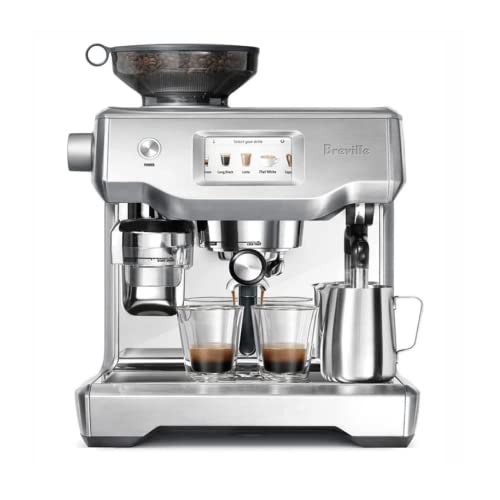
Breville Oracle Touch (BES990) — Best Automated Dual Boiler
The Oracle Touch is for the household that wants dual-boiler performance — doubles and milk simultaneously — without anyone learning to tamp or texture: the machine automates puck prep and steaming while you choose the drink on a touchscreen.
Strengths
- Dual boilers plus automatic grinding, dosing and tamping
- Automatic milk texturing to chosen temperature and foam style
- Touchscreen drink menu with customisable saved drinks
Trade-offs
- The most expensive machine in this guide
- Automation everywhere means technique never develops — a feature or a flaw, by temperament
- Large, heavy and service-dependent
| Type | Dual boiler, automated puck prep |
| Portafilter | 58mm |
| Milk | Automatic texturing wand |
| Interface | Touchscreen with saved drinks |
The Oracle Touch answers a specific prayer: café throughput and consistency for a household with no barista. Its dual boilers deliver the simultaneity this search promises, while the automated grind-dose-tamp and self-texturing wand remove every skill barrier between a sleepy human and a flat white. Doubles arrive properly extracted because the machine’s puck prep is more consistent than most humans’.
The trade is the hobby itself — there is nothing to master here, and the purchase price buys convenience at the highest tier in this guide. For busy multi-drinker households that measure value in mornings saved, the Oracle Touch is not an extravagance; it is the point of the category, fully realised.
Consistency across users is the Oracle’s hidden metric: in a household where three people make drinks, a manual machine produces three quality levels, and the Oracle produces one. Its automated puck preparation does not have tired mornings or rushed Tuesdays. For offices-at-home and multi-generational households, that flat quality curve is worth more than a higher peak — the worst drink of the week rises to meet the best, and the machine quietly becomes the household’s café of record.
The Oracle’s saved-drink customisation handles the household edge cases gracefully — the longer, weaker drink for one member, the extra-hot flat white for another — without anyone learning a workaround. Edge cases are where shared machines fail socially; the Oracle administrates them away.
In one line: the Oracle Touch is the dual-boiler promise with the barista included — the machine for households that want café output as a utility rather than a hobby, and are willing to pay the category’s top price to make mornings exactly that simple.
Best for: busy households wanting dual-boiler drinks without any technique / Not suited for: hobbyists who enjoy the manual craft
Check the current price on Amazon
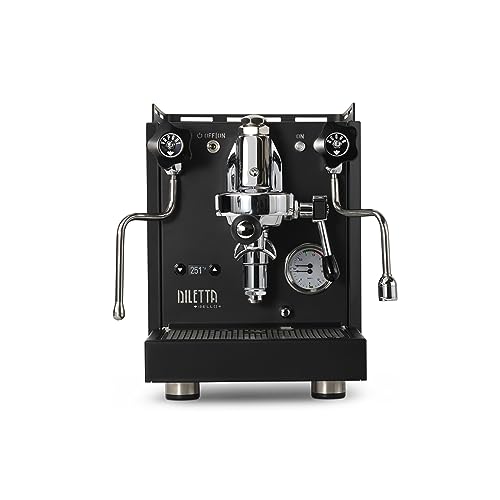
Diletta Bello+ — Best Value Simultaneous Brew & Steam
The Bello+ is for the traditionalist who wants simultaneity without dual-boiler pricing: its heat-exchanger architecture pulls a double while steaming, wrapped in hand-finished Italian E61 hardware.
Strengths
- Heat-exchanger design: brew and steam simultaneously, like café machines of the classic era
- E61 group head with PID temperature control and programmable pre-infusion
- Shot timer and hand-built Italian construction
Trade-offs
- Heat-exchanger temperature management has a learning curve (the cooling flush ritual)
- No built-in grinder — pair with a standalone
- Smaller brand presence than Breville in service and community
| Type | Heat exchanger semi-automatic |
| Group | E61 |
| Temperature | PID control |
| Extras | Shot timer, programmable pre-infusion |
Before dual boilers took over home espresso, the heat exchanger was how serious machines did two things at once — one boiler, steam always ready, brew water flash-heated through a coil. The Bello+ executes that classic architecture with modern manners: PID control steadies the temperature, the E61 group’s thermal mass steadies the shot, and pre-infusion is programmable rather than folklore.
Ownership asks a little ritual — a brief cooling flush before a shot after idle steaming — and rewards it with doubles and milk in true parallel. For the buyer who wants Italian hardware, simultaneous operation and a price below the dual-boiler flagships, the Bello+ is the connoisseur’s value pick.
The E61 group deserves its mythology for a practical reason: its mass of brass holds the extraction temperature steady through the shot in a way lightweight groups cannot, and its mechanical pre-infusion is gentle on the puck in a way that forgives small distribution errors. Doubles from the Bello+ have a forgiving sweetness that makes it an unusually kind machine for intermediate baristas — your technique gets graded on a curve while the hardware covers for you.
The Bello+’s shot timer, a small dial of a feature, changes behaviour: owners actually watch their extractions and adjust, because the number is in front of them. Machines that display time produce better doubles than identical machines that hide it — feedback is a feature.
In one line: the Bello+ is the traditionalist’s shortcut past dual-boiler pricing — an E61 heat exchanger that brews and steams together with Italian hardware manners, asking only a small ritual in exchange for a large saving.
Best for: traditionalists wanting simultaneous brew and steam below dual-boiler prices / Not suited for: set-and-forget buyers who dislike ritual
Check the current price on Amazon
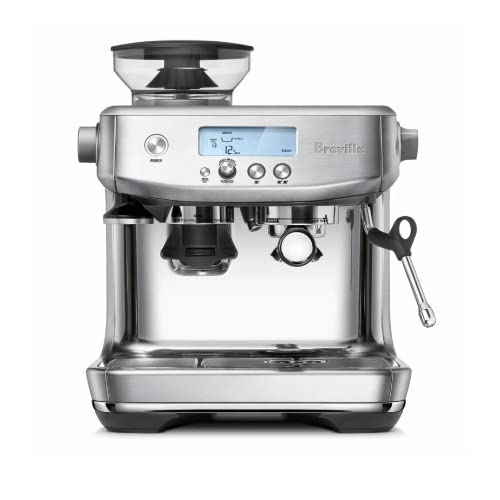
Breville Barista Pro (BES878) — Best Fast Double Shots
The Barista Pro is for the impatient skilled hand: it heats in about three seconds, pulls a proper double from its built-in grinder, and its steam wand is the strongest in the single-element class — sequencing instead of simultaneity, at high speed.
Strengths
- ThermoJet system ready almost instantly — doubles on demand, no warm-up planning
- Fast, dry steam makes milk for a double-based latte in well under a minute
- Intuitive interface with grind and shot feedback for quick dialling-in
Trade-offs
- Single heating element: brew and steam still take turns
- Built-in grinder is the long-term ceiling, as with all all-in-ones
- 54mm ecosystem rather than 58mm
| Type | Semi-automatic with built-in grinder |
| Heating | ThermoJet, ~3-second heat-up |
| Portafilter | 54mm |
| Steam | High-velocity wand |
The Pro makes the honest case against boiler envy: if your household drinks one or two milk drinks at a time, sequencing at ThermoJet speed costs you perhaps forty seconds over a dual boiler — and buys you instant readiness every other hour of the day. Its doubles are full-dose, properly extracted shots; nothing about the cup confesses the architecture.
It is also the best dialling-in teacher in the Breville line, with clear feedback and a grinder that responds predictably. Households graduating from the Express often land here; households feeding a brunch queue should look at the dual boilers above.
The Pro’s steam wand deserves measurement-grade praise: its velocity and dryness texture milk for a double-based drink in the time a boiler machine spends thinking about it, which collapses the sequencing penalty this guide keeps mentioning. For the common real-world case — two lattes, made by one person, a few minutes apart in appetite — the Pro’s total elapsed time sits within a breath of the dual boilers’. Architecture is a means; the clock is the verdict.
The Pro’s interface shows grind time and shot progress with a clarity that shortens the dialling-in of a new bag to a couple of shots. For households that rotate beans often, that feedback loop is the difference between exploring roasters and fearing change.
In one line: the Pro is the speed answer — doubles in seconds from cold, steam with real authority, sequencing so fast the dual boilers only win when the queue gets long. For one- and two-drink households, it is the smart money in this guide.
Best for: skilled one-or-two-drink households valuing speed / Not suited for: back-to-back drinks for a crowd
Check the current price on Amazon

Breville Barista Express (BES870XL) — Best for Learning Doubles
For the beginner whose goal is mastering the double shot itself, the Express remains the best classroom: dual-wall baskets to start, single-wall to graduate, and a gauge that shows extraction happening.
Strengths
- Analogue pressure gauge — the single best double-shot teaching tool in the category
- Both basket types included for the assisted-to-manual progression
- The largest owner community and recipe base to learn from
Trade-offs
- Thermocoil sequencing: doubles then steam, in turns
- Grinder ceiling arrives as skill grows
- Slower heat-up than the ThermoJet models
| Type | Semi-automatic with built-in grinder |
| Heating | Thermocoil |
| Portafilter | 54mm, dual + single wall baskets |
| Feedback | Analogue extraction gauge |
Every other machine in this guide assumes you want the drink; the Express assumes you want to understand the drink. Doubles pulled on it are the full standard — 18-gram doses, real ratios, real timing — and the gauge turns each one into a lesson about grind and distribution that transfers to any machine you will ever own.
As a pure appliance it is outpaced by the Pro above and out-simultaneitied by the dual boilers. As the first chapter of a long espresso life, at a mid tier with everything in the box, it remains the recommendation that has launched more home baristas than everything else combined.
For doubles specifically, the Express’s dual-wall basket is a more thoughtful teaching tool than it gets credit for: it lets a beginner produce a correctly timed, correctly pressured double on day one — learning the ritual and the taste target — while the single-wall basket waits in the drawer for the week the grinder and the hands are ready. Machines that let you succeed while you learn are rare in any craft; in espresso, this progression is the Express’s founding insight.
The Express remains the only machine here whose gauge can teach a complete beginner what extraction pressure looks like as it happens. Every other teaching tool in the category is, in some sense, an imitation of that simple dial.
In one line: the Express teaches the double shot better than any machine ever sold for home use, and its doubles — full-dose, gauge-guided, honestly extracted — need no apology beside the flagships. It is the first chapter of most espresso stories for a reason.
Best for: beginners who want to master the double shot properly / Not suited for: households needing simultaneous steaming
Check the current price on Amazon

Gaggia Classic Pro (RI9380) — Best Boiler Classic for Doubles
The Classic Pro serves the tinkerer whose doubles are a craft: café-format hardware, a boiler’s thermal steadiness, and a modification path that can add the temperature control the factory leaves out.
Strengths
- 58mm commercial portafilter — café baskets, tampers and technique all transfer
- Stainless boiler gives doubles a thermal steadiness thermocoils cannot match
- Repairable, modifiable, and supported by a devoted community
Trade-offs
- Single boiler: doubles and steam strictly in sequence, with temperature transitions between
- No grinder, no gauge — instrumentation is you
- Stock steam power is the weakest in this guide
| Type | Semi-automatic, single boiler |
| Portafilter | 58mm commercial |
| Boiler | Stainless steel |
| Controls | Rocker switches |
Judged purely on the double shot — this search’s core — the Classic Pro is quietly elite: a boiler-fed 58mm group is the original café formula, and its extractions have a steadiness that instant-heating systems envy. Owners who drink doubles straight, or as americanos, get café grammar at a home price.
The milk story is the compromise: one boiler means steam waits for brew and the wand is modest, so latte queues form slowly. Modders close much of the gap over time; stock buyers should choose it for the shot, not the foam. As the traditionalist’s double machine, it earns its place.
The Classic Pro’s doubles have one more advocate worth hearing: the café aftermarket. Because its 58mm ecosystem is the world standard, every serious basket, distribution tool and precision accessory is available to it — meaning the ceiling of its doubles rises with the entire industry’s accessory progress, not just Gaggia’s. A machine bought this year can absorb next year’s innovations through its portafilter. Few consumer products offer that kind of forward compatibility.
The Classic Pro’s boiler gives its doubles one more subtle gift: thermal recovery across a morning’s spaced-out shots is graceful, without the temperature sag that instant systems can show on their third quick drink. Slow mornings are its natural habitat.
In one line: the Gaggia is the double shot in its original grammar — boiler, 58mm, patience — and for drinkers who take their doubles straight and their hobbies seriously, its compromises all live in the milk, where they may never be missed.
Best for: straight-double drinkers and hobbyist tinkerers / Not suited for: milk-drink queues
Check the current price on Amazon
Comparison Table
| Pick | Badge | Key spec | Best for |
|---|---|---|---|
| Breville Dual Boiler (BES920XL) | Best Overall Dual Boiler | Dual boiler, 58mm, PID | serious home baristas making back-to-back milk drinks |
| Breville Oracle Touch (BES990) | Best Automated Dual Boiler | Dual boiler, auto tamp + milk | busy households wanting dual-boiler drinks without any technique |
| Diletta Bello+ | Best Value Simultaneous Brew & Steam | E61 heat exchanger, PID | traditionalists wanting simultaneous brew and steam below dual-boiler prices |
| Breville Barista Pro (BES878) | Best Fast Double Shots | ThermoJet, fast steam | skilled one-or-two-drink households valuing speed |
| Breville Barista Express (BES870XL) | Best for Learning Doubles | Gauge-guided, 54mm | beginners who want to master the double shot properly |
| Gaggia Classic Pro (RI9380) | Best Boiler Classic for Doubles | 58mm, stainless boiler | straight-double drinkers and hobbyist tinkerers |
Double shot vs dual boiler: two meanings, one keyword
A double shot is a recipe: roughly 18 grams of coffee yielding about 36 grams of espresso — the standard unit of café drinks worldwide. Every machine in this guide, and frankly most serious consumer machines, is built around it; “single” shots are the specialty case in 2026, not the default. If your interest in this search is simply machines that make proper doubles, the whole list qualifies, and you should choose on other grounds.
A dual boiler is an architecture: separate brew and steam boilers allowing simultaneous extraction and steaming. It matters only when milk drinks queue up — two lattes for two people, every morning, on a schedule. The honest self-test: count your household’s simultaneous milk drinks per week. Under five, sequencing machines serve you perfectly; over ten, dual boiler (or the Bello+’s heat exchanger) stops being a luxury.
Why dose and ratio matter more than machine price
A double is defined by numbers you control on any machine here: dose in, yield out, time through. An 18-gram dose pulled to 36 grams in 25–30 seconds will taste balanced on a Gaggia or a Dual Boiler alike; a sloppy 14-gram dose pulled long will taste thin on the most expensive machine in this guide. The machine’s job is stability — temperature and pressure held steady while you execute the recipe.
This is why the guide ranks architecture and control (PID, boiler mass, pre-infusion) above ornament. It is also why a scale — the cheapest accessory in espresso — improves doubles more than any machine upgrade: weigh the dose, weigh the yield, and the recipe stops being folklore.
Steam power: the second half of the double promise
Most doubles are destined for milk, which makes steam the silent specification of this category. Judge it by recovery and dryness: can the machine texture milk for a second drink immediately after the first, and is the steam dry enough not to waterlog the texture? Dual boilers answer yes by construction; the Barista Pro’s wand answers yes by velocity within its sequencing limits; the Gaggia answers “eventually”, which is fine for one drink and limiting for four.
Match steam to your real queue and the category sorts itself. Solo drinkers over-buy steam constantly in this category — the money saved by stepping down from a dual boiler buys a superb grinder, which improves every single double you will ever pull.
Making doubles for a crowd: workflow beats hardware
Six guests want lattes. The dual-boiler owner wins on paper — but the practiced sequencing-machine owner who grinds the next dose while the current shot pulls, keeps milk pitchers staged, and works in a grind-pull-steam-grind rhythm will finish within a drink of them. Workflow is a multiplier on any hardware in this guide: stage cups warmed, beans dosed ahead where the grinder allows, milk measured into pitchers before the first shot.
The honest hardware threshold arrives around four back-to-back milk drinks, regularly. Below it, sequencing plus workflow is genuinely sufficient and the money saved belongs in the grinder. Above it, simultaneity stops being a luxury and becomes the difference between hosting and performing kitchen labour while your guests socialise without you.
The grinder pairing guide for double machines
Machines without built-in grinders (Dual Boiler, Bello+, Gaggia) make the pairing decision explicit, so make it well: the grinder must adjust finely enough that one step changes shot time by seconds rather than eras, retain little stale coffee between shots, and dose consistently enough that your 18 grams is 18 grams. Single-dose grinders suit households pulling a few doubles a day; hopper grinders suit queues.
For the all-in-one machines (Barista Pro, Express), the built-in grinder is the correct starting point and the honest ceiling: when your doubles start demanding more than it can give — usually visible as an inability to go fine enough for light roasts — a standalone grinder beside the machine is the upgrade, and both Brevilles continue happily as brewers. Budget for that day if you suspect it is coming; it is a graduation, not a failure.
Reading double-shot quality: crema, time and the taste triangle
A good double announces itself three ways. Visually, the extraction flows like warm honey, tiger-flecked rather than pale or tar-black. By the clock, it lands in the 25–30 second window at the target ratio. By taste, it balances the triangle — sweetness at the centre, acidity bright rather than sour, bitterness as a frame rather than a flavour. When one leg fails, the fix is systematic: sour and fast means grind finer or dose up; bitter and slow means coarser; hollow at correct time means the beans, not the machine.
Every machine in this guide can produce that double; the differences are in how much help they give you on the way — gauges, timers, PID stability, assisted tamping. Learn to read the three signals and you become portable across all of them, which is the real asset a home barista accumulates.
When to split a double and when to pull two
Splitting one double across two cups halves each drinker’s dose — the right call for small milk drinks, afternoon coffees and anyone moderating caffeine, and the wrong call when a guest ordered “a latte” expecting café strength. Pulling two full doubles doubles the workflow on sequencing machines and barely registers on dual boilers, which is why the architecture question and the splitting question are secretly the same question.
A household standard settles it: decide your default (most café-drinking households choose full doubles for milk drinks, splits for straight shots after dinner), set the grinder and cups to match, and let exceptions announce themselves. Consistency of the default is what makes a home espresso routine feel like a café’s — unremarkable, repeatable, right.
The home café corner: setting up for doubles as a daily ritual
Machines that make doubles daily deserve a station, not a parking spot. The working layout is a triangle: machine at the centre, grinder within one step (built-in owners have this solved), knock box and scale at the dominant hand, cups stored above where their warmth can be borrowed from the machine’s top tray. Milk lives one fridge-door swing away. That geography, once set, turns a double from a procedure into a ninety-second ritual.
Add the small disciplines that keep the ritual pleasant: a cloth that lives at the machine for the wand, a brush for the grinder chute, beans in an airtight canister rather than a sunlit hopper if your kitchen is bright. None of it is precious; all of it is the difference between a hobby that integrates into a kitchen and one that slowly colonises it. The machines in this guide reward the household that sets the stage once and then simply cooks.
How to Pull a Perfect Double Shot (and Steam for Two)
The double is espresso’s unit of account. Master this routine and every drink in the café repertoire — latte, cappuccino, flat white, americano — is a variation on it.
Step 1: Dose 18 grams, weighed, every time
Grind directly into the basket on a scale, or weigh the portafilter before and after. Eighteen grams is the standard double dose for 58mm baskets; 54mm Breville baskets take a similar dose in their double basket. Consistency here is what makes every later adjustment meaningful.
Step 2: Distribute, level, tamp once — firmly and flat
Break up clumps with a distribution tool or a gentle tap, level the surface, and tamp straight down with even pressure. The tamp’s job is a flat, uniform bed; channeling — the shot spurting or blonding early — is a distribution failure, not a machine failure.
Step 3: Pull to ratio on a timer
Start the pump and the timer together. You are watching for about 36 grams of espresso — roughly two ounces by volume with crema — in 25–30 seconds. Too fast: grind finer. Too slow: coarser. Change one click, pull again. On dual boilers, your milk can be steaming during this same window.
Step 4: Texture milk while the shot settles (or right after)
Purge the wand, submerge the tip just under the surface to introduce air for the first seconds, then sink it to heat to 60–65°C with a rolling vortex. The target is glossy, pourable microfoam — wet paint, not bubble bath. Knock, swirl, pour promptly.
Step 5: Split or duplicate — decide per drink, not per habit
For two drinkers, choose consciously: split one double for two lighter drinks, or pull two full doubles for the real thing. Make the decision a household standard rather than a per-morning negotiation, set your grinder and workflow to it for a month, and judge the results by the clock and the cup together.
Taste the double straight once a week, even if you always drink milk drinks. It is the only honest diagnostic you have: sour means under-extracted, bitter means over, and balanced means your machine, grinder and hands are all doing their jobs.
Caring for boilers, groups and steam systems
Dual boilers and heat exchangers ask for the same discipline as any serious machine, with one addition: more hot water volume means more scale potential, so water quality moves from recommendation to requirement. Filtered water, correct hardness settings, and descaling on the manufacturer’s schedule protect boilers that are expensive to service. Backflush the group with water daily if you pull daily, and with detergent on the rhythm your manual sets.
Steam wands live or die by the two-second rule: wipe and purge immediately after every use, because milk bakes onto hot steel with surprising permanence. Group seals and shower screens are annual consumables on hard-working machines. None of this is burdensome — it totals minutes a week — but on machines of this class, maintenance is the difference between a decade of café performance and a slow decline into a repair bill.
Common Buying Mistakes
Confusing a dual-wall “double” with a true double shot. Pressurized baskets fake crema with any coffee, including stale pre-ground — fine for beginners, but a true double is fresh coffee, full dose, real extraction. Know which one your machine is pouring.
Buying a dual boiler for a one-latte household. Simultaneity you never use is the most expensive feature in espresso. Sequence-speed machines plus a great grinder serve small households better for the same money.
Skipping the grinder to afford the machine. On the Dual Boiler and Bello+ especially, the grinder is half the system. A flagship machine fed by a blade grinder produces expensive disappointment.
Pulling doubles by volume instead of weight. Crema inflates volume readings wildly. A small scale under the cup turns ratio into a number you can repeat — the cheapest consistency upgrade available.
Letting the second drink wait while the machine recovers. If your household regularly queues milk drinks, that wait is the specification to shop on. It is exactly what dual boilers and heat exchangers exist to eliminate.
Final Recommendation
For the full double promise — extraction and steam together, at temperature, back to back — the Breville Dual Boiler is the benchmark and the Oracle Touch its automated twin. The Diletta Bello+ delivers simultaneity the classic Italian way for less. Below them, the Barista Pro, Barista Express and Gaggia Classic Pro pull doubles of unquestionable quality in sequence, and for most households that sequence costs seconds rather than satisfaction.
Decide by your morning queue, then by your appetite for craft. Count the milk drinks, be honest about the count, and the right machine in this guide names itself.
Start here: Breville Dual Boiler (BES920XL) (best overall dual boiler), Breville Oracle Touch (BES990) (best automated dual boiler), Diletta Bello+ (best value simultaneous brew & steam).
Keep exploring the cluster: Best Consumer Espresso Machines, Best Delonghi Superautomatic Espresso Machines, Best 10 Espresso Machines, Best 1 Group Semi Automatic Espresso Machines, Best Home Espresso Machines.
Frequently Asked Questions
What exactly is a double espresso?
A double shot: about 18 grams of ground coffee extracted to roughly 36 grams (two fluid ounces) of espresso in 25–30 seconds. It is the standard base for nearly all café milk drinks and what most home machines are designed around.
Do I need a dual boiler to make two lattes?
No — you need one only to brew and steam at the same moment. Single-element machines make two lattes in sequence perfectly well; the dual boiler saves a minute or two per round and shines when the queue is daily and long.
Which machine here makes the best-tasting double?
At equal skill, the Dual Boiler and Bello+ offer the most temperature control, which shows in the cup. In practice, the grinder and the beans decide more than the machine — a well-fed Barista Express out-pulls a badly fed flagship.
Can these machines pull single shots too?
Yes, with single baskets and roughly half the dose — but most home baristas pull a double and split it or drink it whole, because singles are fussier to dial in. The double is the native language of every machine here.
Heat exchanger or dual boiler — which is better?
Dual boiler gives independent, precise temperature control for both jobs. A heat exchanger is simpler, usually cheaper, and steams powerfully, with a small temperature-management ritual. Both brew and steam simultaneously; the choice is precision versus classic simplicity.
What grinder should pair with the Dual Boiler or Bello+?
A dedicated espresso grinder with fine, step-less or micro-stepped adjustment and low retention. Budget it as a genuine half of the system — the machines assume it, and their doubles depend on it.
Is a double shot stronger than two single shots pulled separately?
They are the same total coffee and liquid; the double is simply the standard way of producing it in one extraction. Two separately pulled singles can taste marginally fresher for the second cup, at double the workflow — most households pull doubles and split or serve whole.
How many doubles can these machines make in a row?
The dual boilers and the Bello+ are built for continuous service within home reason. The sequencing machines handle three to four milk drinks comfortably before heat management becomes noticeable; beyond that, a short rest restores them. Match the machine to your real queue, not your largest imaginable brunch.
Why do cafés always pull doubles instead of singles?
Consistency and economics: the double is the dose baskets, grinders and recipes are standardised around, it extracts more forgivingly than a small single dose, and one extraction serving two drinks is efficient. Home machines inherited the standard wholesale — which is why this entire guide treats the double as the native drink.
How much counter space does a dual boiler setup need?
Plan for the machine plus a grinder beside it — roughly the footprint of a large microwave and its neighbour — plus working room in front for tamping and milk. The Oracle Touch consolidates the grinder into the machine; the Dual Boiler and Bello+ ask for the full two-unit station.

