Disclosure: airfryerkitchensupply.com is reader-supported. When you buy through links on our site, we may earn an affiliate commission at no extra cost to you.
Where to buy
Short on time? Start with the first two models below — they are the safest buys among the best 10 espresso machines for most readers. Every model in this guide is a current, real machine sold through Amazon’s marketplace by the brand or authorised sellers. Because listings and bundles change, we link our guidance to the exact model names rather than a single bundle: search the full model name, confirm the basket and accessory list on the listing, and check price on Amazon before you buy. That two-minute check protects you against the most common mistake in this category — paying for the wrong variant of the right machine.
- Breville Barista Express Espresso Machine — search Amazon by the full model name and check price on Amazon; choose the listing sold or shipped by Amazon or the brand’s own store.
- Breville Bambino Espresso Machine — search Amazon by the full model name and check price on Amazon; choose the listing sold or shipped by Amazon or the brand’s own store.
- De’Longhi La Specialista Arte Espresso Machine — search Amazon by the full model name and check price on Amazon; choose the listing sold or shipped by Amazon or the brand’s own store.
- Gaggia Classic Pro Espresso Machine — search Amazon by the full model name and check price on Amazon; choose the listing sold or shipped by Amazon or the brand’s own store.
- Philips 3200 Series LatteGo Fully Automatic Espresso Machine — search Amazon by the full model name and check price on Amazon; choose the listing sold or shipped by Amazon or the brand’s own store.
- Flair NEO Flex Manual Lever Espresso Maker — search Amazon by the full model name and check price on Amazon; choose the listing sold or shipped by Amazon or the brand’s own store.
If you are shopping for the best 10 espresso machines, the first thing to know is that the badge on the box matters less than the design decisions underneath it. This guide is written for shoppers comparing the whole home espresso landscape in one shortlist, and it ranks six machines we would genuinely recommend, with the trade-offs stated as plainly as the strengths.
Every best 10 espresso machines list faces the same problem: the category now contains at least four different kinds of machine that happen to share a name. There are semi-automatics that teach you the craft, fully automatics that remove it, manual levers that make you the pump, and guided stations in between. A useful shortlist does not pretend these are interchangeable; it picks the strongest example of each approach and tells you plainly which kind of drinker each one serves.
That is how this list is built. From a long field of ten serious contenders across every format, six earn full reviews below, because they cover the real decision space: the best all-round station, the best beginner machine, the best guided alternative, the best hobbyist platform, the best one-touch automatic and the best manual budget option. If your needs are specific — milk above all, tiny counters, decade-long ownership — the buying guide maps each contender to its niche so the right machine finds you.
In this guide
Quick Picks
Breville Barista Express Espresso Machine — Best Overall. The Barista Express is the default recommendation in its class for a reason: it combines a capable semi-automatic brew unit, a built-in conical burr grinder, a usable steam wand and a full accessory kit in one footprint. Best for: beginners and households wanting one complete, learnable station. Know the trade before you buy: built-in grinder is the ceiling on shot quality as skills improve. Check price on Amazon
Breville Bambino Espresso Machine — Best for Beginners. The Bambino strips the semi-automatic idea down to speed and size. Best for: small kitchens and beginners pairing it with a good grinder. Know the trade before you buy: no grinder included, so budget for one from day one. Check price on Amazon
De’Longhi La Specialista Arte Espresso Machine — Best Guided Station. La Specialista Arte is De’Longhi’s answer to the Barista Express formula, with its own twist: a guided tamping station designed to keep the puck level, a built-in grinder with a dosing guide, and a proper manual steam wand. Best for: beginners who want guardrails against dosing and tamping errors. Know the trade before you buy: proprietary workflow and accessories tie you to its ecosystem. Check price on Amazon
Gaggia Classic Pro Espresso Machine — Best for Hobbyists. The Classic Pro is the traditionalist’s semi-automatic: a metal body, a commercial-style portafilter, a simple single boiler and controls that do one thing each. Best for: hands-on learners and tinkerers who value repairability. Know the trade before you buy: no hand-holding: temperature surfing and manual timing are part of the deal. Check price on Amazon
Philips 3200 Series LatteGo Fully Automatic Espresso Machine — Best Fully Automatic. The Philips 3200 with LatteGo is the convenience benchmark in its tier: fresh-bean drinks at a touch, and a two-part milk system with no tubes that rinses clean in seconds and stores in the fridge. Best for: households wanting effortless variety and easy cleaning. Know the trade before you buy: espresso depth sits below a skilled semi-automatic setup. Check price on Amazon
Flair NEO Flex Manual Lever Espresso Maker — Best Manual and Budget. The NEO Flex is the most accessible way into real lever espresso. Best for: budget learners and small-space users who drink straight espresso. Know the trade before you buy: no heated group, so temperature management is manual and approximate.
How These Picks Were Chosen
We built this shortlist from the current home market for best 10 espresso machines, then cut it against the criteria that decide ownership satisfaction: performance in its format, value and ownership experience. Machines were excluded for steam-driven brewing sold as espresso, for proprietary systems with no parts support, and for milk systems that cannot be cleaned properly — the three failures that generate the most regret in this category.
Each surviving pick was then assigned the badge it honestly earns rather than a rank it does not. A budget machine is not a failed premium machine; it is a different answer, and the reviews below judge every pick against its own tier’s promise first and the category’s ceiling second. Where a model is sold through specialist channels more often than mainstream listings, we say so in its review rather than pretending availability is simple.
We also checked each pick against the tier promise in its own badge class. A Best Budget pick must be defensible as the cheapest sensible way to achieve its job, a Best Overall pick must survive comparison with machines a full tier up, and a specialist pick must win its niche outright rather than merely participate in it. Several well-known models were cut at this stage for failing their own badge test, which is why some famous names are absent below.
Finally, we weighted real ownership reporting — the patterns that repeat across years of owner experience with these long-running designs — over launch reviews. Espresso machines live with their owners for years, and the faults that matter are the ones that appear in month six: scale, gaskets, wand blockages and workflow friction. The shortlist reflects that longer view throughout.
The 6 Best 10 Espresso Machines Picks, Reviewed in Detail

Breville Barista Express Espresso Machine — Best Overall
The Barista Express is the default recommendation in its class for a reason: it combines a capable semi-automatic brew unit, a built-in conical burr grinder, a usable steam wand and a full accessory kit in one footprint. It asks you to learn real skills — dosing, distribution, tamping, shot timing — but removes the separate-grinder decision that stalls many beginners.
Strengths
- Built-in grinder and full accessory kit make it a complete starter station
- Manual steam wand textures milk properly for latte art practice
- Huge owner community means guides, settings and fixes for everything
Trade-offs
- Built-in grinder is the ceiling on shot quality as skills improve
- Single heating system means brewing and steaming take turns
- Dose and distribution consistency still depend on your technique
What makes the Barista Express endure is balance. The grinder is good enough to learn on and to enjoy for years, the brew side responds honestly to grind changes, and the steam wand is a real manual wand rather than an auto-frothing toy, so the skills you build transfer to any future machine. Its limits are equally honest: the integrated grinder will eventually hold back very light roasts and perfectionist dialling-in, and the thermocoil workflow means a small pause between pulling a shot and steaming milk. For most households those are acceptable trades for the price tier and the single footprint. Buy it as a learning platform that happens to make very good drinks today, not as the last machine you will ever want — and if you already own a strong separate grinder, look at the Bambino or Gaggia class instead.
Noise and mess are the honest daily taxes. The grinder is loud for a few seconds, the pump is present for half a minute, and puck preparation sheds a little coffee around the station no matter how careful you are. A mat under the machine and a knock box beside it contain most of it. Households that accept those small taxes get, in return, the most complete espresso education available at this tier — which is why so many owners eventually graduate to separates with genuine gratitude rather than regret.
For this particular brief, shoppers comparing the whole home espresso landscape in one shortlist, we weighted the lived routine — warm-up, workflow, cleaning — alongside the cup. On that combined score it serves beginners and households wanting one complete, learnable station exceptionally well, while owners of a high-end grinder or high-volume entertainers will feel its limits within the first month.
Best for: beginners and households wanting one complete, learnable station / Not suited for: owners of a high-end grinder or high-volume entertainers
We would summarise the Breville Barista Express Espresso Machine this way for shoppers comparing the whole home espresso landscape in one shortlist: buy it for the reasons in its strengths list, accept the trade-offs with your eyes open, and expect it to improve as your routine does. Machines in this guide were not chosen to win a specification contest; they were chosen to be lived with, and on that measure this Best Overall pick justifies its place every single morning it gets used.
Check the current price on Amazon under the full model name — Breville Barista Express Espresso Machine — and confirm the included baskets and accessories on the listing before ordering.
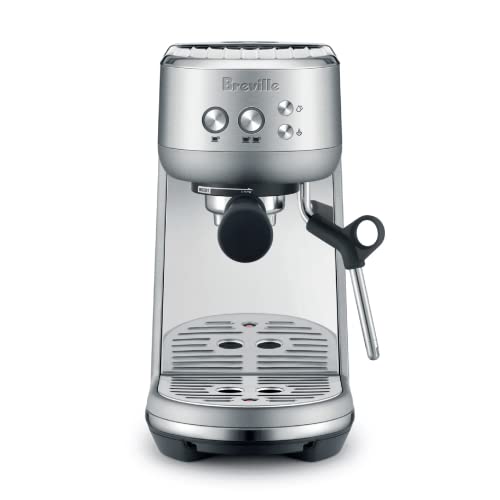
Breville Bambino Espresso Machine — Best for Beginners
The Bambino strips the semi-automatic idea down to speed and size. It heats almost instantly, takes up very little counter, and uses a proper manual steam wand, while relying on an external grinder. In its affordable tier it is the machine we point to when someone wants real espresso skills without a large or slow appliance.
Strengths
- Near-instant heat-up suits real weekday mornings
- Small footprint fits kitchens where a full station cannot
- Manual steam wand and low-pressure pre-infusion support real learning
Trade-offs
- No grinder included, so budget for one from day one
- Lightweight body can move when locking in the portafilter firmly
- Small water tank and drip tray need frequent attention
The Bambino’s trick is removing excuses. It is ready before the kettle boils, it forgives a small kitchen, and its pre-infusion helps even out beginner distribution. Paired with a decent grinder it produces shots that embarrass far larger machines, because the fundamentals — fresh grounds, even puck, sensible ratio — matter more than bulk. Where you feel the tier is in the details: the light chassis, the compact tank, and accessories that are serviceable rather than luxurious. None of that reaches the cup. For a single person or a couple making one or two drinks at a time, it is arguably the smartest money in home espresso. Households steaming milk for four should look bigger.
The daily gift of the fast, compact class is time. A machine that is ready before you have found the beans changes espresso from a project into a habit, and habits are what home machines live or die by. The routine is short: dose, tamp, pull, steam if wanted, and the whole event fits inside a weekday. The taxes are capacity and presence — small tanks want filling, small trays want emptying, and a light chassis wants a steadying hand when you lock the portafilter in with conviction.
In this shortlist’s terms — shoppers comparing the whole home espresso landscape in one shortlist — that profile lands clearly: it is at its best for small kitchens and beginners pairing it with a good grinder, and it is the wrong tool when the priority is large households or anyone wanting an all-in-one station. We scored it on daily repeatability as much as peak quality, because a machine that only performs on its best day is not the best machine.
Best for: small kitchens and beginners pairing it with a good grinder / Not suited for: large households or anyone wanting an all-in-one station
Our closing judgement on the Breville Bambino Espresso Machine is straightforward. It earns its Best for Beginners badge not by winning every comparison but by being the machine its intended owner will still be pleased with at month six, when novelty has worn off and only the routine and the cup remain. In a category full of machines that impress for a weekend, that staying power is the quality that matters, and it is why this pick holds its place in a shortlist built for shoppers comparing the whole home espresso landscape in one shortlist.
Check the current price on Amazon under the full model name — Breville Bambino Espresso Machine — and confirm the included baskets and accessories on the listing before ordering.

De’Longhi La Specialista Arte Espresso Machine — Best Guided Station
La Specialista Arte is De’Longhi’s answer to the Barista Express formula, with its own twist: a guided tamping station designed to keep the puck level, a built-in grinder with a dosing guide, and a proper manual steam wand. It aims to remove the two most common beginner errors — uneven dose and crooked tamp — while still teaching real skills.
Strengths
- Guided tamping station reduces the messiest beginner mistakes
- Built-in grinder with dose guidance streamlines the routine
- Manual wand gives real milk texture and latte-art potential
Trade-offs
- Proprietary workflow and accessories tie you to its ecosystem
- Grinder is a starter ceiling, like other integrated units
- Cold-extraction and preset features vary in usefulness by taste
The Arte’s value is in error reduction. Most sour beginner shots trace back to inconsistent dose and distribution, and the guided station attacks exactly that, which shortens the frustrating first month considerably. The grinder is competent for medium and darker roasts, the wand is genuinely manual, and the whole routine feels designed by people who watched beginners struggle. Where it cannot escape its tier: the integrated grinder will eventually limit you, and the accessory ecosystem is its own rather than the universal one. Compared head-to-head with Breville’s rival, the choice is about which guidance style suits you and which machine’s workflow you prefer touching every morning. Either way, you are buying a learning platform that makes good drinks now.
What owners learn in the first month is dose discipline. The station will happily make a mediocre drink from careless dosing every single day, and a genuinely good one from a weighed, level, consistent puck. A small scale transforms these machines more than any accessory. Steam, on this class, is a real skill with a real wand, so milk improves with practice in a way automatic frothers never allow. Keep the drip tray emptied and the group wiped, descale on schedule, and the station settles into the kitchen like it was always there.
Judged for shoppers comparing the whole home espresso landscape in one shortlist, the balance shifts slightly from the spec sheet. Its natural home is beginners who want guardrails against dosing and tamping errors; its friction shows for accessory collectors or owners of a serious separate grinder. That is not a flaw in the machine so much as a reminder that fit, not features, decides satisfaction in this category.
Best for: beginners who want guardrails against dosing and tamping errors / Not suited for: accessory collectors or owners of a serious separate grinder
To place the De’Longhi La Specialista Arte Espresso Machine precisely: it is the Best Guided Station choice because its strengths line up with what shoppers comparing the whole home espresso landscape in one shortlist actually need day after day, while its trade-offs fall where those owners feel them least. That alignment, rather than any single specification, is what separates a recommendation from a catalogue entry, and on the evidence of long-term ownership in this class, it is an alignment that holds up in real kitchens.
Check the current price on Amazon under the full model name — De’Longhi La Specialista Arte Espresso Machine — and confirm the included baskets and accessories on the listing before ordering.

Gaggia Classic Pro Espresso Machine — Best for Hobbyists
The Classic Pro is the traditionalist’s semi-automatic: a metal body, a commercial-style portafilter, a simple single boiler and controls that do one thing each. It makes no attempt to guide you, which is precisely its appeal. It is also the most modification-friendly machine in its class, with a vast ecosystem of baskets, shower screens and owner knowledge.
Strengths
- Commercial-style group and portafilter reward proper technique and accessories
- Simple, repairable design with excellent parts availability
- Huge modding and troubleshooting community for long-term ownership
Trade-offs
- No hand-holding: temperature surfing and manual timing are part of the deal
- Single boiler means waiting between brewing and steaming
- Out of the box it is less forgiving for absolute beginners
The Classic Pro teaches espresso the old way. You manage boiler temperature by routine, you time shots yourself, and the machine answers good technique with genuinely café-style extractions because the group and basket are the real thing rather than a pressurised shortcut. Ownership satisfaction here comes from mastery and longevity: seals, pumps and valves are replaceable, knowledge is everywhere, and a well-kept Classic runs for many years. The friction is front-loaded — early shots swing sour and bitter while you learn temperature discipline, and milk drinks for a group involve boiler waits. If that sounds like a hobby, this is your machine. If it sounds like a chore, a guided machine will make you happier, and there is no shame in that trade.
Long-term owners develop a maintenance rhythm that looks like affection: gaskets changed before they leak, showers screens cleaned before they flavour shots, descaling done on a calendar rather than a symptom. None of it is difficult, all of it is documented, and the reward is a machine whose tenth year resembles its first. If that rhythm sounds like a burden rather than a pleasure, the guided stations in this programme’s other guides will serve you better — the traditional class asks to be chosen, not defaulted into.
For this particular brief, shoppers comparing the whole home espresso landscape in one shortlist, we weighted the lived routine — warm-up, workflow, cleaning — alongside the cup. On that combined score it serves hands-on learners and tinkerers who value repairability exceptionally well, while anyone wanting guided, forgiving, one-touch drinks will feel its limits within the first month.
Best for: hands-on learners and tinkerers who value repairability / Not suited for: anyone wanting guided, forgiving, one-touch drinks
We would summarise the Gaggia Classic Pro Espresso Machine this way for shoppers comparing the whole home espresso landscape in one shortlist: buy it for the reasons in its strengths list, accept the trade-offs with your eyes open, and expect it to improve as your routine does. Machines in this guide were not chosen to win a specification contest; they were chosen to be lived with, and on that measure this Best for Hobbyists pick justifies its place every single morning it gets used.
Check the current price on Amazon under the full model name — Gaggia Classic Pro Espresso Machine — and confirm the included baskets and accessories on the listing before ordering.

Philips 3200 Series LatteGo Fully Automatic Espresso Machine — Best Fully Automatic
The Philips 3200 with LatteGo is the convenience benchmark in its tier: fresh-bean drinks at a touch, and a two-part milk system with no tubes that rinses clean in seconds and stores in the fridge. For households allergic to both technique and cleaning, that milk system is the reason to buy it.
Strengths
- LatteGo milk system is the easiest to clean in its class
- One-touch fresh-bean drinks suit mixed household tastes
- Intuitive display keeps daily use genuinely effortless
Trade-offs
- Espresso depth sits below a skilled semi-automatic setup
- Ceramic grinder settings are coarse compared with enthusiast grinders
- Ongoing descaling and brew-group care are part of ownership
Every fully automatic makes the same promise; the Philips keeps it with the least friction, because the milk system that ruins rival machines’ reputations — tubes, hidden residue, sour smells — is replaced by two dishwasher-friendly parts. The drinks are consistent and pleasant, the grinder is quiet for its class, and the machine tolerates a household of different tastes gracefully. The ceiling is extraction intensity, which no bean-to-cup in this tier escapes, and ownership includes real maintenance: rinsing the brew group, descaling on schedule, and keeping the carafe honest. If your alternative is a café habit, it pays for itself in routine. If your alternative is learning espresso as a craft, it answers a different question entirely.
The daily experience of a bean-to-cup automatic is closer to a kettle than to a café: fill the beans, fill the water, press for your drink, and empty the grounds bin when it asks. Different household members get different drinks without negotiating a shared technique, and the machine’s consistency means nobody’s morning depends on anybody’s skill. That is a profound domestic virtue, and it is why these machines hold their value with families even though purists rate their espresso lower.
In this shortlist’s terms — shoppers comparing the whole home espresso landscape in one shortlist — that profile lands clearly: it is at its best for households wanting effortless variety and easy cleaning, and it is the wrong tool when the priority is purists chasing maximum espresso intensity. We scored it on daily repeatability as much as peak quality, because a machine that only performs on its best day is not the best machine.
Best for: households wanting effortless variety and easy cleaning / Not suited for: purists chasing maximum espresso intensity
Our closing judgement on the Philips 3200 Series LatteGo Fully Automatic Espresso Machine is straightforward. It earns its Best Fully Automatic badge not by winning every comparison but by being the machine its intended owner will still be pleased with at month six, when novelty has worn off and only the routine and the cup remain. In a category full of machines that impress for a weekend, that staying power is the quality that matters, and it is why this pick holds its place in a shortlist built for shoppers comparing the whole home espresso landscape in one shortlist.
Check the current price on Amazon under the full model name — Philips 3200 Series LatteGo Fully Automatic Espresso Machine — and confirm the included baskets and accessories on the listing before ordering.
Flair NEO Flex Manual Lever Espresso Maker — Best Manual and Budget
The NEO Flex is the most accessible way into real lever espresso. It uses a simple frame, a choice of portafilter styles for learning or for finer control, and your own kettle for hot water. There is no heating element and no steam, which keeps the cost and the complexity down and puts the learning exactly where it belongs: grind, dose and pressure.
Strengths
- Lowest-cost route to genuine, non-pressurised lever espresso as skills grow
- Simple construction with very little to break or descale
- Portable and silent, suiting small kitchens, offices and travel
Trade-offs
- No heated group, so temperature management is manual and approximate
- No milk steaming without a separate frother
- Plastic-heavy build feels less substantial than metal levers
As a teaching tool, the NEO Flex is hard to beat at its tier. The included easier portafilter option forgives a modest grinder while you learn, and the standard basket path lets the same machine grow with a better grinder later. Because the group is unheated, your routine matters: preheat the brew head with kettle water, work promptly, and expect the first shot of a session to be a warm-up act. Within those limits, the cup quality surprises people — real crema, real texture, and the unmistakable lever feel of resistance building under your hand. What you give up is convenience and milk. What you gain is an honest education and a machine that can live in a drawer. For a curious beginner with limited counter space, that trade is often exactly right.
Day to day, what owners report most is how the learning curve flattens. The first fortnight is experimental; by the second month the hands know the resistance they are looking for and the shots settle into a consistency that surprises guests. The machine also travels through life easily — no pump to fail, no electronics to age — so the daily question is never reliability, only whether you have the five calm minutes the ritual asks for. Households that protect those minutes keep these machines for years. Households that cannot, sell them, and the second-hand market for honest manual levers is brisk for exactly that reason.
Judged for shoppers comparing the whole home espresso landscape in one shortlist, the balance shifts slightly from the spec sheet. Its natural home is budget learners and small-space users who drink straight espresso; its friction shows for milk-drink lovers or anyone wanting temperature precision. That is not a flaw in the machine so much as a reminder that fit, not features, decides satisfaction in this category.
Best for: budget learners and small-space users who drink straight espresso / Not suited for: milk-drink lovers or anyone wanting temperature precision
To place the Flair NEO Flex Manual Lever Espresso Maker precisely: it is the Best Manual and Budget choice because its strengths line up with what shoppers comparing the whole home espresso landscape in one shortlist actually need day after day, while its trade-offs fall where those owners feel them least. That alignment, rather than any single specification, is what separates a recommendation from a catalogue entry, and on the evidence of long-term ownership in this class, it is an alignment that holds up in real kitchens.
Check the current price on Amazon under the full model name — Flair NEO Flex Manual Lever Espresso Maker — and confirm the included baskets and accessories on the listing before ordering.
Comparison Table
| Pick | Badge | Key spec | Best for |
|---|---|---|---|
| Breville Barista Express Espresso Machine | Best Overall | Semi-automatic with built-in grinder | beginners and households wanting one complete, learnable station |
| Breville Bambino Espresso Machine | Best for Beginners | Semi-automatic, compact, fast heat-up | small kitchens and beginners pairing it with a good grinder |
| De’Longhi La Specialista Arte Espresso Machine | Best Guided Station | Semi-automatic with guided tamping and grinder | beginners who want guardrails against dosing and tamping errors |
| Gaggia Classic Pro Espresso Machine | Best for Hobbyists | Semi-automatic, traditional boiler | hands-on learners and tinkerers who value repairability |
| Philips 3200 Series LatteGo Fully Automatic Espresso Machine | Best Fully Automatic | Fully automatic bean-to-cup | households wanting effortless variety and easy cleaning |
| Flair NEO Flex Manual Lever Espresso Maker | Best Manual and Budget | Manual lever, entry level | budget learners and small-space users who drink straight espresso |
The table compresses; the reviews explain. In particular, the key spec column describes each machine’s design type rather than a marketing number, because design type — lever, boiler, pressurised pump, automatic — predicts your daily experience far better than any headline figure.
How to Choose the Right Machine for 10 Espresso Machines
Choosing well in this category is mostly an exercise in self-knowledge. The machines in this guide all make good drinks for somebody; the work is deciding which somebody you are. The three sections below cover the decisions that actually separate satisfied owners from disappointed ones for best 10 espresso machines.
Start With Format, Finish With Model
The most expensive espresso mistakes are format mistakes: the hobby machine bought by a household that wanted a button, the automatic bought by a drinker who wanted intensity. Semi-automatics teach and reward; fully automatics serve and simplify; levers involve and purify. Spend your first decision there, with the how-to assessment in this guide, and the model decision becomes a short, calm comparison inside one format.
The Station Budget: Machine, Grinder, Beans
Every format hides a second purchase. Semi-automatics without grinders need one; automatics need descaling and servicing budgets; levers need kettles and scales. Lay out the full station cost before comparing models, and protect the bean budget inside it: fresh beans from a roaster you like will improve your drinks more than the step between any two machines in this list.
Steam, Volume and the Honest Household Count
Count drinks, not people. A two-person household making four milk drinks on a Sunday morning needs steam recovery that a solo espresso drinker never will. Single-group machines make drinks sequentially by design, so your peak simultaneous demand — not your daily total — should size the boiler and the budget.
Reading Reviews Without Being Mislead
Espresso reviewing has a bias problem: reviewers test peak performance, owners live with average performance. When you read about any machine in this field, weight the boring evidence — parts availability, cleaning reports at six months, steam recovery across three drinks — over the exciting evidence of a single perfect shot. A machine’s best day is marketing; its average Tuesday is the product. The six picks here were chosen because their average Tuesdays are documented, over years, to be good ones.
It also helps to read criticism by format. Fully automatics are routinely criticised by people who wanted a hobby; levers are criticised by people who wanted an appliance. Discount any review, including the patterns in this guide, that does not first establish which drinker the machine is for. The best espresso machine is a matching exercise, and the worst reviews are the ones that forget it.
The Ten-Contender Field: How the Shortlist Was Cut
The wider field behind this shortlist included dual-boiler prosumer machines, pod systems and steam-driven toys, and each was cut for a stated reason. Prosumer dual boilers make superb drinks but answer a specialist need at a specialist tier, and most households are better served by the six formats here. Pod systems offer convenience but not espresso in the traditional sense, and their running costs and waste sit poorly in a value-focused guide. Steam-driven machines at the very bottom of the market cannot produce true pump pressure and were excluded on quality grounds alone.
What remains is deliberately unbalanced in format and balanced in purpose. Two guided stations compete for the mainstream, one honest beginner machine strips cost to the essentials, one traditional platform serves the hobbyist, one automatic serves the household, and one manual lever serves the learner with the smallest budget. If none of the six matches your mornings, the honest conclusion is that your format is the prosumer tier, and the lever and semi-automatic guides in this series are the right next read.
What Good Espresso Tastes Like, Whatever the Format
Strip away the formats and the target is the same cup: concentrated but not harsh, sweet before it is bitter, with enough body to carry milk and enough clarity to enjoy straight. Every format in this guide can reach that cup on its good days, which is why format choice should be made on lifestyle rather than on mythology. The differences that survive blind tasting are consistency, intensity and texture — automatics trade a little intensity for total consistency, levers trade a little consistency for texture and sweetness, and semi-automatics sit where most drinkers’ preferences live, in the controllable middle.
The practical consequence is liberating: stop shopping for the machine that makes the best possible shot, and start shopping for the machine that makes your shot, on your mornings, with your household’s habits. A Philips that is used daily will out-serve a prosumer machine that intimidates its owner into weekend-only use. The best espresso machine is the one whose good days happen in your kitchen, at your hour, in your cup — and every pick in this guide was chosen because its good days are documented to be frequent.
How to Choose Your Espresso Format Before You Choose a Model
Most disappointed owners bought the right model in the wrong format. Run this five-minute self-assessment before spending anything.
Count your milk drinks honestly
If most drinks are lattes and cappuccinos, steam quality and milk automation matter more than shot nuance. Straight-espresso drinkers should weight extraction control first.
Decide whether you want a hobby or an appliance
Semi-automatics and levers reward learning with better cups. Fully automatics trade peak quality for zero-effort consistency. Both answers are respectable; mixing them up is expensive.
Measure the counter and the morning
Width, depth and warm-up time decide whether a machine fits your life. A fast-heating compact used daily beats a large boiler machine that stays switched off.
Budget for the grinder as part of the machine
Any format without a built-in grinder needs one. Set the total station budget first, then split it, rather than spending everything on the badge.
Plan the cleaning you will actually do
Milk systems, drip trays and descaling all demand routine. The best machine is the one whose maintenance matches your real habits, not your aspirational ones.
Common Buying Mistakes
Comparing machines across formats by headline features
A fully automatic and a lever are not rivals; they are different answers to different questions. Decide the format first, then compare inside it.
Chasing maximum pump pressure numbers
Headline pressure figures are marketing. Extraction quality comes from grind, distribution, temperature and a sensible pressure at the puck, not the biggest number on the box.
Spending the whole budget on the machine
With no money left for a grinder, beans and basic accessories, even the best machine underperforms. The station is the purchase, not the badge.
Assuming a bigger machine suits a bigger household
Volume depends on workflow: boilers, steam recovery and group count. Several compact machines out-serve large single boilers for a family of four.
Ignoring the cost and effort of maintenance
Descaling, gaskets, milk-system cleaning and eventual servicing are part of ownership. Factor them in, especially with fully automatics.
Final Recommendation
Start with the Barista Express if you want the mainstream answer, the Bambino if budget and space lead, and the Philips if nobody in the house wants a hobby. The Gaggia, Arte and NEO Flex serve the hobbyist, the guided learner and the hands-on minimalist respectively — six machines, six honest answers.
If the decision still feels open, simplify it: the Breville Barista Express Espresso Machine is the pick we would hand to most readers of this guide, and the Breville Bambino Espresso Machine is the alternative when its particular strength matches your mornings. Everything else on the list wins in a specific niche, and the reviews name those niches plainly. Choose the niche you actually live in, keep the routine in the how-to section for the first month, and give any machine a fair settling-in period before judging it.
Finally, remember that no machine in this guide asks for perfection from you. Each was chosen because it forgives the ordinary realities of home life — tired mornings, distracted dosing, a guest who wants something different — while still rewarding the days when you bring your full attention to it. That combination, forgiveness plus headroom, is what separates the recommendations here from the rest of the market, and it is why any of the six is a defensible place to land.
Keep exploring the cluster: Best Espresso Machines Best Affordable Espresso Machines Best 1 Group Semi Automatic Espresso Machines Best Automatic Espresso Machines Best Compact Espresso Machines Best Entry Level Espresso Machines
Frequently Asked Questions
What is the best espresso machine for most people?
For most households, a guided semi-automatic station like the Barista Express or La Specialista Arte hits the balance: real espresso skills, a built-in grinder, proper milk and a learning curve measured in days rather than months.
Are fully automatic espresso machines worth it?
For households that value speed and variety over peak shot quality, yes. They grind fresh for every cup and need no technique. The trade is a milder espresso and more internal cleaning and servicing over the machine’s life.
How much should a beginner spend on espresso?
Spend on the total station, not a number: a forgiving machine plus a capable grinder plus fresh beans. In practice the affordable tier covered in this programme’s affordable guides is enough to make drinks most people prefer to chain cafés.
Do expensive espresso machines make better coffee?
They make more consistent, more controllable coffee, with better steam and build. The gap between a good affordable setup and a premium one is real but smaller than the gap between fresh beans and stale ones, or a good grinder and a poor one.
Can one machine make both espresso and regular coffee?
Espresso machines make concentrated coffee that becomes an Americano with hot water, which many drinkers happily accept as their regular coffee. True drip or filter coffee needs a different brewer, or a combination machine with both systems.
What matters more, the machine or the grinder?
Within reason, the grinder. A mid-tier machine with an excellent grinder outperforms a premium machine with a poor one, because extraction is decided by the grounds before water ever touches them.

