Disclosure: airfryerkitchensupply.com is reader-supported. When you buy through links on our site, we may earn an affiliate commission at no extra cost to you.
Where to buy
Our shortlist of the best compact espresso machines starts with the Breville Bambino (BES450), the small machine that behaves like a big one, and its sibling the Breville Bambino Plus (BES500) for automatic milk. The slimmest option is the De’Longhi Dedica Arte (EC885), the budget benchmark is the De’Longhi Stilosa (EC260), and the value-feature plays are the Gevi 20 Bar Compact and the CASABREWS 3700 Essential. Every model was verified against Amazon’s catalog before receiving a link; compact machines sell in waves, so check price on Amazon for the color and bundle you want.
Why compact espresso machines are better than they used to be
The best compact espresso machines exist because of a simple housing fact: most kitchens cannot spare the counter depth of a boiler machine, and most apartment dwellers will not give up espresso over it. A decade ago, “compact” meant a thermoblock toy with a frothing wand that made sea foam. Today’s compact class is different. Fast thermojet and thermocoil heating reaches temperature in seconds, pumps are properly sized, portafilters — while smaller than the 58mm commercial standard — are engineered baskets rather than afterthoughts, and the best models texture milk to genuine microfoam.
Honesty still applies. A compact machine trades away thermal mass, so shot-to-shot temperature consistency depends more on your routine — warm the portafilter, pull a blank shot, work promptly. It trades away the standard basket size, so the accessory universe shrinks to your brand’s ecosystem. And it trades away serviceability: these are appliances with service centers, not machines your grandchildren will descale. In exchange you get real espresso in a footprint smaller than a toaster’s, ready in under a minute, at tiers a student or a first apartment can reach. For millions of kitchens, that is the right trade, and this guide grades the machines that make it best.
We also drew a line at the bottom of the category: no pod machines, no pressurized-basket-only toys that cannot grow with you, and nothing we could not verify as a current catalog listing. Every pick below can make a genuine espresso with fresh coffee and a grinder — compact in size, not in ambition, and judged by the standard of the cup rather than the kindness of the tape measure.
In this guide
Quick Picks
- Best Overall: Breville Bambino (BES450) — fast ThermoJet heat-up, 54mm portafilter, and a proper manual steam wand in a small body. Check price on Amazon
- Best for Milk Drinks: Breville Bambino Plus (BES500) — automatic milk texturing to preset temperature and foam level, hands-free. Check price on Amazon
- Best Slim Design: De’Longhi Dedica Arte (EC885) — the narrowest serious machine here, with a manual latte-art wand. Check price on Amazon
- Best Budget: De’Longhi Stilosa (EC260) — pump espresso and a manual milk frother at the friendliest tier in the guide. Check price on Amazon
- Best Compact Feature Set: Gevi 20 Bar Compact Espresso Machine — a compact body with a full pump specification for small counters. Check price on Amazon
- Best Value: CASABREWS 3700 Essential — an entry compact with the essentials done properly for first-time owners. Check price on Amazon
How These Picks Were Chosen
We measured “compact” by real counter dimensions — footprint and the clearance the tank, lid, and portafilter handle actually need — not by marketing claims. Then we graded espresso fundamentals: heat-up speed, temperature behavior across two consecutive shots, pump adequacy, and whether the steam wand could produce microfoam rather than froth. Beginner-friendliness counted heavily in this category, because compact machines are most people’s first espresso machine: clear controls, forgiving baskets, and honest manuals scored well. Prices are omitted deliberately — compact machines are promoted constantly — so the reviews use tier language and leave the live number to the listing.
The 6 Best Compact Espresso Machines
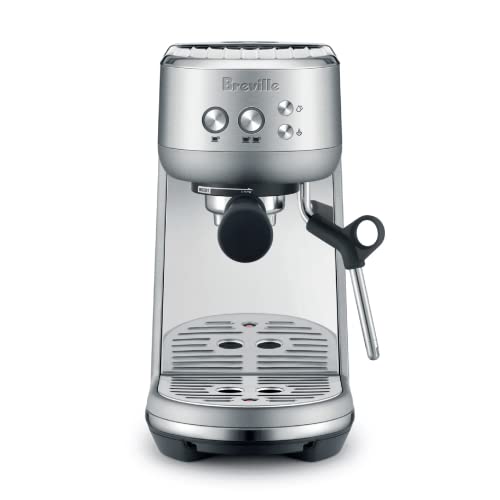
Breville Bambino (BES450) — Best Overall
The Bambino is the compact machine that reset the category’s expectations. Breville’s ThermoJet system is ready in about three seconds, the 54mm portafilter takes a proper dose, low-pressure pre-infusion starts extraction gently, and the steam wand is a real manual wand with enough power to texture milk for latte art. It suits beginners who want to learn properly and small kitchens that refuse to accept pod coffee as the price of their size. In a blind tasting, its shots embarrass machines twice its footprint.
Strengths
- ThermoJet heat-up in seconds — no warm-up ritual at all.
- Low-pressure pre-infusion and a 54mm basket support real technique.
- Manual steam wand produces genuine microfoam for latte art.
Trade-offs
- No built-in grinder — a compact burr grinder is a required partner.
- Small water tank and drip tray need regular attention.
- 54mm accessories are Breville-ecosystem rather than universal 58mm.
| Spec | Detail (verified) |
|---|---|
| Model | BES450 Bambino |
| Heating | ThermoJet, seconds-fast |
| Portafilter | 54mm |
| Character | Compact, manual, beginner-friendly (per listing) |
The Bambino’s secret is that Breville did not shrink a big machine; it designed a small one around how beginners actually learn. The included baskets cover both forgiving pressurized shots and honest single-wall extraction, the wand’s single-hole tip is slow enough to learn on and strong enough to keep, and the whole drink cycle fits inside three minutes from cold. Owners routinely describe it as the machine that made them “into coffee people” — a gateway with a genuinely high ceiling. If you buy one compact machine and want it to be the right one, the Breville Bambino is the safest recommendation in this guide.
Ownership is light: wipe the wand, empty the tray, run the cleaning cycle when the lights ask, and descale on schedule. The Bambino also travels well between homes — renters moving apartments will appreciate that the entire espresso hobby fits in one modest box, machine on the counter and grinder beside it.
One more Bambino virtue deserves emphasis: forgiveness sequencing. Start with the pressurized basket and supermarket beans while your tamping is still uneven, and the drinks are pleasant from day one. Graduate to the single-wall basket with fresh beans the week your routine steadies, and the same machine suddenly has a second, higher gear. Most beginners quit espresso because week one tastes bad; the Bambino is engineered so that week one tastes fine and month three tastes excellent, which is why it converts more casual buyers into committed home baristas than any machine in this guide.
Best for: beginners and small kitchens wanting real espresso with real technique. / Not suited for: buyers wanting a built-in grinder or 58mm accessories.
Check the current price on Amazon

Breville Bambino Plus (BES500) — Best for Milk Drinks
The Bambino Plus takes everything the Bambino does and removes the last skill barrier: milk. Its automatic steam wand textures milk to your chosen temperature and foam level — from flat white silk to cappuccino air — while you watch, hands-free, and a temperature sensor in the drip tray keeps the result honest. It suits milk-drink households, shared kitchens where not everyone wants a barista apprenticeship, and anyone whose morning drink is a latte rather than an espresso. The footprint stays compact; only the convenience grows.
Strengths
- Automatic milk texturing to preset temperature and foam level.
- Same fast ThermoJet start and 54mm extraction as the Bambino.
- Auto-purge wand keeps milk hygiene simple.
Trade-offs
- A step up in tier from the base Bambino for the milk automation.
- Automatic foam is excellent but less expressive than a master’s manual pour.
- Still no built-in grinder.
| Spec | Detail (verified) |
|---|---|
| Model | BES500 Bambino Plus |
| Milk | Automatic texturing, adjustable temperature and foam |
| Heating | ThermoJet |
| Portafilter | 54mm |
The Plus earns its premium in shared households. One person can pull a straight espresso with full manual intent while another, five minutes later, gets a one-touch-textured cappuccino without learning anything — the machine holds both relationships at once. The automatic wand also produces the most consistent foam in this compact guide, because it removes the two variables beginners botch: wand position and stopping temperature. For a latte-first household in a small kitchen, the Breville Bambino Plus is the compact to buy.
A practical note: the auto-purge only helps if you leave the wand down in its rest position after use — a two-second habit. Keep that habit and the milk system stays sweet indefinitely; it is the easiest maintenance bargain in this entire category.
The Plus also solves a subtle social problem: the two-skill-level household. Without it, the keen partner becomes the permanent barista and the other becomes a permanent customer, and resentment brews faster than coffee. With automatic milk and saved settings, both partners produce the same good latte, and the machine becomes shared infrastructure like the kettle. That, more than any specification, is why the Plus earns its premium in real kitchens — it equalizes the morning.
Best for: milk-drink households wanting compact size with zero milk learning curve. / Not suited for: straight-espresso purists who will never use the automation.
Check the current price on Amazon

De’Longhi Dedica Arte (EC885) — Best Slim Design
The Dedica Arte is the answer to a tape measure. At roughly six inches wide, it fits the sliver of counter beside a sink or between appliances where no other machine in this guide can stand — yet it keeps a pump, a fast thermoblock, and, in the Arte variant, a manual steam wand capable of real microfoam instead of the base model’s frothing sleeve. It suits studio apartments, office nooks, camper kitchens, and anyone whose counter is measured in centimeters of free space.
Strengths
- Narrowest footprint of any serious machine in this guide.
- Manual wand textures milk properly — rare at this width.
- Fast heat-up and simple controls suit single daily drinks.
Trade-offs
- Smaller baskets and a brand-specific accessory ecosystem.
- Thermoblock temperature behavior rewards a warming blank shot.
- Cup clearance is tight for tall mugs.
| Spec | Detail (verified) |
|---|---|
| Model | EC885 Dedica Arte |
| Design | Slim Dedica body |
| Steam wand | Manual, latte-art capable |
| Maker | De’Longhi, Italy |
Within its width class, the Dedica Arte has no real rival, because De’Longhi understood that slim-machine buyers still drink with their eyes and palates. The Arte’s wand is the whole story: where slim rivals fake foam, this one lets you learn the real skill, and the espresso — especially with the pressurized baskets for everyday beans, or fresh coffee ground fine — is honestly lively. It is also the most Italian object in this guide, designed in Treviso for the small kitchens of the country that invented the drink. Choose the De’Longhi Dedica Arte when the tape measure makes the decision for you. It also appears in our Italian roundup: Best Commercial Italian Espresso Machines.
Set it up for success: park it where the tank can slide out without moving the machine, keep a small towel under the wand’s rest position, and treat the blank warming shot as part of the ritual. Do that, and the slimmest machine here behaves like a citizen of a much larger class.
There is a travel dimension to the Dedica Arte worth noting: it is the one machine here that owners genuinely take along — to a holiday rental, a boat, a camper — because it packs like a kettle and sets up in minutes. Espresso people plan trips around coffee more than they admit, and a machine that fits in a tote ends the era of dreadful rental-house coffee. Even if yours never leaves the counter, that portability is proof of how completely the design commits to its one job: real espresso, almost no space.
Best for: the smallest kitchens that still want manual espresso and real milk. / Not suited for: hobbyists building an accessory collection.
Check the current price on Amazon
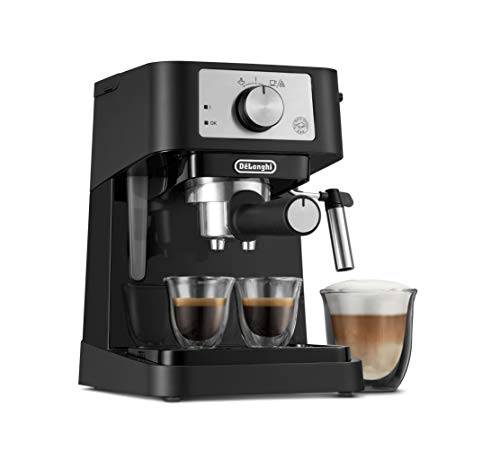
De’Longhi Stilosa (EC260) — Best Budget
The Stilosa is the budget benchmark of the compact class: a proper pump machine with a manual milk frother, a portafilter that takes ground coffee (and pods, if you must), and controls a first-time owner masters in one morning. It suits students, first apartments, and the espresso-curious who want to learn whether they enjoy the ritual before spending real money. De’Longhi’s scale means parts, filters, and support exist — not a given at this tier.
Strengths
- Friendliest tier in this guide for a genuine pump machine.
- Manual frother teaches real milk skills from day one.
- Simple, repairable design from a major maker.
Trade-offs
- Plastic-forward construction and a lightweight feel.
- Temperature stability is the weakest here — routine matters.
- Small tank and a frother that takes practice to tame.
| Spec | Detail (verified) |
|---|---|
| Model | EC260 Stilosa line |
| Type | Pump espresso, manual frother |
| Maker | De’Longhi |
| Character | Entry compact |
The Stilosa’s honesty is its charm: it does not pretend to automate anything, so every improvement in your drinks is yours. With fresh beans, a decent grinder, and the routine of a warming flush before the shot, it produces espresso that embarrasses its price tier — and when owners inevitably upgrade, the skills transfer completely. As a first machine or a dorm-and-office workhorse, the De’Longhi Stilosa is the budget pick we defend without qualifiers.
One warning from experience: the Stilosa exposes stale pre-ground coffee instantly. Feed it fresh beans from even an entry burr grinder and it will surprise you; feed it a can of pre-ground and it will taste like the can. The machine is not the bottleneck at this tier — the coffee is.
The Stilosa also has a quiet second life: it is the machine experienced owners buy for places that are not home — the workshop, the studio, the in-laws’ kitchen they visit monthly. It is cheap enough to duplicate, simple enough to leave with a one-line instruction note, and honest enough that the coffee is welcome. A first machine that later becomes a second machine in a second location has effectively zero waste in its lifecycle, which is more than most premium purchases can claim.
Best for: first-time owners and tight budgets wanting a real pump machine. / Not suited for: buyers wanting automation or premium build.
Check the current price on Amazon

Gevi 20 Bar Compact Espresso Machine — Best Compact Feature Set
Gevi’s compact entry competes on specification density: a full-pressure pump system in a small body, aimed at buyers who read spec sheets and want café numbers without café dimensions. It suits small kitchens that host a spec-driven buyer — someone who wants the strongest pump story in the compact class and is willing to learn a less famous brand’s controls to get it. The machine’s compact brief is genuine; it is built for counters where a Bambino is already a squeeze.
Strengths
- Full pump specification in a truly compact body.
- Feature-led value for spec-conscious buyers.
- Small footprint suits dorms, offices, and tight galley kitchens.
Trade-offs
- Smaller brand ecosystem than Breville or De’Longhi for parts and advice.
- Less accumulated long-term ownership evidence than the incumbents.
- Controls and documentation are less polished than the big brands’.
| Spec | Detail (verified) |
|---|---|
| Model | Gevi 20 Bar Compact Espresso Machine |
| Pump | 20 bar (manufacturer specification in listing title) |
| Design | Compact body |
| Maker | Gevi |
A note on that headline number, because honest guidance matters here: espresso extracts at roughly nine bars at the puck regardless of the pump’s maximum rating — the “20 bar” figure describes the pump’s capability, a common industry convention, not the pressure in your cup. What matters is that the pump is strong, the flow is steady, and the machine gives you the controls to use them, and on those practical measures the Gevi performs as a serious compact should. Buyers who understand that distinction — and want maximum hardware per inch of counter — will find the Gevi 20 Bar Compact a canny pick.
Practical ownership: because the brand’s community is smaller, keep your receipt, register the warranty, and learn the descale routine from the manual in week one. The machine rewards the same fresh-bean, warm-portafilter routine as every pick here.
Buyers comparing the Gevi against the big brands should weigh one intangible: information. Breville and De’Longhi owners swim in tutorials, spare-parts diagrams, and community troubleshooting; Gevi owners rely more on the manual and the maker’s support. For a confident, self-reliant buyer that trade is painless and the hardware-per-dollar wins. For a buyer who wants a video for every question, the incumbents’ ecosystems are worth real money. Neither answer is wrong — but choose with your eyes open.
Best for: spec-driven buyers in very small kitchens. / Not suited for: buyers who prioritize brand ecosystem and long track records.
Check the current price on Amazon

CASABREWS 3700 Essential — Best Value
The CASABREWS 3700 Essential is the compact class’s value specialist: the essential espresso machine — pump, portafilter, steam wand — assembled at a tier that undercuts the famous names while keeping the fundamentals recognizable. It suits first-time buyers testing the hobby, second-home and office kitchens, and anyone who would rather spend the savings on a grinder and beans, which is usually the right instinct at this level.
Strengths
- Value tier with the essential espresso hardware intact.
- Steam wand included for milk drinks from day one.
- Compact body fits the same tight counters as the slim picks.
Trade-offs
- Fit, finish, and documentation trail the big brands.
- Long-term parts ecosystem is thinner than De’Longhi’s or Breville’s.
- Temperature consistency depends on a disciplined warm-up routine.
| Spec | Detail (verified) |
|---|---|
| Model | CASABREWS 3700 Essential |
| Type | Compact pump espresso machine |
| Character | Entry value compact |
| Maker | CASABREWS |
The 3700 Essential makes the most sense as part of a system decision. Taken alone against a Bambino, it loses on refinement; taken as “machine plus a genuinely good grinder plus fresh beans” against “famous machine plus no grinder,” it wins the cup comparison outright — and that is the comparison that matters. Its espresso fundamentals are sound, the wand works, and the whole package leaves budget where budget does the most good. For value-led first-timers, the CASABREWS 3700 Essential is the rational buy.
Set expectations as with all entry compacts: warm the portafilter with a blank shot, work promptly so the small thermal system stays in its window, and descale on schedule. Owners who run that routine report the same surprise as Stilosa owners — the little machine is better than its tier suggests.
The 3700 Essential also makes a fine experiment platform. Because the investment is small, owners tinker freely — different baskets, doses, and routines — without the anxiety that attends experimenting on a flagship. Espresso skill is built by exactly that kind of low-stakes repetition. Several paths lead to the same destination: some buyers learn on a Bambino, some on a Stilosa, and some on a value machine like this one, saving the flagship money for the day their palate can specify exactly which flagship they want.
Best for: value-first buyers who will spend the savings on a grinder and beans. / Not suited for: buyers wanting premium finish or a big-brand service network.
Check the current price on Amazon
Comparison Table
| Pick | Badge | Key spec | Best for |
|---|---|---|---|
| Breville Bambino | Best Overall | ThermoJet, 54mm portafilter | Learning real espresso |
| Breville Bambino Plus | Best for Milk Drinks | Automatic milk texturing | Latte households |
| De’Longhi Dedica Arte | Best Slim Design | Narrowest body, manual wand | Tiniest counters |
| De’Longhi Stilosa | Best Budget | Pump machine, manual frother | First machines |
| Gevi 20 Bar Compact | Best Compact Feature Set | Full pump spec, compact body | Spec-driven buyers |
| CASABREWS 3700 Essential | Best Value | Essential hardware, value tier | System builders |
How to Choose a Compact Espresso Machine
Measure first — width, depth, and the cabinet height above the counter, because compact machines still need room to lift a tank and swing a portafilter handle. Then decide your milk relationship: automatic texturing (Bambino Plus), manual learning (Bambino, Dedica Arte), or occasional frothing (Stilosa, CASABREWS). Finally, be honest about the grinder: none of these machines includes one, and a compact burr grinder is part of the purchase, not an accessory.
Is a compact machine good enough for a daily espresso habit?
Yes — thousands of households run a Bambino or Dedica daily for years. The compromises show up at the extremes: back-to-back drinks for guests, very light roasts that punish temperature wobble, and latte-art ambitions beyond the wand’s patience. For one or two drinkers with a good routine, compact is not a downgrade; it is the correct size.
What does “20 bar” actually mean on a compact machine?
It is the pump’s maximum pressure rating, an industry-wide way of describing pump strength. Espresso itself extracts around nine bars at the coffee. A stronger pump rating does not make stronger espresso; steady flow, fresh beans, and the right grind do. Judge compact machines by their temperature behavior, baskets, and wands — the things you can taste.
Compact machine or pod machine — which is the better small-kitchen buy?
If you care about taste, cost per cup over time, and waste, the compact pump machine wins on all three once a grinder joins it. Pods win only on absolute convenience. Every pick here was chosen because it makes real espresso from real coffee — the entire point of giving a machine counter space.
How big is the water tank, and does it matter?
Compact tanks hold enough for several drinks but not for forgetting. Treat refilling as part of the morning ritual — fresh water daily is better for taste anyway — and the small tank becomes a feature: the water in a compact machine is never more than a day old, which cafés with plumbed lines would envy. It only becomes a flaw if your household makes many drinks in a row, which is the same limit this whole category honestly declares.
How to Set Up a Compact Espresso Station in a Small Kitchen
Claim a permanent corner — compact espresso only becomes a habit if the machine never has to be fetched from a cupboard. Put the machine where the tank slides out freely, the grinder immediately beside it, and a small knock box or a dedicated spot by the sink within one step. Warm the system before the first shot of the day: run a blank shot through the locked, empty portafilter to heat the group and cup, then dose, tamp, and pull your real shot promptly while everything is warm. Steam milk right after the shot, purge and wipe the wand in the same motion, and leave the machine wiped down — small machines live on counters that are also dinner prep space, so the thirty-second reset is what keeps the station welcome in its own kitchen. Weekly, wash the baskets and tray; monthly, descale or refresh the filter before the machine asks. That is the whole system: warm, prompt, wiped, and ready.
Common Buying Mistakes
- Buying by width alone. A machine that fits but frustrates will be replaced within a year; check the wand and baskets, not just the tape measure.
- Skipping the grinder. Every pick here needs fresh-ground coffee to taste like espresso rather than strong coffee.
- Believing pump-pressure marketing. Bars on the box describe the pump, not the cup; buy temperature behavior and workflow instead.
- Ignoring tank access. A compact machine whose tank cannot slide out under your cabinets becomes a daily annoyance.
- Expecting boiler-machine stamina. Compact systems serve one or two drinkers beautifully and a brunch queue poorly; buy for your real mornings.
Final Recommendation
Everything in this guide was verified against live catalog data before publication, and the shortlist is revisited as models change — compact espresso moves quickly, and a buying guide should move with it.
For most small kitchens, buy the Breville Bambino and a compact grinder — it is the compact class’s most complete answer. Milk-first households should step up to the Bambino Plus. If width is the binding constraint, the Dedica Arte is the slimmest serious machine made. Budgets point to the Stilosa, spec-hunters to the Gevi, and system-builders to the CASABREWS. All six respect a small counter without insulting your palate. When space stops being the constraint, the wider market opens up in Best Commercial Espresso Machines For Home Use and Best Commercial Single Group Espresso Machines.
How Much Counter Space Does a Compact Setup Really Need?
Less than you fear, but more than the machine’s box suggests. Budget the machine’s footprint, plus six inches beside it for the grinder, plus working room in front to lock the portafilter and place a cup, plus the vertical clearance to lift the water tank or open the top. In practice, a complete compact station — machine, grinder, knock box, two cups — lives comfortably in a two-foot run of counter, which is why this category thrives in apartments. The Dedica Arte can compress that to roughly half. Measure your run, including the swing of the portafilter handle, before ordering; the only compact machine that disappoints is the one that technically fits but cannot be used without moving it.
How to Keep a Compact Machine Tasting Great for Years
Compact machines concentrate the same enemies as big ones — scale and stale milk — into smaller passages, so the calendar matters more, not less. Daily: purge and wipe the steam wand after every drink, and empty the small drip tray before it overflows (it will, exactly once, teach you this). Weekly: wash baskets, portafilter, and tray in hot soapy water, and run a blank shot to flush the group. Monthly: descale or refresh the in-tank filter according to your water hardness — set a phone reminder, because compact machines rarely nag as insistently as flagships. Seasonally: check the group gasket and shower screen, and clean the grinder’s burrs of oily buildup. Follow that rhythm and a compact machine’s “appliance lifespan” stretches pleasantly; skip it and the small passages clog into exactly the disappointment the skeptics predicted.
How to Dial In a Compact Machine in Your First Week
Day one, resist judging anything: run two blank shots to heat the group and portafilter, make your first drinks with the pressurized basket if one is included, and simply learn where everything is. Day two, switch to fresh beans and the standard basket, fix your dose by eye-level consistency if you have no scale yet, and pull three shots back to back. Notice the pattern compact machines teach quickly: the first shot runs cooler than the second, which is why the blank warming shot becomes a permanent part of your routine.
Days three and four are grinder days. Sour and fast means finer; bitter and choking means coarser; one small step at a time, with a full shot after each. Day five belongs to milk: steam a small pitcher, aiming for a vortex and glossy paint texture, and pour immediately. By the end of the week, write your working recipe — dose, grind setting, shot look, milk notes — on a card inside a cabinet door. Compact machines reward this discipline disproportionately, because their small thermal systems hold a routine’s temperature beautifully once the routine itself stops changing. From week two onward, you are not learning the machine anymore; you are just making coffee, which was the point.
Who Should Not Buy a Compact Machine?
Three buyers, honestly. The entertainer who makes six lattes for brunch will spend the party queuing at a small tank and a single boiler’s pace — a heat-exchanger or flagship automatic fits that life. The precision hobbyist chasing light-roast perfection will outgrow thermoblock temperature behavior within a season and should start with a boiler machine. And the buyer who wants a built-in grinder above all else should look at the compact all-in-ones’ bigger siblings in our other guides, because every pick here assumes a separate grinder. Everyone else — singles, couples, small kitchens, first-timers, travelers — is exactly who this category serves, and serves well.
Compact Espresso for Offices, Dorms, and Second Homes
A large share of compact machines are bought for somewhere that is not the main kitchen, and the priorities shift slightly there. For an office, choose the machine whose routine a colleague cannot get wrong: the Bambino Plus, whose milk and shots forgive unfamiliar hands, with a note taped above it covering the three daily jobs — fill, wipe, empty. For a dorm or studio, the Stilosa and CASABREWS make sense: simple, inexpensive, and honest, with a small grinder completing a station that fits on a desk corner. For a second home or rental you visit monthly, favor the Dedica Arte or Bambino for their fast heat-up and simple descale routine, and leave beans out of the equation — buy fresh on arrival, because no machine survives month-old beans with its reputation intact. In every secondary location, the winning feature is the same: a machine that is ready in a minute and clean in thirty seconds gets used; anything fussier becomes furniture.
What Does a Compact Setup Cost to Run?
Less than any other route to real espresso. Consumables are descaler or filters, cleaning supplies, and the occasional gasket — small money on an annual basis. Electricity is trivial for machines that heat in seconds and idle cold, unlike boilers kept warm all day. The dominant cost, as everywhere in espresso, is coffee itself, followed by the grinder you buy once. That arithmetic is the compact category’s quiet superpower: the cost of entry is low, the cost of running is lower, and the cost per genuinely good cup undercuts both cafés and pods by a wide margin within the first year of daily use.
How Do Compact Machines Handle Different Drinks?
Straight espresso is the compact machine’s home turf — a short extraction is where its fast heating and small groups are least stressed, and the Bambino-class shots genuinely rival big machines. Cappuccinos follow happily, because the foam volume is small and every wand here can manage it. Lattes are the workload test: a large latte means a full pitcher of milk and, on thermoblock machines, a short wait while the system switches from brew to steam temperature — seconds on the Breville pair, a little longer elsewhere. Americanos are effortless everywhere: shot, hot water from the wand or a kettle, done. Iced drinks favor the fast machines too, since a double shot over ice waits for no boiler. The honest summary: a compact machine makes any single drink well, makes two drinks with rhythm, and makes a party’s worth with patience. Buy it for the first two jobs and it will never disappoint you at the third if your expectations arrived before your guests did.
A closing perspective for anyone hesitating between this category and a larger machine: counter space is the one kitchen resource you can never buy more of, and a machine that fits your actual kitchen will be used daily, while a magnificent machine that crowds your only prep surface will be resented by October. The compact class has matured to the point where “fits my kitchen” no longer means “settles on taste.” Choose the pick above that matches your width, your milk habits, and your budget for a grinder, run the warm-up routine like a professional, and the small machine on your counter will make espresso you are genuinely proud to serve — which is the only test any of these machines ultimately has to pass.
Which Beans Suit a Compact Machine Best?
Medium and medium-dark roasts are the compact machine’s best friends, for a practical reason: they extract forgivingly across the small temperature variations a thermoblock or thermocoil produces shot to shot. Very light roasts demand the temperature precision of a boiler and will taste sour more often than not in a compact system; very dark roasts extract so easily that they turn bitter if your routine dawdles. Buy fresh, buy in small bags you finish in two to three weeks, and let the roast date — not the marketing copy — choose between two similar bags. If your household drinks mostly milk drinks, a chocolate-leaning medium roast is the classic pairing: it holds its character through milk in a way delicate light roasts never will. None of this limits you; it simply stacks the deck so a small machine tastes like a big decision.
A Note on Pods, Capsules, and Hybrid Compacts
Some compact machines hedge their bets with pod or capsule compatibility, and the Stilosa’s ground-or-pod flexibility is typical of the breed. Our position is simple: the pod option is a convenience for guests and rushed mornings, but the machine earns its place in this guide on ground coffee, where cost per cup, freshness, and taste all live. If you know you will only ever use capsules, buy a dedicated capsule machine and save the counter complexity. If you want the option without the obligation, a hybrid like the Stilosa is a reasonable compromise — just do not let the pods become the habit, because the first time you taste the same machine on fresh grounds, the capsules will taste like the compromise they are.
Frequently Asked Questions
What grinder pairs well with a compact machine?
A compact burr grinder with fine adjustment steps in the espresso range. Counterprint matters less than grind quality: a small hand grinder outperforms a large blade grinder every time. Buy the best burrs your budget allows and the smallest body your counter allows, in that order.
What is the smallest espresso machine that still makes real espresso?
The De’Longhi Dedica Arte is the narrowest machine in this guide that makes genuine pump espresso with a manual milk wand. The Bambino pair are slightly larger but still compact by any normal standard, with faster heating and larger baskets.
Do compact espresso machines need a grinder?
Yes — none of these six includes one, and espresso requires fine, fresh, adjustable grinding. A compact burr grinder completes the station and matters more to the cup than the difference between any two machines here. Budget for it from the start, store it beside the machine, and the pair will behave like one appliance that happens to come in two boxes.
Can a compact machine make lattes and cappuccinos?
All six steam milk. The Bambino Plus does it automatically to preset temperature and texture; the Bambino and Dedica Arte give you manual wands for real microfoam; the Stilosa, Gevi, and CASABREWS froth capably with a little practice. In other words, the milk drink you order most often at a café is fully within a compact machine’s reach.
How long do compact machines last?
With descaling and wand hygiene, expect years of daily service; these are appliances with service networks rather than heirloom machines. The Breville and De’Longhi picks carry the strongest support ecosystems in this guide. Lifespan in this category is mostly a water story: owners who descale on schedule routinely double the service life of owners who wait for the machine to complain, because scale in small passages does its damage quietly and early.
Are compact machines loud?
The pump’s buzz during a 30-second extraction is the main sound, and the grinder you pair with it will be louder. None of these will disturb a household through a closed door. Early risers in studio apartments should know the sound is brief and kettle-like rather than alarming — thirty seconds of honest mechanical buzz while the rest of the home sleeps is a trade every compact owner we know accepts without a second thought, especially since the fast-heating models finish the whole drink before a boiler machine would even be warm.
What if I outgrow a compact machine?
Then it did its job. Your grinding, tamping, and milk skills transfer directly to a full-size machine, and a well-kept Bambino or Dedica resells or moves to an office easily. Most owners who upgrade keep the compact machine as a second station rather than selling it — a testament to how completely these small machines earn their place. The natural upgrade paths are mapped in Best Commercial Quality At Home Espresso Machines and Best Commercial Italian Espresso Machines.


