Disclosure: airfryerkitchensupply.com is reader-supported. When you buy through links on our site, we may earn an affiliate commission at no extra cost to you.
Where to buy
When you are shopping for the best commercial quality at home espresso machines, start with the two flagships: the Jura Z10, which adds cold-extraction brewing to a commercial-grade automatic platform, and the Breville Oracle Touch, which automates the manual ritual instead of replacing it. Variety seekers should look at the De’Longhi Eletta Explore with its hot and cold foam systems, design-led buyers at the KitchenAid KF8, milk-drink households at the Philips 5500 with LatteGo, and value hunters at the De’Longhi Dinamica Plus. Every pick here was verified against Amazon’s catalog before receiving a link, and because these are premium machines with rotating stock, check price on Amazon for the finish you want.
What “commercial quality” really means at home
The best commercial quality at home espresso machines are not small café machines — they are something arguably harder to build: machines that deliver café-level drinks with domestic levels of effort. Commercial quality, honestly defined, has four parts. The extraction must be stable, because temperature and pressure consistency is what separates a sweet shot from a sour one. The milk system must produce real microfoam, not aerated bath bubbles. The construction must survive daily use for years, with a grinder, brew group, and seals built as serviceable components rather than sealed disposables. And the results must be repeatable by a normal person on a weekday morning, not just by an enthusiast with a scale and a free hour.
That definition is why this list is dominated by premium super-automatics and one very clever hybrid. A super-automatic grinds, doses, tamps, extracts, and steams inside one housing, and the best of them — Jura, De’Longhi’s top lines, KitchenAid’s KF series, Philips’ LatteGo flagships — have closed most of the quality gap with manual machines while keeping the one-button promise. The Breville Oracle Touch takes the opposite path to the same destination: it keeps the portafilter ritual and automates the hard parts (grinding, tamping, milk texturing) around it. Both approaches are legitimate answers to “commercial quality at home”; they differ in how much of the craft you want to keep.
One honesty note: no home machine at any price fully replicates a café’s best barista on a flagship commercial setup with a competition grinder. What these machines do replicate is the good café’s everyday drink — the latte, cappuccino, or flat white you actually buy most mornings — at a consistency many cafés would envy. That is the standard this guide grades against. It is also worth naming who this category serves best: daily drinkers. A flagship automatic justifies itself in cups per week, and households making ten or more drinks weekly will feel the value within the first month, in quality, in time, and in the café trips that quietly stop happening. Occasional drinkers should read the same picks with a smaller budget in mind — the Dinamica Plus end of this list, or the compact machines elsewhere in our cluster.
In this guide
Quick Picks
- Best Overall: Jura Z10 (Diamond Black) — cold extraction process, intelligent grinder adjustment, and Swiss build quality. Check price on Amazon
- Best Hybrid: Breville Oracle Touch (BES990) — automatic grinding, tamping, and milk texturing around a real dual-boiler portafilter machine. Check price on Amazon
- Best for Variety: De’Longhi Eletta Explore — 50+ one-touch recipes with hot and cold foam technology and a travel mug option. Check price on Amazon
- Best Design: KitchenAid KF8 (KES8558) — 40+ recipe options, smart dosing, and appliance-grade fit and finish in stainless steel. Check price on Amazon
- Best for Milk Drinks: Philips 5500 Series with LatteGo (EP5544/94) — 20 hot and iced presets and the easiest milk system to clean in the business. Check price on Amazon
- Best Premium Value: De’Longhi Dinamica Plus — app-connected recipes, LatteCrema milk, and a compact footprint at the friendliest premium tier here. Check price on Amazon
How These Picks Were Chosen
We graded on the four-part definition above. Extraction stability came first: machines had to hold a credible temperature and produce a balanced shot from fresh beans without heroics. Milk quality came second, judged by whether the system — automatic carafe or assisted wand — could produce glossy, pourable microfoam rather than stiff foam. Third was construction and serviceability: metal where it matters, a removable or serviceable brew group where the design allows, and a manufacturer with a real parts and service network. Fourth was repeatability for non-experts, including how honest the machine is about maintenance — the best machines nag you about rinsing, descaling, and filter changes before quality slips, not after.
Prices are deliberately omitted: premium espresso machines swing with promotions and finishes, so reviews use tier language and leave the live number to the listing. If a famous flagship could not be verified as a current listing, it was excluded rather than guessed at.
The 6 Best Commercial Quality At Home Espresso Machines

Jura Z10 (Diamond Black) — Best Overall
Jura’s Z10 is the flagship argument that an automatic can be a connoisseur’s machine. Its signature trick is a cold extraction process that pulses cold water through the grounds for genuine cold brew and iced specialties — a category most espresso machines fake with hot coffee over ice. Around that headline sits the full Swiss package: an intelligent grinder that adjusts itself to the selected product, a large color display that reads like a phone interface, and construction that feels machined rather than assembled. It suits households that want the widest drink menu in the category executed at café standard, with the least daily involvement.
Strengths
- Cold extraction process makes true cold specialties no rival here matches.
- Self-adjusting grinder intelligence keeps extraction consistent across beans.
- Swiss build, quiet operation, and a service network that supports long ownership.
Trade-offs
- The highest tier in this guide; the cold-extraction premium is real money.
- Jura’s brew group is serviced, not user-removed — maintenance is by the book.
- Enthusiasts who enjoy the manual ritual get no ritual here at all.
| Spec | Detail (verified) |
|---|---|
| Model | Z10, Diamond Black |
| Signature | Cold Extraction Process |
| Grinder | Intelligent, product-adjusting |
| Maker | Jura, Switzerland |
Hot drinks are where the Z10 quietly proves itself. Espresso lands balanced and sweet because the machine manages dose, grind, and water with a consistency human hands rarely match at 7 a.m., and the milk system produces the fine, glossy texture that flat whites demand. The interface deserves praise for honesty: it tells you when the filter needs changing, when a cleaning cycle is due, and walks a first-time owner through both. In a household that drinks across the menu — espresso in the morning, cappuccino at noon, cold brew in the afternoon — the Z10 is the one machine that never asks anyone to compromise. Order the Jura Z10 if the budget allows the best automatic execution currently on the counter.
Ownership is deliberately low-drama. Jura designs for filter-based water care that minimizes descaling, guided cleaning tablets, and a milk system that rinses itself after use. Follow the prompts and the machine stays in its window for years; ignore them and it will tell you, politely and repeatedly, which is more than most appliances do.
A word about the cold extraction, because it is easy to dismiss as a gimmick and wrong to do so. True cold brew depends on time and cold water; the Z10’s process uses pressure and pulsed cold water to extract a smooth, naturally sweet cold coffee in the time a normal drink takes. Iced lattes built on it taste composed rather than diluted, and in warm months it becomes the most-used button on the machine. It is also a glimpse of where the category is heading: the flagship automatic is no longer just a robot barista for hot drinks but a complete café station, and Jura got there first with the build quality to back the claim.
Best for: households wanting flagship automatic quality across hot and cold drinks. / Not suited for: manual-ritual lovers or budget-led buyers.
Check the current price on Amazon
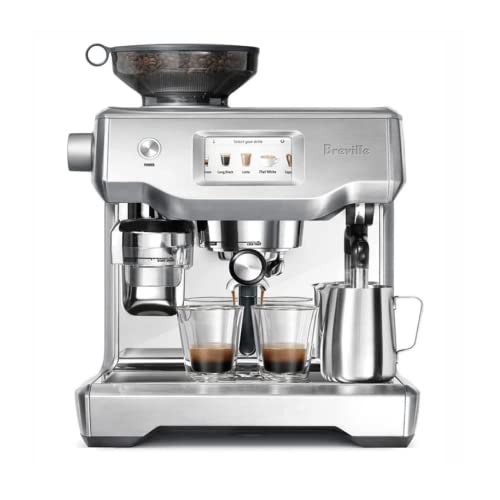
Breville Oracle Touch (BES990) — Best Hybrid
The Oracle Touch refuses to choose between the café ritual and automation, so it automates the ritual itself. Under the touchscreen sits a dual-boiler manual machine with a 58mm-style portafilter; the machine grinds, doses, and tamps into that portafilter, then lets you extract like a barista, while the steam wand textures milk to a temperature and texture you preselect — hands-free. It suits drinkers who love the theatre and taste of manual espresso but not its inconsistency, and households where several people of different skill levels share one machine.
Strengths
- Dual boilers brew and steam simultaneously — true café workflow.
- Automatic grind, dose, and tamp remove the biggest inconsistency sources.
- Auto milk texturing to preset temperature and foam level, hands-free.
Trade-offs
- Premium tier, and a large footprint with the grinder integrated.
- More systems to maintain than a simple automatic — group care still applies.
- Purists may find assisted tamping takes some of the craft away.
| Spec | Detail (verified) |
|---|---|
| Model | BES990 Oracle Touch |
| Boilers | Dual boiler |
| Interface | Touchscreen drink menu |
| Finish | Brushed stainless steel |
The dual-boiler layout is the quality headline. Extraction temperature stays locked while steam waits at full readiness, so a flat white is one continuous motion: lock in, extract, and the milk is already swirling to temperature beside the cup. Because the coffee is made in a real portafilter with a proper shower screen, the shots carry the texture and clarity that basket-based brewing gives and pod-style brew groups cannot. The touchscreen’s saved-drink profiles mean each household member’s version of a latte is one tap away, made the same way every time. For the buyer who wants café craft with the variance engineered out, the Breville Oracle Touch is the most convincing machine in this guide.
Be ready to treat it like the manual machine it is: backflush on schedule, wipe the wand, descale when prompted. The automation removes skill barriers, not hygiene. Owners who keep the routine describe the Oracle as the machine that finally made home drinks indistinguishable from their favorite café’s — which is the entire promise of this category in one sentence.
The Oracle Touch also deserves credit as a teaching machine. Because grinding and tamping are handled, a beginner’s only jobs are locking in the portafilter, watching the extraction, and pouring the milk the wand textured — the three skills that actually build barista intuition. Household members graduate from the touchscreen’s saved drinks to experimenting with the manual controls at their own pace, and the machine never becomes the bottleneck. Few products in any category manage to be simultaneously the easy option and the enthusiast option; the Oracle Touch’s dual identity is exactly why it anchors the hybrid end of this guide.
Best for: ritual lovers who want café workflow with the inconsistency removed. / Not suited for: anyone wanting a sealed, zero-maintenance appliance.
Check the current price on Amazon

De’Longhi Eletta Explore — Best for Variety
The Eletta Explore is built for the household that cannot agree on a drink. Its menu runs to more than fifty one-touch recipes, and uniquely in this guide it foams milk both hot and cold — so the same machine that makes a morning cappuccino makes an iced latte with cold foam in the afternoon, and brews into a travel mug for the commute. It suits varied households, entertainers, and anyone whose coffee habit changes with the weather. De’Longhi’s app control and user profiles keep the variety personal rather than chaotic.
Strengths
- 50+ one-touch recipes, the widest menu in this guide.
- Hot and cold foam systems cover cappuccinos and iced drinks properly.
- User profiles and app control personalize a shared machine.
Trade-offs
- Two milk systems mean more parts to rinse and store.
- Menu depth can overwhelm buyers who only ever drink one thing.
- Premium tier pricing, though it replaces several appliances’ jobs.
| Spec | Detail (verified) |
|---|---|
| Recipes | 50+ one-touch |
| Milk | Hot and cold frother systems |
| Extras | Travel mug brewing, built-in grinder |
| Profiles | 4 user profiles |
Variety is easy to promise and hard to execute; the Explore executes because its fundamentals are right. The grinder and brew unit produce a balanced base espresso, so the fifty drinks built on it taste like variations on something good rather than fifty disguises for something mediocre. The cold-foam system is the genuine differentiator — iced drinks keep their texture instead of collapsing into sweet milk, which is why this machine owns summer in households that own it. The travel-mug function sounds minor until a commuter uses it daily. If your household’s drink order reads like a café menu board, the De’Longhi Eletta Explore is the pick.
Practical notes: keep both milk carafes rinsed and refrigerated between uses, and let the machine’s cleaning prompts run — with this many recipes in play, milk hygiene is the whole ballgame. Do that, and the Explore stays the most entertaining machine on the counter.
Entertaining is where the Explore’s design intelligence shows. Four user profiles mean a dinner party’s worth of preferences — your decaf cappuccino, a guest’s strong flat white, someone’s iced latte — are each one tap, made in sequence, without a notebook or a queue of questions. The machine handles the repetition; you handle the conversation. That is the actual luxury these flagships sell, and the Explore sells more of it per machine than anything else here. Even its over-ice and cold-extraction style drinks hold together at party pace, because the foam systems were designed for them rather than adapted as an afterthought.
Best for: varied households and entertainers who drink hot and iced year-round. / Not suited for: single-drink minimalists.
Check the current price on Amazon

KitchenAid KF8 (KES8558) — Best Design
KitchenAid entered the fully automatic category the way it enters every category: by making the appliance you are happy to leave on the counter. The KF8 offers more than forty recipe options, smart dosing technology that adjusts to the drink, and stainless construction with the brand’s familiar fit and finish. It suits design-conscious households that still want serious output — this is not a styled toy but a full flagship automatic wearing better clothes. The removable components and guided cleaning keep the ownership experience as polished as the exterior.
Strengths
- 40+ recipe options with smart dosing across the menu.
- Stainless build and design that integrate with premium kitchens.
- Quiet, composed operation for an automatic of this power.
Trade-offs
- Newer platform than Jura’s or De’Longhi’s — a shorter long-term track record.
- Premium tier pricing for the design and the badge alike.
- Menu is wide but lacks the Z10’s cold-extraction specialty.
| Spec | Detail (verified) |
|---|---|
| Model | KF8, KES8558 |
| Recipes | 40+ options |
| Dosing | Smart dosing technology |
| Construction | Stainless steel |
In the cup, the KF8 behaves like the flagship it is: balanced espresso, properly textured milk, and drinks that repeat identically across a morning of guests. Smart dosing earns its name when the household switches between drinks of different strengths — the machine adjusts its grind and dose logic rather than serving the same shot in different-sized cups of milk. The interface is calm and legible, and the machine’s cleaning guidance is unusually clear about what to do and when. For buyers who rejected automatics on aesthetic grounds, the KitchenAid KF8 removes the objection without removing the quality.
One consideration: KitchenAid’s espresso service network is younger than the European incumbents’. The build quality inspires confidence, and the brand’s appliance support is broad, but if a decades-long model-specific parts trail matters most to you, the Jura and De’Longhi picks have the longer paper trail.
There is a subtler design win worth naming: the KF8 is quiet in the ways that matter at 6 a.m. Grinder noise is the rudest sound an automatic makes, and KitchenAid’s dosing and grinding package is composed rather than frantic, so the machine can live in an open-plan home without waking the household. Combined with clear water and bean access that does not require dragging the machine out from under a cabinet, the KF8 respects the daily reality of kitchens instead of just their photographs. Premium buyers pay for exactly this kind of thoughtfulness, and here it arrives with forty-plus drinks attached.
Best for: design-led kitchens wanting flagship automatic performance. / Not suited for: buyers prioritizing the longest service history.
Check the current price on Amazon

Philips 5500 Series with LatteGo (EP5544/94) — Best for Milk Drinks
The Philips 5500 wins milk-drink households on one decisive feature: the LatteGo system. Where rival carafes hide a maze of tubes that sour if you forget them, LatteGo is two parts with no tubes at all, rinsed in seconds or dropped in the dishwasher. Around that system sits a complete flagship: twenty hot and iced presets, a ceramic grinder, customizable strength, milk, and cup size, and a quick-start routine that shortens the morning. It suits families whose drink order is mostly lattes and cappuccinos and whose patience for cleaning is honestly limited.
Strengths
- LatteGo milk system cleans in seconds — the easiest in the category.
- 20 hot and iced presets with per-drink customization.
- Ceramic grinder and quick-start keep mornings fast and quiet.
Trade-offs
- Automatic foam is excellent but less art-capable than a manual wand.
- Plastic-forward construction versus the metal flagships here.
- Espresso purists will still prefer a portafilter machine’s texture.
| Spec | Detail (verified) |
|---|---|
| Model | EP5544/94, 5500 Series |
| Presets | 20 hot and iced |
| Grinder | Ceramic, with strength settings |
| Pressure | 15 bars (manufacturer spec in listing) |
The 5500’s real achievement is that the easy-clean milk system does not cost you drink quality. Foam arrives dense and glossy enough for a respectable flat white, the iced presets are genuinely formulated rather than hot drinks poured over ice, and the customization — strength, milk volume, cup size — means the machine learns the household’s taste instead of imposing its own. Philips’ AquaClean filter support stretches the time between descaling dramatically when filters are changed on schedule, which suits exactly the low-maintenance household this machine targets. For milk-first families, the Philips 5500 is the most livable flagship here.
A practical tip: keep the LatteGo carafe in the fridge between uses and rinse it the same day; the two-part design makes that a ten-second habit, and it is the difference between a milk system you trust and one you quietly stop using.
The 5500’s user profiles deserve a mention for family peace. Each person saves their own strength, milk, and size settings, so the machine stops being a source of morning negotiation — the teenager’s sweet latte and the parent’s short cappuccino are both one tap, both remembered. Philips’ interface is the most phone-like here, which sounds trivial until a grandparent uses it without instruction. Accessibility is a quality feature in a shared appliance, and the 5500 treats it as one. It is the flagship we recommend when the machine must serve everyone in the house, not just its buyer.
Best for: milk-drink families who want flagship drinks with minimal cleaning. / Not suited for: manual-craft seekers or metal-build purists.
Check the current price on Amazon

De’Longhi Dinamica Plus — Best Premium Value
The Dinamica Plus is the connoisseur’s value play: De’Longhi’s LatteCrema milk system, a connected app with savable recipes, a smart one-touch menu that promotes your most-made drinks, and a compact body — at the friendliest tier among this guide’s flagships. It suits smaller households and smaller counters that refuse to drop to appliance-grade coffee. The espresso core is De’Longhi’s mature brew unit, which has been refined across a decade of Dinamica and Magnifica machines.
Strengths
- LatteCrema system produces dense, café-style foam automatically.
- App connectivity and profiles personalize recipes beyond the panel.
- Compact footprint for a full-featured automatic.
Trade-offs
- Menu and tank sizes are smaller than the Eletta Explore’s.
- No cold-extraction or cold-foam specialties.
- App features add setup time before the first drink.
| Spec | Detail (verified) |
|---|---|
| Model | Dinamica Plus, connected |
| Milk | LatteCrema system |
| Control | Touch display plus app |
| Maker | De’Longhi, Italy |
What makes the Dinamica Plus feel like commercial quality rather than convenience is the base espresso. De’Longhi’s brew unit, fed by a capable grinder, produces a shot with genuine body, and the LatteCrema foam sits on top of cappuccinos the way café foam should — dense enough to hold a dusting of cocoa, fluid enough to drink through. The smart menu is a small delight: the machine notices what your household actually drinks and puts those drinks first. In a two-person home, this is very often all the flagship anyone needs, at a tier below the Z10 and Eletta. The De’Longhi Dinamica Plus is where we send value-focused buyers first.
As with all carafe systems, rinse the milk container daily and run the cleaning cycle when prompted; De’Longhi’s reminders are clear, and the brew group removes for a weekly rinse under the tap — a serviceability point in its favor over sealed designs.
The Dinamica Plus also wins on a point its spec sheet understates: warm-up and readiness. Automatics live or die by how they fit the first ten minutes of the day, and the Dinamica Plus is awake, rinsed, and ready before a kettle boils, with your most-made drink already promoted to the front of its menu. For a one or two-person household, that frictionless start is worth more than a longer recipe list. Add De’Longhi’s long parts tail and the removable brew group, and the Plus is the flagship most likely to still be serving, uncomplaining, a decade from now in a small kitchen that never had room for anything bigger.
Best for: smaller households wanting flagship drinks at the friendliest premium tier. / Not suited for: big-menu entertainers or cold-drink specialists.
Check the current price on Amazon
Comparison Table
| Pick | Badge | Key spec | Best for |
|---|---|---|---|
| Jura Z10 | Best Overall | Cold extraction, smart grinder | Flagship automatic quality |
| Breville Oracle Touch | Best Hybrid | Dual boiler, auto tamp | Ritual with consistency |
| De’Longhi Eletta Explore | Best for Variety | 50+ recipes, hot/cold foam | Mixed-drink households |
| KitchenAid KF8 | Best Design | 40+ recipes, smart dosing | Premium kitchens |
| Philips 5500 LatteGo | Best for Milk Drinks | 20 presets, tube-free carafe | Low-cleaning families |
| De’Longhi Dinamica Plus | Best Premium Value | LatteCrema, app control | Compact flagship value |
How to Choose a Commercial-Quality Home Espresso Machine
Decide how much ritual you want to keep. If the answer is “all of it, minus the inconsistency,” the Oracle Touch is your category. If the answer is “none of it — I want to press a button,” the decision moves to menu and milk: cold drinks point to the Z10 or Eletta Explore, milk volume points to the Philips, design points to the KF8, and budget points to the Dinamica Plus. Every machine here clears the quality bar; the differences are about your mornings.
Is a super-automatic’s espresso really as good as a manual machine’s?
At the flagship level, the honest answer is: close enough that most drinkers cannot tell in milk, and a small step behind in straight espresso texture, where a portafilter’s basket and a competition grinder still lead. In exchange, the automatic is identically good every single time, including the mornings when you are half awake — a trade most households win.
What maintenance do these machines actually need?
Daily: empty the drip tray and puck container, rinse the milk system. Weekly: rinse removable brew groups where fitted, wipe the interior. On the machine’s prompts: cleaning-tablet cycles, filter changes, and descaling if you are not on filters. The flagships all guide this from the display; the real rule is simply to obey the prompts instead of dismissing them.
How long should a machine at this tier last?
With water care and prompted maintenance, flagship automatics are multi-year, daily-use appliances with manufacturer service networks behind them — Jura and De’Longhi in particular support their machines for a long tail of years. Budget a mid-life service (grinder burrs, seals) into ownership and the machine will not surprise you.
How important is the grinder inside an automatic?
It is half the machine. Flagships use steel or ceramic burr sets with drink-aware adjustment; the Z10 even re-tunes itself per product. What you are listening for in reviews and listings is consistency and retention: a grinder that doses the same amount, at the same fineness, without holding yesterday’s grounds in the path. All six picks clear that bar, which is precisely what separates this tier from budget automatics whose grinders quietly cap their drink quality.
Should you choose a carafe milk system or a steam wand?
Carafes (Jura, De’Longhi, Philips, KitchenAid here) win on effortlessness and repeatability; assisted wands (the Oracle Touch) win on texture control and the pleasure of pouring. Households drinking mostly lattes should choose the carafe whose cleaning design they will actually maintain — tube-free LatteGo for the cleaning-averse, LatteCrema for foam density, Jura’s system for integration. Nobody in this guide makes bad milk; they make it with different amounts of your involvement.
How to Get Café Milk Out of an Automatic System
Start cold: milk straight from the fridge, carafe chilled if your mornings allow it, because cold milk gives the foam time to form before it scalds. Keep the carafe’s intake and nozzles scrupulously clean — dried milk in a nozzle is the number-one cause of “my machine’s foam got worse,” and it is always the nozzle, never the machine. Use the machine’s foam-density settings rather than accepting defaults; flat whites want the densest, wettest setting, cappuccinos the airiest. Pour immediately — automatic foam is stable but not immortal — and swirl the jug or cup once to marry foam and milk before drinking. Finally, run the milk rinse the moment you finish, every time; ten seconds now saves a deep clean later and keeps tomorrow’s first latte tasting like today’s.
How to Set Up a Flagship Automatic for Café-Level Results
Unbox onto a counter with room to open the bean lid and slide the tank. Fill with filtered water and fit the water filter if supplied — this single step governs both taste and how often you descale. Load fresh beans, run the machine’s first-run rinse, then pull and discard two espressos to season the path. Now calibrate: set the grinder one step finer than default, pull a double, and taste. Sour and thin means finer still; bitter and harsh means back off. Set your default drink’s strength and temperature to taste, save each household member’s profile, and position the milk carafe in the fridge door so using it is effortless. From then on the routine is café-simple: beans in, water fresh, prompts obeyed, and a weekly five-minute clean. The machines reward exactly the habits a good café runs on — consistency and hygiene — and punish only neglect.
How to Calibrate a Flagship Automatic in Its First Week
Day one: install the water filter if supplied, fill with filtered water, load a fresh medium-roast bean, and run the machine’s setup rinse. Pull three espressos and throw them away without judgment — you are seasoning the brew path and warming the system, and every flagship tastes off for its first drinks. Day two: choose your house drink and calibrate it. If the espresso base tastes sour, set the grinder one step finer and raise the brew temperature if the menu allows; if it tastes bitter and dry, step coarser. Change one variable per day, because these machines are consistent enough that your notes actually mean something — a luxury manual-machine owners will envy.
Days three and four belong to milk. Make your usual drink with the default foam setting, then with one step denser and one step airier, and save the winner to your profile. Day five: program every household member’s drink and teach the machine’s rinse routine to everyone who will use it — shared machines fail at shared hygiene, not at engineering. By day seven, run the first prompted cleaning cycle even if it feels early, just to learn where the tablets go and how long it takes. From then on, ownership is a rhythm of beans, water, and prompts, and the drinks should hold at café level with no further thought. That is the entire ownership proposition of this category, and a week of calibration is what buys it.
Common Buying Mistakes
- Buying menu size instead of drink quality. Fifty recipes built on a weak shot are still weak; taste the base espresso first.
- Ignoring the milk system’s cleaning design. The best milk system is the one you will actually rinse daily — hence the LatteGo’s advantage.
- Using stale beans in a flagship. Automation cannot rescue old coffee; budget for fresh beans as part of the machine’s cost.
- Dismissing maintenance prompts. Every ignored cleaning cycle quietly taxes drink quality and machine life.
- Overlooking water. Hard water scales premium machines exactly as fast as cheap ones; filter from day one.
Final Recommendation
For the single best automatic experience, buy the Jura Z10. For café ritual with training wheels engineered in, buy the Breville Oracle Touch. Entertainers and variety drinkers get the Eletta Explore; design-led kitchens get the KF8; milk-drink families get the Philips 5500; and value-focused buyers get the Dinamica Plus without feeling short-changed. All six deliver the brief — commercial quality, at home, on a weekday. Compare them with the manual side of the market in Best Commercial Espresso Machines For Home Use and Best Commercial Italian Espresso Machines, or look at the single-group specialists in Best Commercial Single Group Espresso Machines.
How Do Flagship Automatics Compare With Café Drinks, Honestly?
Set a flagship automatic’s cappuccino beside a good café’s and three differences appear, in descending order of importance. First, the beans: the café grinds fresher stock, more often, and a home machine fed month-old beans loses before it starts — a fixable problem. Second, milk texture: a trained barista’s hand-poured microfoam still edges automatic foam for latte art, though for drinking texture the best systems here are effectively level. Third, espresso texture: the portafilter machines — and especially the Oracle Touch in this list — hold a small lead in body and crema quality over brew-group automatics. Against that, the home flagship wins on consistency, on cost per cup over its life, and on the radical convenience of a café drink in ninety seconds at home. For most households the honest verdict is that the gap has closed to the width of a bean purchase.
What Does It Cost to Run a Flagship Machine for Five Years?
Plan for consumables, not surprises. Water filters on the machines that use them, changed on the prompted schedule. Cleaning tablets for the automatic cycles. Descaler if your water or machine calls for it. A set of seals and possibly grinder burrs somewhere in the later years of heavy use, fitted by the maker’s service network. And beans — always the dominant cost, dwarfing every maintenance line combined. The flagships differ mainly in how they schedule these costs: filter-based systems trade filter purchases for freedom from descaling, and Jura’s serviced brew group trades a periodic professional clean for zero daily group maintenance. None of the six hides an expensive gotcha; all of them punish skipped maintenance with slowly declining drink quality rather than sudden failure, which is the graceful way to age.
Who Should Not Buy a Flagship Automatic?
Honesty cuts both ways, and three buyers should look elsewhere in this cluster of guides. The hobbyist who dreams in pressure profiles and bottomless portafilters will be bored by any automatic within a month — the manual machines in our commercial roundup will make them happier for less money. The very occasional drinker — espresso twice a month — will not drink enough to keep beans fresh or justify the counter; a compact machine or a good café habit serves them better. And the buyer whose kitchen water is very hard and who knows they will never change a filter should not put a precision boiler at risk; either commit to the filter prompts or choose the simplest machine on the list. Everyone else — daily drinkers, milk-drink families, entertainers, commuters — is exactly who this category was built for, and the six picks above divide that audience cleanly among themselves.
One final consideration belongs in every flagship purchase: buy for the household you have. A machine with four profiles in a one-person home is wasted money; a compact two-drink machine in a family of five is a daily frustration. Count the drinkers, count the drinks, be honest about who cleans, and the right pick from the six above usually names itself. Then keep the beans fresh, the water filtered, and the prompts obeyed, and the machine will repay the discipline every single morning — which is, in the end, the only definition of commercial quality that matters at home.
Everything in this guide was checked against live catalog data before publication, and the picks will be revisited as models and listings change — espresso is a moving market, and a buying guide should move with it.
Frequently Asked Questions
Which of these machines is quietest for early mornings?
The KitchenAid KF8 and the Philips 5500 are the most composed at dawn, with the Jura close behind; the Oracle Touch’s grinder is the most audible because it is doing a manual machine’s work. None will wake a house through a closed kitchen door, but open-plan sleepers should favor the automatics.
Do these machines work for a home office or a small business?
For a home office, absolutely — a flagship automatic is often the best perk-per-dollar in a small workspace, and several owners buy the Dinamica Plus or Philips 5500 for exactly that role. For a customer-facing business, check local codes first: home-rated machines in commercial service can raise certification questions, and duty cycles at café volume will outrun any warranty written for a kitchen. Within a household or a small team’s own use, all six picks are entirely at home.
What does “commercial quality” mean for a home espresso machine?
Stable extraction, real microfoam, durable serviceable construction, and repeatable results for a non-expert — the four traits that define a good café’s everyday drink, reproduced on a home counter. It does not mean a literal café machine, which needs plumbing and commercial power.
Are super-automatic machines hard to maintain?
They are prompt-driven: the display schedules rinses, cleaning cycles, and filter changes, and each task takes minutes. The discipline required is obedience, not skill. Milk systems are the one daily task, and designs like LatteGo reduce it to seconds.
Can these machines make regular coffee, not just espresso?
Several offer long coffee or americano-style drinks made from the same fresh-ground beans, and the Eletta Explore adds travel-mug brewing. They will not replace a batch drip brewer for a crowd, but for one or two mugs they are excellent — and because every cup starts from whole beans ground seconds earlier, the flavor ceiling is higher than most households expect from anything calling itself a coffee setting on an espresso machine.
Which pick is best for a household of one?
The Dinamica Plus: compact, fast, and flagship-quality without the big-menu overhead. If cold drinks are your daily habit, step up to the Z10 for its cold extraction.
Do I still need fresh beans with an automatic?
More than ever. The machine controls everything except the coffee itself, so bean freshness becomes the largest variable left. Buy smaller bags with roast dates and store them sealed in the hopper only in quantities you will use within a couple of weeks.
How do these compare with manual commercial-style machines?
Manual machines offer a higher ceiling for straight espresso and a craft ritual; flagships here offer consistency, speed, and variety with almost no learning curve. Our manual roundup is at Best Commercial Espresso Machines For Home Use, and the compact end of the market is covered in Best Compact Espresso Machines.


