Disclosure: airfryerkitchensupply.com is reader-supported. When you buy through links on our site, we may earn an affiliate commission at no extra cost to you.
Where to buy
Our shortlist of the best commercial italian espresso machines is anchored by the Diletta Bello+, a handmade-in-Italy E61 machine with PID control, and the two heritage single-boilers, the Rancilio Silvia and the Gaggia RI9380/46 E24. Lever romantics should go straight to the La Pavoni PC-16 Professional, modernists to the De’Longhi La Specialista Arte, and small kitchens to the De’Longhi Dedica Arte. Every linked model was verified against Amazon’s catalog data before inclusion; Italian machines arrive in batches, so if a finish is out of stock, check price on Amazon again in a few days rather than overpaying a third-party listing.
Why Italian espresso machines still set the standard
Espresso is an Italian invention, and the best commercial italian espresso machines carry that heritage in their hardware: the E61 group head patented in 1961, the brass boiler, the lever tradition that predates pumps entirely. Buying Italian is not nostalgia for its own sake. Italian manufacturers — Gaggia, Rancilio, La Pavoni, De’Longhi, and the small workshops behind machines like the Diletta — have spent decades refining a specific philosophy: heavy metal where heat lives, standard parts where wear happens, and controls that stay mechanical enough to repair in twenty years.
That philosophy produces a distinctive ownership experience. Italian machines tend to reward involvement: they warm up thoroughly, respond honestly to grind changes, and steam with authority. They also tend to demand more from the user than a push-button appliance does — descaling on schedule, gaskets on time, and a grinder worthy of the group head. This guide covers the spectrum from a fully manual lever to guided modern designs, but every pick is Italian in design and engineering lineage, and every one was verified through Amazon’s catalog before it received a link. Readers who want the wider, non-Italian market view will find it in the companion guides linked throughout this article.
In this guide
Quick Picks
- Best Overall: Diletta Bello+ — E61 group, PID temperature control, shot timer, and programmable pre-infusion, handmade in Italy. Check price on Amazon
- Best for Purists: Rancilio Silvia — brass-boiler single boiler from a commercial café-equipment maker, built to be serviced forever. Check price on Amazon
- Best Classic Value: Gaggia RI9380/46 E24 — the Classic line in brushed stainless, with a commercial-style 58mm portafilter and solenoid valve. Check price on Amazon
- Best Lever Machine: La Pavoni PC-16 Professional — 16-cup lever flagship with a solid brass boiler, dual frothing systems, and a mounted pressure gauge. Check price on Amazon
- Best Guided Italian: De’Longhi La Specialista Arte (EC9155M) — active temperature control and guided tamping in a slim Italian-designed body. Check price on Amazon
- Best Compact Italian: De’Longhi Dedica Arte (EC885) — a slim machine with a manual milk wand for small counters. Check price on Amazon
How These Picks Were Chosen
We required three things. First, genuine Italian engineering lineage: designed and built by an Italian maker, or — in the Diletta’s case — handmade in Italy to the classic E61 pattern. Second, commercial substance: a metal boiler or serious thermal system, a standard or near-standard portafilter, and spare parts that exist outside a warranty warehouse. Third, verifiability: each machine had to appear in Amazon’s catalog with a title matching the model we intended to recommend, and that title is recorded in our source file.
We also balanced the list across the Italian spectrum on purpose. Italy gave espresso both the lever and the modern guided machine; a list with only one tradition would misrepresent the country. Prices are intentionally absent — Italian machines fluctuate with import batches and finish options — so each review uses tier language (accessible, mid-range, premium) and leaves the live number to the listing itself.
The 6 Best Commercial Italian Espresso Machines
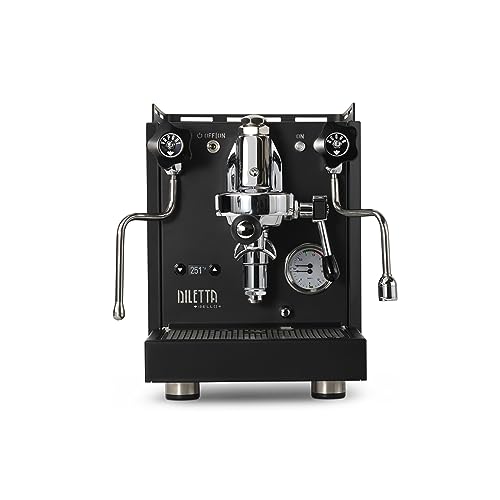
Diletta Bello+ — Best Overall
The Bello+ is what happens when the classic Italian E61 formula is executed without cost-cutting: a heat-exchanger machine with an E61 group, PID temperature control, a shot timer, and programmable pre-infusion, handmade in Italy and finished like furniture. It suits serious home baristas who want café workflow — brew and steam at the same time, a heavy commercial portafilter, and temperature they can set rather than surf. It is the most complete expression of the Italian tradition on this list, and the machine the others are measured against.
Strengths
- E61 group with heat-exchanger design brews and steams simultaneously.
- PID control, shot timer, and programmable pre-infusion as standard equipment.
- Handmade in Italy with fit and finish a class above mass-market rivals.
Trade-offs
- Premium tier pricing and a footprint that needs a dedicated coffee corner.
- Heat-exchanger temperature management still rewards an experienced hand.
- No built-in grinder — budget for a serious separate grinder.
| Spec | Detail (verified) |
|---|---|
| Group | E61 |
| Temperature | PID control |
| Extras | Shot timer, programmable pre-infusion |
| Origin | Handmade in Italy |
The E61 group is the heart of the argument. Its mass of brass holds extraction temperature steady, its mechanical pre-infusion wets the puck gently, and its three-way valve finishes the shot cleanly — a design so right that Italian makers have built around it for over sixty years. Layer modern PID control over that foundation and you get stability the original designers could only chase with technique. Steam from the heat exchanger is available the moment you finish a shot, which changes milk-drink workflow completely: two lattes become a single continuous performance instead of a sequence of waits. In daily use, the Bello+ feels less like an appliance and more like a small café that happens to live in your kitchen. If your budget reaches one machine on this list and your ambitions are café-level, the Diletta Bello+ is the one to reach for.
Ownership notes: the Bello+ rewards the full café routine — filtered water, a cooling flush before the first shot to settle the heat exchanger, weekly backflushing, and a grinder that can hold a fine, consistent setting. Parts follow the E61 standard, so gaskets, screens, and baskets are available from many sources for the long term. This is a buy-once machine in the truest sense: the design is old, proven, and endlessly serviceable, and the modern electronics are layered on top rather than substituted for the fundamentals.
Daily workflow deserves a paragraph of its own, because heat-exchanger machines change how a morning feels. There is no mode switching and no steam queue: you pull a shot for the first cup while the milk for the second is already swirling. The E61’s exposed group also becomes a tactile instrument — you learn its temperature by habit and by the cooling flush ritual, a few seconds of water through the group before the first shot that settles the system into its window. None of this is difficult, but all of it is involving, and that involvement is exactly what buyers at this tier are paying for. The Bello+ does not try to disappear into the kitchen; it anchors a coffee corner and invites you to get better at using it, month after month, with a ceiling high enough that your technique remains the limiting factor for years.
Best for: serious home baristas who want the complete Italian E61 experience with modern control. / Not suited for: beginners, small counters, or anyone wanting a built-in grinder.
Check the current price on Amazon
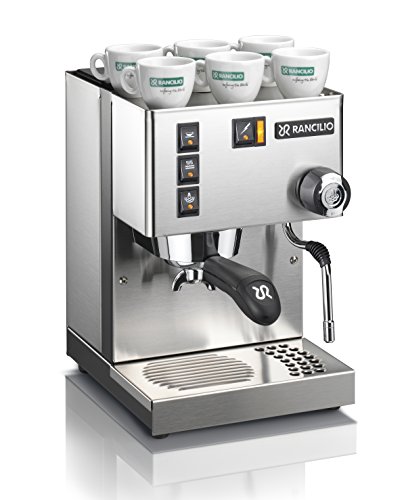
Rancilio Silvia — Best for Purists
Rancilio has built commercial machines since 1927, and the Silvia is that heritage distilled into a single boiler: an iron frame, a brass boiler, a commercial 58mm portafilter, and a steam wand that means business. It suits the purist who wants the Italian café ritual without electronics in the way — and who already owns, or will buy, a grinder that can keep up. Among Italian single-boilers it is the benchmark for build quality, and its owner community is a living repair manual.
Strengths
- Brass boiler and iron frame deliver unmistakably commercial construction.
- Powerful articulating steam wand textures milk to café standard.
- Every wear part is stocked and documented; repairs are home jobs.
Trade-offs
- No factory PID — temperature surfing is part of the ownership ritual.
- Single boiler means brewing and steaming take turns.
- Utilitarian styling that will not decorate your counter by itself.
| Spec | Detail (verified) |
|---|---|
| Portafilter | 58mm commercial style |
| Boiler | Brass, single boiler |
| Frame | Iron with stainless panels |
| Maker | Rancilio, Italy |
The Silvia’s shot quality comes from thermal mass. Once the brass group and boiler are fully warm — give it a proper half hour, or cheat with blank shots — extraction temperature stays put through the pull, and the espresso lands sweet and heavy-bodied in the way Italian espresso is supposed to taste. Steam performance is the other headline: the wand is a scaled café wand, not an appliance accessory, and it will teach you real milk technique because it responds like the real thing. Owners routinely keep Silvias for a decade and more, replacing gaskets and the occasional pump with parts that remain in production. In a market of disposable appliances, that continuity is the most Italian thing about it. The Rancilio Silvia remains the purist’s answer.
One honest caution: the Silvia exposes weak grinders and stale beans mercilessly. Pair it with fresh coffee and a capable burr grinder, learn its temperature rhythm for a fortnight, and it will produce espresso that embarrasses far more expensive setups. Skip those steps and it will produce a daily reminder that you skipped them.
A note on the famous Silvia learning curve, because it is shorter than folklore suggests. The machine asks for two habits: patience at warm-up and a consistent point in the heating cycle to start the shot. Most owners settle both within two weeks, often with help from the enormous written record the community has produced — if a Silvia can do it, someone has documented it. What you receive in exchange is an unusually honest instrument. There is no software smoothing your inputs, so improvements in your grinding, distribution, and tamping show up in the cup immediately and permanently. That feedback loop is why so many long-term home baristas started on a Silvia and why so many, offered an upgrade budget, spend it on a grinder instead and keep the machine.
Best for: purists who want Italian café hardware and lifetime serviceability. / Not suited for: anyone wanting automation or a built-in grinder.
Check the current price on Amazon
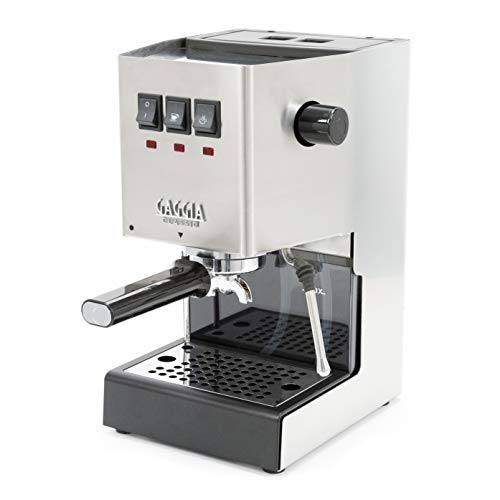
Gaggia RI9380/46 E24 — Best Classic Value
Gaggia is the company that put the pump-driven espresso machine on the map in 1948, and the Classic line is its gift to home users: a traditional Italian boiler machine with a commercial 58mm portafilter and a three-way solenoid valve at the most accessible tier in this guide. This E24 variant in brushed stainless steel is the one to buy for a clean, professional look that matches other stainless appliances. It suits learners and tinkerers equally — forgiving enough to start on, standard enough to modify forever.
Strengths
- Commercial 58mm portafilter and solenoid valve at an entry tier.
- Traditional boiler design, made in Italy, with a huge knowledge base.
- Brushed stainless finish suits modern kitchens and hides wear well.
Trade-offs
- Stock temperature control is basic; consistency is a learned skill.
- Single boiler pacing for milk drinks.
- Drip tray and cup clearance are compact — large mugs need care.
| Spec | Detail (verified) |
|---|---|
| Model | RI9380/46 E24 |
| Finish | Brushed stainless steel |
| Portafilter | 58mm commercial style |
| Valve | Three-way solenoid |
What the Classic formula gets right is the fundamentals-per-dollar ratio. The solenoid valve alone separates it from appliance rivals: it releases pressure after the shot, drying the puck for clean knock-out and allowing detergent backflushing that keeps the group healthy. The group accepts the full 58mm accessory universe, so precision baskets and a bottomless portafilter are future upgrades, not replacement machines. In the cup, a dialed-in Classic produces the dense, bittersweet shot profile that Italian espresso drinkers recognize immediately, and its steam wand — a proper manual wand — will pour latte art once your technique arrives. As a first Italian machine, the Gaggia Classic E24 is very hard to argue with.
Plan on the usual single-boiler rhythm: shot first, steam second, and a short wait while the boiler changes temperature between them. For one or two drinkers that rhythm becomes invisible within a week. For a household of four latte drinkers at breakfast, it becomes the reason to save toward the heat-exchanger class instead — and Gaggia ownership is still the cheapest education in why that upgrade matters.
The E24’s brushed stainless finish is more than cosmetic in a working kitchen. It shrugs off the fingerprints and splashes that show on polished chrome, and it pairs visually with the stainless appliances most kitchens already have. Under the panels, the ownership story is the Classic line’s usual one: a layout a home mechanic can understand, a pump and boiler that are standard service items, and a community that has published a fix for every symptom the machine can develop. It is also worth saying plainly what the Classic is not: it is not a countertop ornament that happens to make coffee, and it is not an automatic. It is a small, honest Italian boiler machine that expects filtered water, a real grinder, and ten minutes of warm-up — and repays all three in the cup.
Best for: learners and tinkerers who want a genuine Italian classic at the friendliest tier. / Not suited for: high-volume milk-drink households or set-and-forget buyers.
Check the current price on Amazon

La Pavoni PC-16 Professional — Best Lever Machine
Before pumps, espresso was lever pressure and human timing, and La Pavoni — founded in Milan in 1905 — still builds that tradition in chrome and brass. The PC-16 Professional is the flagship home lever: a 16-cup capacity, a solid brass boiler, dual frothing systems, and a mounted pressure gauge so you can watch the boiler’s mood. It suits the drinker who wants espresso as a manual craft and a machine that looks like sculpture. It does not suit anyone who wants consistency without practice.
Strengths
- Direct lever control over pressure and flow — no pump between you and the shot.
- Solid brass boiler and chrome finish, made in Italy, built to be inherited.
- Pressure gauge and dual frothing systems add control and flexibility.
Trade-offs
- The steepest learning curve in this guide; the first weeks are tuition.
- Group temperature management is manual and unforgiving of distraction.
- Back-to-back drinks for a group will test your patience and technique.
| Spec | Detail (verified) |
|---|---|
| Model | PC-16 Professional |
| Capacity | 16-cup |
| Boiler | Solid brass, 38 oz |
| Extras | Dual frothing systems, mounted pressure gauge |
A great lever shot has a quality pump owners chase with profiles and pre-infusion settings: a gentle start, a full-pressure middle, and a natural decline as the spring — here, your arm — tires. The PC-16’s larger boiler steadies temperature better than its smaller Europiccola sibling and supports a small round of drinks before it needs a rest. The mounted gauge turns boiler management from folklore into observation. When everything aligns — fresh beans, even tamp, a smooth thirty-second pull — the espresso is famously sweet, syrupy, and quiet, made in near silence. The La Pavoni PC-16 Professional is not the easiest Italian machine to live with, but it may be the most rewarding object on this page.
Be honest with yourself before buying: the lever ritual is the product. If the idea of pulling your own pressure profile sounds like meditation, you will love it for decades. If it sounds like work standing between you and caffeine, choose the Gaggia or the Diletta and be happier.
Technique notes for the PC-16, for buyers who want the full picture. Dose slightly lower than a pump machine’s basket suggests, grind a touch finer, and let the pre-infusion happen by feel: raise the lever, wait for the first drops to gather, then commit to a slow, even pull of about thirty seconds. The gauge tells you when the boiler is in its working band; a damp towel over the group between rounds keeps temperature from climbing during a session. Shots pulled this way have a distinctive softness at the edges — the declining pressure at the end of the stroke spares the puck the harshness that a flat nine-bar profile can extract from the final seconds. It is a flavor signature no machine in this guide duplicates, and for lever devotees it justifies every minute of the learning curve.
Best for: craft-focused drinkers who want the original Italian lever experience at flagship scale. / Not suited for: beginners, rushed mornings, or large households.
Check the current price on Amazon

De’Longhi La Specialista Arte (EC9155M) — Best Guided Italian
De’Longhi, from Treviso, represents the other Italian tradition: engineering that meets the user halfway. The La Specialista Arte wraps manual espresso in guidance — active temperature control, a tamping system that keeps the puck level, and a MyLatteArt wand — inside a slim, handsome body with a built-in grinder. It suits newer Italian-machine buyers who want the ritual without the months of uneven shots, and kitchens where counter depth is precious.
Strengths
- Active temperature control keeps extraction stable shot after shot.
- Guided tamping removes the most common beginner error at the source.
- Slim profile and integrated grinder suit real-world counters.
Trade-offs
- Guidance hardware adds steps that purists will find unnecessary.
- Brew and steam remain sequential, unlike the heat-exchanger class.
- Accessory ecosystem is De’Longhi-specific rather than universal.
| Spec | Detail (verified) |
|---|---|
| Model | EC9155M |
| Temperature | Active temperature control |
| Steam wand | MyLatteArt manual wand |
| Maker | De’Longhi, Italy |
The Arte’s value is repeatability. Temperature stability plus a level tamp means the only variables left are grind and dose — exactly the two a learner should be experimenting with. Milk work is a genuine strength: the wand produces the glossy microfoam that latte art requires, with enough control for a beginner to learn on. Cold-extraction drinks are a modern bonus that fits Italian summer culture surprisingly well. If you want Italian design intelligence applied to the learning curve itself, the De’Longhi La Specialista Arte is the pick.
Long-term, the Arte also works as a bridge machine: owners who master it understand dose, yield, and milk texture well enough to step into a fully manual Italian classic later without fear — and many find they never need to, because the Arte’s ceiling is higher than its friendly face suggests.
Where the Arte quietly outperforms its rivals is in a two-person household. The guidance system means a partner who did not read the manual can still tamp level and pull a stable shot, because the machine enforces the two variables beginners ruin. Morning drinks become a shared routine instead of one expert’s chore. The Arte also handles the modern Italian summer well: its cold-extraction drinks are genuinely refreshing rather than a gimmick, and the slim body leaves room on the counter for the grinder-side accessories — scale, knock box, cups — that a real coffee corner accumulates. Treat it as a complete system rather than a stepping stone and it may be the only machine your household ever needs.
Best for: learners who want Italian style with guided consistency. / Not suited for: purists who reject electronic assistance on principle.
Check the current price on Amazon

De’Longhi Dedica Arte (EC885) — Best Compact Italian
The Dedica Arte answers a very Italian problem: the tiny kitchen. At a fraction of the width of the boiler machines here, it still delivers pump espresso with a manual wand capable of real microfoam — the Arte variant’s whole reason to exist versus the base Dedica. It suits apartment dwellers, office corners, and anyone whose counter cannot host a Silvia. The trade is thermal mass and the full-size portafilter standard; the gain is an Italian espresso ritual that fits almost anywhere.
Strengths
- Slimmest footprint in this guide — fits counters nothing else here can.
- Manual MyLatteArt-style wand textures milk properly, unlike panarello sleeves.
- Fast heat-up suits single morning drinks.
Trade-offs
- Smaller portafilter format limits the accessory universe.
- Thermoblock heating lacks a boiler’s temperature inertia.
- Small tank and drip tray need frequent attention.
| Spec | Detail (verified) |
|---|---|
| Model | EC885 Dedica Arte |
| Design | Slim Dedica body |
| Steam wand | Manual, latte-art capable |
| Maker | De’Longhi, Italy |
Within its class, the Dedica Arte is the connoisseur’s choice precisely because of the wand. Most slim machines fake milk with an auto-frothing sleeve that produces bath foam; the Arte gives you a manual wand and trusts you to learn, and the drinks taste accordingly. Espresso extraction is honest for a thermoblock design — best with the pressurized baskets for everyday beans, and surprisingly lively with fresh coffee and a fine grind. For a studio apartment or a camper kitchen, the De’Longhi Dedica Arte keeps the Italian ritual alive where bigger machines simply cannot go. Our dedicated roundup goes deeper on the category: Best Compact Espresso Machines.
Small-machine compromises are worth naming honestly. The Dedica Arte’s thermoblock will not hold temperature through a long extraction the way the brass classics do, and its smaller baskets are less forgiving of sloppy distribution. In exchange you get a machine that heats in under a minute, fits between a wall and a fruit bowl, and still asks you to steam milk like an adult. For a single drinker making one or two espressos or cappuccinos a day, those compromises are not compromises at all — they are the correct engineering trade-offs, executed by a company that has been miniaturizing espresso since before it was fashionable. Pair it with a compact grinder and the whole Italian ritual fits in a footprint smaller than a cutting board.
Best for: small kitchens that refuse to give up manual Italian espresso. / Not suited for: hobbyists building a 58mm accessory collection.
Check the current price on Amazon
Comparison Table
| Pick | Badge | Key spec | Best for |
|---|---|---|---|
| Diletta Bello+ | Best Overall | E61 group, PID, heat exchanger | Café workflow at home |
| Rancilio Silvia | Best for Purists | Brass boiler, iron frame | Lifetime manual espresso |
| Gaggia Classic E24 | Best Classic Value | 58mm portafilter, solenoid valve | Learners and tinkerers |
| La Pavoni PC-16 | Best Lever Machine | Brass boiler, pressure gauge | Lever craft devotees |
| De’Longhi La Specialista Arte | Best Guided Italian | Active temperature control | Guided learners |
| De’Longhi Dedica Arte | Best Compact Italian | Slim body, manual wand | Tiny kitchens |
How to Choose an Italian Espresso Machine
Choose your tradition first. The boiler classics — Silvia, Gaggia, Diletta — are for people who want to learn espresso as a skill and own a machine for a decade. The lever is for people who want espresso as a practice. The guided De’Longhi machines are for people who want the flavor and the ritual with training wheels that respect their intelligence. None of these is the “wrong” Italy; they are different answers to how much of yourself you want in the cup.
Does “made in Italy” actually change the coffee?
Indirectly, yes. Italian makers build around metal boilers, standard groups, and serviceable layouts because their home market demands machines that last and cafés that cannot stop. The result is thermal stability and longevity, which you taste as consistency. The label alone guarantees nothing — execution does — which is why this list is built from specific models with verified listings, not from flags.
Which Italian machine is best for lattes and cappuccinos?
For back-to-back milk drinks, the heat-exchanger Bello+ stands alone here: steam is ready the second the shot ends. For one or two drinks, the Silvia’s wand is the most café-like, and the La Specialista Arte is the most forgiving teacher. The Dedica Arte pours honest microfoam in a slim body. Match the machine to your drink count, not your drink dreams.
What grinder do Italian machines need?
A burr grinder with fine, repeatable adjustment — the same advice as for any serious machine, doubled. Italian classics are honest instruments; they will show you exactly what your grinder is doing. Budget accordingly, buy fresh beans with roast dates, and weigh your doses. The machine is the stage; the grinder and beans are the performance.
Single boiler, heat exchanger, or thermoblock — which Italian layout fits your mornings?
Single boilers (Silvia, Gaggia) brew, then steam, in sequence — perfect for one or two drinkers, frustrating for a breakfast crowd. A heat exchanger (Bello+) does both at once and is the café workflow transplanted home. Thermoblocks (Dedica Arte) heat in seconds and suit single drinks on tight schedules, trading thermal mass for speed. Count your typical drinks in a row, honestly, and the layout chooses itself.
How much counter and cabinet space do Italian machines need?
More than the product photo suggests. Boiler machines need clearance to lift the tank or open the top, room for the portafilter handle’s swing, and headroom for cups on the warmer. Lever machines need a full arc of vertical space. Measure your counter-to-cabinet height before ordering, and remember the grinder, knock box, and scale all want homes too. The Dedica Arte exists precisely for kitchens where the honest answer to this section is “almost none.”
How to Pull a Proper Italian Espresso at Home
The Italian ritual is specific: a warm machine, a warm cup, a single or double shot pulled in roughly 25 to 30 seconds, drunk standing up, quickly, while the crema is alive. Reproduce it by warming the group and portafilter for at least fifteen minutes (thirty for the brass classics), dosing consistently, distributing the grounds evenly, and tamping level with repeatable pressure. Start the shot and watch the flow: thin and pale means grind finer; dripping and dark means grind coarser. Taste, adjust one variable, and write the recipe down. For milk drinks, steam immediately after the shot on single-boiler machines, purge the wand before and after, and pour while the milk is glossy. Finish the Italian way: rinse the portafilter, wipe the wand, and leave the machine clean enough for tomorrow’s first shot.
How to Dial In an Italian Machine During Your First Week
Day one is for plumbing and patience, not judgment. Fill the tank with filtered water, run a full tank’s worth of blank shots and steam purges through the machine to flush the boiler and heat every gram of metal, and resist evaluating anything you taste. Day two, pick one fresh coffee — a medium or traditional Italian-style roast forgives the most — and fix your dose by weight. Pull, time, and taste three shots, changing nothing. You are establishing a baseline, not chasing perfection.
Days three and four belong to the grinder. If shots run under twenty seconds and taste thin and sour, grind finer in small steps until the flow turns to a slow, honeyed stream and the taste balances. If shots choke or pass thirty-five seconds tasting bitter and dry, step coarser. Change one step at a time and pull a full shot after each change; grinders retain grounds, and impatience here is why beginners chase their tails for a month. By day five, most owners are inside the tasty window. Day six is milk day: practice steaming water with a drop of soap to learn the vortex before sacrificing milk, then texture small pitchers and pour immediately. Day seven, write the recipe down — dose, yield, time, grind setting — and tape it inside a cabinet door. From that day forward, the machine is dialed, the ritual is yours, and every future bag of beans is a small, pleasant adjustment rather than a new apprenticeship.
Common Buying Mistakes
- Buying the badge instead of the boiler. “Italian” styling on a thermoblock appliance is not the tradition this guide is about; check the hardware.
- Under-buying the grinder. Every classic here will expose a weak grinder within the first bag of beans.
- Choosing a lever for convenience. Levers reward patience and punish haste; buy one for the craft or not at all.
- Ignoring warm-up time. Brass classics need real warm-up; if your mornings cannot allow it, the guided and thermoblock picks exist for a reason.
- Skipping the descale schedule. Italian boilers last decades with water care and die early without it.
Final Recommendation
If the budget allows one definitive machine, the Diletta Bello+ is the complete Italian statement: E61 soul, modern control, simultaneous steam. Purists on a saner budget should buy the Rancilio Silvia and a great grinder. Learners and tinkerers start best with the Gaggia Classic E24. Romantics get the La Pavoni, guided learners get the La Specialista Arte, and small kitchens get the Dedica Arte — Italy, in every size. For adjacent views of the same market, see Best Commercial Espresso Machines For Home Use, Best Commercial Single Group Espresso Machines, and Best Commercial Quality At Home Espresso Machines.
What Is the Italian Espresso Tradition, Exactly?
It helps to know what the tradition actually specifies, because “Italian espresso” is a method, not just a mood. The classic recipe is a single or double shot — roughly seven or fourteen grams of coffee — extracted with hot water under pressure in about twenty-five seconds, served small and drunk fast. Italian blends traditionally lean darker, often with a portion of robusta for crema and body, and the drink is priced and paced as a daily ritual rather than an event. The machines in this guide were all designed inside that culture, which is why they prioritize boiler stability, steam readiness, and repairability over cup-warming gimmicks and drink menus.
The tradition also explains the hardware divide in this list. The lever is the original 1948-era approach, refined. The E61 group is the 1961 answer to temperature stability. The single-boiler Silvia and Gaggia are the café’s small siblings. And De’Longhi’s guided machines are the tradition adapting to a generation that wants the ritual without the apprenticeship. Understanding which chapter of that story you want to live in is the fastest way to choose among six genuinely good machines.
How to Care for an Italian Machine So It Ages Like One
Italian machines age gracefully when their owners follow the café calendar. Daily: purge and wipe the steam wand, empty and rinse the drip tray, and knock out pucks promptly. Weekly: backflush with water on solenoid-equipped machines, wash the baskets and portafilter in hot water, and clean the shower screen. Monthly: backflush with espresso detergent, soak the portafilter parts, and brush out the grinder. Seasonally: descale according to your water hardness — more often with hard water, less with soft — and check the group gasket for the tell-tale signs of hardening, drips during extraction or a handle that locks too far. Keep filtered water in the tank at all times; scale is the one enemy no Italian boiler forgives. Owners who keep this rhythm are the ones passing twenty-year-old machines to their kids, which is the most Italian outcome of all.
Should You Buy a Vintage or Used Italian Machine?
The romance is understandable: a gleaming vintage lever or a retired café single-group, restored, making espresso in a home kitchen. Italy’s machines are unusually good candidates for this because they were built to be serviced, and parts for the major makers circulate for decades. But go in with clear eyes. A used boiler machine almost always needs, at minimum, a full descale, new group and boiler gaskets, a shower screen, and a safety-valve check before its first shot — and a vintage lever may need piston seals that only a specialist stocks. Budget that service into the purchase price, insist on seeing the machine heat and hold pressure, and check inside the boiler if the seller allows it; heavy scale is the silent deal-breaker. For most readers, a new machine from this list with a warranty is the wiser romance. For the mechanically confident, a serviced classic can be the best value in espresso — just buy the service before you buy the story.
What Do Italian Machines Cost to Own Over Five Years?
Beyond the purchase, ownership costs are modest but real, and planning for them prevents the resentment that kills good machines. Consumables: detergent for backflushing, descaler or in-tank filters, and replacement group gaskets roughly yearly on the classics. Wear items over a five-year horizon typically include a pump on heavily used vibration-pump machines and steam-valve seals; both are standard parts at standard prices on every boiler machine here. The guided and thermoblock models trade some of that mechanical wear for electronics, which last well but are serviced as assemblies rather than components. The largest running cost, by far, is coffee itself — a household drinking two doubles a day will spend more on fresh beans in a year than on a decade of gaskets. That arithmetic is the final argument for the Italian approach: when the coffee budget dwarfs the maintenance budget, the machine’s job is simply to be worthy of the beans, every single morning.
A closing thought for anyone torn between two picks: the differences at this level are about relationship, not quality. Every machine here will make espresso you are proud to serve. The question is whether you want that espresso to arrive through meditation (the lever), through mastery (the classics), through engineering (the Bello+), or through guidance (the De’Longhi pair). Italy spent a century building all four roads to the same small cup. Choose the road you will actually enjoy traveling every morning, keep the water filtered and the beans fresh, and the destination takes care of itself.
Frequently Asked Questions
Are Italian espresso machines better than other machines?
They are better at a specific philosophy: metal boilers, standard parts, and serviceable, manual-first design. Swiss and German automatics are better at push-button convenience, and Australian-designed Breville machines are better at guided speed. “Better” depends on which tradition matches how you want to make coffee.
What is an E61 group head?
A heavy brass group design from 1961 that circulates boiler water to hold temperature, provides mechanical pre-infusion, and finishes shots through a three-way valve. It remains the reference standard for prosumer machines, and it anchors the Bello+ in this guide.
Do Italian machines need special coffee beans?
No — they need fresh beans, ideally with a visible roast date, ground finely and consistently. Traditional Italian roasts are darker and forgiving; lighter modern roasts are brighter but demand tighter temperature control, which the PID-equipped Bello+ handles best here.
How long will an Italian machine last?
The boiler classics are routinely kept for ten to twenty years because their gaskets, pumps, and valves are replaceable standard parts. Longevity assumes filtered water and scheduled descaling; neglect shortens any machine’s life.
Do Italian machines hold their value?
Better than most appliances, because the boiler classics remain serviceable and desirable for decades; a maintained Silvia or La Pavoni sells quickly on the secondhand market. Buy new for the warranty and the full lifespan, and the value story simply continues from a higher starting point.
Is a lever machine a good first espresso machine?
For a patient hobbyist, yes — nothing teaches extraction faster. For someone who wants reliable lattes in week one, no: start with the Gaggia or the guided De’Longhi, and let the lever be a joyful second machine.
Do Italian machines work for American-style milk drinks and larger cups?
Yes — the boiler machines here steam enough milk for full-size lattes, and the Bello+ does it back-to-back. Watch cup clearance on the compact Gaggia and Dedica models, where a tall mug may need the drip tray removed. The espresso itself does not care what you pour it into; the ritual adapts.
Why are some famous Italian brands missing from this list?
A few boutique Italian makers sell only through specialty dealers and had no verifiable machine listing in Amazon’s catalog when we checked, so we could not link them honestly. We would rather recommend six machines we verified than name-drop brands we could not confirm. The broader home-use picture is in Best Commercial Espresso Machines For Home Use.


