Disclosure: airfryerkitchensupply.com is reader-supported. When you buy through links on our site, we may earn an affiliate commission at no extra cost to you.
Where to buy
Short on time? Start with the first two models below — they are the safest buys among the best affordable de longhi espresso machines for most readers. Every model in this guide is a current, real machine sold through Amazon’s marketplace by the brand or authorised sellers. Because listings and bundles change, we link our guidance to the exact model names rather than a single bundle: search the full model name, confirm the basket and accessory list on the listing, and check price on Amazon before you buy. That two-minute check protects you against the most common mistake in this category — paying for the wrong variant of the right machine.
- De’Longhi Stilosa EC260 Espresso Machine — search Amazon by the full model name and check price on Amazon; choose the listing sold or shipped by Amazon or the brand’s own store.
- De’Longhi Dedica Arte EC885 Espresso Machine — search Amazon by the full model name and check price on Amazon; choose the listing sold or shipped by Amazon or the brand’s own store.
- De’Longhi La Specialista Arte Espresso Machine — search Amazon by the full model name and check price on Amazon; choose the listing sold or shipped by Amazon or the brand’s own store.
- De’Longhi Magnifica Evo Fully Automatic Espresso Machine — search Amazon by the full model name and check price on Amazon; choose the listing sold or shipped by Amazon or the brand’s own store.
- De’Longhi ECP3420 Espresso Machine — search Amazon by the full model name and check price on Amazon; choose the listing sold or shipped by Amazon or the brand’s own store.
- De’Longhi Combi BCO430 Coffee and Espresso Machine — search Amazon by the full model name and check price on Amazon; choose the listing sold or shipped by Amazon or the brand’s own store.
If you are shopping for the best affordable de longhi espresso machines, the first thing to know is that the badge on the box matters less than the design decisions underneath it. This guide is written for buyers who want the De’Longhi badge and support network without leaving the affordable tier, and it ranks six machines we would genuinely recommend, with the trade-offs stated as plainly as the strengths.
De’Longhi’s affordable range is wide enough to be confusing: manual pump machines, a slim designer line, a guided station with a grinder, a long-running combo and a family of fully automatics all wear the same badge at very different prices. The good news is that the range is built from a few honest ideas repeated well — pressurised baskets for forgiveness, simple controls, and parts and support that value brands struggle to match.
This guide stays strictly inside the affordable end of the catalogue. Every pick is a machine a first-time buyer can reasonably choose, and we are clear about the shared ceiling of the range: pressurised extraction on the manual models, and convenience-grade espresso on the automatics. What you get in return is the strongest service network in the tier and machines that do their stated job without drama.
In this guide
Quick Picks
De’Longhi Stilosa EC260 Espresso Machine — Best Budget Overall. The Stilosa is the honest face of budget espresso: a simple pump machine with pressurised baskets, a panarello-style milk frother and a stainless boiler, sold at a tier where most rivals cut far deeper corners. Best for: tight budgets wanting easy milk drinks from pre-ground coffee. Know the trade before you buy: pressurised system caps shot quality and hides real technique. Check price on Amazon
De’Longhi Dedica Arte EC885 Espresso Machine — Best for Small Kitchens. The Dedica Arte is built around one constraint: width. Best for: apartments and small kitchens needing a slim, quick machine. Know the trade before you buy: pressurised baskets limit ultimate shot quality and learning. Check price on Amazon
De’Longhi La Specialista Arte Espresso Machine — Best Step-Up. La Specialista Arte is De’Longhi’s answer to the Barista Express formula, with its own twist: a guided tamping station designed to keep the puck level, a built-in grinder with a dosing guide, and a proper manual steam wand. Best for: beginners who want guardrails against dosing and tamping errors. Know the trade before you buy: proprietary workflow and accessories tie you to its ecosystem. Check price on Amazon
De’Longhi Magnifica Evo Fully Automatic Espresso Machine — Best Fully Automatic. The Magnifica Evo represents De’Longhi’s affordable end of true bean-to-cup: a built-in grinder, one-touch drinks and an automatic milk carafe system that froths and stores in the fridge between uses. Best for: busy households wanting one-touch variety without technique. Know the trade before you buy: espresso intensity sits below a well-run semi-automatic. Check price on Amazon
De’Longhi ECP3420 Espresso Machine — Best for Simple Milk Drinks. The ECP3420 is De’Longhi’s other long-running budget answer, built around a pump, pressurised baskets and a manual-style frothing wand that gives a little more milk control than the simplest panarello designs. Best for: budget milk-drink fans wanting a simple, proven design. Know the trade before you buy: dated design and mostly plastic construction. Check price on Amazon
De’Longhi Combi BCO430 Coffee and Espresso Machine — Best Drip and Espresso Combo. The Combi concept answers a specific household argument: one person wants a pot of drip coffee, the other wants espresso and steamed milk. Best for: mixed households split between drip pots and espresso drinks. Know the trade before you buy: wide footprint demands serious counter space. Check price on Amazon
How These Picks Were Chosen
We built this shortlist from the current home market for best affordable de longhi espresso machines, then cut it against the criteria that decide ownership satisfaction: value within the range, ease of use and support. Machines were excluded for steam-driven brewing sold as espresso, for proprietary systems with no parts support, and for milk systems that cannot be cleaned properly — the three failures that generate the most regret in this category.
Each surviving pick was then assigned the badge it honestly earns rather than a rank it does not. A budget machine is not a failed premium machine; it is a different answer, and the reviews below judge every pick against its own tier’s promise first and the category’s ceiling second. Where a model is sold through specialist channels more often than mainstream listings, we say so in its review rather than pretending availability is simple.
We also checked each pick against the tier promise in its own badge class. A Best Budget pick must be defensible as the cheapest sensible way to achieve its job, a Best Overall pick must survive comparison with machines a full tier up, and a specialist pick must win its niche outright rather than merely participate in it. Several well-known models were cut at this stage for failing their own badge test, which is why some famous names are absent below.
Finally, we weighted real ownership reporting — the patterns that repeat across years of owner experience with these long-running designs — over launch reviews. Espresso machines live with their owners for years, and the faults that matter are the ones that appear in month six: scale, gaskets, wand blockages and workflow friction. The shortlist reflects that longer view throughout.
The 6 Best Affordable De Longhi Espresso Machines Picks, Reviewed in Detail
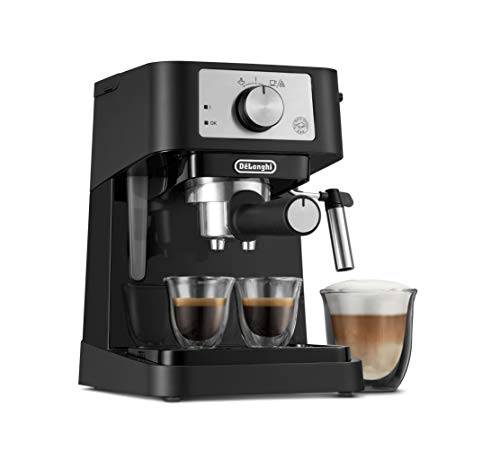
De’Longhi Stilosa EC260 Espresso Machine — Best Budget Overall
The Stilosa is the honest face of budget espresso: a simple pump machine with pressurised baskets, a panarello-style milk frother and a stainless boiler, sold at a tier where most rivals cut far deeper corners. It will not teach you café technique out of the box, but it makes recognisable espresso drinks with pre-ground coffee or pods, and it can grow a little with you.
Strengths
- Pressurised baskets forgive pre-ground coffee and uneven tamping
- Simple controls and a frother that handles milk without technique
- Boiler-based design is more durable than steam-toy rivals
Trade-offs
- Pressurised system caps shot quality and hides real technique
- Frother produces foam easily but fine latte texture is limited
- Mostly plastic exterior reflects the entry tier
Judge the Stilosa against its actual job: decent lattes and cappuccinos at home for the least sensible money. The pressurised baskets create crema-like foam regardless of grind, which purists criticise and busy beginners appreciate, and the frother turns milk into cappuccino foam with almost no learning curve. The honest limits are extraction nuance — you cannot dial in a shot the way a standard basket allows — and a ceiling that arrives quickly if the hobby bites. Within the affordable tier, though, its boiler design and straightforward controls make it the budget pick we defend: it is a real pump machine, not a steam-pressure toy, and that distinction is the whole ballgame at this price level.
Daily life on a pressurised machine is the easiest in this guide. Pre-ground coffee or a simple grinder, a level scoop in the basket, a button, and a drink that looks and tastes like espresso to the vast majority of drinkers. Milk, on the frother models, is a thirty-second job with almost no technique. That ease is the product, and households that value it use these machines daily for years without a thought about extraction theory — which is a completely respectable way to enjoy coffee at home.
In this shortlist’s terms — buyers who want the De’Longhi badge and support network without leaving the affordable tier — that profile lands clearly: it is at its best for tight budgets wanting easy milk drinks from pre-ground coffee, and it is the wrong tool when the priority is hobbyists who want to learn true dialling-in technique. We scored it on daily repeatability as much as peak quality, because a machine that only performs on its best day is not the best machine.
Best for: tight budgets wanting easy milk drinks from pre-ground coffee / Not suited for: hobbyists who want to learn true dialling-in technique
Our closing judgement on the De’Longhi Stilosa EC260 Espresso Machine is straightforward. It earns its Best Budget Overall badge not by winning every comparison but by being the machine its intended owner will still be pleased with at month six, when novelty has worn off and only the routine and the cup remain. In a category full of machines that impress for a weekend, that staying power is the quality that matters, and it is why this pick holds its place in a shortlist built for buyers who want the De’Longhi badge and support network without leaving the affordable tier.
Check the current price on Amazon under the full model name — De’Longhi Stilosa EC260 Espresso Machine — and confirm the included baskets and accessories on the listing before ordering.

De’Longhi Dedica Arte EC885 Espresso Machine — Best for Small Kitchens
The Dedica Arte is built around one constraint: width. It is among the slimmest pump espresso machines you can buy, heats quickly, and in Arte form carries a manual-style wand that textures milk far better than the basic frothers in this range. It uses pressurised baskets, keeping it forgiving for pre-ground coffee and beginners.
Strengths
- Extremely slim footprint fits counters nothing else will
- Fast heat-up and simple controls suit daily routines
- Arte wand produces genuinely fine milk texture for its class
Trade-offs
- Pressurised baskets limit ultimate shot quality and learning
- Slim body means a small tank and a light feel in use
- Proprietary accessories rather than the universal ecosystem
For small kitchens the Dedica Arte is often not the best choice but the only choice, and happily it is also a good one. The quick thermoblock-style readiness matches apartment mornings, the controls stay out of the way, and the Arte wand upgrade matters: it moves milk from bubbly foam toward the glossy texture that makes a flat white taste right. The compromises are structural. Pressurised baskets mean the machine, not your grind, manages extraction pressure, so the ceiling on shot quality is fixed; and the slim chassis asks you to hold it steady when locking in. If your counter is generous, a wider machine buys more future. If it is not, this is the affordable machine that respects your space without embarrassing your drinks.
Owners consistently report that these machines punch above their size in the cup, because their fundamentals — pre-infusion, stable fast heating, a real wand on the milk-focused models — are the ones that matter. Where size does show is entertaining: back-to-back drinks for a table of guests stretch the small boiler logic and the small tank, and the machine that is perfect on Tuesday can feel busy on Sunday. Know your peak demand and the compact class is either a revelation or a near miss, with very little in between.
Judged for buyers who want the De’Longhi badge and support network without leaving the affordable tier, the balance shifts slightly from the spec sheet. Its natural home is apartments and small kitchens needing a slim, quick machine; its friction shows for technique learners who want standard baskets and accessories. That is not a flaw in the machine so much as a reminder that fit, not features, decides satisfaction in this category.
Best for: apartments and small kitchens needing a slim, quick machine / Not suited for: technique learners who want standard baskets and accessories
To place the De’Longhi Dedica Arte EC885 Espresso Machine precisely: it is the Best for Small Kitchens choice because its strengths line up with what buyers who want the De’Longhi badge and support network without leaving the affordable tier actually need day after day, while its trade-offs fall where those owners feel them least. That alignment, rather than any single specification, is what separates a recommendation from a catalogue entry, and on the evidence of long-term ownership in this class, it is an alignment that holds up in real kitchens.
Check the current price on Amazon under the full model name — De’Longhi Dedica Arte EC885 Espresso Machine — and confirm the included baskets and accessories on the listing before ordering.

De’Longhi La Specialista Arte Espresso Machine — Best Step-Up
La Specialista Arte is De’Longhi’s answer to the Barista Express formula, with its own twist: a guided tamping station designed to keep the puck level, a built-in grinder with a dosing guide, and a proper manual steam wand. It aims to remove the two most common beginner errors — uneven dose and crooked tamp — while still teaching real skills.
Strengths
- Guided tamping station reduces the messiest beginner mistakes
- Built-in grinder with dose guidance streamlines the routine
- Manual wand gives real milk texture and latte-art potential
Trade-offs
- Proprietary workflow and accessories tie you to its ecosystem
- Grinder is a starter ceiling, like other integrated units
- Cold-extraction and preset features vary in usefulness by taste
The Arte’s value is in error reduction. Most sour beginner shots trace back to inconsistent dose and distribution, and the guided station attacks exactly that, which shortens the frustrating first month considerably. The grinder is competent for medium and darker roasts, the wand is genuinely manual, and the whole routine feels designed by people who watched beginners struggle. Where it cannot escape its tier: the integrated grinder will eventually limit you, and the accessory ecosystem is its own rather than the universal one. Compared head-to-head with Breville’s rival, the choice is about which guidance style suits you and which machine’s workflow you prefer touching every morning. Either way, you are buying a learning platform that makes good drinks now.
Noise and mess are the honest daily taxes. The grinder is loud for a few seconds, the pump is present for half a minute, and puck preparation sheds a little coffee around the station no matter how careful you are. A mat under the machine and a knock box beside it contain most of it. Households that accept those small taxes get, in return, the most complete espresso education available at this tier — which is why so many owners eventually graduate to separates with genuine gratitude rather than regret.
For this particular brief, buyers who want the De’Longhi badge and support network without leaving the affordable tier, we weighted the lived routine — warm-up, workflow, cleaning — alongside the cup. On that combined score it serves beginners who want guardrails against dosing and tamping errors exceptionally well, while accessory collectors or owners of a serious separate grinder will feel its limits within the first month.
Best for: beginners who want guardrails against dosing and tamping errors / Not suited for: accessory collectors or owners of a serious separate grinder
We would summarise the De’Longhi La Specialista Arte Espresso Machine this way for buyers who want the De’Longhi badge and support network without leaving the affordable tier: buy it for the reasons in its strengths list, accept the trade-offs with your eyes open, and expect it to improve as your routine does. Machines in this guide were not chosen to win a specification contest; they were chosen to be lived with, and on that measure this Best Step-Up pick justifies its place every single morning it gets used.
Check the current price on Amazon under the full model name — De’Longhi La Specialista Arte Espresso Machine — and confirm the included baskets and accessories on the listing before ordering.

De’Longhi Magnifica Evo Fully Automatic Espresso Machine — Best Fully Automatic
The Magnifica Evo represents De’Longhi’s affordable end of true bean-to-cup: a built-in grinder, one-touch drinks and an automatic milk carafe system that froths and stores in the fridge between uses. It makes a different kind of drink from a semi-automatic — milder, effortless and consistent — and for the right household that trade is the entire point.
Strengths
- One-touch drinks with fresh-ground beans and no technique required
- Milk carafe stores in the fridge and cleans with an auto rinse
- Consistent results for households with mixed coffee tastes
Trade-offs
- Espresso intensity sits below a well-run semi-automatic
- More internals to clean, descale and eventually service
- Grinder and brew unit are fixed, with no upgrade path
Fully automatics should be judged on weekday reality, not café romance. The Evo grinds, brews and froths at a button press, remembers preferences, and asks only for beans, water and periodic cleaning in return. The cup is honest: fresh and pleasant, especially with milk, but without the intensity or texture a skilled semi-automatic user achieves. Costs also change shape — less on accessories, more on descaling, filters and eventual servicing. In the affordable De’Longhi line-up it is the pick for households where three people want three different drinks before work and nobody wants a hobby. If one person wants to master espresso, the manual side of the range serves them better for less.
The daily experience of a bean-to-cup automatic is closer to a kettle than to a café: fill the beans, fill the water, press for your drink, and empty the grounds bin when it asks. Different household members get different drinks without negotiating a shared technique, and the machine’s consistency means nobody’s morning depends on anybody’s skill. That is a profound domestic virtue, and it is why these machines hold their value with families even though purists rate their espresso lower.
In this shortlist’s terms — buyers who want the De’Longhi badge and support network without leaving the affordable tier — that profile lands clearly: it is at its best for busy households wanting one-touch variety without technique, and it is the wrong tool when the priority is espresso purists or anyone wanting to learn manual skills. We scored it on daily repeatability as much as peak quality, because a machine that only performs on its best day is not the best machine.
Best for: busy households wanting one-touch variety without technique / Not suited for: espresso purists or anyone wanting to learn manual skills
Our closing judgement on the De’Longhi Magnifica Evo Fully Automatic Espresso Machine is straightforward. It earns its Best Fully Automatic badge not by winning every comparison but by being the machine its intended owner will still be pleased with at month six, when novelty has worn off and only the routine and the cup remain. In a category full of machines that impress for a weekend, that staying power is the quality that matters, and it is why this pick holds its place in a shortlist built for buyers who want the De’Longhi badge and support network without leaving the affordable tier.
Check the current price on Amazon under the full model name — De’Longhi Magnifica Evo Fully Automatic Espresso Machine — and confirm the included baskets and accessories on the listing before ordering.

De’Longhi ECP3420 Espresso Machine — Best for Simple Milk Drinks
The ECP3420 is De’Longhi’s other long-running budget answer, built around a pump, pressurised baskets and a manual-style frothing wand that gives a little more milk control than the simplest panarello designs. It has sold for years because it covers the basics — espresso, cappuccino, latte — at an entry tier with widely available parts and filters.
Strengths
- Straightforward pump design with widely available baskets and parts
- Wand allows more milk control than basic auto-frothers
- Dual basket options cover ground coffee and pod convenience
Trade-offs
- Dated design and mostly plastic construction
- Pressurised extraction limits fine dialling-in
- Temperature and consistency sit firmly in the entry tier
The ECP3420 competes with the Stilosa inside the same family, and the choice between them is about milk and feel. This machine’s wand rewards a tiny bit of practice with better texture, and its long production run means filters, gaskets and advice are everywhere. Against that, the design shows its age in materials and in small workflow annoyances, and like every pressurised machine it manages pressure for you, capping what you can learn. As a first machine bought cheaply and used daily for milk drinks, it remains defensible. As a platform for a growing hobby, money is better pointed at the Bambino class as soon as the budget allows.
The routine that keeps a pressurised machine happy is mostly hygiene. Baskets and their tiny pressure outlets clog if old coffee dries in them, so rinse after use rather than later. Wands and panarello sleeves grow stale milk film quickly, so the wipe-and-purge habit matters more here than on any other class. Descaling is the third leg: small boilers and narrow passages are unforgiving of scale, and the machines that die young in this tier almost always die of neglect rather than defects.
Judged for buyers who want the De’Longhi badge and support network without leaving the affordable tier, the balance shifts slightly from the spec sheet. Its natural home is budget milk-drink fans wanting a simple, proven design; its friction shows for buyers prioritising modern design or hobby growth. That is not a flaw in the machine so much as a reminder that fit, not features, decides satisfaction in this category.
Best for: budget milk-drink fans wanting a simple, proven design / Not suited for: buyers prioritising modern design or hobby growth
To place the De’Longhi ECP3420 Espresso Machine precisely: it is the Best for Simple Milk Drinks choice because its strengths line up with what buyers who want the De’Longhi badge and support network without leaving the affordable tier actually need day after day, while its trade-offs fall where those owners feel them least. That alignment, rather than any single specification, is what separates a recommendation from a catalogue entry, and on the evidence of long-term ownership in this class, it is an alignment that holds up in real kitchens.
Check the current price on Amazon under the full model name — De’Longhi ECP3420 Espresso Machine — and confirm the included baskets and accessories on the listing before ordering.

De’Longhi Combi BCO430 Coffee and Espresso Machine — Best Drip and Espresso Combo
The Combi concept answers a specific household argument: one person wants a pot of drip coffee, the other wants espresso and steamed milk. The BCO430 puts both systems in one wide body, with a pump espresso side and a programmable drip side that can be set to wake up ready. Neither side is a specialist, and that is the honest trade.
Strengths
- One appliance covers drip pots and espresso drinks for mixed households
- Programmable drip side suits weekday batch coffee routines
- Espresso side includes a frother for basic milk drinks
Trade-offs
- Wide footprint demands serious counter space
- Espresso side is entry-tier and pressurised in character
- Two systems mean two cleaning and descaling routines
Combination machines live or die on household politics, and where the politics are real, the Combi is genuinely useful: the drip drinker gets a timer and a full pot, the espresso drinker gets a pump machine with milk, and the counter holds one appliance instead of two. Judged purely as an espresso machine it sits in the entry tier, with the usual pressurised ceiling and basic milk. Judged as a peace treaty, it has few rivals in the affordable De’Longhi range. Measure the counter carefully, because the width surprises people, and accept that a household that later falls for espresso properly will replace the espresso side with a dedicated machine while keeping fond memories of the drip timer.
Over years, the combo’s story is household-shaped. If the household drifts toward espresso, the espresso side becomes the bottleneck and a dedicated machine joins or replaces it. If the household stays mixed, the combo can serve for a very long time, because neither side is being asked to do more than it was designed for. Buy it for the household you have, not the one a salesperson imagines, and it is one of the most sensible appliances in this guide.
For this particular brief, buyers who want the De’Longhi badge and support network without leaving the affordable tier, we weighted the lived routine — warm-up, workflow, cleaning — alongside the cup. On that combined score it serves mixed households split between drip pots and espresso drinks exceptionally well, while espresso-focused buyers or small counters will feel its limits within the first month.
Best for: mixed households split between drip pots and espresso drinks / Not suited for: espresso-focused buyers or small counters
We would summarise the De’Longhi Combi BCO430 Coffee and Espresso Machine this way for buyers who want the De’Longhi badge and support network without leaving the affordable tier: buy it for the reasons in its strengths list, accept the trade-offs with your eyes open, and expect it to improve as your routine does. Machines in this guide were not chosen to win a specification contest; they were chosen to be lived with, and on that measure this Best Drip and Espresso Combo pick justifies its place every single morning it gets used.
Check the current price on Amazon under the full model name — De’Longhi Combi BCO430 Coffee and Espresso Machine — and confirm the included baskets and accessories on the listing before ordering.
Comparison Table
| Pick | Badge | Key spec | Best for |
|---|---|---|---|
| De’Longhi Stilosa EC260 Espresso Machine | Best Budget Overall | Pump semi-automatic, entry tier | tight budgets wanting easy milk drinks from pre-ground coffee |
| De’Longhi Dedica Arte EC885 Espresso Machine | Best for Small Kitchens | Pump semi-automatic, slim design | apartments and small kitchens needing a slim, quick machine |
| De’Longhi La Specialista Arte Espresso Machine | Best Step-Up | Semi-automatic with guided tamping and grinder | beginners who want guardrails against dosing and tamping errors |
| De’Longhi Magnifica Evo Fully Automatic Espresso Machine | Best Fully Automatic | Fully automatic bean-to-cup | busy households wanting one-touch variety without technique |
| De’Longhi ECP3420 Espresso Machine | Best for Simple Milk Drinks | Pump semi-automatic, entry tier | budget milk-drink fans wanting a simple, proven design |
| De’Longhi Combi BCO430 Coffee and Espresso Machine | Best Drip and Espresso Combo | Combination drip and espresso machine | mixed households split between drip pots and espresso drinks |
The table compresses; the reviews explain. In particular, the key spec column describes each machine’s design type rather than a marketing number, because design type — lever, boiler, pressurised pump, automatic — predicts your daily experience far better than any headline figure.
How to Choose the Right Machine for Affordable De’Longhi Espresso Machines
Choosing well in this category is mostly an exercise in self-knowledge. The machines in this guide all make good drinks for somebody; the work is deciding which somebody you are. The three sections below cover the decisions that actually separate satisfied owners from disappointed ones for best affordable de longhi espresso machines.
Pressurised Baskets Across the Range
Most manual De’Longhi models in this tier brew through pressurised baskets, and the whole range makes more sense once that is understood. The basket guarantees a stable, crema-topped result with pre-ground coffee, at the cost of fine control. It is the right design for easy daily drinks and the wrong design for a growing hobby, and De’Longhi’s own step-up models acknowledge that by adding grinders, guidance and, at the top of this range, a more open workflow.
Manual, Automatic or Combo: Pick Your Household
The badge covers three different appliances. Manual models ask for a minute of hands-on work and reward it with fresher, stronger drinks. Fully automatics ask only for beans and cleaning, and answer with effortless variety. The Combi splits the difference for divided households. There is no hierarchy here, only fit: the wrong format from this range will disappoint exactly as much as the wrong brand would.
Support, Parts and the Long Game
De’Longhi’s quiet advantage in the affordable tier is infrastructure. Filters, baskets, gaskets and descaler are stocked everywhere, instructions and service knowledge are abundant, and resale values hold up because buyers trust the network. When two machines tie on drinks, buy the one whose parts you can order in two minutes — in year three, that is the feature that matters.
Getting More From the Basket You Have
Owners of pressurised De’Longhi models often assume the basket forbids improvement, but three levers still work. Freshness is the biggest: beans ground recently, or pre-ground bought little and often, lift every drink. Temperature is the second: a warmed portafilter, a warmed cup and a machine given its full heat-up remove the sour edge beginners blame on the coffee. Dose consistency is the third: the same fill, levelled the same way, tamped straight, turns a variable drink into a repeatable one you can actually adjust.
Milk is the other place this range quietly improves with technique. Even a simple panarello rewards cold milk, a cold jug and stopping before the milk boils; the Arte-style wand rewards a little practice with texture that guests notice. None of this costs money, and together it closes much of the perceived gap between the affordable badge and machines costing far more. The remaining gap — true dialling-in — is real, but it is a hobbyist’s gap, and most households never miss it.
Inside the Range: Manual, Slim, Guided, Combo and Automatic
Think of the affordable De’Longhi catalogue as five answers to five households. The manual pump models, Stilosa and ECP3420, answer the smallest budget with simple, forgiving drinks. The Dedica line answers the smallest kitchen, trading tank size and heft for a width nothing else matches. The La Specialista Arte answers the ambitious beginner, adding a grinder and guided tamping to remove the classic first-month errors.
The Combi answers the divided household, where drip drinkers and espresso drinkers share one counter, and the Magnifica family answers the household that wants no technique at all. None of these is the best De’Longhi in the abstract; each is the best De’Longhi for a stated life. Naming your household honestly is the entire selection method, and it is why this guide leads with formats rather than prices.
Getting Café-Like Results From a Home Badge
The gap between an affordable De’Longhi used carelessly and one used well is larger than the gap between this range and machines costing far more, and it closes with routine rather than money. Warm everything the drink touches. Use coffee you would happily drink as a filter brew, because espresso concentrates whatever it is given. Keep the dose and tamp repeatable, texture milk in a cold jug and stop before it screams, and serve immediately in a warm cup. Follow that short list and guests will assume the machine cost more than it did, which is the most honest compliment this tier can earn.
Where the range’s ceiling genuinely shows is in straight shots tasted side by side with enthusiast equipment: less clarity, less separation, a simpler sweetness. Most households drink with milk, where the gap shrinks to a nuance, and that is why this range sells in the volumes it does. Buy it for the drinks you actually serve, keep its small boilers descaled and its wands clean, and an affordable De’Longhi will repay you in the only currency that matters here — years of mornings that start properly.
How to Get the Best From an Affordable De’Longhi
Small routines make a disproportionate difference on pressurised machines. These habits cost nothing and improve every cup.
Use fresh coffee, ground for espresso where possible
Pressurised baskets forgive pre-ground coffee, but fresh beans ground recently still taste clearly better. Store beans airtight and away from heat.
Preheat the portafilter and cup
Run a blank shot through the empty basket before dosing. Warm metal and a warm cup keep the drink hot and balanced.
Dose consistently and tamp level
Fill the basket evenly, level the surface and tamp straight down with moderate, repeatable pressure. Consistency matters more than force.
Purge and wipe the steam wand every time
Blast a second of steam before and after frothing, and wipe milk off immediately. Dried milk is the main cause of wand blockages in this range.
Descale on schedule, not on symptoms
Affordable machines have small boilers and narrow passages that scale quickly. Follow the maker’s descaling rhythm for your water hardness from the first month.
Common Buying Mistakes
Assuming the badge guarantees the same drink across the range
A Stilosa and a Magnifica share a logo and nothing else about the cup. Choose by format and workflow, not by badge loyalty.
Paying for features your household will not use
Combo drip sides, cold extraction presets and drink menus only earn their money if they match real habits. The simplest model often serves best.
Neglecting the pressurised basket’s limits
These baskets manage pressure for you, which is forgiving and also a ceiling. If dialling-in becomes your hobby, the Specialista class or another brand’s standard-basket machine is the upgrade path.
Letting milk dry on the wand or in the carafe
Most affordable De’Longhi service visits are cleaning failures, not breakdowns. A thirty-second wipe and rinse prevents nearly all of them.
Skipping descaling because the machine still works
Scale builds silently until flow slows and temperature wanders. By the time symptoms show, the descale is harder and the damage partly done.
Final Recommendation
Short on money: Stilosa. Short on space: Dedica Arte. Short on patience: Magnifica Evo. Ready to learn: La Specialista Arte. Split household: the Combi. The badge is the same; the mornings are completely different, so choose the morning first.
If the decision still feels open, simplify it: the De’Longhi Stilosa EC260 Espresso Machine is the pick we would hand to most readers of this guide, and the De’Longhi Dedica Arte EC885 Espresso Machine is the alternative when its particular strength matches your mornings. Everything else on the list wins in a specific niche, and the reviews name those niches plainly. Choose the niche you actually live in, keep the routine in the how-to section for the first month, and give any machine a fair settling-in period before judging it.
One last piece of advice applies to every pick here: give the machine and yourself a fair month. Espresso at home is a routine before it is a result, and routines need repetitions to settle. Keep the beans fresh, keep the routine written down until it is automatic, and judge the purchase at week four rather than day four. Owners who do that almost always keep their machines and their habit. Owners who judge at day four almost always blame a machine that was about to start working.
Keep exploring the cluster: Best Affordable Espresso Machines Best Affordable Home Espresso Machines Best And Affordable Espresso Machines Best Espresso Machines Best Compact Espresso Machines
Frequently Asked Questions
Which affordable De’Longhi is best for a complete beginner?
The Stilosa is the gentlest start: pressurised baskets, simple controls and a forgiving frother. If the counter is very narrow, the Dedica Arte does the same job in a slimmer body with a better wand.
Are De’Longhi’s pressurised baskets a problem?
They are a deliberate trade. They guarantee crema-like results with pre-ground coffee and uneven tamping, at the cost of fine control. For easy daily drinks they are a feature; for hobbyist dialling-in they are a ceiling.
Is a De’Longhi fully automatic worth it over a manual model?
For households wanting one-touch variety, yes: the Magnifica class grinds fresh and froths automatically. The espresso is milder than a well-run manual machine, and ownership includes more cleaning and descaling discipline.
How long do affordable De’Longhi machines last?
With descaling and basic care, the manual pump models commonly serve for years, and their filters, gaskets and baskets are cheap and widely stocked. Fully automatics have more to service but benefit from the same support network.
Can these machines use coffee pods?
Several models accept ESE pods in a dedicated basket, which suits occasional decaf or guest drinks. Pods cost more per cup and taste less fresh than ground coffee, so treat them as a convenience option rather than the main event.
What is the upgrade path from an affordable De’Longhi?
Usually a standard-basket semi-automatic with a separate grinder, which unlocks true dialling-in. The La Specialista Arte is the in-brand step-up; beyond it, most owners cross to enthusiast brands.


