Disclosure: airfryerkitchensupply.com is reader-supported. When you buy through links on our site, we may earn an affiliate commission at no extra cost to you.
Where to buy
Short on time? Start with the first two models below — they are the safest buys among the best affordable home espresso machines for most readers. Every model in this guide is a current, real machine sold through Amazon’s marketplace by the brand or authorised sellers. Because listings and bundles change, we link our guidance to the exact model names rather than a single bundle: search the full model name, confirm the basket and accessory list on the listing, and check price on Amazon before you buy. That two-minute check protects you against the most common mistake in this category — paying for the wrong variant of the right machine.
- Breville Bambino Espresso Machine — search Amazon by the full model name and check price on Amazon; choose the listing sold or shipped by Amazon or the brand’s own store.
- De’Longhi Stilosa EC260 Espresso Machine — search Amazon by the full model name and check price on Amazon; choose the listing sold or shipped by Amazon or the brand’s own store.
- De’Longhi Dedica Arte EC885 Espresso Machine — search Amazon by the full model name and check price on Amazon; choose the listing sold or shipped by Amazon or the brand’s own store.
- CASABREWS 3700 Essential Espresso Machine — search Amazon by the full model name and check price on Amazon; choose the listing sold or shipped by Amazon or the brand’s own store.
- Mr. Coffee Café Barista Espresso Machine — search Amazon by the full model name and check price on Amazon; choose the listing sold or shipped by Amazon or the brand’s own store.
- Gevi 20 Bar Compact Espresso Machine — search Amazon by the full model name and check price on Amazon; choose the listing sold or shipped by Amazon or the brand’s own store.
If you are shopping for the best affordable home espresso machines, the first thing to know is that the badge on the box matters less than the design decisions underneath it. This guide is written for households choosing a first espresso machine for daily home use, and it ranks six machines we would genuinely recommend, with the trade-offs stated as plainly as the strengths.
A home espresso machine lives a different life from a café machine or a hobbyist’s project. It has to fit a real counter, warm up during a real morning, survive being used by people with different skill levels, and clean up without turning breakfast into a maintenance shift. Affordable home machines succeed or fail on those domestic details far more than on extraction theory.
This shortlist is chosen for homes, not for spec sheets. It weighs footprint, noise, warm-up, how forgiving each machine is of the least experienced person in the house, and how much cleaning it quietly demands. The picks span the real home spectrum: a step-up machine that grows with you, the safest budget buy, two space-savers, a feedback-rich learner, and the one-touch milk option for households that want drinks, not lessons.
In this guide
Quick Picks
Breville Bambino Espresso Machine — Best Overall for Home. The Bambino strips the semi-automatic idea down to speed and size. Best for: small kitchens and beginners pairing it with a good grinder. Know the trade before you buy: no grinder included, so budget for one from day one. Check price on Amazon
De’Longhi Stilosa EC260 Espresso Machine — Best Budget for Home. The Stilosa is the honest face of budget espresso: a simple pump machine with pressurised baskets, a panarello-style milk frother and a stainless boiler, sold at a tier where most rivals cut far deeper corners. Best for: tight budgets wanting easy milk drinks from pre-ground coffee. Know the trade before you buy: pressurised system caps shot quality and hides real technique. Check price on Amazon
De’Longhi Dedica Arte EC885 Espresso Machine — Best for Small Home Kitchens. The Dedica Arte is built around one constraint: width. Best for: apartments and small kitchens needing a slim, quick machine. Know the trade before you buy: pressurised baskets limit ultimate shot quality and learning. Check price on Amazon
CASABREWS 3700 Essential Espresso Machine — Best for Learning at Home. The CASABREWS 3700 Essential is the value-brand machine that forced the big names to pay attention: a compact stainless-look body, a steam wand, a pressure gauge on many versions and pressurised baskets that forgive a starter grinder. Best for: first-time buyers wanting maximum features per pound of budget. Know the trade before you buy: pressurised baskets cap how far your technique can develop. Check price on Amazon
Mr. Coffee Café Barista Espresso Machine — Best for Easy Home Lattes. The Café Barista is built for people who want café-style milk drinks without learning to steam: a pump espresso side paired with an automatic milk reservoir that froths and dispenses at a button press, with one-touch drink presets. Best for: households wanting one-touch milk drinks with fresh milk. Know the trade before you buy: milk system needs diligent rinsing to stay fresh and hygienic. Check price on Amazon
Gevi 20 Bar Compact Espresso Machine — Best for Flats and Shared Kitchens. Gevi’s compact espresso machine targets the same value tier as the CASABREWS, with a narrow body, a steam wand, fast heating and pressurised baskets. Best for: space-limited buyers wanting quick, easy milk drinks. Know the trade before you buy: pressurised system limits learning and ultimate cup quality. Check price on Amazon
How These Picks Were Chosen
We built this shortlist from the current home market for best affordable home espresso machines, then cut it against the criteria that decide ownership satisfaction: forgiveness, footprint, noise and cleaning effort. Machines were excluded for steam-driven brewing sold as espresso, for proprietary systems with no parts support, and for milk systems that cannot be cleaned properly — the three failures that generate the most regret in this category.
Each surviving pick was then assigned the badge it honestly earns rather than a rank it does not. A budget machine is not a failed premium machine; it is a different answer, and the reviews below judge every pick against its own tier’s promise first and the category’s ceiling second. Where a model is sold through specialist channels more often than mainstream listings, we say so in its review rather than pretending availability is simple.
We also checked each pick against the tier promise in its own badge class. A Best Budget pick must be defensible as the cheapest sensible way to achieve its job, a Best Overall pick must survive comparison with machines a full tier up, and a specialist pick must win its niche outright rather than merely participate in it. Several well-known models were cut at this stage for failing their own badge test, which is why some famous names are absent below.
Finally, we weighted real ownership reporting — the patterns that repeat across years of owner experience with these long-running designs — over launch reviews. Espresso machines live with their owners for years, and the faults that matter are the ones that appear in month six: scale, gaskets, wand blockages and workflow friction. The shortlist reflects that longer view throughout.
The 6 Best Affordable Home Espresso Machines Picks, Reviewed in Detail
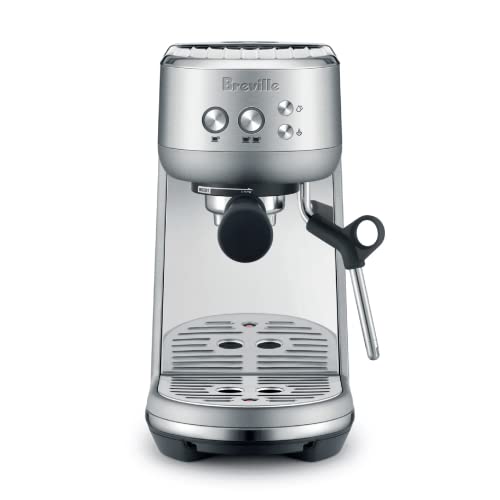
Breville Bambino Espresso Machine — Best Overall for Home
The Bambino strips the semi-automatic idea down to speed and size. It heats almost instantly, takes up very little counter, and uses a proper manual steam wand, while relying on an external grinder. In its affordable tier it is the machine we point to when someone wants real espresso skills without a large or slow appliance.
Strengths
- Near-instant heat-up suits real weekday mornings
- Small footprint fits kitchens where a full station cannot
- Manual steam wand and low-pressure pre-infusion support real learning
Trade-offs
- No grinder included, so budget for one from day one
- Lightweight body can move when locking in the portafilter firmly
- Small water tank and drip tray need frequent attention
The Bambino’s trick is removing excuses. It is ready before the kettle boils, it forgives a small kitchen, and its pre-infusion helps even out beginner distribution. Paired with a decent grinder it produces shots that embarrass far larger machines, because the fundamentals — fresh grounds, even puck, sensible ratio — matter more than bulk. Where you feel the tier is in the details: the light chassis, the compact tank, and accessories that are serviceable rather than luxurious. None of that reaches the cup. For a single person or a couple making one or two drinks at a time, it is arguably the smartest money in home espresso. Households steaming milk for four should look bigger.
Cleaning is proportionate to the machine: quick, light and easy to postpone, which is exactly why it should not be postponed. Small waterways and small boilers scale at the same rate as big ones. A weekly wipe, a monthly descale rhythm matched to your water, and a wand purged after every use keep a compact machine tasting like the day it arrived — and keep a small machine from becoming a short-lived one.
For this particular brief, households choosing a first espresso machine for daily home use, we weighted the lived routine — warm-up, workflow, cleaning — alongside the cup. On that combined score it serves small kitchens and beginners pairing it with a good grinder exceptionally well, while large households or anyone wanting an all-in-one station will feel its limits within the first month.
Best for: small kitchens and beginners pairing it with a good grinder / Not suited for: large households or anyone wanting an all-in-one station
We would summarise the Breville Bambino Espresso Machine this way for households choosing a first espresso machine for daily home use: buy it for the reasons in its strengths list, accept the trade-offs with your eyes open, and expect it to improve as your routine does. Machines in this guide were not chosen to win a specification contest; they were chosen to be lived with, and on that measure this Best Overall for Home pick justifies its place every single morning it gets used.
Check the current price on Amazon under the full model name — Breville Bambino Espresso Machine — and confirm the included baskets and accessories on the listing before ordering.
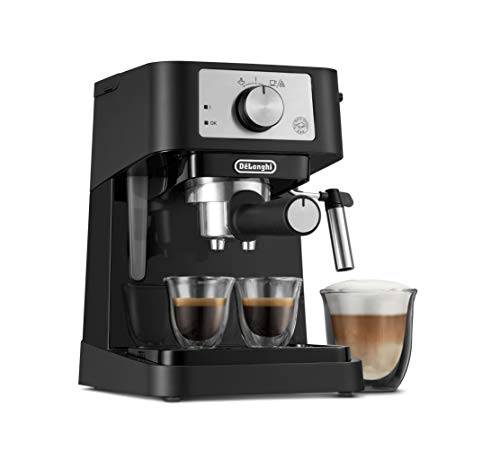
De’Longhi Stilosa EC260 Espresso Machine — Best Budget for Home
The Stilosa is the honest face of budget espresso: a simple pump machine with pressurised baskets, a panarello-style milk frother and a stainless boiler, sold at a tier where most rivals cut far deeper corners. It will not teach you café technique out of the box, but it makes recognisable espresso drinks with pre-ground coffee or pods, and it can grow a little with you.
Strengths
- Pressurised baskets forgive pre-ground coffee and uneven tamping
- Simple controls and a frother that handles milk without technique
- Boiler-based design is more durable than steam-toy rivals
Trade-offs
- Pressurised system caps shot quality and hides real technique
- Frother produces foam easily but fine latte texture is limited
- Mostly plastic exterior reflects the entry tier
Judge the Stilosa against its actual job: decent lattes and cappuccinos at home for the least sensible money. The pressurised baskets create crema-like foam regardless of grind, which purists criticise and busy beginners appreciate, and the frother turns milk into cappuccino foam with almost no learning curve. The honest limits are extraction nuance — you cannot dial in a shot the way a standard basket allows — and a ceiling that arrives quickly if the hobby bites. Within the affordable tier, though, its boiler design and straightforward controls make it the budget pick we defend: it is a real pump machine, not a steam-pressure toy, and that distinction is the whole ballgame at this price level.
Daily life on a pressurised machine is the easiest in this guide. Pre-ground coffee or a simple grinder, a level scoop in the basket, a button, and a drink that looks and tastes like espresso to the vast majority of drinkers. Milk, on the frother models, is a thirty-second job with almost no technique. That ease is the product, and households that value it use these machines daily for years without a thought about extraction theory — which is a completely respectable way to enjoy coffee at home.
In this shortlist’s terms — households choosing a first espresso machine for daily home use — that profile lands clearly: it is at its best for tight budgets wanting easy milk drinks from pre-ground coffee, and it is the wrong tool when the priority is hobbyists who want to learn true dialling-in technique. We scored it on daily repeatability as much as peak quality, because a machine that only performs on its best day is not the best machine.
Best for: tight budgets wanting easy milk drinks from pre-ground coffee / Not suited for: hobbyists who want to learn true dialling-in technique
Our closing judgement on the De’Longhi Stilosa EC260 Espresso Machine is straightforward. It earns its Best Budget for Home badge not by winning every comparison but by being the machine its intended owner will still be pleased with at month six, when novelty has worn off and only the routine and the cup remain. In a category full of machines that impress for a weekend, that staying power is the quality that matters, and it is why this pick holds its place in a shortlist built for households choosing a first espresso machine for daily home use.
Check the current price on Amazon under the full model name — De’Longhi Stilosa EC260 Espresso Machine — and confirm the included baskets and accessories on the listing before ordering.

De’Longhi Dedica Arte EC885 Espresso Machine — Best for Small Home Kitchens
The Dedica Arte is built around one constraint: width. It is among the slimmest pump espresso machines you can buy, heats quickly, and in Arte form carries a manual-style wand that textures milk far better than the basic frothers in this range. It uses pressurised baskets, keeping it forgiving for pre-ground coffee and beginners.
Strengths
- Extremely slim footprint fits counters nothing else will
- Fast heat-up and simple controls suit daily routines
- Arte wand produces genuinely fine milk texture for its class
Trade-offs
- Pressurised baskets limit ultimate shot quality and learning
- Slim body means a small tank and a light feel in use
- Proprietary accessories rather than the universal ecosystem
For small kitchens the Dedica Arte is often not the best choice but the only choice, and happily it is also a good one. The quick thermoblock-style readiness matches apartment mornings, the controls stay out of the way, and the Arte wand upgrade matters: it moves milk from bubbly foam toward the glossy texture that makes a flat white taste right. The compromises are structural. Pressurised baskets mean the machine, not your grind, manages extraction pressure, so the ceiling on shot quality is fixed; and the slim chassis asks you to hold it steady when locking in. If your counter is generous, a wider machine buys more future. If it is not, this is the affordable machine that respects your space without embarrassing your drinks.
Owners consistently report that these machines punch above their size in the cup, because their fundamentals — pre-infusion, stable fast heating, a real wand on the milk-focused models — are the ones that matter. Where size does show is entertaining: back-to-back drinks for a table of guests stretch the small boiler logic and the small tank, and the machine that is perfect on Tuesday can feel busy on Sunday. Know your peak demand and the compact class is either a revelation or a near miss, with very little in between.
Judged for households choosing a first espresso machine for daily home use, the balance shifts slightly from the spec sheet. Its natural home is apartments and small kitchens needing a slim, quick machine; its friction shows for technique learners who want standard baskets and accessories. That is not a flaw in the machine so much as a reminder that fit, not features, decides satisfaction in this category.
Best for: apartments and small kitchens needing a slim, quick machine / Not suited for: technique learners who want standard baskets and accessories
To place the De’Longhi Dedica Arte EC885 Espresso Machine precisely: it is the Best for Small Home Kitchens choice because its strengths line up with what households choosing a first espresso machine for daily home use actually need day after day, while its trade-offs fall where those owners feel them least. That alignment, rather than any single specification, is what separates a recommendation from a catalogue entry, and on the evidence of long-term ownership in this class, it is an alignment that holds up in real kitchens.
Check the current price on Amazon under the full model name — De’Longhi Dedica Arte EC885 Espresso Machine — and confirm the included baskets and accessories on the listing before ordering.

CASABREWS 3700 Essential Espresso Machine — Best for Learning at Home
The CASABREWS 3700 Essential is the value-brand machine that forced the big names to pay attention: a compact stainless-look body, a steam wand, a pressure gauge on many versions and pressurised baskets that forgive a starter grinder. It aims squarely at first-time buyers who want the ritual of a portafilter machine without the big-brand price.
Strengths
- Portafilter ritual and steam wand at a genuinely low tier
- Pressure gauge gives beginners visible feedback on extraction
- Compact body with a removable tank suits small kitchens
Trade-offs
- Pressurised baskets cap how far your technique can develop
- Build and accessory quality reflect the value tier
- Brand support network is thinner than De’Longhi or Breville
What the 3700 gets right is feedback. The gauge turns the invisible into something a beginner can watch, which shortens the loop between a bad shot and understanding why. The wand makes real attempts at milk texture possible, and the whole package feels like a machine rather than a toy, which matters at this tier. The ceiling is the familiar one: pressurised baskets manage the pressure, so grind experiments produce smaller differences than they should, and long-term durability is a reasonable question rather than a proven story. As a low-risk first step into the hobby — or as a machine for easy daily lattes — it earns its value reputation. Buy it with eyes open about the ceiling and it rarely disappoints.
What owners notice over months is consistency of a particular kind: the drinks are the same every day, which families love and explorers eventually chafe against. Changing beans changes the flavour, but changing technique changes very little, because the basket is managing the extraction for you. That is the design working as intended. The day it starts to feel like a limitation rather than a service is the day the step-up guides in this series become interesting reading.
For this particular brief, households choosing a first espresso machine for daily home use, we weighted the lived routine — warm-up, workflow, cleaning — alongside the cup. On that combined score it serves first-time buyers wanting maximum features per pound of budget exceptionally well, while long-horizon buyers wanting proven decades-long support will feel its limits within the first month.
Best for: first-time buyers wanting maximum features per pound of budget / Not suited for: long-horizon buyers wanting proven decades-long support
We would summarise the CASABREWS 3700 Essential Espresso Machine this way for households choosing a first espresso machine for daily home use: buy it for the reasons in its strengths list, accept the trade-offs with your eyes open, and expect it to improve as your routine does. Machines in this guide were not chosen to win a specification contest; they were chosen to be lived with, and on that measure this Best for Learning at Home pick justifies its place every single morning it gets used.
Check the current price on Amazon under the full model name — CASABREWS 3700 Essential Espresso Machine — and confirm the included baskets and accessories on the listing before ordering.
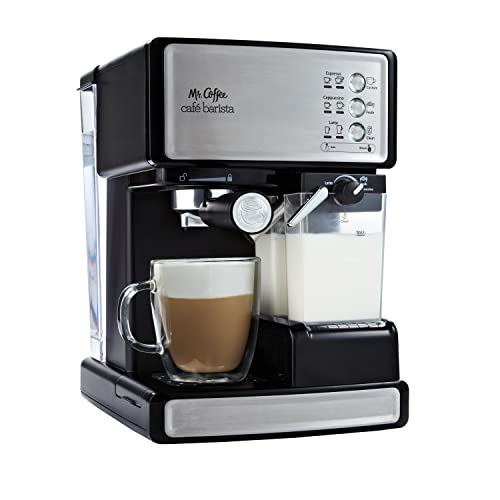
Mr. Coffee Café Barista Espresso Machine — Best for Easy Home Lattes
The Café Barista is built for people who want café-style milk drinks without learning to steam: a pump espresso side paired with an automatic milk reservoir that froths and dispenses at a button press, with one-touch drink presets. It is a convenience design through and through, and it should be judged on that basis rather than as a hobbyist tool.
Strengths
- Automatic milk handling removes the hardest beginner skill
- One-touch presets for espresso, cappuccino and latte simplify mornings
- Removable milk reservoir stores in the fridge between uses
Trade-offs
- Milk system needs diligent rinsing to stay fresh and hygienic
- Pressurised-style extraction limits depth and learning
- Preset drinks offer little room to adjust to taste
For its intended buyer, the Café Barista solves the right problem. Most home drinkers want a latte that tastes like a latte, not a new skill, and the automatic reservoir delivers that with fresh milk rather than powdered substitutes. The discipline it asks in return is cleaning: milk residue is unforgiving, and the reservoir routine must become automatic too. Espresso quality sits in the convenience tier — pleasant with milk, unremarkable straight — and there is no path to dialling in beyond dose and coffee choice. In the affordable home line-up it is the pick for households that value the button more than the ritual. Everyone else should spend the same money on control rather than automation.
Daily life on a pressurised machine is the easiest in this guide. Pre-ground coffee or a simple grinder, a level scoop in the basket, a button, and a drink that looks and tastes like espresso to the vast majority of drinkers. Milk, on the frother models, is a thirty-second job with almost no technique. That ease is the product, and households that value it use these machines daily for years without a thought about extraction theory — which is a completely respectable way to enjoy coffee at home.
In this shortlist’s terms — households choosing a first espresso machine for daily home use — that profile lands clearly: it is at its best for households wanting one-touch milk drinks with fresh milk, and it is the wrong tool when the priority is technique learners or anyone lax about cleaning milk parts. We scored it on daily repeatability as much as peak quality, because a machine that only performs on its best day is not the best machine.
Best for: households wanting one-touch milk drinks with fresh milk / Not suited for: technique learners or anyone lax about cleaning milk parts
Our closing judgement on the Mr. Coffee Café Barista Espresso Machine is straightforward. It earns its Best for Easy Home Lattes badge not by winning every comparison but by being the machine its intended owner will still be pleased with at month six, when novelty has worn off and only the routine and the cup remain. In a category full of machines that impress for a weekend, that staying power is the quality that matters, and it is why this pick holds its place in a shortlist built for households choosing a first espresso machine for daily home use.
Check the current price on Amazon under the full model name — Mr. Coffee Café Barista Espresso Machine — and confirm the included baskets and accessories on the listing before ordering.

Gevi 20 Bar Compact Espresso Machine — Best for Flats and Shared Kitchens
Gevi’s compact espresso machine targets the same value tier as the CASABREWS, with a narrow body, a steam wand, fast heating and pressurised baskets. It is sold on convenience: quick drinks, small footprint, simple dials. Treat headline pressure numbers on any machine in this class as marketing; what matters is the pump-driven, basket-managed extraction it actually delivers.
Strengths
- Narrow, quick-heating design suits dorms, offices and small counters
- Steam wand covers cappuccinos and lattes without extra appliances
- Simple dial controls keep the routine approachable
Trade-offs
- Pressurised system limits learning and ultimate cup quality
- Lightweight build and small tank reflect the compact brief
- Accessory and parts ecosystem is limited
The Gevi makes sense where space and speed outrank depth. It heats fast, asks little counter, and produces the milky drinks most buyers in this tier actually want, with a wand that allows a little technique to develop. Its honest limits mirror its rivals: the pressurised baskets decide extraction for you, the chassis is light, and when the hobby bug bites there is no upgrade path inside the machine. Compared with the CASABREWS, the choice comes down to footprint, control layout and which bundle is complete when you buy. Either is a reasonable first step; neither should be mistaken for a hobbyist platform, and our guidance is to enjoy it for what it is.
The routine that keeps a pressurised machine happy is mostly hygiene. Baskets and their tiny pressure outlets clog if old coffee dries in them, so rinse after use rather than later. Wands and panarello sleeves grow stale milk film quickly, so the wipe-and-purge habit matters more here than on any other class. Descaling is the third leg: small boilers and narrow passages are unforgiving of scale, and the machines that die young in this tier almost always die of neglect rather than defects.
Judged for households choosing a first espresso machine for daily home use, the balance shifts slightly from the spec sheet. Its natural home is space-limited buyers wanting quick, easy milk drinks; its friction shows for aspiring hobbyists or high-volume households. That is not a flaw in the machine so much as a reminder that fit, not features, decides satisfaction in this category.
Best for: space-limited buyers wanting quick, easy milk drinks / Not suited for: aspiring hobbyists or high-volume households
To place the Gevi 20 Bar Compact Espresso Machine precisely: it is the Best for Flats and Shared Kitchens choice because its strengths line up with what households choosing a first espresso machine for daily home use actually need day after day, while its trade-offs fall where those owners feel them least. That alignment, rather than any single specification, is what separates a recommendation from a catalogue entry, and on the evidence of long-term ownership in this class, it is an alignment that holds up in real kitchens.
Check the current price on Amazon under the full model name — Gevi 20 Bar Compact Espresso Machine — and confirm the included baskets and accessories on the listing before ordering.
Comparison Table
| Pick | Badge | Key spec | Best for |
|---|---|---|---|
| Breville Bambino Espresso Machine | Best Overall for Home | Semi-automatic, compact, fast heat-up | small kitchens and beginners pairing it with a good grinder |
| De’Longhi Stilosa EC260 Espresso Machine | Best Budget for Home | Pump semi-automatic, entry tier | tight budgets wanting easy milk drinks from pre-ground coffee |
| De’Longhi Dedica Arte EC885 Espresso Machine | Best for Small Home Kitchens | Pump semi-automatic, slim design | apartments and small kitchens needing a slim, quick machine |
| CASABREWS 3700 Essential Espresso Machine | Best for Learning at Home | Pump semi-automatic, value tier | first-time buyers wanting maximum features per pound of budget |
| Mr. Coffee Café Barista Espresso Machine | Best for Easy Home Lattes | Semi-automatic with automatic milk reservoir | households wanting one-touch milk drinks with fresh milk |
| Gevi 20 Bar Compact Espresso Machine | Best for Flats and Shared Kitchens | Pump semi-automatic, compact value tier | space-limited buyers wanting quick, easy milk drinks |
The table compresses; the reviews explain. In particular, the key spec column describes each machine’s design type rather than a marketing number, because design type — lever, boiler, pressurised pump, automatic — predicts your daily experience far better than any headline figure.
How to Choose the Right Machine for Affordable Home Espresso Machines
Choosing well in this category is mostly an exercise in self-knowledge. The machines in this guide all make good drinks for somebody; the work is deciding which somebody you are. The three sections below cover the decisions that actually separate satisfied owners from disappointed ones for best affordable home espresso machines.
Forgiveness Is a Home Feature
In a home, the machine is used by tired people, distracted people and guests. Pressurised baskets, guided dosing and automatic milk are not dumbing down; they are how a machine serves a household instead of a barista. When you compare picks, score each one for how the least experienced regular user will fare, because that score predicts whether the machine becomes the house’s habit or one person’s project.
Size, Noise and the Geography of the Kitchen
Measure the working zone, not just the machine: room to dose, tamp, knock out and steam, plus storage for beans and jugs. Slim machines earn their compromises in real kitchens. Noise matters too — pumps and grinders are brief but loud — so think about who sleeps near the kitchen before falling for any station, and favour fast warm-up over boiler size if the machine must live switched off.
Capacities Matched to Drink Counts
Tank and drip tray sizes are domestic features disguised as specifications. A solo drinker refills a small tank every few days; a family of four may refill daily and empty trays constantly, which quietly breeds resentment. Count your household’s drinks on the busiest morning and choose capacities that clear that bar with room to spare.
The Two-Drink Test for Any Home Machine
Before buying, run any candidate through the two-drink test in your head. Drink one is yours, at your most rushed, on a weekday: how many steps, how much warm-up, how much cleaning afterwards? Drink two is for the least experienced adult in the house, made without your help: can they succeed, safely, and will the machine forgive their technique? A machine that passes both tests will be used daily. A machine that fails either becomes a weekend hobby or a cupboard resident, whatever its reviews say.
Apply the same realism to placement. The espresso corner that works is near water, near the mugs, and clear of the cooking splash zone, with beans stored away from steam and heat. Five minutes spent planning that corner — and the two-minute reset routine that keeps it pleasant — does more for a home machine’s working life than any feature on any box in this guide.
Designing for Real Homes: Forgiveness, Footprint and the Second User
Reviewers test machines alone, in quiet kitchens, with unlimited patience. Homes are none of those things, and the machines that thrive there share three traits. The first is forgiveness: pressurised baskets, guided dosing or automatic milk, something that lets the least practised person in the house produce a decent drink. The second is a footprint and warm-up that fit the morning as it actually is, which is why slim and fast-heating designs punch above their spec sheets in domestic life.
The third trait is the one nobody markets: graceful sharing. Clear controls, a tank that is easy to fill, a drip tray that signals when it is full, and cleaning that takes two minutes rather than ten. When a machine fails at home it is almost never the extraction that failed; it is the routine around it. Weight these domestic virtues as heavily as the cup, and an affordable machine stops being a compromise and becomes the house’s favourite appliance.
The Morning After: Judging a Home Machine at Month Three
The only review that matters for a home machine is the one your household would write at month three. By then the novelty has gone, the routine has formed, and the truth has arrived: either the machine is a loved fixture with a permanent counter spot and a rhythm everyone knows, or it is a beautiful object migrating toward a cupboard. Everything in this guide — forgiveness, footprint, warm-up, cleaning, capacity — is aimed at the first outcome, because a home machine’s quality is measured in drinks actually made, and drinks actually made are a property of the routine, not the specification.
You can stack the odds before buying. Picture the machine in your kitchen’s real geography, at your household’s real hour, in the hands of its least patient user. Check the tank against your busiest morning and the cleaning against your least disciplined evening. The picks here each pass that test for a different kind of household, which is why the guide refuses to name a single winner. Your month-three review is the one being written; choose the machine that makes it a good one.
How to Set Up an Espresso Corner at Home That Actually Gets Used
Machines that live in cupboards make no coffee. A small, deliberate setup turns a purchase into a daily habit.
Claim a permanent spot near water and power
A machine that must be dragged out and filled at a distant sink will be used weekly, not daily. Give it a home within reach of both.
Keep the daily kit within arm’s reach
Beans, a tamper, a milk jug, a cloth and a knock container in one zone means a drink takes minutes. Scattering the kit across the kitchen kills the habit.
Agree a two-minute reset routine
Whoever makes the drink rinses the basket, purges the wand and empties the tray when it fills. Shared machines fail on unclear cleaning ownership, not on mechanics.
Stock beans on a rhythm, not in bulk
Smaller, fresher batches beat a giant bag going stale. Note the roast date and buy little and often from a roaster whose beans you like.
Put descaling on the family calendar
One shared reminder, matched to your water hardness, protects the machine everyone relies on. It takes minutes and prevents the slow decline nobody notices until the drinks suffer.
Common Buying Mistakes
Buying for the keenest person in the house
If one partner wants a hobby and the other wants a button, the machine must serve the button-presser too, or it becomes one person’s appliance and a source of friction.
Underestimating noise and mess
Grinders are loud and puck prep sheds grounds. A machine exiled to a distant counter for noise reasons is a machine that stops being used.
Choosing by drink menu length
Long preset menus impress in the shop and go unused at home, where most households make two drinks on rotation. Core quality beats menu breadth.
Ignoring tank and tray sizes
Small tanks and trays are fine for one person and irritating for four. Match capacities to the household’s real drink count.
Letting the first month decide everything
Every home machine has a learning curve, including the easy ones. Judge it after a month of routine, not after the first weekend’s experiments.
Final Recommendation
For a home that wants to learn a little, start with the Bambino. For a home that wants easy drinks on a budget, the Stilosa. Small kitchens take the Dedica or Gevi, learners take the CASABREWS, and the household that just wants lattes takes the Mr. Coffee and its automatic milk. Match the machine to the house, not the other way round.
If the decision still feels open, simplify it: the Breville Bambino Espresso Machine is the pick we would hand to most readers of this guide, and the De’Longhi Stilosa EC260 Espresso Machine is the alternative when its particular strength matches your mornings. Everything else on the list wins in a specific niche, and the reviews name those niches plainly. Choose the niche you actually live in, keep the routine in the how-to section for the first month, and give any machine a fair settling-in period before judging it.
Finally, remember that no machine in this guide asks for perfection from you. Each was chosen because it forgives the ordinary realities of home life — tired mornings, distracted dosing, a guest who wants something different — while still rewarding the days when you bring your full attention to it. That combination, forgiveness plus headroom, is what separates the recommendations here from the rest of the market, and it is why any of the six is a defensible place to land.
Keep exploring the cluster: Best Affordable Espresso Machines Best Affordable De Longhi Espresso Machines Best And Affordable Espresso Machines Best Espresso Machines Best Automatic Espresso Machines
Frequently Asked Questions
What is the best affordable espresso machine for a family home?
For most families, a forgiving pump machine with simple controls, like the Stilosa class, or a compact step-up like the Bambino if one person wants to learn properly. The right answer depends on whether the house wants drinks or a hobby.
Is an espresso machine worth it for home use?
If the household buys café milk drinks several times a week, a machine in this tier typically justifies itself quickly in saved spending, while adding the pleasure of coffee at home. Occasional drinkers are better served by simpler brewers.
How much counter space does a home espresso setup need?
The machine is only part of it: allow room for the grinder if separate, a jug, beans and working space in front. Slim machines like the Dedica exist precisely because this total is what real kitchens run out of.
Can children or guests use these machines safely?
The pressurised, simple-control models are the most guest-friendly, with hot water and steam still demanding adult supervision. Fully guided and one-touch milk models reduce the skill needed but not the need for care around steam.
How noisy is a home espresso machine?
The pump runs for under a minute per drink and grinders are briefly loud. In open-plan homes, a morning drink is noticeable but short; machines with built-in grinders concentrate the noise into the same brief window.
What ongoing costs should a household expect?
Beans are the main one, plus descaler, water filters where fitted, and occasional gaskets or baskets over the years. None of the picks here needs costly pods or proprietary consumables for normal use.


