Disclosure: airfryerkitchensupply.com is reader-supported. When you buy through links on our site, we may earn an affiliate commission at no extra cost to you.
Where to Buy
All six ranges below were verified by brand and model against live retailer data, so each carries a working purchase link. Ranges are freight items with delivery and hookup options that vary by address — check price on Amazon and read the delivery terms for your ZIP before you commit, and confirm your fuel type (gas line, 240V electric, or both) against the model you choose.
- ZLINE 36 in. Legacy Dual Fuel Range RA36 — check price on Amazon
- GE Profile 30 in. Slide-In Double Oven Gas Range — check price on Amazon
- ZLINE 30 in. Legacy Dual Fuel Range RA-BR-30 — check price on Amazon
- Frigidaire Professional 30 in. Slide-In Electric Range — check price on Amazon
- Kenmore 5.6 cu. ft. Induction Range — check price on Amazon
- Forno Capriasca 30 in. French Door Dual Fuel Range — check price on Amazon
Introduction
Shopping for the best convection range ovens means shopping for two appliances fused into one cabinet: a cooktop you will touch every day and an oven whose fan-driven heat is the whole point of the search. Convection in a range is not a garnish. Moving hot air with a fan — and, in “true” or “European” convection, heating that air with a dedicated element around the fan — evens out the hot and cold spots that make conventional ovens bake sheet pans unevenly, lets you use multiple racks without rotating everything halfway, and typically trims either temperature or time from standard recipes. If you roast, bake or reheat more than occasionally, it is the single feature that changes daily results.
The second decision hiding inside this search is fuel. A range can be all-gas, all-electric, induction, or dual fuel — gas burners over an electric oven — and each has a genuinely different cooking character and a different installation requirement. This roundup covers the spread deliberately: two dual fuel ZLINE models in 36- and 30-inch widths, a double-oven gas range from GE Profile, a slide-in electric with air fry from Frigidaire Professional, an induction range from Kenmore, and a French-door dual fuel model from Forno. Every pick is a real, verified model; where a configuration is scarce on Amazon — large professional-style ranges sell through many channels — we say so rather than padding the list with lookalikes.
Measure before you fall in love. Range widths are nominal: a “36-inch” range needs a specific cutout, a specific gas or electrical supply, and clearance that your current kitchen may or may not have. The buying guide below walks through sizing, fuel and venting in the order a kitchen remodeler would, because the best convection range oven for your cooking is a paperweight if it does not fit the hole, the hookup and the hood you actually own. We would rather talk you out of a range that does not fit than into one that does — the reviews below therefore name the installation each model demands as plainly as the cooking it delivers, and the final recommendation sorts the six by kitchen situation rather than by a single league table, because in this category the right answer is always conditional on the room.
In this guide
Quick Picks
- ZLINE 36 in. Legacy Dual Fuel Range RA36 — Best Overall. A 36-inch dual fuel range that pairs a 6-burner gas cooktop with an electric convection oven — the configuration most serious home cooks end up choosing when they think it through. Check on Amazon
- GE Profile 30 in. Slide-In Double Oven Gas Range — Best Double Oven. Two oven cavities in a standard 30-inch footprint, five burners up top and true convection, for households that regularly cook a main and a side at different temperatures. Check on Amazon
- ZLINE 30 in. Legacy Dual Fuel Range RA-BR-30 — Best 30-Inch Dual Fuel. The dual fuel formula in the standard 30-inch width: gas burners with brass construction over an electric convection oven, for kitchens that cannot stretch to 36 inches. Check on Amazon
- Frigidaire Professional 30 in. Slide-In Electric Range — Best Slide-In Electric. A front-control slide-in with five elements, air fry and Frigidaire’s Total Convection, built for the huge installed base of kitchens wired for an electric range. Check on Amazon
- Kenmore 5.6 cu. ft. Induction Range — Best Induction. Induction speed and precision on top, true convection and air fry below, in a front-control stainless design — the modern answer for all-electric kitchens. Check on Amazon
- Forno Capriasca 30 in. French Door Dual Fuel Range — Best French Door Design. French doors that open with one hand and stay out of the walkway, over a true convection oven, with gas burners above — a layout small kitchens feel every day. Check on Amazon
How These Picks Were Chosen
We verified every model by brand and model number against live retailer data and only publish purchase links where that verification succeeded — ranges are a category full of stale listings and regional model variants, so this filter removed more candidates than any other. A pick also had to be a true range (cooktop and oven in one unit) with convection in the oven cavity; cooktop-only and wall-oven-only products live in their own guides on this site.
Within the verified set we balanced four axes, and we deliberately included more than one representative of each major fuel so that the comparison inside each fuel class — not just across the whole list — would be useful to a reader whose kitchen has already made that decision for them. Fuel: at least one strong representative each of dual fuel, gas, electric radiant and induction, because fuel is dictated by your kitchen, not by preference alone. Width: 30-inch models for standard kitchens and a 36-inch flagship for remodels. Oven architecture: single large cavities, a double-oven layout, and a French-door variant, since door swing and cavity splitting change daily usability as much as any specification. And convection honesty: we favored models whose listings state true convection or a named convection system, and we describe each system in the terms the manufacturer itself uses rather than inventing performance numbers.
The 6 Best Convection Range Ovens

ZLINE 36 in. Legacy Dual Fuel Range RA36 — Best Overall
The RA36 is the range this category is usually about: 36 inches of dual fuel cooking, six gas burners over a 4.6 cu. ft. electric convection oven, in stainless steel with the substantial grates and proportions of a professional-style range. Dual fuel exists because of a real asymmetry — gas burners give instant, visible, infinitely adjustable flame on top, while electric ovens hold steadier, drier heat that bakes and roasts more evenly than a gas oven cavity. Putting each fuel where it is strongest is not marketing; it is the configuration restaurant logic lands on, scaled for a home kitchen.
Strengths
- Dual fuel pairing: gas flame control above, electric convection precision below
- Six burners and a 4.6 cu. ft. oven give true multi-dish capacity
- 36-inch professional-style proportions fit remodels and serious home kitchens
Trade-offs
- Needs both gas and 240V electric at the opening — not a drop-in for most kitchens
- 36-inch width usually requires cabinet work, not a like-for-like swap
- Freight delivery and a big footprint demand planning before purchase day
| Specification | Detail |
|---|---|
| Width | 36 in. |
| Configuration | Dual fuel — 6-burner gas cooktop, electric convection oven |
| Oven capacity | 4.6 cu. ft. (per listing) |
The oven is where the convection brief gets answered. A 4.6 cu. ft. cavity at 36 inches wide swallows full sheet pans and the largest roasting pans without the Tetris of a 30-inch oven, and electric convection heat keeps multi-rack baking honest — two trays of the same dough finish together instead of one lacing ahead. Up top, six burners spread the layout out: a stockpot, a sauté pan and a simmering sauce can coexist without handles colliding, which is the unglamorous daily luxury the extra six inches actually buys.
Ownership realities: a 36-inch dual fuel range needs both a gas line and a 240V electrical supply at the opening, a 36-inch-wide space that most kitchens only get during a remodel, and ventilation sized for six burners. It is also a freight delivery — plan the route from curb to kitchen, including door widths. If your kitchen already has the opening and the hookups, the RA36 is the most complete answer in this roundup; if it does not, the 30-inch picks below exist precisely for you.
Best for: a remodel or serious cook building the kitchen around the range / Not suited for: a like-for-like replacement in a standard 30-inch opening
Check on Amazon — check the current price on Amazon before you buy, because multi-pack configurations change.

GE Profile 30 in. Slide-In Double Oven Gas Range — Best Double Oven
The double-oven idea sounds like a holiday gimmick until you live with it: two cavities that hold different temperatures at the same time turn “the roast is in, so the rolls wait” into a non-event, and on ordinary weeknights the smaller cavity preheats faster and uses less energy for a single tray of vegetables or a frozen pizza. This GE Profile puts that layout in a standard 30-inch slide-in, adds five burners on a gas cooktop, and gives the main cavity true convection — the fan-and-element arrangement that makes multi-rack results even rather than approximate.
Strengths
- Two cavities cook two temperatures at once — the small one preheats fast for weeknights
- True convection in a mainstream 30-inch slide-in format
- Five-burner gas cooktop keeps flame control for gas households
Trade-offs
- Each cavity is smaller than a single big oven — measure roasting pans before buying
- Gas fuel requires a gas line and adequate ventilation
- Premium tier of the 30-inch class; check the current price on Amazon
| Specification | Detail |
|---|---|
| Width | 30 in. |
| Configuration | Gas cooktop, double oven, slide-in |
| Convection | True convection (per listing) |
Smart features ride along in this tier: GE Profile ranges in this class are built for connected control and guided cooking features, and the slide-in, front-control format keeps the backguard-free look that makes a 30-inch kitchen feel designed rather than assembled. The gas cooktop keeps flame cooking on the table for households with a gas line and no interest in relearning heat on glass — while the ovens below handle the precision work. For households that host, cook two-course meals, or run a side-hustle bakery out of the kitchen on weekends, the second cavity is used weekly, not yearly.
The arithmetic of any double oven is cavity size: two cavities in a 30-inch frame are each smaller than one big cavity, so the largest roasting pan or a truly enormous bird still needs measuring against the lower oven’s dimensions. And a gas range needs a gas line and proper venting — obvious, but the slide-in styling tempts people to forget it is a fuel appliance. If your cooking is parallel rather than merely large, this is the smartest 30 inches in the roundup.
Best for: households that regularly cook two dishes at two temperatures / Not suited for: cooks whose priority is one maximum-size cavity for very large roasts
Check on Amazon — check the current price on Amazon before you buy, because multi-pack configurations change.

ZLINE 30 in. Legacy Dual Fuel Range RA-BR-30 — Best 30-Inch Dual Fuel
Most kitchens cannot grow to 36 inches, and the RA-BR-30 is ZLINE’s answer for them: the same dual fuel architecture — gas cooktop, electric convection oven — in the standard 30-inch width, with four burners built with brass components. Brass burners are a durability and heat-distribution story: brass resists the corrosion and warping that cheaper burner metals suffer over years of thermal cycling, and it is the material professional ranges have used for decades. In a 30-inch range you will own for a long time, burner metallurgy is a legitimate thing to pay for.
Strengths
- Dual fuel in the standard 30-inch width most kitchens already have
- Brass burners bring professional-grade durability to the cooktop
- 4.0 cu. ft. electric convection oven is large for the class
Trade-offs
- Still needs both gas and 240V supplies — verify your opening before ordering
- Four burners, not five or six — big multi-pot meals need planning
- Professional styling and materials sit in the premium tier
| Specification | Detail |
|---|---|
| Width | 30 in. |
| Configuration | Dual fuel — gas cooktop with brass burners, electric convection oven |
| Oven capacity | 4.0 cu. ft. (per listing) |
The oven is a 4.0 cu. ft. electric cavity, which is generous for the width and — being electric with convection — delivers the even, dry heat that makes dual fuel worth wiring for. Four burners on a 30-inch top is the honest layout: no cramped fifth burner wedged in the middle, just four positions with room for real pans. The Legacy styling (this is the RA-BR-30, with brass burner hardware) suits kitchens that want the professional look without the professional footprint.
Same dual fuel caveat as its bigger sibling: you need gas and 240V electric at the same opening, which many 30-inch kitchens — wired for one fuel only — do not have. Confirm both before ordering, and confirm the electrical circuit’s capacity with an electrician if the panel is old. Where both fuels exist, the RA-BR-30 is arguably the sweet spot of this entire roundup: standard width, serious materials, and the right fuel in each half of the appliance.
Best for: a standard-width kitchen with both fuels available and a long ownership horizon / Not suited for: kitchens wired for a single fuel only
Check on Amazon — check the current price on Amazon before you buy, because multi-pack configurations change.

Frigidaire Professional 30 in. Slide-In Electric Range — Best Slide-In Electric
Not every kitchen has a gas line, and the Frigidaire Professional slide-in is built for the enormous number that run on electricity: five elements on a smooth top, front controls, air fry in the oven, and Total Convection — Frigidaire’s name for its convection system — doing the even-heat work below. Slide-in, front-control design is the aesthetic upgrade over the classic backguard range: the controls sit at the front where you can reach them without leaning over hot pans, and the cooktop edges overlap the counter for a built-in line.
Strengths
- Front-control slide-in design with a five-element smooth top
- Total Convection plus in-oven air fry at full sheet-pan scale
- Built for the standard electric range opening — no gas line needed
Trade-offs
- Radiant elements cycle rather than simmer like flame — a learning curve for gas loyalists
- Single oven cavity; no two-temperature cooking
- Glass top needs lift-don’t-slide discipline with heavy cookware
| Specification | Detail |
|---|---|
| Width | 30 in. |
| Configuration | Electric slide-in, 5 elements |
| Oven features | Total Convection and Air Fry (per listing) |
Air fry in a full-size oven deserves a sentence of its own, because it retires the countertop appliance for many households: the same convection fan, driven hard, crisps wings and vegetables across a full sheet pan instead of a small basket, in batches that feed a family at once. Five elements with a mix of sizes covers the standard pot fleet, and the smooth top wipes down in a way coil and grate cooktops never will — the daily-cleaning argument for radiant electric is real, and it compounds over years of ownership.
Radiant electric heat is the trade: elements cycle on and off rather than holding a visible flame, low simmers take learning, and heavy cast iron must be lifted, not slid, to protect the glass. Total Convection evens the oven beautifully, but this is a single cavity — two-temperature cooking belongs to the GE double oven above. For an all-electric kitchen that wants a designed look, family-scale air frying and honest convection baking in a standard opening, this is the pick.
Best for: all-electric kitchens wanting a built-in look and family-size air frying / Not suited for: households with a gas line who prefer flame cooking on top
Check on Amazon — check the current price on Amazon before you buy, because multi-pack configurations change.

Kenmore 5.6 cu. ft. Induction Range — Best Induction
Induction is the third answer to the cooktop question, and this Kenmore makes the case in a full range format: a 5.6 cu. ft. front-control induction range with true convection and air fry in the oven. Induction heats the pan itself through a magnetic field, which is why it boils faster than gas or radiant electric, adjusts almost as instantly as flame, and leaves the surrounding glass merely warm rather than scorching. For households with children, or anyone who has lifted a pan to find a glowing element forgotten underneath, the safety profile is its own argument.
Strengths
- Induction top: fastest boils, instant adjustment, cooler surrounding surface
- Largest oven in the roundup at 5.6 cu. ft., with true convection and air fry
- Standard 240V opening — no gas line required
Trade-offs
- Cookware must be induction-compatible; the magnet test decides your fleet
- Some pans hum at high power settings — normal, but noticeable
- Glass top shares the lift-don’t-slide rule of all smooth tops
| Specification | Detail |
|---|---|
| Width | 30 in. class, front control |
| Configuration | Electric induction range |
| Oven capacity | 5.6 cu. ft. with True Convection and Air Fry (per listing) |
The oven half keeps pace with the top: 5.6 cu. ft. is the largest cavity in this roundup, true convection keeps multi-rack baking even, and air fry covers the crispy category. Front controls and a stainless finish give it the same designed, slide-in-adjacent look as the Frigidaire, and the all-electric installation drops into the standard 240V range opening that millions of kitchens already have — no gas line, no propane conversion, no combustion venting concerns beyond ordinary cooking ventilation.
The induction caveat is cookware: your pans must be magnetic to work. Test your fleet with a fridge magnet — cast iron and most stainless pass; pure aluminum and copper do not — and budget for replacements if the magnet fails, because a new range that ignores half your pans is a bad week. Induction also hums faintly with some pans at high power, a normal trait worth knowing in advance. If your cookware passes the magnet test, this is the most future-facing pick here: fastest top, biggest oven, one fuel.
Best for: all-electric kitchens that want gas-like responsiveness without gas / Not suited for: cooks with a beloved non-magnetic cookware collection they refuse to replace
Check on Amazon — check the current price on Amazon before you buy, because multi-pack configurations change.
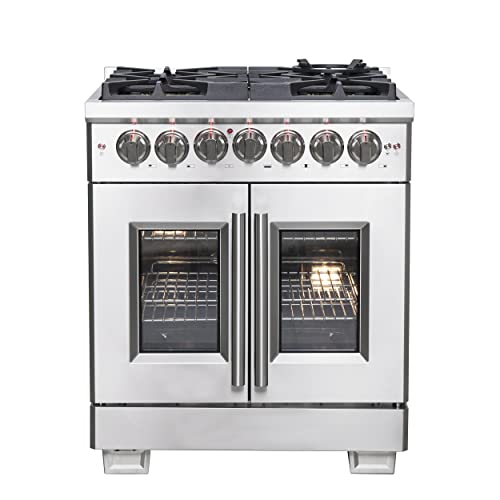
Forno Capriasca 30 in. French Door Dual Fuel Range — Best French Door Design
The Capriasca’s party trick is its doors, and it is more than a trick. French doors open sideways from the center, so you stand beside the oven rather than leaning over a dropped door, and in a galley kitchen or an island layout the open door never blocks the walkway or becomes a shin-level shelf you must reach across with a hot pan. Anyone who has managed a heavy roaster out of a conventional oven in a tight kitchen understands immediately; the design also lets you open the oven with one hand mid-baste, which is how the feature gets used daily.
Strengths
- French doors transform access in tight and galley kitchens
- Dual fuel: gas burners over a 4.32 cu. ft. true convection oven
- Professional styling at a tier below the legacy luxury brands
Trade-offs
- Door swing needs side clearance — check the layout before ordering
- Dual fuel requires both gas and 240V at the opening
- Very wide pans deserve a mental test-fit against the cavity
| Specification | Detail |
|---|---|
| Width | 30 in. |
| Configuration | Dual fuel, French door |
| Oven capacity | 4.32 cu. ft. True Convection (per listing) |
Under the doors sits a 4.32 cu. ft. true convection oven — real capacity, honestly rated for the 30-inch class — and above them, gas burners make this a dual fuel range: flame responsiveness on top, electric convection precision below, the same architecture as the ZLINE picks in a different silhouette. Forno, as a brand, builds professional-styled ranges at tiers below the legacy luxury names, which is the value story here: the layout and fuel pairing of a design-forward range without the design-forward invoice — though as always, check the current price on Amazon rather than trusting any tier assumption.
French doors do ask for French-door habits: both doors swing, so side clearances matter, and the center meeting stile means very wide pans should be test-fitted mentally against the stated capacity before a holiday depends on them. Dual fuel hookups — gas plus 240V — apply as with the ZLINE models. For small or galley kitchens where a drop-down door is a daily obstacle, the Capriasca is not a novelty pick; it is the ergonomically correct one.
Best for: galley and small kitchens where a drop-down oven door blocks the room / Not suited for: kitchens with only one fuel available at the range opening
Check on Amazon — check the current price on Amazon before you buy, because multi-pack configurations change.
Comparison Table
| Pick | Badge | Key spec | Best for |
|---|---|---|---|
| ZLINE RA36 | Best Overall | 36 in. dual fuel, 6 burners, 4.6 cu. ft. | Remodels and serious cooks |
| GE Profile Double Oven | Best Double Oven | 30 in. gas, true convection, 2 cavities | Parallel two-temperature cooking |
| ZLINE RA-BR-30 | Best 30-Inch Dual Fuel | Brass burners, 4.0 cu. ft. oven | Standard width, both fuels |
| Frigidaire Professional | Best Slide-In Electric | 5 elements, Total Convection, Air Fry | All-electric kitchens |
| Kenmore Induction | Best Induction | 5.6 cu. ft., True Convection, Air Fry | Speed and safety on electric |
| Forno Capriasca | Best French Door | Dual fuel, 4.32 cu. ft. True Convection | Tight and galley kitchens |
How to Choose a Convection Range Oven
Fuel first, because your kitchen decides it. Inventory the range opening before you browse: is there a gas line (and which gas — natural gas or propane, which needs a conversion kit and a different regulator setting), a 240V electric receptacle, or both? Both means dual fuel is available to you; one means your shortlist writes itself. Changing the infrastructure is possible — running a gas line or a new 240V circuit is ordinary contractor work — but price it into the project honestly, and never let a range arrive before its fuel does.
Convection, True Convection, and Named Systems
Manufacturers use three levels of language. “Convection” alone usually means a fan circulates oven air that is heated by the standard bake element — already a real improvement in evenness. “True” or “European” convection adds a heating element around the fan itself, so the circulated air is actively heated; multi-rack baking and roasting benefit most. Branded systems (Frigidaire’s Total Convection, GE’s true convection arrangements, and similar) are implementations of these ideas with their own ducting and controls. What matters practically: two racks of the same food finishing together, roasts browning evenly without rotation, and the standard conversion rule — drop the recipe temperature by about 25°F, or shorten the time — when you move a conventional recipe into a convection oven.
Width, Cavity, and the Pan Test
Buy the width your cabinets give you: 30 inches is the standard, 36 is a remodel decision, and anything larger is a project. Within a width, compare cavity volume with your actual cookware, not the number alone — bring your largest roasting pan’s dimensions to the specification sheet, and if you bake half-sheet pans, confirm the interior width accepts them flat. Double ovens trade peak size for parallelism; French doors trade nothing in capacity but demand side clearance; a single large cavity is the holiday-turkey answer. Match the architecture to the meals you demonstrably cook, not the ones you photograph.
Venting, Delivery, and Installation Reality
More burners and more BTUs want more ventilation: a range hood sized to the cooktop keeps grease and combustion byproducts out of the kitchen, and gas installations in particular should not be treated as vent-optional. Delivery of a range is freight, not parcel — confirm whether the listing’s delivery is threshold, room-of-choice, or includes hookup and haul-away, and measure your doorways and turns before the truck is booked. Finally, hookup itself: gas connections and 240V work are licensed-trades territory in many jurisdictions, and a range is exactly the wrong appliance to learn on. Budget the installation when you budget the range.
How to Use Convection in a Range Oven for the First Month
New convection owners typically under-use the fan for a month and then never turn it off. This sequence shortens the learning curve.
- Week 1 — Convert your staples. Take three recipes you know cold and apply the standard conversion: reduce temperature by about 25°F and check doneness early. Roast vegetables, a whole chicken and a tray of cookies teach you more than any manual — the chicken shows you the even browning, the cookies show you whether your oven’s fan favors a side.
- Week 2 — Go multi-rack. Bake or roast on two racks at once — the signature convection advantage. Keep pans off the walls and each other by a couple of inches so air can move; convection cannot fix a cavity packed like a cupboard.
- Week 3 — Air fry at scale (if equipped). Use a dark sheet pan or the supplied air fry tray, single-layer the food, and resist saucing before the crisp forms. Compare honestly against your countertop air fryer; most households retire the countertop unit for family quantities and keep it for snacks.
- Week 4 — Learn your oven’s dialect. Note which dishes you prefer with convection off — delicate soufflés, some custards and quick breads that dome better in still air — and write the conversions that worked into your recipes. Every oven has a personality; a month of notes makes yours legible.
- Ongoing — Keep the fan’s world clean. Wipe spills before they bake into the convection ducting, run the self-clean or steam-clean cycle on the manufacturer’s schedule, and keep the oven door gasket supple and intact — convection depends on a sealed, predictable cavity.
Burner Layout: Why the Top Half Earns Its Keep Daily
Range shoppers obsess over oven specifications and then cook 80 percent of their meals on the cooktop, so judge the top half by your real pan fleet. A six-burner 36-inch top like the ZLINE RA36’s lets a stockpot, a wide sauté pan and a saucepan coexist without handle diplomacy; a 30-inch top — four or five burners — rewards cooks who sequence dishes rather than run them all at once. Look for a genuine low simmer position somewhere: the burner that holds a sauce at a bare bubble without scorching is worth more than a headline maximum output you will use for boiling water twice a month. Griddle burners and center ovals suit households that actually make pancakes for six; everyone else is buying a storage location for a heavy plate.
Electric tops split the same way. Radiant elements under glass (the Frigidaire) are sized in rings — match the large dual-ring element to your biggest skillet and the small ones to saucepans, and remember that flat, heavy, smooth-bottomed pans make the best contact. Induction (the Kenmore) forgives warped pans less but rewards good ones with instant response; the magnet test on your current fleet, described in its review, is the whole compatibility question in one gesture. Whichever top you choose, knobs-versus-touch-controls is a lifestyle call: knobs survive wet hands and give tactile certainty, touch panels wipe clean in one pass. There is no wrong answer, only the one that matches your hands.
Oven Hardware: Racks, Probes and Cleaning Cycles
Inside the cavity, the differences that matter after year one are hardware, not electronics. Rack count and glide quality decide whether a full roasting pan slides out for basting or must be wrestled; heavier racks with smooth glides are a quiet premium worth having. A temperature probe, where fitted, ends the guesswork on large roasts by cooking to internal temperature rather than the clock — if your household roasts whole birds or large cuts monthly, weight it heavily. Convection fans also redistribute splatter, which makes the cleaning cycle a real feature rather than a checkbox: high-heat self-cleaning handles the worst of it but heats the kitchen and locks the oven for hours, while steam-clean modes handle light soil quickly and ask you to finish by hand.
Finally, the unglamorous ownership layer: every range in this roundup is a major appliance with a decade-plus service expectation, and the brands differ in parts availability and service networks by region. Before ordering, it is worth one phone call — to a local appliance servicer — asking which of your shortlisted brands they can get parts for quickly in your area. That single data point, which no listing will give you, predicts your year-seven repair experience better than any feature list, and it costs five minutes.
Slide-In, Front-Control and Freestanding: The Format Decision
Three terms get used interchangeably in listings and mean different things. A freestanding range has finished sides and a backguard carrying the controls; it can stand anywhere, including at the end of a cabinet run, and it is usually the least expensive format in any fuel. A slide-in range has unfinished sides, front controls and a cooktop lip designed to overlap the countertop, producing the built-in look; it must sit between cabinets, and it typically costs more for the same cooking hardware. Front-control freestanding models split the difference — finished sides, controls on the front face, no backguard — and both the Frigidaire and the Kenmore in this roundup live in that modern middle. None of the formats cooks better than the others; the decision is about your cabinet layout and how much the integrated look is worth to you.
One practical consequence hides in the formats: backguard models put the oven controls up and behind the cooktop, which keeps them away from small children and from pan splatter, while front controls put them within reach of both cooks and curious toddlers — households with small children should look for control lockouts on front-control models. Front controls also mean no reaching across hot burners to adjust the oven mid-roast, which is the safety argument in the other direction. Weigh both honestly against your household; the right answer differs between a home with a three-year-old and a home of adult cooks.
What Convection Changes — and What It Does Not
A clear-eyed word about expectations, because convection is sometimes sold as sorcery. What it genuinely does: it narrows the temperature difference between the top and bottom of the cavity, so two racks bake alike; it accelerates surface browning and crisping, which is why roast skin and vegetables improve; and it usually lets you shave temperature or time from conventional recipes. What it does not do: it cannot rescue overcrowded pans (air still needs paths between dishes), it does not make a small cavity large, and it can work against delicate foams and custards that set best in still air — which is why every range here retains a conventional mode. The cooks who love convection longest are the ones who learned it as a second language for their oven rather than a replacement for judgment: fan on for roasts, trays and reheating; fan off for the soufflé. Buy any pick in this roundup with that expectation and the appliance will meet it.
Common Buying Mistakes
- Ordering before inventorying the hookups. A dual fuel range in a gas-only opening — or a gas range where no line exists — is the most expensive mistake in this category and the most avoidable.
- Confusing nominal width with fit. Measure the actual opening, the countertop cutout and the doorway path; “30-inch” is a class, not a measurement.
- Paying for a double oven and cooking like a single. If you never run two temperatures, the big single cavity (or the induction Kenmore’s 5.6 cu. ft.) serves you better.
- Ignoring ventilation. Six burners under a recirculating microwave hood is a grease film on every cabinet you own.
- Assuming your pans fit and work. Sheet pans versus cavity width, and the induction magnet test, take five minutes before purchase and save a return freight bill.
- Skipping the delivery fine print. Threshold delivery of a 300-pound range, alone, in winter, is a story you do not want. Confirm hookup and haul-away terms.
Final Recommendation
If the kitchen can take it, the ZLINE RA36 is the range to build around — dual fuel, six burners, a real oven. In a standard opening with both fuels, the ZLINE RA-BR-30 is the sweet spot; parallel cooks should choose the GE Profile double oven; all-electric kitchens split between the Frigidaire Professional for radiant familiarity and the Kenmore induction for speed; and tight kitchens should seriously consider the Forno Capriasca and its doors. Keep reading within the category: the countertop side of the family is covered at Best And Biggest Countertop Convection Ovens and Best Countertop Ovens With Convection, the built-in side at Best Convection Wall Ovens For New Home, and the dual fuel question in depth at Best Convection Ovens Dual Fuel.
Frequently Asked Questions
What is the difference between convection and true convection in a range?
A convection oven uses a fan to circulate air heated by the regular bake element, which already evens out hot spots. True (European) convection adds a heating element around the fan, so the moving air is itself heated — multi-rack baking and roasting come out more uniform. Branded names like Total Convection are manufacturers’ implementations of the same ideas.
Is dual fuel worth it?
Dual fuel — gas burners over an electric oven — is worth it when you cook seriously on both halves: flame control and instant response on top, steadier and drier heat for baking below. It is not worth it if your kitchen has only one fuel and no plans to add the second, or if your cooking is mostly stovetop-only or oven-only, where a single-fuel range spends the money better.
How do I convert recipes for a convection oven?
The standard rule is to reduce the recipe temperature by about 25°F, or keep the temperature and shorten the time by roughly a quarter — and check doneness early either way. Many modern ranges offer an automatic convection conversion mode that does the temperature math for you. Delicate items like soufflés and some custards may still prefer conventional still-air baking.
Can a convection range replace my countertop air fryer?
For family quantities, usually yes: in-oven air fry modes drive the convection fan hard over a full sheet pan, crisping batches a countertop basket cannot match. For one or two servings, the countertop unit still preheats faster and uses less energy. Many households end up keeping both for a month and then donating the countertop model.
What size range do I need?
Most kitchens are built for 30 inches, and every pick but one in this roundup fits that opening. Width is only the first measurement, though: confirm the depth against your countertops so the door handle clears the walkway, confirm the height adjustability range if your counters are non-standard, and confirm the opening width itself with a tape rather than trusting the nominal size of the range you are replacing — older installations drift, shims happen, and a quarter inch of optimism becomes a range that will not slide home on delivery day. A 36-inch range is a remodel decision that buys six burners and a wider oven — worth it for multi-dish cooks, pointless if the cabinets cannot grow. Whatever the width, test your largest pans against the cavity dimensions before ordering.
Do gas ranges need special ventilation?
Gas cooking produces combustion byproducts and moisture, and any powerful cooktop produces grease-laden air; a properly sized externally vented hood is the responsible pairing, especially for five- and six-burner tops. Check local code — some jurisdictions specify venting for gas installations — and treat a recirculating-only setup as a compromise, not a plan.