Disclosure: airfryerkitchensupply.com is reader-supported. When you buy through links on our site, we may earn an affiliate commission at no extra cost to you.
Where to buy
The six ovens below were verified on 2026-11-22 and chosen for how well convection works as part of a complete countertop oven: alongside air frying, roasting, rotisserie, dehydrating and everyday baking. If your question is not just does it have a fan, but what does the whole machine do for my kitchen, this is your list.
- Ninja Foodi Smart XL Air Fry Oven DT251 (Best Overall Multi-Function Oven): Check the current price on Amazon
- Emeril Lagasse 26QT French Door Air Fryer Toaster Oven (Best for Families): Check the current price on Amazon
- Nuwave Bravo Pro Convection Air Fryer Toaster Oven, 21Qt (Best Temperature Range and Control): Check the current price on Amazon
- TOSHIBA 10-in-1 Convection Toaster Oven, 6-Slice, 1500W (Best with Rotisserie): Check the current price on Amazon
- Hamilton Beach Easy Reach 6 Slice Air Fryer Toaster Oven Combo (Best Door Design): Check the current price on Amazon
- Gourmia 6-Slice Digital Toaster Oven French Door Air Fryer (Best Value Multi-Function): Check the current price on Amazon
The best countertop ovens with convection are really answers to a bigger question: how much of your cooking can one machine on the counter honestly take over? Convection, the fan that moves hot air for faster, more even results, is the engine, but the modern countertop oven wraps that engine in a whole repertoire: air frying, roasting, baking, broiling, toasting, dehydrating, even rotisserie. Chosen well, it becomes the oven you use daily and the big range becomes the appliance you use at holidays.
This guide approaches the category from that whole-machine angle, which makes it deliberately different from a pure convection ranking. The six picks, all verified as current listings, span the class’s personalities: Ninja’s surround-convection flagship with its smart thermometer, Emeril’s 26 quart French-door family machine, Nuwave’s wide-temperature precision cooker, Toshiba’s rotisserie-equipped all-rounder, Hamilton Beach’s roll-top door innovator, and Gourmia’s preset-rich French-door value play. Between them they cover nearly every way a household actually cooks.
Specifications in the spec boxes come only from the verified listing titles, and where a title is silent, on wattage for some models, for example, the review is silent too rather than inventive. Read the guide sections for how convection modes differ in practice, because the difference between ordinary convection and the high-speed air fry variants is the most useful thing a buyer in this category can learn.
In this guide
Quick Picks
- Ninja Foodi Smart XL Air Fry Oven DT251 — Best Overall Multi-Function Oven: A 10-in-1 XL oven with True Surround Convection to 450 degrees and a Smart Cook thermometer, covering air fry, roast, bake and broil. — Check price on Amazon
- Emeril Lagasse 26QT French Door Air Fryer Toaster Oven — Best for Families: A 26 quart French-door convection cooker with 24 one-touch presets, built for family-scale multi-function cooking. — Check price on Amazon
- Nuwave Bravo Pro Convection Air Fryer Toaster Oven, 21Qt — Best Temperature Range and Control: A 21 quart, 10-in-1 convection oven with an unusually wide 50 to 450 degree control range and Quick Even Crisp technology, PFAS free. — Check price on Amazon
- TOSHIBA 10-in-1 Convection Toaster Oven, 6-Slice, 1500W — Best with Rotisserie: A 1500W, 10-in-1 convection oven in stainless steel with rotisserie and pizza functions, LCD knob controls and six accessories included. — Check price on Amazon
- Hamilton Beach Easy Reach 6 Slice Air Fryer Toaster Oven Combo — Best Door Design: A 6-slice combo oven whose roll-top door lifts food access clear of the hot door, with 150 to 450 degree control and auto shutoff. — Check price on Amazon
- Gourmia 6-Slice Digital Toaster Oven French Door Air Fryer — Best Value Multi-Function: A 6-slice French-door digital oven with 14 cooking presets, FryForce 360 air fry technology and dishwasher-safe trays. — Check price on Amazon
How These Picks Were Chosen
We chose for completeness of repertoire built on genuine convection. Each pick had to offer fan-driven cooking as a core capability, not a badge, and then earn its place with a distinct strength: a thermometer-guided system, family capacity, temperature range, rotisserie, door design or preset depth. That distinctness rule is why no two picks here are interchangeable; swapping any one out would lose a capability some kitchen genuinely needs.
Verification ran for every model, and claims in the reviews are fenced to what the titles support: function counts, capacities, temperature ranges and named technologies such as Ninja’s True Surround Convection and Gourmia’s FryForce 360 are quoted from the listings, while general cooking guidance is presented as guidance, not as product specification.
The 6 Best Countertop Ovens with Convection

Ninja Foodi Smart XL Air Fry Oven DT251 — Best Overall Multi-Function Oven
The DT251 is the flagship expression of this category: ten functions in an XL body, True Surround Convection reaching 450 degrees, and a Smart Cook thermometer that takes the guesswork out of roasts by cooking to a target internal temperature rather than to a timer and a prayer. Air fry, roast, bake and broil headline the repertoire the title lists, and the silver finish suits the permanent-counter role the machine is built for.
Strengths
- True Surround Convection to 450F gives it the most powerful convection claim in this guide
- Smart Cook thermometer cooks roasts and proteins to temperature, not to luck
- 10-in-1 repertoire in an XL body covers a household’s whole week
Trade-offs
- Flagship tier pricing and a flagship footprint
- The thermometer system rewards learning; casual toast-only users will underuse it
- XL capacity is wasted on a single-person household’s typical loads
| Functions (from listing title) | 10-in-1 |
| Convection (from listing title) | True Surround Convection to 450F |
| Feature (from listing title) | Smart Cook thermometer |
| Modes (from listing title) | Air fry, roast, bake, broil |
| Model (from listing title) | DT251, silver |
The thermometer changes the relationship between cook and oven. Instead of opening the door to prod a chicken and losing heat each time, you set the target and let the system manage the journey, which in a small convection cavity, where things cook fast, prevents the overshoot that dries out proteins. For households that roast regularly, that single feature justifies the flagship tier more than any preset count.
Surround convection at this level also blurs the line with air frying: the airflow is strong enough to crisp seriously, so the machine’s air fry mode is a difference of degree rather than a separate appliance. Buyers consolidating a fryer and an oven into one footprint will find this the most convincing consolidation in the guide.
Best for: Households that roast and air fry constantly and want thermometer-guided precision / Not suited for: Small households, or buyers who want simple dials and a small footprint
Emeril Lagasse 26QT French Door Air Fryer Toaster Oven — Best for Families
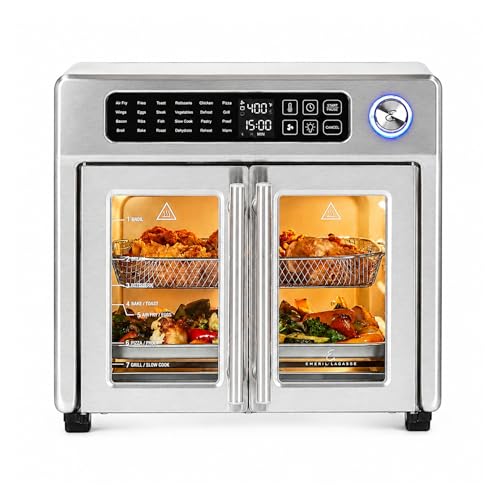
Emeril’s entry is the family extrovert of the group: 26 quarts behind French doors, described in its title as a countertop convection cooker, with 24 one-touch presets doing the thinking for busy cooks. The French doors open sideways for easy loading of big trays, the capacity swallows family portions without negotiation, and the preset library turns the oven into an appliance the whole household can operate without studying it.
Strengths
- 26QT capacity is the largest in this guide, sized for family cooking
- 24 one-touch presets make the full repertoire accessible to every cook in the house
- French doors ease loading and unloading of large, hot trays
Trade-offs
- 26 quarts plus French-door swing demands serious counter space and side clearance
- Preset-led operation suits convenience seekers more than precision cooks
- A family machine’s running scale is wasted on solo households
| Capacity (from listing title) | 26QT |
| Design (from listing title) | French door, multi-function air fryer toaster oven |
| Presets (from listing title) | 24 one-touch preset options |
| Type (from listing title) | Countertop convection cooker |
Capacity plus presets is a specific philosophy: the oven should absorb family logistics. A tray of chicken, a batch of fries, a reheated casserole, all become one-touch operations rather than cooking projects, and in a household where dinner competes with homework and work calls, that absorption is the product. The convection system underneath the presets ensures the results stay crisp and even while the interface stays simple.
The French doors deserve their practical note: they keep the hot door off the counter edge and let you slide trays in with both hands visible, which parents loading dinner around small helpers will appreciate. Measure the swing before ordering; the doors need their room, and a corner installation can quietly ruin the design’s main benefit.
Best for: Families wanting maximum capacity with one-touch simplicity / Not suited for: Small kitchens, or precision cooks who prefer manual control

Nuwave Bravo Pro Convection Air Fryer Toaster Oven, 21Qt — Best Temperature Range and Control
The Bravo Pro’s headline is a number range no rival here matches: control from 50 to 450 degrees Fahrenheit. The low end opens jobs ordinary ovens cannot do, dehydrating, proofing, slow warming, while the top end handles full roasting and crisping, all in a 21 quart, 10-in-1 body with the brand’s Quick Even Crisp technology and a PFAS-free positioning stated in the title. For technique-driven cooks, that range is a playground.
Strengths
- 50 to 450 degree control range is the widest here, enabling dehydrating and proofing as well as roasting
- 21Qt capacity with 10-in-1 functions balances size and repertoire
- PFAS free stated in the title, for buyers who screen coatings
Trade-offs
- A wide-range precision instrument rewards cooks who will actually use the range
- Mint green finish is a style commitment not every kitchen wants
- Feature depth means a real read of the manual before the repertoire opens up
| Temperature range (from listing title) | 50°-450°F control |
| Capacity (from listing title) | 21Qt |
| Functions (from listing title) | 10-in-1 |
| Technology (from listing title) | Quick Even Crisp Tech |
| Coating note (from listing title) | PFAS free |
Low temperatures are the hidden half of countertop cooking. Herbs and chillies dehydrate at the gentle end, dough proofs in a warm still cavity, and plates and serving dishes warm without drama. Most ovens abandon that territory entirely, starting at temperatures that cook rather than coddle. The Bravo Pro’s 50-degree floor turns one appliance into a small climate chamber, and cooks who preserve, bake bread or ferment will feel the difference weekly.
At the other end, the Quick Even Crisp positioning is aimed at the air fry jobs, and the 21 quart cavity gives those jobs room to breathe. It is the most versatile single specification sheet in this guide, and versatility, honestly delivered, is the pick’s whole case.
Best for: Technique-driven cooks who dehydrate, proof and roast in one machine / Not suited for: Set-and-forget preset users, or kitchens that reject the colour

TOSHIBA 10-in-1 Convection Toaster Oven, 6-Slice, 1500W — Best with Rotisserie
Toshiba’s entry is the completist: ten functions including the rotisserie that no other pick here offers, a dedicated pizza function, bake, broil and toast, 1500 watts, LCD knob controls that blend digital precision with dial tactility, and six accessories in the box. In stainless steel at 6-slice capacity, it is the all-rounder for households that want every classic countertop job, including a turning chicken, from one machine.
Strengths
- Rotisserie function sets it apart; no other pick in this guide turns a chicken
- 10-in-1 repertoire with dedicated pizza function covers the classic countertop canon
- LCD knob controls and six included accessories make it complete out of the box
Trade-offs
- 6-slice capacity is mid-sized; XL households should look at the Ninja or Emeril
- Rotisserie adds parts to clean and store
- 1500W is a step below the 1800W class for raw pace
| Functions (from listing title) | 10-in-1: bake, broil, rotisserie, pizza, toast and more |
| Power (from listing title) | 1500W |
| Controls (from listing title) | LCD knob controls |
| Included (from listing title) | 6 accessories |
| Capacity (from listing title) | 6-slice, stainless steel |
Rotisserie cooking in a convection cavity is a small theatre with a delicious ending: the bird bastes itself as it turns, the skin crisps in the moving air, and the whole performance happens on a countertop. If your household’s idea of a celebration involves a roast chicken that did not heat the entire kitchen via the big oven, this is your pick, and the six accessories mean the theatre opens on delivery day.
The LCD knob deserves a sentence of its own. Pure touch panels frustrate wet and floury hands; pure dials lack precision. A knob driving a digital display is the grown-up compromise, and more ovens should steal it. Combined with the dedicated pizza function, the Toshiba feels designed by people who cook rather than people who benchmark.
Best for: All-round households, especially rotisserie fans, wanting one complete machine / Not suited for: XL families, or minimalists who will never use the extra functions

Hamilton Beach Easy Reach 6 Slice Air Fryer Toaster Oven Combo — Best Door Design
Hamilton Beach solved a problem every toaster oven owner knows: the drop-down door puts a hot glass barrier exactly where your hands need to travel, and food at the back of the cavity hides behind it. The Easy Reach’s roll-top door rolls up and away, leaving the cavity open and the food visible and reachable. Around that idea sits a capable 6-slice combo: air fry, bake, broil and toast, 150 to 450 degree adjustable temperature and auto shutoff, in stainless steel.
Strengths
- Roll-top door gives the easiest, safest food access in this guide
- 150 to 450 degree range covers gentle warming through full roasting
- Auto shutoff adds peace of mind for busy and distracted households
Trade-offs
- 6-slice capacity is mid-sized, not family XL
- The repertoire focuses on core functions rather than a 10-in-1 library
- Roll-top mechanism is a moving part to keep clean for smooth operation
| Door (from listing title) | Roll-top door for easy access |
| Functions (from listing title) | Air fry, bake, broil, toast |
| Temperature (from listing title) | 150 to 450ºF adjustable |
| Safety (from listing title) | Auto shutoff |
| Capacity (from listing title) | 6 slice, stainless steel |
Access design sounds minor until you live with it. Retrieving a bubbling gratin, turning fries, or rescuing toast happens daily, and each time the roll-top door removes a small negotiation with a hot surface. For cooks with limited reach, younger cooks learning, and anyone who has collected a forearm burn from a door edge, this is not a gimmick; it is the feature they will mention when recommending the oven.
The rest of the specification is quietly complete: a temperature range with a genuinely low floor for warming, the core function set without bloat, and auto shutoff as standard. Hamilton Beach’s talent is this kind of unshowy rightness, and the Easy Reach is its countertop argument in full.
Best for: Anyone who values safe, easy access, including families teaching younger cooks / Not suited for: Preset collectors, or XL households

Gourmia 6-Slice Digital Toaster Oven French Door Air Fryer — Best Value Multi-Function
Gourmia closes the list with the value proposition in its most complete form: French doors and a digital display in stainless steel, 14 cooking presets, adjustable time and temperature, the brand’s FryForce 360 air fry system, and dishwasher-safe trays that acknowledge how cleaning actually happens. Six-slice capacity keeps the footprint ordinary while the feature list reads a class above.
Strengths
- 14 cooking presets and FryForce 360° deliver the multi-function repertoire at a value tier
- French doors at this price point are a genuine differentiator
- Dishwasher-safe trays make the cleaning routine realistic
Trade-offs
- 6-slice capacity caps family ambitions
- Value tier build compared with the flagship picks
- Preset-rich interfaces still ask new owners for a learning session
| Presets (from listing title) | 14 cooking presets |
| Technology (from listing title) | FryForce 360° |
| Design (from listing title) | French door, digital display, stainless steel |
| Capacity (from listing title) | 6-slice |
| Cleaning (from listing title) | Dishwasher-safe trays |
The Gourmia’s argument is that the modern countertop repertoire, presets, air fry, French doors, digital control, has become affordable without becoming flimsy. Fourteen presets cover the realistic cooking week of most households, and FryForce branding aside, the underlying proposition is strong circulating air for crisping, which is the correct engine for the frozen and reheated foods these ovens mostly cook.
Dishwasher-safe trays are the detail that predicts ownership satisfaction a year in. Ovens whose trays demand hand-washing rituals slowly fall out of use; ovens that clean themselves by dishwasher proxy stay in the daily rotation. For a value pick to understand that is a sign the whole product was thought through.
Best for: Value seekers wanting the full modern repertoire, presets, air fry and French doors included / Not suited for: Large families, or buyers prioritising flagship build over features per dollar
Comparison Table
| Pick | Badge | Key spec | Best for |
|---|---|---|---|
| Ninja Foodi Smart XL Air Fry Oven DT251 | Best Overall Multi-Function Oven | 10-in-1, True Surround Convection, thermometer | Households that roast and air fry constantly and want thermometer-guided precision |
| Emeril Lagasse 26QT French Door Air Fryer Toaster Oven | Best for Families | 26QT, French doors, 24 presets | Families wanting maximum capacity with one-touch simplicity |
| Nuwave Bravo Pro Convection Air Fryer Toaster Oven, 21Qt | Best Temperature Range and Control | 50-450°F range, 21Qt, 10-in-1 | Technique-driven cooks who dehydrate, proof and roast in one machine |
| TOSHIBA 10-in-1 Convection Toaster Oven, 6-Slice, 1500W | Best with Rotisserie | 10-in-1 with rotisserie, 1500W | All-round households, especially rotisserie fans, wanting one complete machine |
| Hamilton Beach Easy Reach 6 Slice Air Fryer Toaster Oven Combo | Best Door Design | Roll-top door, 150-450°F, 6-slice | Anyone who values safe, easy access, including families teaching younger cooks |
| Gourmia 6-Slice Digital Toaster Oven French Door Air Fryer | Best Value Multi-Function | 14 presets, FryForce 360°, French doors | Value seekers wanting the full modern repertoire, presets, air fry and French doors included |
How to Choose the Best Countertop Oven with Convection for Your Cooking
Inventory your cooking before your counter. List the jobs you actually do weekly: toast, reheating, frozen foods, roasting a chicken, baking cookies, dehydrating herbs. Then match the repertoire, not the marketing. A household that roasts twice a week should weight the Ninja’s thermometer or Toshiba’s rotisserie; a household living on frozen convenience foods should weight presets and air fry strength, where the Gourmia and Emeril shine; a bread and preserving household should look hard at the Nuwave’s 50-degree floor.
Capacity comes next, in honest units. Six-slice ovens serve most households’ daily loads; the 21 to 26 quart class serves families and entertainers. Remember that convection needs air space around food, so an oven regularly filled to its walls is effectively a smaller oven. Buy the size that holds your typical load at three-quarter full, not the size that holds your largest-ever load at bursting point.
Finally, choose your control philosophy. Presets trade a little precision for a lot of convenience and make the oven usable by the whole household. Manual and knob control trade convenience for feel and repeatability. Thermometer systems remove the biggest variable in roasting altogether. None is wrong; each is a bet about how your kitchen actually runs at 6pm on a Tuesday.
Convection, Air Fry and Surround Systems: What the Mode Names Really Mean
Standard convection uses a fan to circulate the oven’s hot air, evening out hot spots and modestly accelerating cooking. Air fry modes push that idea harder: faster fan speeds, higher heat and usually a perforated basket that lets air strike food from every side, producing the crisping associated with dedicated air fryers. Surround systems, like the Ninja’s True Surround Convection here, engineer the airflow path itself so heat envelops food rather than merely moving past it.
In practice the modes form a dial, not categories. Gentle convection for baking, where violent air would lean cakes and blow toppings; strong convection for roasting vegetables and reheating; full air fry intensity for frozen foods and wings. The best ovens in this guide let you move along that dial deliberately, and the technique section below turns that into a working method.
Placement, Power and Living with a Countertop Oven Daily
These are serious appliances sharing a counter with your life. Give the oven its manual’s clearances, especially above and behind, keep it out from under low cabinets that trap heat and steam, and put it on a circuit that is not already hosting a kettle and a microwave at breakfast. French-door and roll-top models need their door travel considered before the spot is chosen, not after the first blocked opening.
Daily care is brief and decisive: crumb tray out, a wipe while warm, trays into the dishwasher where the design allows, and a weekly check of door seals and fan guards. A countertop oven used daily earns this minute easily; it is the big oven’s deep clean, avoided, that pays for it many times over.
The Weekly Repertoire Audit: Matching an Oven to Your Real Cooking
Before falling for any feature list, audit one ordinary week of your cooking. Write down every occasion you used, or wished you could use, heat: the toast, the reheated leftovers, the frozen convenience meal, the roast, the batch of cookies, the dried herbs from the garden glut. Most households discover their week is narrower and more repetitive than their ambitions, dominated by perhaps six jobs repeated endlessly. That list, not the showroom repertoire, is the specification your oven must satisfy brilliantly.
Then read this guide’s picks against your list. If reheating and frozen foods dominate, presets and air fry strength are your headline features. If roasting anchors the week, the thermometer and rotisserie picks rise. If the audit surprises you with preserving, proofing or dehydrating ambitions, the wide-temperature pick stops being a curiosity and becomes the answer. The audit takes ten minutes and prevents the most expensive mistake in this category: buying the oven that serves a life you do not lead.
Energy and the Big Oven’s Decline: Why Countertop Convection Wins Weekdays
Heating a full-size oven to cook a single tray is thermodynamic extravagance: a large steel cavity, a long preheat, and most of the energy spent warming air and metal that never touch food. A countertop convection oven heats a fraction of the volume, reaches temperature in minutes and aims its fan at the food itself. For the weekday pattern of small loads cooked singly, the countertop machine is not a compromise version of the big oven; it is the correctly sized tool, and the big oven is the oversized one.
The behavioural consequence matters more than the meter readings. Because the countertop oven is fast and cheap to run, people use it: leftovers get reheated properly instead of microwaved sadly, small batches get baked instead of abandoned, and the frozen pizza gets its ten minutes rather than a delivery order. Appliances change cooking through friction, and convection countertop ovens lower friction to nearly zero.
Accessories That Earn Their Drawer Space, and Those That Do Not
A countertop oven accumulates accessories the way a hobby accumulates gear, so judge each by the audit of your week. The air fry basket earns its place in almost every kitchen, because perforated elevation is the difference between crisped and steamed frozen food. A second rack earns its place in batch households. The rotisserie kit, where offered, earns its place only in homes that roast whole birds regularly; everyone else stores it as a monument to optimism.
The thermometer probe, on models so equipped, is the accessory most owners underrate before use and praise most after: it converts roasting from timing folklore into a measured process. Conversely, novelty trays shaped for a single recipe tend to be used twice. Buy the oven for its cavity, fan and controls, treat included accessories as a bonus census rather than a deciding score, and your drawers will thank you.
Teaching the Household: Making a Multi-Function Oven Everyone’s Appliance
A multi-function oven fails socially before it fails technically: if only one person understands it, it becomes that person’s appliance and everyone else reverts to the microwave. The fix is a household induction as simple as the first-week method in this guide, compressed: show each person the three modes they will actually use, toast, reheat, and their own favourite, and pin the personal timing card where the whole kitchen can see it. Competence spreads, and with it, use.
Preset-led models have an advantage here worth acknowledging: a teenager or a grandparent can produce a respectable result from a labelled button while learning nothing about airflow, and that accessibility is a real feature in a family machine. Precision models repay the opposite investment. Either way, the oven that the whole household uses is worth twice the oven that only its buyer understands, and the difference is an hour of deliberate teaching.
The Second-Oven Effect: Holidays, Parties and Overflow Cooking
Every household that hosts discovers the same bottleneck: the main oven holds one temperature and one large item, while the meal demands three. A countertop convection oven dissolves the bottleneck by becoming the second oven, holding the side dish at its own temperature, crisping the appetiser, warming the plates, reheating the latecomer’s portion. Hosts describe the change as calm: the frantic juggling of a single cavity is replaced by a small, competent system.
This is also where capacity choices prove themselves. The 21 to 26 quart picks in this guide swallow a casserole or a tray of roast vegetables alongside the main event, while the six-slice class handles the warming and reheating tier. If your cooking year peaks at gatherings, weight this overflow role heavily in your choice; it is the use case owners cite most when they say they could not go back.
Noise, Heat and Kitchen Comfort: The Overlooked Ownership Factors
Specifications rarely mention the two things owners feel daily: the fan’s voice and the heat the oven sheds into the room. A countertop convection oven in full air fry mode is an audible appliance, present in conversation in an open-plan space, and it vents warm air that a small kitchen notices in summer. Neither fact is a flaw; both are physics. But they argue for placement with the same care given to a kettle’s steam path, away from the seating side of a kitchen island and out from under anything heat-sensitive.
They also argue for honesty about duty. An oven used for twenty minutes of weeknight cooking sheds a trivial amount of heat. An oven running batch after batch through a summer afternoon becomes a genuine heat source in its own right, and the households that bake in volume learn to schedule around it, early mornings, doors open, the same wisdom bakeries have always practised. Buy the oven for your real pattern, place it with its comfort signature in mind, and neither factor will ever surprise you.
When the Big Oven Still Wins: An Honest Boundary
A guide that only praises its category teaches nothing, so here is the boundary stated plainly. The full-size oven still wins for the largest single items, the biggest turkey, the full sheet pan, several bulky dishes at genuinely different heights, and for long, slow cooks where a large thermal mass smooths every fluctuation. It also wins, in many homes, on simple habit: cooks with decades of muscle memory in one cavity should not be told that memory is worthless.
The countertop convection oven’s claim was never total replacement; it is rightful dominance of the daily pattern, the small, hot, frequent cooking that constitutes most of a household’s actual oven use. The two machines divide the year sensibly in the kitchens that own both: the countertop workhorse takes the weeks, the range takes the feasts. Choosing a countertop oven with that division in mind, rather than as a fantasy of replacing everything, is how buyers end up satisfied in December as well as in June.
Future-Proofing: Buying the Oven Your Next Five Years Need
Countertop ovens are durable goods, and the household that buys one will live with it through changes: children arriving or leaving, a new interest in baking, a smaller kitchen after a move. A little foresight in the purchase absorbs those changes. Capacity bought for today’s household plus one plausible guest load survives family growth; a repertoire one notch wider than today’s cooking survives the new hobby; a footprint that fits a standard counter depth survives the next kitchen.
What does not future-proof is novelty. The feature that exists to be demonstrated in a shop is rarely the feature used in year three, while capacity, convection quality, controls you enjoy touching and a cavity that cleans easily are used every single week of those five years. The six picks in this guide were chosen on exactly those durable criteria, which is why each of them can be recommended not just for the kitchen you have, but for the several kitchens, literal and figurative, that you are likely to cook in next.
A Final Word on Learning Curves
Every multi-function oven in this guide asks for roughly a week of deliberate learning and repays it for years, and that exchange is worth stating as the closing idea of the article. The first-week method in the how-to section is not homework for its own sake; it is the process by which a repertoire of ten functions becomes three or four trusted reflexes, and a timing card becomes the household’s shared memory. Kitchens that invest that week describe their oven as indispensable. Kitchens that skip it often describe the same oven as complicated, and the difference is rarely the machine.
How to Use the Convection Modes: A First-Week Method
New owners often use one mode for everything. This first-week method teaches your hands the repertoire in five small assignments.
- Day one, toast and reheat: use the basic modes and learn the oven’s speed. Note how much sooner things finish than in your old oven.
- Day two, roast vegetables on standard convection: one tray, space between pieces, and observe the even browning the fan delivers.
- Day three, air fry something frozen: use the basket if provided, a single layer, and compare the crispness with your previous method.
- Day four, bake: cookies or a small cake on the gentlest convection or bake setting, checking early, and note any lean or hot corner.
- Day five, use a special feature: the thermometer on a roast, the rotisserie, a dehydrate batch or a low-temperature proof, whichever your model offers.
- Write the five results on one card: mode, temperature, time, verdict. That card is now your oven’s personal manual, worth more than any generic conversion chart.
By the end of the week the mode dial stops being a mystery and becomes a vocabulary, and the oven starts doing the thing it was bought for: quietly taking over the cooking week.
Common Buying Mistakes
- Buying functions instead of fit. A 10-in-1 repertoire in an oven too small for your typical load is a smaller oven with better marketing. Capacity for your real cooking comes first.
- Using air fry intensity for delicate baking. Strong airflow leans cakes, blows light toppings and over-browns edges. Match the mode’s force to the food’s fragility.
- Blocking the airflow you paid for. Foil-wrapped racks, wall-to-wall pans and overfilled baskets all strangle circulation. Leave space; convection needs it.
- Ignoring door travel in placement. French doors and roll-top doors are wonderful until a wall or an appliance blocks them. Measure the swing before choosing the spot.
- Never cleaning the crumb tray or fan guard. Accumulated crumbs smoke, flavour food and blunt the fan’s work. A minute while warm prevents all three.
- Judging by preset count alone. Fourteen presets you use beat twenty-four you ignore. Count the presets that match your actual week, not the total on the box.
Final Recommendation
The Ninja DT251 is the flagship complete answer: surround convection, a thermometer that transforms roasting, and a 10-in-1 repertoire in XL form. Families wanting capacity with simplicity should take the Emeril’s 26 quarts and 24 presets. The Nuwave Bravo Pro is the technician’s choice, its 50 to 450 degree range opening jobs no rival here can do. Toshiba’s rotisserie makes it the completist’s oven, Hamilton Beach’s roll-top door makes it the most accessible, and Gourmia delivers the modern repertoire, French doors included, at the value tier.
Choose by the cooking week you actually live, and any of the six will feel less like an appliance purchase and more like a kitchen upgrade that keeps compounding.
The shortlist in one line: Ninja Foodi Smart XL Air Fry Oven DT251; Emeril Lagasse 26QT French Door Air Fryer Toaster Oven; Nuwave Bravo Pro Convection Air Fryer Toaster Oven, 21Qt; TOSHIBA 10-in-1 Convection Toaster Oven, 6-Slice, 1500W; Hamilton Beach Easy Reach 6 Slice Air Fryer Toaster Oven Combo; Gourmia 6-Slice Digital Toaster Oven French Door Air Fryer.
Keep exploring related guides on this site: Best Counter Top Convection Ovens Best Countertop Convection Ovens That Hold A 12 Pizza Best Countertop Ovens With Convection Best Air Fryer Toaster Ovens Best Toaster Ovens
Frequently Asked Questions
What is the difference between convection and air fry in a countertop oven?
Air fry is convection turned up: faster fan, high heat and usually a perforated basket so hot air strikes food from all sides for maximum crisping. Standard convection is gentler and better for baking and roasting. A good countertop oven offers both intensities so you can match the airflow to the food.
Can a countertop oven with convection replace an air fryer and a toaster oven?
For most households, yes. The ovens in this guide combine air frying, toasting, baking and roasting in one footprint, and models like the Ninja add thermometer-guided roasting on top. Dedicated appliances still win for very large air fry batches or specialist uses, but one good countertop oven covers the great majority of daily cooking.
What size countertop oven does a family need?
Six-slice models handle daily loads for many families, while the 21 to 26 quart class suits larger households and entertaining. Judge by your typical tray or dish, remembering convection needs air space around food: the right size holds your usual load with room to breathe, not stuffed to the walls.
Is a rotisserie in a countertop oven worth it?
If you roast whole chickens regularly, genuinely yes: the turning bird bastes itself and crisps evenly in the convection air, without heating the whole kitchen through the big oven. If roasts are rare, the parts and cleaning it adds may not earn their place, and a standard model will serve you better.
Why do some countertop ovens start at very low temperatures?
Low settings, the Nuwave in this guide reaches down to 50 degrees Fahrenheit, enable dehydrating, dough proofing, fermenting and gentle warming that ordinary ovens cannot do. For bakers and preservers that range is a headline feature; for everyone else it is harmless headroom.
How do I stop food burning at the top in a countertop oven?
Use a lower rack position, reduce the temperature slightly, and choose a gentler mode for delicate items, since countertop cavities place food close to the top element. A halfway check and rotation also helps. Most top-burning is a placement issue, not an oven fault.
How long do countertop convection ovens take to preheat?
Much faster than a full-size oven, typically a few minutes, because the cavity is small and the fan distributes heat quickly. That speed is a core reason owners end up using them daily: the gap between deciding to cook and cooking nearly disappears, which changes weeknight behaviour more than any single feature.
Can I use foil in a countertop convection oven?
Foil has legitimate uses, lining a drip tray or tenting a roast, but never wrap the racks or line the cavity floor in a way that blocks airflow, and keep foil clear of the heating elements, which sit close to food in a compact cavity. Convection depends on moving air; foil used carelessly switches the oven’s main advantage off.