Disclosure: airfryerkitchensupply.com is reader-supported. When you buy through links on our site, we may earn an affiliate commission at no extra cost to you.
Where to Buy
Comparing best convection cooking ovens options? Start with the verified shortlist below.
Every oven below was verified against its live Amazon listing before this guide was written. This search covers a broader church than air fryer ovens: true convection cooking ovens, from serious half-size commercial countertop units through capable domestic models, chosen for even, fan-assisted cooking rather than preset counts.
- Waring WCO500X Countertop Convection Oven, Half-Size (Best Overall): Check the current price on Amazon
- Cadco OV-013SS Half Size Convection Oven (Best Commercial Alternative): Check the current price on Amazon
- VEVOR Commercial Convection Oven 47L Half-Size (Best Commercial Value): Check the current price on Amazon
- KoolMore KM-CTCO-15 Commercial Countertop Convection Oven (Best Mid-Size Commercial): Check the current price on Amazon
- Avantco CO-14 Quarter Size Commercial Convection Oven (Best Compact Commercial): Check the current price on Amazon
- Hamilton Beach Easy Reach 6 Slice Convection Toaster Oven (Best for Home Kitchens): Check the current price on Amazon
The best convection cooking ovens are built around one principle: a fan that keeps hot air moving so food cooks evenly and faster than in a still-air oven. That principle scales from a quarter-size commercial oven turning out trays of pastries in a café, through the half-size workhorses used by caterers and serious home bakers, down to compact domestic convection ovens that roast and bake on a kitchen counter.
This guide therefore mixes categories deliberately, and labels them clearly. The commercial countertop units — Waring, Cadco, VEVOR, Avantco and KoolMore class machines — are built for duty cycles home ovens never see, with simple controls and serviceable construction. The domestic picks trade that industrial build for friendlier features and gentler pricing. Knowing which world you belong to is the first and most important decision in this article.
What convection will not do is rescue bad sizing. An oven too small for your trays, or a commercial unit whose power requirements your kitchen circuit cannot feed, is the wrong oven however well it cooks. The buying guide covers capacity, power and pan sizes in practical terms before the FAQ answers the questions owners actually ask after purchase.
In this guide
Quick Picks
Six ovens span the category: Waring’s half-size and the Cadco half-size for serious volume, VEVOR and KoolMore commercial units for value at scale, Avantco’s quarter-size for compact commercial work, and Hamilton Beach’s domestic convection oven for home kitchens.
- Waring WCO500X Countertop Convection Oven, Half-Size — Best Overall. A genuine commercial half-size convection oven that runs on 120V: four half-size sheet pans, 1.5 cubic feet, NSF listed, and Waring’s decades of countertop equipment experience behind it. Check price on Amazon
- Cadco OV-013SS Half Size Convection Oven — Best Commercial Alternative. Cadco’s half-size oven trims the Waring formula to three pans and a standard plug at 1450W — commercial convection for cafés, kiosks and home producers with a standard outlet. Check price on Amazon
- VEVOR Commercial Convection Oven 47L Half-Size — Best Commercial Value. VEVOR’s 47-litre half-size unit delivers four-tier commercial capacity and 1600W on 120V at a value tier, with trays and racks in the box — capacity first, brand premium last. Check price on Amazon
- KoolMore KM-CTCO-15 Commercial Countertop Convection Oven — Best Mid-Size Commercial. KoolMore’s 23-inch commercial oven splits the difference: half-size pans on four racks, 1600W, stainless construction and ETL safety and sanitation listing at a mid-range tier. Check price on Amazon
- Avantco CO-14 Quarter Size Commercial Convection Oven — Best Compact Commercial. Avantco’s quarter-size oven is the compact commercial option: 0.8 cubic feet, 1440W on 120V, built for cafés and bars that need real convection in a small footprint. Check price on Amazon
- Hamilton Beach Easy Reach 6 Slice Convection Toaster Oven — Best for Home Kitchens. The domestic representative: a 6-slice convection toaster oven with a roll-top door that tucks away for easy access, a 150–450°F range and auto shutoff, sized for real home kitchens. Check price on Amazon
How These Picks Were Chosen
Verification followed the same discipline as every guide in this series: brand and model were searched connection, the returned listing title was matched to the product — including pan-size class and power figures where stated — and only matched products received links. Spec boxes use only verified title data.
Ranking weighed convection performance and capacity class first, then build intent: commercial units were judged on duty cycle, simplicity and pan compatibility, domestic units on everyday usability. A commercial oven’s lack of presets was not held against it, nor was a domestic oven’s lack of NSF certification — each was judged inside its own world, and the reviews say plainly which world that is.
Power requirements received unusual attention in the ranking, because half-size commercial ovens sit near the top of what a standard kitchen circuit delivers. An oven that trips your breaker at a dinner party is a bad recommendation regardless of its cooking quality, so the guide flags electrical appetite wherever the verified data supports it.
Commercial models in this guide were additionally checked for the practicalities of service life: whether shelves and trays are standard sizes, whether the fan and elements are conventional serviceable designs, and whether the maker maintains a parts channel — because a commercial oven is a five-to-ten-year commitment, not a season’s appliance.
The 6 Best convection cooking ovens Picks Reviewed

1. Waring WCO500X Countertop Convection Oven, Half-Size — Best Overall
Choose the Waring if your cooking has outgrown domestic ovens — market baking, catering, a church or café kitchen, or a home baker producing in real volume. It is equipment, bought for output and durability rather than features.
Strengths
- True half-size pan capacity transforms batch baking and roasting throughput
- 120V operation avoids the electrical work many commercial ovens demand
- NSF listing and commercial construction suit food-business use
Trade-offs
- Manual, utilitarian controls — no presets, no digital finesse
- Large and heavy; it claims counter space permanently
- Commercial pricing tier, justified only if the capacity is used
| Specification | Detail (from verified listing title) |
|---|---|
| Model | WCO500X |
| Capacity | 1.5 cubic feet; fits 4 half-size sheet pans |
| Power | 120V |
| Functions | Convection bake, roast, bake and broil |
| Certification | NSF |
The WCO500X is what domestic oven marketing imitates. Four half-size sheet pans in genuine convection means cookies, pastries, roasted vegetables and proteins in production quantities, with the evenness that a properly engineered fan and cavity deliver. For a small bakery or a serious farmers-market operation, this is the class of machine that pays for itself.
Its 120V operation is the practical masterstroke: many kitchens cannot add a 240V circuit, and an oven of this capacity that plugs into standard power removes the biggest barrier to commercial countertop cooking. Respect its current draw with a suitable circuit, keep the pans rotating for perfect uniformity on big loads, and it will simply work, daily, for years.
In ownership terms, the Waring WCO500X Countertop Convection Oven, Half-Size asks little beyond what this guide has already described: keep its verified specification — Half-size, 4 pans, 1.5 cu ft, NSF, 120V — in mind when you set it up, and judge it by the job named in its verdict, serious bakers, caterers and small food businesses. Owners who match a tool to its designed work rarely regret the purchase; owners who ask it to be a different product usually do.
Best for: Serious bakers, caterers and small food businesses / Not suited for: Casual users wanting presets and timers galore
Check on Amazon — check the current price on Amazon before ordering, and confirm the listing matches the model described here.
2. Cadco OV-013SS Half Size Convection Oven — Best Commercial Alternative
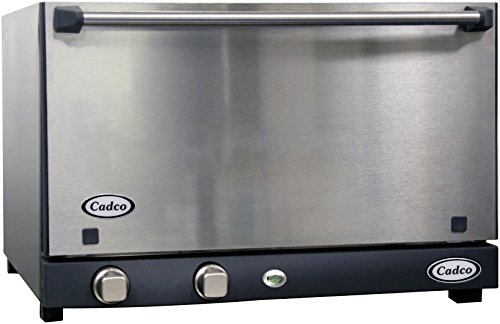
The Cadco fits the smaller commercial footprint: a coffee shop baking off pastries, a deli roasting sandwich components, a home producer whose batches are steady rather than huge. Its standard plug and modest draw make installation trivial.
Strengths
- Commercial Cadco build in a three-pan footprint
- 1450W on a standard NEMA 5-15P plug — no electrician required
- Single-fan simplicity means fewer things to fail in daily service
Trade-offs
- Three pans versus the Waring’s four caps peak throughput
- Single fan gives slightly less aggressive air movement than twin-fan designs
- Controls are commercial-basic, as expected in this class
| Specification | Detail (from verified listing title) |
|---|---|
| Model | OV-013SS |
| Capacity | Half size, 3 pan |
| Power | 120V, 1450W, 12 amps |
| Plug | NEMA 5-15P |
| Shelves | Included |
Cadco has built its reputation in exactly this niche — countertop convection for food service — and the OV-013SS shows the focus. Everything about it is serviceable, cleanable and direct: shelves included, a standard plug, and power draw that an ordinary commercial outlet handles without drama.
For the buyer cross-shopping domestic ovens, the comparison is instructive: this Cadco will outlast and out-bake consumer units in daily service, while offering none of their convenience theatre. If your cooking is a business or a serious production hobby, that trade is the right one. If it is Tuesday dinner, the domestic pick below serves you better.
A word on living with the Cadco OV-013SS Half Size Convection Oven beyond the first week: its character is defined by Half-size 3-pan, 1450W, standard plug, and that character does not change with familiarity — it simply becomes predictable, which is what experienced owners actually want. Bought for small cafés and bakers wanting commercial build at 3-pan scale, it will settle into routine quickly and stay there.
Best for: Small cafés and bakers wanting commercial build at 3-pan scale / Not suited for: Maximum batch volume
Check on Amazon — check the current price on Amazon before ordering, and confirm the listing matches the model described here.
3. VEVOR Commercial Convection Oven 47L Half-Size — Best Commercial Value
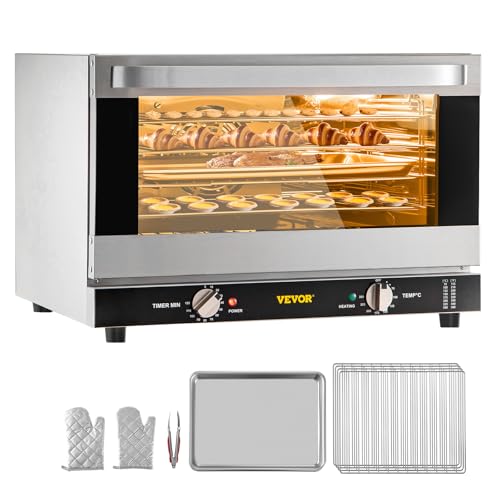
Pick the VEVOR when the business case is capacity per budget: a start-up bakery, food truck or test kitchen that needs half-size throughput now and can accept a value brand’s ownership experience to get it.
Strengths
- Half-size four-tier capacity at a distinctly lower tier than the legacy brands
- 1600W on standard 120V power
- Generous included accessories reduce setup spending
Trade-offs
- Fit, finish and long-term parts support trail Waring and Cadco
- 1600W demands a circuit that is not sharing heavy loads
- Temperature accuracy should be verified with an oven thermometer in critical baking
| Specification | Detail (from verified listing title) |
|---|---|
| Capacity | 47L / 43 Qt, half-size, 4-tier |
| Power | 1600W, 120V |
| Use | Restaurant and bakery |
| Included | Trays, wire racks, clip gloves |
VEVOR’s proposition is consistent across its catalogue: commercial dimensions and honest working capacity at prices that make established brands look indulgent. This 47L oven cooks in real batches, its four tiers match half-size workflow, and for a young business the capital saved can fund ingredients, packaging or a second appliance.
The mature way to buy it is with verification habits: check temperatures with a thermometer in the first week, learn its hot zones, and keep the manual and purchase records for parts enquiries. Treated as capable equipment rather than precision instrumentation, it earns its counter space.
Long-term satisfaction with the VEVOR Commercial Convection Oven 47L Half-Size follows a familiar pattern in this category: the buyers who thrive are those who bought it precisely for budget-conscious small businesses needing half-size capacity and who maintain it on the simple schedule its design assumes. Its headline specification — 47L half-size, 1600W, 4 tiers — is the right lens for every later judgement about whether it was money well spent.
Best for: Budget-conscious small businesses needing half-size capacity / Not suited for: Buyers prioritising brand service networks
Check on Amazon — check the current price on Amazon before ordering, and confirm the listing matches the model described here.

4. KoolMore KM-CTCO-15 Commercial Countertop Convection Oven — Best Mid-Size Commercial
The KoolMore suits the small restaurant, bakery-café or institutional kitchen that needs certification for inspectors and insurers, wants half-size capacity, and prefers a mid-tier brand with a commercial catalogue behind it.
Strengths
- ETL listing satisfies commercial safety and sanitation requirements
- Four racks on half-size pans give flexible batch configuration
- Stainless construction suits commercial cleaning regimes
Trade-offs
- Commercial controls and documentation assume a professional user
- 1600W needs a suitable circuit, as with all ovens in this class
- Over-specified and over-sized for ordinary home cooking
| Specification | Detail (from verified listing title) |
|---|---|
| Model | KM-CTCO-15 |
| Size | 23 inch, half-size pans, 4 racks |
| Power | 1600W |
| Certification | ETL listed for safety and sanitation |
| Finish | Stainless steel |
Certification is the KoolMore’s headline and, in a commercial setting, it is not bureaucracy — it is the difference between equipment an inspector accepts and equipment that closes your kitchen. The ETL listing for safety and sanitation puts this oven on the right side of that line at a price below the heritage brands.
As a cooker, it follows the class formula: strong convection, four-rack flexibility, stainless everywhere it matters. Small operators who need one dependable countertop oven for baking and roasting duty, without paying the flagship premium, are exactly its audience.
In ownership terms, the KoolMore KM-CTCO-15 Commercial Countertop Convection Oven asks little beyond what this guide has already described: keep its verified specification — Half-size, 4 racks, 1600W, ETL listed — in mind when you set it up, and judge it by the job named in its verdict, small restaurants wanting certified equipment at a mid tier. Owners who match a tool to its designed work rarely regret the purchase; owners who ask it to be a different product usually do.
Best for: Small restaurants wanting certified equipment at a mid tier / Not suited for: Domestic users needing friendly controls
Check on Amazon — check the current price on Amazon before ordering, and confirm the listing matches the model described here.
5. Avantco CO-14 Quarter Size Commercial Convection Oven — Best Compact Commercial
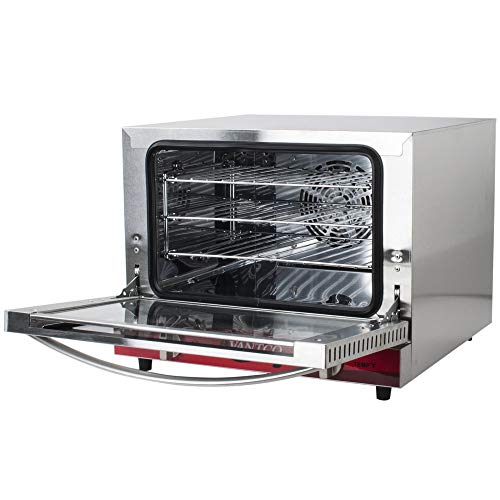
Choose the CO-14 where counter space is the scarcest resource in a business — a kiosk, food stall, bar kitchen or office pantry — and the cooking is pastries, snacks, sandwiches and small roasts rather than production batches.
Strengths
- Quarter-size footprint fits stations where half-size ovens cannot
- Commercial construction at a modest power draw
- Ideal bake-off size for cafés: fresh pastries without a full oven’s energy bill
Trade-offs
- Quarter-size pans limit menu flexibility and batch size
- Too small for family-scale home cooking as a main oven
- Commercial-basic controls, as with the class
| Specification | Detail (from verified listing title) |
|---|---|
| Model | CO-14 |
| Capacity | Quarter size, 0.8 cubic feet |
| Power | 120V, 1440W |
| Class | Commercial countertop |
The quarter-size class exists because many food businesses need convection quality at snack scale. The Avantco delivers that honestly: a real fan oven that bakes off croissants, reheats and crisps credibly, and finishes small roasts, in a box that sits where a microwave might otherwise go.
Avantco is a known name in value commercial equipment, and the CO-14’s appeal is the same as the VEVOR’s, at smaller scale: working capacity and commercial intent without flagship pricing. For a home user it is the wrong shape of oven; for a small station it may be exactly right.
A word on living with the Avantco CO-14 Quarter Size Commercial Convection Oven beyond the first week: its character is defined by Quarter-size, 0.8 cu ft, 1440W, and that character does not change with familiarity — it simply becomes predictable, which is what experienced owners actually want. Bought for kiosks, bars and small stations needing compact convection, it will settle into routine quickly and stay there.
Best for: Kiosks, bars and small stations needing compact convection / Not suited for: Half-size pan workflows
Check on Amazon — check the current price on Amazon before ordering, and confirm the listing matches the model described here.

6. Hamilton Beach Easy Reach 6 Slice Convection Toaster Oven — Best for Home Kitchens
Buy the Hamilton Beach if your convection cooking is home cooking — weeknight bakes, roasts for two to four, toast and reheating — and the commercial units above are more oven than your kitchen wants. Its roll-top door is a genuine ergonomic idea.
Strengths
- Roll-top door opens upward and out of the way, easing access and saving counter depth
- Convection baking at a domestic tier with a wide temperature range
- Auto shutoff adds peace of mind for a countertop appliance
Trade-offs
- Six-slice capacity is modest next to the commercial picks
- Domestic build is not intended for business duty cycles
- No air fry specialisation; it is a convection oven in the classic sense
| Specification | Detail (from verified listing title) |
|---|---|
| Capacity | 6 slice |
| Door | Roll-top door for easy access |
| Functions | Bake, broil and toast |
| Temperature | 150 to 450°F adjustable |
| Safety | Auto shutoff |
The Easy Reach door is one of those designs that seems minor until you live with it: the door rolls up inside the oven rather than swinging down onto your counter, so reaching food at the back is easier and the open door never becomes a hot shelf in your workspace. In small kitchens that difference is felt daily.
As a convection cooker it covers the domestic repertoire honestly — even baking, proper broiling, respectable roasting for small households — at a tier the commercial machines cannot approach. It is included in this guide as the reminder that “best convection cooking oven” for most homes is a good domestic oven, not a small commercial one.
Long-term satisfaction with the Hamilton Beach Easy Reach 6 Slice Convection Toaster Oven follows a familiar pattern in this category: the buyers who thrive are those who bought it precisely for home users wanting convection baking without commercial scale and who maintain it on the simple schedule its design assumes. Its headline specification — 6-slice domestic convection, roll-top door — is the right lens for every later judgement about whether it was money well spent.
Best for: Home users wanting convection baking without commercial scale / Not suited for: Volume baking or food businesses
Check on Amazon — check the current price on Amazon before ordering, and confirm the listing matches the model described here.
Comparison Table
| Pick | Badge | Key Spec | Best For |
|---|---|---|---|
| Waring WCO500X Countertop Convection Oven, Half-Size | Best Overall | Half-size, 4 pans, 1.5 cu ft, NSF, 120V | Serious bakers, caterers and small food businesses |
| Cadco OV-013SS Half Size Convection Oven | Best Commercial Alternative | Half-size 3-pan, 1450W, standard plug | Small cafés and bakers wanting commercial build at 3-pan scale |
| VEVOR Commercial Convection Oven 47L Half-Size | Best Commercial Value | 47L half-size, 1600W, 4 tiers | Budget-conscious small businesses needing half-size capacity |
| KoolMore KM-CTCO-15 Commercial Countertop Convection Oven | Best Mid-Size Commercial | Half-size, 4 racks, 1600W, ETL listed | Small restaurants wanting certified equipment at a mid tier |
| Avantco CO-14 Quarter Size Commercial Convection Oven | Best Compact Commercial | Quarter-size, 0.8 cu ft, 1440W | Kiosks, bars and small stations needing compact convection |
| Hamilton Beach Easy Reach 6 Slice Convection Toaster Oven | Best for Home Kitchens | 6-slice domestic convection, roll-top door | Home users wanting convection baking without commercial scale |
How to Choose a Convection Cooking Oven
Begin with pan size, because it defines the classes. Quarter-size, half-size and full-size sheet pans are the commercial language of capacity; domestic ovens speak in slices, pizzas and quarts. Decide which language your cooking uses. If you bake in batches, cater, or run any food business, half-size compatibility is the standard to buy. If you cook family dinners, domestic sizing is simpler and cheaper in every way.
Next, power. The serious countertop convection ovens in this guide draw 1440–1600W on 120V circuits — near the practical ceiling of a standard outlet. They need a circuit that is not simultaneously running a kettle, microwave or espresso machine. Check your kitchen’s circuits before falling for a half-size oven; the oven is only a bargain if it does not trip the breaker mid-service.
Finally, match build to duty. Commercial ovens assume hours of daily service, hard cleaning and minimal coddling; their controls are basic because professionals cook by time, temperature and eye. Domestic ovens assume intermittent use and reward convenience. Neither is better — but buying across the line in either direction wastes money or lifespan.
What Convection Actually Does to Your Cooking
Still air insulates: in a conventional oven, a layer of cooler air clings to food surfaces and slows cooking, while temperature varies significantly between the top, bottom and corners of the cavity. A convection fan strips that boundary layer away and evens the temperature throughout, so food cooks faster, browns more uniformly, and multiple racks behave consistently.
The working adjustments are simple. Reduce conventional recipe temperatures modestly, or keep temperature and shorten time; start checking earlier than the recipe suggests; and expect superior results exactly where evenness matters — pastry, cookies across a full tray, roasted vegetables, and anything where a pale side and a scorched side would otherwise share the same pan. Delicate items that can dry or be disturbed by strong airflow — soufflés, some custards — are the honest exceptions where gentle or no fan wins.
Commercial vs Domestic: An Honest Buying Framework
Buy commercial if any of these are true: the oven earns money, runs most of the day, must satisfy an inspector, or needs to survive staff rather than a single careful owner. The Waring, Cadco, KoolMore, Avantco and VEVOR picks are built and priced for that world, and their lack of domestic frills is a feature — fewer electronics, more metal, simpler service.
Buy domestic if the oven cooks family meals, lives among other appliances, and is valued for convenience features and a gentle price. The Hamilton Beach represents that world here, and the air fryer oven guide in this series covers its more specialised cousins. The framework matters more than any single pick: most dissatisfaction in this category comes from buying a fine oven from the wrong world.
Pan Standards and Workflow: Thinking Like a Production Kitchen
Commercial convection sizing is expressed in sheet pan fractions because professional kitchens think in pans, not portions. A half-size sheet pan measures roughly 18 by 13 inches; a quarter-size about 13 by 9. Recipes, prep and storage all scale in these units, so an oven that accepts the standard pan plugs into an entire ecosystem of trays, racks, parchment and cooling workflow that domestic pans only approximate.
Home producers adopting commercial ovens should adopt the pan standard with them. Buying a small stock of identical half-size pans, sheet parchment cut to size, and a cooling rack that matches transforms the oven from a bigger box into a faster system: pans rotate through prep, oven and cooling in a rhythm that domestic one-of-each cookware cannot sustain.
The same logic governs loading discipline. Production bakers load pans with consistent spacing because they know convection evens temperature, not geometry — a pan touching the wall still shields its neighbour. Treat the oven’s rated pan count as a maximum for forgiving foods and a suggestion for delicate ones, and your results will match the oven’s reputation rather than its brochure.
Maintenance and Longevity in Commercial Convection Service
Commercial ovens die of neglect in predictable places: fan bearings starved by baked-on grease, door seals hardened by heat and crumbs, and elements cycled to death by doors left ajar. The maintenance that prevents all three is unglamorous — a weekly interior clean while warm, a monthly seal inspection, and a rule that the door is either open for loading or closed for cooking, never parked between.
Calibration drifts with age and use, and production cooking cannot afford a wandering oven. An oven thermometer living permanently on a middle rack turns calibration from an annual event into a daily glance; when the offset grows beyond a few degrees, a service visit restores it. For a business, that thermometer is the cheapest insurance in the kitchen.
Finally, keep the paperwork commercial ovens assume you keep: purchase records, the manual, and a note of the service agent for your brand. When a fan motor fails in year four, the difference between a two-day repair and a two-week closure is usually documentation, not engineering.
Temperature Accuracy and Calibration: Trusting the Dial
Every oven in this guide will, at some point, be accused of lying about its temperature. Sometimes the accusation is just: dials and displays report the sensor’s location, not the whole cavity, and value-tier ovens in particular can run offsets that matter to pastry. The professional response is not outrage but measurement — an oven thermometer, checked at several setpoints and rack positions, produces your unit’s personal truth table within one afternoon.
Convection complicates the comparison in a way that confuses new owners: fan-driven heat transfer makes food cook as if the temperature were higher, even when the measured air temperature matches the dial exactly. This is why the conversion guidance exists, and why judging an oven’s accuracy by a burnt first batch of cookies is a category error. Measure the air; convert the recipe; the two disciplines together eliminate nearly all temperature complaints.
Where an offset is real and consistent, simply compensate in your settings and note it — generations of bakers have cooked superbly on ovens with a known, stable offset. Where an oven swings wildly or cannot hold temperature, that is a fault, and on a new unit it is a warranty conversation. The thermometer distinguishes those cases for the price of a coffee, which is why this guide recommends one in nearly every article it publishes.
For businesses, calibration has a compliance dimension as well: food safety regimes care about actual holding and cooking temperatures, not dial intentions. A documented thermometer check belongs in a small kitchen’s routine alongside the cleaning schedule, and it takes less time than either.
Energy, Heat Load and the Working Kitchen Environment
A convection oven converts electricity into cooked food and a warm kitchen with complete reliability, and in commercial or summer settings the second output deserves planning. Half-size ovens at 1600W are space heaters of respectable power; a small café running one all day needs ventilation that accounts for it, and a home kitchen in July will feel the difference between the countertop oven and the full range mostly in the range’s favour — the countertop unit heats far less air to do the same job.
Duty cycling shapes the real energy picture. An oven holding temperature cycles its elements; an oven loaded cold and opened frequently works continuously. For businesses, the energy difference between a well-insulated commercial cavity and a budget one compounds across thousands of hours into a genuine operating cost — one more reason the established brands can justify their tier in service, even when a budget unit matches them on day-one cooking.
Placement interacts with all of it: an oven boxed into an unventilated alcove runs hotter, ages faster and may nuisance-trip its own thermal protection. The clearances in the manual are an energy and longevity specification as much as a safety one. Give the machine its breathing room and it will repay you in consistency that no specification sheet can promise.
Buying Used Commercial Ovens: A Short, Cautious Guide
Commercial convection ovens hold value and appear on the used market constantly, and a careful buyer can equip a serious kitchen for a fraction of new cost. The inspection that matters is functional, not cosmetic: run the oven to temperature and verify it with a thermometer at two setpoints, listen to the fan for bearing noise through a full heat cycle, check the door seal’s resilience and the door’s alignment, and confirm every control responds. Stainless steel hides age beautifully; bearings and seals do not.
Price the risks honestly. A used oven without documentation may lack a warranty, a service path and any certainty about its duty history — an oven retired from a bakery has lived harder than one retired from a church hall. For home producers and businesses that can absorb a repair, the arithmetic often still favours used. For a business whose Saturday depends on the oven, the new models in this guide, with their warranties and parts channels, are the professional choice.
How to Use a Convection Cooking Oven for Even, Reliable Results
Convection rewards a few consistent habits. Build them from your first cook and the oven will seem to improve with age — it is you improving, which is the point.
- Preheat fully, with racks in position: convection ovens reach temperature quickly, but the cavity walls and racks need the extra minutes to stabilise. Food loaded into a half-heated cavity cooks unevenly no matter how good the fan is.
- Convert recipes deliberately: reduce the conventional temperature modestly or shorten the time, and write down what you did. A small notebook or phone note per staple recipe converts guesswork into your own calibrated settings within a few cooks.
- Load pans with airflow in mind: leave gaps between pans and between pans and walls. Convection cannot even out what it cannot reach; a wall-to-wall load of trays behaves like a still-air oven with extra noise.
- Rotate on big loads: even excellent convection has stronger and weaker zones. Swapping racks top-to-bottom and turning pans halfway through large batches is professional practice, not an admission of failure.
- Use the right pan: low-sided sheet pans expose food to airflow and brown best. Deep dishes shield their contents — use them when you want gentle cooking, and drop to a lower rack position for tall items so tops do not over-brown near the element.
- Verify with a thermometer: an inexpensive oven thermometer tells you your unit’s true temperature and its offset from the dial, and an instant-read food thermometer confirms doneness. Two thermometers remove nearly all convection guesswork.
- Clean on a schedule: commercial and domestic convection ovens both accumulate fan-circulated grease. Wipe interiors while warm, wash racks and trays regularly, and keep the fan guard clear — airflow is the product, and grease is its tax.
Keep notes for the first month — temperatures, times, rack positions, results. Convection ovens are consistent machines; once your notes capture that consistency, repeatability replaces luck and every recipe becomes a known quantity.
Common Buying Mistakes
Running a 1600W oven on a shared, loaded circuit. Half-size convection ovens draw near the limit of a standard outlet. Give the oven a circuit that is not feeding other heavy appliances at the same time, or expect breaker trips at the worst moment.
Blocking the airflow with oversized pans. A pan that spans wall to wall defeats convection entirely. Keep clear gaps around pans so the fan can do the job you paid for.
Using conventional times and temperatures unchanged. Convection cooks faster. Owners who ignore conversion burn the first batches and blame the oven. Reduce temperature or time, check early, and calibrate.
Buying commercial for occasional home use. A half-size commercial oven for Sunday roasts is capital asleep on your counter. Match the build class to the duty the oven will actually see.
Neglecting the fan and interior grease. Convection circulates grease as efficiently as heat. A neglected oven smokes, smells and eventually cooks unevenly as airflow degrades. Regular cleaning is performance maintenance.
Final Recommendation
For serious cooking — business, catering or production home baking — the Waring WCO500X is the benchmark half-size convection oven, with the Cadco OV-013SS as the slightly smaller, plug-friendly alternative and the KoolMore as the certified mid-tier choice. The VEVOR delivers the class’s capacity at a value tier, and the Avantco CO-14 owns the compact commercial niche.
For home kitchens, the Hamilton Beach Easy Reach is the honest recommendation: real convection cooking in a domestic format at a domestic tier. Decide which world your cooking lives in, confirm your circuit can feed the oven you choose, and any pick here will cook evenly and reliably for years.
A closing note for buyers still torn between the commercial and domestic worlds: consider where your cooking will be in three years, not only where it is today. The baker whose market stall is growing into a premises should buy the commercial oven once; the household whose production ambitions are a hopeful January mood should buy the domestic oven and revisit the question when the batches are real. Equipment bought for the cooking you actually do — present tense, honest tense — is the thread running through every recommendation in this guide, and it has never yet produced a regretful owner.
And if the choice still feels finely balanced between two models, let pan compatibility and your circuit be the tiebreakers — they are the two factors no amount of cooking skill can negotiate with later, while every other difference between the ovens in this guide can be cooked around within a week of ownership. Decide on the constraints that cannot change, and the cooking will take care of itself.
Kitchens that cook daily forgive many things, but they never forgive an oven that fights them — and every oven recommended here was chosen, above all, not to fight its owner. That, in the end, is what the word best has meant throughout this guide: not the longest feature list, but the machine whose daily behaviour matches its owner’s daily life.
Buy once, buy in the right class, and the oven will repay the decision at every single service it cooks.
Cook well, and cook often.
The picks at a glance:
- Waring WCO500X Countertop Convection Oven, Half-Size — Best Overall. Serious bakers, caterers and small food businesses.
- Cadco OV-013SS Half Size Convection Oven — Best Commercial Alternative. Small cafés and bakers wanting commercial build at 3-pan scale.
- VEVOR Commercial Convection Oven 47L Half-Size — Best Commercial Value. Budget-conscious small businesses needing half-size capacity.
- KoolMore KM-CTCO-15 Commercial Countertop Convection Oven — Best Mid-Size Commercial. Small restaurants wanting certified equipment at a mid tier.
- Avantco CO-14 Quarter Size Commercial Convection Oven — Best Compact Commercial. Kiosks, bars and small stations needing compact convection.
- Hamilton Beach Easy Reach 6 Slice Convection Toaster Oven — Best for Home Kitchens. Home users wanting convection baking without commercial scale.
Related reading in this series: Best Convection Air Fryer Ovens; Best Convection Counter Top Ovens; Best Convection Microwave Ovens Countertop; Best Commercial Convection Ovens; Best Countertop Ovens.
Frequently Asked Questions
How much faster is convection cooking, really?
As a working rule, convection cooks in roughly three quarters of the conventional time at the same temperature, or matches conventional time at a modestly reduced temperature. The gain is largest on roasting and multi-tray baking, where airflow and evenness matter most.
Can I use my regular pans in a half-size commercial oven?
Half-size ovens are designed around the standard half-size sheet pan; most home pans either fit with room to spare or not at all. Measure your pans against the cavity before ordering — pan compatibility is the most common sizing surprise in this class.
Do commercial convection ovens need special wiring?
The 120V models in this guide plug into standard outlets, which is their great advantage. They do need a circuit with enough spare capacity — 1440 to 1600 watts is most of a typical circuit — so avoid sharing with other heavy appliances during use.
Is convection good for baking cakes and pastry?
Yes, with the standard conversion: slightly reduced temperature and an early check. Pastry and cookies benefit especially from the evenness across a full tray. Very delicate items that can dry out may prefer reduced fan or conventional mode where the oven offers it.
What is the difference between quarter-size and half-size?
It is the sheet pan the oven is built around. Quarter-size ovens suit cafés and small stations baking off modest quantities; half-size ovens double that working capacity and suit production. Choose by the batch sizes you actually cook.
How long do commercial countertop ovens last?
In appropriate duty, the commercial class is built for years of daily service, with simpler controls and heavier construction than domestic ovens. Longevity still follows care: clean interiors, unblocked fans and correct electrical supply are the difference between a workhorse and a warranty story.