Disclosure: airfryerkitchensupply.com is reader-supported. When you buy through links on our site, we may earn an affiliate commission at no extra cost to you.
Finding the best competition charcoal vertical smokers is a different job from finding a good backyard smoker, because a contest pit has to hold temperature for twelve hours or more, recover fast after every door opening, and produce four turn-in boxes that look and taste identical. Vertical charcoal designs dominate this niche for a simple physical reason: heat and smoke rise straight through the cooking chamber, the footprint stays small enough for a crowded contest site, and a water pan or diffuser between the fire and the meat softens the harsh direct heat that ruins bark on a long cook.
The honest market picture is that true competition-grade verticals split into three families. Bullet smokers like the Weber Smokey Mountain are the proven all-rounders that thousands of teams started on and many never left. Drum smokers — the Pit Barrel, the Oklahoma Joe’s Bronco line and the Gateway Drum — cook hotter and faster with meat hung or racked directly over the coals, and they are the fastest-growing style on the circuit. Vertical offset cabinets like the Dyna-Glo Wide Body move the firebox to the side and give you shelf space, at the cost of more seams and more temperature management. All three families are represented below, because the right answer depends on how you cook, not on which style is fashionable.
One warning before the picks: competition cooking exposes build quality mercilessly. Thin steel, leaky doors and toy-grade thermometers that a backyard cook tolerates for a Saturday ribs session become real problems at hour nine of a brisket cook in wind. Every pick below was chosen for sealing, steel weight, grate capacity and the availability of the gaskets, grates and controllers that serious teams add. Where a famous competition name could not be verified for a purchase link, it is included honestly as a pick without a link rather than dropped, because leaving the Gateway Drum out of a competition roundup would be misleading.
Where to buy
Competition verticals are sold through Amazon, barbecue specialty dealers and, for the drum builders, direct from the manufacturer. Amazon is the easiest route for the Weber, Pit Barrel, Bronco and Dyna-Glo picks below, with the exact model and size selectable on the listing — check price on Amazon before ordering, and confirm you are buying the size named in the review, because most of these lines come in two or three diameters that look identical in thumbnail photos.
- Weber Smokey Mountain Cooker 22-inch (Best Overall) — Check the current price on Amazon
- Pit Barrel Cooker Premier Series 18.5-inch Drum Smoker (Best for Drum-Style Hanging) — Check the current price on Amazon
- Oklahoma Joe’s Bronco Pro 21.5-inch Charcoal Drum Smoker (Best Sealed Drum) — Check the current price on Amazon
- Weber Smokey Mountain Cooker 18-inch (Best Mid-Size Bullet) — Check the current price on Amazon
- Dyna-Glo Wide Body Vertical Offset Charcoal Smoker (DGO1890BDC-D) (Best Budget Capacity) — Check the current price on Amazon
- Gateway Drum Smoker 55-Gallon (Best True Competition Drum) — sold through specialist dealers rather than Amazon; see the review below for sourcing notes and check price on Amazon for current marketplace listings.
In this guide
Quick Picks
Six verticals that can genuinely work a contest schedule: two bullets, three drums and one vertical offset, plus the circuit’s favourite drum sold direct. Start with the badge that matches your cooking style.
- Best Overall: Weber Smokey Mountain Cooker 22-inch — The bullet that built modern competition barbecue. Two full grates, a water pan that stabilises temperature for hours, porcelain-enamelled steel that shrugs off weather, and a parts and accessory ecosystem no rival matches. — Check price on Amazon
- Best for Drum-Style Hanging: Pit Barrel Cooker Premier Series 18.5-inch Drum Smoker — The drum that made hanging meat mainstream. Hooks and a rebar frame put ribs, chickens and briskets directly over the coals for fast, even, self-basting cooks with almost no temperature fussing. — Check price on Amazon
- Best Sealed Drum: Oklahoma Joe’s Bronco Pro 21.5-inch Charcoal Drum Smoker — A drum built like a tank: sealed lid, real intake control, a large charcoal basket and 366 square inches of cooking area. The choice for drum cooks who found the Pit Barrel too simple. — Check price on Amazon
- Best Mid-Size Bullet: Weber Smokey Mountain Cooker 18-inch — Everything that makes the 22-inch great, in the size most teams actually cook on weekly. Easier on charcoal, easier to transport, and big enough for a butt-and-ribs programme. — Check price on Amazon
- Best Budget Capacity: Dyna-Glo Wide Body Vertical Offset Charcoal Smoker (DGO1890BDC-D) — A wide-body vertical cabinet with the firebox offset to the side and shelves of cooking space for a budget-tier outlay. Needs gasket work out of the box; rewards it with serious capacity. — Check price on Amazon
- Best True Competition Drum: Gateway Drum Smoker 55-Gallon — The drum the circuit actually runs on: a 55-gallon hot-and-fast specialist with engineered intakes, built for competition first and sold mainly direct by its maker. Included unlinked — see the review.
How These Picks Were Chosen
Picks were chosen on competition criteria, not backyard popularity: temperature stability over a long cook, recovery after door openings, sealing and steel quality, grate or hanging capacity measured against a real four-category programme, and the availability of spares, gaskets and controller options. Every linked product was verified through the Amazon catalogue data available to this site — the exact model, size and configuration named in each review is the one the link points to — and products that could not be verified that way, however famous, were written as a pick without a link with the reason stated in the review.
Two famous categories were deliberately left out. Pellet and electric verticals are excluded by the search itself — this is a charcoal roundup — and cheap bullet clones with toy dampers were cut because their temperature swings fail the basic competition test. We also weighted transport and setup honestly: a cooker that wins on paper but needs two people and forty minutes to assemble at a contest site loses real-world points, and that trade-off is called out in each review rather than hidden.
The 6 Best Competition Charcoal Vertical Smokers

Weber Smokey Mountain Cooker 22-inch — Best Overall
The 22-inch Smokey Mountain is the default recommendation in this category because it removes variables. The porcelain-enamelled bowl and centre section seal well from the factory, the water pan gives you a thermal buffer that forgives small vent mistakes, and the two cooking grates swallow a pair of briskets or four pork butts without crowding. Teams have won on this cooker for decades, which means every problem you will ever have with it already has a documented fix, a gasket kit or a replacement part a search away.
Strengths
- Exceptionally stable temperatures once vents are dialled in, thanks to the water pan buffer
- Two full-size grates give real contest capacity for brisket, butt and ribs in one cook
- Porcelain-enamelled steel, endless spare parts and the deepest accessory ecosystem in the class
Trade-offs
- Access door is thin and often needs reshaping or a gasket kit to seal fully
- Lower grate is awkward to reach mid-cook, so cook order needs planning
- No factory hanging system — drum-style hanging requires aftermarket parts
| Size | 22-inch bullet smoker |
| Grate configuration | Dual cooking grates (per Amazon listing) |
| Construction | Porcelain-enamelled steel (per Amazon listing) |
| Fuel | Charcoal with water pan |
Temperature control is the WSM’s real competition strength. Once the vents are learned, it settles into a narrow band and stays there on a single charcoal load far longer than most rivals, and it recovers predictably after the door opens for wrapping or spritzing. The door itself is the known weak point — it is light and can leak smoke until it is gently reshaped or gasketed — but that is a twenty-minute fix, not a flaw in the cooking design. A hinge kit for the lid and a quality probe thermometer turn it into a genuinely set-and-forget contest tool.
Capacity planning matters at this size. The top grate takes the big cuts; the lower grate runs hotter and suits chicken or a second butt, but access means lifting the top grate out, so plan your cook order around that. Fuel access through the side door is workable rather than generous. None of this stops the 22-inch WSM being the cooker we would hand a first-year team: it is affordable in premium tier terms, durable enough to hand down, and honest about what it is.
Best for: teams who want the most proven, stable all-round competition vertical at any level / Not suited for: cooks committed to hot-and-fast drum hanging as their whole method
Check on Amazon — check price on Amazon for the current listing, configuration options and delivery terms before you order.

Pit Barrel Cooker Premier Series 18.5-inch Drum Smoker — Best for Drum-Style Hanging
The Pit Barrel takes the opposite philosophy to the Weber: instead of shielding meat from the fire, it hangs the meat in the rising heat and lets dripping juices hit the coals, creating the distinctive drum flavour that judges either love or that wins them over. The 18.5-inch Premier is porcelain coated, arrives with hooks, hanging rods and a standard grate, and is famously close to light-it-and-leave-it — the fixed intake design means there is very little to adjust, which at a contest translates to fewer ways to make a mistake at 3 a.m.
Strengths
- Hanging system produces exceptionally even ribs and poultry with no flipping
- Near-zero learning curve — fixed intake design removes most temperature fiddling
- Porcelain-coated steel drum with hooks, rods and grate included in the box
Trade-offs
- Temperature control is coarse compared with a gasketed bullet or sealed drum
- 18.5-inch diameter limits whole-programme capacity in a single cooker
- Hanging full packer briskets is tight and needs practice before contest day
| Size | 18.5-inch drum |
| Construction | Porcelain coated steel (per Amazon listing) |
| Cooking style | Hanging hooks/rods plus standard grate |
| Fuel | Charcoal |
For ribs specifically, this cooker is a weapon. Hung ribs cook evenly end to end with no flipping, finish faster than on a bullet, and come off with a uniform colour that boxes well. Chickens hung by the hook cook quickly and stay moist. Brisket works too, either hung until the wrap or on the grate, though a full packer is a snug fit and you should rehearse the geometry at home before a contest weekend depends on it.
The trade-off for that simplicity is control. You get a deliberately simple cooker: temperature is managed by fuel load, lid cracks and rod positions rather than precision vents, and adding a blower controller means drilling or adapting. Capacity is also capped by the barrel diameter — this is a two-category cooker (ribs plus chicken, or one big cut plus sides) rather than a whole contest programme in one drum. Many teams solve that by owning two, which the mid-range tier pricing makes realistic.
Best for: rib and chicken specialists, and teams who want drum flavour with minimal management / Not suited for: cooks who want precise vent-and-blower temperature control from the factory
Check on Amazon — check price on Amazon for the current listing, configuration options and delivery terms before you order.
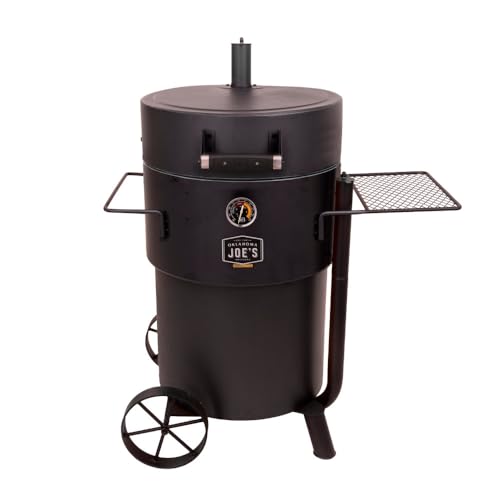
Oklahoma Joe’s Bronco Pro 21.5-inch Charcoal Drum Smoker — Best Sealed Drum
The Bronco Pro answers the two standard complaints about drums — leaks and crude control — with heavy steel, a sealed lid and an intake system that actually meters air. The result is a drum that can run low and slow with bullet-like steadiness or open up for hot-and-fast work, and the 21.5-inch body with 366 square inches of cooking area gives meaningfully more room than an 18.5-inch barrel. A large ash pan and a proper charcoal basket make the long cooks that competition demands practical rather than heroic.
Strengths
- Sealed, heavy-gauge drum holds temperature with bullet-like steadiness
- 366 sq. in. of cooking area plus hanging capability covers a full contest programme
- Real intake control supports both low-and-slow and hot-and-fast cooking
Trade-offs
- Heavy — a two-person lift into a truck despite the wheels
- Painted finish needs a cover for year-round outdoor storage
- Costs more than simpler drums; the premium buys sealing and control, not capacity alone
| Size | 21.5-inch drum |
| Cooking area | 366 sq. in. (per Amazon listing) |
| Construction | Heavy duty steel (per Amazon listing) |
| Fuel | Charcoal, drum and grill modes |
Hanging is fully supported — the Pro ships ready to hang ribs and halves — but unlike the Pit Barrel you are not locked into one method: grates, hanging and grilling all work, and the temperature gauge and side shelf arrangement suit a contest workflow where the cooker doubles as a work surface. Temperature recovery after opening is strong because the sealed body does not dump its heat the way a loose-lidded drum does.
Weight is the price of all that steel. This is a move-it-once cooker with wheels that manage grass and gravel adequately rather than brilliantly, and teams travelling light will feel the difference against a bullet that breaks into three liftable pieces. The finish also deserves a cover if it lives outdoors year-round. Neither point dents its cooking case: as a single drum that can run an entire contest programme, the Bronco Pro is the most complete factory package here.
Best for: drum cooks who want one heavy, sealed cooker for the whole contest / Not suited for: solo competitors who load and unload the pit alone every weekend
Check on Amazon — check price on Amazon for the current listing, configuration options and delivery terms before you order.
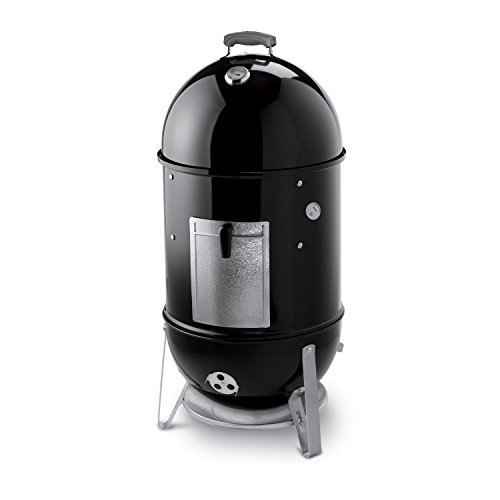
Weber Smokey Mountain Cooker 18-inch — Best Mid-Size Bullet
The 18-inch Smokey Mountain is the connoisseur’s size. It shares the 22-inch model’s porcelain-enamelled construction, water pan and dual grates, but the smaller chamber heats faster, sips charcoal and is noticeably easier to move around a contest site or store in a trailer. For the huge number of teams whose programme is pork butt plus ribs, or ribs plus chicken, it is not a compromise at all — it is the correctly sized tool.
Strengths
- Same stable water-pan cooking as the 22-inch, in a thriftier, more portable size
- Heats and recovers quickly; noticeably lower charcoal use per cook
- Full access to the WSM gasket, hinge, grate and controller aftermarket
Trade-offs
- Full packer briskets need bending or a rib rack to fit flat
- Crowded when three categories share one cook
- Same light access door as the 22-inch — expect to gasket it
| Size | 18-inch bullet smoker |
| Grate configuration | Dual cooking grates (per Amazon listing) |
| Construction | Porcelain-enamelled steel (per Amazon listing) |
| Fuel | Charcoal with water pan |
Where it gives ground to its bigger sibling is the biggest cuts. A full packer brisket needs a slight bend, a rib rack or a skewer trick to fit flat, and two butts plus ribs in one cook gets crowded. Experienced 18-inch owners treat those as solved problems with known workarounds, but if brisket is your headline category and you cook it every weekend, the honest advice is to buy the 22-inch first and add the 18 later for the smaller categories.
Running costs quietly favour this size across a season: less charcoal per cook, faster clean-down, and the same deep accessory and spares ecosystem as every other WSM. As a second cooker beside a drum — bullets for the long cuts, drum for ribs and chicken — it is arguably the most common serious-team pairing in this entire roundup, and the mid-range tier price makes that two-cooker strategy realistic.
Best for: butt-and-ribs programmes, and as the bullet half of a two-cooker team setup / Not suited for: brisket-first teams who need a big packer to lie flat every cook
Check on Amazon — check price on Amazon for the current listing, configuration options and delivery terms before you order.

Dyna-Glo Wide Body Vertical Offset Charcoal Smoker (DGO1890BDC-D) — Best Budget Capacity
The Dyna-Glo Wide Body is the value play of this roundup: a tall vertical cabinet fed by a side firebox, with multiple shelves that swallow ribs, butts and chicken in quantities the bullets cannot match at anything like the tier. For a team stepping up from backyard cooking, or a caterer-adjacent competitor who needs volume for vending alongside turn-ins, that shelf space is the whole argument, and it is a good one.
Strengths
- Huge multi-shelf vertical capacity for a budget-tier outlay
- Offset firebox keeps all direct heat away from the meat
- Shelf temperature gradient can be used deliberately for different categories
Trade-offs
- Thin steel and leaky seams until gasketed and sealed by the owner
- Firebox needs tending more often than a bullet on overnight cooks
- Lid thermometer should be replaced with a probe unit for serious work
| Format | Wide body vertical offset cabinet |
| Fuel | Charcoal and wood chunks, side firebox |
| Construction | Steel, black (per Amazon listing) |
Honesty about the build is required. At this tier the steel is thinner and the door and firebox seams leak until you spend an afternoon with gasket tape and high-temperature sealant — budget for that work and a better thermometer than the lid gauge, and treat both as part of the purchase. Once sealed, the cabinet cooks far above its price class: the offset fire keeps direct heat off the meat entirely, and shelf-to-shelf temperature differences can be used deliberately, hotter shelves for chicken, gentler ones for the long cuts.
Fire management is the skill this cooker demands. The firebox is sized for charcoal with wood chunks rather than full splits, and on a long cook you will tend it more often than a WSM owner tends theirs. Teams who enjoy running a fire will find that engaging; teams who want to sleep through the night cook should look at the bullets above. Judged as capacity per pound spent, though, nothing else in this list is close.
Best for: high-volume teams and first-year competitors who will do the gasket work / Not suited for: set-and-forget cooks who want overnight stability with no fire tending
Check on Amazon — check price on Amazon for the current listing, configuration options and delivery terms before you order.
Gateway Drum Smoker 55-Gallon — Best True Competition Drum
Any honest list of competition verticals has to include the Gateway Drum, because on any given weekend it is one of the most-cooked-on pits in serious competition barbecue. The concept is refined drum cooking: a 55-gallon barrel, precisely placed intake ports, a diffuser option, and a design tuned for hot-and-fast cooking — briskets and butts done in a fraction of low-and-slow time, with the concentrated drum flavour that comes from juices vaporising on the coals below hanging or racked meat.
Strengths
- Purpose-built hot-and-fast competition drum with engineered, repeatable intakes
- 55-gallon capacity runs a complete contest programme in one cooker
- Deep circuit knowledge base — every technique and mod is documented by teams
Trade-offs
- Sold mainly direct/dealer; freight adds significantly to the real cost
- Hot-and-fast drum method has a genuine learning curve for bark management
- Premium tier total cost once accessories and shipping are included
Why is it unlinked here? Gateway sells primarily direct and through specialist barbecue dealers, and no Amazon listing for the cooker itself could be confirmed through our verification process for this guide — the marketplace results are dominated by parts, covers and accessories rather than the drum. Rather than attach a link we cannot stand behind, the pick is written without one. Order direct or through a dealer, confirm the exact configuration — intake style, grate and hanger package, finish — in writing, and factor freight into the comparison, because a 55-gallon drum does not ship cheaply.
As a cooker, its case is the learning curve it removes from hot-and-fast: the intake design makes repeatable temperatures unusually achievable for a drum, and the capacity runs a full programme — brisket, butt, ribs and chicken — in one barrel, which is exactly why teams standardise on pairs of them. The compromises are the drum compromises: you are cooking over the fire, bark management takes technique, and the price lands in premium tier territory once freight and accessories are counted. If your method is hot-and-fast, it is the benchmark the Bronco Pro and Pit Barrel are measured against.
Best for: established hot-and-fast teams who want the circuit-standard drum / Not suited for: buyers who need Amazon purchasing, or low-and-slow-only cooks
This pick is written as a recommendation without a link: no Amazon listing for it could be confirmed through our verification process, so there is no purchase link here. Buy it through an authorised dealer and confirm the exact specification in writing before paying.
Comparison Table
The table below lines the six up by the things that decide contest cooks: format, capacity and the job each one actually does best. Read it with the reviews — the same diameter can mean very different things in a bullet, a drum and a cabinet.
| Pick | Badge | Key spec | Best for |
|---|---|---|---|
| Weber Smokey Mountain Cooker 22-inch | Best Overall | 22-inch bullet, dual grates, water pan | teams who want the most proven, stable all-round competition vertical at any level |
| Pit Barrel Cooker Premier Series 18.5-inch Drum Smoker | Best for Drum-Style Hanging | 18.5-inch drum, hanging system included | rib and chicken specialists, and teams who want drum flavour with minimal management |
| Oklahoma Joe’s Bronco Pro 21.5-inch Charcoal Drum Smoker | Best Sealed Drum | 21.5-inch sealed drum, 366 sq. in. | drum cooks who want one heavy, sealed cooker for the whole contest |
| Weber Smokey Mountain Cooker 18-inch | Best Mid-Size Bullet | 18-inch bullet, dual grates, water pan | butt-and-ribs programmes, and as the bullet half of a two-cooker team setup |
| Dyna-Glo Wide Body Vertical Offset Charcoal Smoker (DGO1890BDC-D) | Best Budget Capacity | Vertical offset cabinet, multi-shelf | high-volume teams and first-year competitors who will do the gasket work |
| Gateway Drum Smoker 55-Gallon | Best True Competition Drum | 55-gallon drum, hot-and-fast design | established hot-and-fast teams who want the circuit-standard drum |
How to Choose the Right Competition Vertical for Your Method
Start with your cooking method, because it eliminates two-thirds of the market immediately. If you cook low and slow with a water pan and value sleep, a bullet is your format. If you cook hot and fast and hang meat, you are a drum cook. If you need shelf volume for vending or big programmes and enjoy tending a fire, the vertical offset earns its place. Buying against your method — a drum for a cook who wants to sleep, a bullet for a hanger — is the most expensive mistake in this category, because the cooker will fight you every single weekend.
Next, size the cooker to your programme, not your ambitions. One brisket, one butt, three racks of ribs and chicken is the standard contest load: a 22-inch bullet, a 21.5-inch drum or a wide cabinet handles it in one cook; an 18-inch bullet or 18.5-inch drum handles it in a planned sequence or with a second cooker. Many strong teams deliberately run two mid-size cookers instead of one giant one — categories stay separated, temperatures stay independent, and a failure in one cooker never ends the weekend.
- Temperature stability beats headline capacity — a cooker that swings 40 degrees cooks worse food than a smaller one that sits still.
- Sealing is a feature, not a detail: gasketed lids and doors are worth more than an extra grate.
- Budget for the ecosystem: probes, gaskets, a cover and a controller cost real money on top of any cooker here.
- Transport is part of the spec — weigh, measure and rehearse loading before the first contest, not at 5 a.m. on the day.
What Actually Matters in a Vertical Charcoal Smoker?
Air control is the whole game. A vertical charcoal cooker is a chimney with food in it: the intake vents set the fire’s oxygen, the exhaust sets the draw, and everything else — water pans, diffusers, insulation — exists to smooth what the vents do. Judge any cooker by how finely and repeatably its intakes adjust, and by whether the body is tight enough that the vents, not the leaks, are in charge. That is why the sealed Bronco Pro and the gasket-friendly Weber score so well here, and why the budget cabinet needs owner-applied gasket work before it cooks to its potential.
Steel weight and finish decide lifespan. Porcelain-enamelled steel, as on the Webers and the Pit Barrel, resists rust and cleans down fast; painted steel needs a cover and the occasional touch-up but allows the heavy gauges of the Bronco Pro at sane prices. Thin steel is not automatically disqualifying — the Dyna-Glo proves that — but it must be paired with realistic expectations about heat retention in wind and cold, and with a windbreak in your contest kit.
Should You Run a Temperature Controller on a Competition Vertical?
A blower controller — a fan unit with a pit probe that feeds the fire exactly the air it needs — is the single most popular upgrade in this class, and on bullets and sealed drums it works superbly, flattening temperature curves and buying the cook sleep. Every linked pick here except the Pit Barrel accepts one readily (the Pit Barrel’s fixed intake needs an adapter approach), and for overnight brisket cooks the case is strong.
The counter-argument is equally real: controllers add a failure point, a power requirement and a setup step, and several of the best drum cooks on the circuit run purely on vents precisely because a drum’s thermal mass and intake design already hold steady. Our advice is to learn your cooker on vents first — two or three full cooks — then add a controller if your logs show swings you cannot vent away. Skill first, gadget second, in that order.
How Much Capacity Do You Really Need for a Four-Category Contest?
Work backwards from the turn-in boxes. A standard programme is one brisket, one or two pork butts, three racks of ribs and chicken — thighs, halves or a whole bird depending on your style. On a 22-inch bullet that load fits across two grates with room to work; on an 18-inch bullet the same load fits only with a rib rack and a sequenced timeline; in a 55-gallon drum it fits hung and racked with space to spare; in the wide-body cabinet it fits almost casually, which is exactly why high-volume teams forgive that cooker its fire-tending.
The mistake is buying for the biggest cook you can imagine instead of the programme you actually run. Oversized cookers burn more charcoal to heat empty air, recover more slowly in proportional terms and tempt you into cooking everything in one chamber at one temperature — when the professional pattern is the opposite: big cuts low, ribs in their window, chicken hotter at the end. Two mid-size cookers running independently will out-cook one giant for most teams, and the picks above were chosen so that a bullet-plus-drum pairing stays within a sane total budget.
Also count the unglamorous capacity: ash and fuel. A cooker whose charcoal basket and ash pan handle a full overnight burn without intervention — the sealed drums and the bullets — effectively has more usable capacity than a larger cabinet that needs its fire rebuilt at hour seven. When you compare spec sheets, the cooking-area number is the beginning of the conversation, not the end of it.
What Does a Season of Running a Competition Vertical Cost?
The cooker is the entry fee, not the season’s cost. Charcoal is the big recurring line: a long contest cook consumes a substantial bag, and a season of contests plus practice cooks multiplies that into real money, with the smaller bullets noticeably thriftier per cook than the big cabinet. Wood chunks for smoke flavour, foil, pans, gloves and turn-in supplies sit behind it. None of this argues for the cheapest cooker — it argues for counting fuel efficiency as a feature, which is one reason the 18-inch WSM earns its place despite its smaller grates.
The second cost is maintenance, and here the field splits cleanly. Porcelain-enamelled cookers mostly need washing and the occasional grate; painted steel needs rust vigilance and touch-ups; every cooker needs its thermometer probes treated as consumables, because a drifting probe loses more contests than a cheap cooker ever will. Budget a replacement probe set into every season and verify your probes in boiling water before the first contest of the year.
Finally, protect the investment in transit. Most competition cooker damage happens in trailers and truck beds, not in cooks: lids dent, doors bend, gauges crack. A cover, a strap system and a loading routine are part of the true cost of campaigning any of these machines, and the teams whose gear looks new in year five are simply the teams who decided that in year one.
What Separates a Competition Vertical From a Backyard Smoker?
Three things, and none of them is size. The first is repeatability: a competition cooker must produce the same result on a windy October morning as on a calm June evening, which is why sealing, steel weight and vent quality dominate this guide’s judgements. The second is recovery: judges’ timelines do not wait for a cooker that takes twenty minutes to regain temperature after the door opens for wrapping. The third is serviceability — gaskets, grates, gauges and doors that can be replaced or repaired in the field, because a cooker that cannot be fixed on a Friday night ends a season, not a weekend.
Backyard smokers optimise for different virtues — price, looks, convenience features — and many are excellent at them. The confusion arises when a backyard machine is marketed with competition language. The test is in the details this guide keeps returning to: can you gasket it, can you control its air in fine increments, can you buy its parts in five years, and does it hold a temperature while you do everything else a contest demands? The six picks above pass those tests in different ways and at different tiers; that, more than any single feature, is what makes them competition verticals.
How to Run a Vertical Charcoal Smoker Through a Full Competition Cook
The sequence below is the standard contest rhythm for a bullet or drum; offsets follow the same logic with more frequent fire checks. Rehearse it once at home with a notebook before it ever counts.
- Light with a chimney or a torch-lit centre of the charcoal basket — for long cooks, arrange unlit charcoal around a small lit core (the minion method) so the fire spreads slowly over hours rather than peaking early.
- Assemble the cooker, fill the water pan if your design uses one, and let it settle at target temperature for at least 30 minutes before meat goes on; a cooker that is still climbing will overshoot with a full load.
- Load the longest cooks first — brisket and butt — and record the time, vent positions and pit temperature in your cook log; that log is your real competition asset.
- Resist opening the cooker. Every opening costs heat and time; batch your spritzing, wrapping and adding of later categories (ribs, then chicken) into planned openings hours apart.
- Wrap brisket and butt when the bark is set and the colour is right, not by the clock, and return them to the gentlest part of the cooker while the faster categories finish.
- Rest every big cut in a dry cooler or holding box for at least an hour before slicing; build that rest into your timeline backwards from turn-in, and slice only when the box is being built.
After the cook, knock ash down while the cooker is warm, brush grates, and note in the log what the cooker did — vent changes, fuel used, weather. Competition verticals reward owners who treat every cook, including practice, as data.
Common Buying Mistakes
Buying by diameter alone. An 18-inch drum, an 18-inch bullet and an 18-inch offset shelf have completely different usable capacities. Compare grate area, hanging room and how your actual cuts fit — ideally with the real meat in a shop or at a practice cook.
Ignoring the voltage of the hobby — your time. The cheapest cooker here in money is the Dyna-Glo; the most expensive in attention is also the Dyna-Glo. Price your own fire-tending honestly before choosing a format.
Trusting the lid thermometer. Lid gauges read the air near the lid, not the grate, and can be far off. Every pick in this guide should be cooked by a grate-level probe thermometer from day one.
Skipping the gasket step. On the Webers’ doors and the Dyna-Glo’s seams, an inexpensive gasket kit is the difference between a cooker that holds temperature and one that hunts all night. Fit it before your first serious cook.
Changing everything at once. New cooker, new charcoal, new rub and a new timeline in the same weekend teaches you nothing. Change one variable per cook and write the result down.
Forgetting freight and accessories in the budget. Drums bought direct carry real freight costs, and every cooker here wants probes, a cover and charcoal storage. The honest total is the cooker plus roughly a tier of extras.
Final Recommendation
If you want one recommendation: buy the Weber Smokey Mountain 22-inch. It is the most forgiving, best-supported competition vertical ever made, and it will still be cooking well when cheaper cookers have rusted out. Drum cooks should choose by temperament — the Pit Barrel for simplicity and rib magic, the Bronco Pro for sealed control, and the Gateway, bought direct, if hot-and-fast is your whole identity and the budget stretches. The 18-inch WSM is the smart second cooker and the Dyna-Glo Wide Body is the capacity bargain for teams willing to gasket it and tend its fire.
Whichever you choose, spend your first month on practice cooks and a logbook rather than accessories. The cooker is the smaller half of competition barbecue; the repeatable process you build around it is the rest.
Start here: the Weber Smokey Mountain Cooker 22-inch for the proven all-round programme, the Oklahoma Joe’s Bronco Pro if you are a drum cook who wants sealed control, or the Pit Barrel Cooker Premier if ribs and chicken are where your trophies come from — check price on Amazon for each, and put the rest of the budget into probes, gaskets and practice cooks.
Related guides on this site: Best Commercial Offset Smokers Best Commercial Meat Smokers Best Commercial Electric Smokers Best Commercial Small Smokers Best Commercial Smokers To Cook Brisket
Frequently Asked Questions
Is a bullet or a drum better for competition barbecue?
Neither is universally better — they suit different methods. Bullets like the Smokey Mountain excel at low-and-slow with minimal management, using a water pan to stabilise temperature. Drums cook hotter and faster with meat hung or racked over the coals, producing a distinctive flavour and shorter cook times. Most teams eventually own one of each and assign categories accordingly.
Can one vertical smoker cook a whole competition programme?
Yes, if it is sized for it. A 22-inch bullet, a 21.5-inch drum, a 55-gallon drum or a wide-body cabinet can run brisket, butt, ribs and chicken in one planned cook. Smaller 18-inch models usually need either a sequenced timeline or a second cooker, which many teams prefer anyway for temperature independence.
Do I need a temperature controller to compete?
No — plenty of teams win on vents alone, especially on drums and well-sealed bullets. A blower controller is a quality-of-life upgrade that flattens temperature swings and helps overnight cooks. Learn your cooker manually first, then add one if your cook logs show a problem it would actually solve.
Why is the Gateway Drum listed without a purchase link?
Gateway sells mainly direct and through specialist dealers, and no Amazon listing for the cooker itself could be confirmed through our verification process — only parts and accessories surfaced. Rather than link to something we cannot stand behind, the pick is documented in full and flagged unlinked, with ordering guidance in the review.
How long will a vertical charcoal smoker run on one load?
It depends on size, weather and target temperature, but the bullets here are known for long, steady runs on a single charcoal load, and sealed drums are close behind. Open cabinets like the Dyna-Glo need more frequent fire attention. Wind is the biggest variable — a sheltered cooker uses dramatically less fuel than an exposed one.
What should I budget beyond the cooker itself?
Plan for a grate-level probe thermometer, gaskets for any cooker with a plain door or seams, a cover, charcoal storage and, for direct-bought drums, freight. Across a season, charcoal and wood chunks are a running cost worth tracking in your cook log alongside results.


