Disclosure: airfryerkitchensupply.com is reader-supported. When you buy through links on our site, we may earn an affiliate commission at no extra cost to you.
Where to Buy
Every model in this guide to the best commercial pressure cookers was checked against its live Amazon listing before this guide was written. “Commercial” in this category means capacity and duty: cookers in the 8-to-12-quart-and-up class, built for restaurant prep, catering, food trucks, institutional kitchens and serious home canning and batch cooking, rather than the 6-quart family countertop class.
- CARORI 12 Qt Electric Pressure Cooker and Canner — Best Electric for Volume — Check the current price on Amazon
- Peterboo Stainless Steel Pressure Cooker, 10 Quart — Best Stainless Stovetop — Check the current price on Amazon
- Hawkins Classic Aluminium 10 Litre Pressure Cooker (CL10) — Best for High-Volume Curry and Rice Kitchens — Check the current price on Amazon
- Hawkins Stainless Steel 10.0 Litre Pressure Cooker — Best Stainless Inner-Lid — Check the current price on Amazon
- Presto 01282 8-Quart Aluminum Pressure Cooker — Best US-Brand Value — Check the current price on Amazon
- Barton 8-Quart Aluminum Stovetop Pressure Cooker & Canner — Best Budget Cooker-Canner — Check the current price on Amazon
Large pressure cookers are heavy, tall and sold in both quart and litre sizes that are easy to confuse, so confirm the capacity and the cooktop compatibility on the product page before ordering. If a pick is unavailable, the buying guide below explains how to judge a big cooker from its listing.
Shopping for the best commercial pressure cookers means shopping at a scale where mistakes get expensive and heavy. A commercial-size pressure cooker — in practice, the class from about 8 quarts up through the big stovetop canners — is bought to do volume work: stocks and broths by the gallon, dried beans in bulk, curries and stews for a service, pulled meats for a food truck, or batch cooking that fills a freezer in one session. At that scale the buying questions change completely. Nobody cares about a yogurt button. Everybody cares about the gasket, the lid design, the metal and whether the pot works on the burner they actually own.
This guide covers six verified large cookers across the three real branches of the category. There is one big electric model for buyers who want volume without a burner. There are stovetop cookers in aluminum and stainless steel, including the inner-lid Hawkins designs that dominate high-volume South Asian commercial cooking. And there are cooker-canners for the canning workload, with an important safety discussion that this guide will not skip: pressure canning has rules, they come from food-safety authorities rather than marketing departments, and they are stated plainly in the guide below.
Every pick was verified against its Amazon listing, with the ASIN taken from the listing response. Sizes are given exactly as the verified listings state them — quarts where the listing says quarts, litres where it says litres — because at commercial scale a quart-versus-litre mix-up is a real purchasing error, not a rounding issue.
One framing note on the word “commercial” itself: none of these cookers is a steam-jacketed industrial kettle, and a licensed restaurant should confirm local code and insurer requirements before putting any countertop or stovetop pressure vessel into service. What these machines are is the largest, heaviest-duty class of pressure cooker sold for professional-adjacent and high-volume use — the class that caterers, small restaurants, commissaries and serious home producers actually buy. Judged on that honest definition, the six below are the picks.
In this guide
Quick Picks
Six verified commercial-size pressure cookers: one large electric, stovetop models in aluminum and stainless, inner-lid Hawkins designs, and a cooker-canner. Badges match the detailed reviews.
- CARORI 12 Qt Electric Pressure Cooker and Canner — Best Electric for Volume: 12 electric quarts and 1600W with 15 presets — the biggest plug-in option, for volume cooking that does not tie up a burner. — check price on Amazon
- Peterboo Stainless Steel Pressure Cooker, 10 Quart — Best Stainless Stovetop: 10 quarts of stainless steel that works on gas and induction, with a pressure indicator and safeguard devices — the modern commercial-kitchen choice. — check price on Amazon
- Hawkins Classic Aluminium 10 Litre Pressure Cooker (CL10) — Best for High-Volume Curry and Rice Kitchens: the inner-lid design that runs countless commercial South Asian kitchens — 10 litres of aluminum with a lid that pressure itself seals tighter. — check price on Amazon
- Hawkins Stainless Steel 10.0 Litre Pressure Cooker — Best Stainless Inner-Lid: Hawkins’ trusted inner-lid architecture in stainless steel — 10 litres for kitchens that want the design and the metal together. — check price on Amazon
- Presto 01282 8-Quart Aluminum Pressure Cooker — Best US-Brand Value: Presto’s 8-quart aluminum stovetop cooker — the American classic at the entry point of commercial size, with unmatched US parts support. — check price on Amazon
- Barton 8-Quart Aluminum Stovetop Pressure Cooker & Canner — Best Budget Cooker-Canner: an 8-quart aluminum cooker-canner with a pressure release valve and locking lid, aimed at home canning and fast batch cooking on a budget. — check price on Amazon
How These Picks Were Chosen
Verification followed the program standard for every pick: the model was searched by brand and model through the airfryerkitchensupply.com Amazon listing data connection, the Amazon title returned by the listing was matched against the intended product, and the ASIN was taken from the listing response.
Selection then filtered on commercial reality: capacity at or near the 8-quart threshold and above, construction suited to repeated heavy use, and a stated role in a real branch of the category — electric volume, stovetop production in aluminum or stainless, inner-lid high-turnover cooking, or cooker-canner duty. Family-size 6-quart multicookers were deliberately excluded even when excellent; they belong to a different guide, and including them here would have blurred the one distinction this search exists to make.
The 6 Best Commercial Pressure Cookers, Reviewed
Each review states capacity in the listing’s own units, the metal, and the burner question, because those three facts decide commercial purchases. Prices are not printed; check the current price on Amazon through the links.

CARORI 12 Qt Electric Pressure Cooker and Canner — Best Electric for Volume
The CARORI is the electric branch of commercial-scale cooking: twelve quarts of capacity with a 1600W element, thirteen functions and fifteen presets, plus delay start and keep warm. For a catering prep kitchen, a church kitchen, a food truck without burner space to spare, or a home producer cooking for events, a self-contained electric unit that can be set up on any counter and left to run its program is a genuinely different tool from a stovetop pot — no burner occupied, no flame to watch.
| Capacity | 12 quart |
|---|---|
| Power | 1600W per listing |
| Functions | 13-in-1 multicooker, 15 presets |
| Extras | Delay start, keep warm |
Strengths
- Largest electric capacity in this guide at 12 quarts
- 1600W element is serious power for an electric pressure cooker
- Presets, delay start and keep warm suit unattended batch workflows
Trade-offs
- Electric pressure cookers should not be relied on for pressure canning — see the canning note in the buying guide
- A newer brand without the decades-long parts track record of Presto or Hawkins
- Big electric units are slow to depressurize fully loaded, which affects batch turnaround
The honest headline here is the word “canner” in the product name, because it needs context this guide will always provide. The manufacturer markets this model for canning, but United States food-safety authorities have not validated electric pressure cookers for safe pressure canning of low-acid foods, and the longstanding guidance is to pressure can in a stovetop pressure canner that can verifiably hold the required pressure for your altitude. Buy the CARORI for what it unquestionably is — a very large, powerful electric pressure cooker for stocks, beans, stews and batch cooking — and do your canning in a rated stovetop canner. That is not a knock on this machine; it is the correct division of labor for the whole category.
As a batch cooker, the workflow case is strong. Twelve quarts converts directly into production: a full batch of stock, a service worth of curry base, or beans for a week of menu prep, cooked under pressure in a fraction of stovetop time, on a counter that was otherwise idle. The presets and delay start suit a prep schedule — load in the morning, program the cook, and let keep warm hold the batch safely until it is needed. For electric volume, nothing else in this guide is close.
Best for: caterers, event kitchens and batch cookers who want maximum volume without using a burner / Not suited for: pressure canning of low-acid foods, or buyers who need a decades-proven parts pipeline
Check the current price on Amazon

Peterboo Stainless Steel Pressure Cooker, 10 Quart — Best Stainless Stovetop
The Peterboo is built for the way commercial kitchens actually cook now: stainless steel, induction compatible, and sized at a full 10 quarts. Stainless is the professional default for reasons that have nothing to do with looks — it does not react with acidic foods, it tolerates steel tools and hard scrubbing, and it survives the dishwasher and the dish pit. The listing specifies compatibility with both gas and induction, which matters enormously in newer kitchens where induction is replacing flame.
| Capacity | 10 quart |
|---|---|
| Material | Stainless steel |
| Compatibility | Gas and induction cookers per listing |
| Safety | Pressure indicator and safeguard devices per listing |
Strengths
- Stainless steel body suits acidic foods and commercial cleaning
- Works on gas and induction — the broadest burner compatibility in this guide
- Pressure indicator gives a clear visual read of the pot’s state
Trade-offs
- Stainless costs and weighs more than aluminum at this size
- A newer name in the US market — confirm gasket availability before committing a kitchen to it
- Stovetop pressure management is manual: the cook watches the burner, as with all stovetop models
Induction compatibility deserves its headline status. A large share of new commercial and high-end home kitchens have moved to induction for its speed and control, and a pressure cooker with the wrong base simply will not work on it — aluminum pots need a magnetic base layer to couple with an induction hob. A stainless cooker listed as induction compatible removes the single most common large-cooker purchasing error. If your kitchen is induction, this pick and the stainless Hawkins below are your branch of the guide, and the aluminum models, however excellent, are not.
The pressure indicator is the other detail professionals notice. On a busy line, being able to read the pot’s pressure state at a glance — rather than judging by sound and habit — is a real safety and workflow feature, and the listing’s mention of safeguard devices reflects the layered protection modern stovetop cookers carry. Ten quarts of stainless is also, honestly, a heavy object when full; budget counter space and a two-handed carry into your plans.
Best for: induction and gas kitchens wanting a durable stainless workhorse at true commercial size / Not suited for: buyers who want the lightest pot, or electric set-and-forget operation
Check the current price on Amazon

Hawkins Classic Aluminium 10 Litre Pressure Cooker (CL10) — Best for High-Volume Curry and Rice Kitchens
If you have eaten in a high-volume Indian restaurant anywhere in the world, there is a fair chance your food was pressure cooked in a Hawkins. The Classic line’s inner-lid design is the reason: the lid sits inside the pot rim, and the pressure itself pushes it up into a tighter seal the higher the pressure climbs — a self-reinforcing safety architecture that commercial cooks trust with enormous batches of dal, rice and curry, several times a day, for years.
| Capacity | 10 litre |
|---|---|
| Material | Aluminium |
| Lid design | Inner lid (lid fits inside the rim, sealed by pressure) |
| Line | Hawkins Classic |
Strengths
- Inner-lid design seals tighter as pressure rises — inherently fail-safe direction
- Aluminum heats fast and evenly for high-turnover batch cooking
- A commercial legend with global gasket and parts availability
Trade-offs
- Aluminum is not induction compatible without a suitable base — check your burner
- Acidic long cooks can discolor aluminum; stainless is better for tomato-heavy production
- The inner-lid technique takes one learning session for cooks raised on outside-lid designs
The inner lid is worth understanding rather than just accepting. On a conventional outside-lid cooker, pressure pushes the lid away from the pot, and the locking mechanism resists it. On the Hawkins, pressure pushes the lid into its seal. The force that could cause failure in one design is the force that guarantees the seal in the other. That is why this design dominates exactly the kitchens where a cooker cycles hardest and failure is least affordable. The gasket still matters and still wears — but gaskets for this line are among the easiest pressure cooker parts on earth to source.
Aluminum is the right metal for this duty cycle, too: it is light enough to move at 10-litre scale, it conducts heat quickly and evenly, and it costs a fraction of equivalent stainless. Its limits are real — no induction, cosmetic darkening with some foods — and they are the reason this guide carries stainless picks alongside it. But for a gas-burner kitchen producing volume day after day, the Classic 10 Litre is not a budget compromise. It is the professional’s tool, priced like a household one.
Best for: restaurants, caterers and large households cooking high-volume curries, dals, rice and beans on gas / Not suited for: induction kitchens, or cooks focused on long acidic braises
Check the current price on Amazon

Hawkins Stainless Steel 10.0 Litre Pressure Cooker — Best Stainless Inner-Lid
This Hawkins takes the same inner-lid architecture as the Classic above and builds it in stainless steel, for the kitchens that want both: the self-sealing lid design and a non-reactive, induction-friendlier, scrub-proof body. It is the premium expression of the Hawkins idea, at the same full 10-litre commercial scale, and it suits kitchens whose menus run acidic — tomato bases, tamarind, vinegar-finished dishes — as hard as they run everything else.
| Capacity | 10.0 litre |
|---|---|
| Material | Stainless steel |
| Lid design | Inner lid (Hawkins design) |
| Line | Hawkins |
Strengths
- Inner-lid safety architecture in a stainless body
- Non-reactive surface handles acidic production without discoloration
- Hawkins parts ecosystem: gaskets and spares are globally available
Trade-offs
- Heavier and pricier than the aluminum Classic
- Stainless conducts heat less evenly than aluminum — burner management matters on wide pots
- Still a manual stovetop cooker: no timers, no presets, a cook attends it
Choosing between the two Hawkins picks is a clean decision once your kitchen answers two questions. What burners do you run, and what do you cook? Gas plus curry-and-dal volume points to the aluminum Classic. Induction, mixed burners, or an acid-heavy menu points here. Both share the design that made the brand, the same gasket discipline and the same learning curve for the inner lid — which, to be clear, is a single afternoon’s familiarity, not a skill barrier.
Stainless at 10 litres also changes the cleaning contract in a commercial setting: the pot can go through aggressive washing, take steel wool to a scorched base, and come back unmarked. In a home kitchen that is a convenience; in a production kitchen it is labor cost, every single day. That, plus the metal’s indifference to ingredients, is what the premium over aluminum buys, and for the right kitchen it buys it back quickly.
Best for: induction or mixed-burner kitchens and acid-heavy menus wanting the Hawkins design in stainless / Not suited for: budget-first buyers or anyone wanting the lightest 10-litre pot
Check the current price on Amazon
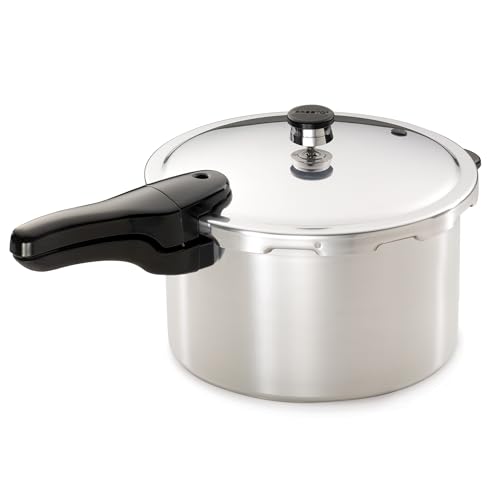
Presto 01282 8-Quart Aluminum Pressure Cooker — Best US-Brand Value
Presto has been making pressure cookers in the United States for generations, and this 8-quart aluminum model is the entry point into commercial size from the brand American cooks know best. Eight quarts is the threshold size: big enough for a serious batch of stock, a family-plus stew or a small catering job, small enough to store like a normal pot. For a first large cooker — or a small operation that needs volume occasionally rather than daily — this is the lowest-risk way in.
| Capacity | 8 quart |
|---|---|
| Material | Aluminum |
| Type | Stovetop pressure cooker |
| Brand | Presto |
Strengths
- Presto’s US parts and gasket availability is the best in the category
- 8 quarts is commercial capacity without commercial storage pain
- Aluminum body is light and heats quickly
Trade-offs
- Aluminum: not for induction, and acidic long cooks can discolor it
- Smaller than the 10-litre and 12-quart picks — true high-volume kitchens will outgrow it
- Manual stovetop operation, as with all stovetop picks
The Presto argument is an ownership argument. A pressure cooker is a gasket-and-valve appliance: the sealing ring ages, the vent parts want periodic replacement, and the cooker you can get parts for in your own country, from a brand that has stocked them for decades, is the cooker that stays in service. Commercial buyers feel this more than anyone — a cooker down for a missing gasket during a busy week costs more than any price difference in this guide. Presto’s support depth is the reason this comparatively simple cooker earns a badge among bigger rivals.
As a cooker, it does the classic stovetop job in the classic way: a weighted-style pressure regulation tradition that American cooks have used for generations, on a pot sized for real batches. Eight quarts cooks roughly a third again what a family 6-quart does, which is exactly the step a growing catering side-business or a large household needs. Buy it as the gateway to commercial size, with the brand’s backing, and it will not embarrass the decision.
Best for: first-time large-cooker buyers, small caterers and US buyers who prize parts support / Not suited for: induction kitchens or operations that already know they need 10-plus litres
Check the current price on Amazon
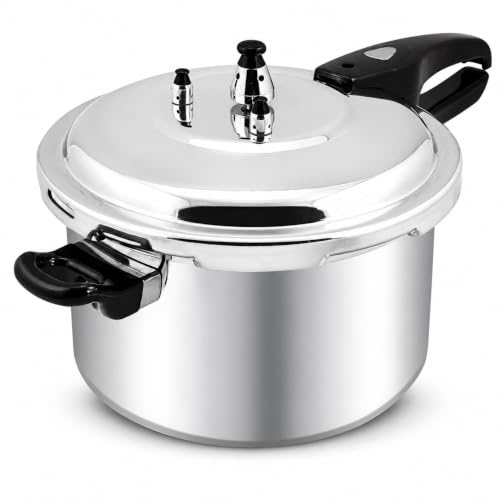
Barton 8-Quart Aluminum Stovetop Pressure Cooker & Canner — Best Budget Cooker-Canner
The Barton occupies the budget corner of the cooker-canner shelf: eight quarts of aluminum with a pressure release valve and a secure locking lid, marketed for fast cooking and home canning. It is the pick for home producers and homesteaders whose canning is at the smaller-batch end — a few jars of stock, a modest run of vegetables — and whose budget rules out the larger dedicated canners, provided it is used within the canning rules laid out in the guide below.
| Capacity | 8 quart |
|---|---|
| Material | Aluminum |
| Features | Pressure release valve, secure locking lid |
| Stated uses | Cooking, stewing, soups, meats and home canning per listing |
Strengths
- Lowest-cost route into an 8-quart stovetop cooker-canner
- Pressure release valve and locking lid cover the core safety functions
- Aluminum is light to handle at canning scale, where pots move full of water and jars
Trade-offs
- 8 quarts limits jar capacity per batch — serious canners need a larger dedicated canner
- Budget brand: verify the pressure system and follow tested recipes exactly
- Aluminum shares the usual limits — no induction, acid discoloration over time
Canning honesty is the whole ballgame with this pick, so here it is in full. Safe pressure canning depends on holding the correct pressure for the correct time for your altitude and your food, following tested recipes from authoritative sources. An 8-quart cooker-canner can process small batches of jars that fit with proper clearance, but it cannot do the volume runs a 16- or 23-quart dedicated canner handles, and no cooker of any size makes an untested recipe safe. Used for small, tested batches — and for everyday pressure cooking, where it is simply a large budget pot — the Barton is a sensible tool. Asked to be a homestead’s entire canning program, it is the wrong size, and this guide would rather tell you that than sell it to you.
As a plain cooker, its value is straightforward: eight quarts, fast pressure cooking of soups, stews and meats, at the lowest cost in this guide. The locking lid and release valve are the features that matter, and both are present per the verified listing. For a buyer whose canning ambitions are modest and whose cooking ambitions are large, the Barton is the budget door into this entire category.
Best for: budget buyers wanting one pot for large-batch cooking and small, tested canning batches / Not suited for: high-volume canners, induction kitchens, or anyone who will skip tested recipes
Check the current price on Amazon
Comparison Table
The six picks side by side, with key specifications taken from each product’s verified listing.
| Pick | Badge | Key Spec | Best For |
|---|---|---|---|
| CARORI 12 Qt Electric Pressure Cooker and Canner | Best Electric for Volume | 12 qt electric, 1600W, 15 presets | caterers, event kitchens and batch cookers who want maximum volume without using a burner |
| Peterboo Stainless Steel Pressure Cooker, 10 Quart | Best Stainless Stovetop | 10 qt stainless, induction compatible | induction and gas kitchens wanting a durable stainless workhorse at true commercial size |
| Hawkins Classic Aluminium 10 Litre Pressure Cooker (CL10) | Best for High-Volume Curry and Rice Kitchens | 10 L aluminium, inner-lid design | restaurants, caterers and large households cooking high-volume curries, dals, rice and beans on gas |
| Hawkins Stainless Steel 10.0 Litre Pressure Cooker | Best Stainless Inner-Lid | 10 L stainless, inner-lid design | induction or mixed-burner kitchens and acid-heavy menus wanting the Hawkins design in stainless |
| Presto 01282 8-Quart Aluminum Pressure Cooker | Best US-Brand Value | 8 qt aluminum, stovetop | first-time large-cooker buyers, small caterers and US buyers who prize parts support |
| Barton 8-Quart Aluminum Stovetop Pressure Cooker & Canner | Best Budget Cooker-Canner | 8 qt aluminum cooker-canner | budget buyers wanting one pot for large-batch cooking and small, tested canning batches |
Read capacity units carefully — this table mixes quarts and litres because the listings do. Ten litres is roughly ten and a half quarts, so the Hawkins models are larger than the 8- and 10-quart picks.
How to Choose the Best Commercial Pressure Cooker for Your Kitchen
Begin with the burner, because it eliminates half the field instantly. Induction kitchens need stainless steel or a magnetic base; aluminum cookers will not couple with an induction hob at all. Gas and electric coil burners accept everything here. Commercial buyers get this wrong more than any other specification because a big pot looks universal. It is not. Confirm your burner type, then confirm the listing’s compatibility statement, in that order.
Next, size honestly against your batches. Eight quarts serves a small operation or a large household stepping up. Ten quarts and 10 litres serve genuine production — a service of curry, a stock day, a catering run. Twelve electric quarts serve batch workflows that need a counter, not a burner. Remember that a pressure cooker should not be filled beyond two-thirds for most foods, and less for foods that foam or expand like beans and grains: your working capacity is roughly two-thirds of the number on the box, and commercial buyers should plan batches on the working number.
Then choose your operating style. Stovetop cookers are faster to pressure, cheaper per quart, and repairable for decades with gaskets and valves; they also occupy a burner and a cook’s attention. Electric cookers free the burner and the attention, program precisely, and cost more per quart with more to go wrong. Production kitchens usually end up with stovetop for the line and electric for background batches — and if you can only have one, the one that matches your scarcest resource, burner space or staff attention, is the right one.
Finally, buy the parts pipeline, not just the pot. A commercial pressure cooker consumes gaskets and occasionally valves. Brands with deep, local parts availability — Presto in the US, Hawkins globally — keep a cooker earning for decades. A cheaper cooker with an unfindable gasket is a disposable cooker at a non-disposable price.
Pressure Canning Safety: What a Commercial Buyer Must Know
This section exists because two picks in this guide carry the word “canner,” and canning is the one pressure-cooking job where errors can seriously harm people. The rules are not this guide’s opinions; they are the standing guidance of food-safety authorities, and they are simple to state. Low-acid foods — vegetables, meats, stocks, soups — must be pressure canned, at the pressure specified for your altitude, for the full time in a tested recipe. Water-bath canning does not make low-acid food safe, and no cooker feature changes that.
Electric pressure cookers, including models marketed with canning language, have not been validated by US authorities for pressure canning low-acid foods, because their pressure and temperature profiles cannot be verified the way a stovetop canner’s can. The correct tool is a stovetop pressure canner — ideally a dedicated large canner for volume work — used with current, tested recipes and processing times. The cooker-canners in this guide are appropriate for small batches of jars that fit with proper headroom, processed by tested recipes; high-volume canning belongs in a 16-quart-plus dedicated canner.
None of this should scare a careful buyer. It should route the purchase correctly: big electric and stovetop cookers for the cooking, a proper canner for the canning, tested recipes over improvisation every time. Commercial operators have the additional duty of local food code, which in many jurisdictions governs home-canned and pressure-processed foods strictly. Check your code before your menu depends on it.
What Does a Commercial Pressure Cooker Cost to Own?
The purchase price is the smaller half of commercial ownership math, and the picks in this guide are deliberately concentrated in the attainable tier — these are hundreds-of-dollars-class tools at most, not industrial equipment budgets. The running costs are gaskets, the occasional valve or weight, and the cook’s time, and they are all small. What is not small is the return: pressure cooking cuts the time and fuel for stocks, beans and braises dramatically against open-pot cooking, and at commercial volumes those savings arrive daily, in labor and in energy, for the entire life of the pot.
The expensive failure mode is not repair; it is downtime and mismatch. A cooker that cannot work on your burners, cannot fit your batch, or cannot get a gasket in your country costs its full price while contributing nothing. That is why this guide spends more words on compatibility, capacity arithmetic and parts pipelines than on any feature list — at commercial scale, the boring specifications are the economics.
Budget one accessory from day one: the spare gasket, already mentioned twice in this guide and worth a third mention in the ownership section. Add a second if the cooker runs daily. Everything else — racks, separator pans, spare weights — can be bought when a menu actually needs it.
Aluminum or Stainless Steel at Commercial Scale?
Aluminum’s case: it is light at sizes that get genuinely heavy, it conducts heat fast and evenly, it costs less per quart, and it is the traditional material of the world’s highest-volume pressure-cooking kitchens. Its debits: no induction, cosmetic darkening with acidic or alkaline foods, and a surface that asks to be kept out of prolonged contact with strong acids.
Stainless steel’s case: it is non-reactive with any food, induction compatible in the right construction, tolerant of brutal cleaning, and effectively immortal as a vessel. Its debits: weight and cost at 10-quart scale, and less even heat conduction, which on wide pots means a cook manages the burner rather than forgetting it. Neither metal is the professional choice in the abstract — the professional choice is the one that matches your burners and your menu, which is why this guide carries both and labels the trade on every pick.
How to Use a Commercial Pressure Cooker for a Production Batch
A gallon-scale batch of stock or beans teaches the whole discipline of big pressure cookers. The steps below apply to the stovetop picks; the electric CARORI follows the same logic through its presets.
- Respect the fill line — two-thirds, and less for foamers. Never fill a pressure cooker more than two-thirds full, and keep beans, grains and other foaming or expanding foods to half. At commercial scale an overfilled pot does not just cook badly; it can clog the vent with foam. This is the single most important rule in this article.
- Load for circulation, not density. Liquids and aromatics should be able to move. Pack ingredients loosely, keep the liquid level honest to the recipe, and never pressure cook a solid frozen mass in a big pot — thaw or break down large items so heat reaches the center on schedule.
- Bring it up on high, then manage the burner. Use high heat to reach pressure, watching for the indicator or the regulator’s signal, then reduce heat to the lowest setting that holds pressure steadily. A stovetop pressure cooker is a managed system: the cook’s job is the burner, and at 10-litre scale that job deserves actual attention.
- Time from full pressure, not from the burner. Cooking time starts when the cooker reaches full operating pressure, not when you light the stove. At commercial volumes the come-up time is significant, and recipes assume the timing convention — start the clock at pressure.
- Release with intention. For stocks and beans, natural release is the default: off the heat, let pressure fall on its own, and keep hands and face clear of the steam path when you open. Quick release has its uses for vegetables, but on a full commercial pot it is violent and messy; plan batches so natural release fits the schedule.
- Log the batch. Production cooking improves with records: quantities, times, release method, results. Commercial kitchens do this by habit, and it is the habit that turns a big cooker from an experiment into a system — especially for gasket wear, which you should note and schedule like any other maintenance.
Run a big cooker this way and it becomes what it is meant to be: not a larger version of a home appliance, but a small piece of production equipment — predictable, safe and fast.
Common Buying Mistakes
Filling to the brim because the batch demands it
The two-thirds rule is a safety specification, not a serving suggestion. A commercial buyer who needs more volume needs a bigger cooker or a second batch. Foaming foods in an overfilled pot can block the vent, and every bad pressure cooker story begins with a version of this decision.
Pressure canning in an electric cooker
Marketing language notwithstanding, electric pressure cookers are not validated for canning low-acid foods. Use a stovetop canner and tested recipes. This mistake is repeated in the guide because it is the one with real health consequences, and it is made every season by buyers who trusted a product name over food-safety guidance.
Buying aluminum for an induction kitchen
The pot will simply never heat. It is the most common and most avoidable commercial cooker error, and it is entirely prevented by reading the compatibility line on the listing before ordering — which is why every review in this guide states it.
Ignoring the gasket until it fails mid-service
Gaskets are consumables. A kitchen that depends on a pressure cooker should own a spare gasket the day the cooker arrives, inspect the fitted one regularly, and replace it at the first sign of hardening, cracking or steam leakage at the rim. The cooker brands in this guide all have real gasket pipelines; use them.
Judging size by the box number alone
Quarts and litres both appear in this category, sometimes in adjacent listings, and the working capacity is two-thirds of either. A buyer who plans production on the headline number will under-deliver every batch. Do the small arithmetic before the purchase, not during the first service.
Final Recommendation
For most commercial buyers, the decision tree is short. Induction or acid-heavy production points to stainless: the Peterboo for a conventional lid design, the stainless Hawkins for the inner-lid architecture. Gas-burner volume cooking points to the Hawkins Classic in aluminum, the design the world’s hardest-working kitchens already chose. US buyers stepping up to commercial size get the lowest-risk entry in the Presto, budget canners get the Barton with its limits understood, and burner-poor operations get genuine volume from the electric CARORI — for cooking, not canning.
Whichever branch is yours, buy the spare gasket with the cooker, respect the fill line, and let tested recipes govern anything that goes into a jar. A commercial pressure cooker bought that way is not an expense; it is equipment that will still be working when the rest of the kitchen has been replaced around it.
To re-check the shortlist before you buy: CARORI 12 Qt Electric Pressure Cooker and Canner, Peterboo Stainless Steel Pressure Cooker, 10 Quart, Hawkins Classic Aluminium 10 Litre Pressure Cooker (CL10). Each link goes to the verified Amazon listing, where you can check the current price on Amazon.
For a related shortlist, see Best Commercial Stainless Steel Pressure Cookers. For a related shortlist, see Best Combo Cookers. For a related shortlist, see Best Large Pressure Cookers. For a related shortlist, see Best Electric Pressure Cookers For Canning. For a related shortlist, see Best 8qt Pressure Cookers. For a related shortlist, see Best Japanese Pressure Cookers.
Frequently Asked Questions
What size counts as a commercial pressure cooker?
In practice the commercial class starts around 8 quarts and runs up through the big stovetop canners. The defining traits are capacity and duty: volume batches, heavy construction, and parts availability for repeated daily use. The picks in this guide run from 8 quarts to 12 quarts and 10 litres, which covers small restaurants, caterers and serious home production.
Can I pressure can in an electric pressure cooker?
You should not rely on one for canning low-acid foods. US food-safety authorities have not validated electric pressure cookers for that job, because their pressure cannot be verified like a stovetop canner’s. Use a stovetop pressure canner, follow tested recipes and processing times for your altitude, and treat any “canner” language in electric cooker marketing with the caution this guide applies.
Are Hawkins pressure cookers good for commercial use?
They are among the most proven commercial pressure cookers in the world, particularly in high-volume South Asian kitchens, where the inner-lid design’s self-sealing behavior and the brand’s global gasket availability have made them a default. The design takes a short learning period for cooks used to outside-lid pots, and aluminum models do not suit induction. Within those facts, yes — emphatically.
How full can I fill a commercial pressure cooker?
Two-thirds full is the maximum for most foods, and half full for foods that foam or expand, such as beans and grains. Your working batch size is therefore about two-thirds of the headline capacity. Plan production on the working number, and if the math fails, buy the next size up rather than filling past the line.
Do commercial pressure cookers work on induction?
Only models built for it — in this guide, the stainless picks whose listings state induction compatibility. Aluminum cookers do not work on induction unless they carry a magnetic base layer, which the aluminum picks here do not claim. Always confirm compatibility on the listing for the specific model, because it can vary within a brand’s range.
How often should I replace the gasket?
Inspect it regularly and replace it at the first signs of hardening, cracking, stretching or steam escaping at the rim — in hard commercial service that can be yearly or sooner. Keep a spare on hand from the day the cooker enters service. A gasket is inexpensive; a cooker out of service during a busy week is not.
Can a restaurant use a cooker from this guide?
Many small operations do, particularly for prep work like stocks, beans and braises. Before putting any pressure vessel into licensed service, confirm your local food code, your insurer’s requirements and any equipment standards your jurisdiction applies — those rules vary and they outrank any product listing. The cookers here are the largest consumer and prosumer class, not certified industrial equipment, and this guide describes them as such.


