Disclosure: airfryerkitchensupply.com is reader-supported. When you buy through links on our site, we may earn an affiliate commission at no extra cost to you.
Where to buy
Every model shortlisted for this guide to the best large pressure cookers is sold on Amazon, where listings carry the current availability for each one. Start with these direct links:
- Presto 01784 23-Quart Induction Compatible Pressure Canner — Check the current price on Amazon
- T-fal 22-Quart Aluminum Pressure Canner — Check the current price on Amazon
- MIRRO 22 Qt Aluminum Pressure Canner — Check the current price on Amazon
- Hawkins Classic Aluminium 10 Litre Pressure Cooker (CL10) — Check the current price on Amazon
- Hawkins Stainless Steel 10.0 Litre Pressure Cooker — Check the current price on Amazon
- Buffalo 37 Quart Pressure Cooker, Stainless Steel — Check the current price on Amazon
The best large pressure cookers live at a scale electric models cannot reach. From 10 litres of everyday stovetop capacity up to 22- and 23-quart canners and a 37-quart commercial vessel, these are the pots for preserving a harvest, cooking for a crowd and making stock by the gallon. Every pick was verified, and this guide keeps two jobs separate that listings love to blur: pressure cooking big food, and pressure canning, which is a food-safety process that belongs only in vessels built and sized for it.
Size language needs translating before you shop. Stovetop cookers are sold in quarts or litres that describe total vessel volume, not how much food goes in; canners additionally need enough capacity for jars, which is why the 22- and 23-quart class exists. The everyday 10-litre Hawkins models cook family-scale batches on any hob, while the big aluminium canners from Presto, T-fal and Mirro are primarily preserving equipment that also cook. The picks below are badged by which of those lives they actually lead.
One more piece of scene-setting: these vessels are seasonal in a way electric cookers are not. The big canners earn their storage space in a few intense weeks of harvest and spend the rest of the year as stockpots and occasional crowd cookers, while the 10-litre everyday models work weekly. Price your purchase against that rhythm. A canner used hard for fifteen seasons costs almost nothing per jar; the same canner bought for one experimental weekend is the most expensive pot you own.
In this guide
Quick Picks
- Presto 01784 23-Quart Induction Compatible Pressure Canner — Best Overall Canner: This is the default big canner for serious home preserving: the standard 23-quart size, from the brand most canning recipes and extension guides quietly assume. Check price on Amazon
- T-fal 22-Quart Aluminum Pressure Canner — Best Value Canner: The T-fal undercuts the reference canner while keeping the essentials: near-identical capacity, selectable pressure settings, and the racks and guide a first-time canner needs in the box. Check price on Amazon
- MIRRO 22 Qt Aluminum Pressure Canner — Best Three-Pressure Control: Choose the Mirro if you like weighted regulation with explicit choices: three regulators covering the standard 5, 10 and 15 PSI working pressures, on a traditional polished aluminium canner. Check price on Amazon
- Hawkins Classic Aluminium 10 Litre Pressure Cooker (CL10) — Best Everyday Large Cooker: This is the large pressure cooker as a daily workhorse: 10 litres of stovetop capacity for beans, curries, rice and batch cooking, in the inner-lid design Hawkins is known for. Check price on Amazon
- Hawkins Stainless Steel 10.0 Litre Pressure Cooker — Best Stainless Everyday: Pick the stainless Hawkins when the CL10’s size and format appeal but you want the durability, acid tolerance and hob compatibility that stainless steel brings. Check price on Amazon
- Buffalo 37 Quart Pressure Cooker, Stainless Steel — Best Commercial Scale: The Buffalo is beyond home scale on purpose: 37 stainless quarts for commercial kitchens, community cooking, and the largest batch and preserving work a stovetop can be asked to do. Check price on Amazon
How These Picks Were Chosen
Every candidate had to be a genuine large vessel, verified in its own listing: 10 litres at the small end, up through the standard canner sizes. We confirmed each ASIN and exact Amazon title account, ignored gaskets, racks and other accessory listings that search results mix in, and kept only complete cookers. Where a brand sells the same vessel in several sizes, we chose the size that matches the large brief.
We then weighed the details that decide whether a huge pot is a tool or a burden: lid style and sealing, weighted-gauge versus dial-gauge pressure control, compatibility with induction and glass hobs, the availability of replacement gaskets, and sheer stored size. Canning suitability was judged conservatively: the big canners are presented as canners because that is their designed purpose, while the smaller everyday cookers are presented as cookers, full stop.
We also checked the unglamorous ownership details that matter at this scale: whether the vessel fits a standard sink for washing, whether its handles stay grippable with wet hands, and whether its base sits stable on a typical grate without rocking. A 23-quart pot of boiling water forgives nothing, and two candidate vessels were cut at this stage for bases and handles that did not inspire confidence at full weight.
The 6 Best Large Pressure Cookers

Presto 01784 23-Quart Induction Compatible Pressure Canner — Best Overall Canner
This is the default big canner for serious home preserving: the standard 23-quart size, from the brand most canning recipes and extension guides quietly assume.
Strengths
- 23-quart capacity handles full canning loads, including stacked quart jars with the right racks
- Induction-compatible base widens hob choice beyond gas and coil
- Deep support ecosystem: gaskets, racks and gauges are easy to source years later
Trade-offs
- Dial gauge needs periodic accuracy checks, an extra chore weighted systems avoid
- Too large to be a sensible everyday cooking pot for most households
- Aluminium body needs care to avoid pitting from long acidic cooks
Key specs (from the verified listing)
- Capacity: 23 quarts
- Compatibility from listing: Induction compatible
- Dimensions from listing: 15-1/2 in overall height, 13-1/2 in overall length
Presto’s 23-quart is the reference size in American home canning for a reason: it fits the jar loads the published processes are written around, and the verified listing confirms the induction-compatible version, which matters as more kitchens move to induction hobs that plain aluminium cannot serve. If you preserve by the case rather than by the jar, this is the vessel the guidance ecosystem, from rack sizes to spare parts, is built around.
The ownership details are honest ones. A dial gauge is a measuring instrument and should be checked for accuracy as the maker directs, typically yearly, because your process times assume it reads true. The pot itself is a specialist: wonderful in August with a counter full of tomatoes, mostly stored the rest of the year unless you also make stock in bulk. Buy it as canning equipment that can cook, not as a cooker that can can, and expectations align perfectly.
A word on the gauge ritual: Presto publishes the checking procedure, and many local extension services test gauges for a small fee or free during canning season. Put the check on the same calendar as the first tomato harvest and it stops feeling like bureaucracy. Canners who switch to weighted systems often cite this single chore; canners who keep dials cite the information the dial gives back. Both are right, which is why this guide carries both styles.
Best for: home canners processing full loads who want the standard, best-supported vessel / Not suited for: everyday cooking for small households
Check on Amazon — check price on Amazon for the current listing.

T-fal 22-Quart Aluminum Pressure Canner — Best Value Canner
The T-fal undercuts the reference canner while keeping the essentials: near-identical capacity, selectable pressure settings, and the racks and guide a first-time canner needs in the box.
Strengths
- Three selectable PSI settings simplify holding the right pressure for your altitude band
- Racks and a canning guide included, so the box is closer to ready-to-preserve
- 22 quarts is effectively the full-size canner class at a friendlier tier
Trade-offs
- Weighted-style settings trade the dial gauge’s fine reading for simplicity; know which control style you prefer
- Accessory and parts ecosystem is smaller than Presto’s
- Same storage reality as any 22-quart vessel: it needs a home of its own
Key specs (from the verified listing)
- Capacity: 22 quarts
- Pressure settings from listing: 3 PSI settings
- Included from listing: Racks and canning guide; supports pressure and water bath canning
Value in a canner is not about shaving capacity; it is about keeping the safety-relevant parts and trimming the rest. The T-fal’s verified listing shows the formula: 22 quarts, three PSI settings so pressure selection is a placed weight rather than a watched needle, and the racks plus canning guide included. For a first canner who wants to follow tested processes without assembling a kit from three orders, that completeness is the appeal.
The trade-offs are ecosystem and feedback. You give up the dial’s continuous readout, which some experienced canners prefer for diagnosing a drifting burner, and the long-tail parts support is thinner than Presto’s. Neither matters much in the first seasons of preserving. If you catch the canning bug seriously, you will know exactly what your second vessel should be; most people find this one simply remains it.
First-time canners should know the included guide is a starting map, not the law: the authority for processing times is always the current tested guidance for your food and altitude, and the maker’s manual for your vessel’s operation. The T-fal’s completeness gets you to the starting line with the right equipment; the recipes you follow should come from tested sources, a discipline this guide repeats because it is the one that matters.
Best for: first-time and budget-conscious canners who want a complete full-size kit / Not suited for: canners who specifically want a dial gauge and the deepest parts support
Check on Amazon — check price on Amazon for the current listing.

MIRRO 22 Qt Aluminum Pressure Canner — Best Three-Pressure Control
Choose the Mirro if you like weighted regulation with explicit choices: three regulators covering the standard 5, 10 and 15 PSI working pressures, on a traditional polished aluminium canner.
Strengths
- Three distinct regulators make pressure selection unambiguous and repeatable
- Weighted control needs no gauge calibration and gives audible feedback in the kitchen
- Full 22-quart canning capacity in a long-established canner format
Trade-offs
- Weighted regulators are a house style; cooks used to dial gauges must relearn their cues
- Polished aluminium shows water marks and needs the same acid care as other aluminium
- Confirm replacement regulator and gasket sourcing before you need them mid-season
Key specs (from the verified listing)
- Capacity: 22 quarts
- Pressure control from listing: 3 regulators at 5, 10 and 15 PSI
- Control style from listing: Automatic pressure control
Mirro’s approach, confirmed in the verified listing, is the classic weighted system refined: separate regulators for 5, 10 and 15 PSI, so the pressure you process at is a physical object you place, not a needle you interpret. Many experienced canners prefer exactly this, because a weight either jiggles correctly or it does not, and the sound tells you the state of the pot from the next room. There is no gauge to send for testing and no parallax in reading a dial over steam.
The ownership note is preparation. Weights and gaskets are small, losable, and brand-specific, so order spares when you buy the pot, not during tomato week. Do that, keep the vent clear, and the Mirro is the kind of canner that gets handed down, which is the traditional fate of good aluminium preserving pots.
The audible side of weighted canning deserves emphasis for households with open-plan kitchens: a correctly jiggling weight is a background sound you will learn like a kettle’s approach to the boil, noticeable when it changes and reassuring when it does not. Canners who process late into the evening often prefer weights for exactly this reason; the pot reports itself without being watched.
Best for: canners who prefer weighted pressure control with explicit PSI choices / Not suited for: buyers who want a dial gauge’s continuous readout
Check on Amazon — check price on Amazon for the current listing.

Hawkins Classic Aluminium 10 Litre Pressure Cooker (CL10) — Best Everyday Large Cooker
This is the large pressure cooker as a daily workhorse: 10 litres of stovetop capacity for beans, curries, rice and batch cooking, in the inner-lid design Hawkins is known for.
Strengths
- Inner-lid design is compact for its capacity and seals with the pressure itself
- 10 litres cooks family batches without canner-scale storage problems
- Hawkins gaskets and parts are widely available for a cooker you will use weekly
Trade-offs
- Aluminium reacts to long acidic storage; cook in it, do not store tomato dishes in it
- Inner-lid loading takes a short learning curve if you are used to twist-on lids
- Not a canner; this is a cooking vessel and should be bought as one
Key specs (from the verified listing)
- Capacity: 10 litres
- Design from listing: Inner lid cooker
- Finish from listing: Silver (CL10)
Most people searching for a large pressure cooker do not need a canner; they need a big cooker that earns weekly use, and the CL10 is the honest answer. The verified listing confirms the 10-litre Classic with its inner lid, a design where the lid seats inside the rim and pressure itself tightens the seal. It is the format that cooks a large share of the world’s daily dal, rice and curries, which is a track record no marketing can fake.
Ten litres is the sweet spot for batch cooking: a serious quantity of beans or a whole family curry, in a pot that still lives in a normal cupboard and lifts when full without drama. Treat the aluminium with basic respect, transfer acidic leftovers to another container, keep a spare gasket in the drawer, and this is a decade-scale purchase at a modest tier.
The CL10’s inner lid has one more practical virtue: it makes the cooker narrower than a clamp-lid design of equal capacity, which matters in the cupboards of the apartments and small kitchens where these cookers often live. It also means the gasket sits protected inside the rim rather than exposed on a lid edge, a small design decision that shows up years later as a longer-lived seal.
Best for: households wanting a big everyday stovetop cooker for batches and staples / Not suited for: canning or cooks who insist on stainless steel
Check on Amazon — check price on Amazon for the current listing.

Hawkins Stainless Steel 10.0 Litre Pressure Cooker — Best Stainless Everyday
Pick the stainless Hawkins when the CL10’s size and format appeal but you want the durability, acid tolerance and hob compatibility that stainless steel brings.
Strengths
- Stainless body shrugs off acidic dishes that aluminium dislikes
- Same practical 10-litre batch capacity in a longer-lived material
- Works happily across gas and modern hob types without aluminium’s care rules
Trade-offs
- Heavier than the aluminium CL10, noticeably so when full
- Costs more than the aluminium version for the same capacity
- Stainless shows heat tinting and needs a soak for caught rice, like any steel pot
Key specs (from the verified listing)
- Capacity: 10.0 litres
- Material from listing: Stainless steel
- Format: Stovetop pressure cooker
The choice between the two Hawkins 10-litre models is a materials decision, and the verified listing makes this one simple: stainless steel, same family-scale capacity. Stainless removes the two aluminium caveats, reaction with acidic foods and gentler cleaning rules, and adds weight and price in exchange. For households whose pressure cooking leans tomato, tamarind and vinegar, that exchange is obviously right.
It is also the better long bet if your next hob is induction, since stainless lines in this class are built with hob compatibility in mind in a way plain aluminium is not; confirm your exact hob against the listing details before ordering, as with any large pot. As a buy-once everyday cooker for a household that cooks staples in bulk, this is the conservative, correct choice.
Stainless also wins the stock argument: a long, gentle stock in this pot can go straight into the fridge in the vessel it cooked in, with no acid reaction and no transfer to another container you then also wash. Aluminium owners should decant. It is a small weekly convenience that compounds, and for stock-making households it can be the deciding paragraph of this entire comparison.
Best for: households wanting a 10-litre cooker in stainless for acidic, frequent cooking / Not suited for: buyers minimising weight or price
Check on Amazon — check price on Amazon for the current listing.
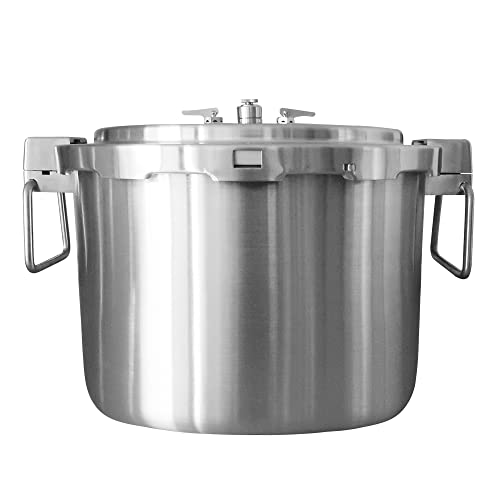
Buffalo 37 Quart Pressure Cooker, Stainless Steel — Best Commercial Scale
The Buffalo is beyond home scale on purpose: 37 stainless quarts for commercial kitchens, community cooking, and the largest batch and preserving work a stovetop can be asked to do.
Strengths
- 37 quarts dwarfs standard canners for true bulk processing
- Stainless construction suits commercial cleaning regimes and acidic loads
- One vessel replaces multiple sequential batches in institutional cooking
Trade-offs
- Far too large for ordinary home burners, storage and lifting when full
- Requires a burner with output and a grate that can carry it safely
- Premium, specialist purchase that most households will never justify
Key specs (from the verified listing)
- Capacity: 37 quarts
- Material from listing: Stainless steel
- Format from listing: Extra large XL commercial stove top pressure canner/cooker
Some searches for a large pressure cooker are not really home searches. The Buffalo’s verified listing says it plainly: 37 quarts, stainless, extra-large commercial. At this scale the questions change from recipes to logistics: a burner that can bring that mass to pressure, a sink or wash area the pot fits, and a plan for moving a vessel that is genuinely heavy before anything goes into it. Community kitchens, small food producers and very large preserving operations are the audience.
For a normal household this is the wrong pot, and the guide says so in the pick itself rather than hiding it. But for the buyer who has been running a 23-quart canner in back-to-back loads all harvest, the Buffalo is the legitimate step up, in a material that tolerates commercial life. Buy it with your burner specs in hand, not on enthusiasm alone.
Before ordering a vessel of this size, do the tape-measure audit honestly: burner diameter and grate strength, the largest sink or wash tub it must fit, the doorway and shelf it will live behind, and the two people who will move it when it is full. Commercial buyers do this instinctively; home buyers tempted by the Buffalo’s price per quart should imitate them, because the pot is the cheap part of owning 37 quarts.
Best for: commercial and community kitchens and extreme bulk preserving / Not suited for: home kitchens with standard burners and cupboards
Check on Amazon — check price on Amazon for the current listing.
Comparison Table
| Pick | Badge | Key spec | Best for |
|---|---|---|---|
| Presto 01784 23-Quart Induction Compatible Pressure Canner | Best Overall Canner | 23 quarts | home canners processing full loads who want the standard, best-supported vessel |
| T-fal 22-Quart Aluminum Pressure Canner | Best Value Canner | 22 quarts | first-time and budget-conscious canners who want a complete full-size kit |
| MIRRO 22 Qt Aluminum Pressure Canner | Best Three-Pressure Control | 22 quarts | canners who prefer weighted pressure control with explicit PSI choices |
| Hawkins Classic Aluminium 10 Litre Pressure Cooker (CL10) | Best Everyday Large Cooker | 10 litres | households wanting a big everyday stovetop cooker for batches and staples |
| Hawkins Stainless Steel 10.0 Litre Pressure Cooker | Best Stainless Everyday | 10.0 litres | households wanting a 10-litre cooker in stainless for acidic, frequent cooking |
| Buffalo 37 Quart Pressure Cooker, Stainless Steel | Best Commercial Scale | 37 quarts | commercial and community kitchens and extreme bulk preserving |
How to Choose: Large Pressure Cookers
Cooker or canner: name your job first
The single most important decision in this category is which job you are buying for. Pressure cooking is about dinner: beans in under an hour, tough cuts tender, stock without a day of simmering. Pressure canning is a preservation process with tested times and pressures by food and jar size, and it demands a vessel designed as a canner, large enough for jars and racks, used exactly as its manual and current tested guidance direct. The 10-litre Hawkins models are superb cookers and are not canners. The 22- and 23-quart Presto, T-fal and Mirro are canners that can also cook. Buying the wrong one for your job is the expensive mistake; the right one is a decade of service.
If you genuinely do both, most households end up prioritising the canner in harvest season and cooking in it carefully the rest of the year, or owning the big canner plus an everyday cooker. What does not work is assuming a mid-size cooker can be promoted into canning duty because it reaches pressure. It cannot, and this is the one area of the guide where we will not soften the line.
Gauge, weight and pressure control
Dial gauges show pressure continuously and let you watch a burner drift, but the gauge is an instrument that needs periodic accuracy checks, and a canner reading low is a safety problem, not a nuisance. Weighted systems, the T-fal’s selectable settings and Mirro’s three regulators, trade the continuous readout for certainty: the weight regulates at its rated pressure with an audible jiggle, and there is nothing to calibrate. Neither is universally better. Cooks who like data and diagnosis pick dials; cooks who like certainty and sound cues pick weights. Altitude decides your working pressure either way, so confirm the settings your altitude requires are the ones the vessel offers.
Whichever system you choose, the vent pipe must be clear before every run and the overpressure plug and gasket inspected on schedule. On a 22-quart vessel these two-minute checks are the whole safety system, and they are not optional garnish.
Material, hobs and the weight of water
Aluminium canners are light for their size, heat quickly and cost less, but they dislike long acidic contact and plain aluminium will not work on induction unless the base is built for it, as the Presto 01784’s listing specifies. Stainless is heavier and pricier, shrugs off acids and commercial cleaning, and suits modern hobs. Match the pot to your hob before anything else: a canner that cannot run on your stove is furniture. Then do the water maths. A quart of water weighs about two pounds; a full 23-quart canner with jars is a serious lift, and a full 37-quart Buffalo is a two-person, plan-ahead object. If your burner grate, sink and storage cannot handle the full weight, the correct size is the smaller one, whatever the harvest says.
Budget Tiers in Plain Language
Canning vessels cluster tightly in price for a reason: the safety-relevant parts, the seal, the vent, the pressure control, cannot be cheapened, so the differences between the Presto, T-fal and Mirro are about control style, included racks and ecosystem rather than corners cut. The everyday Hawkins cookers cost less because they are smaller and simpler, and the Buffalo costs more because stainless steel at 37 quarts is simply a lot of material. The false economy in this category is buying a cooker and trying to can in it; the real economy is buying the right vessel once and feeding it gaskets for twenty years.
Three Seasons, Three Vessels
August, with a garden. Tomatoes by the crate, beans by the bucket, a freezer already full. This is the canners’ season and the standard 22-23 quart size earns its storage in a fortnight. The household that preserves at this scale should own the Presto or its rivals without apology, run the gauge or weight checks in June, and treat the vessel’s winter storage as the rent it pays for August.
The weekly batch kitchen. No garden, no canning, but a household that cooks beans, grains and curries in quantity every week. The canner would be furniture here; the 10-litre Hawkins is the correct inhabitant of this kitchen, on the stove twice a week and in the cupboard the rest of the time, which is the highest compliment a pot can earn.
The community hall. A fundraiser dinner, a church supper, a team’s worth of stew. The Buffalo’s 37 quarts stop sounding absurd in this paragraph and start sounding like the only pot in the guide that was ever going to work. Commercial-scale cooking is a real use case with real buyers; it is simply not the use case of a household reading a best-of guide for its own kitchen, and the pick is badged accordingly.
Why Canner Sizes Cluster at 22 and 23 Quarts
New shoppers often wonder why big canners are almost all 22 or 23 quarts when cookers come in every size. The clustering is about jars, not marketing. A canner must hold a rack plus a practical load of standard jars with headspace for water or steam circulation, and the 22-23 quart envelope is where a full load of quart jars, or two stacked layers of pints with a second rack, fits on a domestic burner. Smaller vessels can cook beautifully but cannot take the standard loads the tested processes assume, which is why they are sold as cookers. The Buffalo’s 37 quarts exists for the same logic at commercial scale: full institutional loads in one run.
This is also why chasing a few extra quarts in a home canner buys little. The standard size already takes the standard load; the next real step is a second canner on a second burner during harvest, which many serious preservers quietly run. Spend the difference on jars, lids, a spare gasket and a jar lifter that does not slip, and your preserving season will go better than it would with an oversized pot and no spares.
One last consideration belongs to anyone choosing between the everyday cookers and the canners on size alone: headroom is not wasted space. Pressure vessels need their vapour space to build and hold pressure safely and to keep foaming foods out of the vent, so a pot that looks half empty with your biggest batch in it is not oversized; it is correctly sized. The shoppers who end up unhappy with large pressure cookers are rarely those who bought too much pot. They are the ones who bought exactly enough pot on paper and then discovered that paper capacity and working capacity are different numbers, a lesson this guide has tried to teach before the purchase rather than after it.
Replacement Parts: The Hidden Cost of a Big Pot
Every large pressure vessel consumes three things: gaskets, which harden and eventually leak steam at the rim; overpressure plugs, which age whether used or not; and, on weighted systems, the regulators themselves, which are small and losable. The mature brands in this guide, Presto above all, make these parts cheap and findable a decade later. Before buying any large cooker, price its gasket and confirm you can order it today; a vessel whose seal cannot be replaced is a vessel with an expiry date, and at 22 quarts that is an expensive date.
Buy the spares with the pot. A spare gasket stored flat and dark, a spare plug, and for Mirro and T-fal owners a duplicate of the regulator you use most, together cost less than one ruined canning load. Harvest week is the worst possible time to discover that your seal weeps and the replacement ships in five days. The canners who never have that story are simply the ones who ordered two of everything in spring.
Storing a Canner Without Ruining It
Store the vessel clean, dry and with the lid inverted or ajar so the gasket rests uncompressed and the interior airs; a sealed aluminium pot stored damp will smell of it forever and can pit. Keep the small parts, weights, gauge covers and spare gaskets, in a labelled container that lives with the pot, not in the kitchen’s miscellaneous drawer, because the entire system must be findable on the first morning of harvest. If storage is a garage or basement, a cotton cover keeps dust and insects out while letting the metal breathe; plastic sheeting traps the moisture you are trying to avoid.
Once a year, before the season, run the pot with plain water: inspect the vent, watch the seal, and confirm the gauge or weight behaves. Fifteen minutes of water in June is the cheapest insurance in home preserving, and it turns the first real load of the season into a routine rather than a reunion with forgotten equipment.
How to Use a Large Stovetop Pressure Cooker Safely
Large stovetop pressure work is safe and routine when the checks become habit. These steps apply to cooking in any pick here; for canning, your canner’s manual and current tested processes govern every detail and override any general summary.
- Inspect before filling: check the gasket for cracks, confirm the vent pipe is visibly clear, and make sure the overpressure plug is seated and supple.
- Fill within limits: no more than two-thirds full for most foods, half for beans, grains and foaming dishes, and for canning only the water level your manual specifies for the load.
- Lock the lid fully and bring the pot up on high heat until steam vents steadily, then vent for the time your manual or recipe directs before applying pressure.
- Set the regulator or watch the gauge as pressure reaches the working level for your altitude, then adjust the burner to the lowest setting that holds it steadily.
- Time from full pressure, not from first steam, and keep the pressure steady; wide swings mean the burner is too hot or the load is foaming.
- Cool as the recipe directs: natural cool-down for canning and for foaming foods, and never force a large pot open or rush it under water unless the maker explicitly allows it.
- Open away from your face once pressure is fully down and the lock has released, then check the gasket and vent while the pot is still warm and easy to clean.
Store the lid inverted or ajar so the gasket rests uncompressed, and keep a spare gasket and, for weighted systems, the regulators in a labelled spot. The season you cannot find the 10-PSI weight is the season the harvest does not wait.
Pre-Purchase Checklist for a Large Pressure Cooker or Canner
At this scale, a mistake is heavy, expensive to return and occasionally unsafe. These five checks are the difference between the right vessel and a decade of working around the wrong one.
- Name the job in one sentence. Write it down: canning, everyday batch cooking, or commercial volume. The sentence chooses the section of this guide you should buy from, and it prevents the two classic errors, canning in a cooker and daily cooking in a canner, which are both miserable in opposite directions.
- Confirm hob compatibility physically. Check your hob type against the vessel’s base: induction needs a compatible base, glass tops have weight limits that a full 23-quart canner can approach, and small gas grates may not carry a wide pot steadily. The manual for your stove, not the pot’s listing, has the final word on weight.
- Know your altitude number. Not roughly, exactly. Your working pressure for canning and your timing adjustments for cooking both come from it, and the vessel’s settings must cover what your altitude demands. This is a two-minute search that should happen before the pot, not during the first load.
- Price the consumables with the pot. Gasket, overpressure plug and, for weighted systems, a spare regulator. Add them to the same order. The total is small, and it converts the vessel from a purchase into a system that cannot be stopped by a five-dollar part in harvest week.
- Plan the storage and the wash. Decide where 22-plus quarts live, how they reach the sink, and who helps move them full. If any answer involves a high shelf, a long carry or a solo lift of a full canner, choose the smaller vessel. The right size is the one your household can handle at its heaviest, not its emptiest.
Common Buying Mistakes
- Promoting a cooker into a canner. A 10-litre cooker that reaches pressure is still not a canner. Canning needs a vessel designed and sized for jar loads and tested processes.
- Skipping the vent check. A blocked vent on a 22-quart vessel is the classic preventable accident. Hold it to the light before every single run.
- Reading capacity as food capacity. Total volume includes headspace the process needs. Fill lines and jar loads, not the headline quarts, decide what fits.
- Ignoring altitude. Working pressure changes with altitude for both cooking and canning. Use the setting your altitude requires, not the one the recipe’s author used at sea level.
- Lifting a full canner alone. A loaded 23-quart canner can exceed what one person should carry. Move jars, not the vessel, and let water cool before draining.
- Storing acidic food in aluminium. Cook the tomato sauce, then jar or refrigerate it in another container. Aluminium left holding acid pits and discolours.
Final Recommendation
For preserving, the Presto 01784 is the reference buy, with the T-fal as the value alternative and the Mirro for those who prefer weighted regulators with explicit settings. For everyday large-batch cooking, the Hawkins CL10 is the workhorse and its stainless sibling is the buy-once upgrade. The Buffalo stands apart as commercial equipment and should be bought only with commercial intent. Decide cooker versus canner first, match the pot to your hob and your altitude, and keep the vent and gasket checks sacred; do that and a large pressure cooker becomes one of the longest-serving tools in the kitchen.
Shortlist again: Presto 01784 23-Quart Induction Compatible Pressure Canner, T-fal 22-Quart Aluminum Pressure Canner, MIRRO 22 Qt Aluminum Pressure Canner — check price on Amazon for each before you decide.
Related guides on this site: Best Large Electric Pressure Cookers Best Meal Cookers Best Microwave Pressure Cookers Best Manual Slow Cookers Best Mini Multi Cookers
Frequently Asked Questions
What size pressure cooker do I need for canning?
For standard home canning loads, the 22- to 23-quart class is the practical answer, because it fits full loads of quart jars or stacked pints with racks. Smaller pressure cookers are cookers, not canners, regardless of the pressure they reach. Always follow the canner maker’s manual and current tested processes for your food, jar size and altitude.
Can I cook everyday meals in a 23-quart canner?
You can, and people do for stock and crowd cooking, but it is oversized for daily meals: more water to heat, more washing, and small batches sit shallow in a huge pot. Most households are happier pairing the canner with a 10-litre everyday cooker like the Hawkins models for weekly use.
Is a dial gauge or a weighted regulator better?
They are different control philosophies. A dial shows pressure continuously but needs periodic accuracy checks. Weights regulate at set pressures with an audible cue and need no calibration, but give no continuous reading. Choose the feedback style you will actually monitor, and confirm the settings cover your altitude.
Why does altitude change pressure settings?
Atmospheric pressure falls as altitude rises, so the same gauge pressure produces a lower absolute pressure and temperature. Tested processes compensate by raising the working pressure at altitude. Skipping the adjustment under-processes canned food and undercooks dense dishes, which is why every serious manual prints altitude tables.
How long do gaskets last on large cookers?
With weekly use, expect to inspect yearly and replace when the gasket hardens, cracks or the pot starts leaking steam at the rim. Keeping a spare on hand is the difference between a small cost and a ruined batch. Store the lid ajar so the gasket is not permanently compressed.
Can I use a large aluminium canner on induction?
Only if the base is built for it. Plain aluminium does not respond to induction. The Presto 01784 in this guide is specifically listed as induction compatible; other aluminium models should be assumed gas and electric only unless the listing says otherwise. Check before buying, not after delivery.


