Disclosure: airfryerkitchensupply.com is reader-supported. When you buy through links on our site, we may earn an affiliate commission at no extra cost to you.
Where to buy
Prices move with promotions and stock, so this guide never prints a fixed figure — use the links to check price on Amazon at the moment you shop.
- Presto 02144 12-Quart Digital Pressure Canner — Best Overall Digital Canner: check price on Amazon.
- Presto 02153 23-Quart Digital Pressure Canner — Best for Big Harvests: check price on Amazon.
- Presto 02152 17-Quart Digital Pressure Canner — Best Mid-Size Canner: check price on Amazon.
- NESCO NPC-9 Smart Electric Pressure Canner and Cooker — Best Alternative Brand: check price on Amazon.
- CARORI 12 Qt Electric Pressure Cooker and Canner — Best Big Cooker (Canning Claim Flagged): check price on Amazon.
- VAJ 12-in-1 Electric Pressure Cooker 8 QT — Best Budget Big Cooker (Canning Claim Flagged): check price on Amazon.
Food-safety authorities are blunt on this point: electric multi-cookers — Instant Pot and its rivals — are not tested or rated for pressure canning, their temperatures at pressure are not verified the way a canner’s are, and low-acid foods processed at the wrong temperature can carry botulism risk. Any guide that sells you a multi-cooker as a canner is selling you a hazard.
The exceptions are dedicated digital pressure canners: countertop appliances engineered and sold specifically for canning, with pre-programmed canning cycles, altitude handling and jar capacity stated in pints and quarts. Presto’s digital canner line and the NESCO Smart Canner are the real category. Alongside them, this guide includes two large electric cookers whose makers market canning functions — the CARORI 12-quart and the VAJ 8-quart — clearly labelled for what they are: fine big cookers whose canning claims rest on the manufacturer, not on independent food-safety testing. You deserve that distinction in writing, and you will find it in every review below.
So the six picks split honestly. Four are purpose-built digital pressure canners in different jar capacities — the only machines in this guide we can recommend for processing low-acid foods, used strictly by their manuals and tested recipes. Two are large multi-cookers included because shoppers type this query will meet them everywhere; they earn their place as cookers, with their canning claims flagged rather than endorsed. Read the reviews with that split in mind and you will shop this category more safely than most.
A word on how to use this guide if you arrived here owning a multi-cooker with a canning button: you do not need to feel foolish, because the marketing is genuinely confusing, and you do not need to throw the machine away, because it remains a fine cooker. What you need is a second, purpose-built appliance for the canning itself — or a stovetop canner — and the knowledge in the buying-guide sections below about why the distinction exists. That knowledge, more than any single product, is what this page exists to give you.
In this guide
Quick Picks
Six electric pressure canners and canning-capable cookers made the cut. Each one carries a badge for the job it does best, and the same badge follows it into the full review further down the page.
- Presto 02144 12-Quart Digital Pressure Canner — Best Overall Digital Canner. The original countertop digital canner: pre-programmed canning cycles, no stovetop babysitting, sized for small-batch preserving. Check price on Amazon.
- Presto 02153 23-Quart Digital Pressure Canner — Best for Big Harvests. The largest digital canner in the line — full harvest-day capacity with the same guided, automatic processing. Check price on Amazon.
- Presto 02152 17-Quart Digital Pressure Canner — Best Mid-Size Canner. The middle Presto: meaningfully more jars per load than the 12-quart, meaningfully less bulk than the 23. Check price on Amazon.
- NESCO NPC-9 Smart Electric Pressure Canner and Cooker — Best Alternative Brand. A 9.5-quart stainless canner-cooker from a food-preservation specialist brand, with dedicated canning programs and a smaller footprint. Check price on Amazon.
- CARORI 12 Qt Electric Pressure Cooker and Canner — Best Big Cooker (Canning Claim Flagged). A genuinely capable 12-quart multi-cooker for gatherings — bought as a cooker, not as a tested canner. Check price on Amazon.
- VAJ 12-in-1 Electric Pressure Cooker 8 QT — Best Budget Big Cooker (Canning Claim Flagged). A stainless 8-quart cooker with a canning preset on the panel — a good cooker whose canning button deserves the same caution as every multi-cooker claim. Check price on Amazon.
How These Picks Were Chosen
Verification here had two layers. That classification is stated in each badge and review, because in this category the difference is a safety issue, not a feature preference.
Within the true canners, the ranking is by jar capacity matched to preserving volume — the only honest way to rank machines whose processing job is identical in kind.
Best electric pressure cookers for canning — The Six Full Reviews

Presto 02144 12-Quart Digital Pressure Canner — Best Overall Digital Canner
The Presto 12-quart is for the home preserver who cans in modest batches — a market haul of tomatoes, a case of peaches, a run of green beans — and wants the process managed by the appliance instead of by a stovetop gauge watched for an hour.
Strengths
- Purpose-built for canning with pre-set pressure canning and water-bath programs
- Digital control holds processing conditions automatically — no dial-gauge calibration or constant adjustment
- Doubles as a cooker for large batches when it is not processing jars
Trade-offs
- Jar capacity is the smallest here — serious high-volume canners will run back-to-back loads
- You must follow its manual and tested recipes exactly; it is not a free-form canner
- Countertop height plus jar lifter clearance needs real vertical space
| Type | Dedicated digital pressure canner |
| Capacity | 12 quart |
| Programs | Pressure canning, water-bath canning, cooking |
| Controls | Digital with pre-programmed cycles |
Presto has made pressure canners longer than any brand in this guide has existed, and the 02144 translates that heritage into a plug-in appliance: load jars, select the program, and the machine manages warm-up, venting, processing and cool-down with prompts at each stage. For beginners, that guided sequence is the difference between canning confidently and canning anxiously.
The size is the honest limit. Twelve quarts processes small batches — think a few pints at a time rather than a harvest-day marathon. If your garden produces canning weekends, step up to the 17- or 23-quart Presto models below. If you preserve in the quantities most households actually eat, the 12-quart is the easiest safe entry into pressure canning that exists.
The guided cycle deserves a closer description, because it is the product. The machine prompts you through jar loading, water level and program selection, manages the venting stage that stovetop beginners most often rush, holds the processing plateau automatically, and then enforces a patient cool-down instead of letting enthusiasm open the lid early. Each of those stages is a place where manual canning quietly goes wrong; the 02144 removes them one by one, which is exactly what a first canner should do.
For apartment preservers, note the 02144’s stovetop independence: it runs from a counter outlet, which means canning day does not monopolise the burners dinner depends on. In small kitchens where the stove is contested territory, that single fact converts canning from a logistical negotiation into a background process — jars processing on the counter while life continues on the stove.
Best for: small-batch home canners who want a guided, purpose-built machine / Not suited for: high-volume harvest canning
Check the current price on Amazon

Presto 02153 23-Quart Digital Pressure Canner — Best for Big Harvests
Choose the 23-quart Presto if you garden seriously, buy produce by the case, or put up meat and broth in quantity. It is the machine for people whose canning is a season, not an afternoon.
Strengths
- Largest jar capacity in this guide — fewer loads per harvest
- Same guided digital canning programs as the smaller Presto models, scaled up
- Handles tall jars and stacked pints that smaller canners cannot
Trade-offs
- Big, heavy and demanding of storage space and counter height
- Premium tier pricing within the digital canner category
- Overkill — in size, cost and warm-up time — for occasional small batches
| Type | Dedicated digital pressure canner |
| Capacity | 23 quart |
| Programs | Pressure canning, water-bath canning, cooking |
| Controls | Digital with pre-programmed cycles |
Everything the 12-quart does, the 23-quart does at harvest scale. The guided cycle matters even more here: a 23-quart load represents a lot of food and a lot of work, and automatic control of venting and processing removes the two stages where stovetop canning most often goes wrong for tired humans at hour six of a canning day.
Plan the logistics before buying: the canner plus jar headroom needs generous vertical clearance, a full load is a two-hand lift, and the appliance will live somewhere for the whole season. Gardeners who measure tomatoes in bushels will not care. Everyone else should honestly size down to the 17- or 12-quart.
Consider the workflow arithmetic at this size: a 23-quart load can represent a full day of garden produce processed in one supervised cycle, where the 12-quart would demand two or three sequential sessions. For a household putting up a winter of tomatoes, beans and stock, that difference is measured in weekends returned. The machine also doubles as the largest water-bath station in this guide, which matters during jam and pickle season when stovetop space is the binding constraint.
The 23-quart also earns a mention as a water-bath vessel: its depth swallows tall quart jars for tomatoes and juices that shallower pots cannot cover by the required margin. Households that water-bath as much as they pressure-can get two full-size stations in one footprint — a consolidation worth real money and storage in a serious preserving kitchen.
Best for: gardeners and bulk preservers processing large seasonal loads / Not suited for: occasional or small-batch canners
Check the current price on Amazon

Presto 02152 17-Quart Digital Pressure Canner — Best Mid-Size Canner
The 17-quart is the sizing sweet spot for the committed-but-not-commercial preserver: a family garden, a hunting season, a bulk-buy habit — loads that overflow the small canner but do not justify the largest.
Strengths
- Balanced jar capacity for family-scale preserving
- Full guided digital canning programs, identical in approach to its siblings
- More manageable footprint and lift weight than the 23-quart
Trade-offs
- Still a large appliance to store between seasons
- Costs notably more than the 12-quart for capacity some households will never use
- Same strict follow-the-manual discipline as every digital canner
| Type | Dedicated digital pressure canner |
| Capacity | 17 quart |
| Programs | Pressure canning, water-bath canning, cooking |
| Controls | Digital with pre-programmed cycles |
Sizing a canner is like sizing a pressure cooker: the right answer is the one that matches your real batch, and for most preserving households that batch is the 17-quart’s. A full run of quarts for soup stock, a double-stacked run of pints for beans, a serious afternoon of salsa in water-bath mode — it absorbs the typical preserving calendar without the 23-quart’s storage penalty.
The digital guidance remains the core value. Processing conditions are maintained by the machine, prompts walk you through venting and cool-down, and the same appliance slow-cooks or pressure-cooks dinner in the off-season. If you can once or twice a month in season, this is the Presto to buy.
The 17-quart is also the best answer for a specific common case: the household that cans quarts of soup, stock and sauce rather than pints of vegetables. Quart jars are tall, and smaller canners that accept them at all often accept too few to justify the session. The 17-quart runs a meaningful load of quarts per cycle, which converts broth-making day from an all-weekend project into a single afternoon — the kind of difference that decides whether a preserving habit survives contact with a busy life.
Owners stepping up from the 12-quart consistently report the same surprise: the 17-quart’s warm-up and processing rhythm is barely longer than the small machine’s, because the guided cycle manages the thermal mass efficiently. The capacity, in other words, arrives nearly free in time — the cost is storage and purchase price, not your afternoon.
Best for: regular family-scale canning through the season / Not suited for: one-weekend-a-year preservers
Check the current price on Amazon
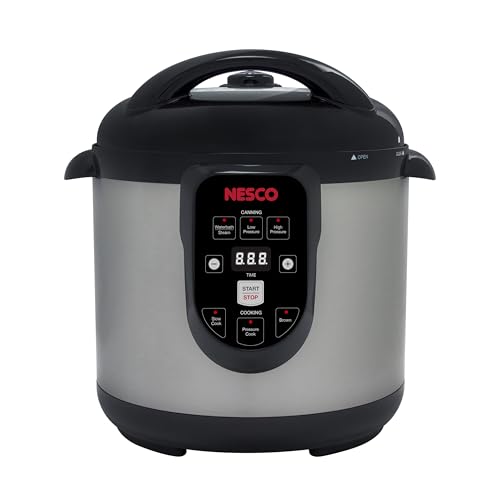
NESCO NPC-9 Smart Electric Pressure Canner and Cooker — Best Alternative Brand
The NESCO NPC-9 suits the space-limited preserver: apartment and small-kitchen canners who process a few jars at a time and want a canning-first machine that also cooks dinner.
Strengths
- Built and marketed specifically for home food preservation, with pressure canning and water-bath programs
- Stainless steel body and a compact 9.5-quart footprint
- Digital controls with canning-specific settings rather than generic multi-cooker menus
Trade-offs
- Smallest jar capacity here — plan on several loads for big preserving days
- Follow NESCO’s own tested procedures; do not freelance processing times
- Cooking performance as a daily multi-cooker is secondary to its canning role
| Type | Electric pressure canner and cooker |
| Capacity | 9.5 quart |
| Body | Stainless steel |
| Programs | Pressure canning, water bath, pressure cook, slow cook |
NESCO comes to this category from food preservation — dehydrators, roasters, vacuum sealers — and the NPC-9 reflects that: the control panel leads with canning, the manual speaks the language of jars and headspace, and the machine is sized for the way apartment dwellers actually preserve, which is a few jars often rather than forty jars once.
The discipline note applies to every digital canner and bears repeating here: use the manufacturer’s procedures and tested recipes, respect altitude guidance, and treat the appliance as a system rather than a generic pot. Used that way, the NPC-9 is a legitimate, space-friendly route into pressure canning from a brand that understands preserving.
The NPC-9’s dual identity is more considered than most canner-cookers. Its control layout leads with preservation — pressure canning and water-bath programs are the headline, not buried submenus — and its 9.5-quart chamber suits the way small households actually preserve: a few jars of jam from a market flat of berries, a small run of pickles, a modest batch of beans. It is the canner for people whose preserving is frequent and small rather than seasonal and huge.
The NPC-9’s cooker mode deserves its sentence: as a 9.5-quart pressure cooker it handles family stews and batch grains credibly, which means the appliance earns counter space in the months when nothing is being canned. Dedicated tools that moonlight well are the ones small kitchens can justify — and justification, in a small kitchen, is survival.
Best for: small kitchens and few-jars-at-a-time preservers / Not suited for: bulk harvest processing
Check the current price on Amazon

CARORI 12 Qt Electric Pressure Cooker and Canner — Best Big Cooker (Canning Claim Flagged)
Buy the CARORI 12-quart for what it verifiably is: a very large, powerful multi-cooker for feeding gatherings, holiday meals and big-batch cooking. Its listing includes canning language; read the flag in this review before acting on that word.
Strengths
- Huge 12-quart capacity with 1600W power for crowd-scale cooking
- Fifteen presets plus delay start and keep-warm cover the entertaining repertoire
- As a cooker — stews, grains, big roasts — it is well specified for the tier
Trade-offs
- Its canning claim is a manufacturer claim, not independent food-safety testing — we do not recommend it for low-acid pressure canning
- Very large footprint; measure storage before buying
- Newer brand with limited long-term track record
| Type | Electric multi-cooker (canning function claimed by maker) |
| Capacity | 12 quart |
| Power | 1600W |
| Functions | 13-in-1, 15 presets |
Judged as a cooker, the CARORI is easy to like: it is the biggest pot in this guide, it heats with authority, and its preset list is built for exactly the big-batch cooking its capacity invites. Thanksgiving sides, church-supper chili, stock in serious volume — this is its home turf, and it performs the role credibly.
Judged as a canner, our position is the same one taken throughout this guide: a marketing claim is not a tested process. Dedicated digital canners exist, are engineered around canning cycles, and are the machines above. If you buy the CARORI, buy it as an excellent big cooker — and do your pressure canning in a Presto or NESCO.
One more consideration in the CARORI’s favour as a cooker: at 1600 watts it is the most powerful heating system in this guide, and big-pot cooking rewards wattage — faster pressurising of full loads, more authoritative sautéing for browning large batches of meat before a stew. If your kitchen regularly feeds twelve, the CARORI’s combination of capacity and power is a legitimate headline act. It simply should not be the headline on a page about canning safety, which is why this guide badges it as a cooker first.
Entertainers should note the CARORI’s keep-warm behaviour at full load: a 12-quart pot of chili held for a gathering stays at serving temperature through an evening without scorching at the base — the failure mode of lesser big pots. As a serving system for crowds, not just a cooking vessel, it is genuinely well judged.
Best for: crowd-scale cooking and holiday batch work / Not suited for: anyone shopping primarily for a pressure canner
Check the current price on Amazon

VAJ 12-in-1 Electric Pressure Cooker 8 QT — Best Budget Big Cooker (Canning Claim Flagged)
The VAJ fits the budget-conscious family cook: stainless build, 24-hour preset flexibility, dishwasher-friendly parts and an 8-quart pot for weekly batch cooking.
Strengths
- Stainless steel multi-cooker body at a value tier
- 24-hour preset/delay flexibility for planned meals
- Dishwasher-safe parts keep big-pot cleanup painless
Trade-offs
- The panel’s canning preset is, again, a maker claim — not a tested canning process we can endorse for low-acid foods
- Generic preset labelling requires some trial and error
- Brand support and spares are the thinnest here
| Type | Electric multi-cooker (canning preset claimed by maker) |
| Capacity | 8 quart |
| Body | Stainless steel |
| Functions | 12-in-1 with canning preset |
As an 8-quart family cooker the VAJ ticks the practical boxes: stainless construction, a full spread of daily programs from sauté to yogurt, delay flexibility for planned dinners, and parts that go in the dishwasher. For stews, grains and steamed vegetables it competes honestly with better-known names at its tier.
The canning preset on its panel is precisely the category problem this guide exists to explain. A button labelled canning on a multi-cooker does not make the appliance a tested canner. Enjoy the VAJ as a cooker — it is a decent one — and process your green beans in a purpose-built digital canner.
The VAJ’s 24-hour preset flexibility deserves its due in the cooker column: few machines at its tier let you schedule a full day ahead, and for households whose cooking is planned around shifts and school runs, that scheduling depth is the difference between a cooker that gets used and one that gathers dust. Combined with dishwasher-safe parts — a mercy at 8-quart scale — it is a thoughtfully practical family machine whose only fault in this guide is a button label it should never have been given.
The VAJ’s dishwasher-safe parts list extends to the components owners actually dread — the inner pot and the removable lid parts — which at 8-quart scale is a meaningful mercy. Big-pot cooking generates big-pot washing; a machine that hands that job to the dishwasher removes the main friction of owning capacity.
Best for: budget family batch cooking in stainless / Not suited for: shoppers who need a true pressure canner
Check the current price on Amazon
Comparison Table
| Pick | Badge | Key spec | Best for |
|---|---|---|---|
| Presto 02144 12-Quart Digital Pressure Canner | Best Overall Digital Canner | 12 qt digital canner | small-batch home canners who want a guided, purpose-built machine |
| Presto 02153 23-Quart Digital Pressure Canner | Best for Big Harvests | 23 qt digital canner | gardeners and bulk preservers processing large seasonal loads |
| Presto 02152 17-Quart Digital Pressure Canner | Best Mid-Size Canner | 17 qt digital canner | regular family-scale canning through the season |
| NESCO NPC-9 Smart Electric Pressure Canner and Cooker | Best Alternative Brand | 9.5 qt canner-cooker | small kitchens and few-jars-at-a-time preservers |
| CARORI 12 Qt Electric Pressure Cooker and Canner | Best Big Cooker (Canning Claim Flagged) | 12 qt, 1600W multi-cooker | crowd-scale cooking and holiday batch work |
| VAJ 12-in-1 Electric Pressure Cooker 8 QT | Best Budget Big Cooker (Canning Claim Flagged) | 8 qt, 12-in-1 stainless | budget family batch cooking in stainless |
Why electric multi-cookers are not pressure canners
Pressure canning is a sterilization process, not a cooking style. Low-acid foods — vegetables, meats, soups, beans — must be held at a verified temperature for a tested time to destroy botulism spores, and those times come from laboratory-tested procedures for specific canner types. Stovetop pressure canners are tested as systems; their gauges and weights are calibrated against that testing.
Electric multi-cookers fail this on evidence, not on vibes: their internal temperatures at a given pressure setting vary by model and load, they are not tested as canning systems, and food-safety authorities have consistently declined to endorse them for pressure canning — including models with a canning button. A multi-cooker that reaches 10–15 PSI has demonstrated cooking pressure, not a validated canning process. The digital canners in this guide are different in kind: they are designed, programmed and sold as canning appliances with guided cycles built around jar processing.
Pressure canning vs water-bath canning: which do your foods need?
High-acid foods — most fruits, jams, jellies, pickles made with vinegar, and properly acidified tomatoes — can be safely processed in a boiling water bath, because acidity does the protective work and the bath delivers the heat. Every digital canner in this guide also runs water-bath programs, which makes them dual-purpose preserving stations.
Low-acid foods — plain vegetables, meats, poultry, seafood, soups, stocks and mixed recipes — must be pressure canned, full stop. There is no water-bath shortcut and no multi-cooker shortcut. If your preserving ambitions are mostly fruit and pickles, a canner is still a fine buy for its water-bath convenience; if they include green beans, corn or venison, a true pressure canner is not optional equipment.
How to choose the right canner capacity
Count jars, not quarts of pot. A preserving session is measured in how many pint or quart jars process per load, and the digital canners above step from small-batch (NESCO 9.5-quart, Presto 12-quart) through family-scale (Presto 17-quart) to harvest-scale (Presto 23-quart). Match the machine to your biggest realistic session, not your biggest imaginable one — oversized canners cost more, store worse and warm up slower for the small loads you will actually run most often.
Also plan the physical space honestly: jar processing needs headroom above the open canner for a lifter and a loaded rack, plus a heat-safe landing zone for hot jars to cool undisturbed for 12–24 hours. The best canner is the one whose full workflow fits your kitchen, not just your counter.
What about stovetop pressure canners?
They remain the reference standard of home canning: tested as systems for generations, available in sizes beyond any countertop model, and independent of electronics that can age out. A weighted-gauge stovetop canner never needs a firmware decision and a dial-gauge model needs only an annual accuracy check. If you already own one and your stove suits it, nothing in this guide is an argument to replace it.
The digital canners earn their place on workflow, not superiority: they free the stove during preserving season, they guide beginners through stages a stovetop leaves to vigilance, and they hold processing conditions automatically through long cycles. Households choosing between the two should decide by temperament — the stovetop rewards the attentive traditionalist, the countertop rewards the busy modern preserver. Both, used with tested recipes, produce safe food.
Understanding the two kinds of “canning” claims
When a multi-cooker advertises a canning function, read precisely what is claimed. Some mean water-bath-style processing of high-acid foods — a far less demanding job that boiling water can do. Others imply full pressure canning of low-acid foods, which is the claim food-safety authorities decline to endorse for multi-cookers as a class. The same word covers both, which is how confusion — and risk — propagates through listings.
The practical rule: for high-acid foods, a boiling water bath in any deep pot with a rack is a tested, accepted method and needs no special appliance at all. For low-acid foods, the appliance must be a pressure canner — stovetop or purpose-built digital — used with tested times. Any product that blurs that line in its marketing should be bought, if at all, for its other virtues.
Altitude, headspace and the other numbers that are not negotiable
Canning recipes specify numbers with the precision of a pharmacy because each one carries a safety function. Headspace lets food expand and a vacuum form; processing pressure compensates for the thinner air at altitude, where water boils cooler; processing time is calibrated to the slowest-heating point at the centre of the densest jar. Changing any of them casually is not a variation — it is a different, untested process wearing a tested recipe’s clothes.
Digital canners help by making the settings explicit and repeatable, but they cannot read your altitude or measure your headspace for you. The discipline is the cook’s. The good news is that the numbers are printed in every tested recipe and every canner manual in this guide: the entire skill of safe canning is following them exactly, every time, especially when experience tempts you to improvise.
Building a preserving pantry: what a canner owner cans across a year
Spring opens with rhubarb and the first pickles; summer is the tomato and stone-fruit flood, split between water-bath and pressure work; autumn brings beans, corn, soups and the hunter’s or gardener’s largest loads; winter is stock season, when carcasses and bones become shelf-stable quarts that make January cooking taste like someone planned it. A canner sized to your biggest season — the logic behind this guide’s capacity ranking — serves all four.
Plan storage with the same honesty as capacity: a year of preserving for a family occupies real shelving in a cool, dark place, and jars are heavy. The households that sustain the habit treat the pantry as infrastructure — labelled, rotated, inventoried — rather than as a cupboard of good intentions.
Getting started without waste: your first three canning projects, in order
Project one: a water-bath batch of jam or pickles in your new digital canner. The stakes are forgiving, the workflow is the full workflow — jars, headspace, processing, seals — and success tastes like toast. This is where you learn your machine’s prompts, your kitchen’s jar-handling geography and your own patience, at a price of one flat of fruit.
Project two: a pressure-canned batch of a simple vegetable, following a tested recipe to the letter — green beans are the classic. One food, one jar size, no variations. Project three: a soup or stock, the first genuinely composite food, canned only after the first two projects have made the discipline automatic. Households that climb this ladder keep canning for decades; households that start with a complex mixed recipe at altitude with borrowed timings are the ones whose canners end up in garage sales.
How to Run Your First Pressure Canning Session Safely
This is the shape of a safe first session with a digital pressure canner. It teaches the workflow; it does not replace your canner’s manual or a tested recipe, both of which govern your actual processing times and pressures.
Step 1: Start from a tested recipe, not a family habit
Choose a current, tested recipe for the exact food you are processing, from the canner manufacturer, a university extension source or a recognized preserving authority. Note the jar size, headspace, pressure setting and processing time — and your altitude adjustment — before any food is chopped. Improvisation is for soup night, not for canning.
Step 2: Inspect jars, lids and the canner
Run a fingertip around every jar rim feeling for nicks, wash jars hot and keep them warm, and use new flat lids unless yours are rated reusable. Check the canner’s gasket, vent and rack, and confirm you have the water volume the manual specifies. Most canning failures are equipment failures noticed too late.
Step 3: Pack jars exactly as the recipe directs
Hot pack or raw pack as specified, fill to the stated headspace — measured, not eyeballed — remove bubbles, wipe rims clean and apply lids fingertip-tight. Headspace is a safety parameter: too little and food expands into the seal; too much and the jar may not exhaust and seal properly.
Step 4: Run the guided cycle without interruption
Load jars on the rack, lock the canner and start the program your machine provides for the recipe. Digital canners manage venting, pressurizing and timing — your job is not to open, adjust or hurry anything. If a cycle is interrupted mid-process, follow the manual: most situations mean starting the full process over.
Step 5: Cool, check seals and store correctly
Let the canner depressurize on its own, then rest jars undisturbed on a towel for 12–24 hours. Check every seal, label with contents and date, and store sealed jars in a cool dark place without the screw bands. Any jar that failed to seal goes to the fridge and gets eaten first.
Step 6: Process a second load only after a full reset
Between loads, let the canner cool as the manual directs, check the water, inspect the gasket and reload with fresh hot jars. Back-to-back processing is where tired canners cut corners; the reset is what keeps load two as safe as load one. Harvest day is a marathon of identical careful sessions, not one long improvisation.
When in doubt, throw it out is not folksy caution — it is the rule. Bulging lids, spurting liquid, off odours or mould mean the jar is discarded without tasting. Safe canning is a system of small disciplines, and the session above is that system in miniature.
Safety habits that matter more than the machine
Keep a canning log: date, recipe source, jar size, headspace, processing setting and time, and the seal result the next morning. The log turns your second season into a skilled season, and if a batch ever raises a question, the log is what lets you answer it with facts instead of anxiety. Every experienced preserver keeps one; every beginner wishes they had started earlier.
Maintain the unglamorous parts: inspect jar rims and retire chipped jars to dry storage, replace flat lids rather than reusing them (unless rated reusable), check the canner’s gasket and vent before the season starts, and store the canner clean and dry with the lid ajar. Canning safety is mostly this — a chain of small, boring disciplines, each one load-bearing.
Common Buying Mistakes
Buying a multi-cooker because it has a canning button. A labelled preset is a marketing feature, not a tested process. For low-acid foods, use a purpose-built pressure canner and tested procedures — this is the single most consequential mistake in the category.
Using grandmother’s timings with modern equipment. Tested recipes are revised as knowledge improves. Old hand-me-down times, open-kettle methods and oven canning are retired for documented reasons; current guidance exists and is easy to find.
Guessing headspace and lid tightness. Both are specified in the recipe because both affect sealing and safety. Measure headspace with a gauge or ruler and tighten bands fingertip-tight — snug, not wrenched.
Rushing the cool-down. Opening a canner early, venting manually to save minutes, or moving hot jars can break seals and crack jars. The boring waiting stages are load-bearing parts of the process.
Storing jars with bands on and never checking seals. Bands left on can hold a failed lid in place and hide the failure. Remove bands after cooling, verify seals, and re-check before use.
Final Recommendation
If you take one sentence from this guide, take this one: for pressure canning, buy a canner. The Presto 02144 12-quart is the right starting point for most households, the 17-quart serves regular preservers, and the 23-quart exists for harvest scale. The NESCO NPC-9 is the small-kitchen alternative from a preservation specialist.
The CARORI and VAJ are good big cookers that happen to wear a canning claim — buy them as cookers if they fit your kitchen, and let a purpose-built canner handle your green beans. Canning done right fills a pantry for a year; canning done casually is the one kitchen gamble not worth taking.
Start here: Presto 02144 12-Quart Digital Pressure Canner (best overall digital canner), Presto 02153 23-Quart Digital Pressure Canner (best for big harvests), Presto 02152 17-Quart Digital Pressure Canner (best mid-size canner).
Keep exploring the cluster: Best Electric Pressure Cookers 8qt, Best Electric Pressure Cookers With A Stainless Steel Pot, Best 10 Quart Pressure Cookers, Best Electric Pressure Cookers For Easy Meals, Best 6 Quart Pressure Cookers.
Frequently Asked Questions
Can I pressure can in an Instant Pot or other multi-cooker?
No — food-safety authorities do not endorse electric multi-cookers for pressure canning, including models with canning buttons, because their processing temperatures are not tested and verified as canning systems. Use a stovetop pressure canner or a dedicated digital pressure canner.
What makes a digital pressure canner different from a multi-cooker?
Design intent and programming: digital canners are built around jar processing, with guided cycles for venting, processing and cooling, canning-specific manuals and jar-capacity ratings. A multi-cooker is built around dinner.
Which foods must be pressure canned?
All low-acid foods: plain vegetables, meats, poultry, seafood, soups, stocks, beans and mixed dishes. High-acid foods like fruits, jams and vinegar pickles can be water-bath canned.
What size digital canner should a beginner buy?
The 12-quart class suits most beginners — small batches, guided cycles, manageable storage. Step up to 17 or 23 quarts only when your preserving volume honestly demands it.
Can these digital canners also cook regular meals?
Yes — the Presto and NESCO models double as large pressure and slow cookers in the off-season, which is part of their value. Just keep the roles separate: cooking is flexible, canning follows tested procedures exactly.
Do I need to adjust canning for altitude?
Yes. Processing pressure and sometimes time change with elevation, and your canner manual plus your tested recipe will specify the adjustment. Digital canners make the adjustment easy to apply, but it is still yours to set.
Can I water-bath can in a regular multi-cooker?
Water-bath processing needs only boiling water, a rack and enough depth to cover jars by an inch or two — a deep stockpot does it as validly as any appliance. The appliance question only becomes critical for pressure canning low-acid foods.
How long do home-canned foods keep?
Properly processed and stored jars are generally used within a year for best quality, per current guidance. Label every jar with contents and date, store in a cool dark place, and always inspect the seal and contents before use — when in doubt, throw it out.
Do digital canners need gauge testing like stovetop dial canners?
Digital canners do not have a user-serviceable dial gauge to calibrate; they manage pressure electronically. Follow the manufacturer’s maintenance guidance, keep sensors and vents clean, and if the machine ever behaves abnormally — failing to pressurise, erroring mid-cycle — stop and contact the maker rather than improvising.


