Disclosure: airfryerkitchensupply.com is reader-supported. When you buy through links on our site, we may earn an affiliate commission at no extra cost to you.
Where to buy
Start with the shortlist itself: the best 6 quart pressure cookers compared in this guide are the six models we verified for it. Amazon carries every cooker in this guide, and the fastest route to each one is the linked list below. You will not find printed prices in the article, because they go stale quickly; each pick asks you to check the current price on its listing instead.
- Instant Pot Duo 6 Qt 7-in-1 Electric Pressure Cooker — check price on Amazon
- Presto 02141 6-Quart Electric Pressure Cooker — check price on Amazon
- Presto 01362 6-Quart Stainless Steel Pressure Cooker — check price on Amazon
- Presto 01264 6-Quart Aluminum Pressure Cooker — check price on Amazon
- Cosori Pressure Cooker 6QT 9-in-1 — check price on Amazon
- COMFEE 12-in-1 Electric Pressure Cooker 6 Quarts — check price on Amazon
Hunting for the best 6 quart pressure cookers means deciding first what kind of cook you are, because this size is served by two proud traditions that behave nothing alike. Six verified models are compared below, three philosophies deep, with the strengths and the honest compromises of each stated in plain terms.
Six quarts is the pressure cooker size that fits real life. It swallows a whole chicken, a serious batch of beans or a family stew, yet still cooks a modest pot of rice without feeling absurd, and it stores in a normal cupboard. Go smaller and batch cooking cramps; go larger and weeknight meals rattle around in a pot built for a crowd.
This roundup deliberately mixes the two pressure traditions. Four picks are electric multicookers that manage pressure themselves, and two are classic stovetop Prestos that reward attention with speed and lifetime durability. Every model was verified against its Amazon listing, so capacities and functions here are the ones actually on sale.
A word about what pressure cooking does to a kitchen’s economics and calendar. The method’s real gift is not speed for its own sake; it is the recovery of dishes that weeknights had deleted. Dried beans without an overnight soak, a stew that tastes like Sunday on a Wednesday, stock whenever the bones accumulate. A 6-quart cooker is the size at which that gift applies to a whole family’s cooking rather than to side dishes.
In this guide
Quick Picks
- Best Overall — Instant Pot Duo 6 Qt 7-in-1 Electric Pressure Cooker: The category default: proven 6-quart pressure cooking, a stainless pot and an ecosystem of recipes and accessories nothing else matches.
- Best Simple Electric — Presto 02141 6-Quart Electric Pressure Cooker: Electric pressure cooking stripped to the essentials by the brand that helped invent the category.
- Best Stovetop — Presto 01362 6-Quart Stainless Steel Pressure Cooker: The traditionalist’s choice: fast, hard-searing stovetop pressure in stainless steel that will outlive its owner.
- Best Budget Stovetop — Presto 01264 6-Quart Aluminum Pressure Cooker: Genuine pressure cooking at the lowest sensible price: light, fast-heating and proven over generations.
- Best Modern Alternative — Cosori Pressure Cooker 6QT 9-in-1: The moderniser: nine functions with sous vide, a ceramic pot that rinses clean and a long safety list.
- Best Value Multicooker — COMFEE 12-in-1 Electric Pressure Cooker 6 Quarts: The value play: twelve functions, a 24-hour timer and easy-clean ceramic in a 6-quart multicooker.
Two philosophies share this list. The electric models believe a cooker should manage itself, and they are right for most modern households. The stovetop models believe a cooker should be a superb pot first, and they are right for the cooks who still enjoy the stove. The badges honour both philosophies, because a roundup that pretended one of them was simply obsolete would be lying about how people actually cook.
How These Picks Were Chosen
Models were confirmed through Amazon listing, checking capacity, cooking type and headline functions against the real products. We weighted pressure performance and pot material first, then the honesty of the feature list, the depth of recipe and accessory support, and cleanup. Stovetop and electric models were judged by the standards of their own tradition rather than forced onto one scale, because they serve genuinely different cooks.
Two editorial rules apply throughout. The guide prints no product prices, because they change too quickly for print to stay truthful, and it cites no fixed star ratings or review totals, which decay just as fast. In their place you get verified listings, specifications taken from those listings, and direct advice.
The 6 Best 6 Quart Pressure Cookers

Instant Pot Duo 6 Qt 7-in-1 Electric Pressure Cooker — Best Overall
The Duo is the default answer in this category for a reason. It defined the modern electric pressure cooker, and the 6-quart version remains the size and feature set against which everything else is measured. Pressure cooking, rice, steaming, sautéing, slow cooking, yogurt and keeping warm live in one stainless pot that lives on the counter of millions of kitchens.
Strengths
- The most recipe-supported pressure cooker in existence, with settings and timings for it in practically every cookbook and community
- Stainless steel inner pot sears properly, scrubs clean and will outlast nonstick coatings
- The 6-quart size is the sweet spot: big enough for a whole chicken, small enough for Tuesday rice
Trade-offs
- Slow cook mode runs cooler than a dedicated slow cooker, so adapted recipes need the higher setting
- The silicone sealing ring absorbs strong flavours and most owners eventually keep a second ring for desserts
- Controls reflect its generation, with a dial-free button layout that takes a week to memorise
Key specs
- Capacity: 6 quart
- Functions: 7-in-1 electric pressure cooker (per Amazon listing)
- Pot: Stainless steel inner pot
- Modes: Pressure cook, slow cook, rice, steam, sauté, yogurt, warm
What ownership actually feels like is support. Every recipe you find assumes this machine’s buttons and pressure behaviour, every accessory from steamer baskets to spare rings is made for it first, and every question you could type has been answered many times over. That ecosystem is a genuine product feature, because a pressure cooker is a technique as much as an appliance, and the Duo shortens the learning curve more than any rival.
The honest limitations are known quantities. As a slow cooker it runs gentler than a stoneware crock, its sealing ring keeps the memory of last week’s curry, and newer rivals add modes it lacks. None of that displaces it. For a first pressure cooker, or the one cooker a small kitchen can justify, the 6-quart Duo remains the purchase the fewest people regret.
Ownership settles into a rhythm quickly: a spare ring in the drawer, a note of your household timings on the fridge, and a pot that handles everything from Monday rice to Sunday short ribs. The Duo’s deepest advantage is that it disappears into routine, which is what a cooker used several times a week is supposed to do.
Who should skip it: cooks who know they will slow cook weekly and pressure cook rarely have the priorities backwards for this machine, and the dedicated crocks in the companion guide will serve them better. For everyone else, and especially for a first purchase, the Duo remains the answer with the fewest possible regrets attached, which is why it leads a field that includes cheaper and newer rivals.
Best for: First-time pressure cooker buyers and anyone who wants maximum recipe and accessory support / Not suited for: Slow-cooking purists who should pair it with, or choose, a dedicated stoneware slow cooker
Check on Amazon — check the current price on Amazon.

Presto 02141 6-Quart Electric Pressure Cooker — Best Simple Electric
Not everyone wants a multicooker that also claims to be a yogurt studio and a sous vide station. The Presto 02141 is the electric pressure cooker for cooks who simply want pressure cooking itself: load the pot, choose a preset, and let a company that has built pressure vessels for decades handle the rest.
Strengths
- Presto has made pressure cookers for generations, and that experience shows in a sensible, uncomplicated design
- Preset-driven controls suit cooks who want to press a button rather than learn a system
- Often the most affordable route into electric pressure cooking from a long-established brand
Trade-offs
- Fewer functions than the multicooker flagships, with no yogurt or app ecosystem
- Inner pot and finish reflect the budget tier compared with stainless multicookers
- Recipe support is thinner, so you will adapt timings from general pressure-cooking charts
Key specs
- Capacity: 6 quart
- Type: Electric pressure cooker
- Brand: Presto
- Controls: Preset-driven, straightforward layout
That restraint is the appeal. The control layout is approachable for a nervous first-time user, the presets cover the everyday jobs of beans, grains, stews and roasts, and there is no account, app or firmware between you and dinner. Presto’s long history with pressure canning and cooking also means the safety engineering comes from a deep well of experience rather than a startup’s enthusiasm.
You trade away the multicooker extras and the vast recipe ecosystem of the category leader. Timings from popular pressure-cooking sources still apply, because pressure is pressure, but you will translate them to presets yourself. For a second cooker, a cabin kitchen, or a cook who values simplicity over modes, that is a fair and often cheaper trade.
The 02141 also earns a mention for repairability of routine: gaskets and basic parts for Presto cookers have historically been easy to source, which matters on a budget appliance expected to work for years. Keep the vent and sealing surfaces clean, treat the pot kindly, and there is very little here to go wrong.
Who should skip it: the cook who wants a screen full of modes, a yogurt function and an app will feel short-changed by design. The cook who wants dinner under pressure without a learning project will not. In a category that keeps adding features, the 02141’s restraint is a position, and for its intended owner it is the right one.
Best for: Cooks who want electric pressure cooking without multicooker complexity / Not suited for: Feature collectors who want yogurt, sous vide and app control in the same pot
Check on Amazon — check the current price on Amazon.

Presto 01362 6-Quart Stainless Steel Pressure Cooker — Best Stovetop
Before electric multicookers, there was this: a heavy stainless pot, a locking lid and the physics of steam. The Presto 01362 remains in this guide because stovetop pressure cooking still does some things better. It comes up to pressure quickly, it sears like the serious saucepan it also is, and it will still be working when today’s electronics are landfill.
Strengths
- Stovetop pressure reaches full pressure faster and sears harder than most electric models
- Stainless steel construction is effectively a lifetime purchase with no electronics to fail
- Doubles as a high-quality stockpot with the pressure lid removed
Trade-offs
- Demands your attention: you manage the burner to hold pressure rather than walking away
- No timer, no presets and no keep-warm, because it is a pot, not an appliance
- Handles and the learning curve suit confident cooks more than nervous beginners
Key specs
- Capacity: 6 quart
- Material: Stainless steel
- Type: Stovetop pressure cooker
- Use: Works on regular and smooth-top ranges (per range guidance in listing family)
The cooking experience is more involved and, for many cooks, more enjoyable. You brown meat properly in the same vessel, deglaze, lock the lid and tend the heat down to a gentle hiss. Pressure is regulated by the burner rather than a circuit board, which gives an experienced cook fine control and gives a beginner a genuine skill to learn. Recipes specify times from the moment pressure is reached, and a kitchen timer becomes part of the ritual.
Choose it with clear eyes: there is no keep-warm while you commute and no button that thinks for you. In exchange you get speed, durability measured in decades, a pot that earns its cupboard space on non-pressure days, and immunity from the electronics lottery. For cooks who like cooking, it is the enthusiast’s pick in a 6-quart field of appliances.
A stovetop habit worth building with the 01362: set a timer the moment the regulator starts its gentle rocking, and learn your burner’s personality, because every stove holds pressure at a slightly different setting. Two or three cooks in, the process becomes meditative rather than demanding, and the results explain why this format survived a century of kitchen fashion.
Who should skip it: anyone whose cooking life depends on walking away, timers and keep-warm, because this pot offers none of them and makes no apology. Cooks who stand at a stove happily, who sear seriously and who measure an appliance’s life in decades will find the 01362 the most satisfying object in this entire roundup.
Best for: Confident cooks who want speed, searing power and a buy-it-for-life pot / Not suited for: Anyone who wants set-and-forget electric convenience and timers
Check on Amazon — check the current price on Amazon.

Presto 01264 6-Quart Aluminum Pressure Cooker — Best Budget Stovetop
Pressure cooking does not have to start with a flagship appliance. The aluminum Presto 01264 has put beans, stews and tough cuts within weeknight reach for generations of budget-conscious cooks, and it remains the cheapest credible way to learn whether pressure cooking suits your kitchen before investing more.
Strengths
- The lowest-cost way into genuine 6-quart pressure cooking from an established maker
- Aluminum heats quickly and evenly, bringing the pot to pressure fast
- Light body is easy to lift, wash and store compared with heavy stainless pots
Trade-offs
- Aluminum reacts with long acidic cooks and will stain with tomato-heavy recipes
- Not the choice for induction cooktops, which need a magnetic base
- Finish and longevity sit below stainless steel over many years of use
Key specs
- Capacity: 6 quart
- Material: Aluminum
- Type: Stovetop pressure cooker
- Weight: Light for its size
Aluminum’s virtues are practical ones. It is light enough to move full of stew without a wrestling match, it responds quickly to burner changes, and it heats evenly across the base. For the core pressure-cooking jobs of dried beans, grains, stocks and braises, it performs the essential trick exactly as well as expensive pots: it traps steam and raises the boiling point, and dinner obeys physics rather than price tags.
The trade-offs are equally clear. Acidic ingredients will discolour it over time, induction owners must look elsewhere, and it will not be handed down like the stainless model above. As a first pressure cooker, a spare for a holiday home, or the pot that proves the technique earns counter space in your life, it makes a compelling and honest case.
For the aluminum 01264, one care note extends its life considerably: avoid long storage of acidic foods in the pot, and transfer tomato-based leftovers to another container for the fridge. Cooked in it daily and stored elsewhere, the pot will give years of service that its price has no business promising.
Who should skip it: cooks with induction hobs, cooks who store acidic leftovers in the cooking pot, and cooks buying a wedding-gift-grade heirloom. Beginners, experimenters and the budget-committed should not skip it; it teaches the same physics as every pot here, at a price that forgives the student.
Best for: Budget buyers and beginners testing whether pressure cooking fits their cooking / Not suited for: Induction cooktop owners or cooks who mostly braise acidic dishes
Check on Amazon — check the current price on Amazon.
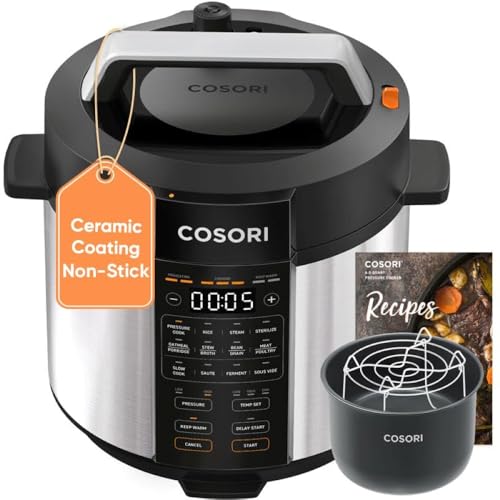
Cosori Pressure Cooker 6QT 9-in-1 — Best Modern Alternative
Cosori’s 6QT is the pick for the buyer who looked at the category default and wanted one generation newer thinking: more functions, an easier-cleaning pot and a safety list that reads like it was written for the nervous. Nine modes stretch from pressure cooking through slow cooking to sous vide, all in a stainless housing that looks at home next to modern appliances.
Strengths
- Nine functions including sous vide give it the broadest mode list among the 6-quart electrics here
- Ceramic-coated pot releases food easily and cleans with less soaking than bare metal
- The listing highlights a dozen built-in safety features, reassuring for first-time pressure users
Trade-offs
- Ceramic coatings wear over years where a stainless pot would not, so treat it with wooden and silicone tools
- Smaller recipe ecosystem than the category leader, though general timings transfer
- Sous vide in a sealed cooker suits small portions rather than big bath cooking
Key specs
- Capacity: 6 quart / 6QT
- Functions: 9-in-1 including sous vide (per Amazon listing)
- Pot: Ceramic-coated inner pot
- Power: 1100W, stainless steel housing
The ceramic-coated inner pot defines daily life with it. Rice releases, oatmeal rinses away and cheesy dishes stop being a soaking sentence. The trade is longevity of the coating itself, which rewards gentle utensils. In exchange, weeknight cleanup, the thing that actually decides whether an appliance gets used in month six, becomes dramatically easier than with a pot that needs scrubbing.
Function for function it challenges the leader, and sous vide gives experimenters a mode the Duo generation never offered. Recipe support is the one gap: you will cook from general electric pressure-cooker timings, which transfer reliably, rather than from a library written for this exact panel. For buyers who value the modern pot and the longer mode list over the bigger cookbook shelf, the Cosori is the smart alternative.
Cosori ownership tip: register your timings as you learn them, because the community library for this exact panel is smaller. Five cooks in, you will have your own chart for beans, grains and stews on the fridge, and from then on the machine’s modern pot and safety list do the rest of the persuading.
Who should skip it: the recipe follower who cooks exclusively from model-specific books and blogs will feel the smaller library. The cook who works from general timings, and who washes the pot more often than they browse for accessories, will find the Cosori the most modern-feeling 6-quart electric in the guide.
Best for: Buyers who want the newest feature set and the easiest-cleaning pot in a 6-quart electric / Not suited for: Cooks who lean heavily on model-specific recipes and accessories
Check on Amazon — check the current price on Amazon.

COMFEE 12-in-1 Electric Pressure Cooker 6 Quarts — Best Value Multicooker
The COMFEE 12-in-1 makes its case with arithmetic: a dozen functions, a delay timer and a 6-quart ceramic pot at the value end of the category. For households that want a multicooker’s flexibility without paying flagship prices, it covers pressure cooking, slow cooking, rice, steaming, sautéing and more in one affordable body.
Strengths
- Twelve functions at a value-tier price make it the most modes per dollar in this roundup
- A 24-hour delay timer lets dinner start itself, rare at this end of the market
- Ceramic nonstick pot keeps cleanup easy for rice, porridge and stew households
Trade-offs
- Value-tier fit and finish, with a lighter build than the premium brands
- Long-term parts and accessory availability is less certain than the big names
- Brand recipe support is modest, so general pressure-cooking charts become your cookbook
Key specs
- Capacity: 6 quarts
- Functions: 12-in-1 with 12 menus (per Amazon listing)
- Timer: 24-hour delay timer
- Pot: Ceramic inner pot, nonstick
The delay timer deserves emphasis because it changes who the machine serves. Load it in the morning, set the start, and pressure cooking begins in time for dinner without anyone standing in the kitchen. Combined with keep-warm, it suits shift workers and busy families better than its price suggests. The ceramic pot keeps the everyday dishes this machine will cook most, rice, porridge, beans and stews, from becoming cleanup projects.
Expectations should match the tier: plastics feel lighter, the accessory shelf is smaller and you will borrow timings from general sources. None of that undermines the core job. If the choice is between a basic cooker from a famous brand and this fully featured one, many households will get more actual cooking out of the COMFEE’s longer mode list and timer.
The COMFEE rewards a cook who explores its menu systematically: one new function a week turns the long list from a brochure into skills. Its delay timer in particular deserves an early test with a safe, forgiving dish like a bean soup, because once you trust the timer, the whole shape of your weeknight cooking changes.
Who should skip it: buyers for whom brand support and a deep accessory shelf are the purchase, not a bonus. Buyers shopping by capability per dollar should not skip it at all; the COMFEE’s timer alone, at its tier, would justify a hard look even with a shorter mode list.
Best for: Value hunters who want maximum functions and a delay timer at a modest price / Not suited for: Buyers who prioritise premium materials and a deep accessory ecosystem
Check on Amazon — check the current price on Amazon.
Comparison Table
| Pick | Badge | Key spec | Best for |
|---|---|---|---|
| Instant Pot Duo 6 Qt 7-in-1 Electric Pressure Cooker | Best Overall | 6 quart | First-time pressure cooker buyers and anyone who wants maximum recipe and accessory support |
| Presto 02141 6-Quart Electric Pressure Cooker | Best Simple Electric | 6 quart | Cooks who want electric pressure cooking without multicooker complexity |
| Presto 01362 6-Quart Stainless Steel Pressure Cooker | Best Stovetop | 6 quart | Confident cooks who want speed, searing power and a buy-it-for-life pot |
| Presto 01264 6-Quart Aluminum Pressure Cooker | Best Budget Stovetop | 6 quart | Budget buyers and beginners testing whether pressure cooking fits their cooking |
| Cosori Pressure Cooker 6QT 9-in-1 | Best Modern Alternative | 6 quart / 6QT | Buyers who want the newest feature set and the easiest-cleaning pot in a 6-quart electric |
| COMFEE 12-in-1 Electric Pressure Cooker 6 Quarts | Best Value Multicooker | 6 quarts | Value hunters who want maximum functions and a delay timer at a modest price |
Notice how the table splits along one line: four appliances that manage themselves, and two pots that reward a cook’s attention. Price, remarkably, does not predict which side of that line a pick sits on. Choose your side by temperament first, then by budget, and the specific model follows from the reviews above.
Your First Five Cooks: A Sensible Apprenticeship
Start with water. A plain water test teaches the sounds, timings and release behaviour of your cooker with nothing at stake. Follow with dried beans, which forgive everything and demonstrate the method’s headline trick, then a soup, then rice or grains, and only then a meat dish with a natural release to learn.
By the fifth cook you will know your machine’s voice: how long it takes to pressurise, what its valve sounds like at a gentle simmer, and how its releases behave. That familiarity is the real product of the first week, and it is why experienced pressure cooks seem fearless. They are not braver; they are five cooks in.
How to Choose: A Best 6 Quart Pressure Cookers Buying Guide
Below is the buying-guide layer of the article, covering the decisions that matter more than any single model’s badge: tradition, size and pot material. Settle those three and the specific cooker almost chooses itself.
Electric vs Stovetop: The First Decision
Electric pressure cookers are appliances: they regulate pressure, time the cook and switch to keep-warm without you. That walk-away convenience is why they dominate, and it makes them the safer recommendation for busy households and beginners. Their ceiling is set by their elements, so searing is good rather than fierce, and when the electronics eventually fail, the cooker is done.
Stovetop models are cookware. They reach pressure faster, sear harder, double as stockpots and last for decades with only gasket replacements. The cost is attention: you set the burner and listen for the regulator. Neither tradition is better in the abstract. Choose the one that matches how you actually cook on a Wednesday.
Why 6 Quarts Is the Sweet Spot
A pressure cooker should be filled no more than two-thirds for most foods, and only half for foaming foods like beans and grains. Six quarts therefore means about four usable quarts, which is a whole chicken with vegetables, a large batch of stock or beans for the week, with headroom that keeps the steam valve clear and the cook safe.
Smaller cookers force batch-splitting on exactly the jobs pressure cooking does best, while 8-quart models heat more water and take longer to pressurise for a two-person dinner. Unless your household is large, six quarts is where capacity, speed and cupboard space balance.
Inner Pot Materials, Explained Plainly
Stainless steel sears best, tolerates metal utensils and lasts indefinitely, at the cost of food sticking more readily and cleanup needing a soak after rice or porridge. Ceramic-coated and nonstick pots release food beautifully and rinse clean, which many owners value more, but the coating is a consumable surface that gentle utensils will prolong and time will eventually retire.
There is no wrong answer, only an honest preference. Cooks who brown meat aggressively in the pot usually end up happiest with stainless. Cooks whose pressure cooker mostly makes rice, grains and saucy dishes usually end up happiest with a coated pot.
Reading a Pressure Cooker Recipe Like an Owner
Recipes in this category are written in a shorthand worth learning early. Times are always at pressure, never including the climb or the release, and liquid quantities assume a sealed pot that loses almost nothing. When a recipe says ten minutes, your evening should budget twenty-five, and knowing that from the start is the difference between a relaxed cook and a hungry, annoyed one.
Also learn your model’s minimum liquid and its fill marks before the first recipe, not during it. Most early failures in pressure cooking are not recipe failures at all; they are a dry pot that never pressurised or a full pot that foamed into its valve. The manual’s dullest page is the one that saves your first month.
Storing and Organising a 6-Quart Cooker
A pressure cooker earns its keep in proportion to how reachable it is. Store it with the lid inverted or ajar so the sealing ring airs and does not take a permanent compression set, and keep the cord, the spare ring and the steamer basket in the same cupboard zone, because a cooker separated from its ring is a saucepan.
If counter space allows, the cooker that lives out gets used three times as often as the one that must be fetched, a ratio every appliance owner recognises from their own kitchen. When something must be banished to make room, banish the single-task gadget, not the pot that cooks beans, grains, stews and stocks on rotation.
Safety Systems, Old and New
Modern electric cookers layer their protection: lids that will not open under pressure, valves that vent before pressure can climb too far, thermal cut-offs and sensors that refuse to start an open pot. Stovetop cookers rely on the regulator’s weighted or spring valve and on designs refined over generations. Both traditions are safe when the user respects fill limits and keeps valves clean.
The dangerous pressure cooker is the neglected one: a blocked vent, a perished gasket, a pot filled past its line with foaming beans. Whichever pick you choose, build the ten-second inspection into every cook. Check the ring, check the valve, check the fill. That habit, not the badge on the box, is the real safety system.
Accessories Worth Owning, and Those That Are Not
A spare sealing ring is the one essential accessory, because rings absorb flavours and eventually stretch. A steamer basket earns its space for vegetables, eggs and reheating, and a second inner pot helps households that cook back to back. A glass lid converts an electric cooker into a comfortable slow cooker and serving pot.
Beyond those, accessory fever is mostly marketing. Egg racks, cake pans and specialised moulds serve the cooks who use them and clutter the cupboards of everyone else. Buy accessories after the dish demands them, not before, and your 6-quart cooker will stay the streamlined tool it was bought to be.
How to Use a 6 Quart Pressure Cooker Safely and Well
Pressure cooking rewards a calm, repeatable routine more than any other method in the kitchen. Learn the sequence below with a forgiving first dish, beans or a soup, and the same steps will carry every recipe that follows.
- Check the sealing ring is seated evenly and the steam release valve moves freely before every cook. Most pressure problems are really sealing problems.
- Add at least the minimum liquid your model requires, usually about a cup for a 6-quart cooker, since steam is what creates the pressure.
- Fill no more than two-thirds full, and only halfway for beans, grains and other foods that foam or expand as they cook.
- Lock the lid, set the valve to sealing, and choose your pressure and time. The clock that matters starts when the cooker reaches pressure, which electrics handle automatically.
- When cooking ends, let pressure release naturally for at least ten minutes for meats and beans; a sudden full release can toughen meat and spray starchy liquid.
- Open the lid away from your face, stir, and taste for salt and finishing touches. Pressure cooking mutes seasoning slightly, so brighten dishes at the end.
After a few cooks, start a small timing notebook for your own model and stove or panel: dish, liquid, minutes at pressure, release style. Pressure cookers are consistent enough that your notes become guarantees, and guarantees are what turn a new appliance into a weeknight habit instead of a weekend experiment.
Common Buying Mistakes
- Overfilling the pot. Foaming foods can block the steam valve. Respect the two-thirds rule, and the half-full rule for beans and grains, every single time.
- Forcing a quick release on everything. Meats and beans need natural release to stay tender and keep their liquid calm. Quick release is for vegetables and delicate foods.
- Cooking with too little liquid. No liquid means no steam and no pressure, plus a burnt layer on the base. Measure the minimum even for saucy ingredients.
- Ignoring the sealing ring. A stretched or curry-scented ring causes leaks and flavour transfer. Wash it after use, store the lid upside down, and keep a spare.
- Expecting slow cooker results on a pressure schedule without adjusting seasoning. Pressure cooking is faster but seasons differently. Finish with salt, acid and fresh herbs after the lid opens, not before it closes.
Final Recommendation
For most kitchens the Instant Pot Duo 6 Qt is still the answer: proven, supported and sized right. Pick the Presto 02141 for electric simplicity, the stainless Presto 01362 if you cook on the stove and buy for life, or its aluminum sibling to learn the craft cheaply. The Cosori brings the modern feature list, and the COMFEE brings the most functions per dollar. Any of them will change what a weeknight can hold.
Whichever tradition you choose, give it a fair first month. Pressure cooking has a learning curve measured in three or four dishes, after which the same households that hesitated cannot imagine Tuesdays without it. Start with beans, forgive the first attempt, and let the pot make its case.
A word for the hesitant, because pressure cooking still carries an old reputation. The modern electric models in this guide are among the most conservatively engineered appliances in the kitchen, and the stovetop models descend from a century of refinement. Respect the fill lines, keep the valves clean, and the method is not merely safe but soothingly predictable.
A closing perspective for the undecided: pressure cooking is one of the few kitchen upgrades whose value compounds. The first month teaches technique, the first season changes what your household eats on weeknights, and by the first year the cooker has usually altered the shopping itself, toward dried beans, whole grains and the tougher, cheaper, more flavourful cuts that pressure makes tender. That compounding is why owners describe the purchase less like buying an appliance and more like adopting a method. The six models in this guide are six doors into the same method, at different prices, in two traditions, with different temperaments. Choose the door that suits your hand, walk through it with the apprenticeship in the guide above, and give the method its fair month. The households that do rarely go back to a kitchen without a pressure cooker in it, and they tend to say so with the mild evangelism of people who have reclaimed their Tuesdays.
Keep exploring the cluster: Best 6 Quart Slow Cookers Best 6 Slow Cookers And Pressure Cookers Best 6qt Multi Function Slow Cookers Best 7 1 Programmable Pressure Cookers Best 8 Qt Electric Pressure Cookers
Frequently Asked Questions
How many people does a 6 quart pressure cooker serve?
Comfortably four to six for main dishes, given the two-thirds fill rule. It handles a whole chicken, a large stew or a weekly batch of beans, which is why it is the most recommended family size.
Is a stovetop or electric pressure cooker better?
Electric is easier and walks away safely, which suits most households. Stovetop is faster to pressure, sears harder and lasts decades, which suits confident cooks. This guide includes both because the honest answer depends on you.
Can a 6 quart pressure cooker replace a slow cooker?
Electric models include slow cook modes, though they often run gentler than a stoneware slow cooker, so adapted recipes may need the higher setting or more time. For occasional slow cooking it is fine; for weekly slow cooking, a dedicated crock still wins.
What is the difference between natural and quick pressure release?
Natural release lets pressure fall on its own as the cooker cools, keeping meats tender and liquids calm. Quick release vents steam immediately, stopping cooking fast for vegetables. Many recipes use ten minutes of natural release, then vent the rest.
Are modern pressure cookers safe?
Yes, when used as directed. Current electric models layer multiple safety systems, and stovetop models use proven regulator designs. Nearly all incidents trace back to overfilling, blocked valves or forcing a lid, all of which the steps in this guide avoid.
How long do dried beans take in a 6 quart pressure cooker?
Most dried beans cook in roughly twenty to forty minutes at pressure depending on type and age, plus the time to pressurise and release. It is the single biggest time saving pressure cooking offers, turning an all-day job into a weeknight option.
Do I need to soak beans before pressure cooking?
No, and that is one of the method’s great gifts. Unsoaked dried beans cook in well under an hour at pressure in a 6-quart cooker, with a texture most cooks prefer to canned. Add a few extra minutes for older beans, and salt after cooking if you like them especially tender.
Can I halve or double a pressure cooker recipe?
Halving works freely as long as you keep the minimum liquid for your cooker. Doubling works until the fill rules stop you: never past two-thirds, and never past half for beans and grains. Timing at pressure stays the same; only the climb and release grow with volume.
Why does my pressure cooker take so long to come to pressure?
Volume and temperature of the load decide it. A full pot of cold ingredients can take a quarter of an hour or more, which is normal and not a fault. Starting with hot liquid from the kettle, where a recipe allows, is the legitimate shortcut experienced cooks use.
What is the first thing I should cook in a new pressure cooker?
Dried beans. They are cheap, forgiving, dramatic in their time saving and almost impossible to ruin, and they teach you your cooker’s pressurising time, valve behaviour and release character in a single low-stakes session. After beans, a soup; after soup, anything.
How should I store a pressure cooker between uses?
With the lid inverted or resting ajar on the pot, so the sealing ring airs and keeps its shape, and with the cord and any accessories kept in the same cupboard. A cooker stored sealed can develop a stale smell in the ring that flavours the next cook, which is the most common and most avoidable complaint new owners have.


