Disclosure: airfryerkitchensupply.com is reader-supported. When you buy through links on our site, we may earn an affiliate commission at no extra cost to you.
Where to buy
Choosing the best chopsticks wood offers starts with a verified natural set — so every pick below is a natural wood or bamboo set verified on Amazon, with its style, pair count, and — where the title states it — length confirmed, so open the listing, check the wood and length against your table, and check price on Amazon. Wood rewards a careful look at the listing: finish and care claims differ more between wood sets than in any other material.
- GLAMFIELDS Japanese Natural Wooden Chopsticks 5 Pairs 8.8 Inches — check price on Amazon
- Antner Handmade Japanese Wooden Chopsticks 5 Pairs Gift Set — check price on Amazon
- MFJUNS Japanese Minimalist Wooden Chopsticks 5 Pairs 8.8 Inches — check price on Amazon
- Japanese Hand-Carved Chopsticks Blood Wood 1 Pair 9.25 Inches Made in Japan — check price on Amazon
- Japanese Hand-Carved Chopsticks Macassar Ebony 1 Pair 9.25 Inches Made in Japan — check price on Amazon
- Jucoan 100 Pairs Bamboo Chopsticks Reusable 9.5 Inches — check price on Amazon
Wood is where chopsticks began, and for many eaters it is still where they feel right: warm in the hand, light on the plate, quiet against ceramic, and grippy in a way no polished synthetic has matched. The best chopsticks wood searchers are really asking about is not one product but a family — everyday Japanese-style wooden sets, natural bamboo’s close cousins, hand-carved single pairs from named woods, and honest bulk bamboo for households that cook and eat with them daily. This guide covers that family with six verified sets and is candid about wood’s one real demand: it asks a little more care than fiberglass or steel.
Specifications below come only from verified listing titles — material and style always; length and pair count where stated. Wood listings are the most romantic in the category and the least disciplined, so this guide asserts nothing a title does not confirm: where a title does not state a length, no length is claimed, and where a finish is described as lacquer-free, that fact is treated as the feature it is. What wood gives back for this honesty is variety no other material offers — every pick here feels different in the hand.
Choose by role. A five-pair Japanese-style set is the daily driver. A hand-carved pair in blood wood or ebony is the personal set you keep for years and hand-wash without resentment. Bamboo bulk sets feed crowds. The minimalist and lacquered options fill the spaces between. The buying guide explains wood care without folklore, because most wood chopsticks die from washing habits, not from use.
In this guide
Quick Picks
Six verified natural sets: two everyday Japanese-style wooden sets, a minimalist set, two hand-carved single pairs in named hardwoods, and a bulk bamboo workhorse. Badges match the reviews.
- Best Overall Wood Set: GLAMFIELDS Japanese Natural Wooden Chopsticks 5 Pairs 8.8 Inches — hand-carved natural wood in the classic Japanese style at 8.8 inches — the daily wood set most households should start with.
- Best Handmade Gift Set: Antner Handmade Japanese Wooden Chopsticks 5 Pairs Gift Set — handmade natural wood in a boxed five-pair gift set — the present that introduces someone to wooden chopsticks properly.
- Best Minimalist Design: MFJUNS Japanese Minimalist Wooden Chopsticks 5 Pairs 8.8 Inches — minimalist natural wood with a non-slip brief at 8.8 inches — the clean-lined set for sushi, noodles, and rice.
- Best Hand-Carved Single Pair: Japanese Hand-Carved Chopsticks Blood Wood 1 Pair 9.25 Inches Made in Japan — a single hand-carved pair in blood wood, made in Japan at 9.25 inches — the personal set for one committed eater.
- Best Premium Hardwood Pair: Japanese Hand-Carved Chopsticks Macassar Ebony 1 Pair 9.25 Inches Made in Japan — Macassar ebony, hand-carved in Japan and billed as premium durable — the connoisseur alternative to the blood wood pair.
- Best Bulk Bamboo: Jucoan 100 Pairs Bamboo Chopsticks Reusable 9.5 Inches — one hundred pairs of natural unpainted bamboo at 9.5 inches — the crowd, party, and restaurant-grade answer in the wood family.
How These Picks Were Chosen
Picks had to be genuinely natural: wood or bamboo confirmed in the verified Amazon title, with style and pair count stated. Fiberglass and wood-effect synthetics were excluded from this guide entirely, however good they are elsewhere — a wood guide that pads itself with synthetics has failed its only job.
The second filter was range within wood. The shortlist deliberately spans daily five-pair sets, a minimalist design, hand-carved single pairs in named hardwoods (blood wood and Macassar ebony), a lacquer-free ebony option, and bulk bamboo, because ‘wood’ buyers are shopping for at least three different objects under one word.
Care honesty was the third filter. Each review states how its set should be treated — hand-washing expectations for carved and lacquered wood, the relative toughness of bamboo — rather than letting readers discover it after the first dishwasher cycle. A pick whose ownership story could not be told honestly was cut.
The 6 Best Chopsticks Wood Shoppers Should Start With
Wood species, style, and pair counts are from verified titles; lengths are stated only where the title states them. Check the current price on Amazon, and read each set’s care note before buying.

GLAMFIELDS Japanese Natural Wooden Chopsticks 5 Pairs 8.8 Inches — Best Overall Wood Set
This GLAMFIELDS set is the centre of the wood category: natural wood, hand-carved, in the classic Japanese style at the shorter 8.8-inch length, sold as a five-pair gift set. The shorter Japanese length suits the way most home diners actually eat — individual bowls, fish, rice, and precision over reach — and natural wood’s light weight and surface warmth make it the set people reach for when several materials share a drawer.
Hand-carved in the title signals slight, pleasant irregularity rather than machine sameness; expect each pair to feel like an object, not an extrusion. Treat it as wood deserves: wash promptly, dry upright, and keep it out of long dishwasher cycles and soaking sinks, and it will serve for years. As a first wooden set or a gift that will actually be used, this is the guide’s anchor recommendation.
Strengths
- Natural hand-carved wood with classic Japanese styling
- Lightweight 8.8-inch length suits most home meals
- Five-pair gift set covers a household
Trade-offs
- Wood needs prompt washing and drying
- Shorter length is less suited to hotpot and shared platters
- Natural variation means pairs are not identical
| Specification | Detail |
|---|---|
| Material | Natural wood, hand-carved |
| Pairs | 5 pairs |
| Length | 8.8 inches / 22.5 cm |
| Style | Japanese classic, gift set |
Best for: households making wood their everyday material / Not suited for: dishwasher-only households that will not hand-wash
Check the current price on Amazon.

Antner Handmade Japanese Wooden Chopsticks 5 Pairs Gift Set — Best Handmade Gift Set
Antner’s handmade set leans into everything wood does socially: natural wooden chopsticks, made by hand, presented in a box as a five-pair gift set. The box matters more than it sounds — it turns a utensil purchase into an object with a place, which is how good chopsticks survive in a household instead of dissolving into a cutlery drawer. For weddings, housewarmings, and the friend who has started cooking Japanese food seriously, this is the pick.
In use, expect the standard virtues of Japanese-style natural wood: light, warm, quiet, and kind to learners. The same care contract applies as with every natural set here — hand-wash, dry promptly, no soaking. Buyers should confirm dimensions on the listing, since the verified title emphasises craft and presentation over measurements; what it guarantees is the material, the handmade character, and the boxed five-pair format.
Strengths
- Handmade natural wood with boxed presentation
- Five pairs — a complete household or gift
- Japanese style suits learners and daily meals
Trade-offs
- Title does not state a length — confirm on the listing
- Handmade wood needs hand care
- Presentation box targets gifting over bulk value
| Specification | Detail |
|---|---|
| Material | Natural wood, handmade |
| Pairs | 5 pairs |
| Presentation | Boxed gift set |
| Style | Japanese |
Best for: gifts and households that value craft presentation / Not suited for: buyers who want dimensions guaranteed without checking the listing
Check the current price on Amazon.
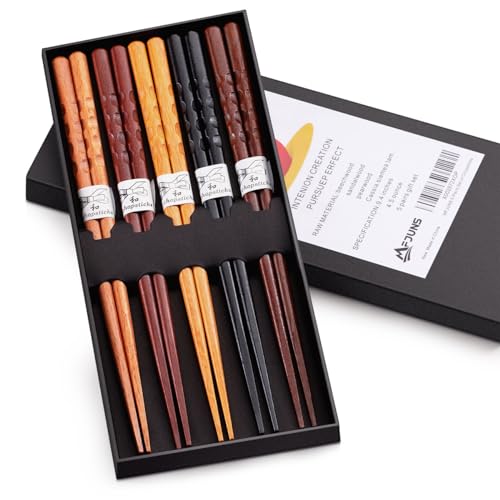
MFJUNS Japanese Minimalist Wooden Chopsticks 5 Pairs 8.8 Inches — Best Minimalist Design
The MFJUNS set strips the wooden chopstick to its essentials: a minimalist Japanese profile in natural wood, five pairs at 8.8 inches, with a non-slip character stated in its title and a brief aimed at sushi, noodles, and rice. Minimalism here is functional — an unadorned stick has no grooves to trap food, no decoration to wear, and a silhouette that sits calmly on any table from a weeknight counter to a set dinner.
Natural wood’s inherent surface does most of the non-slip work, which is the quiet truth of this whole category: wood rarely needs grip engineering because the material itself holds food. This set is the choice for buyers who like that honesty and want it in its plainest form. Care is the standard wood contract — prompt washing, upright drying — and in exchange the set should look appropriate for a decade of tables.
Strengths
- Clean minimalist profile in natural wood
- Non-slip character from the material itself
- Sized and styled for sushi, noodles, and rice
Trade-offs
- Plain design offers no decorative flourish
- Wood care contract applies in full
- 8.8-inch length is short for cooking or hotpot
| Specification | Detail |
|---|---|
| Material | Natural wood |
| Pairs | 5 pairs |
| Length | 8.8 inches |
| Style | Japanese minimalist, non-slip |
Best for: minimalists and Japanese-food households / Not suited for: buyers who want ornate or statement tableware
Check the current price on Amazon.

Japanese Hand-Carved Chopsticks Blood Wood 1 Pair 9.25 Inches Made in Japan — Best Hand-Carved Single Pair
Some chopsticks are equipment; this pair is a possession. Hand-carved in Japan from blood wood — a dense, naturally deep-red hardwood — at 9.25 inches, it is sold as a single pair for a single user who will know it by feel. Dense hardwoods take a fine tip and a smooth, substantial hand-feel that lighter woods cannot imitate, and a carved pair carries the maker’s small decisions in every facet.
The ownership terms are those of any fine wooden object: hand-wash it, dry it, keep it from the dishwasher and the soaking sink, and it will outlast sets bought by the dozen. This is not the pair for children, guests, or the office. It is the pair for the person who eats with chopsticks daily and wants the tool to be worthy of the habit — or the gift for exactly that person.
Strengths
- Hand-carved blood wood, made in Japan
- Dense hardwood takes a fine, precise tip
- A personal pair built to be kept for years
Trade-offs
- Single pair at a connoisseur tier
- Hand care only — no dishwasher shortcuts
- Too precious for guests or children
| Specification | Detail |
|---|---|
| Material | Blood wood, hand-carved |
| Pairs | 1 pair |
| Length | 9.25 inches / 23.5 cm |
| Origin | Made in Japan |
Best for: committed daily users and meaningful gifts / Not suited for: household bulk buying or dishwasher households
Check the current price on Amazon.

Japanese Hand-Carved Chopsticks Macassar Ebony 1 Pair 9.25 Inches Made in Japan — Best Premium Hardwood Pair
Macassar ebony is the dramatic hardwood of the chopstick world: very dense, strikingly figured with dark and golden-brown streaks, and heavy in the hand in a way that reads as quality the moment you lift it. This hand-carved Japanese pair states its case in its title — premium, durable, reusable, 9.25 inches — and delivers the same single-pair, personal-set proposition as the blood wood pick, in a darker and denser register.
Choose between the two carved pairs by temperament: blood wood for warmth and colour, ebony for weight and drama. Both demand hand care and reward it with decades of service, because dense hardwoods resist the dents and moisture that age lighter woods. For a milestone gift — a graduation, a wedding, a retirement — a pair like this says more than a boxed set of ten ever will.
Strengths
- Macassar ebony — dense, figured, premium hardwood
- Hand-carved in Japan at a versatile 9.25 inches
- Density promises exceptional durability
Trade-offs
- Premium single-pair tier
- Heavier feel divides users raised on light woods
- Hand care only, as with all fine hardwood
| Specification | Detail |
|---|---|
| Material | Macassar ebony, hand-carved |
| Pairs | 1 pair |
| Length | 9.25 inches / 23.5 cm |
| Origin | Made in Japan; premium durable per title |
Best for: connoisseurs and milestone gifts / Not suited for: buyers who prefer the lightest possible stick
Check the current price on Amazon.

Jucoan 100 Pairs Bamboo Chopsticks Reusable 9.5 Inches — Best Bulk Bamboo
Every wood guide needs its workhorse, and bamboo is it. The Jucoan set puts one hundred pairs of natural, unpainted, non-slip bamboo at the standard 9.5-inch length into one bulk purchase aimed at homes, restaurants, and parties. Unpainted matters: there is no lacquer to chip into food and no finish to maintain, just bamboo’s natural light grip and warmth, in a quantity that makes loss and breakage non-events.
Bamboo sits inside the wood family honestly — a grass, technically, but the material diners mean when they picture classic chopsticks. It is the least precious pick here by design: use them for sushi nights with twenty guests, for cooking classes, for the drawer at a holiday house. Wash and dry them like any natural set and retire individual pairs as they age; at this quantity, that lifecycle is the plan, not a flaw.
Strengths
- One hundred pairs — crowds and losses covered
- Natural unpainted bamboo, nothing to chip or peel
- Non-slip surface and standard 9.5-inch length
Trade-offs
- Bamboo ages faster than hardwood or synthetics
- Bulk uniformity over individual character
- Storage space for a hundred pairs is real
| Specification | Detail |
|---|---|
| Material | Natural bamboo, unpainted |
| Pairs | 100 pairs |
| Length | 9.5 inches |
| Grip | Non-slip |
Best for: parties, restaurants, big households, and events / Not suited for: buyers seeking one treasured personal pair
Check the current price on Amazon.
Comparison Table
| Pick | Badge | Key spec | Best for |
|---|---|---|---|
| GLAMFIELDS Japanese Natural Wooden Chopsticks 5 Pairs 8.8 Inches | Best Overall Wood Set | Natural wood, 5 pairs, 8.8 in, hand-carved | households making wood their everyday material |
| Antner Handmade Japanese Wooden Chopsticks 5 Pairs Gift Set | Best Handmade Gift Set | Handmade natural wood, 5 pairs, boxed | gifts and households that value craft presentation |
| MFJUNS Japanese Minimalist Wooden Chopsticks 5 Pairs 8.8 Inches | Best Minimalist Design | Natural wood, minimalist, 5 pairs, 8.8 in | minimalists and Japanese-food households |
| Japanese Hand-Carved Chopsticks Blood Wood 1 Pair 9.25 Inches Made in Japan | Best Hand-Carved Single Pair | Blood wood, hand-carved, 1 pair, 9.25 in | committed daily users and meaningful gifts |
| Japanese Hand-Carved Chopsticks Macassar Ebony 1 Pair 9.25 Inches Made in Japan | Best Premium Hardwood Pair | Macassar ebony, hand-carved, 1 pair, 9.25 in | connoisseurs and milestone gifts |
| Jucoan 100 Pairs Bamboo Chopsticks Reusable 9.5 Inches | Best Bulk Bamboo | Bamboo, 100 pairs, 9.5 in, unpainted | parties, restaurants, big households, and events |
How to Choose the Best Chopsticks Wood Offers
Start with the role, because wood spans a wider range of objects than any other material. Daily household sets should be five-pair Japanese-style natural wood like the GLAMFIELDS or MFJUNS picks — light, replaceable, and pleasant enough to use three times a day. A personal pair is a different purchase entirely: dense hand-carved hardwood, bought singly, kept for years. Bulk bamboo serves crowds. Confusing these roles — serving guests from your treasured carved pair, or expecting bulk bamboo to feel special — is how wood buyers end up dissatisfied with good products.
Length in wood follows the Japanese pattern more than the Chinese: most sets here sit at 8.8 to 9.25 inches, suiting individual bowls and precise eating. If your household centres on shared platters and hotpot, note that honestly and choose the 9.5-inch bamboo or add a longer cooking set separately, rather than forcing a short table set to reach across a steaming pot.
Finish is the last decision. Unpainted and lacquer-free woods show their material honestly and never chip a coating into food, but they drink a little more water at washing time and grey gracefully with age. Lacquered finishes protect and decorate, and ask to be kept from harsh dishwasher cycles. Neither is superior; they are different ageing paths, and the verified titles here tell you which path each pick takes wherever the finish is stated.
Wood Care Without Folklore
Wood chopsticks die from water and heat, not from food. The rules are short: wash promptly after eating, do not soak, dry standing upright so the tips drain, and store dry. Dishwashers combine all three enemies — prolonged hot water, detergent, and forced drying — which is why fine and lacquered wood should stay out of them even when a listing tolerates occasional cycles. Bamboo tolerates more, and still lasts longer with the same gentle routine.
Skip the folk remedies. Wood does not need oiling schedules borrowed from chopping boards, and it should never be bleached or boiled. A set that splinters, cracks, or stays rough after drying is finished — retire it. Judged by years of pleasant use per set, honest wood care costs about a minute a day, and the carved hardwoods in this guide can outlive the table they are eaten at.
Bamboo vs Hardwood: The Family Argument
Bamboo is the sprinter: lightest, cheapest, naturally grippy, and produced in quantities that make it effectively semi-disposable at the bulk end — a virtue for parties and restaurants. Its fibres age visibly, and a bamboo pair’s life is measured in months to a few years of daily use. Hardwoods are the marathoners: denser, finer-tipped, more beautiful, and — in carved ebony or blood wood — capable of decades, at a price per pair that bamboo buyers find startling.
Most wood households end up owning both, and this guide is built for that outcome: bamboo for the crowd and the wok-side drawer, a five-pair wooden set for the family, and perhaps one carved pair for the person who cares most. That layered drawer is the traditional answer, and it is traditional because it works.
Why Wood Still Wins the Table
After a century of alternatives, wood keeps its place for reasons that are easy to feel and hard to specify away: it is warm at the first touch, silent against porcelain, light enough to forget, and textured enough by nature to hold food without engineering. Synthetics beat it on durability and dishwasher indifference, and this site’s other guides say so plainly. But for the meal itself — the thirty minutes the chopsticks are actually in your hand — wood remains the material the others are measured against.
If you are converting a household from disposables, wood is also the gentlest bridge: it feels like the bamboo pairs from a restaurant, only better made and yours. Start with a five-pair set from this guide, learn the one-minute care routine, and add the carved pair later if the habit takes. That sequence has converted more households than any argument.
Identifying Woods and What the Names Mean
Wood names on listings reward a moment’s literacy. Bamboo is a fast-growing grass — light, pale, and inexpensive — and the default for bulk and restaurant use. The everyday ‘natural wood’ of Japanese-style sets is typically a sound, light hardwood chosen for workability and price. The named exotics are a different class: blood wood is prized for its natural deep red colour, and Macassar ebony for its dramatic dark-and-gold figure and exceptional density. When a title names the wood, as the carved picks here do, it is making a claim about character and longevity that generic sets do not attempt.
Density is the practical thread through all of it. Denser woods take finer tips, resist denting, and shrug off moisture better at the surface — which is why the premium pairs are carved from the densest stock. Lighter woods and bamboo trade that permanence for price and an easy, friendly hand-feel. Neither end of the scale is a mistake; they are answers to different questions about how long a pair should live and what it should feel like while it does.
Wooden Chopsticks and the Foods They Suit Best
Wood’s natural friction makes it the connoisseur’s choice for the foods that defeat other materials: delicate fish that polished steel tears, glossy noodles that escape fiberglass on a bad day, and soft items that need hold without pressure. This is why sushi counters, where the food is at its most delicate and expensive, are wood and bamboo territory almost without exception. The material’s slight give at the tip reads as gentleness to the food and as feedback to the hand.
Where wood steps back is at the extremes of heat and neglect: long cooking in a wok belongs to dedicated long cooking chopsticks, and a household that cannot keep a pair out of the soaking sink will be happier with the synthetics covered elsewhere on this site. Played to its strengths — the table, the bowl, the carefully made meal — wood is not the nostalgic choice. It is the expert one.
Wooden Chopsticks as Gifts and Heirlooms
Wood is the only chopstick material that supports genuine heirloom thinking, and the carved hardwood pairs in this guide are where that thinking belongs. A blood wood or ebony pair, hand-carved and kept by one person, acquires the small polish of use that manufactured objects never earn; it becomes recognisably someone’s. As gifts, such pairs mark occasions properly — they are small enough to give without burden and significant enough to keep for decades.
Present them with their care contract stated kindly — hand-wash, dry well, keep them yours — because the ritual is part of the gift’s meaning. The boxed handmade set in this guide makes the same gesture at household scale: five pairs, presented properly, for a couple setting up a home. In a category full of disposable thinking, wood is where generosity lives.
Regional Styles in Wood: Japan, China, Korea
The wooden chopstick map follows the food. Japanese wooden sets run shortest — the 8.8-inch picks here — because meals arrive in individual portions and fish rewards precision. Chinese wooden and bamboo sets run longer, for shared dishes and hot pots, which is why the bulk bamboo pick sits at 9.5 inches. Korean tables famously favour metal, but wooden Korean-style sets exist in the same mid lengths for home use. Knowing the map lets you shop by your menu instead of by marketing: cook and eat mostly Japanese food, and the short wooden set is not a compromise — it is the correct tool.
Mixed households can hold the map loosely: a mid-length wooden set serves nearly everything adequately, and specialisation can come later, one pair at a time, as the drawer philosophy in this guide suggests. Wood rewards that gradualism because each addition is inexpensive, beautiful, and immediately at home among the others.
Sustainability, Honestly
Wood and bamboo are renewable materials, and bamboo in particular grows at a pace no forest can match — a genuine point in the bulk pick’s favour. The honest complications are finishes, transport, and lifespan: a lacquered set shipped far and retired early may carry a heavier footprint than a fiberglass set used for a decade. The most sustainable chopstick is therefore the one that stays in service longest, which loops the argument back to care: a wooden set washed and dried properly for ten years beats three disposable-minded replacements of any material.
Buy wood from listings that name their material plainly — as every pick here does — and keep it in service with the one-minute routine from the how-to section. That combination, honest sourcing plus honest care, is the whole sustainability story of this category, without garnish.
Setting a Table With Wooden Chopsticks
Wood flatters a set table in ways worth doing deliberately. Rest each pair on a simple rest parallel to the bowl, tips pointing left for right-handed diners in the Japanese manner, and let the wood’s colour do the decorating — blood wood against pale porcelain and ebony against light linens are compositions that need no help. Mixed fleets look best when one variable is held constant: same length, varied woods reads as a collection; varied everything reads as a drawer emptied in a hurry.
For guests new to chopsticks, set the forgiving equipment without commentary — a shorter wooden pair and a fork in reserve, offered as abundance rather than as a judgement. The table that makes everyone comfortable is the entire point of owning beautiful tools, and wood’s warmth is the most welcoming surface you can put in a nervous hand.
Wooden Chopsticks in the Kitchen
At the stove, wood’s virtues invert slightly: it is the kindest material to cookware, silent in the pan and safe on nonstick, but table lengths are too short for wok work and fine carved pairs should never go near frying oil. The kitchen’s wooden citizens should be dedicated long cooking chopsticks and, for serving and mixing, sturdy bamboo — the bulk pick in this guide moonlights here honestly, since a pair lost to the wok’s neighbourhood is a small loss at that quantity.
Keep the boundary bright: table wood eats, kitchen wood cooks, and the two sets age at their own rates in their own places. Households that respect the boundary find both sets lasting longer, because neither is asked to survive the other’s hazards.
Spotting Quality in a Wooden Listing
Three signals separate serious wooden sets from decorative ones. The title names the material specifically — a species, or bamboo, or at minimum natural wood with a style — rather than hiding behind ‘eco’ adjectives. The format is stated in pairs and, ideally, in a length you can match to your table, as most picks here do. And the maker’s claims stay inside what wood can promise: hand-carved character, gift presentation, non-slip behaviour from the material itself — not miraculous durability or dishwasher immortality.
Apply the same scepticism you would to any craft claim. ‘Handmade’ should come with a format and finish story that coheres, as the Antner set’s boxed presentation does. When a listing’s romance outruns its facts, believe the facts you can verify and let the unverifiable romance go — the verified titles in this guide were chosen to make that discipline easy.
The First Month With Wood: What to Expect
New wooden chopsticks feel slightly dry and grippy in the first weeks — this is the material at its most helpful, and learners should enjoy it. With washing and use, a set mellows: the surface smooths a fraction, the colour deepens or evens, and the pair begins to feel like yours. None of this is decline; it is the patina that distinguishes a kept tool from a stored one, and it is why the same set at month six often feels better than it did on day one.
What should not happen is roughness that catches at lips, tips that fray, or any crack that traps food — those are retirement signals at any age, covered in the care section. Expect, instead, a quiet improvement curve, and let it teach the household the central pleasure of the material: wood is the only chopstick that gets better company with time.
Wood, in One Paragraph of Advice
If this entire guide had to fit in a paragraph, it would read: buy a five-pair natural wood set in the Japanese style for daily life, learn the one-minute wash-and-dry routine, add bamboo in bulk when crowds come, and — if the habit deepens into pleasure — choose one hand-carved hardwood pair, in blood wood or ebony, that is yours alone. Verify the material and the format in the listing title before every purchase, distrust any claim wood cannot keep, and retire pairs kindly when they splinter or crack.
That paragraph contains no secret and no shortcut, because wood does not reward either. It rewards selection, care, and time — three things entirely within a buyer’s control. The six sets verified here give you a starting point at every level of that commitment, from a hundred bamboo pairs to a single carved one. Begin where your life actually is, and let the drawer grow the way the habit does.
Matching Wood to the Meal: A Short Menu Map
Let the menu arbitrate the drawer. Sushi and sashimi nights belong to the short Japanese wooden sets, whose precision flatters raw fish and whose material never chills or flavours it. Noodle soups forgive everything but reward the non-slip natural surface when broth makes the world slippery. Hotpot asks for length above all — the 9.5-inch bamboo at minimum, and dedicated long cooking pairs for the cook. Dumpling nights, the great leveller, suit any sound wooden pair, which is why they are the traditional first meal for a new set.
None of this requires owning the whole map. It requires noticing which meals your household actually repeats — most homes have three — and letting the drawer specialise shamelessly in those. The sets in this guide were chosen so that the commonest three-meal households can cover their map with two purchases at most.
Heirloom or Consumable: Deciding What Wood Means to You
Wood is the only material in the chopstick world that asks you to declare a philosophy. Treat it as a consumable — bulk bamboo, replaced without grief — and it is the cheapest, warmest, most forgiving material in the kitchen. Treat it as an heirloom — one carved hardwood pair, hand-washed for decades — and it becomes the most personal object on the table. Both philosophies are respectable; the failure mode is drifting between them, buying heirloom prices and giving consumable care, or expecting consumable bamboo to carry ceremonial weight.
Declare yours before you shop, and the rest of this guide reads itself: the bulk pick for the consumable household, the five-pair sets for the sensible middle, the carved pairs for the declared heirloom keepers. Wood rewards the decided. It always has — that is rather the point of a material older than every alternative in the drawer.
One Last Test Before You Order
Close the guide with the wood buyer’s three questions. What role is this set playing — fleet, family, crowd, or keepsake — and does its format, from a hundred bamboo pairs to one carved hardwood pair, match that role without stretching? What does its verified title actually claim about material and finish, and have you believed only that, letting unverifiable romance go? And will your household keep the one-minute care contract — wash promptly, dry standing, store dry — that decides whether any wooden set thrives?
A set that passes all three is a purchase you will not revisit, which in this material means something special: it will sit at your table for years, mellowing in the hand, present at hundreds of meals. Wood asks a little more of its buyer than any synthetic — a decision, a routine, a declaration — and repays it in the oldest currency there is: an object that becomes yours.
Why Wood Titles Were Read So Literally
Wood inspires the most lyrical listing copy in the category — forests, traditions, and craftsmanship crowd every paragraph — and lyricism is precisely why this guide read its titles like contracts. A species named is a claim that can be checked; a length stated is a fit that can be planned; a finish described is a care routine that can be followed. Where the romance outran the record, as with one handmade set whose title states no length, the review said so in plain words and told you to confirm the dimension yourself rather than borrowing certainty the listing never offered.
That literalism is not a lack of feeling for the material — this guide’s affection for wood is on every page. It is the respect of taking wood seriously as a specification, the way a carpenter would, instead of as a mood. Buy wood the way woodworkers buy lumber: by species, dimension, and finish, with the poetry as a welcome extra rather than the substance of the deal.
How to Care for Wooden Chopsticks So They Last for Years
Wood care is a routine, not a project. Build these steps into the washing-up you already do and a good set will repay you for years.
- Rinse or wash wooden chopsticks soon after the meal; dried sauce and long soaking are the two ageing accelerants.
- Wash with warm water, mild detergent, and a soft sponge — never steel wool or abrasive pads on wood or lacquer.
- Dry immediately with a cloth, then stand the pairs tips-up in a ventilated holder until fully dry.
- Store dry pairs in a drawer divider or their box, tips protected from knocking against metal cutlery.
- Keep fine and lacquered wood out of the dishwasher entirely; give even sturdy bamboo a rest from harsh cycles when you can.
- Inspect monthly: retire any pair that splinters, cracks, warps, or stays rough after drying.
- Never boil, bleach, or microwave wooden chopsticks to sanitise them — hot soapy water and thorough drying is the correct method.
Followed consistently, this routine is the difference between a wooden set that ages into a mellow, personal tool and one that greys, splits, and disappoints within a year. The routine is also the honest price of the material — if it sounds like too much, the fiberglass guides on this site exist for you, and there is no shame in that drawer either.
Common Buying Mistakes
Soaking wooden chopsticks in the sink. Prolonged water is wood’s main enemy. Wash promptly and dry, every time.
Running carved or lacquered wood through the dishwasher. Heat, detergent, and forced drying crack finishes and split fine wood. Hand-wash the good pairs.
Storing pairs wet in a closed drawer. Trapped moisture warps and dulls wood. Dry fully before storing.
Using one short table set for hotpot and frying. Short wooden pairs near steam and oil are uncomfortable and age fast. Keep lengths matched to jobs.
Keeping splintered pairs in service. A splintering pair is finished. Retire it — bulk bamboo exists precisely so this decision is cheap.
Expecting bulk bamboo to feel like carved hardwood. They are different objects at different tiers. Buy each for its own job.
Final Recommendation
Most households should start with the GLAMFIELDS natural wood set — five hand-carved pairs at the friendly 8.8-inch length. Add the Jucoan bamboo bulk set when crowds enter the picture, and treat yourself or someone else to the blood wood carved pair or the Macassar ebony pair when the habit deserves it.
Continue through the cluster: Best Chopsticks To Use, Best Chopsticks With Case, Best Chopsticks With Grip, Best Bamboo Chopsticks, and Best Japanese Chopsticks. Every guide verifies its material claims from listing titles, just as this one does.
Frequently Asked Questions
Are wooden chopsticks hygienic?
Yes, with ordinary care. Wash them promptly in hot soapy water, dry them thoroughly standing up, and retire pairs that crack or splinter, since damage harbours residue. Cared for this way, wood is a sound everyday material — it has carried this job for centuries.
Can wooden chopsticks go in the dishwasher?
Fine, carved, and lacquered wood should not — heat and detergent crack finishes and split the wood. Sturdy bamboo tolerates more, and any set whose listing explicitly claims dishwasher safety can follow that claim, but hand-washing always extends a natural set’s life.
What is the best wood for chopsticks?
For daily sets, any sound natural wood in the Japanese style serves well. For a personal pair, dense hardwoods — blood wood and Macassar ebony in this guide — take finer tips, resist ageing, and feel substantial. Bamboo, the family’s lightweight, wins on value and quantity.
How long do wooden chopsticks last?
Bulk bamboo may serve months to a few years of daily use; good wooden household sets last years with proper drying; dense hand-carved hardwood pairs can last decades. Lifespan is decided mostly by washing habits, not by the wood itself.
Why are Japanese wooden chopsticks shorter?
Japanese meals centre on individual bowls and fish, where a shorter stick gives precision close to the hand. The 8.8 to 9.25-inch sets in this guide follow that pattern; choose the 9.5-inch bamboo or a dedicated longer set for shared dishes and hotpot.
Should I oil wooden chopsticks?
No routine oiling is needed for chopsticks, unlike chopping boards. Keep them clean, dry, and out of soaking water. If a very old, dry pair looks thirsty, the honest answer is usually that it has reached retirement, not that it needs treatment.


