Disclosure: airfryerkitchensupply.com is reader-supported. When you buy through links on our site, we may earn an affiliate commission at no extra cost to you.
Where to buy
Choosing the best chopsticks to use starts with an honest listing — so every pick below is sold on Amazon with the pair count, material, and length stated in their verified listing titles, so open the listing, confirm the length suits your hand and your dishes, and check price on Amazon. Chopsticks are light and cheap to ship, which makes Amazon the natural place to compare the full material range side by side.
- HIWARE 10 Pairs Fiberglass Chopsticks Black 9.5 Inches — check price on Amazon
- GLAMFIELDS 10 Pairs Fiberglass Chopsticks 9.5 Inches — check price on Amazon
- Antner 5 Pairs Natural Bamboo Chopsticks 8.8 Inches — check price on Amazon
- MUYOS Stainless Steel Chopsticks 5 Pairs Silver — check price on Amazon
- Ceramic Chopsticks Blue Peony Bone China 5 Pairs 9.7 Inches — check price on Amazon
- Hiware 10 Pairs Fiberglass Chopsticks Gold 9.5 Inches — check price on Amazon
Ask ten regular chopstick users what the best chopsticks to use are and you will get ten answers, because the honest answer depends on what you eat, what you cook, and how much maintenance you will tolerate. Fiberglass shrugs off the dishwasher forever. Bamboo is light and kind to beginners. Stainless steel is indestructible but slippery until your technique settles. Ceramic is beautiful and fragile in equal measure. This guide refuses to crown one material for everyone; instead it matches six verified sets to the six ways people actually use chopsticks at home.
Every specification below comes from the verified listing title of that set — material, pair count, length, and dishwasher claims — and nothing else is asserted about a product. Where a material has a real weakness, the review says so in the trade-offs, because a set that warps in your dishwasher or chips in your sink is not a bargain at any tier. Lengths cluster around nine to nine and a half inches, the versatile middle ground for table eating, and the guide explains below when you would deliberately go shorter or longer.
The six picks cover a family stock-up set, a dishwasher-proof everyday set, a bamboo set for learners, a stainless set for maximum lifespan, a porcelain set for the table you set carefully, and a second fiberglass option for households that want a spare set in a different finish. If you read only one section after the picks, read the material comparison in the buying guide — material choice decides ninety percent of your experience, and brand decides the rest.
In this guide
Quick Picks
Six verified sets across five materials, so the right answer depends on your food and your habits. Badges match the detailed reviews.
- Best Overall: HIWARE 10 Pairs Fiberglass Chopsticks Black 9.5 Inches — ten dishwasher-safe fiberglass pairs at the versatile 9.5-inch length — the set most households should simply buy first.
- Best for Dishwasher-Everything Homes: GLAMFIELDS 10 Pairs Fiberglass Chopsticks 9.5 Inches — another ten-pair fiberglass stock-up set, with a non-slip design brief — the alternative finish and feel to the HIWARE pick.
- Best for Beginners: Antner 5 Pairs Natural Bamboo Chopsticks 8.8 Inches — light natural bamboo at a shorter 8.8-inch Japanese-style length — the forgiving set to learn on, and its title confirms dishwasher safety.
- Best for Maximum Lifespan: MUYOS Stainless Steel Chopsticks 5 Pairs Silver — hollow-core stainless with non-slip tips — the buy-it-for-a-decade set that answers metal’s usual weight and grip objections.
- Best for the Table: Ceramic Chopsticks Blue Peony Bone China 5 Pairs 9.7 Inches — bone-china porcelain with a blue peony design at 9.7 inches — the set for meals where the table itself matters.
- Best Dressed Everyday Set: Hiware 10 Pairs Fiberglass Chopsticks Gold 9.5 Inches — the same dishwasher-proof fiberglass practicality as the top pick, in a gold finish that looks deliberate on the table.
How These Picks Were Chosen
Picks were chosen material-first. The shortlist had to cover the materials home users actually ask about — fiberglass, bamboo, stainless steel, porcelain, and wood-adjacent bamboo variants — with at least one set per material verified on this site, its title confirming material, pair count, and length. Sets whose titles could not confirm those basics were not used.
Dishwasher behaviour was the second filter, because it is where home users most often ruin a set. Fiberglass, stainless, and the bamboo set whose title explicitly claims dishwasher safety are presented as low-maintenance options; natural wood and porcelain picks are framed honestly as hand-care or gentle-cycle choices, and their reviews say exactly that.
Finally, each pick had to suit a recognisable job: feeding a family nightly, learning as a beginner, surviving a decade of daily use, dressing a dinner table, or stocking a drawer cheaply in quantity. A set that did no job better than another set was cut, however attractive its listing looked.
The 6 Best Chopsticks to Use
Lengths, materials, and pair counts below are taken from each set’s verified listing title. Check the current price on Amazon, and note the care guidance in each trade-off list before you buy.

HIWARE 10 Pairs Fiberglass Chopsticks Black 9.5 Inches — Best Overall
Fiberglass is the material the restaurant trade settled on for a reason: it does not warp, crack, absorb odours, or care about the dishwasher, and it keeps a matte, slightly textured surface that grips food better than polished metal or lacquered wood. The HIWARE set puts ten pairs in the drawer at the standard 9.5-inch table length, which means a family of four eats, a spare set covers guests, and a pair can live in the lunch bag without anxiety.
This is the recommendation for anyone who does not want chopsticks to become a hobby. They go in the dishwasher with the cutlery, come out unchanged, and will outlast several sets of bamboo bought over the same years. The aesthetic is plain black and functional — if your table asks for beauty, the porcelain pick below exists — but for nightly noodles, rice bowls, and dumplings, nothing in this guide is easier to own.
Strengths
- Dishwasher safe with no warping or cracking
- Ten pairs cover family plus guests
- Matte fiberglass grips food securely
Trade-offs
- Plain black look is purely functional
- Fiberglass lacks the warm feel of wood
- Too utilitarian for a formal table setting
| Specification | Detail |
|---|---|
| Material | Fiberglass |
| Pairs | 10 pairs |
| Length | 9.5 inches |
| Care | Dishwasher safe |
Best for: families and anyone who wants one durable everyday set / Not suited for: hosts who want chopsticks that dress a formal table
Check the current price on Amazon.

GLAMFIELDS 10 Pairs Fiberglass Chopsticks 9.5 Inches — Best for Dishwasher-Everything Homes
The GLAMFIELDS set makes the same fiberglass argument as the HIWARE pick with a non-slip emphasis in its verified title, and having two near-identical anchors in this guide is deliberate: fiberglass is the correct default material for most homes, and the choice between these two comes down to tip feel and finish preference at the listing. Both are 9.5 inches, both are ten pairs, both are dishwasher safe.
Where the GLAMFIELDS earns its own slot is for households equipping two locations — a home drawer and a camper, office kitchen, or second home — or for buyers who prefer this set’s styling. Buy whichever of the two fiberglass anchors you find in stock in the finish you like; do not agonise, because the ownership experience converges. Your energy is better spent on the length and material decisions in the buying guide.
Strengths
- Non-slip design brief for greasy foods
- Ten pairs at the standard table length
- Fully dishwasher safe fiberglass
Trade-offs
- Overlaps heavily with the HIWARE pick
- No natural-material feel
- Finish options are darker tones
| Specification | Detail |
|---|---|
| Material | Fiberglass |
| Pairs | 10 pairs |
| Length | 9.5 inches |
| Care | Dishwasher safe, non-slip |
Best for: stocking two locations or buyers who prefer this finish / Not suited for: buyers who want variety across materials in one purchase
Check the current price on Amazon.
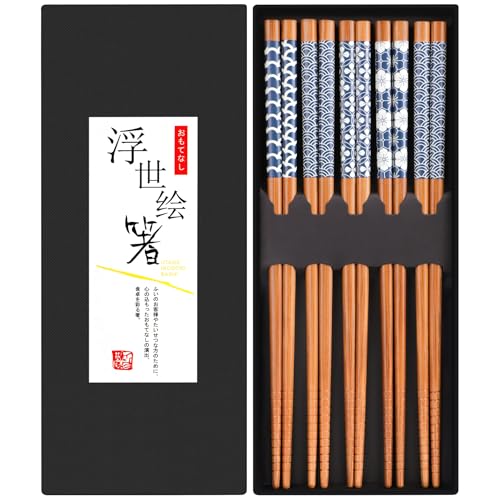
Antner 5 Pairs Natural Bamboo Chopsticks 8.8 Inches — Best for Beginners
Beginners fail with chopsticks for two reasons: the sticks are too heavy, or the tips are too slippery. Bamboo solves both. It is the lightest common material, and its natural surface holds a light texture that keeps a noodle or a piece of tofu from skating away while your fingers learn the fulcrum. At 8.8 inches in the Japanese style, this Antner set is also shorter than the Chinese table standard, which puts the tips closer to your hand and makes early control noticeably easier.
Unusually for bamboo, the verified title claims dishwasher safety, which removes the classic bamboo objection for learners who will not hand-wash a training tool. Bamboo still ages faster than fiberglass — expect gradual darkening and eventual replacement over years — but as the set you learn on and keep for guests, it is the friendliest starting point in this guide.
Strengths
- Lightweight bamboo is easy to control
- Shorter 8.8-inch length suits learners and smaller hands
- Title confirms dishwasher safety
Trade-offs
- Bamboo ages and darkens over time
- Shorter length is less ideal for shared hotpot dishes
- Five pairs is a smaller household supply
| Specification | Detail |
|---|---|
| Material | Natural bamboo |
| Pairs | 5 pairs |
| Length | 8.8 inches / 22.5 cm |
| Care | Dishwasher safe per title |
Best for: beginners, smaller hands, and Japanese-style meals / Not suited for: buyers who want a decade-long single purchase
Check the current price on Amazon.
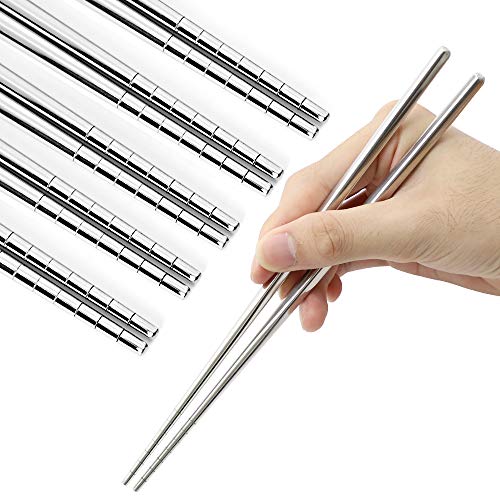
MUYOS Stainless Steel Chopsticks 5 Pairs Silver — Best for Maximum Lifespan
Stainless steel is the permanent material: it cannot warp, stain, splinter, or absorb anything, and it will survive treatment that destroys every other pick in this guide. Its two classic objections are weight and slipperiness, and the MUYOS design answers both in its verified title — a hollow-core build keeps the weight down, and non-slip tips address the grip problem where it actually happens, at the food.
New users should still expect a short adjustment period; metal tips on ceramic bowls are louder and less forgiving than bamboo while your touch calibrates. After that week, this is the set you stop thinking about entirely. It is also the hygienic choice for households that share chopsticks across many users, since steel tolerates any washing regime you give it.
Strengths
- Effectively unlimited lifespan
- Hollow core keeps metal weight manageable
- Non-slip tips and dishwasher safe
Trade-offs
- Metal feels slippery until technique settles
- Clinks against ceramic bowls
- Conducts heat from very hot food
| Specification | Detail |
|---|---|
| Material | Stainless steel, hollow core |
| Pairs | 5 pairs |
| Tips | Non-slip tips |
| Care | Dishwasher safe |
Best for: buyers who want one set for the long term / Not suited for: absolute beginners still learning basic grip
Check the current price on Amazon.

Ceramic Chopsticks Blue Peony Bone China 5 Pairs 9.7 Inches — Best for the Table
Porcelain chopsticks exist for the same reason porcelain plates do: some meals are occasions. This bone-china set, with its blue peony pattern and gift-set presentation, is the pick for dinner parties, holiday tables, and anyone whose everyday pleasure includes beautiful objects. At 9.7 inches it is also the longest table set in this guide, which suits larger hands and shared serving dishes.
The honesty paragraph: porcelain is fragile. A drop onto tile or a knock in a crowded sink can end a pair, and no dishwasher claim changes the risk of chips from neighbouring crockery. Treat this set the way you treat good wine glasses — worth it for the meals it elevates, wrong for a student kitchen. Its verified title does claim dishwasher safety and easy cleaning, and porcelain’s non-porous surface is genuinely the most hygienic here.
Strengths
- Bone-china porcelain with a classic blue peony design
- Non-porous surface cleans completely
- Longer 9.7-inch length suits serving and larger hands
Trade-offs
- Fragile — drops and knocks can chip or break pairs
- Not suited to children or careless sinks
- Gift-set presentation targets occasions, not bulk value
| Specification | Detail |
|---|---|
| Material | Bone china porcelain |
| Pairs | 5 pairs |
| Length | 9.7 inches |
| Care | Dishwasher safe per title; handle as porcelain |
Best for: dinner parties, gifts, and carefully set tables / Not suited for: busy family kitchens and young children
Check the current price on Amazon.

Hiware 10 Pairs Fiberglass Chopsticks Gold 9.5 Inches — Best Dressed Everyday Set
This Hiware variant exists for buyers who accepted the fiberglass argument — durability, dishwasher safety, ten pairs, 9.5 inches — but looked at the plain black set and wanted something that reads as chosen rather than issued. The gold finish lifts the set’s presence for everyday family dinners and casual guests without giving up a single practical property.
Everything else mirrors the Best Overall pick, which is the point: finish is the only variable you should be choosing between these two. Households often buy one of each, using the darker set for weeknights and the gold set when friends come over, and because both are fiberglass the care routine never changes. That consistency across a drawer of mixed sets is a small, real quality-of-life win.
Strengths
- Gold finish suits guests and occasions
- Identical fiberglass durability to the top pick
- Ten pairs, dishwasher safe
Trade-offs
- Finish is cosmetic — no functional gain
- Still a synthetic feel versus wood
- Decorative finish deserves gentler stacking
| Specification | Detail |
|---|---|
| Material | Fiberglass |
| Pairs | 10 pairs |
| Length | 9.5 inches |
| Finish | Gold; dishwasher safe |
Best for: buyers who want fiberglass practicality with a dressed-up look / Not suited for: purists who prefer natural materials at the table
Check the current price on Amazon.
Comparison Table
| Pick | Badge | Key spec | Best for |
|---|---|---|---|
| HIWARE 10 Pairs Fiberglass Chopsticks Black 9.5 Inches | Best Overall | Fiberglass, 10 pairs, 9.5 in, dishwasher safe | families and anyone who wants one durable everyday set |
| GLAMFIELDS 10 Pairs Fiberglass Chopsticks 9.5 Inches | Best for Dishwasher-Everything Homes | Fiberglass, 10 pairs, 9.5 in, non-slip | stocking two locations or buyers who prefer this finish |
| Antner 5 Pairs Natural Bamboo Chopsticks 8.8 Inches | Best for Beginners | Bamboo, 5 pairs, 8.8 in, dishwasher safe | beginners, smaller hands, and Japanese-style meals |
| MUYOS Stainless Steel Chopsticks 5 Pairs Silver | Best for Maximum Lifespan | Stainless steel, 5 pairs, hollow core, non-slip tips | buyers who want one set for the long term |
| Ceramic Chopsticks Blue Peony Bone China 5 Pairs 9.7 Inches | Best for the Table | Bone china, 5 pairs, 9.7 in, blue peony | dinner parties, gifts, and carefully set tables |
| Hiware 10 Pairs Fiberglass Chopsticks Gold 9.5 Inches | Best Dressed Everyday Set | Fiberglass, 10 pairs, 9.5 in, gold finish | buyers who want fiberglass practicality with a dressed-up look |
How to Choose the Best Chopsticks to Use
Decide material before anything else, using your real habits rather than your aspirations. If everything you own goes in the dishwasher, buy fiberglass or stainless steel and stop deliberating — the picks above prove both are excellent. If you eat mostly Japanese food at home and value a light, precise feel, bamboo and wood reward you. If you host, add one beautiful set — porcelain or a fine wood gift set — and keep it for the meals that deserve it, rather than forcing one set to do every job.
Length is the second decision. Japanese-style sets run shorter, around 8.8 to 9 inches, and suit smaller hands, beginners, and fish-focused meals where precision beats reach. The 9.5-inch middle ground used by most picks here suits the widest range of home eating. Longer sticks — ten inches and beyond at the table, and much longer in the kitchen — belong to shared dishes, hotpot, and cooking, where distance from steam and oil matters more than fingertip precision.
Finally, count pairs like a host. A household of two that never entertains can live with five pairs. Families should think in tens, because chopsticks migrate — into lunch bags, desk drawers, and the dishwasher at the moment guests arrive. The ten-pair fiberglass sets in this guide exist because running out of clean pairs is the most common real-world chopstick failure, and it has nothing to do with quality.
Fiberglass vs Bamboo vs Steel vs Porcelain: The Honest Comparison
Fiberglass wins on ownership: no warping, no cracking, full dishwasher tolerance, and a matte grip that flatters beginners and experts alike. It loses on feel and aesthetics — it is unmistakably a manufactured object. Bamboo wins on feel-per-effort: lightest, kindest to learners, naturally grippy. It loses on lifespan, ageing visibly over years of washing. Neither is better; they optimise different lives.
Stainless steel wins on permanence and hygiene, and modern hollow-core designs with textured tips have narrowed its old grip problem to a one-week learning curve. It loses on table manners — it is the loudest material against ceramic and the least forgiving while you learn. Porcelain wins on beauty and cleanliness and loses on physics: it is the only material here that a single drop can retire. Choose the loss you can live with; that is the whole method.
Grip, Tips, and Why Food Keeps Escaping
Slipping food is a tip problem before it is a skill problem. Matte, textured, or squared tips hold noodles, dumplings, and pieces of fish far more securely than polished round tips, which is why the fiberglass and steel picks in this guide emphasise non-slip tip designs in their titles. If you are learning, pair textured tips with bamboo or fiberglass and your progress will feel twice as fast.
Hand position matters next: the lower stick rests still on the ring finger and the base of the thumb, and only the upper stick moves, driven by the index and middle fingers. If both sticks move, everything wobbles. Practice with large, forgiving foods — roasted vegetables, thick noodles, pieces of omelette — before attempting peas, and never practise hungry on a meal you care about.
One Set or a Drawer System?
Most satisfied households end up with a small system rather than a single perfect set: a durable everyday fleet in fiberglass or steel, one natural set for the feel of it, and optionally one beautiful set for occasions. This guide is structured to build exactly that drawer — the HIWARE or GLAMFIELDS as the fleet, the Antner bamboo as the natural set, and the bone-china porcelain as the occasion set — without buying anything twice or pretending one material does everything.
Resist the giant mixed bundle as your only purchase. Mixed bundles hide weak pairs among strong ones and usually mix lengths that make the drawer feel inconsistent. Build the drawer from sets whose titles verify the material and length you actually want, as each pick here does.
Chopstick Etiquette That Actually Matters at Home
A few habits make shared meals smoother and cost nothing. Do not pass food directly from your chopsticks to someone else’s; set it on their plate or a serving dish instead. Do not spear food with a single stick when a grip would do, and rest your pair across the bowl or on a rest rather than planted upright in rice. None of this is ceremony for its own sake — it is the practical politeness of people who eat this way daily, and guests who know these basics are welcome at any table.
Serving chopsticks deserve a mention in family-style meals: a dedicated pair for shared dishes keeps the meal comfortable for everyone, and it is one more reason the ten-pair sets in this guide make sense. Keep the serving pair visually distinct — the gold Hiware set among black pairs, for instance — so the system runs itself without anyone having to ask.
Stocking the Drawer: A Simple Two-Year Plan
Buy the fleet first — one ten-pair fiberglass set — and live with it for a month. Note what your household actually reaches for and what it avoids. Then add exactly one set for the gap you felt: bamboo for the learner, steel for permanence, porcelain for occasions. This staged approach beats buying a grand mixed collection on day one, because it spends the second purchase on evidence rather than guesses.
Retire and replace on inspection, not on schedule. Once or twice a year, empty the drawer, and remove any pair that is cracked, warped, splintered, or chipped. The drawer that results — small, matched to your habits, and all in good condition — is what experienced households actually own, whatever the catalogues suggest.
Chopsticks for Cooking vs Eating: Do Not Conflate Them
This guide’s picks are table chopsticks, and the kitchen deserves its own sentence. Cooking chopsticks are longer — often dramatically so — because distance from oil, steam, and wok heat is their entire purpose, and several materials that shine at the table, like porcelain, have no business near a fryer. If you cook East Asian food weekly, add one long wooden or bamboo cooking pair to the drawer rather than abusing a table set; the table set will last longer and your forearms will thank you at the wok.
The boundary also runs the other way: a long cooking pair at the table feels like eating with oars. Households that own both lengths stop having both problems, which is why experienced drawers look layered — table sets in the lengths this guide covers, one or two long cooking pairs, and nothing asked to do a job it was not sized for.
What Restaurants Know That Home Buyers Can Steal
Restaurants choose fiberglass and bamboo in bulk for reasons that translate directly home: fiberglass because it survives industrial dishwashers indefinitely, bamboo because it is light, grippy, and cheap enough to replace without a meeting. The home versions of those insights are the HIWARE fleet and the bamboo learner set in this guide. What restaurants do not do is buy precious materials for daily service — and homes that host weekly might copy that restraint too, keeping the porcelain for the meals where it will be appreciated rather than endangered.
The other restaurant habit worth stealing is standardisation: one model, many pairs, no favourites. A drawer of identical fiberglass pairs ends the small daily friction of mismatched lengths and orphaned singles. Save individuality for the one special set; let the fleet be a fleet.
A Word on Children’s Chopsticks
Children learn fastest on equipment sized and helped for them: shorter sticks, textured tips, and — for the youngest — trainer designs with finger guides, several of which this site covers in its dedicated children’s guides. The bamboo pick in this guide suits older children who are ready for real chopsticks, because its light weight and shorter Japanese length forgive developing technique. What does not work is handing a child the longest, slickest adult set in the drawer and calling the struggle character-building.
Expect the learning curve to be measured in weeks of family meals, not in a single lesson, and keep the atmosphere light: children who associate chopsticks with being fed well and praised often become adults who reach for them by preference. The equipment’s job is simply to never be the reason a meal was frustrating.
Chopsticks and Health: The Shared-Dish Question
Households that eat family-style eventually ask whether shared dishes and personal chopsticks are hygienic enough. The practical answer used across Asia is the serving-pair system described earlier in this guide: personal pairs for mouths, a dedicated pair for shared plates. It costs one extra pair per meal and settles the question completely. Materials play a supporting role — non-porous porcelain and steel tolerate any washing regime, while wood and bamboo ask for prompt washing and thorough drying, which this guide’s care sections cover.
For guests, the cleanest gesture is a fresh or freshly washed set that is visibly theirs for the meal — one more reason the ten-pair fiberglass fleets anchor this guide. Nobody has to wonder, and the host never has to improvise. Good systems make politeness automatic.
How Long Is Too Long? A Sizing Walkthrough
Hold a candidate pair in your normal grip and look at the overhang: a comfortable table set extends a short distance past the hand at the back and reaches the food without your hand hovering over the plate. If the back end digs into the web of your thumb or the tips land far beyond the food, the set is long for you; if you must grip near the very end to reach across a shared dish, it is short. The 8.8 to 9.7-inch span of this guide’s picks covers the great majority of adults precisely because manufacturers have converged on what hands are.
Children and smaller hands should start at the short end of that span or below it, in dedicated children’s sizes, rather than choking up on an adult set. The control gained from correct length is worth more than any grip texture, a point the companion grip guide makes in full. When in doubt between two sizes, choose the shorter — control beats reach at the table, because the bowl can always come closer.
From Disposable to Reusable: The Conversion Kit
Households converting from disposable chopsticks need exactly three things: a fleet set that survives their real washing habits, one pair per person that feels personal enough to keep track of, and a small ritual — a holder by the sink, a divider in the drawer — that makes the reusable system as easy as tearing open a paper sleeve. The HIWARE fleet plus the Antner bamboo set covers the first two for most homes; the ritual is free and takes a weekend to become invisible.
Expect a short novelty period where disposables still appear for picnics and takeaways, and do not let it trouble you. The measure of success is the weekly default, not perfection. Within a month most households find the drawer system easier than the packet ever was, because the pairs are simply always there — washed, matched, and ready.
Chopstick Rests, Holders, and Small Infrastructure
A chopstick rest is a two-dollar object that improves every meal in this guide: it keeps tips off the table, keeps pairs from rolling, and signals a set table even on a Tuesday. Porcelain rests suit the porcelain pick; simple ceramic or wooden rests serve the rest. At minimum, rest pairs across the bowl’s rim rather than on the tablecloth — the habit costs nothing and reads as care.
Storage infrastructure matters at the other end of the meal. A drawer divider or a simple upright holder keeps pairs matched and tips protected, and a holder by the sink for drying — tips up, air moving — is the single best longevity habit for natural materials. None of this is elaborate. It is the small, fixed geography that turns a handful of sticks into a system a household keeps for years.
The Drawer, Audited: A Closing Inventory
End where this guide began — at your own drawer. A complete answer to the question of which chopsticks to use looks like this in practice: a fiberglass fleet for the week, a natural set for the meals that deserve it, steel if permanence is your temperament, porcelain if your table is your hobby, and lengths matched to the hands that eat at your table. No single set in this guide pretends to be all of that, and the honesty of the system is that each piece was bought for a named job and does it without apology.
If your current drawer holds one tired set and a handful of disposables, the upgrade path is short and inexpensive: the fleet first, one character set second, and the rest only as your cooking asks for it. Chopsticks are among the cheapest tools in the kitchen and among the most used; giving them one deliberate afternoon of thought, as you just have, pays out at roughly three meals a day.
Materials and the Planet, Briefly and Honestly
Reusable chopsticks of any material in this guide beat disposables over any horizon that matters, but the materials are not equal in footprint or in story. Bamboo grows fastest and asks least of the earth, and its shorter service life is offset by how little each pair embodies. Fiberglass and steel invert the trade: more embodied in manufacture, repaid across years or decades of service that bamboo cannot match. Porcelain sits between, fragile in the hand and ancient in the kiln’s accounting. The honest ranking depends on how long you actually keep the set, which returns the question, once again, to care and fit: the set you keep is the green set.
Buy the material your household will genuinely maintain — bamboo for the hand-washers, fiberglass for the dishwasher loyalists — because a sustainable purchase abandoned in a year is neither. The guides on this site will happily sell you either drawer; the planet prefers the one you keep.
A Note on Chopsticks and Left-Handed Diners
Chopsticks are among the most handedness-neutral tools ever made: the grip described in this guide mirrors cleanly to the left hand, the sticks themselves are symmetrical in nearly every design here, and no pick in this guide is built for one hand over the other. Left-handed learners sometimes arrive believing they face a special obstacle, usually because a right-handed teacher demonstrated in mirror image. Learn from a written grip description or a mirrored video, and the skill transfers without translation.
At shared tables, the only courtesy owed is space: a left-handed diner’s elbows negotiate with neighbours exactly as a right-handed diner’s do, and seating arrangements solve what equipment never needed to. Choose your set by material, length, and grip like everyone else — the category, refreshingly, does not care which hand you were born favouring.
One Last Test Before You Order
Before you order any set in this guide, run the three-question audit that summarises it. First: what does my household eat most, and does this material flatter it — fiberglass for everything, bamboo for feel, steel for permanence, porcelain for occasions? Second: what is my real washing routine, stated without optimism, and does this set survive it for years rather than weeks? Third: whose hands must this set serve — learners, children, grandparents, guests — and is its length and surface kind to the least confident pair of hands at the table?
A set that answers all three questions well is not merely a good purchase; it is the end of the chopstick question for your household, possibly for years. That is the modest, genuine promise of this category when it is shopped with verified facts instead of vibes: six honest sets, three honest questions, and a drawer that simply works at every meal that follows.
Why This Guide Refused to Crown One Winner
Most buying guides end by anointing a single product, and for chopsticks that ritual would be a small lie. The material that serves a dishwasher-loyal family of five is wrong for the solo cook who hand-washes and eats at a counter, and both are wrong for the host whose table is a stage. What this guide crowned instead is a method: match material to washing reality, length to hand and dish, and quantity to the way your household actually hosts. The six badges are starting points for six different lives, not a podium.
If you take only that method away — and buy your set anywhere, from any seller — the guide has done its work. The verified titles and the cluster of companion guides exist to make the method easy to apply, but the method itself is the durable asset. Chopsticks will be replaced; drawers will change; the questions in the final audit will still sort the next purchase correctly, years from now, in a market none of us can predict.
How to Use Chopsticks Well: Grip, Practice, and Care
Good chopstick technique is a fifteen-minute skill followed by a week of meals that quietly train it. Set up the grip once, correctly, and then let ordinary eating do the practice for you.
- Rest the first chopstick on the base of your thumb and the side of your ring finger; this stick never moves.
- Lay the second chopstick across the tips of your index and middle fingers, braced by your thumb, like holding a pen.
- Practise opening and closing by moving only the upper stick; the tips should meet cleanly without crossing.
- Start with large foods — thick noodles, vegetable pieces, sushi rolls — and keep the bowl close to you.
- Hold food with the tips, not the middle of the sticks, and lift with a relaxed hand; squeezing harder makes food escape.
- After eating, wash fiberglass and steel in the dishwasher freely; wash bamboo promptly and dry it standing up; handle porcelain as you would good glasses.
- Store sets dry and together in pairs — an elastic band or a drawer divider keeps pairs matched and tips protected.
If food still escapes after a week, change one variable: switch to a textured-tip set from this guide, or drop half an inch in length. Technique problems are usually equipment mismatches in disguise, and the fix is cheaper than frustration.
Common Buying Mistakes
Buying polished metal as a first set. Smooth steel tips are the hardest learning surface. Start with bamboo or textured fiberglass, then graduate.
Choosing length by habit. A set that is too long feels clumsy no matter how good it is. Match length to your hand and your dishes.
Putting natural wood through harsh dishwasher cycles for years. Even dishwasher-rated bamboo ages faster under heat and detergent. Rotate sets and replace bamboo when it splinters.
Buying one pair per person exactly. Pairs vanish into bags and dishwashers. Own spares — that is what ten-pair sets are for.
Using table chopsticks for frying. Cooking needs length for distance from oil. Table sets near a wok are a burn waiting to happen.
Storing chopsticks wet in a closed drawer. Trapped moisture ages natural materials and dulls finishes. Dry first, store second.
Final Recommendation
Start with the fleet: the HIWARE fiberglass ten-pair set covers daily life for most homes, with the GLAMFIELDS set as its equal alternative. Add the Antner bamboo set if anyone at your table is learning, the MUYOS steel set if you want a permanent set, and the bone-china porcelain set when the table itself is part of the meal.
Keep exploring the cluster: Best Chopsticks With Case, Best Chopsticks With Grip, Best Chopsticks Wood, Best Chopsticks For Beginners, and Best Chopsticks Dishwasher Safe. Each guide verifies its picks the same way and argues for its own use case.
Frequently Asked Questions
What is the best chopstick material for everyday use?
Fiberglass, for most households. It is dishwasher safe, does not warp or crack, grips food well, and lasts for years. The HIWARE and GLAMFIELDS sets in this guide are the default recommendation; choose bamboo for feel, steel for permanence, or porcelain for occasions.
What length of chopsticks should I buy?
Around 9.5 inches suits most adults and most home dishes. Shorter Japanese-style sets near 8.8 inches suit beginners and smaller hands, while longer sets suit shared dishes and cooking. If you are between sizes, the shorter set will feel more controllable.
Are metal chopsticks harder to use?
At first, slightly — polished metal tips are slippery and the sticks feel less forgiving. Hollow-core designs with non-slip tips, like the MUYOS pick here, narrow the gap a lot, and most users adapt within a week of regular meals.
Can bamboo chopsticks go in the dishwasher?
Only when the listing says so. The Antner bamboo set in this guide carries a dishwasher-safe claim in its verified title; unrated bamboo should be washed promptly by hand and dried upright to prevent splitting and warping.
How many pairs should a household own?
More than the headcount. Five pairs serve a couple; ten-pair sets suit families and anyone who hosts, because pairs are always in the dishwasher, a lunch bag, or a drawer at the wrong moment.
When should chopsticks be replaced?
Replace any set that splinters, cracks, warps, or — for porcelain — chips at the tip. Fiberglass and steel sets can serve for many years; bamboo typically shows its age first and should be retired when the surface roughens.

