Disclosure: airfryerkitchensupply.com is reader-supported. When you buy through links on our site, we may earn an affiliate commission at no extra cost to you.
Where to buy
Choosing the best chopsticks with case starts with a confirmed case — so each pick below was verified on Amazon with a case, carrying case, or storage bag confirmed in its listing title, so open the listing, check which case style it includes, and check price on Amazon. A case you dislike carrying is a case you will leave at home, so choose the style honestly.
- Snow Peak Titanium Chopsticks with Carrying Case — check price on Amazon
- Keith Ti5633 Pure Titanium Solid Square Chopsticks with Gray Aluminum Case — check price on Amazon
- Snow Peak Wabuki Chopsticks Collapsible L with Case — check price on Amazon
- Youda Pure Titanium Chopsticks 1 Pair with Black Carrying Case — check price on Amazon
- Thous Winds Titanium Chopsticks Foldable 9 Inch with Storage Bag — check price on Amazon
- Ceramic Chopsticks White Set of 5 with Case — check price on Amazon
The best chopsticks with case solve a problem that home sets never face: chopsticks that travel get lost, bent, contaminated, and left behind. A case keeps a pair together, keeps the tips clean in a bag or desk drawer, and turns a loose utensil into a small, deliberate object you remember to bring. The market splits into three honest families — titanium travel sets built for backpacks, collapsible and folding designs built for pockets and lunch kits, and home sets that simply bundle a case for tidy storage — and this guide covers all three with verified picks.
Every pick below has its case confirmed in the verified listing title: an included carrying case, a named aluminium case, a case in the product name itself, or a storage bag. That verification rule matters, because plenty of chopstick listings show a case in photos that is not included in the box. Where the case is a soft storage bag rather than a hard shell, the review says so, and the buying guide explains which protection level your routine actually needs.
Materials in this guide lean toward titanium, because travel is where titanium earns its keep: it is ultralight, it cannot rust, and it shrugs off being washed in a campsite sink or an office kitchen. One porcelain home set with a case rounds out the list for buyers whose ‘travel’ is between the kitchen drawer and the dining table. Read the case styles as carefully as the chopsticks — for this search, the case is half the product.
In this guide
Quick Picks
Six verified case-bundled sets: three titanium travel designs, a collapsible classic, a folding titanium pair, and a porcelain home set with case. Badges match the reviews.
- Best Overall: Snow Peak Titanium Chopsticks with Carrying Case — 22-gram titanium with the carrying case included — the benchmark travel pair from a benchmark outdoor brand.
- Best Hard-Case Protection: Keith Ti5633 Pure Titanium Solid Square Chopsticks with Gray Aluminum Case — solid square titanium protected by a named aluminium case — the pick for bags that get crushed, dropped, and lived in.
- Best Collapsible Design: Snow Peak Wabuki Chopsticks Collapsible L with Case — the long-running collapsible classic: stainless sections that pack short in their case and assemble into a full-size pair.
- Best Value Titanium with Case: Youda Pure Titanium Chopsticks 1 Pair with Black Carrying Case — 99.8% pure titanium and a black carrying case at an accessible tier — the straightforward way into titanium travel sets.
- Best Folding Design: Thous Winds Titanium Chopsticks Foldable 9 Inch with Storage Bag — folding titanium that packs short into a storage bag, opening to a full 9-inch pair — the middle path between solid and collapsible.
- Best for Home Storage: Ceramic Chopsticks White Set of 5 with Case — five porcelain pairs with a case for the drawer — the pick when ‘with case’ means tidy, protected home storage.
How These Picks Were Chosen
The first filter was the case itself: a pick only qualified if its verified Amazon title confirms a case, carrying case, or storage bag is included. Listings that merely pictured a case, or sold it separately, were excluded — for this search, an unconfirmed case is a failed promise.
The second filter was travel logic. Picks were weighed on weight, packed length, and material resilience, which is why titanium dominates: its verified titles quote ultralight builds and, in one case, an exact weight. A collapsible stainless design and a folding titanium design cover the two different answers to the packed-length problem.
Finally, the set had to include one home-storage option, because many buyers type this query want tidy drawers, not trail gear. The porcelain set with case fills that role honestly, with its fragility stated rather than hidden.
The 6 Best Chopsticks with Case
Case type is stated for every pick from its verified title. Check the current price on Amazon, and match the case style to where the chopsticks will actually live.

Snow Peak Titanium Chopsticks with Carrying Case — Best Overall
Snow Peak’s titanium chopsticks are the reference point for this category, and the verified title shows why: ultralight titanium, a carrying case included, and a stated weight of 22 grams for the set. On a backpacking trip that number is the whole argument — a full eating tool that weighs less than the energy bar beside it — and in a daily lunch kit it means the pair disappears into a bag until needed.
Titanium also brings the practical virtues: it cannot rust in a wet pack, it does not hold flavours from yesterday’s curry, and its heat-reducing character keeps the hand end comfortable with hot food. The honest trade-offs are price tier and table feel — titanium is a premium material, and its light, slightly springy feel divides people who love wood. For travel, camping, and commuting, this is the set to beat.
Strengths
- Only 22 grams for the set
- Carrying case included and confirmed
- Titanium cannot rust and holds no flavours
Trade-offs
- Premium material tier
- Ultralight feel is not for everyone at the table
- A single pair — no household spares
| Specification | Detail |
|---|---|
| Material | Titanium |
| Weight | 22 grams |
| Case | Carrying case included |
| Use | Camping, travel, hiking |
Best for: backpackers, campers, and daily lunch-kit carriers / Not suited for: buyers equipping a family drawer on a budget
Check the current price on Amazon.

Keith Ti5633 Pure Titanium Solid Square Chopsticks with Gray Aluminum Case — Best Hard-Case Protection
Keith specialises in titanium outdoor tableware, and the Ti5633 makes two deliberate choices: solid square-section chopsticks, which sit securely in the fingers and do not roll off a table or a rock, and a gray aluminium case, the hardest protection in this guide. If your chopsticks travel in a work bag, a toolbox-adjacent lunch kit, or the bottom of a travel pack, this is the case that answers the crushing question.
Square tips also grip food with a confidence that round travel sticks often lack, because the flat faces meet the food rather than skating across it. The set is a single pair aimed at one committed user rather than a household, and solid titanium plus a metal case is the heaviest travel format here — still light in absolute terms, but honest weight next to the 22-gram Snow Peak. Choose it when protection outranks grams.
Strengths
- Aluminium hard case — best crush protection here
- Square section resists rolling and grips well
- Pure titanium build from a specialist maker
Trade-offs
- Heaviest travel format in this guide
- Single pair only
- Hard case is bulkier than a soft bag
| Specification | Detail |
|---|---|
| Material | Pure titanium, solid square |
| Case | Gray aluminium case |
| Pairs | 1 pair |
| Profile | Square, anti-roll |
Best for: rough daily bags and travellers who prioritise protection / Not suited for: ultralight hikers counting every gram
Check the current price on Amazon.

Snow Peak Wabuki Chopsticks Collapsible L with Case — Best Collapsible Design
The Wabuki is the design that defined collapsible chopsticks: sections that break down to roughly half length for the case and screw or slot together into a full-size pair at the meal. For travellers whose bag space is measured in centimetres — bikepackers, minimalists, anyone with a small everyday-carry pouch — packed length matters more than the last few grams, and this is the pick that optimises it.
The stainless construction keeps the pair durable and easy to clean anywhere, and the L size suits adult hands. The honest costs of collapsibility are moving parts: joints need a rinse after sticky meals, and a lost section is a bigger problem than a lost plain stick. Buyers who keep gear for decades and maintain it lightly will get along with the Wabuki exactly as its long production run suggests.
Strengths
- Packs to roughly half length in its case
- Full-size pair when assembled, L size
- Stainless sections are durable and easy to clean
Trade-offs
- Joints need rinsing after sticky food
- More parts to keep track of when travelling
- Assembly step before every meal
| Specification | Detail |
|---|---|
| Material | Stainless steel |
| Design | Collapsible, size L |
| Case | Case included |
| Use | Camping and travel |
Best for: space-first travellers and everyday-carry kits / Not suited for: users who dislike assembling utensils or cleaning joints
Check the current price on Amazon.
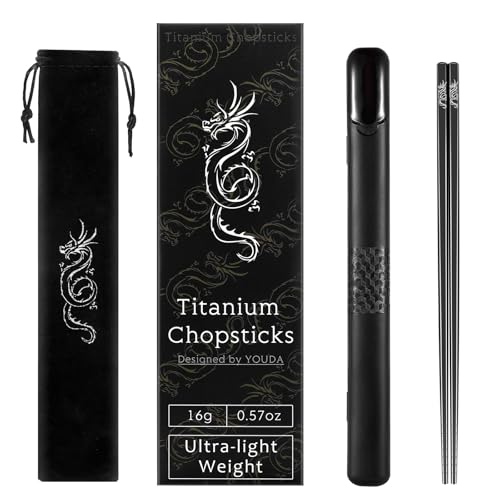
Youda Pure Titanium Chopsticks 1 Pair with Black Carrying Case — Best Value Titanium with Case
Youda’s set states its material claim plainly in the verified title — 99.8% pure titanium — and pairs it with a black carrying case for camping, home, and travel. It is the uncomplicated version of the titanium idea: no collapsible joints, no exotic finish, just a light, rust-proof pair and a case to keep it clean and findable.
That simplicity is the value proposition. Buyers who want titanium’s ownership experience — wash it anywhere, forget it in a bag for a month, use it for years — without paying the premium-brand tier will find this the easiest yes in the guide. As with all single-pair travel sets, the case protects one person’s pair; households should look at the home-storage pick below instead.
Strengths
- Stated 99.8% pure titanium
- Carrying case included for camp, home, and travel
- Simple one-piece design with nothing to assemble
Trade-offs
- Single pair — personal set only
- Less established brand than the outdoor specialists
- Plain presentation versus gift-oriented sets
| Specification | Detail |
|---|---|
| Material | Titanium, 99.8% pure per title |
| Pairs | 1 pair |
| Case | Black carrying case |
| Use | Camping, home, travel |
Best for: buyers who want titanium practicality at an accessible tier / Not suited for: shoppers who want a multi-pair household set
Check the current price on Amazon.

Thous Winds Titanium Chopsticks Foldable 9 Inch with Storage Bag — Best Folding Design
Folding is the third answer to the packed-length problem: the Thous Winds pair hinges down for its storage bag and opens to the full 9-inch length stated in its title. Against the collapsible Wabuki, a folding pair has fewer separate pieces to lose; against solid titanium, it packs meaningfully shorter. For hikers and travellers who found both extremes slightly wrong, this is the engineered compromise.
Be honest about the storage bag, though: it organises and contains, but it is not crush protection like the Keith aluminium case. Carry this set in a pocket of your pack rather than under the heavy gear. The 9-inch open length is a touch shorter than the 9.5-inch table standard, which most users will not notice and smaller hands may prefer.
Strengths
- Folds short, opens to a full 9-inch pair
- Fewer loose pieces than collapsible designs
- Ultralight titanium for hiking and travel
Trade-offs
- Storage bag is not crush-proof
- Hinge needs the same joint care as any folder
- 9-inch length is slightly under the table standard
| Specification | Detail |
|---|---|
| Material | Titanium |
| Design | Foldable, 9 inches open |
| Case | Storage bag included |
| Use | Camping, backpacking, travel, home |
Best for: hikers who want short packing without loose sections / Not suited for: bags where gear gets crushed under heavy loads
Check the current price on Amazon.

Ceramic Chopsticks White Set of 5 with Case — Best for Home Storage
Not every case search is about travel. This porcelain set of five, sold as a gift set with a case, answers the home version of the question: how do I store a beautiful set so the pairs stay together, the tips stay unchipped, and the drawer looks intentional? The case here is a presentation and storage case, and for a household set that is exactly the right job.
The porcelain itself is the easy-clean, non-porous material of the set in the companion guide, with a dishwasher-safe claim in its verified title — but porcelain remains porcelain, and the case does not make it travel-proof. Keep this set at home, let the case protect it in the drawer, and take titanium when you leave the house. Judged on its actual job, it is the most elegant storage answer in this guide.
Strengths
- Five pairs with a storage and gift case
- Porcelain is non-porous and easy to clean
- Case keeps pairs matched and tips protected at home
Trade-offs
- Porcelain is fragile — home use only
- Case is for storage, not trail protection
- Heavier than any travel pick here
| Specification | Detail |
|---|---|
| Material | Ceramic / porcelain |
| Pairs | 5 pairs |
| Case | Gift set case included |
| Care | Dishwasher safe per title |
Best for: home drawers, gifts, and carefully kept table sets / Not suited for: travel, camping, or lunch bags
Check the current price on Amazon.
Comparison Table
| Pick | Badge | Key spec | Best for |
|---|---|---|---|
| Snow Peak Titanium Chopsticks with Carrying Case | Best Overall | Titanium, 22 g, carrying case included | backpackers, campers, and daily lunch-kit carriers |
| Keith Ti5633 Pure Titanium Solid Square Chopsticks with Gray Aluminum Case | Best Hard-Case Protection | Solid square titanium, aluminium case | rough daily bags and travellers who prioritise protection |
| Snow Peak Wabuki Chopsticks Collapsible L with Case | Best Collapsible Design | Collapsible stainless, size L, with case | space-first travellers and everyday-carry kits |
| Youda Pure Titanium Chopsticks 1 Pair with Black Carrying Case | Best Value Titanium with Case | Pure titanium, 1 pair, black carrying case | buyers who want titanium practicality at an accessible tier |
| Thous Winds Titanium Chopsticks Foldable 9 Inch with Storage Bag | Best Folding Design | Foldable titanium, 9 in, storage bag | hikers who want short packing without loose sections |
| Ceramic Chopsticks White Set of 5 with Case | Best for Home Storage | Porcelain, 5 pairs, storage case included | home drawers, gifts, and carefully kept table sets |
How to Choose the Best Chopsticks with Case
Start by naming where the chopsticks will actually travel. A backpacking kit wants minimum weight and a case that keeps tips clean in a food bag — the Snow Peak titanium model is built for exactly that. A daily work bag wants crush protection, because bags get sat on, dropped, and stuffed — that is the aluminium-cased Keith. A minimalist pouch wants packed length above all, which is what the collapsible and folding designs optimise. The case is not an accessory here; it is the answer to a specific carrying life.
Then decide solid, collapsible, or folding with clear eyes. Solid pairs are the most durable and the easiest to clean, and they ask only for their full length in your bag. Collapsible pairs pack shortest but introduce joints that trap sauce and sections that can be lost. Folding pairs split the difference with a hinge. None of these is a wrong answer; each is a different trade between packed size and simplicity, and your bag decides.
Finally, check what the case really is. Hard aluminium protects against crushing. A fitted carrying case protects tips and keeps things hygienic. A storage bag mostly organises. Match the protection to the journey — and be suspicious of any listing where the case appears in photographs but not in the confirmed contents, which is why every pick in this guide has its case stated in the verified title.
Why Titanium Dominates Travel Chopsticks
Titanium’s travel case rests on three facts: it is dramatically lighter than steel at useful strength, it cannot rust no matter how wet the trip gets, and it is flavour-neutral, so yesterday’s meal never ghosts into today’s. The verified titles in this guide underline the point with a 22-gram set weight and purity claims — numbers no steel or wood set can approach.
The costs are equally real. Titanium sits in a premium tier, its light feel can seem insubstantial to diners raised on wood, and it conducts heat along its length more than bamboo does — the Snow Peak title’s heat-reducing design note exists because the material needs the help. For a home-only buyer, fiberglass or bamboo usually makes more sense; for anything that leaves the house weekly, titanium earns its place.
Case Care and Travel Hygiene
A case protects chopsticks only if the chopsticks go into it clean and dry. Sealing a damp pair into a closed case for a week invites exactly the mustiness the case was meant to prevent. On trips, rinse and dry the pair before casing it; at home, let a washed pair air for a few minutes before it goes back in the drawer case.
Wash the case itself on the same schedule as the sticks — fabric bags and bags with linings especially. Aluminium cases wipe clean in seconds; soft bags may need a hand wash and full drying. Treat the pair and its case as one object with one care routine, and both will last as long as the titanium inside them.
One Pair or Several? The Travel Drawer
Committed travellers usually end up with a graded kit: the best pair for trips that matter, a simpler titanium pair for the daily bag, and the home set staying home. This guide maps onto that kit naturally — Snow Peak or Keith as the primary pair, Youda as the everyday carrier, and the porcelain set never leaving the house.
Resist carrying your only good home set when you travel. Travel is where chopsticks get lost, and a pair with a case is cheap insurance against both the loss and the hygiene problem. That, ultimately, is what this search is really buying: not a case, but a pair you can always find, always trust, and always bring.
What to Look for in the Case Itself
Judge a case on four things: whether it protects the tips, whether it keeps the pair findable, whether it can be cleaned, and whether it suits the bag it will live in. Tip protection is the non-negotiable — exposed tips in a bag pick up everything the bag has met. Findability is a design property: a case with a distinct colour or shape surfaces in a crowded pack, while a black tube in a black bag is a daily search. Cleanability separates travel gear from travel souvenirs; if the case cannot be washed, it will eventually be the dirtiest object in your kit.
Closure matters more than material at the margin. A case that opens in the bag has failed at its only job, so favour closures that click, snap, or zip positively over friction fits for rough use. The aluminium Keith case and the fitted Snow Peak case both close with intent; soft bags rely on ties and folds and belong in gentler pockets. Match the closure to the chaos of your bag and the set will still be with you next year.
Cased Chopsticks Beyond Travel
The case habit pays in places that are not trips. A cased pair in a desk drawer ends the disposable-cutlery cycle at work and survives office cleanouts that claim loose utensils. A cased pair in a child’s school bag — age-appropriate and supervised — builds the same skill at lunch that the family practises at dinner. Even at home, a case keeps a special pair separate from the fleet: the carved pair, the gift pair, the pair that is yours alone.
Think of the case as the pair’s address. Objects with addresses come back; objects without them wander. That is the whole economics of this category in one sentence, and it is why the small premium for a confirmed case — verified in the title, as every pick here is — is among the best-value upgrades in the entire chopstick market.
The Lunch-Kit System Around a Cased Pair
A cased pair works best as part of a tiny system: the pair, a cloth or napkin that doubles as a rest and a wrapper, and a fixed pocket in the bag where the case always returns. The napkin is the unsung component — it gives the chopsticks somewhere clean to rest mid-meal, wipes the tips before casing, and pads the case against rattling. Travellers who build this three-part habit stop losing pairs, because the system has a place for everything at every stage of the meal.
At work, the same system lives in a desk drawer and ends reliance on whatever cutlery the office kitchen happens to hold. The case keeps the pair visibly yours, which matters in shared kitchens, and visibly clean, which matters everywhere. It is a small domestic technology, but it compounds daily.
Sizing a Travel Pair to Your Real Trips
Match the travel set to the trips you actually take, not the expedition in your imagination. The daily commuter needs cleanability and findability above all — the Youda or Snow Peak in a lunch kit. The occasional flyer needs packability and a case that survives being screened, stuffed, and sat on — the Keith’s aluminium or the Wabuki’s short pack. The backpacker needs grams — the 22-gram Snow Peak, full stop. Buying for imaginary trips produces gear that is wrong for real ones, and chopsticks are small enough that the honest match is easy once the trip is named.
If your travel is mostly hotels and restaurants that provide chopsticks anyway, your cased pair is really a preference object — your own tips, your own hygiene, your own feel. That is a perfectly good reason to carry one; just choose it for feel, like the square Keith, rather than for survival specifications you will never test.
Gifting a Cased Set Well
A cased pair is one of the most giftable objects in the kitchen: personal, portable, and used daily by the right recipient. The gifting judgement is in the match — titanium for the traveller and the camper, the aluminium-cased set for the bag-carrying professional, the porcelain storage set for the home cook who would never take it anywhere. A case turns each of those from a utensil into a possession, which is what a gift should be.
Include the one-line care note with the gift — wash, dry, then case — because the only way to ruin a cased set early is to seal it wet. Recipients who learn that habit on day one will still be using your gift in a decade, which is more than most presents can claim.
Cases for Children and School Kits
A case changes what a child can be trusted with. Loose chopsticks in a school bag are lost by Friday; a cased pair — bright, closable, and clearly theirs — survives terms. For younger children, pair the case habit with trainer or shorter sets from this site’s children’s guides; for older children ready for standard pairs, a simple fitted case from the styles in this guide teaches the same wash-dry-case routine that adult travellers use. The routine, once learned at nine, is never unlearned.
Label the case, because school lost-property boxes are full of identical good intentions. A name inside the lid returns more chopsticks than any tracking technology, and it costs a marker pen. Choose closure styles small hands can work confidently — a case a child cannot open is a case that comes home full and frustrated.
Flying With a Cased Set: Practical Notes
Chopsticks travel in cabin baggage on most routes without incident, as ordinary cutlery-class items, but the traveller’s experience varies by airport and officer, and rules change. The low-friction approach: pack the cased set in an accessible pocket so it can be shown if asked, prefer checked baggage for metal sets on unfamiliar routes, and never argue a screening decision — the pair is replaceable and the flight is not. Titanium’s light weight makes it the natural cabin choice when it is carried at all.
At the destination, the case earns its keep in hotel rooms and rented apartments whose kitchen drawers are lotteries. Your own pair, in its case, in your wash bag’s neighbourhood, is a small constant in unfamiliar places — which, for people who travel for work in long stretches, is worth more than the specifications suggest.
When the Case Is the Product: Collectors and Special Pairs
Some pairs are bought for the case as much as the sticks: presentation boxes, aluminium tubes, and fitted cases turn chopsticks into objects that are displayed, gifted, and kept. There is no pretence to apologise for here — humans keep beautiful tools longer and treat them better, and a case that makes a pair feel significant is performing real protective work through psychology. The porcelain storage set in this guide trades on exactly this effect at household scale.
If you collect, store pairs in their cases with the same dry-first discipline as travel, and keep cases out of steamy kitchens, where trapped humidity works on contents and case alike. A collection kept dry and handled at meals will outlive its owner in usable condition — the finest outcome any utensil can hope for.
Repair, Loss, and the Life of a Travel Pair
Travel pairs live dangerously, so plan for the two failure modes: a lost case and a lost stick. A lost case is survivable — the pair can ride in a cloth wrap or a zip pocket until a replacement arrives — while a lost stick ends the pair, which is why committed travellers who depend on their set sometimes carry the simpler Youda as a backup in a second bag. That redundancy sounds excessive until the first business trip where the alternative is a plastic fork and a room-service tray.
Inspect hinges, joints, and case closures monthly if you travel weekly. Folding and collapsible pairs announce their wear at the moving parts first, and a wobble caught at home is a nuisance, while the same wobble discovered at a trailhead is a broken tool. Five seconds of attention per trip is the whole maintenance budget of this category.
The Habit Is the Product
Strip the category to its essence and a cased pair is a habit wearing a product’s clothes. The case gives the habit a home: wash, dry, case, same pocket, every time. People who keep the habit stop losing chopsticks, stop eating with doubtful utensils in doubtful places, and stop thinking about any of it — which is the entire return on a modest purchase. The six verified sets in this guide differ in material, mechanism, and protection, but they are all delivery devices for that one routine.
Choose the delivery device that fits your bag and your temperament, confirm the case is truly in the box as every title here confirms, and give the routine two weeks to set. After that, the pair simply travels with you, the way a good pen or a house key does — present without being thought about, and missed immediately on the one day it is forgotten.
Cases in Materials: Aluminium, Fabric, and Fitted Shells
Aluminium cases, like the Keith’s in this guide, are the armour of the category: rigid, wipeable, and indifferent to being sat on, at the price of a little weight and a metallic rattle some travellers pad with the napkin trick from the lunch-kit section. Fitted hard cases from the outdoor brands split the difference — shaped to the pair, lighter than metal, protective against everything except a determined crush. Soft bags and fabric wraps are the minimalists’ answer: they keep tips clean and pairs together, weigh nothing, and ask to be carried in pockets that are not war zones.
Choose by the worst day your bag reliably has, not its best. A case that survives the worst day makes the pair a permanent resident; a case chosen for the best day makes it a former resident. Every pick in this guide was matched to a carrying life on exactly that principle, and the reviews name the life each case is for.
The Second Pair Problem: Spares and Households
Travel has a way of separating people from the objects they carry, and a cased pair lost on a trip raises the household question: was that your only good pair? The graded kit described earlier in this guide — a primary travel pair, a simpler titanium backup, the home fleet staying home — exists so that a loss is an annoyance with a next step rather than a small domestic tragedy. The Youda set’s accessible tier is what makes the backup-pair strategy rational; insuring a premium pair with a second premium pair is a collector’s logic, not a traveller’s.
Households that travel together should case pairs per person rather than sharing one case between two pairs, unless the case was designed for it. Pairs that share a case tangle, wear against each other, and — the true cost — become one person’s responsibility to remember. Individual cases distribute the remembering, which is why they come home more often.
One Last Test Before You Order
Audit your carrying life with the same three questions this guide used to choose. Where will the pair actually live — a lunch kit, a work bag, a backpack, a drawer — and is the case’s protection matched to that home’s worst ordinary day? How will the pair be cleaned on the road, and does the case’s own cleanability support the routine you will really keep? And if the pair vanished tomorrow, is it a replaceable traveller or your one treasured set — because that answer decides whether it should have been travelling at all.
A cased set that passes the audit disappears into your life within a fortnight, which is the highest compliment travel equipment can earn. The six verified options here cover every honest answer to those questions, from a 22-gram titanium whisper to a porcelain set whose journey is six feet from drawer to table. Choose the one whose life matches yours, and the case will do the rest.
Why the Case Had to Be in the Title
This guide applied its strictest verification rule to its smallest feature, and the reason deserves a paragraph. Cases are the easiest component in all of e-commerce to imply and the easiest to omit: a photograph shows one, a bundle quietly excludes it, and the buyer’s disappointment arrives with the parcel. By requiring every pick’s case to be stated in its verified listing title — included, named, or built into the product’s own name — the guide traded a longer shortlist for a promise it could keep on every single pick.
Hold every future listing to the same standard, in this category and beyond: the box contains what the confirmed contents say it contains, and nothing else, however the photography arranges itself. Sellers who include a case say so, as all six makers here did. That sentence, applied consistently, is worth more than any individual recommendation in these pages.
How to Pack, Carry, and Care for Cased Chopsticks
A cased pair becomes part of your routine in about a week. The steps below set the routine up properly from day one.
- Before the first trip, wash the chopsticks and the case, dry both fully, and practise opening, assembling, or unfolding the pair at home.
- After each meal out, rinse the tips as soon as you reasonably can; dried sauce is the enemy of joints and hinges.
- Dry the pair before casing it — a quick wipe is enough — so the closed case never traps moisture.
- Store the cased pair in the same pocket of the same bag every time; findability is the case’s main job.
- Once a week at home, wash the case itself and let it dry open before the pair goes back in.
- For collapsible and folding pairs, run water through the joints after sticky or oily meals and dry them extended, not folded.
- Keep the home porcelain set in its storage case in the drawer, tips protected, and never lend the case to travel duty.
If you find the cased pair still sitting at home after two weeks, the case style is wrong for your life — a hard case you find bulky, or a bag that vanishes in your pack. Switch case styles before you blame your habits; the right case is the one that disappears into your routine.
Common Buying Mistakes
Assuming a photographed case is included. If the confirmed contents do not name a case, it is an accessory sold separately. Every pick here has the case in its verified title.
Sealing wet chopsticks into a closed case. Trapped moisture defeats the hygiene the case exists for. Dry first, always.
Buying a soft bag for a crush-prone bag. Storage bags organise; they do not protect. Rough daily bags need a hard case.
Ignoring packed length. A solid pair that does not fit your pouch will be left behind. Measure the pouch, then choose solid, folding, or collapsible.
Travelling with your only home set. Travel loses chopsticks. A dedicated cased travel pair is the cheap fix.
Neglecting joints on collapsible pairs. Sauce dries in joints and hinges. Rinse them the same day, not the same month.
Final Recommendation
For most travellers, the Snow Peak titanium set is the answer: 22 grams, a confirmed carrying case, and nothing to assemble. Choose the Keith Ti5633 when your bag is rough on its contents, the Wabuki collapsible when packed length rules, and keep the porcelain set with case for the drawer at home.
Related guides in this cluster: Best Chopsticks To Use, Best Chopsticks With Grip, Best Chopsticks Wood, Best Backpacking Chopsticks, and Best Chopsticks For Travel. Each applies the same verified-title rule to its own slice of the category.
Frequently Asked Questions
Is a hard case or a soft case better?
It depends on the bag. A hard aluminium case, like the Keith pick, protects against crushing in work bags and travel packs. A soft carrying case or storage bag is lighter and fine inside a lunch kit or a protected pocket. Match protection to how rough the journey is.
Why are most travel chopsticks titanium?
Weight and corrosion. Titanium sets can weigh as little as 22 grams, cannot rust in wet conditions, and do not retain flavours. Steel and wood travel sets work, but they give up at least one of those three advantages.
Collapsible, folding, or solid — which packs best?
Collapsible packs shortest, folding is close behind with fewer loose pieces, and solid pairs need their full length but are simplest and toughest. Choose by the space you actually have, not by novelty.
Can I take chopsticks with a case in hand luggage?
Chopsticks are ordinary eating utensils and are generally carried like cutlery, but rules vary by carrier and country, and a metal set in a hard case can draw a second look at screening. When in doubt, pack them in checked luggage or confirm with your airline.
How do I keep a cased pair hygienic on a long trip?
Rinse and dry the pair before casing it after every meal, wash the case itself weekly, and never seal a damp pair away. The case keeps a clean pair clean; it cannot clean a dirty one.
Is a case worth it for home chopsticks?
For a good set, yes — as storage. A case keeps pairs matched, protects porcelain and wood tips in a crowded drawer, and makes a set giftable. The porcelain pick in this guide is built around exactly that home-storage logic.


