Disclosure: airfryerkitchensupply.com is reader-supported. When you buy through links on our site, we may earn an affiliate commission at no extra cost to you.
Where to buy
Every pick below was checked against Amazon’s own catalogue data before this guide was written, and each linked model is sold through Amazon. Start with the shortlist for the best chopsticks for ramen:
- GLAMFIELDS 5 Pairs Japanese Fiberglass Chopsticks (Black) — Best Overall. Check the current price on Amazon before you buy, because listings change.
- Helen’s Asian Kitchen Bamboo Chopsticks (10.5 in, 10 Pairs) — Best for Deep Bowls. Check the current price on Amazon before you buy, because listings change.
- Fiberglass Chopsticks Wavy (10 Pairs, 9.5 in) — Best Textured Grip. Check the current price on Amazon before you buy, because listings change.
- MUYOS Stainless Steel Chopsticks (5 Pairs, Silver) — Best Metal. Check the current price on Amazon before you buy, because listings change.
- YUNDUOJIA Bamboo Chopsticks (5 Pairs, 9.8 in) — Best Bamboo Feel. Check the current price on Amazon before you buy, because listings change.
- Fiberglass Chopsticks for Rice Noodles (5 Pairs, 9.6 in) — Best for Slippery Noodles. Check the current price on Amazon before you buy, because listings change.
The best chopsticks for ramen have to survive the harshest working conditions in the chopstick world: a deep bowl, near-boiling broth, steam in the face, and noodles engineered by wheat and water to be as slippery as food gets. Ramen exposes weak chopsticks instantly. Short pairs drown, smooth tips surrender, and flimsy shafts flex under a proper lift of noodles and chashu.
That is why ramen rewards a specific specification: length around 9.5 to 10.5 inches to work a deep bowl, tips with genuine texture, and a material indifferent to hot broth. Fiberglass dominates serious ramen shops’ home equivalents for exactly those reasons, bamboo brings the traditional grip, and even metal has a case for the eater who values hygiene and precision over raw friction. The six verified picks below cover the ramen bowl from every reasonable angle, including the long bamboo pair for the deepest bowls and the textured specialists for the slipperiest noodles.
Ramen also has a honesty problem in the marketplace: any chopstick can be photographed beside a ramen bowl, and most are. The picks below were filtered for the bowl’s actual demands, depth clearance, broth-proof materials and tips that work when coated, and several popular styles did not survive that filter. What remains is shorter than the internet’s ramen content but considerably more useful at the table.
In this guide
Quick Picks
- Best Overall: GLAMFIELDS 5 Pairs Japanese Fiberglass Chopsticks (Black) — a Japanese-style fiberglass set with non-slip tips and full dishwasher tolerance, the balanced ramen tool for everyday bowls.
- Best for Deep Bowls: Helen’s Asian Kitchen Bamboo Chopsticks (10.5 in, 10 Pairs) — the longest dining pair in this guide at 10.5 inches, with bamboo’s natural grip, built for deep ramen bowls and generous broth clearance.
- Best Textured Grip: Fiberglass Chopsticks Wavy (10 Pairs, 9.5 in) — a wavy-profile fiberglass set whose textured tips are made, in the maker’s own words, for ramen, noodles, sushi and rice, in a ten-pair family format.
- Best Metal: MUYOS Stainless Steel Chopsticks (5 Pairs, Silver) — hollow-core stainless steel chopsticks that solve metal’s weight problem, with non-slip tips, for eaters who want metal’s hygiene and permanence.
- Best Bamboo Feel: YUNDUOJIA Bamboo Chopsticks (5 Pairs, 9.8 in) — a classic natural bamboo set at the in-between 9.8-inch length, with a traditional patterned finish, for eaters who prefer natural materials at the ramen bowl.
- Best for Slippery Noodles: Fiberglass Chopsticks for Rice Noodles (5 Pairs, 9.6 in) — a fiberglass set marketed for rice noodles, the slipperiest category of all, with heat resistance stated to 356°F for broth work.
How These Picks Were Chosen
Every pick was verified against Amazon’s catalogue data for this site before writing: the brand, material, length, pair count and care claims in each review come from the manufacturer’s own listing, not from roundups or guesswork. Where a listing states a heat resistance or a dishwasher claim, we report it as stated; where it does not, the review says nothing rather than inventing a number.
Selection filtered for the job named in the search first and general quality second. Length was matched to the food, tip texture was matched to how slippery that food is, and material was matched to the heat and washing routine involved. Sets that duplicated another pick’s exact role were cut, so the six slots cover genuinely different ways to solve the same meal.
We also weighted the unglamorous arithmetic of sets: how many pairs arrive, whether the count matches the household the pick claims to serve, and whether the set’s role, dining, cooking or bulk reserve, stays honest. A ten-pair set that cannot survive a dishwasher is a worse family pick than a five-pair set that can, and the reviews score that reality rather than the headline count.
Ramen-specific weighting deserves a sentence of its own: in this category we scored heat behaviour and broth behaviour ahead of appearance, because a pair lives its whole service life in steam and soup. A beautiful pair that warms uncomfortably in the hand, stains in miso or slips when coated fails the ramen test regardless of its table manners elsewhere, and the reviews say so where it applies.
Sushi weighting ran opposite to the ramen guide’s: here we scored tip finesse, hand feel and table quietness ahead of heat tolerance, because nothing at a sushi table is hot, deep or heavy. A pair that would triumph over a steaming bowl can be merely adequate over a platter of nigiri, and the reviews judge each pick by sushi’s own examination, which is placement under delicacy.
Stage accuracy was the first filter in this category, ahead of design appeal. Each pick was classified by the assistance it actually provides, alignment, guidance or transition, and several charming products were cut because their assistance was decorative rather than mechanical. A trainer that does not change the physics of the child’s attempt is a toy shaped like a lesson, and the reviews below only include tools that change the physics.
Within the style, selection weighted the working properties of the northern table: length for communal reach, profiles that do not roll, materials that tolerate broth and shared service, and pair counts matched to how this cuisine is actually eaten, which is together. Decorative sets that could not work a hotpot or survive a festival table were excluded, however handsome their photographs.
The 6 Best Chopsticks for Ramen

GLAMFIELDS 5 Pairs Japanese Fiberglass Chopsticks (Black) — Best Overall
GLAMFIELDS’ Japanese fiberglass set is the ramen all-rounder: 9.5 inches of rigid, broth-proof fiberglass with non-slip tips, in a five-pair gift-ready set. It handles the ramen routine, boiling broth, heavy lifts, dishwasher afterwards, without a single special instruction, which is what a weeknight tool owes you.
Strengths
- Non-slip tips hold broth-coated ramen noodles through the lift, wind and cool routine
- Fiberglass ignores hot broth entirely: no warping, no absorbing flavours, no staining from curry or miso broths
- Dishwasher safe, so the set survives nightly ramen habits without hand-wash friction
Trade-offs
- 9.5 inches is right for standard bowls but a touch short for the deepest oversized ramen bowls
- Five pairs suit a small household; big ramen-night groups need the ten-pair sets
- Fiberglass hand-feel is smooth in the fingers compared with bamboo’s natural warmth
| Material | Fiberglass |
| Length | 9.5 in |
| Pairs | 5 |
| Care | Dishwasher safe |
Ramen eating is a rhythm: lift, wind, rest on the spoon, eat, repeat for twenty minutes over a steaming bowl. A chopstick that demands attention breaks that rhythm, and this set never does. The shaft stiffness is the quiet hero, because ramen noodles arrive in heavy, broth-laden bundles and a flexing pair sheds half the load back into the soup with a splash.
As the single set to buy for a ramen habit, this is the guide’s answer. Add the long bamboo pick below only if your bowls are exceptionally deep, and the ramen station is complete.
A season of ramen will also test a set’s manners with toppings, and this is where the GLAMFIELDS set’s all-round competence shows: the same tips that wind noodles also lift a halved egg without splitting it and fish out corn and scallion with reasonable precision. Ramen is a composed bowl, and a pair that only handles the noodle component handles two-thirds of the meal. This set handles the meal.
Best for: regular ramen eaters who want one dependable, easy-care set / Not suited for: households serving ramen to crowds; size up to a ten-pair fiberglass set
Check on Amazon — check price on Amazon for the current listing.

Helen’s Asian Kitchen Bamboo Chopsticks (10.5 in, 10 Pairs) — Best for Deep Bowls
Helen’s Asian Kitchen is a long-standing Asian kitchenware line, and this 10.5-inch bamboo set exists for one reason: depth. The extra inch over standard dining pairs keeps fingers clear of the broth surface in deep ramen bowls and gives leverage on the long lift from bowl bottom to spoon. Ten pairs make it a household set, not a novelty.
Strengths
- 10.5-inch length masters deep bowls where 9-inch pairs leave knuckles in the steam
- Bamboo’s natural surface friction is the friendliest grip for learners and slippery noodles alike
- Ten pairs at a working length is rare; most long sets are cooking tools, not dining sets
Trade-offs
- Bamboo requires hand washing and prompt drying to avoid splitting and fraying
- Natural bamboo will pick up broth colour over time, especially from curry and tomato-based bowls
- The extra length feels oversized in small bowls and for small hands
| Material | Bamboo |
| Length | 10.5 in |
| Pairs | 10 |
| Style | Chinese-length dining |
Bowl depth is the variable most ramen buyers never measure. Restaurant ramen bowls are deep by design, to hold heat and volume, and home bowls have followed them. If your fingertips have ever skimmed hot broth mid-lift, your chopsticks are too short, and this set is the direct fix, with bamboo’s forgiving grip as a bonus for eaters still building technique.
Accept the bamboo bargain knowingly: a quick hand wash and a standing dry after each meal. In exchange you get the warmest, grippiest dining experience in this guide and the length that deep-bowl ramen actually demands.
One practical pairing: keep this long set at the ramen station and resist lending it to the wok. Bamboo used for frying absorbs oils at high heat and ages in a month; bamboo kept to dining, even in hot broth, ages in seasons. The set’s ten pairs make the discipline easy, because there is always a dining pair available and the cooking can be left to a dedicated long pair from the companion noodles guide.
Best for: deep-bowl ramen lovers and households wanting a longer dining standard / Not suited for: dishwasher-only homes; fiberglass keeps its promises there instead
Check on Amazon — check price on Amazon for the current listing.

Fiberglass Chopsticks Wavy (10 Pairs, 9.5 in) — Best Textured Grip
The wavy profile is the idea here: the shaft’s undulating shape gives fingers purchase and stops the pair rolling, while textured tips work on the food end. The listing names ramen first among its uses and states heat resistance to 120°C, comfortably beyond any broth temperature a bowl can hold.
Strengths
- Wavy shaft profile resists rolling in the hand and on the table, a small design with daily payoffs
- Textured tips plus a ten-pair count make it the family ramen-night set
- Stated heat resistance to 120°C covers boiling broth work without concern
Trade-offs
- The wavy profile divides opinion; traditionalists prefer a straight, clean shaft line
- PET-fiberglass blend is a newer construction than pure fiberglass sets, with less long-term history
- Decorative colours may not suit a formal table
| Material | PET + fiberglass (BPA-free, stated) |
| Length | 9.5 in |
| Pairs | 10 |
| Heat resistance | 120°C (stated) |
Grip failures happen at two ends of the chopstick: the tip drops the noodle, or the shaft rolls in sweaty, steam-softened fingers and the whole alignment collapses. Most sets only engineer the tip. The wavy profile engineers the hand end too, and over a long, hot bowl of ramen that second fix is the one you feel in the final third of the meal, when concentration fades.
For families, the ten-pair count and full dishwasher tolerance make it the set that actually gets used nightly rather than saved. Ramen is a repeat dish; its tools should be bought in repeat quantities.
The wavy profile has one more beneficiary worth naming: children and older eaters at the ramen table. A shaft that does not roll forgives a developing or weakening grip, and the textured tips forgive developing aim. If your ramen nights are family nights, this set quietly lowers the skill floor for everyone at the table without looking like a training tool, which older children in particular will appreciate.
Best for: families and heavy ramen households that want grip engineered at both ends / Not suited for: purists who want a straight traditional shaft and natural materials
Check on Amazon — check price on Amazon for the current listing.
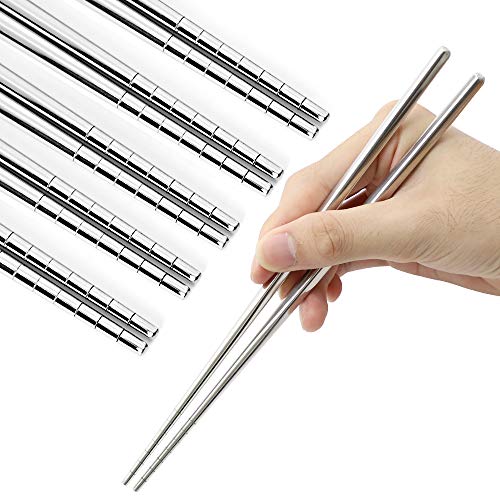
MUYOS Stainless Steel Chopsticks (5 Pairs, Silver) — Best Metal
Metal chopsticks divide the ramen world, so let the case be made honestly. MUYOS builds these from stainless steel with a hollow core, which keeps the pair light enough for a long meal, and finishes the tips for grip. Steel is non-porous, flavour-neutral across a thousand broths, and effectively immortal in a dishwasher. For the eater who prioritises hygiene and precision, this is the metal benchmark.
Strengths
- Hollow-core construction removes the wrist fatigue solid metal pairs cause over a long bowl
- Stainless steel never absorbs broth flavours or odours, so last week’s curry ramen never ghosts this week’s shoyu
- Dishwasher-proof forever, with no warping, splitting or fading possible
Trade-offs
- Metal tips, even textured ones, remain the slipperiest option on broth-coated noodles
- Steel conducts heat, so a pair left resting in hot broth warms up in the hand
- Metal on ceramic bowls is the loudest combination here, which some diners dislike
| Material | Stainless steel, hollow core |
| Pairs | 5 |
| Tips | Non-slip |
| Care | Dishwasher safe |
Technique decides whether metal works for ramen. The winding method, wrapping noodles around the tips rather than pinching a bundle, largely neutralises metal’s slipperiness, and practiced eaters genuinely prefer the precision of a slim steel tip for separating noodles and handling toppings. If your technique is already sound, steel rewards you with the most hygienic, longest-lived pair in this guide.
If your technique is still developing, be honest about the learning curve: start with fiberglass or bamboo, and let metal be the graduation set. Bought in the right order, this is a lifetime purchase; bought first, it is the set most likely to be blamed for the eater’s own apprenticeship.
Steel’s defenders should also note its behaviour with the ramen spoon: a metal pair and a metal spoon free the eater from all material care at once, one dishwasher load, no sorting, no exceptions, forever. For the household that has decided to optimise for zero-maintenance across its whole kitchen, that system-level simplicity is a rational reason to accept metal’s grip demands, and this hollow-core set is the least demanding version of the choice.
Best for: experienced eaters who value hygiene, precision and lifetime durability / Not suited for: beginners still learning grip; start with the fiberglass or bamboo picks
Check on Amazon — check price on Amazon for the current listing.

YUNDUOJIA Bamboo Chopsticks (5 Pairs, 9.8 in) — Best Bamboo Feel
At 9.8 inches, YUNDUOJIA’s bamboo set sits between the Japanese dining length and the long Chinese style, a genuinely useful middle for ramen bowls. The bamboo is natural, the finish carries a traditional pattern, and the listing states dishwasher safety, unusual for bamboo and worth noting, though gentle hand washing will still extend any bamboo set’s life.
Strengths
- 9.8-inch middle length suits ramen bowls better than short Japanese pairs without overwhelming small hands
- Natural bamboo grip is forgiving for learners and secure on wet noodles
- Traditional patterned finish makes a working set handsome enough for guests
Trade-offs
- Bamboo remains a consumable material; expect eventual tip wear and replacement, unlike fiberglass or steel
- Patterned finishes vary, and heavy dishwasher use will fade them despite the listing’s claim
- Five pairs is a small-household count
| Material | Bamboo |
| Length | 9.8 in / 25 cm |
| Pairs | 5 |
| Style | Classic patterned |
Some eaters simply think better with natural materials in hand, and ramen, a dish with deep craft traditions, is where that preference feels most at home. Bamboo’s slight surface tooth, its warmth and its quietness against ceramic are real qualities, and this set delivers them at the length ramen actually wants.
Buy it as a consumable and it will never disappoint you: a set in service, a set in reserve, replaced when the tips tire. That rhythm, rather than lifetime ownership, is bamboo’s honest contract, and at this tier it is a cheap contract to keep.
Bamboo’s defenders get their paragraph too: there is a sensory rightness to bamboo at a ramen bowl that no synthetic has matched, the slight tooth on the noodle, the warmth, the quiet against the bowl’s rim during the rest between lifts. Eaters who notice such things are not imagining them, and this set is priced so that honouring the preference costs little and can be renewed as often as the material asks.
Best for: natural-material eaters who want a mid-length bamboo set for ramen / Not suited for: buyers wanting a buy-once lifetime set; choose fiberglass or steel
Check on Amazon — check price on Amazon for the current listing.

Fiberglass Chopsticks for Rice Noodles (5 Pairs, 9.6 in) — Best for Slippery Noodles
Rice noodles, in pho and in ramen-adjacent bowls, are the grip championship: flat, slick and fragile, they punish both slippery tips and clumsy pressure. This fiberglass set is built and named for that job, with a non-slip brief, a 9.6-inch working length and stated heat resistance far beyond broth temperatures, so the same pair can stir the pot and eat the bowl.
Strengths
- Named and textured for rice noodles, the hardest grip test in the noodle family
- Stated heat resistance to 356°F lets one pair move between pot and bowl
- Rigid fiberglass supports a bundle without crushing delicate flat rice noodles the way a hard pinch does
Trade-offs
- Five pairs only, so it is a specialist set rather than household depth
- The rice-noodle brief is narrow marketing; the set is equally a general fiberglass pair, which some buyers may prefer from a bigger brand
- Fiberglass tips still trail bamboo for pure softness of bite on fragile noodles
| Material | Fiberglass |
| Length | 9.6 in |
| Pairs | 5 |
| Heat resistance | 356°F (stated) |
| Care | Dishwasher safe |
The technique this set rewards is the scoop-and-support: slide under the rice noodles, lift with the shafts supporting the bundle’s weight, and let the textured tips merely steer. Pressure is what breaks rice noodles and drops them; support is what delivers them. A rigid, grippy pair makes that technique available to ordinary eaters, not just the practiced.
Pho households should read this pick as addressed to them as much as ramen households. The bowls, broths and noodles are cousins, and the tool that masters one masters the other.
Finally, a note for the pho crossover cook: flat rice noodles break under a hard pinch, and this set’s technique lesson, support the bundle on the shafts, steer with the tips, is the whole skill. Practise it on the first bowl and the pair will feel purpose-built; pinch at rice noodles like wheat noodles and no tool in this guide can save the bowl. The tool and the technique are a package, and this pick teaches the package fastest.
Best for: pho and rice-noodle lovers, and ramen eaters whose bowls run slippery / Not suited for: large households needing depth; pair it with a ten-pair set
Check on Amazon — check price on Amazon for the current listing.
Comparison Table
| Pick | Badge | Key spec | Best for |
|---|---|---|---|
| GLAMFIELDS 5 Pairs Japanese Fiberglass Chopsticks (Black) | Best Overall | Fiberglass, 5 pairs, 9.5 in, non-slip, dishwasher safe | regular ramen eaters who want one dependable, easy-care set |
| Helen’s Asian Kitchen Bamboo Chopsticks (10.5 in, 10 Pairs) | Best for Deep Bowls | Bamboo, 10.5 in, 10 pairs | deep-bowl ramen lovers and households wanting a longer dining standard |
| Fiberglass Chopsticks Wavy (10 Pairs, 9.5 in) | Best Textured Grip | PET + fiberglass, 10 pairs, 9.5 in, heat resistant to 120°C (stated) | families and heavy ramen households that want grip engineered at both ends |
| MUYOS Stainless Steel Chopsticks (5 Pairs, Silver) | Best Metal | Stainless steel, 5 pairs, hollow-core lightweight, non-slip tips, dishwasher safe | experienced eaters who value hygiene, precision and lifetime durability |
| YUNDUOJIA Bamboo Chopsticks (5 Pairs, 9.8 in) | Best Bamboo Feel | Bamboo, 5 pairs, 9.8 in / 25 cm, dishwasher safe (stated) | natural-material eaters who want a mid-length bamboo set for ramen |
| Fiberglass Chopsticks for Rice Noodles (5 Pairs, 9.6 in) | Best for Slippery Noodles | Fiberglass, 5 pairs, 9.6 in, heat resistant to 356°F (stated), dishwasher safe | pho and rice-noodle lovers, and ramen eaters whose bowls run slippery |
How to Choose Chopsticks for Ramen
Measure your bowl before your chopsticks. A standard ramen bowl wants a 9.5-inch pair; a deep, wide restaurant-style bowl wants 10 to 10.5 inches. The rule is clearance: with the tips at the bowl’s bottom centre, your fingers should sit comfortably above the broth line. Every dropped-noodle and scalded-knuckle story in ramen begins with a pair that was an inch too short.
Choose tip texture for broth, not for looks. Ramen broth is a lubricant, whether it is a rich tonkotsu or a clear shoyu, so matte, grooved or otherwise textured tips are functional equipment. Glossy tips and smooth metal are advanced-mode choices that reward established technique and punish learning.
Match material to your washing and eating rhythm. Ramen is a repeat dish, often weekly, so dishwasher-proof fiberglass earns its place in busy homes. Bamboo is the traditionalist’s grip and feel, maintained by hand. Steel is the lifetime, hygiene-first choice for practiced hands. None is the correct answer for everyone, and this guide’s ranking is a starting point for your household’s habits, not a law.
Ramen Bowl Ergonomics: Length, Weight and Balance
A ramen meal is twenty minutes of repeated precise lifting over steam, so ergonomics compound. Weight matters more here than in any other chopstick use: a heavy pair that feels fine for sushi becomes a wrist ache by the bottom of a big bowl, which is why hollow-core construction matters in the metal pick and why fiberglass’s lightness is a genuine feature rather than a compromise.
Balance matters too. A pair balanced slightly toward the hand end feels agile; a tip-heavy pair feels like it is always trying to dive into the broth. You cannot test balance from a listing, but material is a fair proxy: bamboo and fiberglass are reliably hand-friendly, solid metal is the risk, and hollow metal is the engineered answer.
Finally, consider the spoon partnership. Ramen is eaten with chopsticks in one hand and a spoon in the other, and the chopsticks’ job includes parking noodles on the spoon to cool. A pair with enough length and tip control makes that transfer cleanly; a short or slippery pair makes it a negotiation. Buy for the whole system, bowl, spoon and pair together, and the meal becomes the calm ritual it is supposed to be.
Broth by Broth: How Soup Changes the Tool
Tonkotsu and other emulsified broths coat everything in a slick of fat, and they are the strongest argument for textured tips and against polished anything. Miso broths stain natural materials a little deeper with every bowl, which bamboo owners accept as patina and fiberglass owners never see. Clear shoyu and shio broths are the gentlest environment and the one place an elegant smooth pair survives on merit.
Spicy broths add a chemical dimension: capsaicin oils linger in porous materials, and a bamboo pair that served a fiery tantanmen can ghost the next morning’s mild bowl. Households that swing between heat levels often keep the fiberglass set for spicy service and the bamboo for clear broths, an arrangement that sounds fussy and is, in practice, just two sets in a drawer each doing what it does best.
The Ramen Spoon Partnership, Specified
Since ramen is eaten with two tools, the spoon deserves the same thirty seconds of thought as the pair. A deep-bowled Asian soup spoon, ceramic or melamine, gives noodles a cooling platform and broth a vehicle; a shallow Western teaspoon does neither well. Resting noodles on the spoon is also the splash-control technique, so the spoon’s size directly affects your shirt’s survival across a ramen habit.
Chopstick rests complete the station for the same reason they matter at sushi: a pair laid on the table between lifts picks up the table. A rest per setting, washed with the bowls, keeps the eating ends clean through a long meal and costs less than the shirt it saves. Buy the station once, as a set of decisions, and ramen night becomes a system rather than an improvisation.
Ramen Around the World, One Pair at a Time
Ramen’s global spread has quietly standardised its tools: the deep bowl, the soup spoon and the mid-length pair now appear from Osaka to Ohio, because the dish’s physics does not negotiate. Regional broths differ, toppings differ, noodle thickness differs, but the lift, wind and rest rhythm is identical everywhere, and so is the tool that performs it. Buying the ramen-correct pair is therefore one of the rare purchases that travels: the same set serves a Tokyo counter, a home kitchen and a college dorm with equal competence.
That universality is also why ramen chopsticks make unusually good gifts for cooks. A pair sized and finished for ramen slots into any kitchen that makes noodles at all, which in the age of the global instant noodle is nearly every kitchen on earth.
Setting Up a Ramen Station in a Small Kitchen
Ramen’s equipment footprint is mercifully small, and a dedicated station fits in one drawer section and one shelf: the pairs in their rest tray, the deep spoons nested, one long cooking pair across the pot cupboard, and the bowls stacked where steam from the dishwasher will not reach the bamboo. The station matters because ramen is a momentum dish; a cook who hunts for tools while noodles overcook loses the bowl’s timing, and the eater who hunts for a rest mid-meal loses the rhythm this guide’s technique section builds.
Stock the station against your real frequency. A weekly ramen household justifies the full arrangement and the ten-pair depth; a monthly household should buy the five-pair fiberglass set, one spoon per regular eater, and borrow the rest from the general kitchen without guilt. Equipment bought beyond frequency becomes clutter that hides the tools you actually use, which is the opposite of a station.
Finally, keep the station honest about broth. If your ramen runs spicy or curry-based most weeks, default the station’s pairs to fiberglass and steel, and let bamboo be the guest set for clear-broth nights. Matching the station’s materials to the household’s actual broth habits is the kind of unglamorous decision that determines whether a set still looks and feels right in its third year.
Noodle Freshness and the Cook’s Pair at Home
Home ramen cooks face the pot problem in its purest form: fresh and dried noodles must be loosened, separated and lifted at exactly the right second, and the tool in the pot is a long pair, not the dining pair from the table. Boiling noodles glue themselves into a block within the first thirty seconds, and the cook’s long chopsticks, worked gently through the block as it softens, are how individual strands survive to the bowl. A dining pair pressed into this service is too short for comfort and comes back to the table heat-dulled and broth-logged, which is why this guide’s system always separates the two stations.
Portioning is the cook’s second job and the long pair does it with a cook’s precision: lift a bundle, judge it against the bowl, return the excess, add the shortfall. Restaurants portion by eye trained over thousands of bowls; home cooks portion by the same tool more slowly, and the result, even bowls that eat at the same pace, is worth the extra ten seconds per serving. If your household makes ramen for more than two, the long cooking pair is not an accessory to this guide’s picks but their necessary partner, and the noodles companion guide lists the verified options.
Timing is the third job, and here the pair becomes a testing instrument: a strand lifted, cooled a moment and bitten tells the cook more than any timer, because noodle batches vary. Keep the cooking pair in hand through the boil and the decision makes itself, which is the difference between ramen that is merely served and ramen that is cooked.
How to Eat Ramen With Chopsticks Like a Regular
Ramen has a technique, and it is learnable in one bowl. The goal is a steady rhythm that keeps noodles hot, broth in the bowl and shirt fronts clean.
- Set up: chopsticks in the dominant hand with the lower stick resting still on the ring finger, spoon in the other hand, napkin deployed before the first lift, not after.
- Stir once, gently, to loosen the noodle block and distribute the broth; ramen arrives clumped and the first job is separation, with the chopstick tips, not force.
- Take a modest bundle, lift it clear of the bowl, and let it drain for a breath; most splashes happen when a dripping bundle travels too far, too fast.
- Wind the bundle once around the tips or rest it on the spoon to shorten the strands, then eat from the spoon end for the cooling benefit.
- Alternate noodles, toppings and spoonfuls of broth rather than finishing components in sequence; the bowl was composed to be eaten in mixture.
- Rest the pair on the bowl’s rim or a rest between bites, tips together, never standing upright in the noodles.
Slurping, for the record, is functional: it cools the noodles and aerates the broth. With the lift-and-wind rhythm in place, you have the technique; the rest is appetite.
Keeping Ramen Chopsticks in Service
Broth is a harsh environment: salt, fat, heat and pigment in every meal. Fiberglass and steel shrug it off in the dishwasher. Bamboo asks for a prompt rinse before the broth dries into the grain, a wash, and a standing dry; curry and miso broths will tint it over time, which owners of natural materials accept as patina rather than damage. Whichever material you choose, store pairs dry and separated from steam-heavy spots like directly above a kettle, where constant humidity shortens any natural set’s life.
Building the Home Ramen Kit
Beyond the pair itself, three accessories complete a home ramen setup: a deep spoon that matches your bowls, a chopstick rest per setting so pairs stay off the table, and one long cooking pair for the noodle pot so dining pairs are not pressed into steam duty. None is expensive, and together they turn an occasional dish into a repeatable household ritual, which is the point of owning the right chopsticks in the first place.
Instant Ramen Deserves Real Chopsticks Too
Most home ramen is instant ramen, and there is no shame in equipping it properly: the same depth, heat and slipperiness apply, in a smaller bowl. A dedicated pair kept with the instant noodle shelf, fiberglass for obvious care reasons, upgrades the most-eaten version of the dish in most households. The fork that usually serves there sheds noodles, cools them badly and teaches nothing; the pair from this guide turns a dormitory staple into a small daily competence.
Reading Ramen Chopstick Listings Skeptically
Ramen listings borrow credibility from photography, so read for specifications instead: length in inches or centimetres, material by name, tip finish described in words, and a care claim the seller is willing to print. A listing that offers only a bowl photograph and adjectives has told you nothing a purchase can rely on. Every pick in this guide passed that reading test against its own manufacturer’s text, which is the standard to hold any alternative to before it earns a place in your drawer.
One Pair, Two Generations: Durability as a Family Feature
Fiberglass and steel ramen sets have an under-sung property: they can be handed down. The pair a parent buys for a first apartment can serve a child’s first kitchen a generation later, unchanged by the decades in a way no bamboo set can promise. Households that think in those terms buy the durable picks in this guide once and stop thinking about ramen chopsticks entirely, which is perhaps the strongest definition of a best buy the category offers.
Common Buying Mistakes
Buying sushi-length chopsticks for ramen. Short Japanese dining pairs are elegant and wrong for deep bowls. Ramen wants 9.5 inches at minimum, and deep bowls want more.
Judging grip on dry noodles. Dry noodles grip anything. The test is broth-coated, mid-meal, with steam-softened hands, and that is the test textured tips are built for.
Choosing solid heavy metal for long meals. Weight compounds over twenty minutes of lifting. If you want metal, hollow-core is the construction that respects the ramen meal’s length.
Skipping the rest and the spoon. Ramen is a two-tool system. A spoon for broth and cooling, and a rest for the pair, are part of eating it properly, not restaurant theatre.
Leaving bamboo soaking in broth after the meal. Bamboo left in liquid swells, stains and splits. Rinse it when you clear the bowls and it will serve for months.
Final Recommendation
The GLAMFIELDS fiberglass set is the default answer for most ramen households: right length, real grip, zero care demands. Deep-bowl devotees should take the 10.5-inch Helen’s Asian Kitchen bamboo, and grip obsessives the wavy-profile ten-pair set, which engineers both ends of the problem.
Metal loyalists get a properly engineered option in the hollow-core MUYOS, natural-material eaters get their bamboo at a ramen-correct length in the YUNDUOJIA, and rice-noodle households get a specialist in the final pick. Ramen is a dish people build rituals around; choose the pair that fits your bowl and your habits, and the ritual takes care of itself.
Start your shortlist with the GLAMFIELDS 5 Pairs Japanese Fiberglass Chopsticks (Black), the Helen’s Asian Kitchen Bamboo Chopsticks (10.5 in, 10 Pairs) and the Fiberglass Chopsticks Wavy (10 Pairs, 9.5 in) — check price on Amazon for each of them first, because those three cover the widest range of needs in this guide.
Keep researching within this category: Best Chopsticks For Noodles Best Chopsticks For Sushi Best Chopsticks To Grip Noodles Best Chopsticks For Cooking Best Chinese Chopsticks Best Chopsticks
Frequently Asked Questions
What is the ideal chopstick length for ramen?
9.5 inches for standard bowls and 10 to 10.5 inches for deep restaurant-style bowls. The test is clearance: tips at the bowl’s bottom, fingers above the broth. When in doubt between two lengths for ramen, take the longer one.
Are metal chopsticks bad for ramen?
Not bad, but demanding. Smooth metal is the slipperiest surface on broth-coated noodles and conducts heat, so it rewards practiced winding technique. Hollow-core sets with textured tips, like the MUYOS pick here, are the metal option engineered for the job.
Why do ramen shops use long chopsticks?
For cooking and portioning: length keeps hands out of steam and lets the cook lift and arrange noodle bundles precisely. At the table, diners use standard dining lengths; the long pairs in a ramen kitchen are tools, not tableware.
Fiberglass or bamboo for ramen?
Fiberglass for care-free durability and consistent grip; bamboo for natural feel and the softest bite on noodles. Both are legitimate ramen materials. Choose by your washing routine: dishwasher households belong with fiberglass, hand-wash households can enjoy bamboo’s character.
How do I stop noodles sliding off at the table?
Shorten the load, wind the bundle once around the tips, and let it drain a second before moving it. If escapes persist, the tips are too smooth for broth work and a textured pair will change the meal more than any amount of practice.
Can ramen chopsticks go in the dishwasher?
Fiberglass and stainless steel sets in this guide can, as their listings state. Bamboo should be hand washed even when a listing tolerates the dishwasher, because heat and long wet cycles are what split and fray natural fibres over time.


