Disclosure: airfryerkitchensupply.com is reader-supported. When you buy through links on our site, we may earn an affiliate commission at no extra cost to you.
The best chopsticks for cooking are a different tool from the ones you eat with, and the difference is a single dimension: length. At sixteen and a half inches, a cooking chopstick keeps your hand a safe, cool distance from spitting oil, rising steam and boiling broth while giving you more precision than tongs and more gentleness than a spatula — turning frying dumplings one by one, separating noodles strand from strand, retrieving the exact piece of tempura that is done from the batch that is not. This guide covers the verified long-length specialists: wooden workhorses, a graduated three-length set, stainless steel for the fiercest heat, and the multipacks that hotpot nights consume.
Length claims are the soul of this category and the first thing its marketing inflates, so each review states the verified length plainly and judges the stick at that length: what it reaches, what it turns, and how the hand fares at the far end of it.
Material is the second decision, and it is a heat decision. Wood and bamboo are the traditional cooking materials — cool in the hand, silent in the pan, kind to every coating — with a lifespan the stove gradually collects. Stainless steel answers with permanence and high-heat indifference, at the cost of conducted warmth and a harder touch on delicate coatings. The picks below divide honestly along that line, including which pans each material should never meet.
A scope note before the reviews: these are kitchen tools, bought in pairs and multipacks, used hard and replaced without ceremony. None of them belongs on the dining table, and your dining pairs — covered by the companion guides in this series — should never be conscripted to the stove, where pan heat destroys in minutes what years of dinners would not. Keep the two drawers separate and both sets live their full lives.
If you have never cooked with chopsticks, one honest preview: the first session feels like a magic trick you are performing on yourself — pieces turning individually, noodles behaving, the hand cool and uninvolved — and by the third session the trick has become simply how cooking is done. The picks below are ordered so that a first-time buyer can stop at the very first review with complete confidence, while cooks equipping a serious or social kitchen will find their specialists waiting further down the list.
Where to buy
All six picks are sold through Amazon, where you can check the current price on Amazon and verify the two facts this category lives by — exact length and pair count — directly in the listing title before ordering.
- Donxote Wooden Cooking Chopsticks (16.5 Inches, 2 Pairs) — Best Overall: Check the current price on Amazon
- Donxote Cooking Chopsticks with Anti-Slip Design (16.5 Inches, 2 Pairs) — Best for Slippery Work: Check the current price on Amazon
- YOSUKATA Natural Wooden Long Cooking Chopsticks (Set of 3 Pairs: 11.8, 13, 14.2 Inches) — Best Versatile Set: Check the current price on Amazon
- Stainless Steel Long Cooking Chopsticks with Non-Slip Threaded Grip (15.3 Inches, 2 Pairs) — Best for High Heat: Check the current price on Amazon
- Patelai Long Cooking Chopsticks (4 Pairs, 15.3 Inches) — Best Multipack: Check the current price on Amazon
- Dicunoy Extra Long Cooking Chopsticks (10 Pairs, 16.5 Inches) — Best for Entertaining and Bulk Use: Check the current price on Amazon
In this guide
Quick Picks
Six long-length cooking specialists: two wooden benchmarks at 16.5 inches, a three-length graduated set, stainless steel for fierce heat, and two multipacks for hotpot and entertaining.
- Donxote Wooden Cooking Chopsticks (16.5 Inches, 2 Pairs) — Best Overall: The benchmark cooking length in natural wood — extra-long sticks for noodles, frying and hotpot, in the classic two-pair working set. Check the current price on Amazon
- Donxote Cooking Chopsticks with Anti-Slip Design (16.5 Inches, 2 Pairs) — Best for Slippery Work: The same 16.5-inch wooden platform with anti-slip shaping — the variant for oily frying and slick noodles, where grip is the whole game. Check the current price on Amazon
- YOSUKATA Natural Wooden Long Cooking Chopsticks (Set of 3 Pairs: 11.8, 13, 14.2 Inches) — Best Versatile Set: Three pairs at three graduated lengths in natural wood — a length for the sauté pan, the noodle pot and the wok, in one considered set. Check the current price on Amazon
- Stainless Steel Long Cooking Chopsticks with Non-Slip Threaded Grip (15.3 Inches, 2 Pairs) — Best for High Heat: Fifteen-point-three inches of stainless steel with a threaded non-slip grip — the permanent, dishwasher-proof answer for frying and hotpot. Check the current price on Amazon
- Patelai Long Cooking Chopsticks (4 Pairs, 15.3 Inches) — Best Multipack: Four pairs at a working 15.3 inches — the multipack for households where cooking is a team sport and sticks migrate. Check the current price on Amazon
- Dicunoy Extra Long Cooking Chopsticks (10 Pairs, 16.5 Inches) — Best for Entertaining and Bulk Use: Ten pairs at the full 16.5-inch professional length — the bulk set for hotpot parties, cooking classes, canteens and big-batch kitchens. Check the current price on Amazon
How These Picks Were Chosen
Selection began with verified length. A cooking chopstick must clear fifteen inches to earn the name — below that, the hand crowds the pan’s heat — so candidates were admitted on the length stated in their verified listing titles: sixteen and a half inches for the wooden benchmarks and the bulk pack, fifteen-point-three for the steel and its multipack, and a graduated eleven-point-eight to fourteen-point-two range for the versatile set, whose shorter members serve sautéing and serving rather than deep-frying. Dining-length sticks wearing a cooking keyword were excluded without appeal.
Verification followed the programme’s mechanical rule: brand-and-model search, returned title matched to the intended product, links only on exact matches. In a category of near-identical long wooden sticks, that discipline pinned each review to a real product with a real length, material and pair count — the three facts a cook actually buys.
Judging then weighed the stove’s own criteria: grip under oil-slicked conditions, where anti-slip shaping matters more than at any table; tip precision for turning and retrieving; balance across a long lever, which decides hand fatigue across a frying session; and the material’s honest relationship with heat, coatings and washing. Multipack logic closed the assessment — cooking sticks are dropped in oil, scorched, lent to helpers and lost, so pair counts shaped the badges as surely as materials did.
The six map to six kitchens: the all-round home cook, the value stocker, the cook who wants a length for every task, the high-heat fryer, the hotpot host, and the bulk buyer feeding crowds and classes. Find your kitchen in a badge and the drawer decides itself.
One exclusion deserves a sentence, because shoppers will wonder: metal chopsticks of dining length, however excellent at the table, were not promoted into this guide as cooking tools. Cooking is a length specification before it is a material one, and a short steel stick at a deep fryer is a burn looking for an occasion. The single steel pick here earns its place at a verified fifteen-point-three inches — the minimum territory where the conversation about heat can honestly begin.
What are the 6 best chopsticks for cooking?

Donxote Wooden Cooking Chopsticks (16.5 Inches, 2 Pairs) — Best Overall
Sixteen and a half inches is the length the cooking-chopstick tradition settled on, and the Donxote set is its modern benchmark: natural wooden sticks long enough to fry, boil, steam and hotpot with the hand in another climate from the food. Wood is the correct default material at the stove — it stays cool to hold, moves silently in metal pans, flexes with a liveliness steel cannot imitate, and treats coatings and delicate foods with the gentleness that makes chopsticks worth using over tongs in the first place. Two pairs is the working cook’s count: one in the pan, one resting, both replaceable without grief.
At the stove the Donxote’s virtues are specific. Noodles separate strand by strand in the boil instead of clumping into a single destiny. Frying pieces turn individually, at the moment each is done, without the splash a fork invites or the crush a tong applies. In the wok, the length reaches the far side’s sear while the wrist stays clear of the flame’s weather. This is the tool that converts cooks who try it — the first tempura session usually completes the persuasion.
Wood’s terms are honest and known: it is a consumable professional tool, happiest hand-washed and dried, gradually darkening and eventually retiring after long service over heat. At this set’s working price, that lifecycle is the tradition’s own economics — buy the benchmark, use it hard, replace it without a meeting.
Strengths
- 16.5-inch benchmark length — hand stays clear of oil, steam and broth
- Natural wood: cool in hand, silent in pans, kind to coatings and food
- Two working pairs — the count a frying session actually uses
Trade-offs
- Wood is a consumable over heat — it darkens and eventually retires
- Hand-wash care regime; not a dishwasher set
- Round wooden profile is less grippy than anti-slip variants when oily
| Specification | Detail |
|---|---|
| Material | Natural wood |
| Length | 16.5 inches |
| Quantity | 2 pairs |
| Use | Noodles, frying, hotpot (verified title) |
Best for: home cooks wanting the classic all-round cooking chopstick / Not suited for: dishwasher-only households — see the steel pick
Check the current price on Amazon

Donxote Cooking Chopsticks with Anti-Slip Design (16.5 Inches, 2 Pairs) — Best for Slippery Work
Cooking with chopsticks has one recurring enemy, and it is not heat — it is oil. A stick that grips dry food beautifully can surrender a frying dumpling at the exact moment of the turn, and the anti-slip variant of the Donxote platform exists for that moment. Its shaping gives the tips purchase on slick surfaces — oil-filmed tempura, broth-glossed noodles, marinade-wet meat — while keeping the wooden virtues of the benchmark: cool hand, quiet pan, gentle touch, and the full sixteen-and-a-half-inch safety margin.
Choose between the two Donxote listings by your menu’s centre of gravity. Dry and steamy work — boiling, separating, serving — flatters the classic smooth stick, which slides between noodles like a comb. Wet and oily work — deep-frying, stir-frying in generous oil, hotpot retrieval — flatters the anti-slip tips, which hold what the smooth stick negotiates with. Many serious kitchens keep one of each and reach without thinking, the way they keep a chef’s knife and a paring knife in the same block.
The care and lifespan terms are the wooden platform’s own: hand-wash, dry, retire when tired. Within those terms, the anti-slip Donxote is the specialist that completes the category’s core drawer — and the pick this guide hands to anyone whose cooking lives in a wok.
Strengths
- Anti-slip tips hold oily, slick foods at the turn
- Full 16.5-inch wooden platform — cool, quiet, coating-safe
- The wok and deep-fryer’s variant of the benchmark
Trade-offs
- Anti-slip texture needs a rinse’s attention after oily sessions
- Wooden consumable lifecycle, as with all wooden stove tools
- Two pairs — heavy entertainers should add a multipack below
| Specification | Detail |
|---|---|
| Material | Wood |
| Length | 16.5 inches |
| Quantity | 2 pairs |
| Design | Anti-slip (verified title) |
Best for: frying and wok cooking where oil defeats smooth sticks / Not suited for: cooks who only boil and steam — the classic Donxote suffices
Check the current price on Amazon

YOSUKATA Natural Wooden Long Cooking Chopsticks (Set of 3 Pairs: 11.8, 13, 14.2 Inches) — Best Versatile Set
The YOSUKATA set rejects the idea that one length cooks everything. Its three pairs graduate from eleven-point-eight inches — a sauté and serving length, where the hand wants proximity and control over a shallow pan — through thirteen inches for the general pot work of weeknight cooking, to fourteen-point-two for the wok and the deeper vessels. Natural wood throughout keeps the hand cool and the pans unmarked, and the graduated logic mirrors how experienced cooks actually reach: short for finesse, long for weather.
Be precise about what this set is not: at fourteen-point-two inches, its longest pair is a moderate cooking length, not the deep-fryer’s sixteen-and-a-half — the Donxote picks above own that territory, and a cook whose life is tempura should buy accordingly. What the YOSUKATA owns is the varied middle of real cooking, where most meals actually happen, plus a serving elegance the pure utility sticks do not attempt: these are handsome enough to carry food from pan to table at an informal dinner.
As a first cooking-chopstick purchase it is arguably the smartest in the guide, because it lets a new user discover their own length preference across three honest options instead of guessing once. Kitchens, like hands, have a favourite length; this set is how you learn yours.
Strengths
- Three graduated lengths — a tool matched to each pan and task
- Natural wood: cool, quiet and coating-friendly throughout
- Doubles as serving sticks — handsome enough for the table
Trade-offs
- Longest pair is 14.2 inches — not a deep-fryer’s full reach
- Three lengths to store and keep sorted
- Wooden care regime: hand-wash and dry
| Specification | Detail |
|---|---|
| Material | Natural wood |
| Lengths | 11.8 / 13 / 14.2 inches |
| Quantity | 3 pairs |
| Use | Wok and general cooking (verified title) |
Best for: cooks wanting one set that covers sauté, pot and wok / Not suited for: dedicated deep-fryers — take the 16.5-inch picks
Check the current price on Amazon
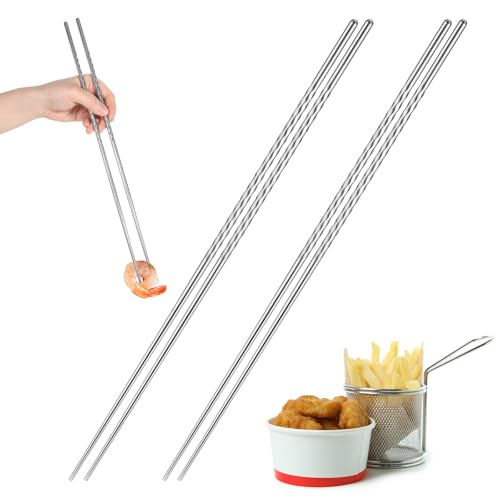
Stainless Steel Long Cooking Chopsticks with Non-Slip Threaded Grip (15.3 Inches, 2 Pairs) — Best for High Heat
Stainless steel is the material for cooks whose heat is serious and whose patience for consumables is not. At fifteen-point-three inches with a non-slip threaded grip section, this pair shrugs off the deep-fryer’s temperatures indefinitely, goes in the dishwasher without a thought, never absorbs the ghost of last week’s garlic oil, and will be in the drawer, unchanged, when the wooden sets have been replaced twice. The threaded grip answers steel’s traditional flaw — slipperiness — exactly where the hand holds, and the length keeps the hand’s climate temperate even over open flame work.
Steel’s terms must be accepted with open eyes. It conducts some warmth down its length over long frying sessions — noticeably less dangerous than its reputation, noticeably more present than wood’s silence — and it is the one material here that non-stick coatings have opinions about: use it in stainless, carbon steel, cast iron and enamel with confidence, and keep it out of delicate non-stick pans, where the wooden picks are the correct citizens. Its touch on food is also firmer; tempura survives it happily, silken tofu prefers wood’s diplomacy.
Choose steel when the cooking is hottest, the sessions are longest, or the household’s religion is dishwasher-everything. It is the permanence pick of the category, and in a heavy-frying kitchen it is not close.
Strengths
- Stainless steel: indefinite heat tolerance, dishwasher-proof, no flavour memory
- Threaded non-slip grip solves steel’s slipperiness at the hand
- 15.3-inch length covers frying and hotpot with margin
Trade-offs
- Conducts warmth on long frying sessions, unlike wood
- Keep out of delicate non-stick pans — use the wooden picks there
- Firmer touch — silken foods prefer wood
| Specification | Detail |
|---|---|
| Material | Stainless steel |
| Length | 15.3 inches |
| Quantity | 2 pairs |
| Grip | Non-slip threaded (verified title) |
Best for: high-heat frying, hotpot and dishwasher-everything kitchens / Not suited for: delicate non-stick pans and silken-tofu diplomacy
Check the current price on Amazon

Patelai Long Cooking Chopsticks (4 Pairs, 15.3 Inches) — Best Multipack
Real cooking is rarely a solo performance with a single pair of sticks. There is a helper turning dumplings, a second pot coming to the boil, a pair resting in oil that should not travel to the noodle water — and the Patelai four-pack is packed for that kitchen. At fifteen-point-three inches, the pairs carry a genuine cooking length, long enough for frying and hotpot duty, in a quantity that lets a household assign pairs to tasks and people without negotiation.
Multipacks also solve the entropy problem honestly. Cooking chopsticks lead hazardous lives — dropped in oil, scorched at a rim, adopted as plant stakes by persons unknown — and a four-pair set absorbs those losses while keeping the drawer functional. For hotpot households the count has a second meaning: guests cook their own food at the table, and a long pair per guest is both the tradition and the safety equipment, keeping every diner’s hand clear of the communal broth.
Judge this pick as infrastructure rather than instrument: it will not out-feel the Donxote benchmarks pair for pair, and it is not trying to. It is the set that makes a busy, social, multi-pot kitchen work — and in that kitchen it is the first purchase, with a benchmark pair added later for the head cook’s hand.
Strengths
- Four pairs — helpers, multiple pots and hotpot guests all equipped
- 15.3-inch working length suits frying, boiling and hotpot
- Absorbs the losses and scorching of a busy kitchen’s real life
Trade-offs
- Utility-first feel — benchmarks above are finer instruments
- Four pairs to wash, store and eventually sort
- Length is a margin below the 16.5-inch specialists
| Specification | Detail |
|---|---|
| Length | 15.3 inches |
| Quantity | 4 pairs |
| Use | Long cooking chopsticks (verified title) |
| Role | Multipack / hotpot service |
Best for: team cooking, hotpot nights and busy family kitchens / Not suited for: solo cooks wanting one fine instrument — take a Donxote
Check the current price on Amazon

Dicunoy Extra Long Cooking Chopsticks (10 Pairs, 16.5 Inches) — Best for Entertaining and Bulk Use
Some kitchens cook for a crowd, and crowds consume chopsticks the way they consume napkins. The Dicunoy set answers with ten pairs at the full sixteen-and-a-half-inch extra-long format — every hotpot guest equipped at the safe length, every station in a cooking class holding the same tool, every big-batch frying session supplied with rotation pairs while others wash. The verified title’s own list of territories — cooking, frying, hotpot, grilling, camping — reads like the itinerary of a set bought to work everywhere people gather around heat and food.
Bulk changes a tool’s psychology for the better: nobody rations a Dicunoy pair, nobody mourns one, and the host’s attention stays on the guests instead of the utensils. The wooden construction keeps every one of those hands cool and every pan unmarked, and the uniform length means a guest’s first hotpot is conducted at the same safe distance as the host’s hundredth.
Home kitchens cooking for two should buy the benchmarks above and leave this set to its natural citizens: entertainers, teachers, community kitchens, festival stalls and the glorious annual hotpot for fourteen. In those rooms, ten pairs is not excess — it is the correct first line of the shopping list.
Strengths
- Ten pairs at the full 16.5-inch length — crowds fully equipped
- Wooden comfort and pan-safety at every seat and station
- Bulk pricing logic: losses and scorching stop mattering
Trade-offs
- Ten pairs is storage and washing volume a small kitchen feels
- Utility grade — not the connoisseur’s instrument
- Wooden lifespan terms apply across a large fleet
| Specification | Detail |
|---|---|
| Material | Wood |
| Length | 16.5 inches |
| Quantity | 10 pairs |
| Use | Cooking, frying, hotpot, grilling, camping (verified title) |
Best for: hotpot parties, classes, canteens and crowd cooking / Not suited for: couples — the two-pair benchmarks serve you better
Check the current price on Amazon
Comparison Table
| Pick | Badge | Key spec | Best for |
|---|---|---|---|
| Donxote Wooden Cooking Chopsticks (16.5 Inches, 2 Pairs) | Best Overall | Wood, 16.5in, 2 pairs | home cooks wanting the classic all-round cooking chopstick |
| Donxote Cooking Chopsticks with Anti-Slip Design (16.5 Inches, 2 Pairs) | Best for Slippery Work | Wood anti-slip, 16.5in, 2 pairs | frying and wok cooking where oil defeats smooth sticks |
| YOSUKATA Natural Wooden Long Cooking Chopsticks (Set of 3 Pairs: 11.8, 13, 14.2 Inches) | Best Versatile Set | Wood, 3 lengths to 14.2in, 3 pairs | cooks wanting one set that covers sauté, pot and wok |
| Stainless Steel Long Cooking Chopsticks with Non-Slip Threaded Grip (15.3 Inches, 2 Pairs) | Best for High Heat | Stainless steel, 15.3in, 2 pairs | high-heat frying, hotpot and dishwasher-everything kitchens |
| Patelai Long Cooking Chopsticks (4 Pairs, 15.3 Inches) | Best Multipack | 15.3in, 4 pairs multipack | team cooking, hotpot nights and busy family kitchens |
| Dicunoy Extra Long Cooking Chopsticks (10 Pairs, 16.5 Inches) | Best for Entertaining and Bulk Use | Wood, 16.5in, 10 pairs bulk | hotpot parties, classes, canteens and crowd cooking |
How do these cooking chopsticks perform across a season of real cooking?
Donxote benchmark across a season
The pair becomes the hand’s default: noodles, dumplings, stir-fries and breakfast eggs all route through it without a decision being made. The wood darkens honourably, the tips stay true, and the cook’s only regret is the years spent turning individual pieces with a fork.
Anti-slip Donxote across a season
Frying confidence is its season’s story — the dropped-dumpling count falls to near zero and stays there. Cooks report reaching for it pre-emptively whenever oil is involved, which is the surest sign a specialist tool has found its exact job.
YOSUKATA across a season
The set teaches its owner their own hand: most cooks discover a favourite length within a month and a task-map for the other two soon after. The shortest pair quietly becomes a serving favourite, extending the set’s life from stove to table.
Stainless steel across a season
Permanence is the report: unchanged by a season of fierce sessions, unbothered by the dishwasher’s daily cycle, and always the pair chosen when the oil is hottest. Its owner stops thinking of it as a purchase and starts treating it as kitchen infrastructure.
Patelai multipack across a season
The pack’s value shows in the negative space: no session cancelled for a missing pair, no guest under-equipped, no helper improvising with a fork near hot oil. Busy kitchens measure this set in dramas that did not happen.
Dicunoy across a season
For the entertaining household, the bulk set turns hotpot from an equipment anxiety into a standing invitation. Pairs retire, the fleet sails on, and the host’s reputation — the one whose table everyone can cook at — compounds quietly.
The two-drawer moral
Across every pick, the season’s lesson is separation: cooking sticks at the stove, dining sticks at the table, each living its full lifespan in its own climate. Households that enforce the two-drawer rule stop replacing chopsticks altogether — the surest review this category can earn.
A note on replacing wooden cooking sticks
Retirement is a skill too: replace a wooden pair when it splits, warps, holds a permanent oily smell or loses its tip integrity — and replace it without nostalgia, because the tradition itself treats these as honest consumables. Households that keep a spare benchmark pair in the drawer never face a frying night with the wrong tool, which is the entire point of the two-pair format.
What the professionals would add
Ask a noodle-shop cook about this category and the answer is a drawer, not a product: several wooden pairs at the full length, rotated without sentiment, replaced without ceremony, and a personal pair — often the anti-slip pattern — that nobody else touches. This guide’s structure quietly encodes that drawer: benchmark, specialist, steel for the fierce work, multipacks for the crowd. Build the drawer in that order and you have professionalised a home kitchen for less than a single knife.
Why are cooking chopsticks so long?
Heat rises, oil spits and broth steams in a radius around the pan that a dining-length stick forces your hand to occupy. Sixteen and a half inches moves the hand outside that radius while keeping the tips inside the food — the entire engineering of the category in one sentence. Length also buys leverage and reach: across a wok’s far slope, into a stockpot’s depth, down a fryer’s basket zone, all without the wrist entering the weather. The graduated YOSUKATA set exists because not every task wants maximum reach — a sauté pan rewards the control of a shorter lever — but for frying, boiling and hotpot, length is safety, and safety is the spec.
What can cooking chopsticks do that tongs and spatulas cannot?
Precision with gentleness. A tong grips with spring force it chooses, not you; a spatula arrives under food like weather. Chopsticks apply exactly the pressure your fingers decide, to exactly the piece you choose: the single dumpling that is done, the noodle strand that is tangled, the tempura shrimp that must turn now and not in five seconds. They also stir, separate, whisk small quantities, test doneness by feel, plate with tweezers’ accuracy and retrieve from depths no spoon reaches. Cooks who adopt them describe the same conversion: the pan becomes a place of decisions instead of interventions.
- Turning individual frying pieces at their exact moment
- Separating noodles and grains strand by strand in the boil
- Retrieving specific pieces from hotpot and fryer depths
- Testing doneness by resistance — a noodle’s bite, a dumpling’s give
- Plating and garnishing with tweezer precision
Wood or stainless steel for cooking chopsticks?
Wood for feel and for coatings; steel for heat and for permanence. Wood stays cool, moves quietly, forgives delicate food and respects non-stick surfaces, and pays for it with a consumable lifespan over heat. Steel is forever, dishwasher-proof and indifferent to the fiercest oil, and pays with conducted warmth, a firmer touch and an exclusion from delicate non-stick pans. Most serious kitchens end with both — wood as the daily instrument, steel as the high-heat and heavy-session specialist — which is why this guide’s badges divide by task rather than declaring a material winner.
How do you use cooking chopsticks safely?
Keep the grip high and the hand dry — a wet or oily hand on a long lever is the category’s one real hazard, and the anti-slip and threaded-grip picks exist because of it. Never leave wooden sticks soaking in hot oil or resting across a flame’s path; retrieve, rest them on a holder, return. Treat the fryer with the respect of distance the length was bought for: no reaching across a boiling pot’s steam column, no crowded pans where turning room disappears. And keep cooking sticks for cooking — the pair that lives at the stove should never be a guest’s dining pair that wandered.
How long do cooking chopsticks last, and how should they be cared for?
Wooden cooking sticks are professional consumables: washed promptly, dried upright, kept out of prolonged soaking, they serve through many months of regular frying before heat and oil retire them — darkening is cosmetic, but splitting, warping or a persistent oily smell is a retirement notice. Steel is effectively permanent with ordinary washing. All materials share one care rule that matters more than the rest: never leave a cooking stick sitting in the pan between tasks, because resting in hot oil ages a wooden stick more in ten minutes than a month of honest frying.
How do cooking chopsticks handle eggs, batter and other delicate work?
This is where the tool leaves every rival behind. A beaten egg folded in the pan with sticks becomes the soft, layered curds of a proper tamagoyaki or a silken scramble, because the sticks stir in ribbons instead of scraping in sheets. Batter work — lifting a tempura piece without stripping its coat, swirling a frying morsel to set its crust evenly — is done by contact so light it barely qualifies as touching. Even plating benefits: the sticks that cooked the food can arrange it, moving from pan to plate without a tool change, which is why restaurant kitchens that plate with chopsticks produce food that looks handled by intention rather than by equipment.
What about grilling, steaming and serving with long chopsticks?
At the grill, long wooden sticks turn skewers and small pieces with a precision tongs cannot match, keeping hands at the category’s safe distance — the Dicunoy’s verified territory list includes grilling for exactly this reason. In the steamer, they retrieve the dumpling that has slid to the basket’s far edge without collapsing its neighbours or scalding the retrieving hand. At the table, the longer YOSUKATA pairs serve from shared dishes with a reach and delicacy that serving spoons abandon. One tool, four stations — the economy of the long chopstick is that it keeps being the right shape for the next job.
How to cook with chopsticks: the five core techniques
The grip is the dining grip — one stick still, one stick moving — at a longer address. These five techniques cover the overwhelming majority of what cooking chopsticks are actually for, and each is learnable in a single session at the stove.
- The noodle separation: as noodles enter boiling water, stir immediately with a slow figure-eight, then lift and shake small bundles apart. Repeat at intervals so strands cook as individuals, not as a brick.
- The fryer’s turn: work piece by piece in a loose circle, turning each item once at its moment — judged by colour and the sound’s pitch — and lifting finished pieces to drain at the pan’s edge for two breaths before plating.
- The wok toss-assist: use the sticks in the non-dominant hand to lift and turn while the spatula drives, or alone for small batches — sliding under ingredients and folding them toward you, keeping the far slope of the wok in play.
- The hotpot retrieve: commit to one piece at a time, grip firmly before lifting, pause a breath above the broth to drain, and travel low and slow to the bowl. Communal pots reward patience and punish swinging.
- The doneness test: pinch a noodle against the pot’s side and feel its give; press a dumpling for spring; lift a piece of vegetable and watch its bend. The sticks transmit texture your eyes cannot see through steam — this is the technique that makes cooks evangelists.
Practise the set on a forgiving first menu — a noodle soup, a batch of pan-fried dumplings — and the hand will calibrate itself within the meal. Within a month of regular use, most cooks report the sticks have replaced two other tools in the drawer and demoted the tongs to barbecue-only duty, which is the category’s quiet definition of success.
Store the cooking pairs where the cooking happens — a crock by the stove or the top kitchen drawer — and never back in the dining drawer, even once, even washed. Tools live where they are used; the one time a cooking pair winters with the dining sets is the night a guest eats with the smell of last week’s fryer, and both drawers deserve better management than that.
Common Buying Mistakes
- Using dining chopsticks at the stove. Pan heat destroys dining pairs in minutes — warping, scorching and ruined tips — and their length puts your hand in the weather. The two drawers exist for a reason.
- Choosing steel for a delicate non-stick pan. Metal marks and eventually ruins fine coatings. Non-stick belongs to the wooden picks; steel owns the stainless, carbon and cast-iron territory.
- Leaving wooden sticks resting in hot oil. A stick parked in the fryer ages faster than a month of cooking. Retrieve, rest on a holder, return — every time.
- Overcrowding the pan and then blaming the sticks. Chopsticks turn pieces one by one; a pan with no turning room defeats the tool and the cook. Fry in batches the sticks can conduct.
- Soaking wooden cooking sticks overnight. Prolonged soaking swells and splits wood. Wash promptly, dry upright, and let the dishwasher belong to the steel set.
- Buying dining-length sticks labelled for cooking. Length is the category. A ten-inch stick at a fryer is a dining stick in danger, whatever its title claims — verify the inches in the listing, as this guide’s picks were verified.
- Storing cooking sticks in a steamy crock by the hob permanently. Constant ambient steam ages wood between sessions. A drawer or a crock away from the steam’s direct path keeps the fleet drier and longer-lived.
Final Recommendation
Start with the Donxote benchmark at sixteen and a half inches — or its anti-slip twin if your cooking lives in oil — and you own the category’s centre. Add the YOSUKATA graduated set when your pans diversify, the stainless steel when your heat gets serious, and the Patelai or Dicunoy multipacks when your kitchen fills with helpers and guests. Kept apart from the dining drawer and used with the five techniques above, cooking chopsticks will quietly become the tool your hand reaches for first — as they have been, for a very long time, in the kitchens that invented them.
Buy the length your hottest vessel demands, in the material your pans allow, in the quantity your kitchen’s population requires — those three honest answers, and nothing else, separate the six picks above. Get them right and the humblest tool in this entire programme becomes, improbably, the one your hand reaches for most.
- Donxote Wooden 16.5in — Best Overall: Check the current price on Amazon
- YOSUKATA Graduated Set — Best Versatile Set: Check the current price on Amazon
- Stainless Steel Long — Best for High Heat: Check the current price on Amazon
Keep researching within this range: Best Chopsticks Dishwasher Safe Best Chopsticks For Beginners Best Long Chopsticks Best Wooden Chopsticks Best Chopsticks For Hotpot
Frequently Asked Questions
What length of cooking chopsticks should I buy?
Sixteen and a half inches is the classic full length for frying, boiling and hotpot, and the safest default. Fifteen-point-three suits most home pans with a little less margin; graduated shorter lengths serve sautéing and serving. Match the longest tool to your deepest, hottest vessel.
Can I use cooking chopsticks in a non-stick pan?
Wooden ones, yes — wood is the non-stick-friendly material and a traditional pairing. Keep stainless steel sticks for stainless, carbon steel, cast iron and enamel pans, where they cannot harm the surface.
Are cooking chopsticks hard to learn if I already eat with chopsticks?
No — the grip is identical and the length is the only new variable. Most dining users are competent at the stove within one meal and fluent within a few, because the hand already knows the pattern and only the lever has changed.
How many pairs of cooking chopsticks does a kitchen need?
Two working pairs cover a solo cook completely — one in play, one resting. Add multipacks when helpers, second pots or hotpot guests enter the picture; the Patelai and Dicunoy sets exist for those kitchens.
Can cooking chopsticks go in the dishwasher?
The stainless steel pick can, indefinitely. Wooden cooking sticks should be washed promptly by hand and dried upright — heat, detergent and soaking are the three forces that shorten their working lives.
Why not just use tongs?
Tongs grip with spring force and crush what chopsticks persuade; they also commit to one piece clumsily where sticks select precisely. Tongs keep their place for heavy barbecue work — at the stove and the pot, chopsticks are the finer instrument, which a single tempura session demonstrates permanently.
Do I need different chopsticks for a wok and a deep fryer?
The same 16.5-inch wooden pair serves both well. Add the anti-slip variant if frying dominates, and steel if your fryer sessions are long and fierce — but a single benchmark pair is a complete starting kitchen, not a compromise.
Can beginners cook with chopsticks, or should they master eating first?
Eating first is the kinder sequence — the companion beginners’ guide in this series builds the grip at the table — but cooking forgives more than it appears to, because the food is larger and the pace is yours. A confident eater is usually a competent stove hand within one session.

