Disclosure: airfryerkitchensupply.com is reader-supported. When you buy through links on our site, we may earn an affiliate commission at no extra cost to you.
The best chopsticks for your kitchen depend on three honest answers: what you eat, what you cook, and how you wash up. Chopsticks are the world’s oldest precision utensil, and the modern market has specialised them — fiberglass pairs that live in dishwashers, bamboo pairs that carry a thousand years of table tradition, stainless pairs that will outlive their owners, titanium pairs built for backpacks, and sixteen-inch cooking pairs that turn a wok into an extension of your hand. This guide ranks the best across those jobs, so the pair you buy is the pair your actual life needed.
Every pick was confirmed on the airfryerkitchensupply.com account, with the product matched against the listed title before its ASIN was recorded. Prices are never printed here; check the current price on Amazon for the set you choose. The roundup deliberately spans materials and roles — an overall winner, the best wooden, metal, premium-travel and budget sets, and the cooking pair no serious wok household should be without — because a single ‘best chopstick’ is a fiction this guide declines to sell.
If your search is narrower than this page — Chinese tradition, Chinese style, or trainers for a child — the sibling guides in this cluster go deeper, and they are linked at the end. This is the map of the whole territory, drawn carefully enough that most households can simply buy from it.
Where to buy
The confirmed picks in this guide are sold through Amazon, where you can check the current price on Amazon for each set and confirm length, material and pair count on the listing. Start with these confirmed options:
- HIWARE 10 Pairs Fiberglass Chopsticks, Black, 9.5 Inches — Best Overall: Check the current price on Amazon
- GLAMFIELDS Japanese Natural Wooden Chopsticks, 5 Pairs, 8.8 Inches — Best Wooden: Check the current price on Amazon
- MUYOS Stainless Steel Chopsticks, 5 Pairs, Silver — Best Metal: Check the current price on Amazon
- Snow Peak Titanium Chopsticks — Best Premium & Travel: Check the current price on Amazon
- Antner 5 Pairs Natural Bamboo Chopsticks, 8.8 Inches — Best Budget Bamboo: Check the current price on Amazon
- Donxote Wooden Cooking Chopsticks, 16.5 Inches, 2 Pairs — Best for Cooking: Check the current price on Amazon
Chopstick listings are a dimensions game: the same photograph can illustrate an 8.8-inch Japanese set and a 10.5-inch Chinese one. Confirm the inches and the material on the page for whichever pick you choose — the reviews below state both as verified from the listing titles, so your shortlist starts from solid ground.
In this guide
Quick Picks
- Best Overall: HIWARE 10 Pairs Fiberglass Chopsticks, Black, 9.5 Inches — The set that ends the search for most households: grippy, indestructible, dishwasher-native — Check the current price on Amazon
- Best Wooden: GLAMFIELDS Japanese Natural Wooden Chopsticks, 5 Pairs, 8.8 Inches — Hand-carved natural wood in the classic Japanese format — the warmest hand-feel here — Check the current price on Amazon
- Best Metal: MUYOS Stainless Steel Chopsticks, 5 Pairs, Silver — Hollow-core stainless — metal’s hygiene and permanence without the hand fatigue — Check the current price on Amazon
- Best Premium & Travel: Snow Peak Titanium Chopsticks — A 22-gram titanium pair with its own case, from the Japanese outdoor outfitter — Check the current price on Amazon
- Best Budget Bamboo: Antner 5 Pairs Natural Bamboo Chopsticks, 8.8 Inches — Natural bamboo in a five-pair gift set at the gentlest tier in this guide — Check the current price on Amazon
- Best for Cooking: Donxote Wooden Cooking Chopsticks, 16.5 Inches, 2 Pairs — Sixteen and a half inches of wooden reach for woks, fryers and noodle pots — Check the current price on Amazon
How These Picks Were Chosen
Picks were chosen by role, because chopsticks have roles. The roundup fills six of them: the best overall set for a modern household, the best wooden set, the best metal set, the best premium and travel set, the best budget bamboo set, and the best cooking pair. Within each role, candidates were judged on grip, length appropriateness, material honesty, care burden and value logic, and every finalist was verified by brand and product.
Two principles governed the judging. First, a set had to be good at being what it is — the titanium pick is not penalised for its price because travel gear is judged as travel gear; the bamboo pick is not penalised for mortality because bamboo is a consumable by nature. Second, no set was admitted on a title’s adjectives: lengths, materials and counts come from the verified Amazon titles, and where a listing’s language is loose, the review says what is actually known.
Excluded: disposable bulk (a catering purchase, not a utensil), children’s trainers (their own guide), and novelty chopsticks whose function is a joke. What remains is a shortlist a household can buy from once and use for years — which is the only promise a guide like this should make.
The 6 Best Chopsticks

HIWARE 10 Pairs Fiberglass Chopsticks, Black, 9.5 Inches — Best Overall
HIWARE’s fiberglass set is the best overall chopsticks for the way most households actually live: ten pairs at a versatile 9.5 inches, with textured tips that grip noodles honestly, in a material that goes through the dishwasher nightly and emerges unchanged for years. It suits families, beginners and veterans alike — the rare set with no learning curve, no care ritual and no replacement schedule.
Strengths
- Fiberglass shrugs off heat, water, stains and dishwashers — the lowest-maintenance material in the category
- Non-slip tips give beginners confidence and veterans precision
- Ten uniform pairs stock a family drawer in one purchase
Trade-offs
- No natural-material warmth or tradition in the hand
- 9.5 inches is mid-length: ideal for dining, short for wok cooking
- Uniform black is practical rather than decorative
Key specs: 10 pairs, fiberglass, 9.5 inches, black, dishwasher safe (per Amazon title)
Fiberglass won the overall slot by removing every friction from chopstick ownership. Wood asks for drying rituals, steel asks for technique, porcelain asks for care — fiberglass asks for nothing and delivers grip that beginners feel immediately and control that experienced users respect. The restaurant trade reached this conclusion years ago, which is why so many working Chinese and Japanese kitchens run fiberglass; HIWARE’s set is that professional logic in a home package, at a home quantity.
Buy it as your household’s default and the chopstick question closes: guests get a proper pair, children graduate onto them from trainers, the dishwasher never lacks a full set, and the drawer never holds a mismatched survivor. Add specialised sets later only if a specific job demands them — the cooking pair below is the usual first addition. As a single purchase for a household starting from zero, nothing in this guide serves more meals per dollar.
Best for: most households, beginners, families — the default set / Not suited for: traditionalists who want natural materials, or dedicated cooks needing length
Check the current price on Amazon

GLAMFIELDS Japanese Natural Wooden Chopsticks, 5 Pairs, 8.8 Inches — Best Wooden
For buyers who believe a utensil should feel alive in the hand, GLAMFIELDS’ hand-carved wooden set is the pick: five pairs of natural wood at the Japanese 8.8-inch length, light, warm and quietly individual — no two pairs share exactly the same grain. It suits individual-bowl dining, sushi and Japanese home cooking, and any table where wood’s softness against porcelain is part of the meal’s calm.
Strengths
- Natural wood warmth and silence — no clicking on bowls, no chill in the hand
- Hand-carved character in a giftable five-pair set
- Shorter Japanese length is precise and nimble for individual servings
Trade-offs
- Wood is porous and mortal: hand-wash, dry upright, replace as it ages
- 8.8 inches is short for shared Chinese dishes and hot pot reach
- Five pairs is a household set, not a hosting arsenal
Key specs: 5 pairs, natural wood, hand-carved, 8.8 inches, gift set (per Amazon title)
Wood’s case is sensory, and this set makes it well. A wooden pair weighs almost nothing, arrives at room temperature in the mouth, and grips food with a friction no manufactured material quite copies — which is why wood remains the connoisseur’s material a millennium after alternatives appeared. The hand-carved finish matters beyond romance: slight facets along the shaft give fingers purchase that a perfectly round, machine-polished stick cannot, a detail you feel in the first bowl of noodles.
Own it on wood’s terms and it will serve graciously: wash by hand when you can, dry it standing, keep it out of soaking water and direct heat, and let its gradual darkening read as patina. The gift-set format also makes it this guide’s easiest recommendation for giving — a present that is beautiful, useful and correctly sized for the Japanese-style meals it will meet. Households whose table is primarily Japanese should start here and add the fiberglass set for the dishwasher days.
Best for: Japanese-style dining, wood lovers, and gift-givers / Not suited for: shared-dish Chinese dining, dishwasher-only households, or hot pot reach
Check the current price on Amazon
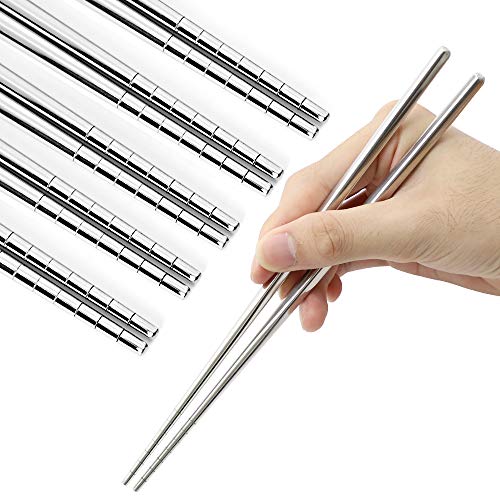
MUYOS Stainless Steel Chopsticks, 5 Pairs, Silver — Best Metal
MUYOS is the metal pick for people who have tried metal before and been defeated by its weight: the hollow-core design keeps stainless steel’s total hygiene and lifetime durability while bringing the weight down to wooden-pair territory. It suits hot pot households, hygiene-first buyers, and anyone who wants to buy chopsticks exactly once and bequeath them.
Strengths
- Stainless steel is the sanitation ceiling — non-porous, dishwasher-immortal, stain-proof
- Hollow core removes metal’s traditional heaviness
- A permanent purchase: these will not warp, fray or fade
Trade-offs
- Smooth metal is slippery on noodles until your pinch technique firms up
- Conducts heat at the hot pot and clicks in a quiet dining room
- Industrial feel divides opinion at traditional tables
Key specs: 5 pairs, stainless steel, hollow-core lightweight design, silver (per Amazon title)
Metal chopsticks are the connoisseur’s argument in the opposite direction from wood: nothing absorbs, nothing ages, nothing needs replacing — the utensil as pure function. The historical objection was ergonomic, and MUYOS’s hollow core answers it so completely that the remaining debate is purely about feel and sound. In broth-heavy cooking the case strengthens further: a steel pair’s fiftieth hot pot dip is identical to its first, a claim no organic material can make.
Expect a one-week technique adjustment — metal rewards a decisive pinch and punishes a lazy one — after which many users find their overall chopstick skill has permanently improved. That training effect makes this set a legitimate purchase even for households that keep wood or fiberglass as their daily drivers. Buy it once, wash it however you like, and remove chopsticks from your household’s list of things that wear out.
Best for: hygiene-first buyers, hot pot regulars, buy-it-for-life households / Not suited for: beginners still building pinch confidence, or quiet traditional tables
Check the current price on Amazon

Snow Peak Titanium Chopsticks — Best Premium & Travel
Snow Peak built its reputation equipping people who carry their kitchen on their backs, and its titanium chopsticks are the category’s premium object: a single pair at 22 grams, in a carrying case, made by a brand whose outdoor gear is collected as much as used. It suits travellers, campers, desk-drawer lunch devotees and anyone who wants one personal pair of chopsticks, for life, that goes everywhere they do.
Strengths
- Titanium is effectively eternal: no rust, no taste, no wear at human timescales
- 22 grams disappears into a bag, pocket or lunch kit
- The included case makes it a true everyday-carry utensil
Trade-offs
- A single pair at a premium tier — this is personal gear, not family stock
- Titanium’s smoothness demands decent technique, like all metal
- Too precious for the communal drawer where pairs go to be lost
Key specs: 1 pair, titanium, 22 grams, carrying case included (per Amazon title)
Judge this pair as equipment, not tableware, and its logic is flawless. Titanium’s heat-reducing property — it conducts warmth poorly compared with steel — means the tips can work in hot food while the hand end stays comfortable, a genuine functional edge at a camp stove or a street-food stall. The weight is the other headline: at 22 grams the pair is lighter than the case it travels in, which is why hikers who count grams still make room for it. Snow Peak’s machining and finish are the best in this guide; you feel it in the first grip.
The ownership model is personal: this is your pair, kept in its case, taken to offices, trips and restaurants whose disposable sticks you would rather decline. That ritual — one perfect tool, carried — is the real product, and for the right person it is worth more than a drawer of sets. If that person is you, no other pick in this guide is even a substitute; if it is not, the fiberglass set will serve you better per dollar and per meal.
Best for: travellers, campers, and everyday-carry devotees wanting one perfect pair / Not suited for: families stocking a drawer, or anyone buying for a household rather than a person
Check the current price on Amazon
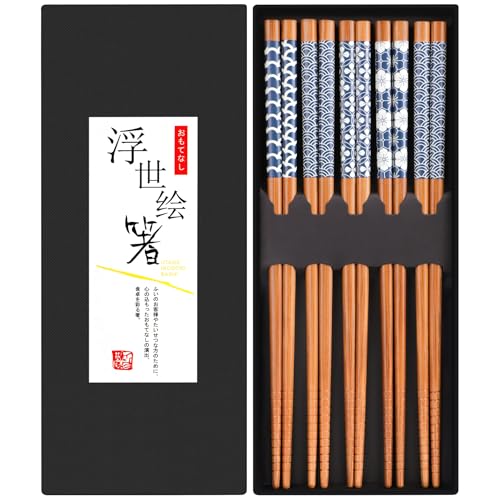
Antner 5 Pairs Natural Bamboo Chopsticks, 8.8 Inches — Best Budget Bamboo
Antner’s bamboo set is the budget-tier doorway into real chopsticks: five pairs of natural bamboo in the classic Japanese style, presented as a gift set, at the kind of tier that lets a household equip itself today and upgrade later without regret. It suits students, first apartments, beginners testing whether chopsticks belong in their kitchen, and anyone who needs decent pairs in several places at once.
Strengths
- Natural bamboo feel — light, warm, grippy — at the guide’s friendliest tier
- Gift-set presentation makes five pairs feel like an occasion, not a compromise
- Dishwasher-safe rating per the listing suits real student and family routines
Trade-offs
- Bamboo mortality applies in full: expect seasons, not decades
- 8.8-inch Japanese length is not the tool for shared dishes or woks
- Budget bamboo varies pair to pair more than premium sets
Key specs: 5 pairs, natural bamboo, 8.8 inches, dishwasher safe per listing, gift set (per Amazon title)
Budget picks earn their place by being honestly good at the basics, and bamboo’s basics are the category’s soul: the grip, the lightness, the quiet. Antner’s set delivers those without the splinters, warps and mouldy surprises that disgrace the true bottom of the bamboo market, in a presentation tidy enough to give. For a beginner, there is a specific mercy in bamboo’s forgiveness — food stays held while technique forms — that neither metal nor porcelain offers at any price.
Treat the set as the consumable it is and it will never disappoint: rotate the pairs, dry them upright, replace the set when tips fray, and count the cost per meal in fractions of cents. Many households discover, somewhere in the second Antner set, that bamboo was their material all along — at which point the wooden pick above is the upgrade path. Others graduate to fiberglass and keep a bamboo set for guests. Either way, this is the correct first five pairs for the money-conscious.
Best for: beginners, students, first kitchens and bamboo-curious households / Not suited for: buyers wanting a permanent set or Chinese-length reach
Check the current price on Amazon

Donxote Wooden Cooking Chopsticks, 16.5 Inches, 2 Pairs — Best for Cooking
Cooking chopsticks are a different tool that happens to share a name, and Donxote’s 16.5-inch wooden pairs are the form perfected: long enough to turn food in a wok or lift noodles from a deep pot while your hand stays out of the steam, wooden so they never scratch a pan or conduct heat, in a two-pair set because a cook wants one in hand and one clean. If you cook East Asian food seriously, this is not an accessory — it is the missing hand tool.
Strengths
- 16.5 inches is the true cooking length: reach without steam-burned knuckles
- Wood is pan-safe on every surface including nonstick, and stays cool to hold
- Two pairs matches kitchen reality — one working, one ready
Trade-offs
- Useless at the table — these are stove tools, full stop
- Wood care rules apply, amplified by kitchen heat and oil
- Long pairs need real storage: a tall crock or a drawer that fits them
Key specs: 2 pairs, wood, 16.5 inches, extra-long cooking format (per Amazon title)
Once a cook learns wok work with long chopsticks, tongs feel like boxing gloves. The Donxote pairs give fingertip-level control at sixteen inches of distance: separating noodle strands as they boil, turning gyoza one by one, retrieving the single mushroom from the fryer at the exact second of doneness, testing a dumpling’s give. Wood is the correct material for all of it — silent, heat-proof in the hand, gentle on every pan surface ever made — and the length is calibrated to home woks and stockpots rather than restaurant ranges.
Keep them at the stove, washed and dried like the wooden tools they are, and a pair lasts years of daily cooking. Pair them — in the shopping sense — with any dining set in this guide and your chopstick kit is complete in the way a knife set is completed by its chef’s knife: the dining pairs serve the meal, these create it. Of all the picks here, this is the one most likely to change how its owner cooks, which is the highest praise a utensil guide can give.
Best for: wok cooks, noodle makers, fryers and anyone who cooks East Asian food seriously / Not suited for: diners only — buy a dining set; this tool never leaves the stove
Check the current price on Amazon
Comparison Table
Sort by role first — daily eating, cooking, travel — then by material, because material decides care, grip and lifespan in one decision.
| Pick | Badge | Key spec | Best for |
|---|---|---|---|
| HIWARE 10 Pairs Fiberglass Chopsticks, Black, 9.5 Inches | Best Overall | Fiberglass, 9.5in, 10 pairs | most households, beginners, families — the default set |
| GLAMFIELDS Japanese Natural Wooden Chopsticks, 5 Pairs, 8.8 Inches | Best Wooden | Natural wood, 8.8in, 5 pairs | Japanese-style dining, wood lovers, and gift-givers |
| MUYOS Stainless Steel Chopsticks, 5 Pairs, Silver | Best Metal | Stainless steel, 5 pairs, hollow-core | hygiene-first buyers, hot pot regulars, buy-it-for-life households |
| Snow Peak Titanium Chopsticks | Best Premium & Travel | Titanium, ultralight, with case | travellers, campers, and everyday-carry devotees wanting one perfect pair |
| Antner 5 Pairs Natural Bamboo Chopsticks, 8.8 Inches | Best Budget Bamboo | Bamboo, 8.8in, 5 pairs | beginners, students, first kitchens and bamboo-curious households |
| Donxote Wooden Cooking Chopsticks, 16.5 Inches, 2 Pairs | Best for Cooking | Wooden cooking, 16.5in, 2 pairs | wok cooks, noodle makers, fryers and anyone who cooks East Asian food seriously |
How to Choose the Best Chopsticks for Your Life
Separate the jobs before spending anything. Dining chopsticks (roughly 8.8 to 10.5 inches depending on tradition) eat; cooking chopsticks (16 inches and up) cook; travel pairs travel. A household that cooks East Asian food needs at least the first two, and the most common buying error in the category is expecting one pair to do both — dining pairs burn knuckles at the wok, cooking pairs are absurd at the table. The picks in this guide are labelled by job; respect the labels and half the decision is already made.
Material is the second decision, and it is really three decisions wearing one coat: grip (textured fiberglass and wood hold slippery food best; smooth metal and porcelain demand technique), care (fiberglass and steel go in the dishwasher forever; wood wants hand-washing and upright drying; porcelain wants to be treated as tableware), and lifespan (titanium and steel are permanent; fiberglass is nearly so; wood and bamboo are honourable consumables). Choose the material whose care rules match the routine your household actually keeps, not the one it aspires to.
Length follows cuisine: Japanese-style individual dining suits 8.8–9.5 inches; Chinese shared-table dining suits 9.5–10.5; smaller hands suit the shorter end of any range. When in doubt, the 9.5-inch middle — this guide’s overall pick’s length — is the dimension the modern market has converged on for mixed households, and convergence at this scale is information, not accident.
Materials Compared: Fiberglass, Wood, Bamboo, Steel, Titanium, Porcelain
Fiberglass is the modern default for a reason: it grips, it survives the dishwasher and the decade, and it asks nothing. Its deficits are romance and tradition, which some tables feel and others never miss. Wood and bamboo are the original materials — warm, light, quiet, kind to cookware — with porosity as their price: they absorb a little of every meal and are replaced on a cycle of months to years. Treat that cycle as the subscription cost of the most pleasant hand-feel in the category.
Steel is the permanence-and-hygiene extreme: nothing absorbs, nothing stains, nothing wears — and the hand must learn its smoothness, which takes a week and improves your technique permanently. Titanium takes steel’s permanence, halves the weight, reduces heat conduction, and prices itself as the premium personal tool it is. Porcelain is tableware thinking: non-porous beauty that chips if you treat it as a tool instead of crockery. Each material in this guide has a pick that represents it at its best, because the category’s honest answer is a shortlist, not a champion.
A practical synthesis most households land on: fiberglass or bamboo for daily dining, wood for cooking length, and one special set — porcelain for the table’s beauty or titanium for the bag — where the heart insists. That trio covers every meal a home produces, and it is assembled from this page for less than a single premium knife.
Grip, Tips and Technique: Getting the Most from Any Pair
All chopstick skill reduces to one arrangement: the lower stick rests motionless on your ring finger and the web of your hand; the upper stick, held like a pencil, does all the moving. If your sticks scissor, the grip — not the material — is the problem, and five minutes of deliberate practice with the bottom stick held still rewires it. Beginners should start on grippy materials (fiberglass, wood, bamboo) whose tips forgive an imperfect pinch; smooth materials are the graduation, not the classroom.
Tip shape trades precision against forgiveness. Fine, tapered tips pick a single sesame seed and slide under fish flakes; squared or textured tips hold noodles and dumplings with less effort. Households that eat mostly noodles and shared dishes should weight grip; households that eat mostly fish and delicate work should weight finesse. Many sets split the difference with a tapered tip and a textured finish — the overall pick’s formula, and not by coincidence.
Care for the grip you bought: do not leave wooden pairs soaking (they swell and roughen), do not use any pair as a lever, can opener or drum kit, and store pairs together so tips are not chipped in a jumbled drawer. Technique and care are the same virtue at different timescales — attention — and both compound quietly into years of service.
Building a Complete Chopstick Kit on Any Budget
The minimal complete kit is two purchases: a dining set in your material and a cooking pair if you cook. Budget tier: the Antner bamboo dining set plus the Donxote cooking pairs equips a kitchen fully for less than a single restaurant dinner for two. Mid tier: the HIWARE fiberglass set as the daily foundation, Donxote at the stove, and the GLAMFIELDS wood set when the table wants warmth. Premium tier: add the Snow Peak titanium as a personal carry and a porcelain set from the Chinese guides for occasions.
Buy pair counts for your real life: five pairs serves a small household, ten serves a family or a hosting habit, and a spare pair at the office or in the travel kit converts more lunches than any other small purchase in the kitchen category. Replace consumable materials on evidence — frayed tips, cracks, lingering odours — rather than on a calendar, and keep one retired pair for paint stirring and plant stakes, where old chopsticks go to be useful forever.
Finally, resist the novelty drawer. Chopstick-shaped objects that light up, fold into animals or promise to teach you in a day are entertainment, and the picks in this guide were chosen against them deliberately. A small kit of honest tools, bought once and used daily, is the entire philosophy — the rest of this programme’s chopstick guides exist for the households that want to go deeper into one tradition, one style, or one small pair of hands.
Chopsticks Around the World: A Two-Minute Field Guide
The picks in this guide make more sense with the world map in view. China’s tradition is the longest and the most communal — shared dishes, woks and hot pots shaped the 10.5-inch wooden standard. Japan’s is the shortest and most precise, individual bowls and a fish cuisine rewarding fine tips and an 8.8-inch hand. Korea’s is the metal outlier — flatter, steel, mid-length pairs evolved beside metal bowls, barbecue and fiery stews that punish wood. Southeast Asian tables split the difference by dish, chopsticks for noodle soups and spoon-and-fork for rice, a reminder that no culture treats the sticks as a religion.
The modern global market — the one this guide actually shops in — has blended all of it: fiberglass from restaurant supply, titanium from the outdoor industry, Korean steel in Chinese lengths, Japanese carving on bamboo sold everywhere. That blending is why this guide judges by role and material rather than by flag: a household in Ohio or London does not need cultural purity, it needs a dining set that grips, a cooking pair that reaches, and materials its dishwasher can live with. The traditions remain the best design teachers; the picks simply let you hire them all.
One frontier deserves a sentence: sustainability. Reusable chopsticks of any material in this guide displace the disposable pairs that much of the world still burns through by the billion, and the durable picks — steel, titanium, fiberglass — make that displacement permanent rather than seasonal. The oldest utensil on earth turns out to be a thoroughly modern answer to a modern problem, which is a satisfying place for a buying guide to end up.
The Chopstick Drawer Audit: What to Keep, Replace and Add
Open the drawer and apply this guide’s logic as an audit. Keep: any pair whose tips are smooth, whose length suits a job you actually do, and whose material you would buy again — including the odd beloved single whose partner is lost, demoted to plant stakes and paint stirring with honour. Replace: anything frayed, cracked, warped, stained past washing, or chewed by a dishwasher it was never rated for; consumable materials are designed to be retired, and keeping them in food service past their evidence is the one true error in this category.
Add, in order of impact: a cooking pair if the drawer holds only diners (the single largest capability jump available); a grippy daily set if every current pair is smooth and noodles are a household staple; a second dining set in a contrasting material if hosting or occasions regularly expose the main set’s limits; and a personal travel pair if restaurant disposables have begun to annoy you — that annoyance is the market signal the titanium pick exists to answer.
The audit’s destination is a small, complete kit in which every pair has a job and every job has a pair — the state this guide’s final recommendation describes. Drawers that reach it stop accumulating, because there is nothing left for a random purchase to improve. That quiet completeness, applied to a four-thousand-year-old tool, is the real best-chopsticks answer; the six picks above are simply the fastest route to it from wherever your drawer stands today.
A Short Buyer’s Glossary: Terms Listings Use and What They Mean
Listings in this category speak a dialect, and fluency saves money. ‘Fiberglass’ in chopsticks means a glass-fibre composite — light, hard, dishwasher-proof, and the restaurant trade’s standard. ‘Iron wood’ names a family of very dense hardwoods, not one species; expect weight and durability, and variation between makers. ‘Bone china’ is porcelain with bone ash in the body, giving whiteness and translucency; ‘porcelain’ and ‘ceramic’ in listings usually describe the same high-fired family at tableware grade. ‘Hollow-core’ in metal pairs means the shaft is a tube, not a rod — the weight saving is the point, and it is a feature, not a shortcut.
Dimension language needs the same care: length is always the full stick, tip to end, and a listing that will not state it plainly is telling you something. ‘Pairs’ means pairs — a ’10 set’ that means ten sticks exists in the wild, which is why this guide verified counts from Amazon titles and still tells you to confirm on the page. ‘Dishwasher safe’ on wood means survivable, not recommended; on fiberglass and steel it means genuinely indifferent. Read listings the way this guide read them — dimensions and materials as facts, adjectives as weather — and the category becomes one of the most honest in the kitchen.
How to Use Chopsticks Well: The Five-Minute Foundation
Every expert hand you have ever admired runs on the same simple mechanics. Install them once, with any dining pair from this guide, and every cuisine that follows is just practice.
- Rest the bottom stick across the base of your thumb and the tip of your ring finger. Lock it there mentally: this stick is a shelf, and shelves do not move.
- Hold the top stick like a pencil — thumb, index, middle — resting above the shelf stick. Wiggle it: the tips should open and close like a beak.
- Check the meeting. Close slowly and watch the tips meet point to point. Crossing tips mean the top stick sits too low in your fingers; slide it up slightly and try again.
- Lift something forgiving. A peanut, a chunk of broccoli, a marshmallow. Success first, noodles later — confidence is a technique ingredient.
- Graduate the targets. Dumplings, then noodles (small bundles, lifted and settled, never chased strand by strand), then the final exam: a single pea, a slice of sashimi, an ice cube for applause.
- Mind the table manners. Never spear food, never stick chopsticks upright in rice, pass food with the serving pair or your own pair reversed — three rules that mark a considerate diner in every chopstick culture.
- Practise inside meals, not instead of them. Ten real dinners will take you further than any drill, and the fork stays available without shame the whole way.
Within a fortnight of meals, the beak becomes thoughtless — which is the definition of skill in every utensil. If one material keeps defeating you, change the material before you blame the hand: grippy fiberglass or wood has rescued more learners than any tutorial, and the metal pairs will still be there, patiently, when your pinch is ready for them.
Common Buying Mistakes
Chopstick buying mistakes are small, cheap and completely avoidable — which makes them the most annoying kind. These are the six that fill drawers with regret.
- Buying one pair for every job. Dining pairs at the wok burn hands; cooking pairs at the table are comedy. Two tools, two lengths, no exceptions.
- Choosing smooth metal as a first pair. Steel and titanium punish a forming pinch. Learn on fiberglass, wood or bamboo; graduate to metal when the grip is honest.
- Ignoring the inches. An 8.8-inch set at a shared Chinese table, a 10.5 at a sushi counter — length is tradition made physical. Read dimensions, not adjectives.
- Dishwashing wood on principle. If your household machine-washes everything, buy the materials that thrive on it. Do not wage a care war your utensils will lose.
- Keeping frayed pairs in service. Split, cracked or roughened tips belong in the garden, not near food. Consumable materials are cheap precisely so you will replace them.
- Storing pairs loose and mixed. The jumbled drawer chips tips, loses partners and shortens every set’s life. A holder or insert is the cheapest upgrade in the category.
Final Recommendation
If you buy one thing from this guide, buy the HIWARE fiberglass set: it is the daily answer for most households, full stop. Add the Donxote cooking pairs the day you next face a wok, and your kit is functionally complete. From there, follow your table’s heart — GLAMFIELDS wood for warmth, MUYOS steel for permanence, Antner bamboo for the gentlest entry, Snow Peak titanium for the pair that travels through life with you.
Every pick was verified, with lengths and materials taken from the verified titles — check the current price on Amazon, confirm the inches on the page, and match the material to the routine your household truly keeps. Do that, and the oldest utensil in the world will feel, within a week of dinners, like it was designed for your hand. Because across four thousand years of refinement, it was.
Keep exploring the cluster: Best Chinese Chopsticks Best Chinese Style Chopsticks Best Children’s Chopsticks Best Bamboo Chopsticks Best Ceramic Chopsticks Best Stainless Steel Chopsticks
Frequently Asked Questions
What are the best chopsticks for beginners?
Grippy, mid-length, forgiving ones: fiberglass or bamboo at about 9.5 inches. The HIWARE fiberglass pick is this guide’s beginner default because its textured tips hold food while technique forms and it survives the dishwasher era of a learner’s kitchen. Avoid smooth metal until your pinch is confident.
What length chopsticks should I buy?
Match length to tradition and table: 8.8–9.5 inches for Japanese-style individual dining, 9.5–10.5 for Chinese shared dishes, 16-plus for cooking. Mixed households eating mixed cuisines are best served by the 9.5-inch middle for dining plus a dedicated cooking pair.
Which chopstick material lasts longest?
Titanium and stainless steel are effectively permanent; fiberglass is close behind. Wood and bamboo are consumables by nature — months to years depending on care — which their price reflects. Longevity is only one virtue, though: wood’s hand-feel keeps it the connoisseur’s choice despite its mortality.
Are metal chopsticks hard to use?
They are less forgiving, not hard: smooth surfaces demand a firmer, more correct pinch. Most users adjust within a week and find their technique permanently improved. Hollow-core designs like the MUYOS pick remove the weight problem, leaving only the grip learning curve.
Can chopsticks go in the dishwasher?
Fiberglass and stainless steel sets in this guide are dishwasher-safe without qualification. Bamboo and wood tolerate occasional cycles (one pick here is rated for it) but live far longer hand-washed and dried upright. Porcelain should be treated as the tableware it is.
How many pairs of chopsticks does a household need?
Five pairs covers a small household; ten covers families and hosts. Add a cooking pair if you cook East Asian food, and a personal travel pair if you eat out often. More important than the count is the rotation: pairs that rest between uses outlast pairs in constant service.
Do expensive chopsticks actually perform better?
Up to a point, and the point arrives quickly. Beyond honest materials and correct dimensions — which the budget picks in this guide already deliver — money buys refinement: better finish, better balance, rarer materials and, in titanium’s case, genuine engineering. It does not buy a different grip or a longer reach. Spend first on having the right pairs for each job; spend on refinement only when a specific set has earned your affection.
Should I buy chopsticks with rests included?
If you set a table with any ceremony at all, rests are worth having: they keep tips off the surface, pairs aligned, and porcelain off hard edges. Some gift-format sets include them; most working sets do not, and rests are inexpensive bought separately in ceramic, wood or steel to match your pairs. Households that eat at a counter or over bowls can skip them without consequence — rests serve the table, not the eating — but the moment guests sit down, rests are the detail that makes a set look chosen.

