Disclosure: airfryerkitchensupply.com is reader-supported. When you buy through links on our site, we may earn an affiliate commission at no extra cost to you.
Where to buy
If you are shopping for the best chef chopsticks online, buy them where length, material and pair count are stated plainly on the listing. Chef-length cooking chopsticks are stocked thinly by general kitchen retailers, so Amazon is where we recommend buying the verified picks below: lengths, pair counts and materials are stated on the listings, and length is the entire product here. Measure your deepest pan and your usual frying setup before ordering — the right length is the one that keeps your hand clear of your own cookware, not a number from a product title.
- YOSUKATA Natural Wooden Long Cooking Chopsticks (Set of 3 Pairs) — Best Overall: Check on Amazon
- Donxote Wooden Cooking Chopsticks 16.5 Inches (2 Pairs) — Best for Deep Frying: Check on Amazon
- GLAMFIELDS 16.5 Inches Wooden Cooking Chopsticks (2 Pairs) — Best Long Wooden Alternative: Check on Amazon
- Stainless Steel Long Cooking Chopsticks 15.3 Inch (2 Pairs) — Best Metal and Dishwasher Pick: Check on Amazon
- Patelai 4 Pairs Long Cooking Chopsticks 15.3 Inch — Best Value Multi-Pack: Check on Amazon
- Donxote 16.5 Inches Cooking Chopsticks Anti-Slip (2 Pairs) — Best Grip for Hotpot and Noodles: Check on Amazon
Introduction
The best chef chopsticks are not eating chopsticks that wandered into the kitchen. They are a distinct tool — saibashi in Japanese kitchens, long cooking chopsticks across Chinese cooking — built at 15 to 17 inches so your hand works above a wok or fryer while the tips do precision work in hot oil, boiling water and steam. Once a cook has turned frying food with a long pair, tongs feel clumsy by comparison; the chopstick is tongs, fork, whisk and tester in one piece of wood.
Every pick in this guide was verified through Amazon’s catalogue data, and the shortlist is deliberately wood-heavy, because wood is the correct material at the stove: it does not conduct heat to your hand, does not scratch non-stick or enamel, does not melt, and gives the tactile feedback that tells you whether a coating is crisp or a dumpling is set. One stainless steel pick is included for cooks who prioritise dishwasher permanence over feel, badged honestly for that trade.
Length is the decision that matters most, and this guide treats it seriously: too short and your knuckles live over the oil, too long and the pair feels like conducting an orchestra from the balcony. The six picks below span the useful range — a graduated multi-length set, classic 16.5-inch frying pairs, and a 15.3-inch value tier — each badged for the cooking it serves best.
A note on who this guide serves: not only devotees of Asian cooking. Any cook who fries, boils pasta, blanches vegetables, fishes items from jars or turns food in a pan owns the jobs this tool does, and Western kitchens have been quietly adopting the long pair for a generation. If your drawer holds tongs, a fork and a slotted spoon that all annoy you in the same three situations, the long chopstick is probably the tool those situations were asking for.
In this guide
Quick Picks
Six verified cooking pairs, organised by stove job rather than by brand. The badge beside each name matches its full review below — pick by the cooking you actually do, because at the stove the job defines the tool.
- YOSUKATA Natural Wooden Long Cooking Chopsticks (Set of 3 Pairs) — Best Overall. The thinking cook’s set. Three pairs in three graduated lengths, so the tool matches the pan — shorter for saucepans and eggs, longest for the wok — in natural wood from a wok-focused maker. Check on Amazon
- Donxote Wooden Cooking Chopsticks 16.5 Inches (2 Pairs) — Best for Deep Frying. The frying classic. A full 16.5 inches of wood between your hand and the oil, in a two-pair set — the format tempura, fried chicken and spring rolls have always been turned with. Check on Amazon
- GLAMFIELDS 16.5 Inches Wooden Cooking Chopsticks (2 Pairs) — Best Long Wooden Alternative. The same full-length idea from a tableware name. GLAMFIELDS’ 16.5-inch wooden pairs for noodles, frying and hotpot — the alternative long pair, useful when you want a second set or a giftable brand. Check on Amazon
- Stainless Steel Long Cooking Chopsticks 15.3 Inch (2 Pairs) — Best Metal and Dishwasher Pick. The permanence pick. Stainless steel at 15.3 inches with a threaded non-slip grip section — for cooks who want cooking chopsticks that go in the dishwasher and effectively never need replacing. Check on Amazon
- Patelai 4 Pairs Long Cooking Chopsticks 15.3 Inch — Best Value Multi-Pack. Four pairs, one sensible length. The 15.3-inch middle length in a four-pair pack — the teaching-kitchen, shared-house and hot-pot-party pick where several cooks need long pairs at once. Check on Amazon
- Donxote 16.5 Inches Cooking Chopsticks Anti-Slip (2 Pairs) — Best Grip for Hotpot and Noodles. The full-length pair with grip engineered in. Donxote’s anti-slip version of the 16.5-inch wooden classic — for wet, steamy work where a plain pair can twist in the hand. Check on Amazon
What is missing is deliberate: no eating-length pairs pretending to be cooking tools, and no silicone-tipped novelties. Professional kitchens use plain long wood for this work for sound physical reasons, and this shortlist respects those reasons.
How These Picks Were Chosen
Verification came first: each model was confirmed, with length, material and pair count taken from the listing itself. In cooking chopsticks, length claims are the specification, so a listing that hid its length or blurred eating and cooking formats was excluded.
Second, stove criteria replaced table criteria. We weighted heat behaviour — a handle end that stays holdable over a fryer — tip control for turning and retrieving food, length relative to real pans and woks, and whether the pair could also whisk eggs, lift noodles from boiling water and test doneness, because a chef pair earns its place by doing all of those in one service.
Third, material honesty. Wood dominates professional use for physical reasons this guide explains rather than assumes, and the single steel pick is included with its trade-offs stated: permanence and dishwasher ease against heat conduction and pan manners. No pick was allowed to borrow wood’s reputation while being something else.
Fourth, value in pairs. Cooking chopsticks are sold singly, in twos and in bundles, and working cooks genuinely need more than one pair — one in the oil, one resting, one in a partner’s hand. Set sizes were scored as a feature, and prices, which move constantly in this niche, are handled with check price on Amazon throughout.
Heat behaviour at the handle end was tested by reasoning cooks actually use: a pair held over frying oil for a full batch should stay comfortable without gloves or grip changes. Wood passes this test by nature; the steel pick is included with the explicit warning that its working zone is water, not oil. Any product that blurred this distinction in its marketing — steel pairs photographed deep-frying bare-handed — was treated as a lesser recommendation for exactly that dishonesty.
The 6 Best Chef Chopsticks

YOSUKATA Natural Wooden Long Cooking Chopsticks (Set of 3 Pairs) — Best Overall
Most cooking-chopstick purchases force one length to serve every pan, and this YOSUKATA set refuses that compromise: three pairs at 11.8, 13 and 14.2 inches, in natural wood, from a maker known for wok equipment. The graduated idea sounds simple and proves, in a week of cooking, to be obviously right.
Strengths
- Three lengths match three real jobs — eggs and saucepans, general frying, deep wok work
- Natural wood gives heat insulation, pan kindness and tactile feedback in one material
- Three pairs means one can be in the oil while another rests — how cooks actually work
Trade-offs
- The longest pair, at 14.2 inches, is shorter than the 16.5-inch deep-frying specialists here
- Natural wood needs hand-washing and drying, like all stove wood
- Graduated sets ask you to build a small habit of choosing — some cooks prefer one pair, always
Key specs
- Material: Natural wood
- Lengths: 11.8, 13 and 14.2 inches (per listing)
- Set size: 3 pairs
- Style: Wok cooking chopsticks (per listing)
The shortest pair quietly becomes the most used: at 11.8 inches it is a superb saucepan and egg tool, closer to an extension of the hand than a reach tool. The 14.2-inch pair handles wok tossing and frying with proper clearance. Owning the gradient teaches you your own preferences faster than any review can, which is why this set is the guide’s top pick for cooks building the skill.
The graduated set also future-proofs a growing cook: the beginner lives on the short pair, the confident cook migrates to the long one, and the set grows with the skill instead of being replaced by it. YOSUKATA’s wok focus shows in proportions that favour control over decoration — these are tools that expect to be worked, oiled by use and darkened honestly at the tips over time. That patina is the signature of a real kitchen, and this set earns it gracefully.
Best for: home chefs who cook widely and want the right length per pan / Not suited for: deep-frying specialists who need maximum 16.5-inch clearance
Check on Amazon — check the current price on Amazon before you buy, and confirm the pair count and length on the listing, because sellers in this category adjust bundle sizes often.

Donxote Wooden Cooking Chopsticks 16.5 Inches (2 Pairs) — Best for Deep Frying
When the job is hot oil, length is safety, and this Donxote pair brings the classic full measure: 16.5 inches, wooden, sold as two pairs. It is the long-standing reference format for frying and noodle work — the pair that keeps knuckles cool while tips turn tempura with fingertip precision.
Strengths
- Full 16.5-inch length gives the greatest hand-to-oil distance in this guide
- Wood tips turn delicate frying food without tearing coatings the way tongs do
- Two pairs included, so one works while one rests, as frying rhythm demands
Trade-offs
- At 16.5 inches the pair is unwieldy in small saucepans and tight kitchens
- Plain wood asks for hand-washing and thorough drying after oily work
- Long pairs store awkwardly in standard utensil crocks — expect them to live diagonally
Key specs
- Material: Wood
- Length: 16.5 inches
- Set size: 2 pairs
- Use: Noodles, kitchen cooking, frying (per listing)
Frying is where cooking chopsticks convert sceptics: a battered piece can be lifted, turned and drained with a delicacy no tong achieves, and the wood tells your fingers when a crust has set. The 16.5-inch length also makes this the hot-pot and noodle-boiling pair of the guide — retrieving a tangle from a tall pot is exactly its home ground. If you fry weekly, this is your pair; the YOSUKATA set is for everyone who cooks everything.
There is a rhythm to frying with two pairs that professionals take for granted: one pair works the oil, the other rests across the draining rack, and hands alternate without ever setting a hot, oily tool on the counter. This set is sold in exactly that configuration, which suggests its maker understands the work. Home fryers who adopt the two-pair rhythm find their station cleaner and their timing calmer within a single session.
Best for: frying, tempura, hot pot and tall-pot noodle work / Not suited for: small-pan cooks who rarely fry
Check on Amazon — check the current price on Amazon before you buy, and confirm the pair count and length on the listing, because sellers in this category adjust bundle sizes often.

GLAMFIELDS 16.5 Inches Wooden Cooking Chopsticks (2 Pairs) — Best Long Wooden Alternative
Two verified 16.5-inch wooden options is not duplication; in a working kitchen the long pair is the most borrowed, most misplaced and most worth doubling. This GLAMFIELDS set matches the classic format — extra-long wood, two pairs, explicitly for noodles, frying and hotpot — from a brand many readers will know from the eating-chopstick guides in this cluster.
Strengths
- Full 16.5-inch reach for frying and hotpot, in the proven wooden format
- Two pairs per set supports the work-and-rest rhythm of real cooking
- Brand continuity for households already using GLAMFIELDS eating pairs
Trade-offs
- Functionally close to the Donxote pick — choose on availability and hand feel
- Same wood care contract: hand-wash, dry well, retire when tips char or split
- Too long for small pans, like every full-length pair here
Key specs
- Material: Wood
- Length: 16.5 inches
- Set size: 2 pairs
- Use: Noodles, frying, hotpot (per listing)
The honest role of this pick is depth of bench: buy it as your second long set, your hot-pot-night set, or your first set if the Donxote is out of stock — the format matters more than the label at this length. Hot-pot hosts in particular will find two pairs per diner-group transforms the meal, with long pairs serving the pot and eating pairs staying at the plate.
GLAMFIELDS’ presence across both the eating and cooking sides of this cluster is a practical convenience for households standardising their drawer: one brand’s lengths and finishes to learn, one reordering habit. The cooking pair itself is unpretentious in the right way — plain wood, honest length, no coatings at the working end — which is precisely the specification a professional would write. Sometimes the best review of a tool is that there is nothing to criticise.
Best for: hot-pot hosts and cooks wanting a second full-length set / Not suited for: minimalists who keep exactly one pair per tool
Check on Amazon — check the current price on Amazon before you buy, and confirm the pair count and length on the listing, because sellers in this category adjust bundle sizes often.
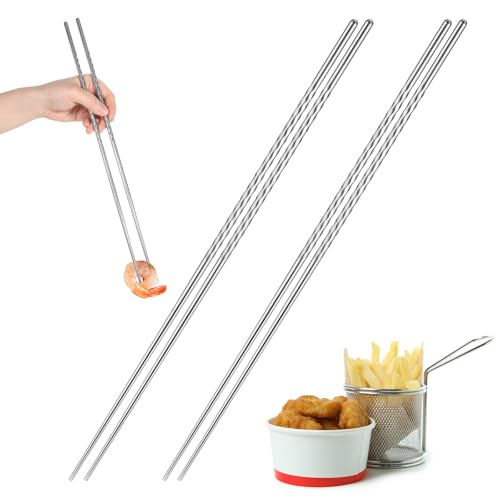
Stainless Steel Long Cooking Chopsticks 15.3 Inch (2 Pairs) — Best Metal and Dishwasher Pick
Every material argument has two sides, and this is steel’s: a 15.3-inch stainless cooking pair with a threaded non-slip section, built to be washed any way you like and to outlast a drawer of wooden pairs. For cooks whose kitchens run on dishwashers and who cook more with steam and boiling water than with deep oil, it is a rational first choice.
Strengths
- Stainless steel is effectively permanent and fully dishwasher-proof
- Threaded grip section addresses metal’s slipperiness at the handle end
- Excellent for boiling, steaming and hot-pot work where wood eventually tires
Trade-offs
- Steel conducts heat — over a fryer the handle end warms up in a way wood never does
- Metal can scratch non-stick and enamel surfaces that wood would never mark
- Heavier and less tactile than wood; you feel the food less through it
Key specs
- Material: Stainless steel
- Length: 15.3 inches
- Set size: 2 pairs
- Grip: Non-slip threaded (per listing)
Place this pair where it is strong: the noodle pot, the steamer, the hot pot, the dishwasher afterwards. Keep it out of the non-stick frying pan, where its virtues invert into vices, and it will serve indefinitely. Many complete kitchens end up owning this pair and a wooden pair, using each where the material logic points — which is not indecision, it is how professionals equip a stove.
Steel also owns one job outright: fishing items from boiling water and steamers, repeatedly, all day, without the gradual waterlogging that tires wooden pairs in commercial-style sessions. A home cook running a dumpling marathon or a hot-pot night with constant retrieval will feel that advantage directly. Keep the pair by the pot, keep wood by the pan, and the two materials stop competing and start specialising — which is the mature state of every good kitchen.
Best for: boiling, steaming and hot-pot cooks who want zero-maintenance permanence / Not suited for: non-stick pan frying or cooks who prize tactile feedback
Check on Amazon — check the current price on Amazon before you buy, and confirm the pair count and length on the listing, because sellers in this category adjust bundle sizes often.

Patelai 4 Pairs Long Cooking Chopsticks 15.3 Inch — Best Value Multi-Pack
Some kitchens need one perfect pair; others need four good ones — a couple cooking together, a family hot-pot night, a cook who teaches friends. This Patelai pack answers with four pairs at 15.3 inches, the middle length that fries respectably, boils comfortably and does not overwhelm smaller pans or newer cooks.
Strengths
- Four pairs covers multiple cooks and the work-rest rotation in one purchase
- 15.3-inch length is the most versatile single length for mixed stove work
- Value-tier multi-pack pricing makes loss or damage a non-event
Trade-offs
- Value-tier finishing — expect honest utility rather than the finest tip work
- 15.3 inches gives a little less oil clearance than the 16.5-inch specialists
- Listing detail is thinner than our top picks, so confirm material on the page when ordering
Key specs
- Length: 15.3 inches
- Set size: 4 pairs
- Format: Long cooking chopsticks (per listing)
The multi-pack logic is social as much as economic: long chopsticks are a skill, and skills spread when there are enough tools to go around. A household that puts a long pair in every interested hand at the hot pot will convert more cooks in one evening than a year of owning one precious pair. For that purpose — and for spares, gifts and second kitchens — this pack is the guide’s practical champion.
The four-pack also solves the gift and gateway problem elegantly: a cook who has converted to long chopsticks can hand a pair to a curious friend without diminishing their own station. Tools that spread skills are worth more than tools that merely perform them, and at this tier the generosity costs almost nothing. Expect one of the four to become the household’s beater pair for barbecues and messy jobs — every multi-pack in history has elected one, and it is a useful office.
Best for: shared cooking, hot-pot groups and teaching kitchens / Not suited for: solo perfectionists wanting one finest pair
Check on Amazon — check the current price on Amazon before you buy, and confirm the pair count and length on the listing, because sellers in this category adjust bundle sizes often.

Donxote 16.5 Inches Cooking Chopsticks Anti-Slip (2 Pairs) — Best Grip for Hotpot and Noodles
Hot-pot and noodle work is wet work: steam condenses on the shaft, broth slicks the tips, and a plain long pair can rotate in your fingers at the worst moment. This Donxote variant keeps the classic 16.5-inch wooden format and adds an anti-slip design per the listing — a small change aimed at exactly that failure.
Strengths
- Anti-slip design addresses the real weakness of long pairs in steam and broth
- Full 16.5-inch wooden length for hotpot, frying and noodle retrieval
- Two pairs included for the cook-and-serve rhythm
Trade-offs
- Grip texturing is a help, not a guarantee — technique still does most of the work
- Wood care applies in full, and hotpot pairs live a wet life by definition
- As with all 16.5-inch pairs, small pans need not apply
Key specs
- Material: Wood
- Length: 16.5 inches
- Design: Anti-slip (per listing)
- Set size: 2 pairs
Choose between the two Donxote picks by your dominant cooking: the plain classic for frying, where dry hands and oil argue for the traditional smooth shaft, and this anti-slip variant for hotpot and noodle service, where everything is wet. Owning both is not excess for a serious Asian-food kitchen — it is the difference between a tool drawer and a tool collection that actually matches the menu.
Hot-pot veterans will recognise the specific misery this design targets: the pair that slowly rotates in a steam-damp hand until the tips cross and the meat slice returns to the broth. Anti-slip shaping interrupts that failure at its source. It is a small engineering answer to a real, recurring annoyance, and for households whose long-pair life is mostly wet work, it makes this variant — not the classic — the correct Donxote to own.
Best for: hot-pot hosts and noodle cooks working in steam and broth / Not suited for: dry-heat-only cooks served equally by the classic pair
Check on Amazon — check the current price on Amazon before you buy, and confirm the pair count and length on the listing, because sellers in this category adjust bundle sizes often.
Comparison Table
At the stove, length and material decide everything. Use the table to match the pair to your pans, your heat source and how many cooks share your kitchen.
| Pick | Badge | Key spec | Best for |
|---|---|---|---|
| YOSUKATA Natural Wooden Long Cooking Chopsticks (Set of 3 Pairs) | Best Overall | Natural wood, 3 pairs in 11.8 / 13 / 14.2 in, wok format | home chefs who cook widely and want the right length per pan |
| Donxote Wooden Cooking Chopsticks 16.5 Inches (2 Pairs) | Best for Deep Frying | Wood, extra long 16.5 in, 2 pairs | frying, tempura, hot pot and tall-pot noodle work |
| GLAMFIELDS 16.5 Inches Wooden Cooking Chopsticks (2 Pairs) | Best Long Wooden Alternative | Wood, extra long 16.5 in, 2 pairs, hotpot and frying | hot-pot hosts and cooks wanting a second full-length set |
| Stainless Steel Long Cooking Chopsticks 15.3 Inch (2 Pairs) | Best Metal and Dishwasher Pick | Stainless steel, 15.3 in, threaded non-slip grip, 2 pairs | boiling, steaming and hot-pot cooks who want zero-maintenance permanence |
| Patelai 4 Pairs Long Cooking Chopsticks 15.3 Inch | Best Value Multi-Pack | Long cooking format, 15.3 in, 4 pairs | shared cooking, hot-pot groups and teaching kitchens |
| Donxote 16.5 Inches Cooking Chopsticks Anti-Slip (2 Pairs) | Best Grip for Hotpot and Noodles | Wood, 16.5 in, anti-slip design, 2 pairs, hotpot and frying | hot-pot hosts and noodle cooks working in steam and broth |
The table reduces to two decisions. Length: 16.5 inches for frying and hot pots, graduated or 15.3 inches for everything else. Material: wood for pans and feel, steel for pots and permanence. Every pick here is the right answer to one cell of that grid, which is why this guide resists crowning a single winner for all kitchens — your stove, your pans and your menu have already cast the deciding votes.
How to Choose Chef and Cooking Chopsticks
Choose length from your cookware, not from a chart. Rest your usual frying pan or wok on the stove and mime turning food in it: your hand should clear the rim and the oil’s splash zone with margin. For most home woks and deep pans that lands between 15 and 17 inches. For saucepan work — eggs, blanching, stirring — 12 to 14 inches is more controllable, which is why the graduated YOSUKATA set leads this guide: real kitchens contain both jobs.
Choose wood unless you have a specific reason not to. Wood insulates your hand from heat, never scratches a pan surface, tolerates any cooking temperature a home stove produces, and transmits the small vibrations that tell you a crust has set or a noodle is done. Its costs — hand-washing, eventual replacement — are small and predictable. Steel earns its place for boiling and steaming permanence, and loses it at the non-stick fryer; let the job, not a blanket preference, assign the material.
Judge the tips as you would judge tongs. Cooking tips should be tapered enough to get under frying food, textured or plain according to your wet-or-dry work, and free of lacquer at the working end, since coatings and frying heat are poor companions. A pair whose tips are blunt clubs will tear tempura; a pair whose tips are needle-fine will flex and drop a fried chicken thigh. The middle — a firm, gentle taper — is the professional standard for a reason.
Buy pairs, plural, from the start. Cooking rhythm uses them in rotation, partners cook together, and a dropped pair mid-fry should not end the operation. Two pairs is a working minimum, and the multi-pair sets in this guide are priced to make that painless. A single exquisite pair is a lovely object and a fragile system.
Cooking Chopsticks vs Tongs, Forks and Tweezers
Against tongs, chopsticks win on delicacy and lose on mass. A tong closes with spring force and tears soft coatings; a chopstick pinch is metered by your own fingers, which is why fried and delicate food across Asia is turned with sticks. For a heavy roast or a whole chicken, tongs win without argument — the tools divide the kitchen by food weight and fragility, and a complete kitchen owns both without feeling any contradiction.
Against the fork, chopsticks win on pan manners and multitasking: no scratching, no piercing that leaks juices, and the same tool stirs, separates noodles in the pot, fishes out a taste to test, and plates with precision. Culinary tweezers beat chopsticks for fine plating and nothing else — they are a finishing tool, where the long chopstick is a cooking tool that also finishes respectably.
The honest summary most working cooks reach: long chopsticks become the default hand at an Asian-food stove, tongs keep the grill and the roasts, and the fork returns to the table where it belongs. If you cook stir-fries, noodles, dumplings or fried food weekly and do not own a long pair, it is the cheapest meaningful upgrade left in your kitchen.
The Jobs Cooking Chopsticks Do in a Professional Kitchen
Frying is the headline job, but working cooks reach for the long pair constantly for quieter tasks: separating noodles as they boil so they cook loose rather than clumped, lifting a single strand to test doneness, arranging pieces in a pan so they brown evenly, retrieving the bay leaf, the dropped garlic clove, the tea bag from the mug. Each is a two-second job that tongs do clumsily and a fork does destructively, and across a day of cooking they add up to the tool’s real value.
In Japanese kitchens the long saibashi also mixes and serves: beating eggs with a figure-eight motion that keeps the whites silky, folding delicate ingredients without breaking them, portioning from a shared pot onto small plates with a precision no spoon matches. Chinese wok cooking adds tossing and tasting to the list. The pattern across traditions is the same — the long pair is not a frying accessory but the cook’s general-purpose hand at a distance.
That generality is why this guide recommends the tool even to cooks who rarely deep-fry. If your stove life is stir-fries, noodles, dumplings, eggs and soups, a long pair will still be in your hand daily. Buy it for the frying you imagine, keep it for the hundred small jobs you did not.
Safety at the Stove with Long Chopsticks
Length is the first safety feature, and it only works if the rest of your habits agree: sleeves rolled, the pair held at its back third, food lowered into oil away from your body so the splash falls forward into the pan. Never reach across a hot burner with the pair, and never leave a wooden pair resting in a hot pan while you answer the door — wood left in oil is a fire lesson nobody needs to learn personally.
Wet food and hot oil are the dangerous combination, and chopsticks are actually the safest tool for managing it, because they let you lower pieces gently and individually rather than tipping a bowl’s worth at once. Pat frying food dry as the recipe allows, add pieces in small numbers, and let the pair’s distance do what it was bought to do. Burns in home frying cluster around rushed loading, not around the tool.
Finally, keep the working station honest: a resting spot for the hot pair that is not the stove’s edge, a clear path between pan and draining rack, and retired pairs removed from service the moment their tips weaken. Long chopsticks are among the safest tools at a fryer precisely because they keep the cook distant and deliberate — provided the cook returns the favour by keeping the system around them in order.
Keep one more distinction straight in the drawer: mark your cooking pairs so they are never carried to the table by a helpful guest. A wrap of heat-safe tape at the handle end, or simply storing the long pairs at the stove rather than in the cutlery drawer, preserves both the tools and the table’s hygiene in a single habit.
How to Use Long Cooking Chopsticks at the Stove
Grip a cooking pair further back than an eating pair — the back third is your handle, and the length ahead of it is reach, not leverage to fight with. Keep the same shelf-and-lever technique as at the table: lower stick still, upper stick moving. For frying, lower food away from you, turn once when the crust tells you it is ready, and lift with a slight tilt so oil drains back into the pan rather than onto the stove.
Use the pair as your tester as well as your turner. A noodle lifted and bitten — blown on first — tells you more than any timer; a dumpling’s slight resistance to the pinch tells you its wrapper has set; the gentle bend of a frying piece tells you its crust is done. This is the tactile channel wood provides and the real reason chefs keep the tool: it reports while it works.
Care is stove-simple: wash promptly, especially after oily work, dry thoroughly, and store where the long pairs are not bent under a pile of utensils. Retire a pair whose tips have charred, split or softened — at 16 inches over hot oil, a failing tip is a safety issue, not a cosmetic one. Kept sound, a wooden cooking pair is a years-long companion; kept badly, it is a short one, and the difference is entirely in the drying.
Practise the skill before the oil is hot. A bowl of dried beans or uncooked pasta pieces, five minutes of picking, turning and transferring with the long pair, builds the grip geometry without consequences. Cooks who rehearse this way find the first real frying session calm; cooks who debut at a spitting fryer learn the same lessons with worse feedback. The tool is simple, but it is still a tool, and thirty rehearsals beats one trial by fire.
Common Buying Mistakes
Cooking-chopstick mistakes are mostly category errors — eating tools at the stove, stove tools at the wrong pan. These five are the ones that matter.
Using eating chopsticks for frying. Table length puts your fingers in the splash zone and lacquered tips in frying heat. The burns and the ruined pair both arrive quickly; a long cooking pair exists precisely to prevent them
Buying the longest pair for a small kitchen. A 16.5-inch pair in a tiny saucepan is a wand, not a tool. Match length to your pans — or buy the graduated set and let each pan choose
Taking metal chopsticks to a non-stick pan. Steel tips and non-stick coatings are enemies. Keep the steel pair for pots, steamers and hot pots, and let wood do the pan work
Cooking with a lacquered or coated pair. Decorative finishes and frying heat do not belong together, and flakes of failed coating belong in no one’s dinner. Working ends should be plain wood
Keeping a charred or split pair in service. A weakened tip over hot oil can drop food or fail entirely. Cooking pairs are inexpensive; replace on evidence and cook with sound tools
Final Recommendation
Most cooks should start with the YOSUKATA graduated set: it teaches you your own length preferences while covering nearly every pan in the kitchen. Dedicated fryers should go straight to a 16.5-inch Donxote pair — plain for dry frying work, anti-slip for hotpot and noodles — with the GLAMFIELDS set as bench depth. Boiling-and-steaming cooks who hate maintenance will live happily with the steel pair, and shared kitchens should stock the Patelai four-pack and spread the skill around.
Whichever you choose, keep the pair plain, long and sound, and practise on a week of ordinary dinners. Cooking chopsticks reward that small investment with a level of control at the stove that no other inexpensive tool provides.
Equip in the order your cooking demands: the graduated set if you cook everything, the 16.5-inch pair if you fry, the steel pair if you boil and steam, the multi-pack if you share. Resist the collector’s urge to own every length before owning the skill — one pair used daily for a month teaches more than a rack of lengths used monthly. After that month, you will know exactly which second pair your kitchen is asking for, and it will probably be in this guide.
- YOSUKATA Natural Wooden Long Cooking Chopsticks (Set of 3 Pairs): Check on Amazon
- Donxote Wooden Cooking Chopsticks 16.5 Inches (2 Pairs): Check on Amazon
- GLAMFIELDS 16.5 Inches Wooden Cooking Chopsticks (2 Pairs): Check on Amazon
- Stainless Steel Long Cooking Chopsticks 15.3 Inch (2 Pairs): Check on Amazon
- Patelai 4 Pairs Long Cooking Chopsticks 15.3 Inch: Check on Amazon
- Donxote 16.5 Inches Cooking Chopsticks Anti-Slip (2 Pairs): Check on Amazon
Keep exploring the cluster: Best Chopsticks Best Chopsticks For Cooking Best At Home Chopsticks Best Bamboo Chopsticks Best Authentic Chopsticks Best Ceramic Chopsticks
Frequently Asked Questions
What length should cooking chopsticks be?
For most home woks and frying pans, 15 to 17 inches keeps your hand clear of heat and oil while staying controllable. For saucepan work like eggs and blanching, 12 to 14 inches handles better. If you cook both ways, a graduated set with multiple lengths — the top pick in this guide — is the practical answer rather than a single compromise length.
Why do chefs use chopsticks instead of tongs?
Control and information. A chopstick pinch is metered by your fingers, so it turns delicate frying food without tearing it, and the wood transmits texture — crust set, noodle done, dumpling firm — while you work. Tongs remain better for heavy items and grilling. Most professional kitchens use both, assigning each to the food it serves best.
Can I use regular chopsticks for cooking?
For gentle jobs — stirring eggs, lifting noodles from a small pot — a sturdy plain pair will do in a pinch. For frying and wok work, no: eating length puts your hand too close to the heat, and lacquered or decorated tips suffer in hot oil. A dedicated long pair is inexpensive and removes both problems at once.
Are wooden cooking chopsticks hygienic?
Yes, with normal stove care: wash promptly after use, dry thoroughly, and retire pairs whose tips char, split or stay stained. Wood’s long professional history at the stove is built on exactly that routine. Cooks who want a zero-judgement option can add the stainless pair from this guide for boiling and steaming work.
How do I stop food slipping from long chopsticks?
Grip further back for control, pinch with the tips rather than the shafts, and make sure the food’s surface is as dry as the recipe allows before it meets the pan. For wet work like hotpot, an anti-slip design helps. Most slipping is technique in the first week and disappears as the longer leverage becomes familiar.
How many cooking chopsticks should I own?
Two pairs is the working minimum — one in use, one resting or in a second cook’s hand. Households that host hot-pot nights or cook together regularly will use four happily. Given the modest cost of the multi-pair sets in this guide, depth here is cheap insurance against the dropped-pair moment in the middle of frying.
What is the difference between saibashi and regular chopsticks?
Saibashi are the Japanese kitchen’s dedicated cooking chopsticks: longer than table pairs, usually plain wood, and traditionally used as a connected pair in some forms or two separate long sticks in others. The function matters more than the name — length for heat distance, plain wood for pan safety and feel. Every pick in this guide serves the saibashi role whether or not it carries the word.
Can cooking chopsticks go in the dishwasher?
Wooden pairs should be hand-washed: dishwasher heat and detergent dry the wood and shorten its life, and long pairs fare badly in racks. The stainless steel pick in this guide is the dishwasher-safe exception and the right choice for cooks who consider hand-washing a deal-breaker. For everyone else, a cooking pair rinses clean in seconds — it is among the fastest tools in the kitchen to wash.

