Disclosure: airfryerkitchensupply.com is reader-supported. When you buy through links on our site, we may earn an affiliate commission at no extra cost to you.
Where to buy
If you are shopping for the best at home chopsticks online, buy them where the pair counts, lengths and materials are stated plainly and returns are easy. Every pick in this guide is sold on Amazon, and Amazon is where we recommend buying chopsticks for home use: the pair counts, lengths and materials are stated on the listings, returns are painless if a set arrives warped or mismatched, and you can compare the verified options below side by side before choosing. Buy one good reusable set per regular eater in the house rather than a drawer of mixed takeout pairs, and keep a spare set for guests.
- HIWARE 10 Pairs Fiberglass Chopsticks (Black) — Best Overall: Check on Amazon
- Antner 5 Pairs Natural Bamboo Chopsticks — Best Budget: Check on Amazon
- MUYOS Stainless Steel Chopsticks (Silver) — Best for Slippery Noodles: Check on Amazon
- GLAMFIELDS Japanese Natural Wooden Chopsticks (5 Pairs) — Best Natural Wood Feel: Check on Amazon
- LEETOYI Ceramic Chopsticks Set of 5 (White) — Best for Guests and Table Setting: Check on Amazon
- BALWOO Korean Stainless Steel Chopsticks (5 Sets) — Best for Korean Home Cooking: Check on Amazon
Introduction
Finding the best at home chopsticks sounds trivial until you actually shop for them: the category mixes disposable takeout bundles, restaurant-supply packs, gift-boxed single pairs and genuinely good everyday sets, all photographed to look identical. What separates a set you will reach for nightly from a set that migrates to the back of the drawer is not the product photo. It is the tip texture, the length relative to your bowls, the material’s behaviour in your dishwasher, and whether the pair still feels balanced after six months of daily use.
This guide is deliberately limited to reusable chopsticks suited to home kitchens and home tables. We verified every pick through Amazon’s own catalogue data before writing, matched each model to a clear household job — the daily workhorse, the natural-wood set, the metal set for slippery noodles, the ceramic set for guests — and left out the no-name multipacks whose tips arrive rough and whose lengths vary pair to pair inside the same box.
One honest note up front: there is no single best material. Fiberglass wins on zero-maintenance durability, bamboo and wood win on grip and warmth in the hand, stainless steel wins on hygiene and noodle control once you learn it, and ceramic wins on looks while demanding careful handling. The right answer depends on how your household actually eats, which is why each pick below carries a badge for a specific job instead of a generic ranking.
A word about what this guide is not: it is not a ranking of the prettiest chopsticks on the internet, and it is not a disposable-buying guide wearing a reusable costume. Home chopsticks succeed or fail across hundreds of ordinary meals, so every judgement here — grip, length, washing, storage — is made on behalf of your future ordinary Tuesday, not your next dinner party. The dinner party is covered too, by the ceramic pick, but it was not allowed to outvote the Tuesdays.
In this guide
Quick Picks
Short on time? These are the six sets we would stock in a home kitchen, each with one clear job. The badge beside each name is the same badge used in its full review below, so you can jump straight to the detail that matters to you.
- HIWARE 10 Pairs Fiberglass Chopsticks (Black) — Best Overall. The zero-fuss household default. Ten matched pairs in a practical 9.5-inch length, textured tips that actually grip noodles, and a fiberglass body that goes in the dishwasher nightly without warping, fading or absorbing odours. Check on Amazon
- Antner 5 Pairs Natural Bamboo Chopsticks — Best Budget. The low-cost way into a proper reusable set. Natural bamboo in a shorter Japanese-style 8.8-inch length, light in the hand, kind to non-stick pans, and gentle enough for learners while still feeling like real chopsticks. Check on Amazon
- MUYOS Stainless Steel Chopsticks (Silver) — Best for Slippery Noodles. Metal done sensibly for home use. A hollow core keeps the weight down, the tips are textured for grip, and the steel shrugs off stains, smells and the dishwasher forever — the pick for noodle lovers who find wood too vague. Check on Amazon
- GLAMFIELDS Japanese Natural Wooden Chopsticks (5 Pairs) — Best Natural Wood Feel. For people who eat with their hands as much as their mouths. Hand-carved styling, natural wood warmth and a fine Japanese point — the set that makes a plain weeknight rice bowl feel considered. Check on Amazon
- LEETOYI Ceramic Chopsticks Set of 5 (White) — Best for Guests and Table Setting. The set that makes the table look intentional. Smooth white porcelain at a generous 9.6 inches, non-porous and easy to clean, made for the meals where presentation is half the point. Check on Amazon
- BALWOO Korean Stainless Steel Chopsticks (5 Sets) — Best for Korean Home Cooking. The authentic Korean table format, made in Korea: flatter-profile metal pairs designed for kimchi, grilled meats and banchan, with the heft and grip that Korean home cooking assumes. Check on Amazon
Notice what is not here: disposable bundles and unbranded mixed packs. For eating at home every day, a matched reusable set costs little more over a year, grips better, washes cleaner and does not shed splinters into a bowl of soup. Disposables have their place at parties — that is a different guide.
How These Picks Were Chosen
We started with the full field of reusable chopsticks sold for home use on Amazon, then applied four filters. First, verification: every model below was confirmed as a real, current listing, with brand, material and size matched against the listing title before a link was earned. If a model could not be verified, it was written about without a purchase link or left out entirely — never linked from memory.
Second, home fit. A pick had to suit a domestic table and a domestic dishwasher or sink routine: sensible lengths for bowls and plates, pair counts that match households rather than banquet halls, and finishes that survive normal washing. Restaurant bulk packs and novelty shapes were cut unless they genuinely served a home purpose.
Third, grip honesty. Chopstick product pages love the word non-slip, so we weighted tip design — textured, tapered, squared or grooved tips — over marketing language, and we flag in each review which foods each pick handles well and which it fights with, especially glass noodles, soft tofu and boiled eggs.
Fourth, material balance. A home drawer benefits from more than one material, so the six picks span fiberglass, bamboo, wood, stainless steel and ceramic rather than six near-identical versions of one idea. Prices move constantly in this category, so this guide uses check price on Amazon throughout instead of printing numbers that would be stale within weeks.
A final filter deserves its own paragraph because readers ask about it constantly: safety and materials transparency. Every pick here is a mainstream food-contact material with a long household history — fiberglass of the kind used across Japanese and Korean home kitchens, natural bamboo and wood, stainless steel and glazed porcelain. We avoided novelty coatings, painted tips that meet food, and any product whose material description dissolved into adjectives when read closely. If a listing cannot name its material plainly, it does not belong in a kitchen drawer.
The 6 Best At Home Chopsticks

HIWARE 10 Pairs Fiberglass Chopsticks (Black) — Best Overall
If a household wants one set that simply ends the chopstick question, this is it. The HIWARE fiberglass set gives you ten identical pairs at the most versatile home length, and fiberglass is the material that behaves best under real domestic abuse: hot soup, dishwashers, oily stir-fries and the occasional drop into the sink disposal zone.
Strengths
- Ten matched pairs means the whole table eats with the same tool and spares are always clean
- Textured tips grip noodles and dumplings far better than smooth lacquered wood
- Fiberglass does not warp, crack, absorb smells or stain from chilli oil and turmeric
Trade-offs
- The feel is functional rather than warm — no natural material character in the hand
- Black-only styling in this variant will not dress up a formal table
- Tips are grippy enough that very delicate soft tofu needs a gentler touch
Key specs
- Material: Fiberglass
- Length: 9.5 inches
- Set size: 10 pairs
- Care: Dishwasher safe (per listing)
The 9.5-inch length is the quiet reason this set works at home: long enough to keep fingers clear of a steaming ramen bowl and to reach across a shared plate, short enough to stay controllable over a rice bowl and to fit a standard cutlery drawer without diagonal Tetris. In daily rotation the pairs stay straight and the tips stay textured, which is exactly where cheap bamboo sets fail first. Buy this set as the household baseline, then add wood or ceramic later for feel and occasion if you want them.
In a family rotation test of the imagination every home cook runs — Monday ramen, Wednesday stir-fry, Friday takeaway sushi — this is the set that never gives you a reason to think about it, and that invisibility is the highest praise a daily utensil can earn. The pairs come out of the dishwasher straight, matched and ready; nobody’s favourite pair goes missing because every pair is the same. Households graduating from takeout disposables will feel the upgrade most at the level of grip: the textured tips end the quiet frustration of noodles sliding home, meal after meal.
Best for: most households wanting one durable, dishwasher-safe everyday set / Not suited for: shoppers who want natural materials or gift presentation
Check on Amazon — check the current price on Amazon before you buy, and confirm the pair count and length on the listing, because sellers in this category adjust bundle sizes often.
Antner 5 Pairs Natural Bamboo Chopsticks — Best Budget
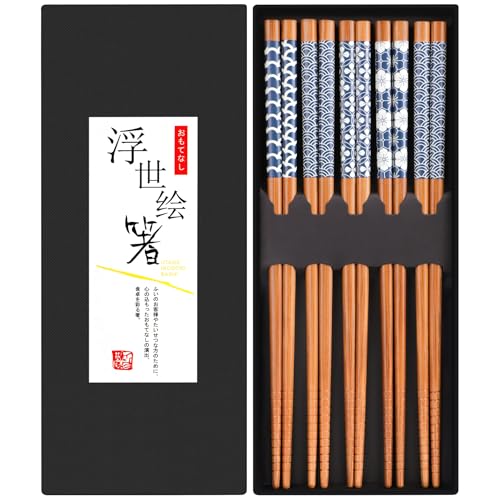
Bamboo is where most home chopstick journeys should start, and this Antner set is the sensible budget version: five pairs of natural bamboo in the shorter Japanese table style, light, warm and forgiving. The shorter length is not a compromise — over rice bowls, sushi and small side dishes it is genuinely easier to control than a long pair.
Strengths
- Natural bamboo grip is forgiving for learners and children building confidence
- Shorter 8.8-inch length excels at rice bowls, sushi and precise pick-up work
- Very light in the hand, so long meals do not tire smaller hands
Trade-offs
- Bamboo is the least durable pick here — expect eventual tip wear and replacement
- Shorter length is awkward for shared hot pots and deep serving bowls
- Natural finish varies slightly pair to pair, which perfectionists may notice
Key specs
- Material: Natural bamboo
- Length: 8.8 inches / 22.5 cm
- Set size: 5 pairs
- Care: Dishwasher safe (per listing); hand-washing extends life
Treat bamboo as a renewable consumable rather than a lifetime purchase and it makes complete sense: it is inexpensive, pleasant, and when a pair finally roughens at the tip you replace the set without regret. Keep it out of prolonged soaking, dry it upright, and it will serve a year or more of regular meals. Households that eat a lot of noodle soup may prefer the longer fiberglass pick as the main set and keep this bamboo set for rice-and-sushi nights.
Bamboo also earns a place in this guide on pan manners: it is the material you can safely use to nudge food in a non-stick pan or lift a piece from a ceramic bowl without a wince. Parents teaching children will appreciate that the same forgiving grip that helps learners also slows food down — meals become calmer when the tool is not fighting the eater. Keep a spare set in the kitchen for cooking-adjacent tasks and the table set stays at the table, which is how small households quietly organise themselves.
Best for: budget shoppers, learners and rice-and-sushi households / Not suited for: buyers wanting a buy-it-for-life set or long hot-pot reach
Check on Amazon — check the current price on Amazon before you buy, and confirm the pair count and length on the listing, because sellers in this category adjust bundle sizes often.
MUYOS Stainless Steel Chopsticks (Silver) — Best for Slippery Noodles
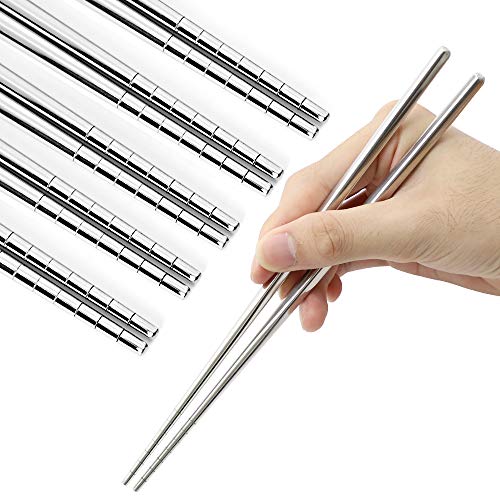
Stainless steel chopsticks divide opinion at home: some cooks love the precision and hygiene, others find metal slippery and noisy. This MUYOS set is the version most likely to convert the sceptics, because the hollow-core design keeps each pair light and the non-slip tips address the one real weakness of metal — its grip on wet noodles.
Strengths
- Hollow-core build avoids the heavy, tiring feel of solid metal chopsticks
- Textured tips give metal a fighting chance with ramen, udon and glass noodles
- Steel never stains, never holds garlic or chilli smells, and is fully dishwasher-proof
Trade-offs
- Metal conducts heat, so resting the tips in a hot pot is a mistake you make once
- Clinks against ceramic bowls, which some households find annoying at a quiet table
- A short learning curve: the narrower tips punish a sloppy grip more than wood does
Key specs
- Material: Stainless steel, hollow core
- Set size: 5 pairs
- Tips: Non-slip textured (per listing)
- Care: Dishwasher safe (per listing)
At home, steel earns its drawer space on noodle nights and with oily, sauce-heavy food that would stain bamboo by the third meal. It is also the most hygienic option for households that share serving chopsticks, since it tolerates a proper hot wash every time. If your household is split, the common peace treaty is steel for the noodle devotees and bamboo or fiberglass for everyone else — the pair counts here make that affordable.
The hollow-core detail deserves emphasis because it is the difference between metal chopsticks people keep and metal chopsticks people abandon. Solid steel pairs feel impressive for one meal and tiring by the fifth; the MUYOS weight sits close enough to wood that the hand forgets the material, while the tips keep steel’s precision. Diners who eat a lot of Korean and noodle food at home tend to convert permanently once that weight problem is solved — and this is the set that solves it at a household price tier.
Best for: noodle households and anyone prioritising hygiene and permanence / Not suited for: diners who dislike metal-on-ceramic noise or heat conduction
Check on Amazon — check the current price on Amazon before you buy, and confirm the pair count and length on the listing, because sellers in this category adjust bundle sizes often.

GLAMFIELDS Japanese Natural Wooden Chopsticks (5 Pairs) — Best Natural Wood Feel
Some home diners do not want the most durable chopstick; they want the most pleasant one. This GLAMFIELDS wooden set is the feel-first pick: natural wood, a hand-carved look, and the fine tapered point of the Japanese table style, which is unmatched for separating fish flakes and picking bones cleanly.
Strengths
- Natural wood warmth and texture that synthetics cannot imitate
- Fine Japanese-style point is the most precise tip shape in this guide
- Lightweight pairs suit long, relaxed meals and smaller hands
Trade-offs
- Wood asks for hand-washing and drying if you want it to last
- Fine points are the first thing to chip if pairs are rattled loose in a drawer
- Not the set to lend to a communal hot pot where pairs get mixed and soaked
Key specs
- Material: Natural wood
- Length: 8.8 inches / 22.5 cm
- Set size: 5 pairs
- Style: Japanese, hand-carved styling (per listing)
Wood rewards a tiny amount of care: wash, dry, store tips-up or in a case, and the pairs age gracefully instead of degrading. The Japanese point is a real functional difference at a home table that serves whole fish, delicate tofu or carefully plated food — work that feels clumsy with blunt fiberglass tips. Consider this the household’s good set that still gets used daily, not a display piece.
Wood also changes the acoustics and temperature of a meal in ways regular users notice subconsciously: no clink against teeth or bowls, no cold metal shock with the first bite, no heat creeping up the shaft from a steaming bowl. Those small comforts are why wooden pairs remain the emotional default in Japanese homes despite every synthetic alternative. This set delivers them in a consistent, giftable format that does not ask you to hunt speciality shops or gamble on anonymous marketplace wood.
Best for: diners who value feel and precision, and Japanese-style home cooking / Not suited for: dishwasher-only households wanting zero care
Check on Amazon — check the current price on Amazon before you buy, and confirm the pair count and length on the listing, because sellers in this category adjust bundle sizes often.

LEETOYI Ceramic Chopsticks Set of 5 (White) — Best for Guests and Table Setting
Ceramic chopsticks are the tableware choice: they match porcelain dinnerware, feel cool and smooth in the hand, and photograph beautifully — which is why this LEETOYI set is our pick for guest meals and deliberate table settings at home rather than for Tuesday-night takeaway on the sofa.
Strengths
- Porcelain is completely non-porous — no stains, no retained flavours between meals
- The 9.6-inch length and smooth finish suit a formal, unhurried table
- White porcelain coordinates with almost any dinnerware a home already owns
Trade-offs
- Ceramic can chip or break if dropped on tile or stone — it is the fragile pick here
- Smooth tips are the slipperiest in this guide on wet noodles
- Heavier in the hand than bamboo or fiberglass over a long meal
Key specs
- Material: Porcelain ceramic
- Length: 9.6 inches
- Set size: 5 pairs
- Care: Easy to clean (per listing); handle with care
Be honest about the role: ceramic is the occasion set. Used for guest dinners, holiday meals and the home sushi night you plate properly, it will last for years; used as the everyday family set with children and a stone floor, it will not. Its non-porous hygiene is real, though — for households uneasy about shared utensils, a porcelain set that washes perfectly clean every time has genuine appeal beyond looks.
Ceramic’s case at home is ultimately about occasion gravity: the meals where you light the table properly, plate the food with care and want every object on the table to belong to the same world. A porcelain pair does that for the price of a modest bottle of wine, and unlike the wine it is still doing it in five years. The discipline it asks — gentle handling, protected storage — is the same discipline as your dinnerware already receives, which is why porcelain households find ceramic chopsticks far less fragile in practice than their reputation suggests.
Best for: guest dinners, styled home tables and porcelain dinnerware owners / Not suited for: households with young children or hard kitchen floors as the only set
Check on Amazon — check the current price on Amazon before you buy, and confirm the pair count and length on the listing, because sellers in this category adjust bundle sizes often.

BALWOO Korean Stainless Steel Chopsticks (5 Sets) — Best for Korean Home Cooking
Korean home cooking exposes the wrong chopsticks quickly: oily grilled meat, slippery kimchi and a table full of small shared dishes demand the flat-profile metal style used in Korea itself. This BALWOO set is made in Korea in that tradition, which is why it earns a place in a home guide rather than being a curiosity.
Strengths
- Flat Korean profile stops round food like beans and meat slices rolling between the tips
- Made in Korea to the format Korean recipes and restaurants actually assume
- Steel build handles oily barbecue food without staining or absorbing smells
Trade-offs
- The flat profile feels unfamiliar for the first few meals if you learned on round sticks
- Metal heat conduction applies here too — keep tips out of the grill and hot pot
- Less versatile as a sushi or fine Japanese pick, where a pointed wood tip is better
Key specs
- Material: 430 stainless steel (per listing)
- Set size: 5 sets
- Origin: Made in Korea (per listing)
- Style: Korean flat profile
If Korean food is a weekly event at home — bibimbap, kimchi stew, home barbecue — matching the utensil to the cuisine is not pedantry, it is ergonomics: the flat profile was refined for exactly those foods. Households that cook broadly across Asia often end up with two home sets, a pointed Japanese-style pair and a flat Korean pair, and this is the Korean half of that drawer done properly.
The made-in-Korea provenance matters beyond national pride: Korean manufacturers build to the exact flat profile, length and weight distribution that Korean home cooking assumes, in the way Japanese makers build to the fine point. Imitations copy the silhouette and miss the balance. For the growing number of Western homes where Korean food is a weekly staple rather than an occasional restaurant treat, owning the correct tool in its correct form is a small, daily pleasure that compounds across hundreds of meals.
Best for: Korean home cooking, barbecue nights and kimchi lovers / Not suited for: diners who only eat Japanese-style dishes or dislike metal
Check on Amazon — check the current price on Amazon before you buy, and confirm the pair count and length on the listing, because sellers in this category adjust bundle sizes often.
Comparison Table
Use this table to match a set to your household’s real routine — dishwasher habits, typical dishes and who is eating — rather than to shop by looks alone.
| Pick | Badge | Key spec | Best for |
|---|---|---|---|
| HIWARE 10 Pairs Fiberglass Chopsticks (Black) | Best Overall | Fiberglass, 9.5 in, 10 pairs, dishwasher safe | most households wanting one durable, dishwasher-safe everyday set |
| Antner 5 Pairs Natural Bamboo Chopsticks | Best Budget | Natural bamboo, 8.8 in, 5 pairs, dishwasher safe | budget shoppers, learners and rice-and-sushi households |
| MUYOS Stainless Steel Chopsticks (Silver) | Best for Slippery Noodles | Stainless steel, hollow core, 5 pairs, non-slip tips | noodle households and anyone prioritising hygiene and permanence |
| GLAMFIELDS Japanese Natural Wooden Chopsticks (5 Pairs) | Best Natural Wood Feel | Natural wood, hand-carved style, 8.8 in, 5 pairs | diners who value feel and precision, and Japanese-style home cooking |
| LEETOYI Ceramic Chopsticks Set of 5 (White) | Best for Guests and Table Setting | Porcelain ceramic, 9.6 in, set of 5 pairs | guest dinners, styled home tables and porcelain dinnerware owners |
| BALWOO Korean Stainless Steel Chopsticks (5 Sets) | Best for Korean Home Cooking | 430 stainless steel, made in Korea, 5 sets | Korean home cooking, barbecue nights and kimchi lovers |
Read the table by columns rather than rows. The badge column tells you the job each set was hired for; the key spec column tells you whether its length and material fit your bowls and your washing routine; the best-for column is the honest summary of a thousand small meals. If two picks still tie, choose by material care: the set whose washing routine matches your real habits will be the set still in daily use next year, and that is the only ranking that ultimately matters at home.
How to Choose Chopsticks for Home Use
Start with length, because it decides control. Home eating lengths cluster between about 8.8 and 9.5 inches. The shorter Japanese style suits rice bowls, sushi and smaller hands, and gives beginners finer control. The longer end suits noodle soups, shared plates and taller adults. Cooking chopsticks are a separate, much longer tool and are covered in our chef chopsticks guide — do not try to make one pair do both jobs, because a length that is safe at the stove is clumsy at the table.
Next, choose material by your washing routine, honestly. If everything goes in the dishwasher, fiberglass and stainless steel are the stress-free choices and bamboo is acceptable with faster wear. If you hand-wash anyway, natural wood becomes viable and rewards you with the best feel. Ceramic fits households that set a deliberate table and handle tableware carefully. There is no moral ranking here — the best material is the one whose care routine you will actually keep up in February, not the one you aspire to in January.
Then look at the tips, the most under-shopped detail. Textured, grooved or squared tips grip noodles, dumplings and sauced food; smooth polished tips look elegant and then drop the same foods repeatedly. A fine tapered point is a precision instrument for fish and deboning. If your household eats a lot of noodle soup, tip texture matters more than any other single feature — it is the difference between eating and fishing.
Finally, buy pair counts that match your real table. A household of two regular users plus guests is well served by five to ten pairs of one matched set, which keeps washing rotation easy and the drawer coherent. Mixed drawers of orphaned pairs in different lengths are why home chopstick use feels subtly annoying: every meal starts with hunting for a matched pair.
Building a Home Chopstick Drawer That Actually Works
The households that use chopsticks happily every day tend to converge on the same simple system: one everyday set in a dishwasher-proof material, one feel-or-occasion set, and separate long cooking chopsticks by the stove. That is it. The everyday set absorbs the wear, the good set makes plated meals feel right, and nobody is tempted to eat with the cooking pair or cook with the eating pair.
Storage matters more than people expect. Loose pairs rattling in a cutlery tray chip fine wooden tips and tangle metal ones. A simple divider, a chopstick rest habit at the table, and storing pairs together — many sets include or pair well with simple cases or rests — keeps tips aligned and pairs matched. For wood and bamboo, dry storage is the whole game: never leave them soaking in the sink, and let them dry upright before they go back in the drawer.
Know when to retire a pair. Bamboo and wood that have roughened, split or started to splinter at the tip should be replaced, not endured — a damaged tip harbours residue and ruins grip. Fiberglass and steel last far longer, but a bent steel pair or a fiberglass pair with worn-smooth tips has also reached its end. Replacing a home set every year or two for natural materials, and far less often for synthetics and steel, is the normal, inexpensive rhythm of this category.
Matching Chopsticks to the Food Your Household Actually Eats
Noodle households should weight tip texture above everything else in this guide. Ramen, udon, pho and glass noodles are the foods that expose smooth tips, and the fiberglass and steel picks exist in this list largely because of them. Twirling technique helps, but equipment that grips turns a frustrating meal into an easy one, and noodle night is too important to fight through with lacquered showpieces.
Rice-and-grill households live at the opposite end: short, precise pairs for rice bowls and small dishes, with the flat Korean profile earning its place when grilled meat and banchan enter the picture. Sushi households should privilege the fine Japanese point of the wooden pick, which was shaped over centuries for exactly that food. The pattern is consistent — cuisine first, product second — and households that reverse it end up with beautiful chopsticks that sit out the meals they were bought for.
Shared-dish households, finally, should think in systems: one matched everyday set for personal eating, and the household’s longer pairs reserved for serving and hot pots so personal pairs stay personal. That small separation is standard practice across East Asian home tables, it is more hygienic, and it quietly solves the mixed-drawer chaos that makes home chopstick use feel harder than it is.
Chopstick Etiquette at the Home Table, Without the Anxiety
Home etiquette is hospitality, not examination, and a handful of habits covers nearly everything. Do not pass food directly from your chopsticks to someone else’s — in Japanese tradition the gesture echoes a funeral rite, and even where nobody present knows that, a small plate does the job better. Do not point with your pairs, spear food that could be pinched, or dig through a shared dish hunting for the best piece; take the piece nearest you and let the dish rotate.
Resting manners matter for comfort rather than ceremony: pairs rest on a rest, a side plate or the bowl’s edge, never stuck upright in rice and never crossed on the table. When taking from shared dishes in company, using the clean back ends of your pair — or a dedicated serving pair, as several picks in this guide make affordable — is the gesture every host notices and appreciates.
None of this needs to be taught as rules at your own table. Model it, provide the rests and serving pairs that make it easy, and guests absorb the shape of it by osmosis. The goal was never correctness; it is a table where everyone can relax, which is the entire point of eating at home.
How to Hold and Use Chopsticks Comfortably at Home
Most home frustration with chopsticks is a grip problem, not a talent problem, and it is fixable in one meal. Rest the lower chopstick on the base of your thumb and the side of your ring finger, braced by your middle finger. That lower stick barely moves — it is the shelf. Hold the upper stick like a pencil between thumb, index and middle fingers, and move only that one. Food is pinched between a still shelf and a moving lever, which is why relaxing your hand matters more than squeezing harder.
Practise on forgiving food first: chunky stir-fry vegetables, meatballs, thick noodles, pieces of omelette. Avoid the classic confidence killers — peas, glass noodles, soft tofu cubes and boiled eggs — until the basic pinch is automatic, then add them deliberately. Households teaching children or adult beginners do well to start meals with the shorter bamboo or wooden pairs, whose grip and lighter weight forgive imperfect technique.
At the table, a few habits keep home meals pleasant: use the opposite, clean end of your pair when taking from shared dishes if your household prefers, rest pairs on a rest or the bowl edge rather than across food, and never leave eating chopsticks standing upright in a bowl of rice. None of this is ceremony for its own sake — rests and clean ends are simply what make shared home eating comfortable for everyone at the table.
One more home habit separates contented chopstick households from frustrated ones: keep a pair of rests, or at least a consistent resting place, at the table. Pairs laid across bowls roll, pairs laid on the table pick up crumbs and sauces, and pairs balanced on bowl rims slide into soup with a regularity that feels like malice. A rest costs almost nothing, protects tips and tablecloths, and quietly teaches children the shape of a set table. It is the smallest purchase in this entire guide and, per dollar, possibly the most satisfying.
Common Buying Mistakes
Home chopstick purchases go wrong in predictable ways. These are the mistakes we see most often, and each one is avoidable in about ten seconds of thought before ordering.
Buying disposable bundles as the home solution. A giant sleeve of takeout-style disposables looks economical and eats badly: rough tips, inconsistent lengths and a splinter risk that never fully goes away. A modest reusable set costs little, grips far better and stops the recurring purchase entirely
Choosing length by the photo instead of by your bowls. A pair that looks elegant online can be hopelessly long for your rice bowls or too short for your noodle bowls. Measure against a pair you already use comfortably, or default to the 9 to 9.5 inch home range for mixed use
Ignoring tip texture. Smooth, glossy tips are the number one cause of dropped noodles and the false conclusion that you are bad at chopsticks. For noodle-heavy homes, textured or squared tips are not a detail, they are the product
Soaking wood and bamboo in the sink. Natural pairs left in dishwater swell, roughen and split, then get blamed as poor quality. Wash them promptly, dry them upright, and they last far longer
Using eating chopsticks at the stove. Table-length pairs put your fingers over hot oil and steam, and lacquered or bamboo tips suffer in frying heat. Keep a separate long cooking pair by the stove and the problem disappears
Final Recommendation
For most homes, start with the HIWARE fiberglass set as the everyday baseline: ten matched, dishwasher-safe pairs that grip well and ask for nothing. Add the GLAMFIELDS wooden set if feel and Japanese-style precision matter to you, or the LEETOYI ceramic set if your table is a deliberate, guest-facing place. Noodle devotees should put the MUYOS steel set in the drawer, and Korean-cooking households will get daily value from the BALWOO set. The Antner bamboo set remains the right first purchase for learners and the tightest budgets.
Whichever you choose, buy the matched set, keep tips dry and stored together, and replace natural pairs when the tips roughen. Home chopsticks are a small purchase that touches two or three meals a day — it is worth the ten minutes this guide took to read.
If you are furnishing a first kitchen, buy in this order: the fiberglass set now, the wooden set when you know your cuisine leans Japanese, the steel set when noodles become a weekly event. That sequence spends money only as your habits prove the need, and each step will feel like an upgrade rather than a correction. Readers furnishing a family home can compress it — the fiberglass and bamboo sets together cover nearly every hand and meal you will host this year.
- HIWARE 10 Pairs Fiberglass Chopsticks (Black): Check on Amazon
- Antner 5 Pairs Natural Bamboo Chopsticks: Check on Amazon
- MUYOS Stainless Steel Chopsticks (Silver): Check on Amazon
- GLAMFIELDS Japanese Natural Wooden Chopsticks (5 Pairs): Check on Amazon
- LEETOYI Ceramic Chopsticks Set of 5 (White): Check on Amazon
- BALWOO Korean Stainless Steel Chopsticks (5 Sets): Check on Amazon
Keep exploring the cluster: Best Chopsticks Best Bamboo Chopsticks Best Ceramic Chopsticks Best Chef Chopsticks Best Authentic Chopsticks Best Backpacking Chopsticks
Related guides
Frequently Asked Questions
What length chopsticks are best for home use?
For most adults eating at home, 9 to 9.5 inches is the versatile range: long enough for noodle bowls and shared plates, short enough for control over a rice bowl. The shorter 8.8-inch Japanese style suits smaller hands, rice-and-sushi-focused meals and beginners. Children and learners usually do better starting at the shorter end, where the tips are easier to coordinate.
Which chopstick material is best for everyday home meals?
Fiberglass is the lowest-maintenance everyday answer: it is dishwasher safe, does not warp or stain, and textured versions grip noodles well. Stainless steel matches it on durability and hygiene with a short learning curve. Bamboo and wood feel best and grip naturally but need prompter washing and drying, and ceramic is best reserved for occasion tables because it can chip.
Are metal chopsticks harder to use at home?
Slightly, at first. Metal is smoother and often narrower, so the first few meals demand a more deliberate pinch. Textured tips and a flat Korean-style profile both reduce the difficulty a lot. Most home users adapt within a week of regular meals, after which the hygiene and permanence of steel become the dominant experience.
How many pairs should a household own?
One matched pair per regular eater, plus two to four spare pairs for guests and washing rotation, covers almost every home. In practice that means a five-pair set for a couple and a ten-pair set for a family. Matched sets matter more than raw count, because mixed lengths in one drawer make every meal start with an annoying search.
Can I put wooden or bamboo chopsticks in the dishwasher?
Some bamboo sets are listed as dishwasher safe, and occasional cycles will not destroy them, but repeated hot cycles dry, roughen and eventually split natural materials. If you want natural pairs to last, hand-wash and dry them upright — it takes under a minute. If your household rule is dishwasher-or-nothing, choose fiberglass or stainless steel and skip the guilt.
When should I replace home chopsticks?
Replace bamboo or wood when the tips roughen, split, splinter or stay stained and odorous after washing. Replace fiberglass when the tip texture has worn smooth and grip noticeably worsens. Steel lasts longest and mainly needs replacing if bent. As a rhythm, natural home sets commonly last a year or two of regular use, which is normal for the category, not a defect.
Should every person in the house have their own pair?
It is a good system where practical: a personal pair per regular eater, washed and stored together, plus shared spares for guests. Many East Asian households mark personal pairs by colour or design, which ends the whose-is-whose question at the drawer. It is a preference, not a hygiene requirement — a properly washed shared set is perfectly safe — but households that adopt it rarely go back.
What are the best chopsticks for children at home?
Shorter, lighter pairs with grippy tips — the bamboo pick in this guide is the natural starting point. Length around the shorter Japanese size keeps the tips controllable while small hands learn the shelf-and-lever grip, and bamboo’s texture forgives an imperfect pinch. Training chopsticks with connectors help the very youngest beginners, but most children graduate to a short standard pair faster than parents expect.

